Distributed Denial of Service attacks remain one of the most disruptive threats to online services, capable of overwhelming infrastructure and rendering applications inaccessible within seconds. These attacks are designed to flood systems with massive volumes of traffic originating from multiple sources, often forming a coordinated network of compromised devices. This network, commonly referred to as a botnet, operates under the control of malicious actors who exploit vulnerabilities in user devices. Once activated, these bots generate enormous request traffic, exhausting server resources and bandwidth. As organizations increasingly rely on cloud-based systems to deliver services, the need for resilient and scalable protection mechanisms becomes critical. Cloud providers must not only absorb traffic spikes but also distinguish between legitimate users and malicious requests in real time, ensuring uninterrupted service availability even during large-scale attacks.
The Role of Managed DDoS Protection Services
Cloud platforms have evolved to include built-in defense mechanisms that automatically respond to network anomalies. Managed DDoS protection services eliminate the need for organizations to build complex mitigation systems from scratch. Instead, these services operate continuously in the background, monitoring traffic patterns and applying mitigation strategies when suspicious behavior is detected. The advantage of such services lies in their ability to scale instantly, leveraging global infrastructure to absorb and neutralize attack traffic before it reaches application endpoints. This approach significantly reduces operational complexity while improving response time. Organizations benefit from automated detection, rapid mitigation, and integration with other security tools, forming a layered defense strategy that adapts to evolving threats.
Introduction to AWS Shield and Its Core Purpose
AWS Shield is designed as a dedicated protection service that safeguards applications running in the cloud from DDoS attacks. It operates as part of a broader ecosystem of security services, ensuring that infrastructure remains resilient under heavy and potentially malicious traffic loads. By default, AWS Shield is enabled for all users, providing a baseline level of protection without requiring manual configuration. This default protection focuses on defending against common network and transport layer attacks, ensuring that essential services remain operational. For organizations with higher security demands, an advanced tier is available that extends protection capabilities and introduces additional features tailored for complex threat scenarios.
Baseline Protection with AWS Shield Standard
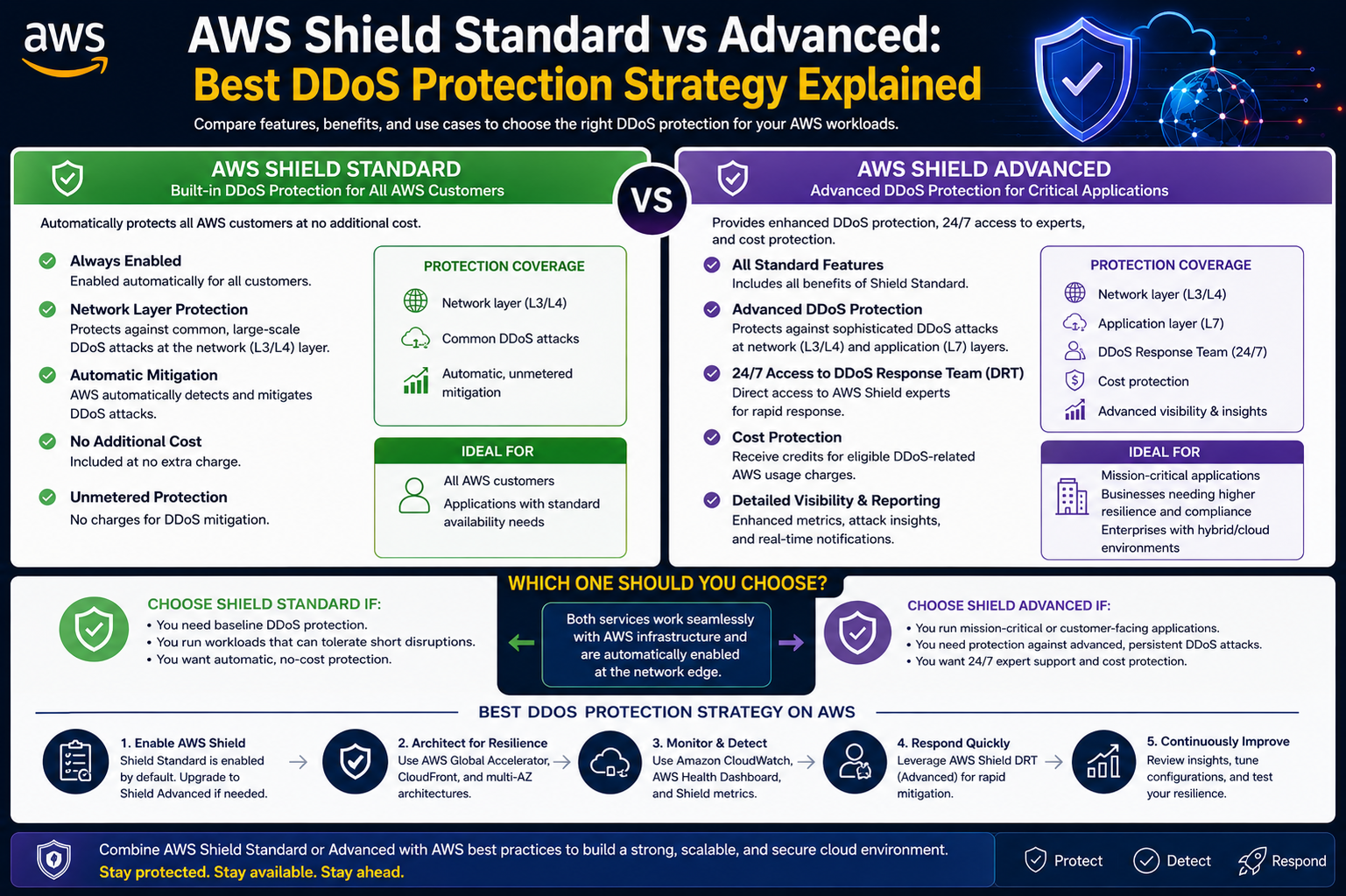
AWS Shield Standard delivers automatic protection against the most common types of DDoS attacks, particularly those targeting network and transport layers. This includes attacks such as SYN floods, UDP floods, and reflection-based amplification attempts. The service continuously monitors traffic flows using anomaly detection algorithms that identify unusual patterns indicative of an attack. Once detected, mitigation mechanisms are applied in real time, reducing the impact without requiring user intervention. This level of protection is seamlessly integrated with core cloud services, ensuring that resources such as content delivery networks, DNS services, and load balancers remain available. Because it operates as a default service, organizations benefit from immediate protection without incurring additional costs or administrative overhead.
How AWS Shield Standard Detects and Responds to Threats
The detection capabilities of AWS Shield Standard rely on sophisticated traffic analysis techniques that establish a baseline of normal activity. By continuously analyzing incoming requests, the system identifies deviations that may signal malicious intent. When an anomaly is detected, mitigation actions are triggered automatically, often within seconds. These actions may include traffic filtering, rate limiting, or rerouting requests to absorb excess load. The automation ensures that response times are minimal, reducing the likelihood of service disruption. However, the thresholds and response mechanisms are predefined, meaning users have limited control over how protection is applied. This makes the service highly effective for general use cases but less adaptable to unique or highly targeted attack scenarios.
Limitations of Standard-Level Protection
While AWS Shield Standard provides robust baseline security, it is not designed to handle highly sophisticated or application-layer attacks. These attacks often target specific vulnerabilities within web applications, using techniques such as HTTP floods or malformed requests to bypass traditional defenses. Because the standard tier focuses primarily on lower-layer threats, it may not fully mitigate complex attacks that require deeper inspection and customization. Additionally, the lack of detailed visibility and reporting can make it challenging for organizations to analyze attack patterns or refine their defense strategies. For businesses with critical workloads or high exposure to targeted threats, relying solely on baseline protection may not be sufficient.
Advanced Protection with AWS Shield Advanced
AWS Shield Advanced offers an enhanced level of security designed for organizations that require comprehensive protection across multiple layers. In addition to covering network and transport layers, it extends its capabilities to the application layer, addressing more complex attack vectors. This expanded protection is particularly important for applications that handle sensitive data or experience high traffic volumes. Shield Advanced introduces advanced mitigation techniques that dynamically adapt to evolving threats, ensuring that even sophisticated attacks are effectively neutralized. By leveraging additional resources and intelligent routing strategies, the service can absorb larger attack volumes while maintaining application performance.
Expanded Coverage Across Cloud Resources
One of the key advantages of AWS Shield Advanced is its ability to protect a broader range of cloud resources. This includes compute instances, load balancers, content delivery networks, and DNS services. By extending protection across these components, organizations can ensure that their entire application stack is safeguarded against DDoS attacks. The service also allows resources to be grouped for customized protection, enabling tailored security policies based on specific requirements. This flexibility is particularly valuable for complex architectures where different components may have varying levels of risk exposure.
Integration with Web Application Firewall Capabilities
A significant feature of AWS Shield Advanced is its integration with web application firewall functionality. This allows organizations to filter and control incoming traffic based on predefined rules, effectively blocking malicious requests before they reach application servers. During an attack, the system can automatically generate and apply new rules based on observed traffic patterns. For example, if a surge of requests originates from suspicious IP addresses or contains malformed data, the firewall can block those requests in real time. This automated response enhances protection against application-layer attacks, which are often more difficult to detect and mitigate.
Real-Time Visibility and Monitoring Enhancements
AWS Shield Advanced provides detailed insights into traffic patterns and attack metrics, enabling organizations to monitor their security posture more effectively. Enhanced visibility allows teams to identify the nature, scale, and origin of attacks, facilitating better decision-making and response planning. Metrics are available in real time, offering a comprehensive view of how mitigation strategies are performing. This level of transparency is essential for organizations that need to maintain strict security standards or comply with regulatory requirements. By understanding attack behavior, teams can refine their defenses and improve resilience over time.
Access to Dedicated Response Support Teams
In addition to automated protection, AWS Shield Advanced includes access to a dedicated response team that operates around the clock. This team provides expert assistance during active attacks, helping organizations implement additional mitigation strategies when needed. The availability of human expertise ensures that even the most complex scenarios can be addressed արդյունավետly. This support is particularly valuable for organizations without extensive in-house security expertise, as it provides immediate access to specialized knowledge and guidance.
Cost Considerations and Value Assessment
Unlike the standard tier, AWS Shield Advanced requires a subscription fee, making cost evaluation an important factor in decision-making. Organizations must consider the potential financial impact of DDoS attacks, including downtime, lost revenue, and reputational damage. For businesses that rely heavily on online services, the cost of advanced protection may be justified by the reduction in risk. Additionally, the service includes cost protection features that help offset expenses الناتجة عن increased resource usage during attacks. This ensures that organizations are not penalized financially for scaling resources to absorb malicious traffic.
Comparing Protection Levels and Capabilities
The primary difference between AWS Shield Standard and Advanced lies in the depth and scope of protection. While the standard tier focuses on common infrastructure-level attacks, the advanced tier extends coverage to application-level threats and offers greater customization. Shield Advanced also introduces additional features such as real-time monitoring, dedicated support, and integrated firewall capabilities. These enhancements make it suitable for organizations with higher security requirements or more complex architectures. However, for smaller workloads or less critical applications, the standard tier may provide sufficient protection without additional costs.
Determining the Right Level of Protection for Your Organization
Selecting the appropriate level of DDoS protection depends on several factors, including the size of the organization, the sensitivity of its data, and its exposure to potential threats. Businesses operating in industries such as finance, healthcare, or e-commerce often face higher risks and may benefit from advanced protection. Similarly, applications that experience high traffic volumes or are critical to business operations require stronger دفاع mechanisms. On the other hand, smaller applications with limited exposure may find baseline protection adequate. A thorough risk assessment can help determine the most suitable approach.
Evaluating Risk and Preparing for Potential Attacks
Understanding the potential impact of DDoS attacks is essential for effective planning. Organizations must evaluate their vulnerability, considering factors such as traffic patterns, user base, and application architecture. By identifying potential نقاط الضعف, they can implement appropriate mitigation strategies and choose the right مستوى of protection. Regular testing and monitoring are also গুরুত্বপূর্ণ, ensuring that defenses remain effective against evolving threats. Proactive planning reduces the likelihood of service disruption and enhances overall resilience.
Building a Comprehensive DDoS Defense Strategy
Effective DDoS protection requires a multi-layered approach that combines automated defenses, real-time monitoring, and expert support. AWS Shield provides a strong foundation for this strategy, offering both baseline and advanced protection options. By integrating these services with additional security tools, organizations can create a robust الدفاع system capable of handling a wide range of threats. Continuous improvement and adaptation are key, as attackers constantly develop new techniques to bypass defenses.
Conclusion
AWS Shield plays a critical role in protecting cloud-based applications from the disruptive impact of DDoS attacks. The standard tier offers essential protection against common threats, ensuring that infrastructure remains resilient without additional cost. For organizations with greater security needs, the advanced tier provides enhanced capabilities, including application-layer protection, real-time visibility, and dedicated support. Choosing between these options requires careful consideration of risk, cost, and operational requirements. By aligning protection levels with business needs, organizations can safeguard their services, maintain user trust, and ensure uninterrupted availability in the face of evolving cyber threats.