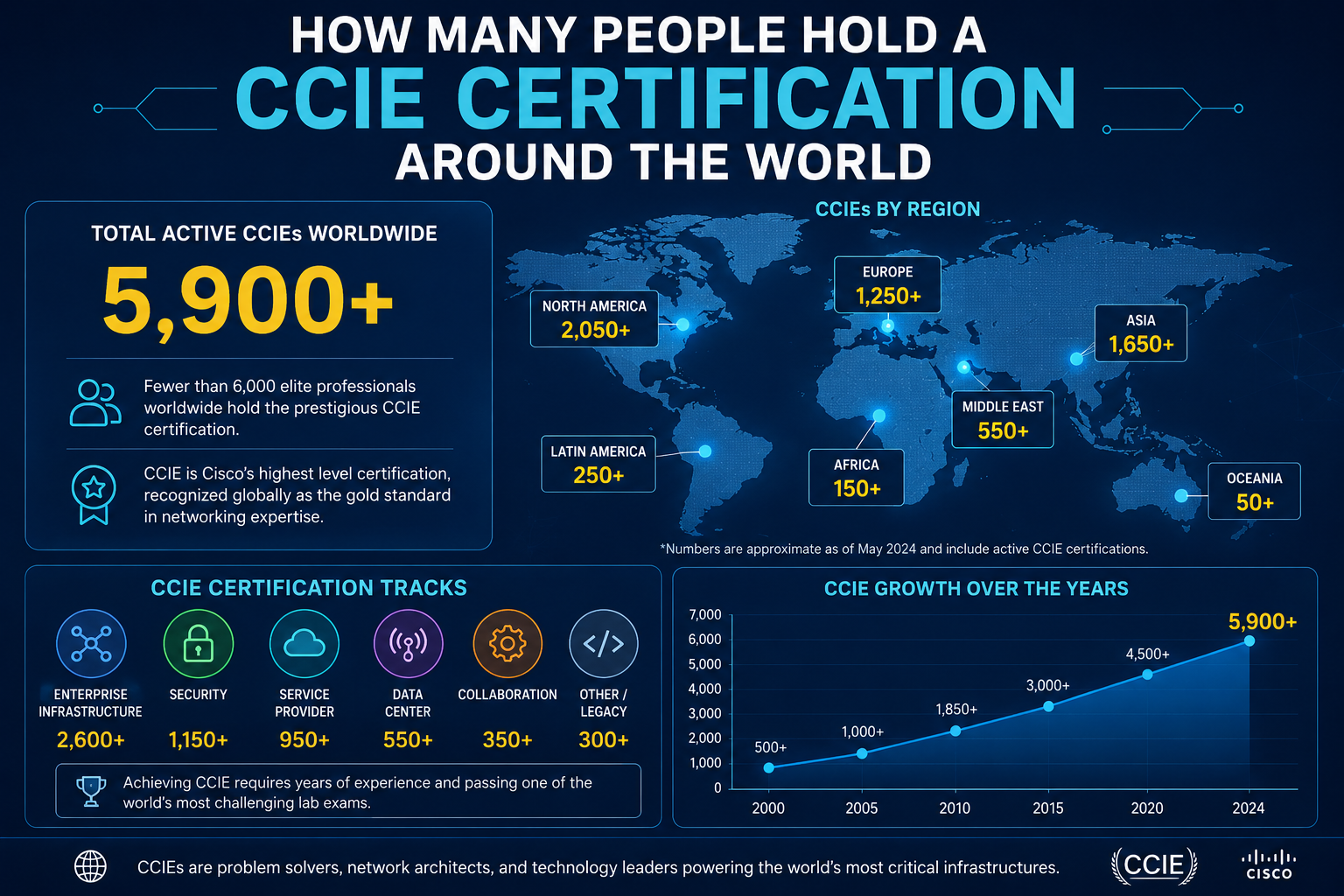
The question sounds simple at first glance. After all, the Cisco Certified Internetwork Expert certification, commonly known as CCIE, has existed for decades and follows a numbered system. Many people naturally assume that counting CCIEs should be straightforward. If every certified expert receives a unique number, then finding the total should be as easy as checking the highest assigned number. However, the reality is much more complicated than that.
Over the years, networking professionals, recruiters, engineers, certification candidates, and technology enthusiasts have all tried to estimate how many CCIEs exist worldwide. The challenge is that there is no fully transparent public database listing every active or inactive CCIE. While Cisco maintains official records internally, the company does not publicly release complete and regularly updated totals covering all certification holders across every specialization and region.
Because of this lack of direct public data, people have relied on multiple methods to estimate the total number of CCIEs globally. Some use public CCIE numbers. Others analyze professional networking profiles. Some study historical certification trends or community-maintained records. Each method produces slightly different results, and every estimate comes with limitations.
Despite these challenges, one thing is clear: the CCIE remains one of the most respected and difficult certifications in the networking industry. The relatively low number of certified experts compared to the size of the global IT workforce highlights just how demanding the certification path really is.
Understanding how many CCIEs there are in the world also provides insight into the evolution of networking technologies, enterprise infrastructure, telecommunications, cloud computing, and cybersecurity. The numbers reveal not only the scale of elite networking expertise but also how the IT industry itself has changed over time.
Why the Total Number of CCIEs Is Difficult to Measure
At first, sequential numbering appears to offer a perfect solution. Every CCIE holder receives a unique identification number, and these numbers have historically increased over time. Logically, if someone knows the first issued CCIE number and the latest assigned number, they should be able to calculate the approximate total.
The difficulty comes from several factors.
First, not every issued CCIE number represents a currently active certification holder. Some individuals may have retired from the industry, allowed their certification to lapse, changed careers, or stopped renewing their credentials. Others may hold multiple CCIE certifications under a single number. As a result, the total count of issued numbers does not necessarily equal the total number of active experts.
Second, Cisco has introduced, retired, renamed, and reorganized several certification tracks over the years. Older tracks such as SNA/IP and ISP Dial are no longer active, while newer areas like Data Center and Collaboration, reflect changing networking technologies. This evolving certification structure complicates historical tracking.
Third, many public estimates rely on self-reported information. Professional networking profiles, certification communities, and online directories depend on individuals updating their own records accurately. Some profiles are outdated, while others may include inactive certifications or duplicate entries.
Finally, Cisco itself does not regularly publish a definitive worldwide count. Without direct access to official certification databases, researchers and analysts must piece together information from multiple sources.
This is why different studies often report different totals. One estimate may suggest around fifty thousand CCIEs, while another pushes the number closer to sixty thousand or beyond. The differences usually come down to methodology, timing, and assumptions regarding active versus inactive certifications.
The History Behind the CCIE Certification
To understand the significance of the numbers, it helps to understand the history of the certification itself.
The CCIE program was introduced in the early 1990s as an expert-level networking credential designed to validate advanced technical skills. At that time, enterprise networking was rapidly expanding. Businesses were building larger infrastructures, internet connectivity was becoming more important, and organizations needed highly skilled engineers capable of designing and troubleshooting complex environments.
Unlike entry-level certifications, the CCIE was intended for experienced professionals who could demonstrate deep practical knowledge. The certification became famous for its difficult hands-on laboratory exam, where candidates were required to configure and troubleshoot real networking scenarios under intense time pressure.
Over the years, the CCIE has developed a reputation as one of the hardest certifications in information technology. Candidates often spent years preparing. Many failed multiple times before finally passing. The difficulty of the lab exam became legendary within the networking community.
This difficulty is one reason why the global number of CCIEs remains relatively small compared to the millions of IT professionals worldwide. Earning the certification requires not only technical knowledge but also persistence, discipline, and substantial practical experience.
As networking technologies evolved, Cisco expanded the CCIE program into multiple tracks. Routing and Switching became one of the most popular and recognizable specializations, but additional tracks emerged to address growing industry demands. Security, Service Provider, Wireless, Collaboration, and Data Center certifications reflected the increasing complexity of enterprise networking environments.
Each track represented a distinct area of expertise, allowing engineers to specialize deeply in their chosen fields. Some professionals even pursued multiple CCIE certifications, earning recognition as experts across several technologies.
Estimating the Worldwide CCIE Population
One widely discussed estimate places the total number of CCIEs at roughly 59,737. This figure was derived using publicly available CCIE numbers combined with historical tracking.
The reasoning behind the estimate is relatively straightforward. Since CCIE numbers are issued sequentially, researchers compared the earliest human-issued CCIE number with the highest publicly known CCIE number. The difference between those values provided an estimated total count.
At one point, the highest publicly reported CCIE number was in the range of 57,597. By comparing this with the original numbering sequence beginning around 1,025, analysts estimated nearly sixty thousand CCIE certifications were issued.
Later reports suggested even higher numbers as new certification holders continued to emerge. For example, one engineer who earned a CCIE in late 2018 reportedly received a number above 60,500. This suggested that Cisco had continued issuing several thousand additional certifications over time.
Researchers then estimated how many new CCIEs were being issued annually by comparing date ranges between known certification numbers. Based on these calculations, estimates indicated that Cisco was issuing approximately four new CCIE certifications per day during certain periods.
Although these calculations are not perfect, they provide a useful approximation of the global CCIE population. The estimates also demonstrate how exclusive the certification remains. Even after decades of existence, the total number of CCIEs worldwide remains relatively small when compared to other professional certifications.
Active Versus Inactive CCIEs
One of the most important distinctions in these discussions is the difference between active and inactive CCIEs.
An issued CCIE number remains part of certification history permanently. However, maintaining an active status requires periodic recertification. Certified professionals must demonstrate ongoing knowledge and technical competency to keep their credentials current.
Some engineers maintain an active status for many years, continuously renewing their certifications and staying deeply involved in networking technologies. Others eventually allow their certifications to expire due to career changes, retirement, management transitions, or shifting professional priorities.
As a result, the number of active CCIEs is almost certainly lower than the total number of issued CCIE numbers.
This distinction matters because the networking industry often focuses more on active experts. Employers seeking highly skilled engineers generally prefer professionals whose certifications remain current and aligned with modern technologies.
The recertification process itself reflects how rapidly networking changes. Technologies evolve constantly, including software-defined networking, automation, virtualization, cloud infrastructure, and cybersecurity integration. Engineers who earned certifications many years ago must continue learning to stay relevant.
The uncertainty surrounding inactive certifications contributes significantly to the challenge of determining the exact number of CCIEs in the world. Without direct access to official certification databases, no outside organization can accurately separate active experts from historical certification holders.
The Role of Community-Maintained Records
One fascinating aspect of CCIE culture is the strong sense of community among certification holders. Over the years, networking professionals created directories, forums, and public records where CCIEs could voluntarily share their achievements.
These community-maintained records became valuable sources of information for estimating certification numbers. By analyzing publicly reported CCIE numbers, researchers could track trends and estimate growth rates.
Such records also revealed interesting patterns regarding specialization choices and multiple certifications. Some engineers earned certifications in several tracks, demonstrating extraordinary technical depth across multiple networking disciplines.
Community records highlighted how certain certification paths became more popular over time. Routing and Switching dominated the early years, reflecting the central role of enterprise routing infrastructure during the growth of corporate networks. Later, Security and Service Provider certifications gained prominence as cybersecurity and large-scale telecommunications infrastructure became increasingly important.
These records also showcased the global nature of the CCIE community. Engineers from countries across North America, Europe, Asia, the Middle East, Africa, and Latin America contributed to the growing population of certified experts.
The worldwide distribution of CCIEs reflects the global importance of networking technologies. Large enterprises, internet providers, financial institutions, healthcare organizations, governments, and cloud providers all rely on advanced networking expertise.
Why CCIE Remains So Prestigious
The relatively small number of CCIEs worldwide contributes heavily to the certification’s prestige.
Unlike many certifications that rely primarily on multiple-choice testing, the CCIE has historically emphasized practical skill validation. Candidates must solve real technical problems under pressure, demonstrating not only theoretical understanding but also hands-on operational expertise.
The lab exam became particularly famous for its intensity. Candidates often spent months or years preparing for the challenge. Many built extensive home labs, participated in study groups, and practiced advanced troubleshooting scenarios repeatedly.
Failure rates were notoriously high. Even experienced engineers sometimes needed multiple attempts before passing. This difficulty created a strong sense of accomplishment among successful candidates.
Because of the certification’s reputation, employers often viewed CCIE holders as elite technical professionals capable of handling critical infrastructure responsibilities. CCIEs frequently worked on enterprise architecture, service provider networks, data center operations, and complex security environments.
The certification also became associated with career advancement. Many CCIEs moved into senior engineering roles, consulting positions, architecture leadership, or technical management careers.
In some regions, holding a CCIE significantly increased earning potential. Organizations recognized the certification as evidence of deep technical expertise and problem-solving ability.
The combination of difficulty, rarity, and industry recognition helped establish the CCIE as one of the most respected credentials in information technology.
Multiple CCIE Certifications and Elite Networking Experts
An especially interesting aspect of the CCIE community is the existence of professionals who earn multiple CCIE certifications.
Achieving a single CCIE already requires substantial dedication. Earning two or more demonstrates extraordinary commitment to networking mastery.
Community data suggests that thousands of professionals have earned multiple CCIEs. Some pursued additional tracks to expand their expertise into emerging technologies. Others specialized deeply across several infrastructure domains.
For example, an engineer might first earn a Routing and Switching certification before later pursuing Security or Service Provider expertise. Another professional might combine Data Center and Collaboration certifications to support modern enterprise communication systems.
A very small number of individuals achieved exceptionally high numbers of CCIE certifications, earning recognition throughout the networking industry for their accomplishments.
These multiple-certification holders often became influential technical leaders, trainers, architects, consultants, or infrastructure strategists. Their broad expertise allowed them to understand networking environments from multiple perspectives.
The trend toward multiple certifications also reflected broader changes in enterprise technology. Modern infrastructures increasingly require integration between networking, security, cloud services, automation, and collaboration platforms. Engineers capable of bridging these domains became highly valuable.
The Dominance of Routing and Switching
Historically, Routing and Switching emerged as the most common entry point into the CCIE program.
This makes sense because routing and switching form the foundation of enterprise networking. Before engineers specialize in advanced areas like security or data center infrastructure, they typically develop strong expertise in core network operations.
Community data showed that a large majority of CCIEs began their journey with Routing and Switching. The specialization became synonymous with the classic image of a CCIE engineer working on enterprise routers, switches, protocols, and network troubleshooting.
The dominance of Routing and Switching also reflected the networking priorities of earlier decades. As businesses expanded internet connectivity and internal infrastructure, reliable routing and switching expertise became essential.
Over time, however, the technology landscape evolved. Virtualization, cloud computing, software-defined networking, and cybersecurity shifted industry priorities. Cisco eventually reorganized several certification tracks to align with modern networking trends.
Despite these changes, Routing and Switching maintained a powerful legacy within the networking community. Many veteran engineers still associate the track with the original spirit of CCIE expertise.
The Growth of Security and Service Provider Tracks
While Routing and Switching remained dominant, other CCIE tracks experienced significant growth as enterprise technology evolved.
Security became increasingly important as organizations faced growing cyber threats, compliance requirements, and data protection challenges. Enterprises needed experts capable of designing secure architectures, implementing advanced firewalls, managing secure access systems, and protecting critical infrastructure.
As a result, the CCIE Security track attracted many engineers seeking specialized cybersecurity expertise. Security-focused CCIEs often worked in industries where infrastructure protection was especially critical, including finance, healthcare, telecommunications, and government.
The Service Provider track also gained popularity due to the expansion of global internet infrastructure. Telecommunications companies, internet providers, and large-scale network operators required engineers capable of managing complex carrier-grade environments.
These infrastructures demanded expertise in technologies such as MPLS, traffic engineering, large-scale routing architectures, and high-availability systems. Service Provider CCIEs became essential for maintaining the backbone networks supporting global connectivity.
The rise of these specialized tracks reflected the growing complexity of networking itself. Modern infrastructure engineering extends far beyond basic connectivity. Networks now support cloud computing, remote work, cybersecurity, streaming services, mobile communications, and massive data flows across global systems.
How LinkedIn and Professional Profiles Influence Estimates
Another major method used to estimate the global CCIE population involves professional networking platforms.
Because earning a CCIE is considered a major career achievement, many certified engineers proudly display the credential on their professional profiles. Researchers have used keyword searches and advanced filtering techniques to estimate how many individuals publicly identify as CCIE holders.
These searches produced estimates ranging above fifty thousand professionals worldwide. Analysts filtered out recruiters, training providers, certification candidates, and unrelated results to improve accuracy.
Although this approach has limitations, it provides valuable insight into the visibility and distribution of CCIE professionals across industries and geographic regions.
Profile analysis also revealed interesting career patterns. Many CCIEs held senior engineering, architecture, consulting, or leadership positions. Others worked in specialized technical roles supporting large enterprise infrastructures.
The data further highlighted the global diversity of the CCIE community. Professionals from numerous countries and industries appeared throughout the results, reinforcing the certification’s international reputation.
The Global Distribution of CCIE Professionals
The worldwide presence of CCIE-certified professionals reflects the global importance of networking infrastructure in the modern digital economy. Although the total number of CCIEs remains relatively small compared to the broader IT workforce, these experts are spread across nearly every major technology market in the world. From multinational corporations to telecommunications providers, governments, cloud platforms, financial institutions, and healthcare systems, organizations rely on highly skilled network engineers to keep critical systems operating efficiently.
The geographic distribution of CCIEs reveals important patterns about technological development and digital transformation. Countries with strong investments in telecommunications, enterprise infrastructure, internet expansion, and cloud computing tend to produce larger numbers of CCIE-certified professionals. Regions with rapidly growing technology sectors also show increasing interest in expert-level networking certifications as businesses modernize their infrastructure.
North America has historically maintained one of the largest concentrations of CCIE professionals. The United States, in particular, became an early hub for advanced networking expertise due to the rapid growth of enterprise computing, internet service providers, data centers, and large-scale corporate networks during the rise of the internet era. Many early CCIEs came from organizations building foundational internet infrastructure and enterprise networking systems.
Europe also developed a substantial CCIE population as multinational businesses expanded their digital operations across multiple countries. Major financial centers, telecommunications providers, and international technology firms created strong demand for engineers capable of designing and maintaining complex networks. Countries such as the United Kingdom, Germany, France, and the Netherlands became important centers for networking expertise.
Asia experienced particularly dramatic growth in CCIE certifications over the past two decades. As economies expanded and digital infrastructure investments accelerated, countries such as China, India, Japan, Singapore, and South Korea developed large communities of networking professionals. Massive telecommunications deployments, cloud expansion, mobile network growth, and enterprise modernization projects all contributed to rising demand for expert-level certifications.
The Middle East also emerged as an increasingly significant region for advanced networking expertise. Governments and enterprises invested heavily in smart city projects, telecommunications infrastructure, financial technology systems, and large-scale digital transformation initiatives. These projects required highly skilled engineers capable of managing advanced network architectures.
Latin America and Africa, while historically smaller markets for CCIE certifications, have also seen steady growth in networking expertise as internet penetration and enterprise infrastructure investments have increased. Expanding connectivity projects, cloud adoption, and modernization efforts continue creating opportunities for highly skilled networking professionals in these regions.
The global distribution of CCIEs demonstrates how networking has become essential to nearly every aspect of modern society. Regardless of geography, organizations require reliable, secure, and scalable infrastructure to support digital operations.
Why the CCIE Is Considered One of the Hardest Certifications
One major reason the number of CCIEs remains relatively low is the extreme difficulty of the certification process itself. The certification earned its reputation not through marketing or branding alone, but through decades of consistently demanding technical evaluation.
Unlike many certifications that focus heavily on theoretical knowledge, the CCIE places enormous emphasis on practical problem-solving skills. Candidates must not only understand networking concepts but also apply them in realistic operational environments under strict time constraints.
The hands-on laboratory examination became the defining challenge of the CCIE journey. Engineers entering the lab environment face complex scenarios requiring advanced configuration, troubleshooting, optimization, and integration skills. The exam tests both depth and breadth of expertise across multiple networking technologies.
Preparation often takes years rather than months. Candidates typically spend significant portions of their professional lives studying advanced networking concepts, building practice labs, troubleshooting simulated failures, and refining configuration skills.
Many engineers describe the preparation process as mentally exhausting. The sheer amount of technical material involved can be overwhelming. Routing protocols, switching technologies, security implementations, automation concepts, quality of service, virtualization, network design principles, and troubleshooting methodologies all require a deep understanding.
The pressure of the examination environment adds another layer of difficulty. Candidates must solve technical problems accurately while managing time efficiently. A single configuration error or troubleshooting oversight can impact multiple sections of the lab.
Failure is extremely common, even among highly experienced engineers. Many successful CCIEs required multiple attempts before passing. Some spent several years pursuing the certification before finally achieving success.
This high barrier to entry is one of the main reasons the certification retains such strong industry respect. Employers understand that earning a CCIE requires exceptional discipline, persistence, technical ability, and practical experience.
The certification’s reputation also contributes to its long-term value. Even as technology changes, the ability to solve complex networking problems under pressure remains highly respected across the industry.
The Evolution of Networking Technology and the CCIE Program
The history of the CCIE program closely mirrors the broader evolution of networking technology itself. As enterprise infrastructure changed over time, Cisco adapted the certification tracks to reflect new technical realities.
In the early years, enterprise networking focused heavily on routing and switching infrastructure. Organizations needed reliable local area networks, wide area connectivity, and internet access. Routing protocols such as OSPF, BGP, and EIGRP became central components of enterprise operations.
As networks expanded, engineers required advanced expertise in redundancy, scalability, traffic optimization, and fault tolerance. The Routing and Switching track emerged as the flagship specialization because it addressed these foundational technologies.
Over time, however, networking became far more complex.
The rise of cybersecurity threats transformed infrastructure priorities. Enterprises could no longer focus solely on connectivity; they also needed sophisticated protection mechanisms. Firewalls, intrusion prevention systems, VPN architectures, access control systems, and secure segmentation became critical components of modern networks.
This shift drove the expansion of the Security certification track. Engineers specializing in network security became increasingly valuable as organizations faced growing threats from cyberattacks, ransomware, data breaches, and advanced persistent threats.
Cloud computing introduced another major transformation. Traditional enterprise networks evolved into hybrid environments connecting on-premises systems with public cloud platforms. Virtualization technologies changed how applications and services were delivered.
The Data Center track reflected these changes by focusing on technologies such as storage networking, virtualization, fabric architectures, automation, and high-performance computing infrastructure.
Collaboration technologies have also evolved significantly. Voice communication systems expanded into unified communications platforms integrating voice, video, messaging, conferencing, and remote collaboration tools. The Collaboration track emerged to support these increasingly sophisticated communication environments.
Wireless networking became another major area of specialization as mobile devices transformed workplace connectivity. Enterprises needed experts capable of designing secure, scalable wireless infrastructures supporting thousands of users and devices.
Automation and software-defined networking further reshaped the industry. Modern network engineers increasingly work with programmability, APIs, orchestration systems, and infrastructure automation tools. These technologies continue influencing certification updates and skill requirements.
The evolution of the CCIE program demonstrates how networking itself has transformed from basic connectivity management into a highly specialized and multidimensional field.
The Human Side of the CCIE Journey
Behind every CCIE number is a personal story of dedication, sacrifice, and persistence. While statistics provide useful insight into certification trends, they cannot fully capture the emotional and professional challenges involved in achieving expert-level status.
For many engineers, the CCIE journey becomes a defining chapter in their careers.
Preparation often requires balancing demanding work responsibilities with extensive study schedules. Candidates frequently spend evenings, weekends, and holidays practicing configurations, troubleshooting labs, and reviewing technical material.
The process can place significant strain on personal life. Long study hours reduce time available for family, social activities, and recreation. Many candidates describe periods of isolation while pursuing the certification.
Financial challenges also play a role. Building practice labs, purchasing study materials, traveling to exam locations, and paying examination fees can require substantial investment. Some candidates spend years gradually assembling the resources necessary to continue their preparation.
Emotional pressure becomes particularly intense after failed attempts. The lab examination is known for its difficulty, and many highly capable engineers fail multiple times before succeeding. Recovering from these setbacks requires resilience and determination.
At the same time, the CCIE journey often creates strong professional communities. Study groups, online forums, mentorship relationships, and collaborative lab sessions help candidates support one another through the process.
Many successful CCIEs later become mentors themselves, helping newer candidates navigate the challenges they once faced. This culture of shared learning has become an important part of the networking community.
Achieving the certification often produces a profound sense of accomplishment. For some engineers, passing the lab exam represents the culmination of years of effort and personal sacrifice. Receiving a CCIE number becomes more than just earning a credential; it symbolizes mastery of an extremely demanding discipline.
The emotional significance of the achievement helps explain why many CCIEs proudly display the certification throughout their careers.
Industries That Depend Heavily on CCIE Expertise
The importance of CCIE-level expertise extends across numerous industries, many of which rely on highly available and secure networking infrastructure for daily operations.
Telecommunications companies represent one of the largest employers of advanced networking professionals. Internet service providers, mobile carriers, and backbone infrastructure operators require engineers capable of managing enormous traffic volumes and maintaining global connectivity.
Financial institutions also depend heavily on reliable networking systems. Banks, trading firms, payment processors, and investment companies require low-latency, highly secure infrastructure supporting real-time transactions and sensitive financial data.
Healthcare organizations increasingly rely on advanced networking to support electronic medical records, telemedicine platforms, connected medical devices, and secure patient data systems. Downtime or security failures can have serious operational consequences.
Government agencies use sophisticated networks for communication, security, intelligence operations, and public services. These environments often require strict security standards and resilient infrastructure architectures.
Cloud computing providers represent another major area of demand. Massive data centers supporting millions of users require highly skilled engineers capable of designing scalable, automated, and fault-tolerant systems.
Large multinational corporations also maintain extensive enterprise networks connecting offices, manufacturing facilities, cloud platforms, remote workers, and business applications across multiple countries.
Energy companies, transportation systems, educational institutions, and media organizations all depend on complex networking infrastructure as well.
The broad range of industries employing CCIEs demonstrates how essential networking has become to modern civilization. Nearly every digital service people use daily depends on the underlying infrastructure managed by highly skilled professionals.
The Rise of Automation and Its Impact on Networking Careers
One of the biggest changes affecting the networking industry in recent years has been the rise of automation.
Traditional network management relied heavily on manual configuration through command-line interfaces. Engineers individually configured routers, switches, firewalls, and other devices using device-specific commands.
As infrastructures grew larger and more complex, this manual approach became increasingly difficult to scale. Organizations managing thousands of devices needed more efficient operational models.
Automation technologies emerged to address these challenges. Modern network engineers now work with scripting languages, APIs, orchestration systems, and software-defined infrastructure platforms.
This shift has changed the skill sets expected from advanced networking professionals.
Today’s CCIE-level engineers increasingly combine traditional networking expertise with automation knowledge. Understanding routing protocols alone is no longer sufficient in many environments. Engineers must also understand programmability, infrastructure-as-code concepts, automation frameworks, and cloud integration technologies.
Software-defined networking further accelerated this transformation. Centralized management systems, policy-based automation, and virtualized network functions altered how networks are designed and operated.
Some industry observers initially feared automation would reduce demand for networking professionals. Instead, the opposite largely occurred. As infrastructure complexity increased, organizations needed engineers capable of managing automation systems and designing scalable architectures.
Automation changed the nature of networking work rather than eliminating it. Engineers shifted from repetitive manual tasks toward higher-level architecture, optimization, integration, and troubleshooting responsibilities.
The CCIE program evolved alongside these industry trends. Modern certification tracks increasingly incorporate automation concepts and software-defined technologies to reflect current operational realities.
Why Employers Continue to Value the CCIE
Despite rapid technological change, the CCIE remains highly respected among employers across the technology industry.
One reason is that the certification validates not only technical knowledge but also problem-solving ability. Organizations recognize that engineers capable of passing the CCIE lab exam have demonstrated exceptional troubleshooting skills under pressure.
This capability becomes particularly valuable during infrastructure failures or high-stakes operational incidents. Businesses depend on experienced engineers who can diagnose complex problems quickly and restore critical services.
The certification also signals dedication and persistence. Employers understand that earning a CCIE requires long-term commitment to professional development and continuous learning.
Another important factor is practical expertise. Many certifications rely primarily on theoretical testing, but the CCIE’s hands-on reputation distinguishes it from many alternatives. Hiring managers often view CCIE holders as professionals with real operational capability rather than purely academic knowledge.
The certification’s long history further contributes to its credibility. Over the decades, the CCIE became associated with some of the industry’s most skilled network engineers, architects, consultants, and infrastructure leaders.
In consulting environments, CCIE-certified professionals may help organizations design large-scale network transformations, cloud migrations, security upgrades, or data center modernization projects.
Enterprises also value CCIEs because infrastructure reliability directly affects business operations. Downtime, latency issues, or security failures can create major financial and operational consequences.
As networks become increasingly integrated with cloud services, remote work systems, cybersecurity platforms, and digital business operations, experienced networking professionals remain critically important.
The Changing Nature of Certification Prestige
The technology certification landscape has evolved significantly over the past two decades. Many new certifications emerged covering cloud computing, cybersecurity, automation, DevOps, artificial intelligence, and data analytics.
Despite this growing competition, the CCIE retained a unique position within the networking industry.
Part of this resilience comes from the certification’s historical reputation. The CCIE became widely recognized as one of the toughest technical credentials in IT, and that reputation continues to influence employer perceptions.
However, the nature of prestige itself has changed somewhat.
Earlier generations of networking professionals often viewed the CCIE as the ultimate technical achievement within infrastructure engineering. Today, career paths have become more specialized and diversified.
Some engineers focus heavily on cloud architecture. Others specialize in cybersecurity, site reliability engineering, infrastructure automation, or platform engineering. As a result, the CCIE now exists within a broader ecosystem of advanced technical specializations.
Even so, the certification remains highly respected because networking continues serving as the foundation of digital infrastructure. Cloud platforms, cybersecurity systems, distributed applications, and remote collaboration technologies all depend on reliable connectivity.
Modern enterprises still require professionals capable of understanding complex network behavior, troubleshooting infrastructure problems, and designing scalable systems.
The CCIE’s continued relevance demonstrates that while technologies evolve, deep networking expertise remains essential.
How Networking Careers Have Changed Over Time
The role of network engineers has changed dramatically since the early days of enterprise networking.
In earlier decades, networking teams focused primarily on hardware infrastructure. Engineers configured routers, switches, leased lines, and physical connectivity systems supporting office networks and internet access.
Today’s networking environments are far more dynamic and integrated.
Cloud computing blurred traditional boundaries between networking, systems administration, and software engineering. Virtualization introduced new layers of abstraction. Security became deeply integrated into infrastructure design. Automation transformed operational workflows.
Remote work also changed networking priorities. Organizations now support distributed workforces connecting securely from multiple locations and devices. This requires advanced expertise in VPN systems, zero-trust architectures, cloud connectivity, and secure access frameworks.
Performance expectations increased as well. Modern applications require low latency, high availability, and rapid scalability. Video conferencing, streaming services, cloud applications, and real-time collaboration systems place enormous demands on infrastructure.
The Internet of Things introduced additional complexity by connecting industrial systems, sensors, cameras, medical devices, and smart infrastructure to enterprise networks.
As networking responsibilities expanded, the value of highly skilled experts increased accordingly.
CCIE-certified professionals often adapted successfully to these changes because the certification process emphasized deep conceptual understanding rather than narrow product memorization. Engineers who understand routing behavior, traffic flows, redundancy models, and troubleshooting principles can often adapt more easily to evolving technologies.
The networking profession continues evolving rapidly, but the need for expert-level infrastructure knowledge remains constant.
The Future of CCIE Certifications in a Cloud-Driven World
As technology continues evolving at a rapid pace, many professionals wonder what the future holds for expert-level networking certifications. Cloud computing, artificial intelligence, automation, and software-defined infrastructure have transformed the IT industry, leading some people to question whether traditional networking expertise will remain as important as it once was. However, the continued growth of digital services suggests that networking knowledge is becoming even more valuable, not less.
Modern businesses depend on connectivity for nearly every operation. Cloud platforms, remote work systems, streaming services, online banking, cybersecurity tools, and enterprise applications all rely on reliable network infrastructure. Even though much of today’s technology is virtualized or cloud-based, the underlying systems still require highly skilled engineers who understand how data moves across networks.
This is one reason why the CCIE certification continues to evolve rather than disappear. Cisco has consistently updated certification tracks to align with modern infrastructure trends. Automation, programmability, cloud integration, and software-defined networking are now deeply connected to expert-level networking roles. The modern CCIE is no longer limited to configuring routers and switches manually. Today’s engineers often work with APIs, orchestration platforms, automation frameworks, and hybrid cloud architectures.
The rise of artificial intelligence may also influence networking careers in unexpected ways. AI-powered systems can assist with monitoring, analytics, anomaly detection, and automated troubleshooting, but organizations will still require experienced professionals to design architectures, interpret complex failures, and make strategic infrastructure decisions. Automation can simplify repetitive tasks, yet large-scale networks remain too critical and complex to operate without human expertise.
Cybersecurity is another factor driving long-term demand for advanced networking professionals. As cyber threats continue growing in sophistication, businesses need secure infrastructure designs that integrate networking and security together. Firewalls, segmentation, zero-trust models, secure remote access, and cloud security all require strong networking foundations. Engineers who understand both connectivity and protection mechanisms are becoming increasingly valuable.
The global expansion of internet-connected devices will likely increase demand for networking expertise even further. Smart cities, industrial automation, autonomous systems, healthcare technologies, and Internet of Things deployments all depend on scalable and reliable infrastructure. These environments generate enormous amounts of traffic and require advanced network management strategies.
Another important trend is edge computing. Instead of processing all data in centralized cloud environments, organizations increasingly move computing resources closer to users and devices. This creates more distributed infrastructure, which in turn increases networking complexity. Managing these systems requires professionals capable of understanding latency, redundancy, bandwidth optimization, and traffic engineering across geographically dispersed environments.
The certification landscape itself is also changing. Employers today often value practical skills and real-world problem-solving more than memorization-based testing. Certifications that maintain strong hands-on components are likely to remain respected because they demonstrate operational capability rather than purely theoretical understanding.
The CCIE’s long-standing emphasis on practical lab examinations gives it an advantage in this area. The certification has always focused heavily on real technical implementation and troubleshooting. This practical reputation continues helping it stand out in a crowded certification market.
At the same time, the path toward earning a CCIE may continue evolving to reflect modern learning methods. Virtual labs, cloud-based practice environments, remote testing technologies, and integrated automation platforms could make preparation more accessible to candidates around the world. In earlier decades, building physical practice labs required significant financial investment. Modern virtualization technologies have lowered some of these barriers.
The worldwide networking community surrounding the certification also continues growing. Online collaboration platforms, virtual study groups, mentorship communities, and shared technical resources have made it easier for candidates to connect with experienced professionals globally. This collaborative culture helps sustain interest in advanced networking certifications even as technologies change.
The prestige associated with the CCIE is unlikely to disappear anytime soon. The certification represents more than technical knowledge alone. It symbolizes persistence, discipline, and the ability to solve difficult infrastructure problems under pressure. Those qualities remain valuable regardless of how networking technologies evolve.
Although the exact number of CCIEs worldwide may continue changing over time, the certification’s influence on the networking industry remains significant. The relatively small global population of certified experts reflects the difficulty of the journey and the depth of expertise required to succeed.
As digital transformation accelerates across industries, organizations will continue depending on highly skilled infrastructure professionals to design, secure, optimize, and troubleshoot the networks supporting modern life. Whether working in cloud computing, cybersecurity, telecommunications, enterprise infrastructure, or emerging technologies, CCIE-certified professionals are likely to remain an important part of the global technology landscape for many years to come.
Conclusion
Determining exactly how many CCIEs exist in the world has never been a simple task. While certification numbers, community records, and professional networking profiles provide useful estimates, the true total remains difficult to verify publicly. Factors such as inactive certifications, retired tracks, multiple certifications under a single individual, and the absence of a fully transparent database all contribute to the uncertainty. Even so, available estimates consistently show that the number of CCIE-certified professionals worldwide is relatively small compared to the global IT workforce.
That rarity is one of the reasons the certification continues to hold such strong industry recognition. For decades, the CCIE has represented expert-level networking knowledge, advanced troubleshooting ability, and the determination required to master highly complex technologies. Earning the certification is widely viewed as a major professional achievement because the journey demands not only technical expertise but also persistence, discipline, and real-world experience.
The growth of networking technologies over the years has also shaped the evolution of the CCIE program itself. What began as a certification focused heavily on routing and switching has expanded into multiple specialized areas, including security, collaboration, wireless, data center technologies, and service provider infrastructure. These changes reflect how modern networks have become more integrated, intelligent, and essential to everyday business operations.
At the same time, the role of networking professionals continues evolving alongside cloud computing, automation, cybersecurity, and artificial intelligence. Despite these changes, the need for highly skilled infrastructure experts remains stronger than ever. Modern organizations still depend on reliable, secure, and scalable networks to support digital services, remote connectivity, cloud platforms, and real-time communication systems.
The CCIE certification remains an important symbol of technical excellence within this rapidly changing environment. Whether there are fifty thousand, sixty thousand, or even more CCIEs worldwide, the certification continues to represent a small group of professionals who have reached one of the highest levels of networking expertise. As global digital infrastructure keeps expanding, CCIE-certified engineers will likely continue playing a critical role in building and maintaining the systems that power the connected world.