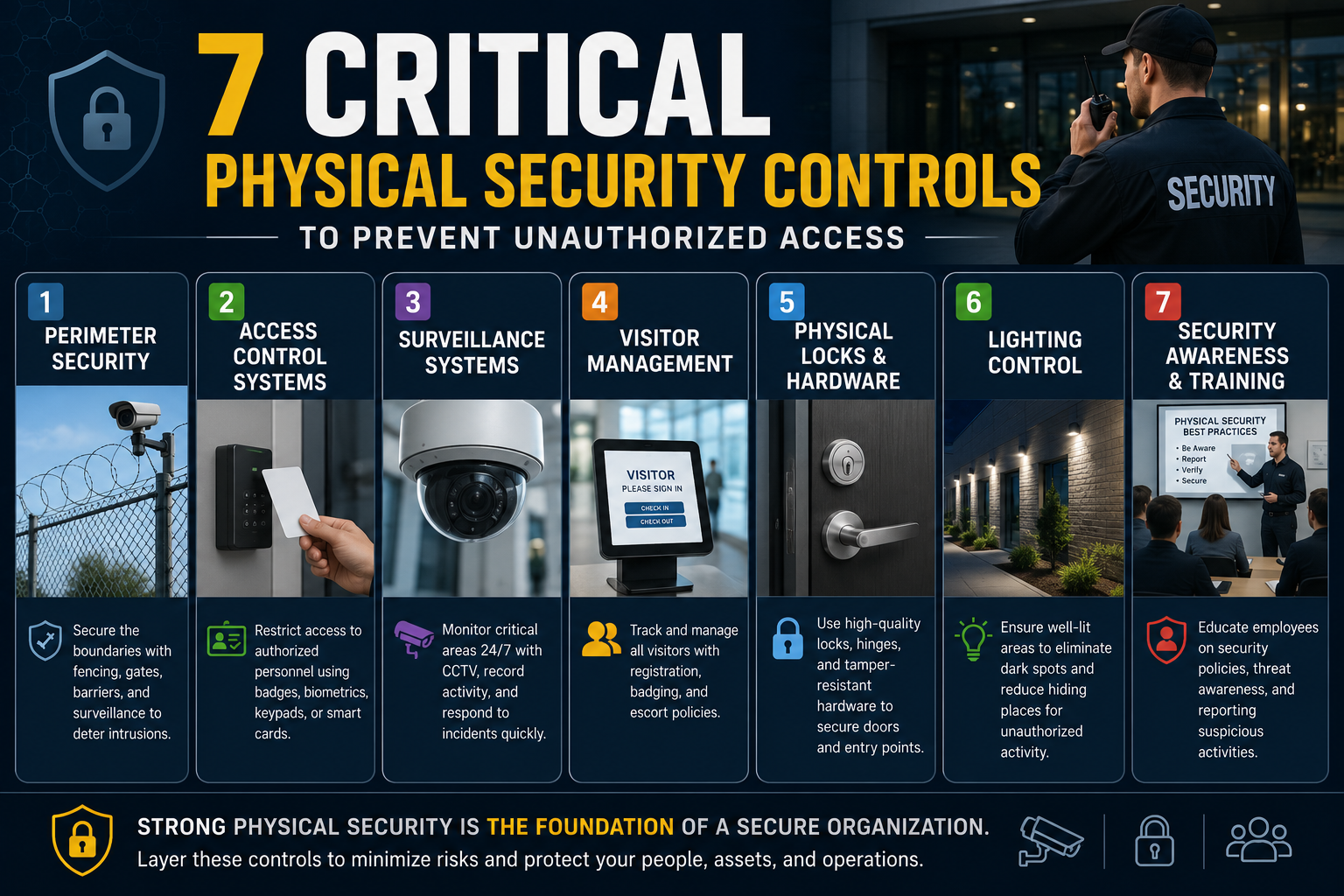
Modern businesses depend heavily on digital systems, cloud infrastructure, and connected networks. Cybersecurity discussions often focus on firewalls, malware protection, encryption, and user authentication. While these technical defenses are critical, they represent only one side of the security equation. Every organization also relies on physical assets that require protection. Buildings, offices, hardware, documents, inventory, and employee workspaces all contain valuable information and resources that can become targets if left vulnerable.
Physical security controls are the protective measures designed to safeguard those tangible assets from theft, damage, unauthorized access, sabotage, and environmental hazards. They create barriers between a company’s resources and potential threats. These controls can range from something as simple as outdoor lighting to more advanced technologies such as biometric access systems and intelligent surveillance cameras.
A strong physical security strategy supports digital security efforts. If an attacker can physically enter a building, steal a device, connect to an unused network port, or access confidential paperwork, many cybersecurity protections instantly lose their effectiveness. For this reason, organizations increasingly recognize that physical security and information security are deeply connected.
The most effective physical security strategies use multiple layers of defense rather than relying on a single safeguard. Each layer reduces risk differently. Some controls discourage criminals from attempting unauthorized access in the first place, while others detect suspicious behavior or help security teams respond quickly to incidents. Together, these measures create a safer environment for employees, equipment, and sensitive information.
Why Physical Security Matters in the Digital Age
Many people assume that cyberattacks happen entirely online. In reality, physical access often plays a major role in security breaches. An unattended laptop, an unlocked server room, or an exposed network connection can provide attackers with opportunities that bypass technical safeguards completely.
Organizations store enormous amounts of sensitive data inside physical devices. Desktop computers, laptops, backup drives, printers, and mobile devices may contain confidential financial information, customer records, intellectual property, and internal communications. Even seemingly harmless equipment can expose security risks if stolen or accessed improperly.
Physical security also protects against threats beyond criminal activity. Fires, floods, electrical failures, vandalism, and workplace accidents can disrupt operations and damage critical infrastructure. Security planning must therefore account for both intentional attacks and environmental risks.
Businesses of all sizes face these challenges. Large corporations may manage massive campuses with complex access systems, while small businesses might only have a single office and limited resources. Despite the differences in scale, every organization benefits from implementing practical physical security controls that match its level of risk.
Security is ultimately about reducing vulnerabilities. No system can eliminate risk, but layered defenses make attacks more difficult, time-consuming, and expensive. Criminals often seek the easiest targets. When a property appears well-protected, many intruders decide it is not worth the effort.
The Layered Security Approach
Physical security works best when organizations treat it as a system of overlapping protections. This concept is often called layered security or defense in depth. Instead of depending on one solution, businesses combine multiple controls that support one another.
Imagine a company office protected only by a locked front door. If someone bypasses that lock, the building is completely exposed. Now imagine additional layers: perimeter fencing, security cameras, alarm systems, access badges, security guards, and monitored server rooms. Each layer increases the effort required to compromise the facility.
Layered security also helps compensate for weaknesses in individual controls. No protection method is perfect. Cameras can fail, locks can be picked, and employees can make mistakes. Multiple safeguards reduce the chances that a single failure will lead to a major incident.
An effective layered strategy typically includes three major goals:
Deterrence discourages unauthorized behavior before it happens. Visible cameras, fencing, and lighting signal that the property is protected and monitored.
Detection identifies suspicious activity quickly. Motion sensors, alarms, and surveillance systems help organizations notice incidents in real time.
Response allows security personnel or emergency services to react effectively. Quick action minimizes damage and improves recovery efforts.
Physical security planning should also balance safety with convenience. Extremely restrictive environments may frustrate employees and reduce productivity. Organizations must carefully evaluate risks, operational needs, and budgets when deciding which controls to implement.
Perimeter Protection as the First Line of Defense
Perimeter security creates the outer boundary between a property and the outside world. It represents the first opportunity to discourage unauthorized access and establish controlled entry points.
Many organizations begin with fencing. While fences may appear simple, they remain one of the most widely used and effective physical barriers. A fence defines private property, limits direct access, and forces intruders to spend additional time and effort attempting entry.
The effectiveness of fencing depends on several factors, including height, material, visibility, and maintenance. Chain-link fencing is common because it is durable and relatively affordable. Some organizations use reinforced steel fencing or anti-climb designs for higher-security environments. Others incorporate gates with electronic locking systems that restrict vehicle or pedestrian access.
Landscaping also contributes to perimeter protection. Overgrown bushes and poorly maintained grounds create hiding spots near entrances and windows. Clear sightlines improve visibility and help security personnel monitor activity more effectively. Thorny shrubs placed beneath windows can discourage unauthorized access without creating an unwelcoming atmosphere.
Parking areas deserve attention as well. Employees and visitors often leave valuable property inside vehicles, making parking lots attractive targets for theft. Controlled parking access, adequate lighting, and visible surveillance reduce risks in these spaces.
Security planners must remember that perimeter controls are not intended to stop every intruder completely. Instead, they delay access and increase visibility, buying valuable time for detection and response.
The Role of Security Cameras in Modern Protection
Video surveillance has become one of the most recognizable physical security measures in the modern workplace. Advances in camera technology have transformed surveillance systems from grainy analog recordings into intelligent digital platforms capable of delivering detailed, real-time monitoring.
Modern cameras provide organizations with both deterrence and evidence collection. Visible surveillance equipment signals that activity is being monitored, which can discourage theft, vandalism, and unauthorized access. At the same time, recorded footage helps investigators review incidents after they occur.
Strategic camera placement is essential. Entrances, exits, hallways, parking lots, loading docks, and server rooms are common monitoring locations. Blind spots should be minimized wherever possible. Organizations should also consider how lighting conditions affect image quality during nighttime or poor weather conditions.
High-definition video has dramatically improved the usefulness of surveillance systems. Security teams can now zoom in on details, recognize faces, identify license plates, and track movement across multiple cameras. Many systems also allow remote access through secure applications, enabling administrators to review footage from almost anywhere.
Motion detection features help reduce unnecessary storage usage by recording only when activity occurs. Some advanced systems include artificial intelligence capabilities that identify unusual behavior, recognize unauthorized entry attempts, or alert staff when individuals enter restricted areas.
Despite these benefits, surveillance systems are not without limitations. Cameras do not physically stop intruders. They are most effective when combined with alarms, access controls, and active monitoring. Organizations must also protect surveillance networks themselves, since poorly secured cameras can become cybersecurity vulnerabilities.
Privacy considerations are equally important. Businesses should establish clear policies regarding surveillance use, recording retention, and employee awareness. Cameras intended for security should not intrude on reasonable expectations of privacy.
Alarm Systems and Real-Time Threat Detection
Alarm systems add an active response layer to physical security. Unlike cameras, which primarily record events, alarms immediately notify people when suspicious activity occurs.
The most familiar alarms involve door and window sensors that trigger alerts when unauthorized entry is detected. However, modern alarm systems include a much wider range of technologies designed to identify various threats.
Motion detectors sense movement inside restricted areas. Glass-break sensors recognize the sound frequencies associated with shattered windows. Environmental sensors monitor smoke, fire, flooding, temperature changes, or hazardous conditions that could damage equipment and facilities.
Integrated alarm systems often connect directly to security personnel, monitoring centers, or emergency responders. Rapid notification allows organizations to respond faster and potentially prevent greater damage or loss.
Audible alarms serve another important purpose by drawing attention to incidents. Loud sirens can scare off intruders while alerting nearby employees or security staff. Visible warning lights further increase awareness during emergencies.
Organizations should carefully consider how alarm systems fit into daily operations. Excessive false alarms can reduce effectiveness by causing employees to ignore warnings or become frustrated. Proper calibration, routine maintenance, and employee training help minimize unnecessary activations.
Alarm response procedures matter just as much as the technology itself. Staff should understand what to do when an alarm activates, including evacuation protocols, reporting requirements, and communication procedures. A well-designed system combined with clear operational planning creates a more effective security environment.
Managing Access to Sensitive Areas
Controlling who can enter a facility or specific room is one of the most important aspects of physical security. Access control systems allow organizations to regulate movement within buildings and restrict unauthorized individuals from reaching sensitive areas.
At the most basic level, access control may involve traditional locks and physical keys. While simple and inexpensive, key-based systems present challenges. Lost keys require locks to be replaced or rekeyed, and tracking who has access becomes difficult over time.
Electronic access systems provide greater flexibility and oversight. Employees may use identification badges, PIN codes, smartphone credentials, or biometric scans to enter authorized areas. These systems create detailed access logs showing who entered specific locations and when.
RFID-based access cards remain extremely popular because they are affordable, convenient, and easy to manage. Administrators can quickly disable lost cards or update permissions without changing physical locks. Access levels can also vary depending on employee roles, schedules, or departments.
Biometric systems add another layer of security by verifying physical characteristics such as fingerprints, facial recognition, or iris scans. Since biometric traits are difficult to duplicate, these systems reduce the risks associated with stolen credentials. However, they also introduce privacy and data protection considerations that organizations must manage carefully.
Access control should extend beyond exterior doors. Server rooms, executive offices, research labs, storage facilities, and records rooms often require additional restrictions due to the sensitivity of their contents.
Tailgating remains a common challenge in secure environments. This occurs when unauthorized individuals follow authorized personnel through controlled entrances without presenting credentials themselves. Employee awareness training plays a major role in preventing this behavior.
Organizations should regularly review access permissions to ensure former employees, contractors, or temporary workers no longer retain entry privileges after their roles end.
Lighting as a Security Tool
Lighting is one of the simplest yet most effective physical security measures available. Well-lit environments discourage criminal behavior by increasing visibility and reducing hiding opportunities.
Outdoor lighting should focus on entrances, walkways, parking lots, loading areas, and building perimeters. Intruders generally prefer darkness because it reduces the likelihood of detection. Bright, consistent lighting makes suspicious activity more noticeable to employees, security personnel, and passing observers.
Motion-activated lighting adds another layer of deterrence. Sudden illumination can surprise trespassers and immediately draw attention to movement in restricted areas. These systems also conserve energy by activating only when needed.
Indoor lighting contributes to both security and safety. Hallways, stairwells, storage rooms, and emergency exits should remain properly illuminated at all times. Inadequate lighting increases accident risks and may create vulnerable areas within a building.
Emergency lighting systems are particularly important during power outages or evacuations. Battery-backed lights help guide occupants safely through buildings when normal electrical systems fail. Routine testing ensures these systems function properly during emergencies.
Organizations should avoid creating excessive glare or harsh shadows when designing lighting layouts. Effective security lighting improves visibility without making it difficult for people or cameras to identify activity clearly.
Smart lighting systems increasingly allow automated scheduling, remote management, and integration with other security technologies. Businesses can program lighting to adapt to occupancy patterns, business hours, or detected motion.
Protecting Physical Documents and Sensitive Information
Despite the growth of digital storage, paper documents remain a major part of many business operations. Contracts, financial records, employee files, legal paperwork, medical information, and internal reports often exist in printed form. If these materials are improperly handled or discarded, they can expose organizations to serious security risks.
Document security begins with proper storage. Sensitive files should remain in locked cabinets or restricted-access rooms rather than being left unattended on desks or shared workspaces. Clean desk policies help reduce accidental exposure of confidential information.
Printing practices also matter. Documents left unattended at shared printers may be viewed or taken by unauthorized individuals. Secure printing systems that require employee authentication before releasing print jobs reduce this risk.
Disposal procedures are equally critical. Simply throwing documents into regular trash bins creates opportunities for information theft. Shredding sensitive paperwork before disposal prevents criminals from recovering valuable data.
Many organizations use professional shredding services to handle large volumes of confidential documents securely. These providers often destroy materials onsite or transport them using controlled chain-of-custody procedures.
Information security extends beyond paper. Digital storage devices contain enormous amounts of recoverable data even after files appear deleted. Hard drives, USB devices, printers, and copiers may all store sensitive information internally.
Secure data destruction methods ensure old equipment cannot expose company information after disposal. Software-based wiping tools overwrite existing data, while physical destruction methods such as shredding or degaussing permanently destroy storage media.
Asset disposal policies should clearly define how equipment is tracked, sanitized, and recycled. Without proper procedures, forgotten devices in storage rooms can become significant security liabilities.
Building a Culture of Physical Security Awareness
Technology alone cannot secure an organization. Employees play a central role in maintaining physical security because human behavior directly influences how effectively controls function.
Security awareness training helps staff recognize risks and follow safe practices consistently. Employees should understand why physical security matters, how different systems operate, and what behaviors support a safer workplace.
Simple habits often make a substantial difference. Locking unattended computers, securing identification badges, reporting suspicious behavior, and challenging unfamiliar visitors all contribute to stronger protection.
Visitor management is another important aspect of security awareness. Reception areas should verify guests, maintain visitor logs, and issue temporary badges when appropriate. Employees should avoid allowing unknown individuals to roam freely through facilities without authorization.
Social engineering attacks frequently exploit human trust rather than technical weaknesses. An intruder posing as a delivery worker, contractor, or maintenance technician may gain access simply because employees hesitate to question them. Training helps staff balance politeness with security responsibilities.
Organizations benefit from encouraging employees to report concerns without fear of criticism. Prompt reporting of broken locks, malfunctioning cameras, suspicious individuals, or unusual activity allows security teams to address issues before they escalate.
Physical security awareness should also extend to remote and hybrid work environments. Employees working from home still handle company devices, documents, and credentials that require protection. Secure home office practices reduce risks outside traditional corporate facilities.
Environmental Threats and Facility Resilience
Physical security is not limited to preventing theft or intrusion. Organizations must also protect facilities against environmental threats that can disrupt operations or damage infrastructure.
Fire protection systems are among the most critical safeguards in any building. Smoke detectors, sprinkler systems, fire extinguishers, and emergency evacuation procedures help minimize injuries and property damage during emergencies.
Data centers and server rooms often require specialized fire suppression systems designed to protect electronic equipment without causing water damage. Temperature and humidity monitoring further protect sensitive hardware from overheating or environmental failure.
Flooding presents another major risk, particularly in areas prone to severe weather or plumbing failures. Elevated equipment placement, water sensors, and proper drainage systems help reduce exposure to water damage.
Power reliability directly affects both safety and operations. Backup generators and uninterruptible power supplies allow critical systems to continue functioning during outages. Security systems themselves should have backup power capabilities to avoid becoming disabled during emergencies.
Natural disasters such as earthquakes, storms, and extreme weather events also require planning. Organizations should evaluate regional risks and develop contingency procedures that support business continuity during disruptions.
Facility resilience involves preparing for unexpected situations rather than assuming normal conditions will always exist. Businesses that proactively address environmental risks recover faster and experience fewer operational interruptions during crises.
Strengthening Workplace Safety Through Physical Security Planning
Physical security is often associated with locks, cameras, and alarms, but its role extends far beyond protecting property from theft. A well-designed physical security program also creates a safer environment for employees, visitors, contractors, and customers. When organizations take security seriously, they reduce the likelihood of workplace violence, unauthorized access, accidents, and operational disruptions.
Every workplace has different risks depending on its industry, size, and location. A hospital faces very different challenges than a warehouse, retail store, or office building. However, all organizations benefit from identifying vulnerabilities before problems occur. Security planning allows businesses to prepare for emergencies, reduce confusion during incidents, and maintain better control over their facilities.
Effective planning begins with understanding how people move through a building. Organizations must identify entry points, high-traffic areas, restricted zones, and locations where sensitive assets are stored. Security professionals often evaluate how easily an unauthorized person could access important systems or move unnoticed through the property.
Employee safety is central to this process. Workers who feel secure in their environment are generally more productive and confident. They are also more likely to follow organizational procedures when they understand that security policies exist to protect both people and assets.
Emergency preparedness is another critical element of workplace safety. Fires, medical emergencies, severe weather, and security incidents can happen unexpectedly. Businesses should establish clear evacuation routes, communication procedures, and emergency response plans that employees can follow without confusion.
Organizations that treat physical security as part of their overall workplace culture tend to achieve stronger long-term results. Instead of viewing security measures as obstacles, employees begin to see them as normal and necessary parts of maintaining a safe professional environment.
Securing Entrances and Reception Areas
Building entrances are among the most sensitive areas in any facility because they represent the transition point between public and private spaces. If entry points are poorly managed, intruders may gain access before anyone realizes a problem exists.
Reception areas play a vital role in controlling access. A visible front desk staffed by trained personnel immediately creates accountability for visitors entering the building. Guests can be greeted, identified, and directed appropriately instead of wandering through offices unchallenged.
Visitor management systems improve security by recording who enters the facility, when they arrive, and whom they are visiting. Temporary badges help employees distinguish authorized visitors from unfamiliar individuals who should not have unrestricted access.
Organizations should also establish policies for contractors, delivery personnel, and maintenance workers. These individuals often require temporary access to restricted areas, which creates opportunities for security gaps if procedures are inconsistent.
Some facilities use security turnstiles or controlled entry gates to regulate movement more effectively. These systems prevent multiple individuals from entering through a single authorization and reduce the risk of tailgating.
Glass doors and windows near entrances can present additional vulnerabilities. Reinforced glass, security film, or protective barriers may reduce the risk of forced entry or vandalism. Entrance design should balance openness and accessibility with practical security considerations.
Security personnel assigned to entrances require proper training beyond simply checking badges. They should understand how to identify suspicious behavior, respond to emergencies, and communicate effectively with employees and visitors during stressful situations.
Organizations must also consider after-hours access. Many security incidents occur outside normal business hours when fewer people are present. Controlled nighttime access procedures reduce opportunities for unauthorized entry during quieter periods.
The Importance of Securing Server Rooms and IT Infrastructure
One of the most sensitive areas in any organization is the location where IT infrastructure is stored. Servers, networking equipment, backup systems, and telecommunications hardware form the foundation of digital operations. If attackers gain physical access to these systems, they may bypass many traditional cybersecurity protections.
Server rooms should never function like ordinary office spaces. Access must be tightly controlled and limited only to authorized personnel who require entry for operational reasons. Even trusted employees should not enter these areas without legitimate business purposes.
Electronic access logs provide valuable records of who enters secure spaces and when. These logs support both accountability and investigations if suspicious activity occurs.
Environmental controls are especially important for IT infrastructure. Excessive heat, humidity, dust, or water exposure can damage sensitive hardware and disrupt operations. Dedicated cooling systems and environmental monitoring tools help maintain stable conditions for equipment.
Cable management is another overlooked aspect of physical security. Exposed or poorly organized cabling may allow unauthorized individuals to connect rogue devices or tamper with network infrastructure. Secure cable routing and locked network cabinets reduce these risks.
Portable devices also present security concerns. Laptops, tablets, external drives, and backup media are attractive targets because they are easy to remove from a facility. Organizations should implement secure storage policies and ensure devices are encrypted in case theft occurs.
Cleaning crews, maintenance staff, and third-party vendors sometimes require temporary access to technical spaces. These situations must be carefully supervised because even brief unsupervised access can create vulnerabilities.
Physical protection of IT infrastructure directly supports cybersecurity goals. Strong digital defenses become far more effective when attackers cannot physically manipulate systems or remove sensitive equipment from the premises.
Security Challenges in Shared Buildings and Public Spaces
Many organizations operate in environments where they do not fully control the surrounding property. Multi-tenant office buildings, coworking spaces, shopping centers, and industrial complexes introduce unique physical security challenges because multiple businesses and large numbers of people share common areas.
In these settings, organizations must coordinate closely with property management teams and neighboring tenants to maintain security standards. Shared entrances, elevators, hallways, and parking structures increase the number of individuals moving through the environment daily.
Access control becomes more complicated in shared buildings because employees from different companies may occupy the same spaces. Businesses should clearly define which areas are public, semi-restricted, and fully restricted to reduce confusion.
Elevator access systems can help limit movement between floors. Employees may use badges to reach authorized areas while visitors remain restricted to designated locations.
Mailrooms and package delivery zones deserve careful attention as well. Deliveries can create opportunities for unauthorized individuals to enter facilities unnoticed, particularly during busy periods.
Coworking spaces present additional concerns because multiple organizations often share open office environments. Confidential discussions, visible documents, and unattended devices may expose sensitive information if employees are not careful.
Retail environments face different challenges due to constant public access. Shoplifting, vandalism, and crowd management become major concerns. Security personnel and surveillance systems help reduce risks while maintaining a welcoming customer experience.
Industrial facilities and warehouses often manage large outdoor areas, shipping operations, and vehicle traffic. Securing loading docks, storage yards, and inventory areas requires specialized controls that account for operational efficiency without sacrificing protection.
Organizations operating in public-facing environments must strike a balance between accessibility and security. Overly restrictive measures may create frustration, while insufficient controls increase vulnerability.
Preventing Insider Threats Through Physical Security Measures
Not all security threats originate from outsiders. Employees, contractors, vendors, or former staff members may intentionally or unintentionally create risks within an organization. Insider threats are particularly challenging because these individuals often already possess some level of authorized access.
Physical security controls help limit the damage insiders can cause by restricting unnecessary access and maintaining accountability. Employees should only access areas relevant to their roles rather than having unrestricted movement throughout a facility.
Segregation of duties reduces opportunities for abuse. For example, the individuals responsible for approving access permissions should not be the same people auditing access logs or investigating incidents.
Terminated employees represent another significant concern. Access credentials must be disabled immediately when employment ends. Delays in revoking badges, keys, or remote access permissions can leave organizations vulnerable to retaliation or unauthorized entry.
Monitoring unusual activity patterns may help identify potential problems early. Frequent after-hours access, repeated attempts to enter restricted areas, or abnormal behavior around sensitive systems could indicate security concerns that require investigation.
Organizations should also secure physical records related to personnel, finances, and operations. Insider threats often involve attempts to obtain confidential information rather than simply stealing equipment.
Workplace culture plays a major role in reducing insider risks. Employees who feel respected, informed, and supported are generally less likely to engage in harmful behavior. At the same time, organizations should maintain clear policies regarding acceptable conduct and consequences for violations.
Managers and supervisors should encourage employees to report suspicious activity without fear of retaliation. Many insider incidents escalate because warning signs go ignored or unreported.
Physical security controls are most effective when combined with cybersecurity measures, employee screening, and strong operational oversight. Together, these efforts create a more comprehensive defense against internal risks.
Using Security Policies to Support Physical Protection
Technology and equipment alone cannot create a secure environment. Organizations need clearly defined security policies that explain expectations, procedures, and responsibilities related to physical protection.
Policies establish consistency across the organization. Without written guidelines, employees may interpret security requirements differently, leading to confusion and weak enforcement.
A strong physical security policy typically addresses building access, visitor procedures, badge usage, emergency response, equipment handling, and incident reporting. It should also define who is responsible for maintaining different aspects of the security program.
Clear communication is essential when introducing new policies. Employees are more likely to comply with procedures when they understand their purpose and practical benefits.
Organizations should avoid creating overly complicated rules that are difficult to follow consistently. Excessive restrictions often encourage employees to bypass procedures for convenience, which weakens security overall.
Regular training reinforces security awareness and keeps policies relevant. New employees should receive orientation regarding physical security expectations, while existing staff benefit from periodic refresher sessions.
Security policies must also adapt as organizations grow and technology evolves. Expanding office spaces, hybrid work arrangements, and changing operational needs may require updated procedures and controls.
Enforcement matters just as much as documentation. Policies that exist only on paper provide little value if violations are routinely ignored. Leadership should demonstrate commitment by consistently following and supporting established procedures themselves.
Organizations may also conduct physical security drills to test readiness during emergencies. Practicing evacuations, lockdowns, or incident response procedures helps employees react more confidently during real situations.
A well-structured policy framework strengthens every aspect of physical security by aligning technology, employee behavior, and operational processes under a unified strategy.
The Growing Role of Smart Security Technologies
Physical security technology continues to evolve rapidly. Traditional systems such as locks and cameras now integrate with intelligent software platforms that provide greater automation, visibility, and efficiency.
Smart surveillance systems can analyze video feeds in real time to identify suspicious behavior, unattended objects, or unauthorized movement. Instead of relying entirely on human monitoring, organizations can receive automated alerts when unusual activity occurs.
Cloud-based security platforms allow administrators to manage access permissions, surveillance footage, and alarm systems remotely. This flexibility is especially valuable for organizations with multiple locations or distributed operations.
Mobile credentials are increasingly replacing traditional access cards. Employees may use smartphones or wearable devices to unlock doors securely, reducing the need for physical badges.
Facial recognition technology has also gained popularity in certain environments. While these systems can improve convenience and security, they raise important privacy and ethical considerations that organizations must address carefully.
Integrated security ecosystems offer another major advantage. Cameras, alarms, lighting systems, and access controls can communicate with one another to create coordinated responses during incidents. For example, a forced-entry alarm might automatically activate nearby cameras and increase lighting in the affected area.
Artificial intelligence is transforming how organizations analyze security data. Instead of manually reviewing hours of surveillance footage, AI-driven tools can identify patterns, highlight anomalies, and accelerate investigations.
Despite these advances, technology should support human decision-making rather than replace it entirely. Skilled personnel remain essential for interpreting information, responding to incidents, and maintaining operational oversight.
Organizations adopting advanced technologies must also secure those systems against cyber threats. Internet-connected cameras, smart locks, and cloud platforms introduce new attack surfaces that require proper protection.
As physical and digital security become increasingly interconnected, businesses must approach security planning with a broader perspective that considers both environments together.
Physical Security in Remote and Hybrid Work Environments
The rise of remote and hybrid work has changed how organizations think about physical security. Traditional office-based protections are no longer sufficient when employees regularly work from home, shared spaces, or public locations.
Remote workers often handle sensitive information outside controlled corporate environments. Laptops, printed documents, mobile devices, and video calls may expose confidential data if employees lack proper security practices.
Home office security begins with basic precautions. Employees should secure devices when not in use, avoid leaving equipment visible in vehicles, and prevent unauthorized household access to company systems.
Public spaces such as coffee shops and airports create additional risks. Unsecured Wi-Fi networks, shoulder surfing, and unattended devices can compromise sensitive information quickly.
Organizations should guide secure remote work environments, including recommendations for device storage, privacy screens, and secure disposal of printed materials.
Equipment tracking becomes more important when devices regularly leave corporate facilities. Asset management systems help organizations maintain visibility over laptops, monitors, phones, and other portable technology.
Remote work also complicates incident response. If a device is stolen from an employee’s home or vehicle, organizations need clear reporting procedures and rapid containment strategies.
Hybrid work environments may require flexible access control policies as employees move between locations more frequently. Businesses must ensure credentials remain secure while supporting operational convenience.
Physical security awareness should remain part of employee training regardless of where work occurs. Security risks do not disappear simply because employees are outside the office.
Organizations that adapt their physical security strategies to modern work arrangements are better positioned to protect information, maintain operational continuity, and support employee safety across diverse environments.
Conducting Physical Security Risk Assessments
Every organization faces different physical security challenges, which is why effective protection begins with a thorough risk assessment. Businesses cannot secure everything equally, so they must identify which assets, locations, and operations require the greatest attention.
A physical security risk assessment evaluates vulnerabilities, potential threats, and the possible impact of security incidents. The goal is to understand where weaknesses exist before they can be exploited. This process helps organizations prioritize resources and make informed decisions about security investments.
The first step involves identifying critical assets. These may include servers, confidential records, expensive equipment, inventory, intellectual property, or areas essential to business operations. Once these assets are identified, organizations can determine what types of threats are most likely to affect them.
Threats vary depending on the environment. An office building in a busy city may face higher risks of unauthorized entry or theft, while a manufacturing facility could face concerns related to vandalism, sabotage, or environmental hazards. Retail businesses often focus heavily on theft prevention, while healthcare facilities prioritize patient safety and controlled access.
After identifying threats, organizations examine vulnerabilities that could allow incidents to occur. Poor lighting, broken locks, outdated surveillance systems, unrestricted visitor access, or inadequate employee training are all examples of weaknesses that may increase risk.
Assessments should also consider how incidents would affect operations. Some losses may be minor inconveniences, while others could cause severe financial damage, legal consequences, or reputational harm. Understanding potential impact helps organizations determine which protections deserve the highest priority.
Risk assessments are not one-time projects. Businesses evolve constantly through expansion, staffing changes, technology upgrades, and operational adjustments. Security reviews should occur regularly to ensure protections remain aligned with current risks.
Organizations that perform routine assessments often discover overlooked vulnerabilities before they become serious problems. A forgotten storage room filled with outdated equipment, an emergency exit that no longer locks properly, or access cards assigned to former employees can all create unnecessary exposure if left unresolved.
The Human Element in Physical Security
No matter how advanced security technology becomes, people remain at the center of physical security. Employees, visitors, contractors, and security personnel all influence how well an organization’s protective measures function daily.
Human error is one of the most common causes of security incidents. An employee may accidentally leave a door unlocked, share access credentials, misplace sensitive documents, or allow an unauthorized visitor into a restricted area. These small actions can create opportunities that bypass expensive technical safeguards.
Security awareness helps reduce these risks by encouraging employees to think more carefully about their surroundings and responsibilities. Workers should understand that physical security is not solely the responsibility of security guards or IT departments. Every person inside the organization contributes to maintaining a secure environment.
One of the most effective ways to strengthen awareness is through realistic training. Employees benefit from practical examples that show how security incidents can occur in everyday situations. Teaching staff how to recognize suspicious behavior, challenge unfamiliar individuals politely, and report concerns quickly can significantly improve overall security posture.
Social engineering remains a major concern in physical security. Attackers often manipulate trust, urgency, or authority to gain access to buildings or information. Someone pretending to be a delivery driver, maintenance technician, or new employee may exploit politeness to bypass restrictions.
Organizations should create clear procedures for verifying identities and escorting visitors. Employees should feel comfortable questioning unusual situations without worrying about appearing rude or overly cautious.
Security culture becomes stronger when leadership actively supports it. Managers who consistently follow badge policies, secure sensitive materials, and encourage reporting set positive examples for the rest of the organization. When leadership ignores procedures, employees are far less likely to take security seriously themselves.
Recognition and communication also matter. Employees who report vulnerabilities or suspicious activity should be encouraged rather than dismissed. Positive reinforcement helps create an environment where security awareness becomes part of normal workplace behavior instead of an occasional obligation.
Balancing Security with Convenience and Productivity
One of the biggest challenges in physical security is finding the right balance between protection and usability. Overly restrictive environments can frustrate employees, slow operations, and reduce productivity, while insufficient security leaves organizations vulnerable to threats.
Businesses must carefully evaluate which controls provide meaningful protection without creating unnecessary obstacles. For example, requiring multiple layers of authentication for every office door may improve security slightly, but it could also waste time and create frustration during normal daily operations.
Physical security works best when it integrates smoothly into existing workflows. Employees are more likely to follow procedures that feel practical and efficient. If security measures become too difficult or disruptive, people may attempt to bypass them entirely.
Access control systems illustrate this balance clearly. Traditional keys are simple but difficult to manage at scale, especially when employees leave or lose keys. Electronic badges provide greater flexibility and accountability, but they also require infrastructure, maintenance, and employee cooperation.
Organizations should consider how security affects visitors and customers as well. Businesses that interact frequently with the public need environments that remain welcoming while still maintaining proper control over sensitive areas.
Emergency procedures also require balance. Security measures should never prevent people from evacuating safely during fires, medical emergencies, or other urgent situations. Exit routes must remain accessible even in highly secure environments.
Another important consideration is cost. Some organizations may invest heavily in advanced technologies without addressing simpler vulnerabilities that pose greater risks. Effective security planning focuses on realistic threats and practical solutions rather than unnecessary complexity.
Layered security helps organizations achieve a better balance because it spreads protection across multiple controls instead of relying excessively on one restrictive measure. Good lighting, employee awareness, visitor management, surveillance, and controlled access can work together without creating an oppressive environment.
The goal is not to eliminate every possible risk. Instead, organizations aim to reduce vulnerabilities to acceptable levels while supporting normal business operations effectively.
Conclusion
Physical security controls are a critical part of protecting any organization’s people, property, equipment, and information. While cybersecurity often receives most of the attention in modern business environments, physical threats can be just as damaging when buildings, devices, or sensitive documents are left exposed. A strong security strategy recognizes that digital and physical protection must work together rather than separately.
From fences and lighting to surveillance systems, access control, and regular security audits, each layer of protection contributes to reducing risk and improving overall safety. No single measure can eliminate every threat, but combining multiple controls creates a more resilient and secure environment. Businesses must also remember that employees play a major role in security success through awareness, responsible behavior, and consistent adherence to policies.
As technology and workplaces continue to evolve, organizations need flexible security strategies that can adapt to new risks and operational changes. Investing in physical security is not simply about preventing theft or unauthorized access. It is about creating a stable, safe, and reliable environment where employees can work confidently, and business operations can continue without unnecessary disruption.