Modern businesses operate in a world where nearly every process depends on digital connectivity. Organizations store sensitive customer information in cloud platforms, employees work remotely from different locations, and business operations rely on internet-connected applications every minute of the day. While this digital transformation has created incredible opportunities, it has also introduced serious security risks.
Cybercriminals no longer target only large corporations with massive budgets. Small businesses, schools, healthcare providers, financial institutions, and even government agencies face constant threats from ransomware, phishing attacks, credential theft, malware infections, and data breaches. Attackers continuously search for weaknesses in networks, applications, wireless systems, and remote access tools.
Years ago, traditional firewalls were enough for many organizations. Those firewalls focused mainly on filtering traffic based on ports, IP addresses, and simple rules. They acted like security guards checking basic identification before allowing traffic into a network. However, as cyberattacks became more sophisticated, traditional security methods began to struggle.
Hackers learned how to disguise malicious traffic as legitimate communication. Malware evolved into advanced forms capable of bypassing older defenses. Encrypted traffic became common, making it harder for organizations to inspect network activity. Remote work expanded the attack surface even further. Businesses needed smarter and more adaptive protection systems.
This growing demand for stronger security helped drive the rise of next-generation firewalls. These advanced systems transformed the firewall from a simple traffic filter into an intelligent security platform capable of detecting modern threats in real time. One company that became heavily associated with this evolution is Fortinet.
Fortinet established itself as one of the leading names in cybersecurity by building powerful firewall technologies and expanding into a complete security ecosystem. Today, its products protect networks, cloud environments, wireless infrastructure, remote users, and enterprise applications around the world.
Understanding Fortinet requires more than simply learning about firewalls. It involves exploring how modern cybersecurity works, why integrated security ecosystems matter, and how organizations defend themselves against increasingly advanced threats.
How Firewalls Evolved from Basic Protection to Intelligent Security
To understand Fortinet’s role in cybersecurity, it helps to examine how firewalls evolved. Early firewalls were relatively simple devices designed to control traffic entering and leaving a network. Administrators manually created rules that allowed or blocked specific traffic types.
These traditional firewalls relied heavily on access control lists. An administrator would define which IP addresses could communicate with internal systems, which ports were open, and which protocols were allowed. While effective for their time, these systems required extensive manual management.
For example, if an organization wanted to block traffic from a malicious website, administrators needed to explicitly define rules for that traffic. If they wanted to permit secure web browsing through HTTPS, they had to manually allow traffic on port 443. Every change required human intervention.
This approach became difficult as networks grew larger and threats became more dynamic. Attackers constantly changed IP addresses, launched attacks through encrypted channels, and used legitimate applications to hide malicious behavior. Traditional firewalls could not effectively inspect the actual contents of network traffic.
Next-generation firewalls changed the game entirely. Instead of focusing only on ports and IP addresses, they introduced deep packet inspection, application awareness, intrusion prevention, user identity controls, and automated threat intelligence.
These advanced firewalls analyze traffic at a much deeper level. They can identify specific applications running across the network, detect suspicious behavior patterns, inspect encrypted data streams, and automatically respond to threats in real time.
Artificial intelligence and machine learning further enhanced firewall capabilities. Modern systems can recognize unusual activity, detect zero-day attacks, identify ransomware behavior, and adapt to evolving threats without requiring constant manual updates.
This evolution transformed the firewall into a central security platform rather than just a network filter. Fortinet became one of the companies leading this transformation.
The Origins and Growth of Fortinet
Fortinet was founded with a strong focus on cybersecurity and network protection. From the beginning, the company concentrated heavily on developing high-performance security appliances capable of handling large amounts of traffic while maintaining advanced threat detection capabilities.
One of the key reasons Fortinet gained attention in the industry was its use of specialized hardware. Instead of relying entirely on general-purpose processors, the company designed custom ASIC chips optimized specifically for security tasks such as deep packet inspection and threat analysis.
These hardware innovations allowed Fortinet devices to inspect traffic at high speeds without causing major network slowdowns. Performance became one of the company’s strongest selling points, especially for enterprises managing massive amounts of network traffic.
As cyberthreats continued evolving, Fortinet recognized that securing only the network perimeter was no longer enough. Organizations were increasingly using wireless technologies, cloud platforms, mobile devices, remote workers, and distributed applications. Every connected system introduces additional attack surfaces.
Rather than focusing solely on firewalls, Fortinet expanded into a broader range of security and networking products. This expansion eventually created what the company refers to as a unified security ecosystem.
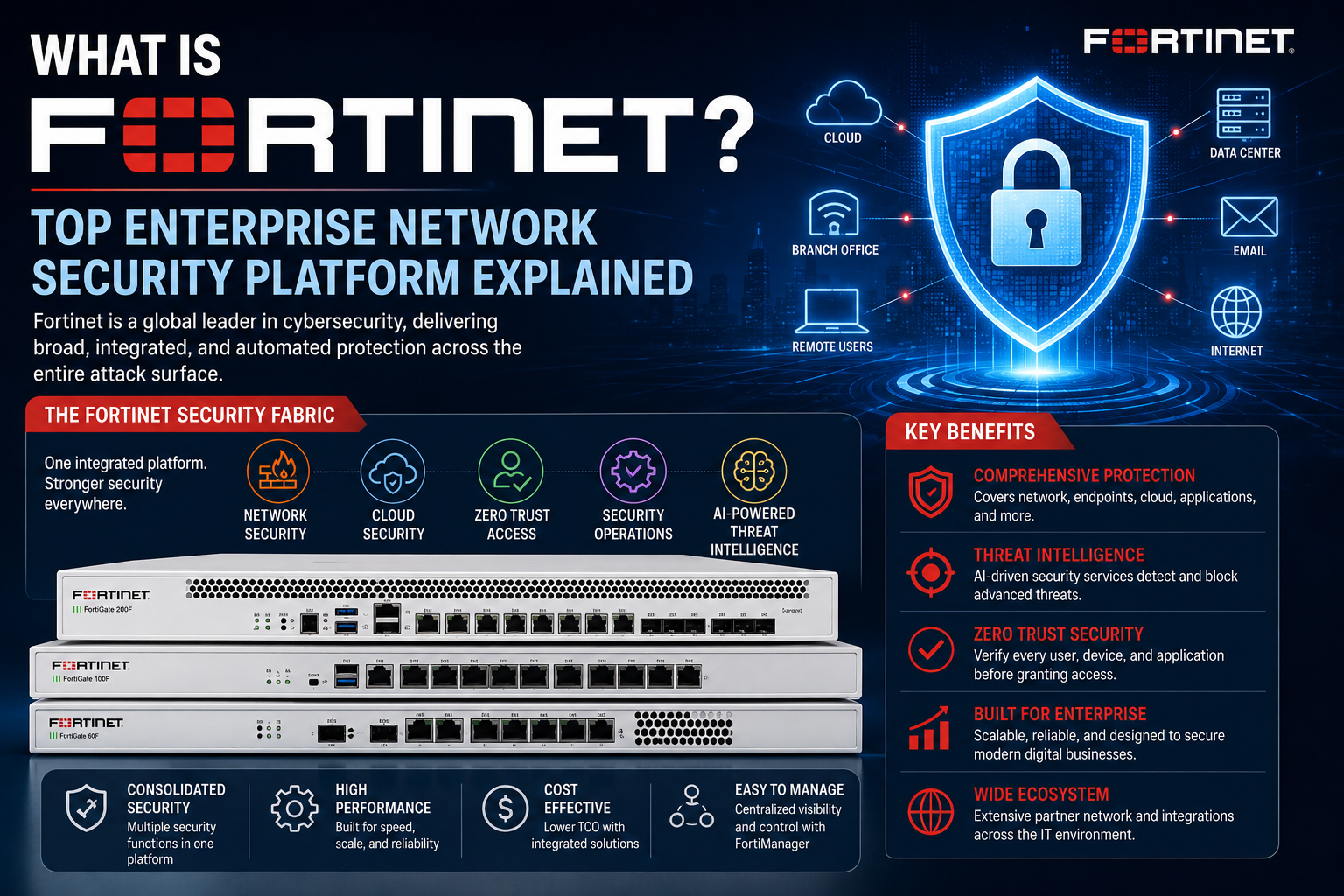
Today, Fortinet’s portfolio includes firewalls, wireless access points, secure switches, endpoint protection tools, cloud security platforms, VPN solutions, email security systems, identity management tools, sandboxing technologies, and centralized security management software.
The company’s strategy centers around integration. Instead of treating each security product as an isolated tool, Fortinet designs its technologies to share threat intelligence and coordinate responses across the entire infrastructure.
This integrated approach became increasingly valuable as organizations struggled to manage fragmented security environments consisting of disconnected products from multiple vendors.
Why Security Ecosystems Matter in Modern IT Infrastructure
Cybersecurity has become far more complicated than simply protecting a single office network. Modern businesses often operate across multiple locations, cloud providers, remote users, and mobile devices. Security teams must monitor countless systems simultaneously.
When organizations use isolated security products that cannot communicate effectively, visibility gaps emerge. Threats may go undetected because information remains trapped within separate systems.
A security ecosystem solves this problem by enabling different security tools to share data and coordinate actions automatically. Fortinet built much of its reputation around this ecosystem-driven approach.
For example, imagine an employee unknowingly downloads malware onto a company laptop. In a fragmented security environment, the endpoint protection software may detect suspicious behavior, but the firewall, wireless network, and cloud security tools may remain unaware of the threat.
In an integrated ecosystem, however, the endpoint detection tool can immediately share threat intelligence with the firewall and other security systems. The firewall may automatically block communication with malicious servers. Access controls may isolate the infected device from sensitive systems. Security teams may receive automated alerts with detailed information.
This coordinated defense improves response speed and reduces the risk of widespread compromise.
Fortinet extends this philosophy across its entire product line. Wireless access points, switches, firewalls, cloud systems, and management platforms all communicate within the broader security framework.
The goal is to provide centralized visibility, automated threat response, and consistent policy enforcement throughout the organization.
Understanding the Role of FortiGate Firewalls
Although Fortinet offers many products, FortiGate remains its flagship technology. FortiGate firewalls serve as the foundation of many Fortinet deployments and represent the company’s core identity in the cybersecurity market.
FortiGate devices combine multiple security functions into a unified platform. Rather than using separate appliances for firewalling, intrusion prevention, VPN access, web filtering, and antivirus scanning, organizations can manage these capabilities through a single system.
This consolidation simplifies security management while improving overall visibility.
FortiGate firewalls provide application awareness, allowing administrators to identify and control specific applications running on the network. Instead of merely allowing or blocking traffic by port number, administrators can create detailed policies based on user roles, application behavior, and security risk levels.
For instance, a company may permit employees to use cloud collaboration platforms while restricting unauthorized file-sharing applications. The firewall can recognize these applications directly, even when they use standard web ports.
Deep packet inspection allows FortiGate systems to analyze the contents of network traffic rather than only examining headers and addresses. This capability helps identify malware, suspicious payloads, and hidden attack techniques.
Encrypted traffic inspection is another critical feature. Since much of today’s internet traffic uses encryption, attackers often hide malicious activity within encrypted sessions. Modern firewalls must inspect this traffic without significantly impacting performance.
FortiGate devices also include intrusion prevention systems capable of identifying known attack signatures and abnormal behavior patterns. Combined with threat intelligence feeds, these systems can block attacks before they compromise internal systems.
Many organizations also use FortiGate appliances to support secure remote access. Virtual private network functionality enables employees to connect securely to corporate resources from remote locations.
As hybrid work environments continue expanding, secure remote connectivity has become increasingly important for businesses worldwide.
The Expanding Threat Landscape Facing Organizations
The cybersecurity landscape changes constantly. Attackers continuously develop new methods to bypass defenses, exploit vulnerabilities, and steal sensitive information.
Ransomware remains one of the most damaging threats facing organizations today. Attackers infiltrate systems, encrypt valuable data, and demand payment in exchange for restoring access. Some groups also steal sensitive data before encryption, threatening public leaks if victims refuse to pay.
Phishing attacks continue evolving as well. Cybercriminals create highly convincing emails, fake login pages, and social engineering campaigns designed to trick users into revealing credentials or downloading malware.
Supply chain attacks have also become more common. Instead of attacking organizations directly, hackers compromise trusted software providers or vendors to distribute malicious updates to downstream customers.
Internet of Things devices introduce additional challenges. Smart devices often lack strong security protections, making them attractive targets for attackers seeking entry points into corporate networks.
Cloud adoption further complicates security management. Organizations now operate workloads across multiple cloud providers, each with different configurations, permissions, and security requirements.
Remote work expands the attack surface even more. Employees connect from home networks, public Wi-Fi environments, and personal devices, creating new vulnerabilities that traditional security models were never designed to handle.
Fortinet addresses many of these challenges by combining network security, endpoint protection, cloud security, and centralized management into a unified ecosystem.
The Importance of Cloud Security Integration
Cloud computing has fundamentally changed how businesses operate. Companies increasingly rely on platforms like Amazon Web Services, Microsoft Azure, and Google Cloud for hosting applications, storing data, and delivering services.
However, cloud environments create new security complexities. Organizations must manage permissions, monitor configurations, detect threats, and ensure compliance across multiple platforms simultaneously.
Fortinet expanded its capabilities to support modern cloud infrastructures through cloud-native security tools and centralized management platforms.
Cloud security integration enables organizations to monitor both on-premises and cloud environments through a unified interface. Security teams gain visibility into workloads, user activity, data flows, and configuration risks across the entire infrastructure.
Automation plays a major role in cloud security management. Modern security platforms can automatically identify misconfigured storage buckets, exposed services, weak access controls, and suspicious activity patterns.
Threat intelligence sharing between cloud systems and on-premises infrastructure improves overall protection. If malicious activity appears in one environment, security policies can adapt across the broader ecosystem.
This integration becomes especially important for organizations operating in hybrid or multi-cloud environments where applications and users span multiple platforms.
Wireless Security and the Expanding Attack Surface
Wireless connectivity transformed modern networking by providing flexibility, mobility, and convenience. However, wireless infrastructure also introduced new security risks.
Attackers frequently target wireless networks because they can sometimes bypass traditional perimeter defenses. Rogue access points, insecure Wi-Fi configurations, and unauthorized devices create potential entry points into corporate environments.
Fortinet recognized early that wireless security needed to become part of the broader cybersecurity strategy rather than a separate concern.
The company expanded into wireless products to help organizations secure both wired and wireless infrastructure through centralized management and coordinated threat response.
Integrated wireless security allows administrators to monitor connected devices, enforce access policies, detect suspicious behavior, and isolate compromised systems automatically.
For example, if a wireless device exhibits malicious behavior, integrated security systems can immediately restrict its access, alert administrators, and share threat intelligence with firewalls and endpoint protection tools.
As organizations continue adopting remote work, mobile devices, and wireless-first environments, securing wireless infrastructure becomes increasingly critical.
Automation and Artificial Intelligence in Modern Security
Cybersecurity teams face an overwhelming number of alerts, threats, and incidents every day. Manual security management alone is no longer sufficient for protecting large and complex environments.
Automation and artificial intelligence help address this challenge by enabling faster threat detection and response.
Modern next-generation firewalls use machine learning algorithms to identify abnormal behavior patterns that may indicate attacks. Instead of relying solely on known signatures, AI-driven systems analyze network behavior in real time.
For instance, unusual login activity, abnormal data transfers, suspicious encryption patterns, or unexpected application behavior may trigger automated investigations or defensive actions.
Automation also reduces response times during security incidents. Instead of waiting for human intervention, integrated systems can automatically quarantine infected devices, block malicious IP addresses, revoke compromised credentials, or isolate vulnerable applications.
This rapid response capability is especially important during ransomware attacks, where every minute matters.
Fortinet incorporates automation across many of its products to improve efficiency and reduce operational complexity for security teams.
Centralized Management and Visibility
One of the biggest challenges organizations face is maintaining visibility across large and distributed environments. Security teams often manage multiple offices, cloud platforms, remote users, mobile devices, and third-party services simultaneously.
Without centralized visibility, detecting threats becomes far more difficult.
Fortinet addresses this issue through centralized management platforms that allow administrators to monitor security events, enforce policies, analyze traffic, and coordinate responses from a single interface.
Centralized management simplifies operations by reducing the need to configure each device individually. Security policies can be applied consistently across the organization, improving both efficiency and compliance.
Unified dashboards provide real-time insights into network activity, threat levels, device health, user behavior, and security incidents.
This visibility helps organizations respond more effectively to evolving threats while maintaining operational control over increasingly complex infrastructures.
The Competitive Cybersecurity Market
Fortinet operates within a highly competitive cybersecurity industry filled with major vendors offering advanced security products and services.
Organizations evaluating security platforms often compare features such as performance, scalability, integration capabilities, cloud support, automation, threat intelligence, and ease of management.
What differentiates Fortinet for many customers is its emphasis on integration, hardware performance, and ecosystem-wide coordination.
The company’s use of specialized processors allows many of its security appliances to handle deep inspection workloads efficiently. Its integrated ecosystem approach appeals to organizations seeking simplified security operations and centralized control.
However, cybersecurity decisions vary significantly depending on business size, technical requirements, compliance obligations, and operational priorities.
Small businesses may focus on affordability and simplicity, while large enterprises prioritize scalability, advanced automation, and global visibility.
Fortinet offers products targeting organizations of various sizes, from small office deployments to massive enterprise networks supporting thousands of users and devices.
Why Fortinet Skills Matter in the IT Industry
As cybersecurity continues growing in importance, professionals with experience managing advanced security platforms remain in high demand.
Organizations increasingly seek network engineers, security analysts, system administrators, and cloud professionals who understand modern security architectures and threat management strategies.
Fortinet technologies appear across many industries, including healthcare, finance, education, manufacturing, telecommunications, and government environments.
Understanding how next-generation firewalls operate provides valuable insight into modern network security practices. Learning about integrated security ecosystems also helps IT professionals understand how organizations coordinate protection across complex infrastructures.
The rise of hybrid work, cloud computing, IoT devices, and advanced cyberthreats ensures that cybersecurity knowledge will remain highly relevant for years to come.
Modern security professionals must understand not only how to configure individual tools but also how those tools interact within broader ecosystems. Integrated security management, automation, cloud protection, and threat intelligence sharing are becoming essential components of enterprise cybersecurity strategies.
Fortinet’s technologies provide one example of how the cybersecurity industry continues evolving to meet the demands of increasingly connected and threat-prone digital environments.
The Shift Toward Integrated Network Security
Modern organizations no longer operate inside a single building with a handful of desktop computers connected to a local server. Today’s business environments are highly distributed. Employees work remotely from home offices, applications run across multiple cloud platforms, customers connect through mobile devices, and data moves continuously between locations around the world.
This transformation has forced businesses to rethink cybersecurity completely. Traditional security strategies were built around the idea of protecting a clearly defined perimeter. Once users entered the internal network, they were often trusted automatically. That model no longer works effectively because networks are now decentralized and constantly changing.
Cybercriminals understand this shift. Attackers no longer focus only on breaching a single firewall at the edge of the network. Instead, they target cloud applications, compromised user credentials, remote access systems, wireless infrastructure, third-party integrations, and endpoint devices. Every connected system represents a possible entry point.
Because of this growing complexity, organizations increasingly prefer integrated security platforms instead of isolated security tools. They want networking, endpoint protection, cloud security, access control, and threat detection systems to operate together rather than independently.
This is one of the areas where Fortinet became highly influential. Instead of viewing cybersecurity as a collection of disconnected products, Fortinet developed a broader architecture designed to connect different layers of security into a coordinated ecosystem.
Businesses today often need real-time visibility into thousands of devices, users, applications, and cloud workloads. Security teams must identify suspicious activity quickly, respond to incidents rapidly, and maintain consistent security policies across all environments. Integrated systems help reduce operational complexity while improving overall protection.
The growing demand for unified cybersecurity solutions continues driving the adoption of platforms capable of managing security holistically rather than piece by piece.
How Businesses Build Security Around the Network Edge
Even though cybersecurity now extends far beyond the traditional perimeter, the network edge still plays a critical role in protecting organizations from external threats. The edge is where users, devices, applications, and internet traffic interact with internal systems.
This is where next-generation firewalls remain extremely important.
Businesses deploy advanced firewalls at branch offices, headquarters, data centers, and cloud environments to inspect incoming and outgoing traffic continuously. These firewalls help prevent unauthorized access, malware infections, command-and-control communication, and data exfiltration attempts.
Modern firewalls do far more than block ports or filter IP addresses. They examine user behavior, analyze applications, inspect encrypted sessions, and identify anomalies that may indicate malicious activity.
For example, if an employee’s device suddenly begins transmitting unusually large amounts of encrypted traffic to an unknown external server, the firewall may identify this behavior as suspicious. Automated policies can then block the connection, isolate the affected system, and alert security teams immediately.
Organizations also use firewall segmentation to limit the spread of attacks within the network. Instead of allowing unrestricted communication between all internal systems, businesses divide infrastructure into controlled security zones.
Critical systems such as financial databases, healthcare records, or production servers may operate within isolated segments that require additional authentication and stricter access controls.
This segmentation strategy becomes especially valuable during ransomware attacks. If malware infects one part of the network, segmentation helps prevent attackers from moving laterally across the environment.
Integrated firewall systems also help organizations enforce compliance requirements by monitoring traffic, generating logs, and controlling access to sensitive resources.
The Role of Zero-Trust Security in Modern Organizations
One of the biggest shifts in cybersecurity thinking is the rise of zero-trust architecture. Traditional security models assumed that users inside the network could generally be trusted. Zero trust rejects that assumption completely.
Instead, zero-trust security operates on the principle of “never trust, always verify.” Every user, device, application, and connection must continuously prove its legitimacy before gaining access to resources.
This approach became necessary because attackers increasingly use stolen credentials, compromised accounts, and insider threats to bypass traditional defenses.
Businesses implementing zero-trust strategies use multiple layers of verification, including identity management, device validation, behavior analysis, multifactor authentication, and continuous monitoring.
Fortinet technologies often support zero-trust initiatives through identity-aware firewalls, secure access controls, endpoint integration, and network segmentation capabilities.
For instance, a remote employee attempting to access internal resources may first need to authenticate through multifactor verification. The security system may then check whether the employee’s device meets compliance requirements, such as updated antivirus software and operating system patches.
Even after access is granted, the user may receive permission only for specific applications rather than unrestricted network access. If suspicious behavior appears later, the system can revoke access automatically.
Zero trust also applies to cloud environments, application access, and communication between devices. The goal is to minimize implicit trust throughout the entire infrastructure.
As organizations continue embracing remote work and cloud computing, zero-trust security models are becoming increasingly common across many industries.
Securing Remote Workforces and Hybrid Environments
Remote work fundamentally changed how organizations approach cybersecurity. Employees now connect from homes, hotels, airports, coffee shops, and mobile devices spread across different geographic regions.
While remote work increases flexibility and productivity, it also creates additional security challenges. Home networks may lack enterprise-grade protection, personal devices may not follow corporate security standards, and remote connections may expose sensitive data to interception risks.
Businesses needed security solutions capable of protecting users regardless of location.
Secure remote access technologies became essential during this transition. Virtual private networks allow employees to establish encrypted connections to corporate environments while working remotely.
However, VPNs alone are not enough for modern security requirements. Organizations also need endpoint monitoring, identity verification, application control, and threat detection integrated into remote access workflows.
Fortinet expanded heavily into secure remote connectivity and secure access service edge technologies to support hybrid work environments.
These systems combine networking and security services into cloud-delivered platforms that protect users wherever they connect. Traffic inspection, access enforcement, and threat prevention occur consistently regardless of physical location.
Remote work security also requires continuous endpoint visibility. If a remote laptop becomes infected with malware, organizations must identify and isolate the threat quickly before attackers gain deeper access.
Integrated security platforms help businesses coordinate protection across remote endpoints, cloud applications, and on-premises infrastructure simultaneously.
Hybrid work environments are likely to remain a permanent part of modern business operations, making secure remote access an ongoing priority for organizations worldwide.
Why Cloud Security Has Become a Critical Priority
Cloud adoption accelerated dramatically as businesses pursued scalability, flexibility, and cost efficiency. Companies increasingly host applications, databases, collaboration tools, and storage systems in public and private cloud environments.
While cloud computing offers major advantages, it also introduces unique security risks.
One common misconception is that cloud providers handle all security responsibilities automatically. In reality, cloud security operates under a shared responsibility model. Providers secure the infrastructure itself, but organizations remain responsible for protecting their applications, user accounts, configurations, and data.
Misconfigured cloud environments are among the most common causes of modern data breaches. Publicly exposed storage buckets, weak identity permissions, unsecured APIs, and improperly configured workloads can all create serious vulnerabilities.
Managing security across multiple cloud providers further increases complexity. Many businesses operate in multi-cloud environments where workloads span Amazon Web Services, Microsoft Azure, Google Cloud, and private infrastructure simultaneously.
Security teams must maintain visibility across all these environments while enforcing consistent policies and detecting threats in real time.
Fortinet developed cloud-native security tools designed to provide centralized management across hybrid and multi-cloud infrastructures. These platforms help organizations monitor workloads, identify risks, automate compliance checks, and respond to suspicious activity more effectively.
Automation plays an especially important role in cloud security. Security platforms can continuously scan configurations for vulnerabilities, identify exposed resources, and recommend remediation steps before attackers exploit weaknesses.
Cloud security integration also allows businesses to correlate events across environments. Suspicious activity detected in one cloud platform can trigger automated defensive actions elsewhere within the infrastructure.
As cloud adoption continues growing, organizations increasingly prioritize platforms capable of protecting distributed applications and data consistently across complex environments.
The Importance of Threat Intelligence Sharing
Cybersecurity depends heavily on visibility and information sharing. Attackers constantly develop new malware variants, phishing campaigns, exploit techniques, and evasion methods. Organizations need access to up-to-date threat intelligence to defend themselves effectively.
Threat intelligence refers to information about current cyberthreats, malicious infrastructure, attacker tactics, vulnerabilities, and indicators of compromise.
Modern security platforms continuously collect and analyze data from networks, endpoints, cloud systems, and global threat research teams. This information helps identify emerging threats and improve defensive responses.
Fortinet integrates threat intelligence throughout its ecosystem so that different products can share information automatically.
For example, if a firewall detects communication with a known malicious server, that intelligence can immediately propagate to endpoint protection tools, wireless systems, cloud platforms, and centralized management dashboards.
This coordinated approach allows organizations to react faster to evolving threats.
Threat intelligence sharing also improves detection accuracy. By analyzing patterns across multiple environments, security systems can identify suspicious behavior more effectively than isolated tools operating independently.
Artificial intelligence further enhances threat analysis by processing massive amounts of security data at high speed. Machine learning models help identify anomalies, classify threats, and reduce false positives.
Threat intelligence is especially valuable against rapidly evolving attacks such as ransomware campaigns, phishing operations, and zero-day exploits.
The faster organizations can identify and respond to threats, the better their chances of preventing serious damage.
Protecting Internet of Things Devices and Smart Infrastructure
Businesses increasingly rely on Internet of Things devices for operational efficiency and automation. Smart sensors, cameras, industrial systems, medical devices, and connected equipment now appear throughout many industries.
However, IoT devices often create major security concerns.
Many smart devices were designed primarily for functionality rather than security. Some lack strong authentication mechanisms, receive infrequent updates, or operate with outdated software vulnerabilities.
Attackers frequently target insecure IoT devices because they can serve as entry points into larger networks.
For example, compromised surveillance cameras or smart building systems may allow attackers to establish footholds inside corporate environments. From there, attackers may attempt lateral movement toward more sensitive systems.
Organizations need visibility into all connected devices to manage these risks effectively.
Integrated security platforms help businesses identify IoT devices automatically, monitor their behavior, enforce segmentation policies, and detect abnormal activity.
Network segmentation becomes especially important for IoT security. Organizations often isolate smart devices into separate network zones with restricted communication privileges.
Behavior analysis also helps identify compromised devices. If a smart sensor suddenly begins transmitting unusual traffic patterns, the security system may flag it for investigation or isolate it automatically.
As IoT adoption continues expanding across healthcare, manufacturing, logistics, retail, and smart infrastructure environments, securing connected devices remains a major cybersecurity priority.
The Human Factor in Cybersecurity
Technology alone cannot fully protect organizations from cyberthreats. Human behavior continues playing a major role in security incidents.
Employees may accidentally click phishing links, reuse weak passwords, mishandle sensitive data, or fall victim to social engineering attacks. Even highly advanced security infrastructures can be compromised through human error.
Because of this, businesses increasingly combine technical defenses with user education and security awareness programs.
Modern security platforms support human-focused security strategies in several ways.
Identity-based access controls help limit the damage caused by compromised accounts. Multifactor authentication reduces the risk of stolen credentials. User behavior analytics help identify suspicious activity associated with insider threats or account compromise.
Automated policy enforcement also reduces reliance on manual security processes. For example, organizations can automatically block risky downloads, restrict unauthorized applications, or require additional verification for sensitive operations.
Security teams also benefit from centralized visibility and automation because they face overwhelming volumes of alerts and incidents daily. Integrated platforms help prioritize threats, reduce alert fatigue, and streamline investigations.
Cybersecurity increasingly requires collaboration between technology, processes, and human decision-making.
Organizations that combine strong security architectures with employee awareness and operational discipline are generally better positioned to defend against modern threats.
Security Operations and Incident Response
No organization can eliminate cyber risk. Even with strong defenses, security incidents may still occur. What matters most is how quickly businesses detect, contain, and recover from those incidents.
Security operations centers play a vital role in monitoring networks, analyzing alerts, investigating suspicious activity, and coordinating responses.
Modern security operations depend heavily on centralized visibility and automation. Analysts need access to logs, threat intelligence, endpoint data, network activity, and cloud events within a unified environment.
Integrated platforms simplify incident response by allowing security teams to correlate information across multiple systems rapidly.
For example, if malware appears on an endpoint device, analysts can immediately review firewall logs, user activity, cloud access patterns, and related alerts from other systems.
Automated workflows further improve response efficiency. Security platforms can isolate infected devices, block malicious domains, disable compromised accounts, and trigger investigation procedures automatically.
Rapid response capabilities are especially important during ransomware attacks, where delays can significantly increase operational damage.
Businesses also use centralized management tools to support compliance reporting, forensic investigations, and long-term threat analysis.
As cyberthreats continue evolving, security operations increasingly rely on integrated ecosystems capable of delivering visibility, automation, and coordinated defense across distributed environments.
How Cybersecurity Continues to Change
Cybersecurity never stands still. Every year, organizations adopt new technologies that improve productivity and efficiency, but those same technologies also create new attack surfaces for cybercriminals to exploit. As businesses move deeper into cloud computing, artificial intelligence, automation, remote work, and connected infrastructure, security systems must evolve alongside them.
This constant evolution is one of the reasons next-generation firewalls remain such an important part of modern IT environments. Firewalls are no longer just devices that filter internet traffic. They have become intelligent security platforms capable of analyzing behavior, enforcing policies, identifying threats, and coordinating protection across entire digital ecosystems.
Fortinet has spent years adapting its technologies to meet these changing demands. Instead of focusing solely on perimeter defense, the company has expanded into cloud security, endpoint protection, identity management, secure networking, and automated threat response. This broader strategy reflects how cybersecurity itself has transformed.
Organizations now require continuous visibility into users, devices, applications, and data, regardless of where those resources exist. The future of cybersecurity will likely depend on integrated platforms that can protect increasingly distributed environments.
Businesses are also beginning to recognize that cybersecurity is no longer only an IT concern. Security now affects business continuity, customer trust, regulatory compliance, operational stability, and brand reputation. A major cyberattack can disrupt supply chains, halt operations, damage public confidence, and create significant financial losses.
Because of this, organizations are investing more heavily in long-term security strategies rather than relying only on reactive defenses. Companies want platforms capable of adapting to future threats instead of simply addressing current ones.
Artificial Intelligence and the Next Stage of Threat Detection
Artificial intelligence is becoming one of the most influential technologies in cybersecurity. Security systems now process enormous amounts of data every second, including network traffic, user behavior, cloud activity, endpoint telemetry, and application logs. Human analysts alone cannot efficiently analyze all this information in real time.
AI-driven security tools help identify patterns that might indicate malicious activity. These systems can detect anomalies such as unusual login behavior, suspicious data transfers, unauthorized application usage, or abnormal communication between devices.
For example, if an employee account suddenly logs in from multiple geographic locations within minutes or begins accessing systems outside its normal role, AI-based analytics may recognize the behavior as suspicious. Automated policies can then require additional verification or temporarily restrict access.
Modern next-generation firewalls increasingly incorporate machine learning models capable of adapting to evolving threats. Instead of relying solely on pre-defined signatures, these systems continuously learn from network behavior and global threat intelligence.
This approach is important because cybercriminals constantly change their tactics. Malware variants, phishing campaigns, and ransomware operations evolve rapidly to avoid detection. AI allows security platforms to identify behavioral indicators of attacks even when the exact threat has never been seen before.
Fortinet and similar cybersecurity vendors continue investing heavily in automation and AI-assisted security operations. The goal is not to replace human analysts entirely but to reduce workload, improve detection accuracy, and accelerate response times.
As threats become more sophisticated, AI will likely play an even larger role in identifying hidden attack patterns and coordinating defensive actions automatically.
The Growing Importance of Secure Access Service Edge
One of the biggest changes in enterprise networking is the movement away from traditional centralized architectures. In the past, employees usually worked inside corporate offices connected directly to internal networks. Security tools were concentrated at the network perimeter.
Today, users connect from almost anywhere. Applications may operate in public clouds, private data centers, or software-as-a-service platforms. Employees often use mobile devices and remote internet connections instead of office-based infrastructure.
This shift created demand for Secure Access Service Edge, commonly known as SASE. SASE combines networking and security functions into cloud-delivered services that protect users regardless of location.
Instead of routing all traffic through centralized data centers, SASE platforms apply security policies closer to the user. This improves both security and performance while supporting distributed work environments.
Fortinet expanded into this area because organizations increasingly need unified solutions capable of securing remote users, cloud applications, and branch offices simultaneously.
SASE platforms typically combine several technologies, including secure web gateways, zero-trust access controls, firewall-as-a-service capabilities, cloud access security brokers, and software-defined wide-area networking.
The rise of SASE reflects a broader trend toward flexible, cloud-based security architectures that support modern business operations more effectively than traditional perimeter models.
As hybrid work becomes permanent for many organizations, secure access technologies will remain central to enterprise cybersecurity strategies.
Why Cybersecurity Skills Will Remain in High Demand
The cybersecurity industry continues to grow rapidly because organizations face increasing pressure to protect digital assets and maintain operational resilience. Businesses in nearly every industry now depend heavily on secure networks, cloud platforms, and connected infrastructure.
At the same time, cyberthreats are becoming more frequent and more damaging. Ransomware attacks disrupt hospitals, schools, manufacturing facilities, and government agencies. Data breaches expose sensitive customer information. Supply chain attacks compromise trusted software providers. Social engineering schemes target employees directly.
Because of these risks, companies need skilled professionals capable of designing, managing, and securing complex environments.
Knowledge of next-generation firewalls, cloud security, network segmentation, identity management, and incident response has become highly valuable in the job market. Security professionals must understand how different technologies work together within larger ecosystems.
Fortinet technologies appear in many enterprise environments, making familiarity with their platforms useful for network engineers, security analysts, cloud specialists, and IT administrators.
However, the broader importance lies in understanding modern cybersecurity concepts rather than memorizing individual products. Professionals who understand integrated security architecture, zero-trust principles, automation, and cloud protection are likely to remain in demand as the industry evolves.
Cybersecurity roles also continue expanding into specialized areas such as threat intelligence, security automation, cloud governance, digital forensics, and industrial control system protection.
The future workforce will need both technical expertise and strategic thinking to address increasingly sophisticated threats.
Conclusion
Modern cybersecurity is far more complex than it was just a decade ago. Organizations now operate in highly connected environments where employees work remotely, applications run in the cloud, and billions of devices exchange data continuously. This rapid digital expansion has created enormous opportunities for businesses, but it has also opened the door to increasingly advanced cyberthreats. As attackers evolve their methods, companies must rely on security solutions that can adapt just as quickly.
Fortinet has become one of the most recognized names in this space because it approaches cybersecurity as a complete ecosystem rather than a single product. While many people associate Fortinet primarily with next-generation firewalls, the company’s broader strategy involves integrating networking, cloud security, endpoint protection, wireless infrastructure, automation, and centralized management into one coordinated platform. This unified approach allows organizations to improve visibility, automate threat response, and secure increasingly distributed environments more effectively.
Next-generation firewalls themselves have transformed dramatically over the years. They are no longer limited to filtering traffic through static rules. Today’s NGFWs analyze applications, inspect encrypted data, detect malicious behavior, support zero-trust security models, and use artificial intelligence to identify evolving threats in real time. These capabilities are critical in a world where ransomware, phishing attacks, cloud vulnerabilities, and sophisticated malware campaigns continue growing in scale and complexity.
As technology continues advancing, cybersecurity will remain a major priority for businesses of all sizes. Organizations will need integrated security architectures capable of protecting users, devices, applications, and data across both physical and cloud-based infrastructures. Understanding how platforms like Fortinet operate provides valuable insight into the future of enterprise security and highlights why modern cybersecurity depends on intelligent, connected, and adaptive defense systems rather than isolated tools alone.