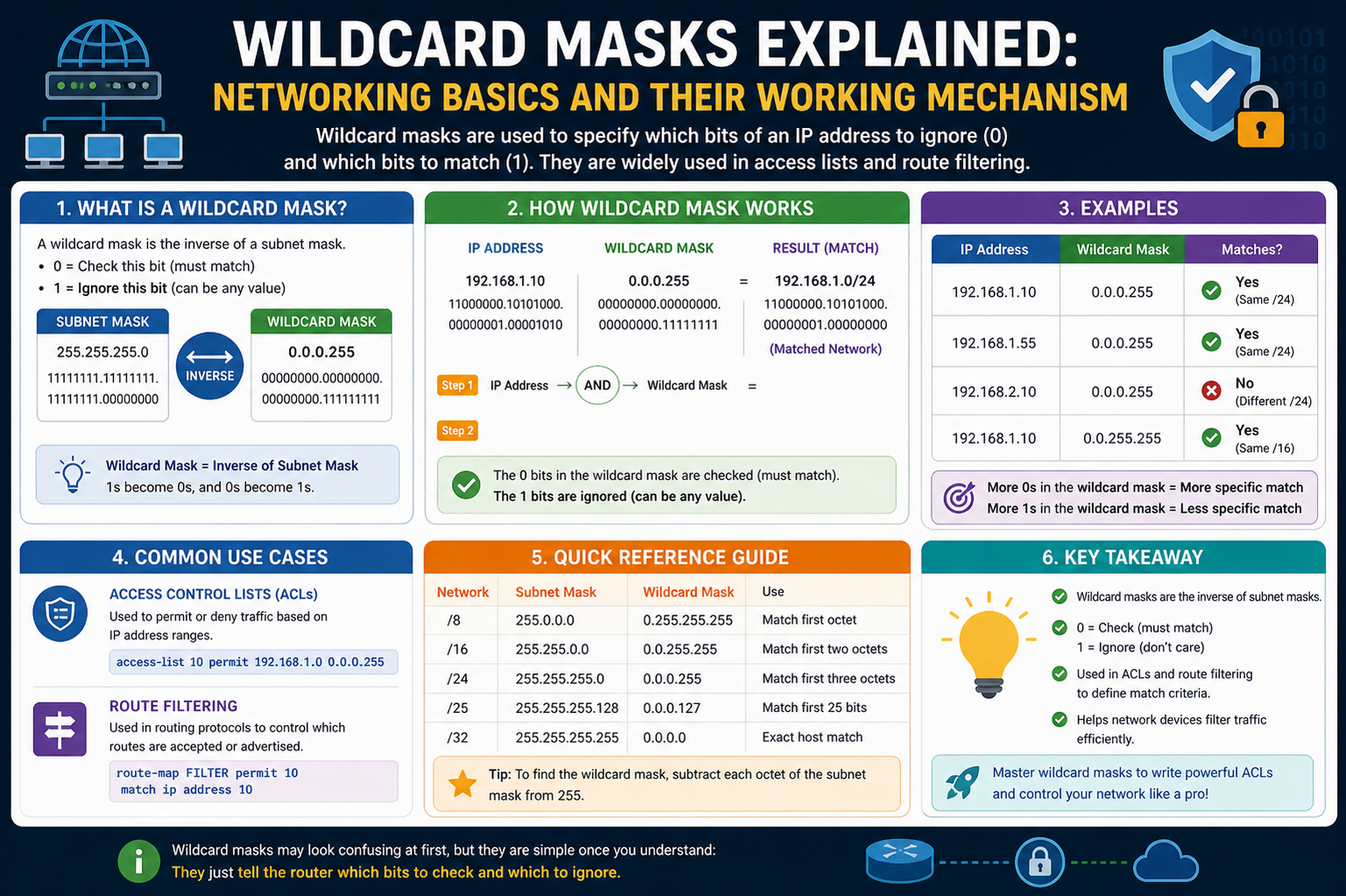
A wildcard mask is a powerful tool used in networking to control how IP addresses are matched when applying rules, especially within access control configurations. It acts like a filter that tells a router or networking device which parts of an IP address should be strictly checked and which parts can be ignored completely. Instead of treating an IP address as a single fixed identity, a wildcard mask breaks it into flexible and non-flexible sections, allowing network administrators to define traffic rules with precision or broad scope depending on the need.
At its core, a wildcard mask works in contrast to how IP addresses are normally understood. In a standard IP structure, every number has meaning, and each segment represents either a network or a device. However, when a wildcard mask is applied, it changes the way these numbers are evaluated. It introduces flexibility by marking certain bits as “must match” and others as “don’t care.” This allows traffic rules to be applied not just to one device but to a whole range of devices, or even specific parts of a network.
Unlike a subnet mask, which defines the structure of a network, a wildcard mask focuses on selection. It is commonly used in access control lists where routers need to decide whether to allow or block traffic. This makes it an essential part of traffic filtering and network security design.
Understanding the Concept Through Simple Thinking
To understand wildcard masks more clearly, imagine a situation where decisions are made based on what matters and what does not. Think of a scenario where choices are flexible, and only certain conditions must be strictly followed while others are ignored. This idea reflects how wildcard masks operate in networking environments.
For example, if a system only cares about the first three parts of an IP address and ignores the last part, it means it is not concerned about individual devices, only the broader network they belong to. This selective attention is what makes wildcard masks useful. They allow network devices to focus only on the important parts of an address while ignoring unnecessary details.
This approach is especially helpful in large networks where manually specifying every single IP address would be impractical. Instead, a wildcard mask can define a rule that applies to hundreds or even thousands of devices at once with a single configuration entry.
How Wildcard Masks Actually Function in Networking
Wildcard masks work by comparing each bit of an IP address against a corresponding bit in the mask. If the wildcard mask bit is set to zero, it means that the corresponding IP address bit must match exactly. If the wildcard mask bit is set to one, it means that particular bit can be ignored.
This binary-level decision-making allows extremely flexible matching rules. Instead of checking full IP addresses one by one, the system evaluates patterns. This makes filtering faster and easier to manage.
For example, consider a situation where a network administrator wants to control traffic coming from a specific network range. Instead of listing every IP address in that range, a wildcard mask can represent the entire block. The router then automatically applies the rule to all matching addresses.
This is especially useful in environments where networks are divided into subnets, and each subnet contains multiple devices. A wildcard mask helps define rules that apply to the entire subnet without needing individual configuration for each device.
Real-World Interpretation of Wildcard Logic
To better understand how wildcard masks behave, imagine a situation where a decision-maker does not care about every detail but only specific parts of information. In networking terms, this means certain bits of the IP address are important while others are irrelevant.
For instance, if a wildcard mask is designed to focus only on the network portion of an IP address, it ignores the device-specific portion. This allows administrators to apply rules to an entire network segment instead of individual machines.
This behavior is similar to grouping people based on shared characteristics rather than identifying each person separately. It simplifies decision-making and reduces complexity in large systems.
Binary Matching and Bit-Level Control
At a deeper level, wildcard masks operate using binary logic. Every IP address is made up of binary digits, and the wildcard mask interacts with these digits directly. A zero in the wildcard mask means “this bit must match exactly,” while a one means “this bit can be anything.”
This system allows extremely precise control over network traffic. It gives administrators the ability to define very strict rules or very broad ones depending on requirements.
For example, a very specific wildcard mask can match a single device, while a more general wildcard mask can match an entire range of networks. This flexibility is what makes wildcard masks so valuable in routing and access control systems.
Relationship Between Wildcard Masks and Access Control Rules
Wildcard masks are most commonly used in access control configurations. These configurations determine which traffic is allowed into or out of a network. By combining IP addresses with wildcard masks, administrators can define rules that control access at a very granular or broad level.
When a rule is applied, the router checks incoming traffic against the defined IP and wildcard mask combination. If the traffic matches the rule, it is either allowed or denied depending on the configuration.
This makes wildcard masks essential for managing network security. Instead of manually controlling each individual connection, administrators can define patterns that automatically apply to multiple devices or networks.
Example-Based Understanding of Wildcard Behavior
To understand this better, consider a network where a specific range of IP addresses needs to be controlled. Instead of listing every device in that range, a wildcard mask can represent the entire block.
For example, if a network includes multiple devices within a structured IP range, a wildcard mask can be used to apply a rule to all of them at once. This simplifies configuration and reduces the risk of errors that might occur when handling large numbers of individual entries.
In this way, wildcard masks help transform complex network rules into simple, manageable instructions.
Why Wildcard Masks Are Useful in Large Networks
In large-scale networking environments, managing individual IP addresses becomes extremely difficult. There may be hundreds or thousands of devices connected to different parts of the network. Wildcard masks solve this problem by allowing administrators to group devices logically.
Instead of thinking in terms of individual machines, network rules can be applied to entire sections of the network. This improves efficiency and reduces administrative workload.
Wildcard masks also help ensure consistency in network policies. When a rule is applied using a wildcard mask, it automatically covers all relevant devices without needing repeated configuration.
Difference Between Care and Don’t Care Bits
The fundamental idea behind wildcard masks is the concept of “care” and “don’t care” bits. A bit that must match is considered important and must be checked exactly. A bit that is marked as “don’t care” can be anything and does not affect the rule.
This allows flexible rule creation. Administrators can decide exactly how strict or relaxed a rule should be by adjusting the wildcard mask accordingly.
This concept makes wildcard masks highly adaptable. They can be used for very narrow filtering or very broad network matching depending on requirements.
Practical Interpretation in Network Control
In practical networking environments, wildcard masks are often used when configuring routing rules or security filters. They help define which traffic should be monitored, blocked, or allowed.
For example, a network administrator may want to block traffic from a specific department or subnet. Instead of listing every IP address in that department, a wildcard mask can represent the entire group.
This makes network control much more efficient and scalable, especially in enterprise environments where network sizes can grow rapidly.
How Wildcard Masks Simplify Complex Configurations
Without wildcard masks, network configuration would require listing every single IP address individually. This would be time-consuming and highly error-prone.
Wildcard masks simplify this process by allowing pattern-based definitions. Instead of focusing on individual devices, administrators can focus on groups of devices.
This abstraction makes network management easier and allows for quicker changes when network structures evolve or expand.
Behavior of Wildcard Masks in Traffic Filtering
When traffic enters a network device, it is compared against existing rules that include wildcard masks. The device evaluates whether the incoming IP address matches the pattern defined by the rule.
If the pattern matches, the rule is applied. If it does not match, the traffic is evaluated against other rules or rejected depending on configuration.
This process happens very quickly and allows networks to handle large volumes of traffic efficiently.
Wildcard masks are especially useful in environments where traffic patterns are predictable and structured.
Importance of Logical Grouping in Networking
Wildcard masks enable logical grouping of devices within a network. Instead of treating each device separately, they allow grouping based on IP structure.
This makes network design more efficient and organized. It also helps in maintaining security policies across multiple devices without repetitive configuration.
Logical grouping also improves scalability, making it easier to expand networks without redesigning existing rules.
Early Understanding of Wildcard Behavior in Systems
At a conceptual level, wildcard masks teach an important idea in networking: not all information needs equal attention. Some parts of a system are critical, while others can be ignored depending on context.
This selective attention is what makes wildcard masks powerful. They allow systems to focus only on what matters while ignoring irrelevant details.
This principle is widely used in many areas of networking and system design.
Foundation for Advanced Network Control Concepts
Wildcard masks serve as a foundation for more advanced networking techniques. By understanding how they control pattern matching, learners can better grasp how routers and firewalls make decisions.
They introduce the concept of bit-level control, pattern recognition, and traffic filtering, all of which are essential in modern networking environments.
As networks become more complex, the importance of such flexible tools increases significantly.
Understanding Their Role in Network Structure
Wildcard masks are not just tools for filtering; they are also part of how network structures are interpreted. They help define boundaries between networks, subnets, and device groups.
This structural role makes them important for both configuration and design. They influence how traffic flows and how networks are segmented.
Without wildcard masks, many advanced networking configurations would be far more difficult to implement efficiently.
Summary of Core Understanding
Wildcard masks represent a flexible way of matching IP addresses by defining which parts should be checked and which should be ignored. They simplify network configuration, improve scalability, and enable efficient traffic filtering. Through binary-level control and logical grouping, they allow administrators to manage complex networks with ease while maintaining precise control over access and routing behavior.
Understanding the Role of Wildcard Masks in IP Address Matching
Wildcard masks play a critical role in how networking devices interpret and match IP addresses during traffic evaluation. Instead of treating an IP address as a single fixed value, a wildcard mask breaks it into flexible components that can either be strictly matched or completely ignored. This selective matching allows routers and switches to apply rules to specific devices, groups of devices, or entire network ranges with a single configuration entry.
In practical networking environments, this concept is essential because networks are rarely small or simple. They often consist of multiple interconnected subnets, each containing a large number of devices. Without wildcard masks, managing traffic rules for each individual device would become extremely inefficient and prone to configuration errors. By introducing pattern-based matching, wildcard masks simplify how network rules are applied across large and complex infrastructures.
The core idea behind wildcard matching is not just filtering but intelligent selection. A network administrator can define exactly which portion of an IP address matters for a rule and which portion should be ignored. This allows the same rule to apply broadly or narrowly depending on how the wildcard mask is structured.
This flexibility is one of the reasons wildcard masks are widely used in access control configurations and routing policies. They make it possible to write fewer rules while still maintaining precise control over traffic behavior.
Binary Logic Behind Wildcard Mask Processing
At the foundation of wildcard mask operation is binary logic. Every IP address in a network is made up of binary numbers, and wildcard masks operate directly on this binary representation. Each bit in the wildcard mask corresponds to a bit in the IP address being evaluated.
When a bit in the wildcard mask is set to zero, it indicates that the corresponding bit in the IP address must match exactly. When a bit is set to one, it means that the corresponding bit can be ignored, regardless of its value. This simple binary rule creates a powerful mechanism for flexible matching.
This bit-by-bit evaluation allows network devices to quickly determine whether a packet matches a rule without needing to compare entire IP addresses in a rigid way. Instead, they evaluate patterns, which makes processing faster and more efficient.
This binary behavior also explains why wildcard masks are often considered the inverse of subnet masks. While subnet masks define network structure, wildcard masks define flexibility in matching rules. One enforces structure, while the other enables freedom in selection.
Understanding this binary foundation is important because it helps explain how complex filtering decisions are made at high speed inside routers and firewalls.
Pattern-Based Matching Across Network Ranges
Wildcard masks enable pattern-based matching, which is one of their most powerful features. Instead of targeting individual IP addresses, network administrators can define patterns that represent entire groups of devices.
For example, if a network is divided into structured IP blocks, a wildcard mask can be used to match all devices within a specific block. This allows a single rule to apply to multiple systems without needing to list each one separately.
This pattern-based approach is particularly useful in enterprise environments where networks are large and frequently segmented. It reduces complexity and improves maintainability by allowing administrators to think in terms of groups rather than individual devices.
Pattern matching also helps ensure consistency in network policies. When a rule is applied using a wildcard mask, every device that matches the pattern is automatically included. This reduces the risk of misconfiguration and ensures uniform enforcement of network rules.
This ability to define broad or narrow matching patterns is what makes wildcard masks such a versatile tool in networking design.
Wildcard Masks in Traffic Filtering Mechanisms
In traffic filtering, wildcard masks are used to determine whether incoming or outgoing packets should be allowed or denied. When a packet arrives at a router or firewall, its IP address is compared against a set of rules that include wildcard masks.
Each rule defines a specific pattern, and the device evaluates whether the packet’s IP address matches that pattern. If it matches, the rule is applied. If it does not match, the system moves on to the next rule or denies access based on configuration.
This process happens extremely quickly, allowing networks to handle large volumes of traffic in real time. The efficiency of wildcard-based filtering is one of the reasons it is widely used in access control systems.
In many cases, wildcard masks allow administrators to block or permit entire networks instead of individual hosts. This is especially useful when dealing with large organizational structures where traffic needs to be controlled at a higher level rather than at a granular device level.
By simplifying filtering decisions into pattern matching, wildcard masks reduce the complexity of network security management.
Logical Segmentation of Networks Using Wildcard Masks
Wildcard masks also support logical segmentation of networks. Instead of focusing on physical devices, they allow networks to be divided into logical groups based on IP address structure.
This logical segmentation is essential in modern networking, where systems are often distributed across multiple locations and interconnected through complex routing systems. Wildcard masks allow administrators to define boundaries between these segments without physically altering the network.
For example, a wildcard mask can be used to define all devices within a specific department, location, or subnet. This makes it easier to apply policies such as security restrictions, routing rules, or traffic prioritization.
Logical segmentation improves both security and performance. By controlling traffic at a group level, networks can reduce unnecessary data flow and ensure that only relevant communication occurs between segments.
Wildcard masks make this segmentation process more flexible and scalable compared to static configuration methods.
Efficiency in Large-Scale Network Environments
In large-scale network environments, efficiency is a key requirement. Managing thousands of devices individually is not practical, which is why wildcard masks are so valuable.
They allow administrators to define broad rules that automatically apply to large groups of devices. This reduces the number of configuration entries required and simplifies ongoing maintenance.
When networks grow or change, wildcard-based rules can easily adapt without needing to be rewritten for every individual device. This scalability is essential in dynamic environments such as corporate networks, data centers, and service provider infrastructures.
Wildcard masks also reduce administrative overhead. Instead of constantly updating individual rules, administrators can rely on a few well-designed wildcard patterns to manage entire sections of the network.
This efficiency improves operational stability and reduces the likelihood of configuration errors.
Comparison of Precision and Flexibility in Wildcard Usage
One of the most important characteristics of wildcard masks is their balance between precision and flexibility. Depending on how they are configured, they can be extremely specific or very broad.
A highly precise wildcard mask might target a single device by matching every bit of its IP address exactly. On the other hand, a more flexible wildcard mask might ignore large portions of the address, allowing it to match an entire network range.
This dual capability makes wildcard masks adaptable to different networking needs. In some cases, precision is required for strict security controls. In others, flexibility is more important for efficient traffic management.
The ability to adjust this balance is what makes wildcard masks suitable for a wide variety of networking scenarios.
Role in Routing and Access Control Systems
Wildcard masks are commonly used in routing protocols and access control systems. In routing, they help define which networks should be included or excluded in routing decisions. In access control, they determine which traffic should be allowed or blocked.
In both cases, wildcard masks simplify configuration by allowing administrators to define rules based on patterns rather than individual entries.
This pattern-based approach reduces complexity in routing tables and access control lists, making network management more efficient.
Routers use wildcard masks to quickly evaluate whether a given route or packet matches a defined rule set. This improves performance and ensures that routing decisions are made efficiently.
Reducing Configuration Complexity in Networking
Without wildcard masks, network configuration would be significantly more complex. Every rule would need to be defined for each individual IP address, which would be impractical in large networks.
Wildcard masks reduce this complexity by allowing a single rule to represent multiple addresses. This not only saves time but also reduces the risk of configuration errors.
Simplifying configuration is especially important in environments where network changes happen frequently. Wildcard masks make it easier to update rules without needing to modify large numbers of entries.
This simplification improves both reliability and scalability in network management systems.
Behavior in Hierarchical Network Structures
In hierarchical network structures, wildcard masks help define relationships between different layers of the network. For example, they can distinguish between core networks, distribution layers, and access layers.
Each layer may require different traffic rules, and wildcard masks allow these rules to be applied efficiently based on IP structure.
This hierarchical control helps maintain order in large networks and ensures that traffic flows correctly between different levels of the system.
It also allows administrators to implement layered security models, where different levels of the network have different access permissions.
Adaptive Control in Dynamic Network Environments
Modern networks are often dynamic, with devices joining and leaving frequently. Wildcard masks provide adaptive control by allowing rules to automatically apply to new devices that match existing patterns.
This reduces the need for constant manual updates and ensures that network policies remain consistent even as the network changes.
Adaptive control is particularly important in environments such as cloud networks, enterprise systems, and virtualized infrastructures where changes occur frequently.
Wildcard masks help maintain stability in these environments by ensuring that rules remain relevant even as network structures evolve.
Foundational Importance in Network Design Concepts
Wildcard masks are not just a configuration tool; they are also a foundational concept in network design. They introduce the idea of pattern-based decision-making, which is used throughout modern networking systems.
Understanding wildcard masks helps build a strong foundation for learning more advanced topics such as routing protocols, firewall configuration, and network segmentation strategies.
They also demonstrate how binary logic can be applied to solve real-world networking problems efficiently.
By mastering wildcard masks, network professionals gain insight into how complex systems manage large volumes of data and traffic with precision and speed.
Wildcard Masks in Access Control List (ACL) Design
Wildcard masks are deeply connected to Access Control Lists, which are used to permit or deny traffic based on defined rules. In ACL design, wildcard masks act as the matching logic that determines which IP addresses a rule applies to. Instead of evaluating every single address individually, the system uses wildcard masks to identify patterns of addresses that should be included in a rule.
This makes ACL configuration significantly more efficient. A single rule can control traffic for an entire subnet or a group of networks, depending on how the wildcard mask is structured. This pattern-based control is especially useful in environments where traffic needs to be filtered at scale, such as corporate networks, data centers, and service provider infrastructures.
When an ACL rule is processed, the device compares the incoming packet’s IP address with the rule’s base address and wildcard mask. If the bits align according to the wildcard logic, the rule is considered a match. This match then triggers the action defined in the ACL, such as permitting or denying the traffic.
This system allows administrators to design highly flexible security policies without needing to manually list every possible IP address. Instead, they can focus on defining logical groups of devices or networks.
The integration of wildcard masks into ACLs is one of the key reasons modern networks can maintain both security and scalability at the same time.
Bit-Level Decision Making in ACL Processing
At a deeper level, ACL processing with wildcard masks relies on bit-level decision making. Every IP address is broken down into binary form, and each bit is evaluated against the corresponding bit in the wildcard mask.
If the wildcard mask bit is zero, the system enforces a strict match for that position. If it is one, the system ignores that position entirely. This binary comparison happens across all bits of the address, allowing for extremely precise control over which traffic is included or excluded.
This bit-level evaluation ensures that ACL rules are both fast and efficient. Instead of performing complex comparisons, the device simply evaluates binary patterns. This reduces processing time and allows high-speed traffic filtering even in large networks.
This method also allows for very granular control. Administrators can design rules that match a single device, a range of devices, or entire networks depending on how specific the wildcard mask is configured.
Understanding this bit-level mechanism is essential for designing efficient and secure ACL structures.
Scalability Benefits in Large Network Systems
One of the most important advantages of wildcard masks is their ability to support scalability in large network systems. As networks grow, the number of devices and IP addresses increases significantly. Managing each one individually becomes impractical.
Wildcard masks solve this problem by allowing administrators to group large numbers of IP addresses into a single rule. This reduces the total number of ACL entries required and simplifies overall configuration.
In large-scale environments such as enterprise networks or cloud infrastructures, this scalability is essential. Without wildcard masks, network administrators would face overwhelming complexity when trying to manage security policies.
By using wildcard masks, networks can expand without requiring a complete redesign of existing rules. New devices that fall within defined patterns are automatically included in existing configurations.
This makes wildcard masks a key component in designing scalable and maintainable network systems.
Wildcard Masks and Network Segmentation Strategy
Network segmentation is the practice of dividing a network into smaller, manageable sections. Wildcard masks play an important role in implementing segmentation strategies because they allow rules to be applied to specific segments without affecting the entire network.
Each segment of a network may have different security requirements, traffic rules, or performance needs. Wildcard masks make it possible to define these differences clearly and efficiently.
For example, one segment might contain administrative systems, while another contains general user devices. Wildcard masks allow separate ACL rules to be applied to each segment without needing individual configurations for every device.
This improves both security and organization within the network. It ensures that sensitive systems are protected while still allowing general traffic to flow where appropriate.
Segmentation using wildcard masks also improves troubleshooting and management, as each section of the network can be controlled independently.
Role in Reducing Configuration Complexity
Wildcard masks significantly reduce configuration complexity in networking environments. Without them, administrators would need to manually define rules for every IP address, which would be time-consuming and error-prone.
With wildcard masks, a single rule can represent an entire range of addresses. This reduces the number of configuration lines required and simplifies ongoing management.
This reduction in complexity also improves reliability. Fewer manual entries mean fewer chances for mistakes, which helps maintain stable network performance.
In addition, simplified configuration makes it easier for teams to understand and manage network policies. New administrators can quickly interpret wildcard-based rules without needing to analyze large lists of individual IP addresses.
This simplicity is one of the reasons wildcard masks remain widely used in modern networking systems.
Integration with Routing Decisions
Wildcard masks are not limited to ACLs; they also play a role in routing decisions. In routing protocols, wildcard masks help define which networks should be included in routing updates or path selection.
By using wildcard masks, routing protocols can efficiently advertise or filter network information based on defined patterns. This reduces unnecessary routing traffic and improves overall network performance.
In dynamic routing environments, wildcard masks help routers quickly identify which networks are relevant to a specific routing process. This improves convergence speed and reduces processing overhead.
Their integration into routing systems demonstrates their versatility beyond simple access control functions.
Flexible Control Over Traffic Flow
Wildcard masks provide flexible control over how traffic flows through a network. Depending on how they are configured, they can either tightly restrict traffic or allow broad access.
This flexibility allows administrators to design policies that match the specific needs of different network environments. For example, a highly secure environment might use strict wildcard masks to limit access to only specific devices. In contrast, a more open environment might use broader wildcard masks to allow wider communication.
This adaptability is essential in modern networking, where different systems often require different levels of security and access control.
Wildcard masks make it possible to implement these varying requirements using a consistent and efficient method.
Behavior in Hierarchical Network Environments
In hierarchical networks, wildcard masks help define rules at different levels of the network structure. Each level, such as core, distribution, and access layers, may have different traffic requirements.
Wildcard masks allow administrators to apply rules that are specific to each layer without affecting others. This ensures proper traffic segmentation and control across the entire network hierarchy.
This layered approach improves both performance and security. It ensures that traffic is properly filtered at each level of the network, reducing unnecessary load on higher-level devices.
Hierarchical control using wildcard masks also simplifies policy management, as rules can be applied systematically across different layers.
Efficiency in Policy Implementation
Wildcard masks improve efficiency in policy implementation by reducing the number of rules needed to achieve a desired outcome. Instead of creating multiple individual rules, a single wildcard-based rule can cover a large number of scenarios.
This efficiency is especially valuable in environments where policies change frequently. Administrators can quickly adjust wildcard masks to modify the scope of a rule without rewriting the entire configuration.
This reduces downtime and ensures that network policies remain up to date with minimal effort.
Efficiency in policy implementation is a key advantage of using wildcard masks in modern networking systems.
Adaptability in Changing Network Environments
Modern networks are constantly changing due to the addition of new devices, services, and users. Wildcard masks provide adaptability by automatically including any IP addresses that match their defined pattern.
This means that as long as new devices fall within a defined network range, they will automatically be governed by existing rules. This reduces the need for constant manual updates.
Adaptability is especially important in environments such as cloud computing, virtual networks, and large enterprise systems where changes occur frequently.
Wildcard masks help ensure that network policies remain consistent even as the environment evolves.
Foundation for Advanced Security Design
Wildcard masks form an important foundation for advanced network security design. They introduce the concept of pattern-based filtering, which is used in more advanced systems such as firewalls, intrusion prevention systems, and dynamic access control mechanisms.
Understanding wildcard masks helps build the knowledge needed to design complex security architectures. They demonstrate how simple binary logic can be used to create powerful and flexible security rules.
This foundational understanding is essential for anyone working in network security or infrastructure design.
Summary of Functional Importance
Wildcard masks are essential tools in network configuration, especially in ACL design, routing, and traffic filtering. They provide scalable, flexible, and efficient control over how IP addresses are matched and evaluated.
By using binary logic and pattern-based matching, they simplify complex network configurations and allow administrators to manage large systems with ease.
Wildcard Masks in Real Network Security Environments
Wildcard masks play a major role in real-world network security environments where traffic control must be both precise and scalable. In these environments, security policies are not applied randomly; they are carefully designed to control how data moves between different parts of a network. Wildcard masks help enforce these policies by allowing administrators to define exactly which IP address patterns should be included or excluded from specific rules.
In practical terms, this means a security system does not need to inspect every single device individually. Instead, it evaluates whether an incoming or outgoing connection matches a defined pattern. If the pattern matches, the system applies the corresponding security rule, such as allowing access, blocking traffic, or redirecting communication.
This approach is especially important in enterprise-level networks where thousands of devices may be active at the same time. Without wildcard masks, managing security policies would require extremely large and complex rule sets. Wildcard masks reduce this complexity by grouping devices logically and applying rules at a broader level.
This makes security enforcement more efficient, more consistent, and easier to maintain over time. It also reduces the risk of human error, since fewer individual entries are needed in configuration files.
Precision Control Through Pattern Matching Logic
Wildcard masks provide precision control by allowing network administrators to define exactly how much of an IP address should be considered during rule evaluation. This precision is achieved through pattern matching logic that operates at the binary level.
Each IP address is compared against a wildcard mask bit by bit. If the wildcard bit is set to require a match, the corresponding IP bit must be identical. If the wildcard bit is set to ignore, that part of the address is not considered in the comparison.
This allows highly precise targeting of network traffic. For example, administrators can create rules that apply to a single host, a specific subnet, or an entire network block depending on how the wildcard mask is configured.
This precision is critical in security environments where certain systems must be strictly isolated from others. It ensures that only the intended devices are affected by a rule, while all others remain unaffected.
The ability to combine precision with flexibility is one of the strongest features of wildcard-based systems.
Wildcard Masks in Large Organizational Networks
In large organizational networks, managing communication between departments, servers, and user devices requires structured control. Wildcard masks help achieve this structure by enabling rule-based grouping of devices.
Instead of treating every device as an individual entity, wildcard masks allow devices to be grouped based on their IP address structure. For example, all devices in a specific department can be controlled using a single wildcard-based rule.
This simplifies network administration significantly. It also allows policies to be applied consistently across departments, ensuring that security rules are uniform and predictable.
Large organizations benefit greatly from this approach because it reduces administrative workload while improving control over network behavior.
As organizations grow, wildcard masks make it easier to scale network policies without redesigning the entire configuration system.
Role in Traffic Segregation and Isolation
Traffic segregation is an important concept in network design, and wildcard masks are often used to implement it. Segregation involves separating different types of network traffic so that they do not interfere with each other or create security risks.
Wildcard masks help define boundaries between different traffic groups. For example, administrative traffic can be separated from general user traffic, or internal network traffic can be isolated from external connections.
This separation improves both performance and security. By controlling which devices can communicate with each other, wildcard masks reduce unnecessary traffic flow and minimize exposure to potential threats.
Isolation is particularly important in sensitive environments where certain systems must remain protected from general access. Wildcard masks provide a simple yet effective way to enforce these isolation rules.
Dynamic Adaptation in Modern Networks
Modern networks are dynamic, meaning devices are frequently added, removed, or relocated. Wildcard masks support this dynamic nature by automatically adapting to changes within defined IP ranges.
If a new device is added to a network segment that matches an existing wildcard pattern, it automatically becomes subject to the same rules as other devices in that segment. This eliminates the need for manual updates every time a change occurs.
This dynamic behavior is especially useful in cloud environments, virtual networks, and large-scale enterprise systems where change is constant.
Wildcard masks ensure that network policies remain consistent even as the underlying infrastructure evolves. This reduces administrative effort and helps maintain stability in rapidly changing environments.
Simplifying Complex Routing Structures
In complex routing environments, wildcard masks help simplify how routing rules are defined and managed. Instead of listing every possible network destination individually, administrators can use wildcard patterns to represent multiple networks at once.
This simplifies routing configurations and reduces the size of routing tables. Smaller, more efficient routing tables improve overall network performance and make troubleshooting easier.
Wildcard masks also help routing protocols determine which networks should be included in updates or advertisements. This ensures that only relevant routing information is shared between devices.
By reducing complexity in routing structures, wildcard masks contribute to faster and more efficient network communication.
Reducing Human Error in Network Configuration
One of the major challenges in network management is human error. When configurations become too large or complex, mistakes are more likely to occur. Wildcard masks help reduce this risk by minimizing the number of individual entries required.
Instead of configuring rules for every single IP address, administrators can define broader rules using wildcard masks. This reduces repetition and lowers the chance of incorrect entries.
Fewer configuration lines also make it easier to review and audit network policies. This improves overall reliability and ensures that security rules behave as intended.
By simplifying configuration, wildcard masks indirectly improve network stability and reduce downtime caused by misconfiguration.
Behavior in High-Traffic Network Systems
In high-traffic network systems, efficiency is critical. Wildcard masks contribute to this efficiency by enabling fast pattern matching at the hardware or software level.
When traffic is processed, the system quickly compares IP addresses against wildcard rules without needing to perform complex computations. This allows large volumes of traffic to be filtered in real time.
This efficiency is essential in environments such as data centers, internet service providers, and enterprise networks where millions of packets may be processed every second.
Wildcard masks help ensure that performance is maintained even under heavy load conditions.
Integration with Security Policies and Firewalls
Wildcard masks are often integrated into firewall rules and security policies. Firewalls use them to determine which traffic should be allowed or blocked based on IP patterns.
This integration allows for more flexible security configurations. Instead of creating separate rules for every device, administrators can define broader policies using wildcard masks.
This makes firewall management more efficient and scalable. It also allows security policies to adapt quickly to changes in network structure.
By combining wildcard masks with firewall logic, networks can enforce strong security while maintaining flexibility.
Long-Term Maintenance Advantages
Over time, networks tend to grow and become more complex. Wildcard masks provide long-term maintenance advantages by reducing the need for constant configuration updates.
Once a wildcard-based rule is defined, it can continue to function effectively even as new devices are added to the network. This reduces ongoing maintenance workload and ensures that policies remain stable.
Long-term stability is a key advantage in enterprise environments where downtime or configuration errors can have significant consequences.
Wildcard masks help ensure that network policies remain sustainable over time.
Supporting Structured Network Design
Wildcard masks encourage structured network design by promoting logical grouping and organized IP allocation. When networks are designed with clear IP structure, wildcard masks become even more effective.
This structured approach makes it easier to apply consistent rules across different parts of the network. It also improves clarity in configuration and reduces confusion during troubleshooting.
Well-structured networks combined with wildcard masks result in more efficient and manageable systems.
Importance in Modern Networking Practices
In modern networking practices, wildcard masks remain an essential concept despite the introduction of newer technologies. Their simplicity, flexibility, and efficiency make them highly relevant in both traditional and advanced network environments.
They continue to be used in routing protocols, security systems, and access control configurations. Their ability to simplify complex problems ensures that they remain a foundational tool in networking education and real-world applications.
Wildcard masks demonstrate how simple binary logic can be used to solve large-scale networking challenges effectively.
Final Thoughts
Wildcard masks are a fundamental networking tool that enables flexible, efficient, and scalable control over IP address matching. They simplify complex configurations, support dynamic environments, and improve both security and performance in network systems.
By allowing pattern-based evaluation instead of rigid comparisons, they help administrators manage large networks with ease and precision.