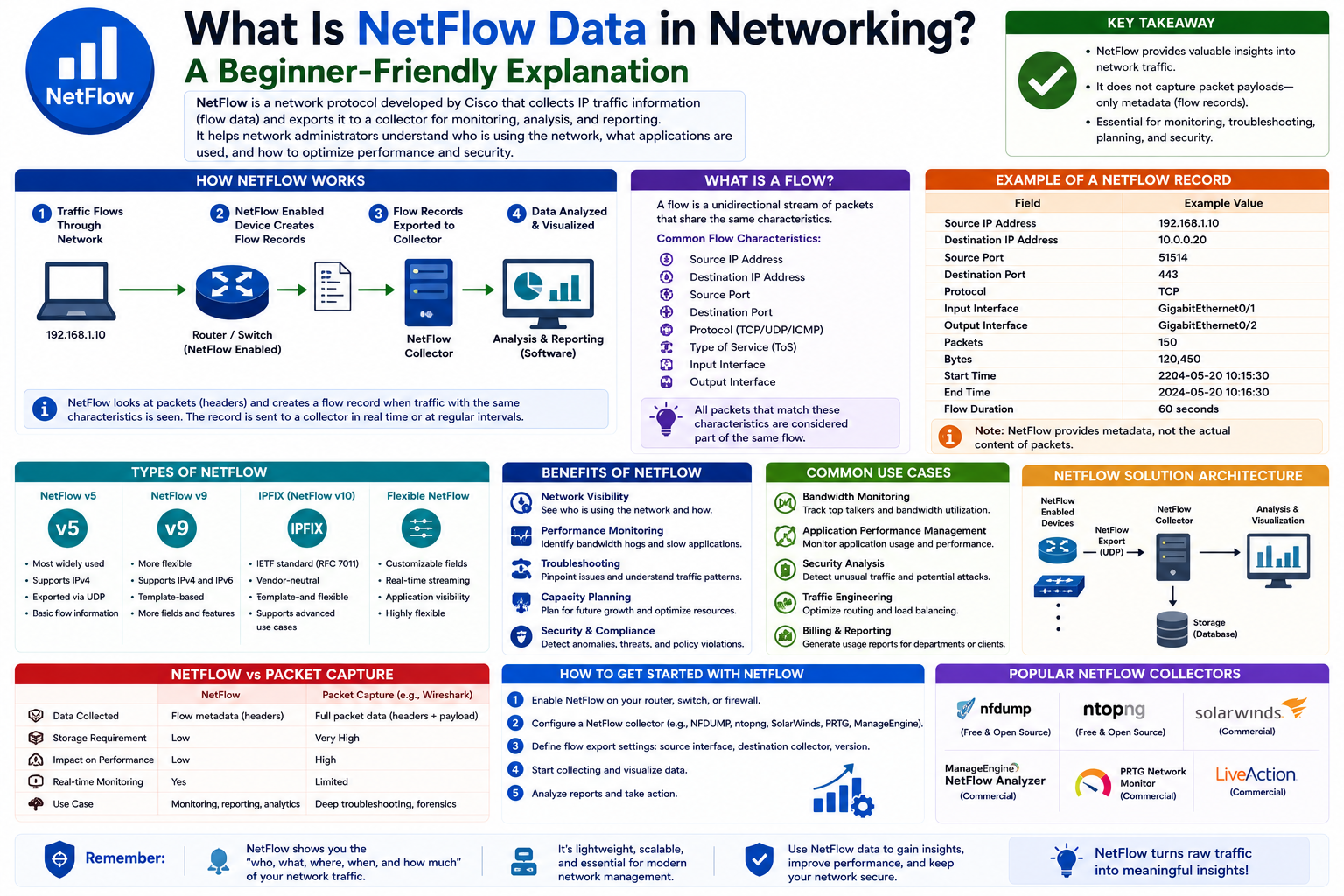
NetFlow data is a structured way of understanding how information moves across a network. Instead of focusing on individual packets in isolation, it groups communication into meaningful “flows,” allowing network engineers to see a complete picture of conversations happening between devices. This shift from packet-level inspection to flow-level insight is what makes NetFlow so powerful in modern networking environments.
At its core, NetFlow data is about visibility. In any active network, thousands or even millions of packets are constantly moving between servers, users, applications, and external systems. Without a method of organizing this traffic, it becomes extremely difficult to understand what is happening inside the network at any given moment. NetFlow solves this challenge by summarizing traffic into flows that can be easily analyzed for performance, security, and optimization purposes.
A network flow is essentially a sequence of packets that share common attributes. These attributes usually include source and destination IP addresses, source and destination ports, protocol type, and sometimes additional metadata depending on the version in use. By grouping packets this way, NetFlow allows administrators to see conversations rather than isolated events.
This approach becomes especially valuable in large-scale environments such as enterprise networks, data centers, and service provider infrastructures. In such environments, traditional monitoring methods often fail to provide enough context. NetFlow data, however, offers a structured view of traffic behavior, making it easier to identify anomalies, bottlenecks, and performance issues.
Another important aspect of NetFlow data is its historical value. It not only shows real-time traffic but also stores records that can be analyzed later. This means administrators can go back in time and understand exactly what happened during a network event, outage, or security incident. This historical insight is one of the reasons NetFlow has remained relevant for decades.
Origins and Evolution of NetFlow
NetFlow was originally developed in the mid-1990s as a feature within Cisco networking devices. At that time, network traffic was growing rapidly, and administrators needed a better way to understand how bandwidth was being used. Traditional tools were limited in scope and often could not provide enough detail to diagnose performance or security issues effectively.
The original design of NetFlow focused on simplicity and efficiency. Rather than analyzing every single packet in real time, it summarized traffic into flows and exported this data to external systems for analysis. This design choice significantly reduced processing overhead on networking devices while still providing valuable insights.
As networks evolved, so did NetFlow. Different versions were introduced to support new protocols, improve scalability, and increase flexibility. One of the most significant advancements came with the introduction of version 9, which allowed customizable templates for flow records. This made NetFlow far more adaptable to different environments and use cases.
Over time, NetFlow also influenced the development of similar technologies across the industry. Vendors created their own implementations and extensions, while standardized versions such as IP Flow Information Export emerged to ensure compatibility across different platforms. Despite these variations, the fundamental idea remained the same: capturing and analyzing network flows for better visibility.
Today, NetFlow is not just a Cisco-specific feature but a widely adopted concept in network monitoring. Many modern systems use NetFlow-like data structures to analyze traffic patterns, detect security threats, and optimize performance.
Core Concept of Network Flow
To fully understand NetFlow data, it is essential to understand the concept of a network flow itself. A flow is a unidirectional sequence of packets that share a common set of characteristics. These characteristics define the relationship between two endpoints communicating over a network.
For example, when a user accesses a website, multiple packets are exchanged between the user’s device and the web server. Instead of treating each packet separately, NetFlow groups them into a single flow. This flow represents the entire conversation, making it much easier to analyze.
A key characteristic of flows is that they are directional. This means that traffic from A to B is considered a separate flow from traffic going from B to A. This separation allows for more precise analysis of communication patterns and traffic directionality.
Flows also have a lifecycle. They begin when the first packet of a conversation is detected and end after a period of inactivity or when the communication stops. During this lifecycle, NetFlow tracks various metrics such as packet count, byte count, duration, and timestamps.
One of the most important advantages of this model is efficiency. Instead of storing information about every single packet, the system only stores summarized flow data. This reduces storage requirements while still preserving meaningful insights about network activity.
Flow-based monitoring also enables pattern recognition. By analyzing flows over time, network engineers can identify trends such as increased bandwidth usage, unusual traffic spikes, or recurring communication patterns between specific devices. These insights are essential for maintaining network performance and stability.
Flow Records Explained
Flow records are the actual data outputs generated by NetFlow. Each record represents a summarized version of a network flow and contains detailed information about that communication session.
A typical flow record includes metadata such as the start and end time of the flow, the total number of packets transferred, the total number of bytes exchanged, and the source and destination information. Depending on the configuration and version, it may also include additional attributes such as interface details or quality-of-service information.
These records are not stored on networking devices indefinitely. Instead, they are periodically exported to external systems for processing and analysis. This design ensures that network devices are not overwhelmed by storage or processing demands.
Flow records serve as the foundation for all NetFlow-based analysis. Without them, it would be impossible to reconstruct traffic patterns or understand network behavior over time. Each record contributes to a larger dataset that provides a comprehensive view of network activity.
One of the most powerful aspects of flow records is their ability to provide context. For example, instead of simply showing that data was transmitted, a flow record can reveal who communicated with whom, when the communication occurred, how much data was exchanged, and how long the session lasted.
This level of detail makes flow records invaluable for troubleshooting. When a network issue occurs, administrators can analyze flow data to determine exactly when the problem started, which devices were involved, and what type of traffic was affected.
Flow records also play a critical role in security monitoring. By examining patterns within flow data, it becomes possible to detect unusual behavior such as unexpected data transfers, repeated connection attempts, or abnormal traffic volumes. These indicators often point to potential security threats that require further investigation.
Flow Exporters and Collectors
NetFlow architecture relies on two primary components: flow exporters and flow collectors. These components work together to capture, transmit, and analyze flow data.
Flow exporters are devices that generate NetFlow data. These are typically routers, switches, or firewalls that observe network traffic as it passes through them. When a flow is detected, the exporter begins collecting relevant information and preparing it for export.
The exporter does not store detailed packet data. Instead, it continuously summarizes traffic into flow records based on predefined rules. Once a flow is completed or reaches a timeout threshold, the exporter sends the flow record to a collector.
Flow collectors are systems designed to receive, store, and analyze NetFlow data. They act as centralized repositories where flow records from multiple devices are aggregated. This centralized approach makes it possible to analyze traffic across an entire network rather than individual devices.
Once flow data reaches the collector, it can be processed using specialized tools. These tools transform raw flow records into meaningful insights through visualization, aggregation, and statistical analysis. This helps network administrators understand traffic distribution, identify top talkers, and detect anomalies.
The relationship between exporters and collectors is essential for scalable network monitoring. Exporters handle data generation at the source, while collectors handle storage and analysis. This separation ensures that network devices remain efficient while still providing detailed visibility into network activity.
How NetFlow Interprets Traffic
NetFlow interprets traffic by continuously observing packets as they pass through a device. Each packet is analyzed for key attributes such as IP addresses, ports, and protocol type. These attributes are then used to determine whether the packet belongs to an existing flow or whether a new flow should be created.
Once a flow is identified, NetFlow begins tracking it. It records the first seen time, updates packet counts, and measures data volume. As additional packets belonging to the same flow are detected, these metrics are updated in real time.
When the flow becomes inactive or reaches a timeout threshold, it is finalized and exported as a flow record. This process ensures that only meaningful, summarized data is sent to the collector rather than raw packet information.
This interpretation mechanism allows NetFlow to operate efficiently even in high-traffic environments. Instead of analyzing every packet independently at all times, it focuses on aggregating data into structured flows that can be processed more effectively.
Key Attributes Captured in NetFlow Data
NetFlow captures a variety of attributes that help define and describe each flow. These attributes form the basis of network analysis and provide detailed insight into communication behavior.
One of the most important attributes is the source and destination IP address. These values identify the endpoints involved in a communication session. Alongside this, source and destination ports help determine which applications or services are being used.
The protocol field indicates the type of communication taking place, such as TCP or UDP. This helps differentiate between different types of traffic and understand how applications are interacting across the network.
Time-based attributes are also critical. NetFlow records capture the start and end time of each flow, allowing administrators to determine how long a communication session lasted. This is useful for identifying long-running connections or unusually short bursts of traffic.
Volume-related attributes include the number of packets and bytes transferred. These metrics help determine how much data was exchanged during a flow and can highlight bandwidth-heavy applications or abnormal usage patterns.
Together, these attributes form a detailed profile of network activity. When analyzed collectively, they provide a comprehensive understanding of how traffic moves through the network.
Relationship to Modern Networking Environments
In modern networking environments, NetFlow data plays a central role in performance monitoring and security analysis. As networks become more complex and distributed, the need for structured visibility becomes even more important.
NetFlow supports this need by providing a scalable method for tracking traffic across large infrastructures. It allows organizations to monitor cloud environments, hybrid networks, and multi-site deployments with consistent visibility.
In addition, NetFlow data is often integrated into broader monitoring systems. These systems combine flow data with logs, metrics, and alerts to create a unified view of network health. This integration enables faster troubleshooting and more proactive network management.
Security teams also rely heavily on NetFlow data to detect threats. By analyzing traffic patterns, they can identify unusual behavior that may indicate malicious activity. This makes NetFlow an essential component of modern cybersecurity strategies.
As networking continues to evolve, the importance of flow-based monitoring continues to grow. NetFlow remains one of the foundational technologies that enable deep visibility into network behavior without overwhelming system resources.
NetFlow Architecture Deep Dive
To understand NetFlow data at a deeper level, it is important to look at how it is structured inside a network environment. NetFlow does not operate as a single function but rather as a coordinated system of components working together to observe, summarize, export, and analyze traffic behavior.
At the core of this architecture are three major roles: the device that observes traffic, the system that exports summarized data, and the platform that collects and analyzes that data. Each role contributes to a continuous pipeline of information flow that transforms raw packet activity into structured intelligence.
When a packet enters a network device such as a router or switch, it is inspected at the forwarding level. The device does not store the entire packet but instead extracts relevant metadata. This metadata includes source and destination IP addresses, port numbers, protocol type, and interface information. Based on this information, the device determines whether the packet belongs to an existing flow or if it should create a new flow entry.
Once a flow entry is created, the device continuously updates it as additional packets match the same criteria. This process continues until the flow becomes inactive or reaches a predefined timeout threshold. At that point, the flow is finalized and prepared for export.
This architecture ensures that the network device does not become overloaded with storage or processing tasks. Instead, it focuses on real-time summarization, which allows it to maintain high performance even in environments with heavy traffic loads.
Flow Export Lifecycle in Detail
The lifecycle of a NetFlow record is a structured process that begins with packet observation and ends with analytical processing in a collector system. This lifecycle can be understood as a continuous loop that repeats for every flow in the network.
It begins when a device detects the first packet of a new communication session. At this stage, the device creates a flow entry and starts tracking relevant metrics. These metrics include packet count, byte count, timestamps, and interface details.
As more packets belonging to the same flow arrive, the system updates the existing flow entry. This ensures that all communication between two endpoints is grouped rather than treated as separate events.
Eventually, the flow reaches a termination point. This can happen due to inactivity, completion of the session, or a forced timeout. When this occurs, the flow entry is converted into a flow record.
The flow record is then exported from the device to a centralized collector. This export process typically occurs using a lightweight transport mechanism designed for efficiency. The goal is to minimize overhead while ensuring reliable delivery of summarized data.
Once exported, the flow record leaves the device and enters the analysis phase, where it becomes part of a larger dataset used for monitoring and diagnostics.
Evolution of NetFlow Versions and Their Differences
Over time, NetFlow has evolved through several versions, each designed to address limitations of earlier implementations and support new networking requirements. Understanding these versions helps clarify how NetFlow adapts to modern environments.
The earliest widely used version was NetFlow version 5. This version introduced a fixed format for flow records, which made it simple and efficient but somewhat limited in flexibility. It worked well for IPv4 networks but lacked support for newer technologies and extended data fields.
NetFlow version 9 marked a major shift in design. Instead of using a fixed record structure, it introduced a template-based approach. This meant that devices could define what information they wanted to export, making the system far more flexible and extensible. This version also introduced support for IPv6 and improved scalability for high-speed networks.
Another important development in the NetFlow ecosystem is IP Flow Information Export. This standard was designed to provide a vendor-neutral approach to flow export. It builds upon the ideas introduced in NetFlow version 9 but standardizes them for broader compatibility across different manufacturers.
In addition to these, vendor-specific implementations such as J-Flow emerged. These variations follow the same core principles but are adapted for specific hardware ecosystems. Despite differences in naming and implementation, all these versions share the same fundamental concept: capturing and exporting flow-based network data.
Each version represents an evolution toward greater flexibility, scalability, and interoperability, reflecting the increasing complexity of modern networks.
Sampling Mechanisms and Their Importance
In high-speed networks, analyzing every single packet is often impractical due to performance limitations. To address this, NetFlow uses sampling techniques that reduce the amount of data processed while still maintaining statistically meaningful insights.
Sampling works by selecting a subset of packets from the overall traffic stream. Instead of analyzing every packet, the system may analyze one packet out of every hundred or thousand. This reduces processing overhead while still providing an accurate representation of network behavior.
There are different types of sampling methods used in NetFlow environments. Systematic sampling selects packets at fixed intervals, while random sampling selects packets in a non-deterministic manner. Both approaches aim to balance accuracy with performance efficiency.
The key advantage of sampling is scalability. In large enterprise or service provider networks, traffic volumes can be extremely high. Without sampling, flow monitoring systems could become overwhelmed, leading to performance degradation.
However, sampling also introduces trade-offs. Since not all packets are analyzed, some level of precision is lost. This means that while sampling is effective for trend analysis and anomaly detection, it may not always capture every detail of network activity.
Despite these limitations, sampling remains a widely used technique because it allows NetFlow to operate efficiently in environments where full packet analysis would be impractical.
NetFlow in High-Speed Network Environments
High-speed networks present unique challenges for traffic monitoring. As data transfer rates increase, the volume of packets passing through network devices grows exponentially. In such environments, traditional monitoring approaches are often insufficient.
NetFlow addresses this challenge by focusing on flow-level summarization rather than packet-level inspection. This reduces the processing burden on network devices while still providing meaningful visibility into traffic patterns.
In high-speed environments, NetFlow implementations are often optimized for performance. This may include hardware acceleration, optimized data structures, and efficient memory management techniques. These optimizations ensure that flow tracking does not interfere with the primary function of forwarding traffic.
Another important consideration in high-speed networks is export frequency. Flow records must be exported frequently enough to provide timely insights but not so frequently that they overwhelm the collector system. Striking this balance is essential for maintaining system stability.
High-speed networks also benefit from distributed flow collection architectures. Instead of sending all flow data to a single collector, multiple collectors may be used to distribute processing load. This improves scalability and ensures that analysis can keep up with traffic volume.
Flow Export Protocols and Transport Mechanisms
The process of exporting NetFlow data relies on efficient transport mechanisms designed to minimize overhead. Since flow data is generated continuously, it must be transmitted in a way that does not disrupt network performance.
Most NetFlow implementations use lightweight transport protocols to send flow records from exporters to collectors. These protocols are designed for speed and efficiency rather than reliability guarantees. In many cases, the focus is on fast delivery rather than guaranteed delivery of every single record.
Flow export packets are typically sent in batches rather than individually. This batching approach reduces network overhead and improves efficiency. Each batch contains multiple flow records grouped for transmission.
Once the data reaches the collector, it is parsed and stored for further analysis. The collector is responsible for ensuring that the incoming data is properly organized and indexed for efficient querying.
Transport mechanisms also play a role in scalability. In large networks, flow data may be exported from hundreds or even thousands of devices simultaneously. Efficient transport ensures that this data can be handled without congestion or loss of performance.
Flow Storage and Data Normalization
Once NetFlow data reaches a collector system, it must be stored and organized in a way that supports efficient analysis. This involves a process known as data normalization.
Normalization refers to converting raw flow records into a standardized format that can be easily queried and analyzed. Since flow data may come from different devices and versions, normalization ensures consistency across the dataset.
During this process, fields such as IP addresses, timestamps, and byte counts are structured into a unified schema. This makes it possible to compare and analyze data from multiple sources without compatibility issues.
Storage systems used for NetFlow data are typically optimized for high write throughput. This is because flow records are continuously generated and must be stored in real time.
Over time, stored flow data can become extremely large. As a result, retention policies are often implemented to manage storage usage. These policies define how long data is kept before being archived or deleted.
Flow storage systems also support indexing, which allows for fast querying of historical data. This is essential for troubleshooting and forensic analysis, where administrators need to quickly retrieve specific traffic records.
NetFlow for Network Security Analysis
One of the most important applications of NetFlow data is network security analysis. By examining traffic flows, security teams can detect unusual behavior that may indicate potential threats.
For example, sudden spikes in traffic volume may indicate a denial-of-service attack. Similarly, unexpected communication between internal systems and external addresses may suggest data exfiltration or unauthorized access.
NetFlow data also helps identify lateral movement within a network. If an internal device begins communicating with multiple other devices in unusual patterns, it may indicate malware activity or compromised credentials.
Another key security use case is anomaly detection. By establishing a baseline of normal network behavior, deviations from this baseline can be flagged for investigation. This approach is particularly effective in detecting unknown or emerging threats.
NetFlow also supports forensic investigations. After a security incident occurs, flow data can be analyzed to reconstruct the timeline of events. This helps security teams understand how an attack occurred and what systems were affected.
Performance Monitoring and Traffic Optimization
Beyond security, NetFlow data plays a crucial role in performance monitoring. By analyzing traffic patterns, network administrators can identify bottlenecks and optimize resource allocation.
For example, if a particular link consistently shows high utilization, it may indicate that traffic needs to be redistributed or infrastructure needs to be upgraded. Similarly, if certain applications consume disproportionate bandwidth, they can be optimized or restricted.
NetFlow also helps in capacity planning. By analyzing historical traffic trends, organizations can predict future bandwidth requirements and scale their infrastructure accordingly.
Quality of service management is another area where NetFlow is valuable. By understanding how different types of traffic behave, administrators can prioritize critical applications and ensure consistent performance.
Integration with Analytical Systems
NetFlow data becomes even more powerful when integrated with analytical platforms. These systems process flow records and transform them into visual dashboards, reports, and alerts.
Analytical systems aggregate flow data across multiple devices, providing a unified view of the entire network. This makes it easier to identify trends and correlations that would be difficult to detect from individual devices.
In addition to visualization, these systems often include alerting mechanisms. When unusual traffic patterns are detected, alerts can be generated to notify administrators in real time.
Integration with other data sources further enhances analysis capabilities. By combining flow data with logs and system metrics, organizations can gain a more complete understanding of network behavior.
Challenges and Limitations of NetFlow Data
Despite its advantages, NetFlow is not without limitations. One of the primary challenges is the balance between detail and performance. While flow data provides valuable insights, it does not capture every packet-level detail.
Another limitation is the potential loss of data due to sampling or export constraints. In high-speed networks, some flow records may be dropped or aggregated, reducing accuracy in certain scenarios.
Storage requirements can also become significant over time. As flow data accumulates, managing long-term retention can be challenging without proper archiving strategies.
Finally, interpreting NetFlow data requires expertise. While the data itself is structured, deriving meaningful insights often requires experience in network behavior and traffic analysis patterns.
Despite these challenges, NetFlow remains one of the most effective tools for understanding and managing complex network environments.
Advanced NetFlow Data Analysis and Traffic Intelligence
As networks grow in scale and complexity, NetFlow data becomes more than just a monitoring tool—it evolves into a foundation for advanced traffic intelligence. At this stage, the focus shifts from simply collecting flow records to interpreting patterns, identifying correlations, and extracting actionable insights that support operational decision-making.
Advanced NetFlow analysis begins with the idea that raw flow records alone are not sufficient. While they contain valuable metadata, their true potential is unlocked when they are aggregated, correlated, and analyzed over time. This transformation turns raw telemetry into meaningful intelligence about how a network behaves under different conditions.
One of the most important aspects of advanced analysis is traffic classification. Instead of viewing flows as isolated communication events, systems group them into categories such as web traffic, database traffic, streaming traffic, or internal service communication. This classification helps administrators understand how network resources are being consumed across different application types.
Another key aspect is temporal analysis. By examining flow data over time, patterns emerge that reveal usage cycles, peak traffic periods, and recurring behavioral trends. These patterns are essential for capacity planning and performance optimization, as they help predict future network demands based on historical behavior.
Advanced NetFlow analysis also involves correlation across multiple devices. In large environments, a single flow may traverse multiple routers, switches, and firewalls. By correlating flow records from these different points, a more complete picture of end-to-end communication can be constructed. This enables deeper insight into latency, routing inefficiencies, and potential failure points.
NetFlow Data Enrichment and Contextualization
Raw NetFlow data provides foundational information, but its real value increases significantly when it is enriched with contextual data. Enrichment involves adding external or derived information to flow records to make them more meaningful and easier to interpret.
One common form of enrichment is geographic mapping. By translating IP addresses into geographic locations, organizations can visualize where traffic originates and where it is destined. This helps identify unexpected traffic sources or unusual international communication patterns.
Another form of enrichment involves asset mapping. Instead of viewing traffic as interactions between IP addresses, enriched data associates those IPs with actual devices, applications, or business services. This transforms technical data into business-relevant insights.
Application identification is another important enrichment technique. By analyzing port usage, packet behavior, and flow characteristics, systems can infer which applications are generating traffic. This is particularly useful in environments where multiple applications share similar infrastructure.
Enrichment can also include threat intelligence data. By comparing flow records against known malicious IP databases, systems can quickly identify potentially dangerous communication patterns. This enhances security monitoring by adding external intelligence to internal traffic data.
Flow Data Correlation Across Multiple Sources
Modern networks generate data from many different sources, including routers, firewalls, load balancers, and cloud infrastructure. NetFlow data becomes significantly more powerful when it is correlated with these additional sources.
Correlation allows administrators to reconstruct a complete narrative of network activity. For example, a firewall log may show that a connection was allowed, while NetFlow data reveals how much data was transferred during that session. Combined, these datasets provide both policy-level and traffic-level insight.
Log correlation is particularly important in incident response scenarios. When investigating a security event, analysts often need to combine authentication logs, system logs, and flow data to understand the full scope of the incident.
Another important correlation technique involves combining NetFlow with performance metrics such as CPU usage, memory utilization, and interface errors. This helps determine whether network issues are caused by traffic patterns or underlying hardware constraints.
In distributed environments, correlation also extends across geographic regions and cloud platforms. This ensures that traffic visibility remains consistent even when infrastructure is spread across multiple locations.
NetFlow vs Other Flow Monitoring Technologies
While NetFlow is widely used, it is not the only flow monitoring technology available. Other systems, such as sFlow and IP Flow Information Export, offer similar capabilities but differ in their design and implementation.
NetFlow focuses on flow-based summarization at the network device level. It captures metadata about traffic flows and exports it for analysis. This approach provides high detail and structured data, but can require significant processing resources on the exporting device.
sFlow, on the other hand, uses packet sampling combined with interface counters. Instead of tracking complete flows, it captures random samples of packets and interface statistics. This makes it more scalable in extremely high-speed environments, but less detailed than full flow records.
IP Flow Information Export is a standardized version designed for vendor neutrality. It builds on the concepts introduced by NetFlow version 9 but ensures interoperability across different vendors. It is widely used in multi-vendor environments where consistency is important.
Each of these technologies has trade-offs between accuracy, scalability, and complexity. NetFlow generally provides the most detailed flow-level visibility, while alternatives may offer better performance in specific scenarios.
NetFlow in Cloud and Virtualized Environments
As organizations increasingly adopt cloud computing and virtualization, NetFlow data has adapted to remain relevant in these environments. Traditional network monitoring focused on physical devices, but modern infrastructure is often abstracted into virtual machines, containers, and software-defined networks.
In cloud environments, NetFlow-like data is often generated at the virtual network layer. This allows administrators to monitor traffic between virtual machines, containers, and cloud services. Even though physical infrastructure is hidden, flow data still provides visibility into communication patterns.
Virtualized environments introduce additional complexity because network boundaries are no longer fixed. Workloads can move dynamically between hosts, making traditional monitoring approaches less effective. Flow-based monitoring helps address this by focusing on communication patterns rather than physical topology.
In software-defined networks, flow data plays a critical role in controlling and optimizing traffic routing. Since network behavior is defined programmatically, flow analysis can be used to dynamically adjust policies and improve performance.
Cloud environments also benefit from distributed flow collection systems. Since traffic may span multiple regions or availability zones, centralized visibility becomes essential for maintaining control and understanding performance.
NetFlow Template Mechanism and Flexible Data Structures
One of the most powerful features introduced in advanced NetFlow versions is the template mechanism. This system allows devices to define the structure of flow records dynamically rather than relying on fixed formats.
Templates describe which fields are included in a flow record. These fields can vary depending on configuration and requirements, allowing organizations to customize what data is collected.
When a device exports flow data, it first sends a template to the collector. This template defines how subsequent flow records should be interpreted. The collector uses this information to decode incoming data correctly.
This flexibility is particularly important in modern networks where requirements vary widely. Some environments may require detailed application-level data, while others may focus on basic traffic statistics.
Templates also enable extensibility. As new protocols and technologies emerge, new fields can be added without changing the underlying architecture. This ensures that NetFlow remains adaptable to evolving network standards.
Traffic Baseline Modeling and Behavioral Analysis
One of the most powerful applications of NetFlow data is baseline modeling. This involves establishing a normal pattern of network behavior and then comparing real-time traffic against that baseline.
Baseline models are created by analyzing historical flow data over extended periods. These models capture typical traffic volumes, communication patterns, and usage cycles.
Once a baseline is established, deviations from normal behavior can be detected automatically. For example, a sudden increase in outbound traffic from a server that normally has low activity may indicate a security issue or misconfiguration.
Behavioral analysis extends this concept by focusing on how entities behave over time rather than just static thresholds. Instead of triggering alerts based on fixed values, systems analyze patterns and detect anomalies based on deviation from expected behavior.
This approach is particularly effective in detecting subtle or emerging threats that may not trigger traditional rule-based alerts.
NetFlow in Incident Response Workflows
During a network incident, NetFlow data becomes a critical resource for investigation and resolution. It provides a detailed timeline of events that helps analysts understand what happened and when.
Incident response typically begins with identifying the scope of the issue. NetFlow data helps determine which devices were involved, how much traffic was affected, and when abnormal behavior started.
Once the scope is established, analysts use flow records to trace communication paths. This helps identify the source of the problem and any affected systems.
NetFlow also supports post-incident analysis. After an issue is resolved, flow data can be reviewed to understand root causes and prevent future occurrences.
In many cases, NetFlow data is combined with other telemetry sources during incident response. This multi-layered approach provides a more complete understanding of complex network events.
Scaling NetFlow Infrastructure in Large Networks
As networks grow, scaling NetFlow infrastructure becomes a critical concern. Large environments may generate millions of flow records per second, requiring robust systems for collection and analysis.
Scaling begins at the exporter level. Devices must be configured to handle high volumes of traffic efficiently without impacting performance. This often involves optimizing sampling rates and export intervals.
At the collector level, scalability is achieved through distributed architectures. Instead of relying on a single collector, multiple collectors are deployed to handle incoming data streams.
Load balancing is often used to distribute flow data across collectors. This ensures that no single system becomes a bottleneck.
Storage systems must also scale to handle large volumes of historical data. This often involves using high-performance databases designed for time-series or event-based data.
Efficient indexing and partitioning strategies are essential for maintaining query performance at scale. Without these optimizations, retrieving historical flow data can become slow and inefficient.
NetFlow Data Visualization Techniques
Visualization plays a key role in making NetFlow data understandable. Raw flow records are complex and difficult to interpret without a visual representation.
Common visualization techniques include traffic graphs, heat maps, and network topology diagrams. These visualizations help identify trends, anomalies, and usage patterns at a glance.
Time-based visualizations are particularly useful for identifying traffic spikes and usage cycles. By plotting traffic over time, administrators can quickly see when network load increases or decreases.
Flow maps provide a geographic representation of traffic flows. This helps visualize communication between different regions or countries.
Top talker analysis is another common visualization method. It identifies which devices or applications are consuming the most bandwidth, allowing for quick identification of heavy users.
NetFlow for Capacity Planning and Forecasting
Capacity planning is one of the most strategic uses of NetFlow data. By analyzing historical traffic trends, organizations can predict future network requirements and plan infrastructure upgrades accordingly.
Forecasting models use past flow data to estimate future bandwidth needs. These models consider growth trends, seasonal variations, and usage patterns.
Capacity planning also involves identifying underutilized resources. Flow data can reveal which parts of the network are not being fully utilized, allowing for more efficient resource allocation.
In addition to bandwidth planning, NetFlow data helps with infrastructure scaling decisions. This includes decisions about upgrading hardware, expanding network links, or optimizing traffic routing.
By using data-driven forecasting, organizations can avoid both over-provisioning and under-provisioning of network resources.
NetFlow Role in Modern Security Architectures
In modern security architectures, NetFlow data plays a foundational role in establishing visibility and control. It is often integrated into broader security frameworks that include intrusion detection, endpoint protection, and access control systems.
One of the key principles in modern security is visibility. Without understanding what is happening on the network, it is impossible to enforce effective security policies. NetFlow provides this visibility by showing how devices communicate across the network.
It also supports zero-trust principles by continuously monitoring traffic between systems. Instead of assuming trust based on network location, flow data helps verify that communication patterns are legitimate.
NetFlow is also used in segmentation analysis. By examining traffic flows between different network segments, organizations can ensure that segmentation policies are working as intended.
In advanced security environments, flow data is often analyzed in real time. This allows for immediate detection of suspicious behavior and faster response to potential threats.
Conclusion
NetFlow data has become one of the most important tools for understanding modern network behavior. Transforming raw packet movement into structured flow records, it gives network administrators a clear and organized view of how traffic moves across complex systems. Instead of dealing with isolated packets, NetFlow allows the entire communication between devices to be observed as meaningful conversations, making analysis far more practical and insightful.
Across its different versions and implementations, NetFlow has evolved to meet the demands of increasingly large and dynamic networks. From its early use in basic traffic monitoring to its current role in advanced analytics, security monitoring, and performance optimization, it continues to provide a reliable foundation for network visibility.
One of its greatest strengths lies in its versatility. NetFlow data supports troubleshooting, capacity planning, anomaly detection, and even strategic decision-making in IT environments. When combined with modern analytical tools and enrichment techniques, it becomes even more powerful, offering deep insight into application behavior, user activity, and infrastructure performance.
As networks continue to expand into cloud, virtualized, and hybrid environments, the importance of flow-based monitoring will only grow. NetFlow remains a key technology that bridges the gap between raw network activity and actionable intelligence.
Ultimately, organizations that effectively leverage NetFlow data gain a significant advantage in maintaining secure, efficient, and high-performing networks. It not only helps identify problems but also supports proactive improvement, ensuring that network systems remain stable, scalable, and resilient in an ever-changing digital landscape.