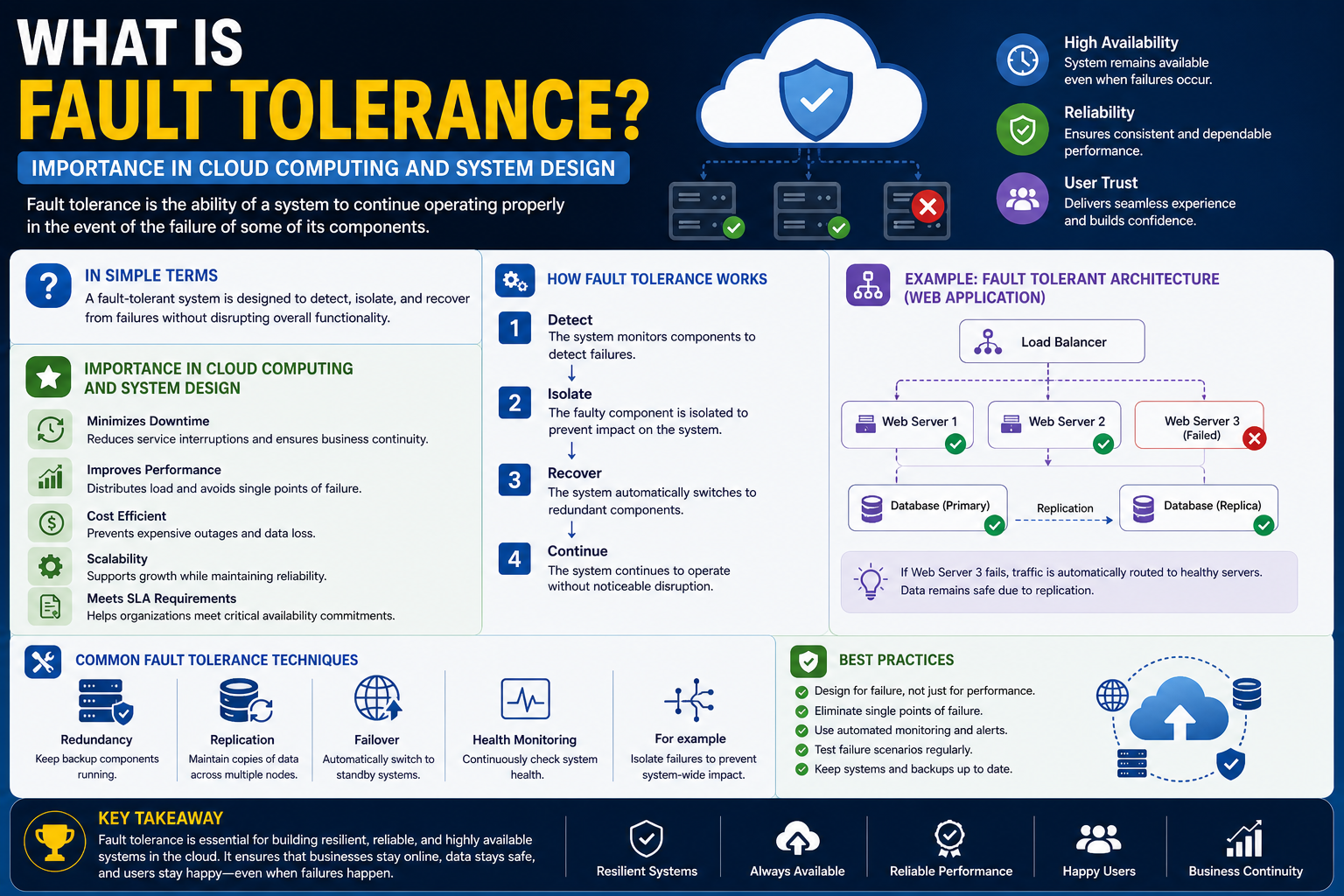
Fault tolerance is one of the most important design principles in modern computing and network architecture, especially in environments where continuous availability is critical. At its core, fault tolerance refers to the ability of a system to keep functioning correctly even when one or more of its components fail. These failures can occur in hardware, software, or even within the communication links that connect different parts of a system. Instead of shutting down or becoming unavailable, a fault-tolerant system is designed to absorb the failure and continue operating, often without users even noticing that something has gone wrong.
In practical terms, fault tolerance is what allows large-scale digital services to remain accessible even when unexpected issues arise behind the scenes. Whether it is an online banking platform processing transactions, a hospital system managing patient records, or a global communication network handling millions of messages per second, fault tolerance ensures that a single point of failure does not bring everything to a halt. This resilience is not accidental; it is the result of deliberate architectural decisions made during system design.
The idea of fault tolerance is closely tied to the reality that no system is perfect. Hardware components wear out over time, software may contain bugs that only appear under specific conditions, and external factors such as power fluctuations or network congestion can introduce instability. Because of this, system designers assume that failures will happen rather than hoping they will not. The goal is not to eliminate failures, which is impossible, but to ensure that failures do not lead to a complete system breakdown.
A key characteristic of fault-tolerant systems is that they are built with redundancy at multiple levels. This means that critical components are duplicated or mirrored so that if one fails, another can immediately take over. This can apply to servers, storage devices, network paths, and even entire data centers. The system continuously monitors itself to detect signs of failure or degraded performance and responds automatically to maintain stability.
Fault tolerance also relies heavily on intelligent coordination between system components. It is not enough to simply have backups; those backups must be ready to activate instantly and seamlessly. This requires synchronization, constant data updates, and mechanisms that ensure continuity of operations. The smoother the transition between a failing component and its backup, the more effective the fault tolerance becomes.
Another important aspect of fault tolerance is its relationship with risk and cost. Implementing highly fault-tolerant systems often requires additional infrastructure, complexity, and investment. Organizations must evaluate how critical their systems are and what level of downtime is acceptable. For some services, even a few seconds of interruption can lead to significant financial loss or safety risks, making fault tolerance essential rather than optional.
Why Systems Fail: The Reality Behind Faults
To understand fault tolerance properly, it is important to first understand why systems fail in the first place. Failures are not rare exceptions in computing environments; they are expected events that occur regularly across different layers of infrastructure. These failures can be categorized into several types, each with its own causes and implications.
Hardware failure is one of the most common sources of system faults. Physical components such as hard drives, memory modules, power supplies, and processors degrade over time due to heat, electrical stress, and general wear and tear. Even with high-quality manufacturing, no hardware component lasts indefinitely. When a critical piece of hardware fails, it can interrupt services unless there is a backup component ready to take over.
Software failures are another major cause of system disruption. Unlike hardware, software does not physically degrade, but it can still fail due to logic errors, unexpected input conditions, memory leaks, or conflicts between different applications. Some software bugs only appear under rare or extreme conditions, making them difficult to predict during development and testing. When such conditions occur in production environments, they can lead to crashes, performance degradation, or incorrect outputs.
Network-related failures also play a significant role in system instability. Communication between systems depends on a complex infrastructure of routers, switches, cables, and wireless links. Any disruption in this chain can affect the flow of data. Congestion, signal loss, misconfigurations, or physical damage to network components can all result in communication breakdowns between systems that otherwise function correctly on their own.
Environmental factors can also contribute to system failures. Power outages, temperature fluctuations, flooding, fire, and other external events can damage infrastructure or disrupt operations. Data centers and critical facilities often invest heavily in environmental controls, but these risks can never be eliminated.
Human error is another important factor that cannot be ignored. Misconfigurations, incorrect updates, accidental deletions, or improper maintenance procedures can introduce faults into otherwise stable systems. Even experienced professionals can make mistakes, especially in complex environments with many interconnected components.
The important takeaway is that failure is not an anomaly but a normal part of system operation. This reality is what makes fault tolerance such a necessary design approach. Instead of trying to prevent every possible failure, systems are built with the assumption that failures will occur and that the system must be prepared to handle them gracefully.
Core Principles That Enable Fault Tolerance
Fault tolerance is not a single technology or feature; it is a combination of multiple design principles working together to ensure system continuity. These principles form the foundation of resilient system architecture and are applied at different layers depending on the complexity and requirements of the environment.
One of the most important principles is redundancy. Redundancy involves duplicating critical components so that if one fails, another can immediately take over. This can be implemented at various levels, including hardware redundancy such as duplicate power supplies or storage drives, and system-level redundancy such as multiple servers performing the same function. The purpose of redundancy is to eliminate single points of failure, which are vulnerabilities that can bring down an entire system if they stop working.
Another key principle is replication. Replication focuses specifically on data and ensures that information is stored in multiple locations simultaneously. This means that if one storage system becomes unavailable, the same data can still be accessed from another location. Replication is essential for maintaining consistency and availability, especially in systems that handle critical or frequently updated data. Depending on the design, replication can be synchronous, where data is updated in real time across all copies, or asynchronous, where updates are slightly delayed but still consistent over time.
Load distribution is another important concept. In systems that handle large volumes of traffic or requests, distributing workload evenly across multiple resources helps prevent overload. When one component becomes too busy, traffic can be redirected to others, ensuring that no single system becomes a bottleneck. This not only improves performance but also reduces the risk of failure caused by excessive load.
Monitoring and detection mechanisms are also central to fault tolerance. A system cannot respond to a failure if it does not detect that a failure has occurred. Continuous monitoring allows systems to track performance, detect anomalies, and identify early signs of malfunction. This enables proactive responses before small issues escalate into major failures. Monitoring systems often check metrics such as response time, error rates, resource usage, and connectivity status.
Failover mechanisms provide the actual switching process when a failure is detected. Failover ensures that backup components take over automatically without requiring manual intervention. The speed and smoothness of failover are critical, as delays can result in noticeable service interruptions. In well-designed systems, failover is designed to be seamless, allowing users to continue their activities without disruption.
Another supporting principle is consistency management. When multiple copies of data or services exist, the system must ensure that all versions remain synchronized. Without consistency, users may experience conflicting or outdated information. Maintaining consistency across distributed components is one of the more complex challenges in fault-tolerant design, especially in large-scale environments.
How Fault Tolerance Differs from High Availability
Fault tolerance is often discussed alongside high availability, and while the two concepts are closely related, they are not identical. Both aim to ensure that systems remain accessible and functional, but they differ in their approach to handling failures and downtime.
Fault tolerance is designed to eliminate downtime, even when failures occur. In a fault-tolerant system, components are built in such a way that failure is effectively invisible to the user. The system continues operating without interruption because backup components instantly take over when needed. The focus is on seamless continuity, where the transition between active and backup components happens so quickly that users do not experience any disruption.
High availability, on the other hand, focuses on minimizing downtime rather than eliminating it. High-availability systems are designed to recover quickly from failures, but there may still be brief interruptions during the recovery process. These systems typically aim for a very high percentage of uptime over a given period, ensuring that services are accessible almost all the time, even if occasional short outages occur.
The difference between the two approaches often comes down to cost, complexity, and business requirements. Fault-tolerant systems require more redundancy, tighter synchronization, and more sophisticated infrastructure. This makes them more expensive and complex to implement. As a result, they are typically used in environments where even minimal downtime is unacceptable.
High-availability systems strike a balance between reliability and cost. They are widely used in most commercial environments where short interruptions are tolerable, but extended downtime is not. These systems still rely on redundancy and failover mechanisms, but they may not achieve the same level of instantaneous switching as fault-tolerant systems.
Despite these differences, both concepts share common techniques such as replication, load balancing, and monitoring. In many real-world systems, fault tolerance and high availability are combined to create layered resilience, where critical components are fully fault-tolerant while other parts of the system are designed for high availability.
Real-World Scenarios Where Fault Tolerance Matters
Fault tolerance plays a critical role in many real-world systems where continuous operation is essential. One of the most prominent examples is financial infrastructure. Banking systems, stock trading platforms, and payment processing networks require extremely high levels of reliability. Even a brief interruption in these systems can lead to financial loss, transaction failures, and loss of customer trust. Fault tolerance ensures that transactions continue to be processed even if individual servers or components fail.
Healthcare systems also rely heavily on fault tolerance. Hospitals and medical facilities depend on digital systems for patient records, diagnostic tools, monitoring equipment, and emergency response coordination. In such environments, system downtime can have direct consequences on patient safety. Fault-tolerant systems help ensure that critical medical data and services remain accessible at all times, even during hardware or software failures.
Transportation and aviation systems are another area where fault tolerance is essential. Air traffic control systems, navigation systems, and railway management platforms must operate continuously and reliably. Any disruption in these systems can have serious safety implications. Fault-tolerant design ensures that backup systems are always ready to take over control if primary systems encounter issues.
Large-scale online services also depend heavily on fault tolerance. Social media platforms, streaming services, and cloud-based applications serve millions of users simultaneously. These systems are distributed across multiple data centers and regions to ensure that even if one location experiences failure, others can continue serving users without interruption.
Industrial control systems in manufacturing and energy production also rely on fault-tolerant architectures. Automated production lines, power grids, and utility management systems must operate continuously to avoid disruptions in production or service delivery. Fault tolerance ensures that these systems can handle component failures without halting operations.
In each of these scenarios, the cost of failure is high, whether measured in financial loss, safety risk, or service disruption. Fault tolerance provides a structured way to manage these risks by building systems that assume failure is inevitable and prepare for it in advance.
Architectural Foundations of Fault-Tolerant Systems
Building fault tolerance into a system is not something that can be added at the end like an extra feature. It is an architectural decision that influences how every part of the system is designed, connected, and managed. In modern computing environments, especially those built on distributed systems and cloud infrastructure, fault tolerance is embedded into the very structure of how services operate.
At the architectural level, fault tolerance begins with the idea that no single component should be critical enough to bring down the entire system. This principle shapes how servers are deployed, how data is stored, and how requests are processed. Instead of relying on one powerful machine or one centralized system, modern architectures distribute responsibility across multiple independent components.
Distributed architecture is one of the most important foundations of fault-tolerant design. In a distributed system, multiple machines work together to perform tasks that would traditionally be handled by a single system. These machines may be located in the same physical data center or spread across different geographic regions. The key advantage of this structure is that the failure of one machine does not affect the others.
This distribution introduces complexity, but it also significantly increases resilience. When systems are spread across multiple nodes, each node can take over part of the workload if another node becomes unavailable. This allows the system to continue operating even in the presence of partial failures, which are common in large-scale environments.
Another important architectural principle is decentralization. In decentralized systems, control is not concentrated in a single central point. Instead, decision-making and processing are distributed across multiple components. This reduces the risk of catastrophic failure caused by a single point of control. If one part of the system becomes unreachable, other parts can continue functioning independently.
Fault-tolerant architecture also relies heavily on stateless design principles wherever possible. A stateless system does not rely on previous interactions or stored session data to function correctly. Each request is treated independently, which allows any available server to handle it. This makes it easier to redirect traffic when failures occur, since any node can replace another without requiring complex data synchronization.
However, not all systems can be fully stateless. Many applications require persistent data and session continuity. In such cases, stateful components are carefully managed through replication and synchronization techniques to ensure that state information is not lost during failures.
Redundancy at Multiple System Layers
Redundancy is one of the most widely used and essential techniques in fault-tolerant systems. It refers to the deliberate duplication of critical components so that if one fails, another can take over without interruption. However, redundancy is not limited to a single layer of a system. Instead, it is implemented across multiple layers, each addressing different types of potential failures.
At the hardware layer, redundancy is used to protect against physical failures. This includes duplicate power supplies, mirrored storage drives, multiple network interface cards, and backup cooling systems. These components ensure that if one piece of hardware fails, another can immediately take over its function. For example, mirrored storage drives allow data to remain accessible even if one drive becomes damaged.
At the server level, redundancy is achieved by deploying multiple servers that perform the same role. Instead of relying on a single server to handle all requests, workloads are distributed across several machines. If one server becomes unavailable, others continue handling traffic. This type of redundancy is especially important in web services and application hosting environments.
Network redundancy is another critical layer. Communication between systems depends on reliable network paths, but these paths can fail due to congestion, hardware issues, or external disruptions. To address this, multiple network routes are established between systems. If one route becomes unavailable, traffic is automatically redirected through another path. This ensures that communication remains uninterrupted even when parts of the network are compromised.
Data redundancy ensures that information is not stored in a single location. Instead, multiple copies of data are maintained across different storage systems. This protects against data loss in case of disk failure or corruption. Depending on the system design, these copies may be synchronized in real time or updated periodically.
Geographical redundancy extends this concept even further by distributing systems across different physical locations. Entire data centers may be replicated in different cities or countries. This protects against large-scale disasters such as earthquakes, power grid failures, or regional outages. If one data center becomes unavailable, another can immediately take over its responsibilities.
Advanced Load Distribution Mechanisms
Load distribution plays a crucial role in maintaining system stability and performance in fault-tolerant environments. When systems experience high levels of traffic or processing demand, distributing the workload evenly across available resources prevents overload and ensures consistent performance.
One of the primary mechanisms used for load distribution is intelligent request routing. In this approach, incoming requests are analyzed and directed to the most appropriate server based on current load, availability, and performance metrics. This ensures that no single server becomes overwhelmed while others remain underutilized.
Load distribution systems continuously monitor the health and performance of all available resources. If a server begins to show signs of stress, such as increased response times or high CPU usage, the system automatically reduces the amount of traffic directed to it. Conversely, healthier servers receive more traffic to balance the overall load.
Another important aspect of load distribution is session handling. In some systems, users maintain ongoing sessions that must be preserved across multiple requests. Load balancers must ensure that these sessions are either consistently routed to the same server or shared across multiple servers through synchronized session storage. This prevents disruptions in user experience during load-balancing operations.
Adaptive load balancing techniques take this concept further by dynamically adjusting routing decisions based on real-time conditions. These systems can detect sudden spikes in traffic and redistribute workloads within milliseconds. This responsiveness is essential in environments where traffic patterns are unpredictable.
Load distribution also works closely with redundancy systems. When a server fails, the load balancer automatically removes it from the pool of active resources and redirects traffic to healthy servers. This integration ensures that system performance remains stable even during component failures.
Synchronization and Data Consistency Strategies
Maintaining data consistency is one of the most complex challenges in fault-tolerant system design. When data is replicated across multiple systems, it is essential to ensure that all copies remain synchronized and reflect the most recent updates. Without proper consistency mechanisms, systems can end up with conflicting or outdated information.
There are different models of consistency used in fault-tolerant systems, each with its own trade-offs. Strong consistency ensures that all users see the same data at the same time, regardless of which system they access. This requires immediate synchronization between all replicas, which can introduce latency but provides a high level of accuracy.
Eventual consistency, on the other hand, allows temporary differences between replicas. Updates are propagated gradually, and all copies eventually converge to the same state. This approach improves performance and scalability but may temporarily expose users to outdated information.
Some systems use a hybrid approach that balances consistency and performance based on application requirements. Critical operations may use strong consistency, while less sensitive operations rely on eventual consistency.
Conflict resolution is another important aspect of synchronization. When multiple updates occur simultaneously on different replicas, the system must determine how to reconcile these changes. This can be done using timestamps, version tracking, or predefined conflict resolution rules.
Replication strategies also influence consistency. Synchronous replication ensures that all copies are updated simultaneously, while asynchronous replication allows updates to be propagated with a delay. Each method has advantages depending on system requirements and performance constraints.
Failover Strategies and Recovery Mechanisms
Failover is a critical mechanism in fault-tolerant systems that ensures continuity of operations when a primary component fails. The effectiveness of a failover system depends on how quickly and smoothly the transition to backup components occurs.
In active-passive failover configurations, one system operates as the primary while another remains on standby. The standby system continuously monitors the primary and remains synchronized with its state. When a failure is detected, the standby system immediately becomes active and takes over operations.
In active-active configurations, multiple systems operate simultaneously and share the workload. If one system fails, the remaining systems automatically absorb the additional load. This approach improves both performance and resilience but requires more complex coordination.
Automatic failover systems rely on continuous monitoring to detect failures. These systems track various indicators such as response time, error rates, and system health metrics. When predefined thresholds are exceeded, failover is triggered automatically without human intervention.
Recovery mechanisms are closely linked to failover systems. Once a failed component is restored, it must be reintegrated into the system without disrupting ongoing operations. This process may involve state synchronization, data updates, and performance validation.
Checkpointing is a technique used to support recovery. It involves periodically saving the state of a system so that it can be restored in case of failure. This reduces the amount of work lost during unexpected disruptions.
Rollback mechanisms allow systems to revert to a previous stable state if a failure occurs during an operation. This ensures that partial or corrupted changes do not affect system integrity.
Fault Detection and Continuous Monitoring
Continuous monitoring is essential for maintaining fault tolerance. Without real-time visibility into system behavior, it is impossible to detect failures early enough to respond effectively. Monitoring systems track a wide range of metrics that provide insight into system health and performance.
Performance metrics such as CPU usage, memory consumption, disk activity, and network throughput help identify resource bottlenecks. Sudden spikes or unusual patterns in these metrics can indicate underlying problems.
Error tracking is another important aspect of monitoring. Systems record error rates, failed requests, and exception logs to identify malfunctioning components. A sudden increase in errors often signals that a system is approaching failure.
Latency monitoring measures the time it takes for systems to respond to requests. Increasing latency can indicate performance degradation, even before complete failure occurs.
Health checks are automated processes that regularly verify whether system components are functioning correctly. These checks may involve simple connectivity tests or more complex functional validations.
Alerting systems are built on top of monitoring infrastructure. When predefined thresholds are exceeded, alerts are generated to notify system administrators or trigger automated responses. This allows for rapid intervention before failures escalate.
Predictive monitoring takes this a step further by using historical data and patterns to anticipate potential failures before they occur. This enables proactive maintenance and reduces the likelihood of unexpected downtime.
Fault Tolerance in Distributed and Cloud Environments
Distributed systems and cloud environments have fundamentally changed how fault tolerance is implemented. Instead of relying on isolated systems, modern architectures span multiple physical and virtual environments that work together as a unified platform.
In cloud environments, resources are dynamically allocated and managed across large pools of infrastructure. This allows systems to scale automatically in response to demand while maintaining redundancy and resilience. If one physical machine fails, virtual instances can be moved or recreated on other machines without affecting service availability.
Cloud providers typically design their infrastructure with multiple layers of redundancy, including availability zones and regions. Availability zones represent isolated locations within a region, while regions are geographically separate clusters of infrastructure. This structure ensures that failures in one area do not affect others.
Distributed systems also rely heavily on consensus mechanisms to maintain consistency and coordination. These mechanisms ensure that all nodes in the system agree on the current state, even in the presence of failures or communication delays.
Partition tolerance is another important concept in distributed fault-tolerant systems. It refers to the ability of a system to continue operating even when network partitions prevent some components from communicating with others. This is a critical requirement in large-scale distributed environments where network failures are inevitable.
The combination of distribution, redundancy, and intelligent coordination makes cloud-based systems some of the most resilient computing environments in existence today.
Trade-Offs and Design Decisions in Fault-Tolerant Systems
Fault tolerance is not a free feature that can be added without consequences. Every decision made to increase resilience introduces trade-offs that affect performance, cost, complexity, and scalability. Designing a fault-tolerant system requires balancing these competing factors carefully, because optimizing for one aspect often weakens another.
One of the most important trade-offs is between performance and redundancy. Adding redundant components improves reliability, but it also increases overhead. More servers, more storage copies, and more synchronization processes mean that the system must work harder to maintain consistency. This can sometimes lead to increased latency or reduced throughput, especially in systems that require real-time synchronization across multiple nodes.
Another major trade-off involves consistency versus availability. In distributed systems, it is often impossible to guarantee both at the same time under network failure conditions. Systems that prioritize strict consistency ensure that all users see the same data at all times, but they may become temporarily unavailable during network partitions. On the other hand, systems that prioritize availability continue operating even when some nodes cannot communicate, but they may temporarily serve outdated or inconsistent data.
These trade-offs become especially important in large-scale environments where systems span multiple regions and handle millions of requests per second. Engineers must decide which property is more critical for each part of the system, and these decisions shape the overall architecture.
Cost is another significant factor. Fault-tolerant systems require additional infrastructure such as duplicate servers, backup networks, and replicated storage systems. Maintaining this infrastructure increases operational expenses. Organizations must evaluate whether the cost of downtime is higher than the cost of preventing it. In mission-critical systems, the investment in fault tolerance is justified, but in less critical systems, simpler designs may be preferred.
Complexity also increases with fault tolerance. More components mean more interactions, and more interactions mean more potential points of failure. Managing this complexity requires careful design, automation, and monitoring. Without proper management, a highly redundant system can become difficult to maintain and debug.
Recovery Objectives and System Resilience Planning
Fault tolerance is closely tied to recovery planning, which defines how quickly a system must recover after a failure and how much data loss is acceptable. These goals are often expressed using two key metrics: recovery time objective (RTO) and recovery point objective (RPO).
Recovery time objective refers to the maximum acceptable time that a system can be down after a failure. A low RTO means that systems must recover almost instantly, while a higher RTO allows for longer downtime. Fault-tolerant systems typically aim for extremely low RTO values, sometimes approaching zero.
The recovery point objective defines how much data loss is acceptable in the event of a failure. It is measured in terms of time, representing how far back the system can revert without causing unacceptable consequences. A low RPO means that systems must replicate data continuously or in real time, ensuring minimal or no data loss.
These two metrics guide the design of backup systems, replication strategies, and failover mechanisms. For example, a system with strict RTO and RPO requirements may require synchronous replication and active-active failover configurations. In contrast, systems with more relaxed requirements may use asynchronous replication and simpler recovery processes.
Resilience planning also involves identifying critical components and prioritizing them based on their importance to system operation. Not all components require the same level of redundancy. Core services that handle transactions or essential data processing typically receive higher levels of protection than secondary services such as reporting or analytics.
Disaster Recovery and Large-Scale Failure Handling
While fault tolerance focuses on handling individual component failures, disaster recovery deals with large-scale system disruptions. These disruptions may include natural disasters, power grid failures, cyberattacks, or complete data center outages. In such scenarios, entire regions or infrastructures may become unavailable, requiring systems to switch to alternative locations.
Disaster recovery strategies rely on geographically distributed infrastructure. By replicating systems across multiple physical locations, organizations can ensure that a failure in one region does not affect the availability of services in another. These backup locations are often designed to be fully operational and capable of taking over workloads immediately when needed.
There are different levels of disaster recovery readiness. Some systems maintain hot standby environments, where fully synchronized systems are always running and ready to take over instantly. Others use warm standby setups, where systems are partially active and can be quickly brought online. Cold standby systems require more time to activate because the infrastructure must be started and configured during recovery.
The choice of disaster recovery strategy depends on business requirements, cost constraints, and acceptable downtime. High-criticality systems often require hot standby configurations, while less critical systems may rely on slower recovery processes.
Data backup strategies are also an essential part of disaster recovery. Regular backups ensure that data can be restored even if replication systems fail. These backups are often stored in multiple locations and verified regularly to ensure integrity.
Testing disaster recovery plans is crucial because theoretical designs do not always behave as expected in real-world conditions. Organizations often simulate failure scenarios to validate whether systems can recover within required timeframes and without data loss.
Fault Tolerance in Modern Application Architectures
Modern applications are increasingly built using modular and distributed architectures such as microservices. In this model, applications are divided into small, independent services that communicate over networks. Each service is responsible for a specific function, and they work together to form a complete system.
Fault tolerance in microservices architectures is achieved by isolating failures within individual services. If one service fails, it does not necessarily bring down the entire application. Other services can continue functioning independently, and fallback mechanisms can be used to maintain partial functionality.
Service isolation is a key principle in this architecture. Each service operates in its own environment with its own resources, reducing the risk of cascading failures. Communication between services is designed to be resilient, often using retry mechanisms, timeouts, and fallback responses to handle temporary disruptions.
Another important concept is graceful degradation. Instead of failing when a component becomes unavailable, systems are designed to reduce functionality in a controlled manner. For example, an application might disable non-essential features while maintaining core functionality during a partial outage.
Containerization technologies also support fault tolerance by isolating application components into lightweight, portable environments. Containers can be quickly restarted, replaced, or moved between hosts if failures occur. This flexibility improves recovery speed and reduces downtime.
Orchestration systems further enhance fault tolerance by automatically managing the deployment, scaling, and recovery of containerized applications. These systems continuously monitor container health and replace failed instances without manual intervention.
Observability and System Intelligence
Observability is a critical aspect of fault-tolerant systems that focuses on understanding system behavior through external outputs such as logs, metrics, and traces. Unlike simple monitoring, which only detects predefined conditions, observability allows engineers to investigate unknown issues and understand system behavior in depth.
Logs provide detailed records of system events, including errors, transactions, and state changes. These logs help identify the root cause of failures and track the sequence of events leading up to a problem.
Metrics provide quantitative measurements of system performance, such as response time, throughput, and resource utilization. These metrics help identify trends and detect early signs of degradation.
Tracing follows the path of requests as they move through different components of a system. This is especially useful in distributed environments where a single request may pass through multiple services before completing. Tracing helps identify bottlenecks and failure points in complex workflows.
Together, these three pillars of observability enable systems to become self-aware in a sense. They provide the data needed to detect, diagnose, and respond to failures more effectively.
Modern systems often use automated analysis tools that process observability data in real time. These tools can detect anomalies, predict failures, and even trigger automated recovery actions. This level of intelligence significantly improves fault tolerance by reducing response times and minimizing human intervention.
Chaos Engineering and Failure Simulation
Chaos engineering is a modern approach to improving fault tolerance by deliberately introducing failures into a system to observe how it behaves. The idea is based on the assumption that systems should be tested under failure conditions before those failures occur in production environments.
In chaos engineering experiments, components such as servers, network connections, or services are intentionally disrupted. Engineers then observe how the system responds and whether it continues to function as expected. These experiments help identify weaknesses that may not be apparent during normal operation.
One of the key benefits of chaos engineering is that it exposes hidden dependencies within systems. In complex architectures, components may rely on each other in ways that are not immediately obvious. By simulating failures, engineers can discover these dependencies and redesign systems to be more resilient.
Chaos experiments also help validate failover mechanisms. It is not enough to design a failover system; it must be tested under real conditions to ensure that it works correctly when needed.
Over time, chaos engineering builds confidence in system resilience. It ensures that systems are not only theoretically fault-tolerant but also practically capable of handling real-world failures.
Fault Tolerance in Emerging Technologies
As technology continues to evolve, fault tolerance is becoming increasingly important in new computing paradigms such as edge computing, Internet of Things (IoT), and artificial intelligence systems.
In edge computing environments, processing is distributed closer to the source of data rather than centralized in large data centers. This introduces new challenges for fault tolerance because edge devices may have limited resources, unstable connectivity, and varying levels of reliability. Fault-tolerant design in these environments focuses on local processing, intermittent synchronization, and adaptive workload distribution.
IoT systems consist of large numbers of connected devices that collect and transmit data. These devices may operate in unpredictable conditions, making failures common. Fault tolerance in IoT systems relies on distributed coordination, local autonomy, and robust communication protocols that can handle intermittent connectivity.
Artificial intelligence systems also depend on fault tolerance, especially when deployed in critical applications such as autonomous vehicles, healthcare diagnostics, and financial modeling. These systems must remain reliable even when individual components or data inputs are unreliable.
Machine learning models themselves can also be part of fault-tolerant architectures. Redundant models may be deployed to ensure that predictions remain accurate even if one model fails or produces inconsistent results.
Security Considerations in Fault-Tolerant Design
Security and fault tolerance are closely related, but they are not the same. However, they influence each other significantly. A system that is resilient to failures must also be resilient to attacks and malicious behavior.
One important aspect is ensuring that redundancy does not introduce security vulnerabilities. Multiple copies of data and systems increase the number of potential attack surfaces. Each redundant component must be secured properly to prevent unauthorized access.
Authentication and authorization mechanisms must remain consistent across all redundant systems. If security policies differ between components, attackers may exploit inconsistencies during failover events.
Fault-tolerant systems must also handle security failures gracefully. For example, if a security service becomes unavailable, the system must decide whether to continue operating in a restricted mode or halt operations entirely.
Encryption plays an important role in protecting data during replication and transmission. Even if data is copied across multiple systems, it must remain secure and inaccessible to unauthorized users.
Intrusion detection systems are often integrated into fault-tolerant architectures to identify and respond to security threats in real time. These systems can trigger failover processes or isolate compromised components to prevent further damage.
Conclusion
Fault tolerance is a fundamental concept in modern computing that ensures systems remain operational even when unexpected failures occur. In real-world environments, no system is completely immune to breakdowns. Hardware deteriorates, software encounters unforeseen errors, networks experience disruptions, and human mistakes can introduce instability. Because of this, fault tolerance is not an optional enhancement but a necessary design principle for systems that require reliability and continuity.
Throughout modern system architecture, fault tolerance is achieved through a combination of strategies such as redundancy, replication, failover mechanisms, load distribution, and continuous monitoring. These techniques work together to eliminate single points of failure and ensure that alternative resources are always available when something goes wrong. Whether it is a duplicated server, a mirrored database, or an alternate network path, each layer of redundancy contributes to system resilience.
Fault tolerance also plays a crucial role in balancing performance, cost, and complexity. While highly resilient systems may require more infrastructure and careful coordination, they provide significant benefits in environments where downtime is unacceptable. Industries such as finance, healthcare, transportation, and large-scale digital services rely heavily on these principles to maintain uninterrupted operations and protect critical processes.
Ultimately, fault tolerance reflects a shift in mindset from preventing failures entirely to designing systems that expect and withstand them. Instead of treating failure as an anomaly, modern computing embraces it as a normal condition that must be managed intelligently. This approach ensures that even in the presence of faults, systems can continue delivering services reliably, securely, and efficiently.