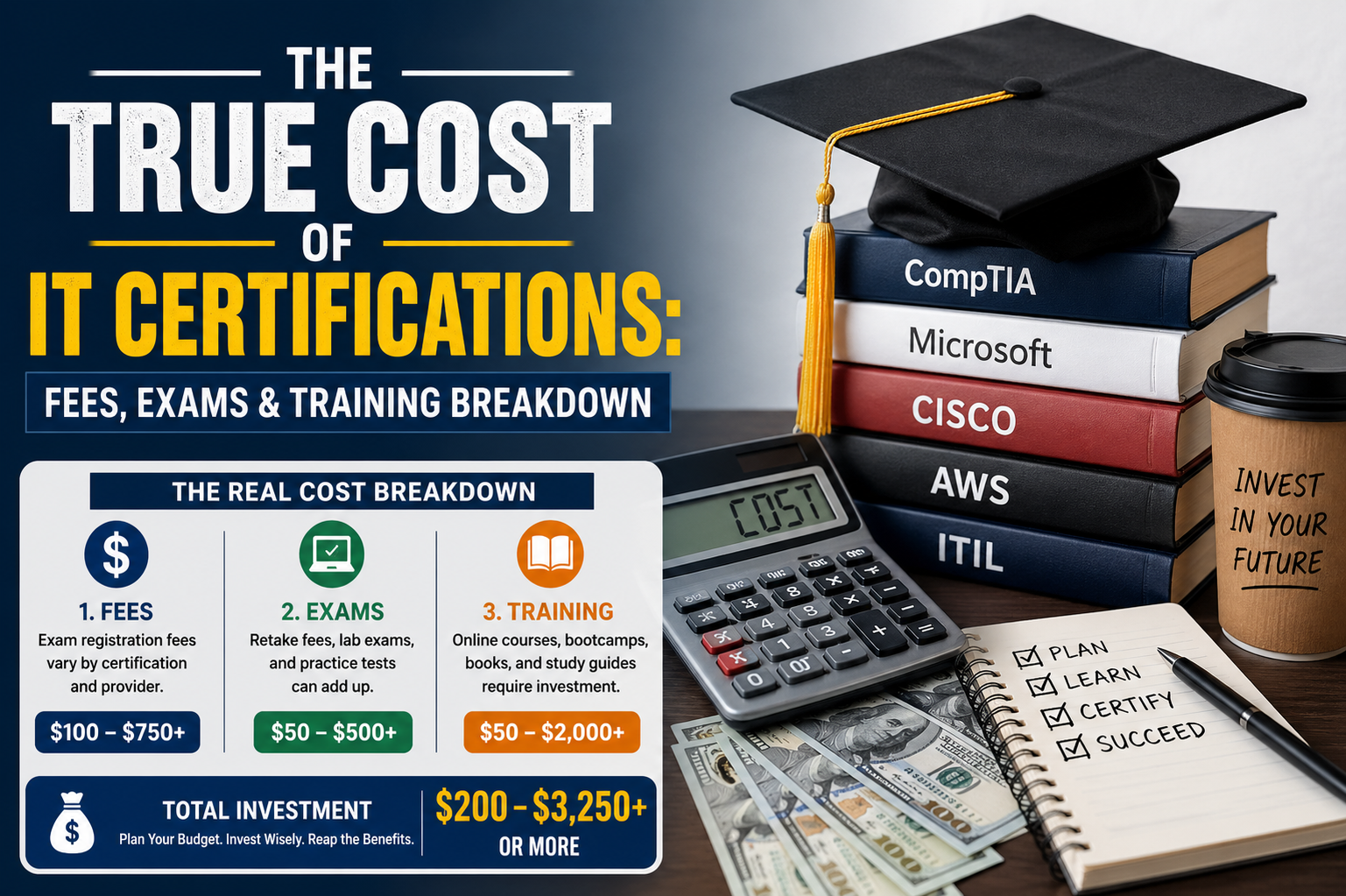
IT certifications come with a wide range of costs, and there is no single price that fits every certification path. Some certifications are relatively affordable and designed for beginners, while others require a significant financial investment and are aimed at experienced professionals. For example, entry-level cloud certifications can cost as little as $100, while advanced certifications like expert-level networking credentials can exceed $2,000 for exam fees alone. This variation reflects differences in complexity, skill level, and industry demand.
The cost of certification is not limited to just the exam fee. Many candidates also spend money on preparation resources such as books, online courses, practice exams, and instructor-led training. Although exam fees are the most visible cost, preparation expenses can sometimes equal or even exceed the price of the exam itself. However, when focusing purely on exam pricing, there are still clear patterns across vendors and certification levels.
One of the most consistent trends is that entry-level certifications are generally more affordable than advanced ones. This makes sense because they are designed to attract newcomers to the field and lower the barrier to entry. On the other hand, expert-level certifications require extensive knowledge and hands-on experience, which is reflected in their higher cost. These exams often include practical components, labs, or multi-stage assessments, all of which contribute to the increased price.
Another important factor to consider is the structure of certification programs. Some certifications require only one exam, while others require multiple exams or a combination of written and practical tests. This can significantly affect the total cost. For example, a certification that requires two exams priced at $300 each will ultimately cost $600, even though each individual exam may seem reasonably priced.
Understanding these cost structures is essential for planning your certification journey. By knowing what to expect financially, you can better prepare and choose certifications that align with your career goals and budget.
Cost Structure Across Certification Levels
Certification programs are typically divided into levels such as entry, associate, professional, and expert. Each level is designed to validate a specific depth of knowledge and skill set, and the pricing generally increases as you move up the ladder. Entry-level certifications focus on foundational knowledge and are usually the least expensive. Associate-level certifications build on that foundation and are moderately priced, while professional and expert certifications demand a higher level of expertise and come with higher fees.
At the entry level, certifications are often priced to encourage participation. These exams are accessible to students, beginners, and individuals transitioning into IT careers. Because they cover basic concepts, they are less complex and therefore less expensive to administer. This makes them an attractive starting point for anyone looking to enter the technology field.
Associate-level certifications are the next step and typically cost more than entry-level exams. These certifications validate practical skills and are often required for mid-level roles in IT. The pricing reflects the increased complexity of the exam and the higher expectations placed on candidates. Despite the higher cost, associate-level certifications are considered a worthwhile investment because they significantly improve employability.
Professional-level certifications are designed for individuals with several years of experience. These exams are more challenging and often require a deeper understanding of specific technologies or roles. As a result, the cost is higher, and candidates may need to pass multiple exams to earn the certification. This adds to the overall expense but also increases the value of the credential.
Expert-level certifications represent the highest tier and are the most expensive. These certifications often include both written and practical components, such as lab exams that test real-world skills. The cost of these exams reflects the resources required to administer them, including specialized equipment and testing environments. Additionally, candidates may need to travel to specific testing centers, further increasing the overall cost.
Cisco Certification Costs Explained
When it comes to networking certifications, Cisco offers one of the most structured and widely recognized certification programs in the IT industry. Cisco certifications are divided into five main levels: Entry, Associate, Professional, Expert, and Architect. Each level has a standardized pricing structure, although there are some variations depending on the specific exam.
At the entry level, Cisco certifications are relatively affordable. These exams typically cost around $125 and are designed to validate basic networking knowledge. They serve as a stepping stone for more advanced certifications and are ideal for individuals who are new to networking or IT in general.
The associate level includes certifications like the CCNA, which is one of the most popular networking certifications בעולם. The cost of the CCNA exam is $300, and it requires passing a single exam. This is a significant improvement over the previous structure, which required multiple exams and was more expensive overall. The simplified approach makes it easier for candidates to understand the certification path and manage costs.
In addition to the CCNA, Cisco also offers associate-level certifications in areas like software development and cybersecurity. These certifications are priced similarly, making the associate level consistent and predictable in terms of cost. This standardization helps candidates plan their certification journey more effectively.
Professional-level Cisco certifications require passing two exams: a core exam and a concentration exam. The core exam typically costs $400, while the concentration exam costs $300, bringing the total to $700. This structure allows candidates to specialize in specific areas while maintaining a strong foundation in core concepts. Although the cost is higher than associate-level certifications, the value of these credentials in the job market often justifies the investment.
At the expert level, Cisco certifications become significantly more expensive. These certifications require both a written exam and a hands-on lab exam. The written exam costs around $400, while the lab exam can cost between $1,600 and $1,900. This brings the total cost to approximately $2,000 to $2,300, depending on the exam format.
The lab exam is particularly challenging and requires candidates to demonstrate real-world skills in a controlled environment. Because of its complexity, many candidates need multiple attempts to pass, which can further increase the cost. Additionally, travel expenses may be required if the lab exam is not available locally.
At the highest level, the Cisco Certified Architect certification is the most expensive. This certification involves a board review process and can cost up to $15,000. It is designed for senior professionals who have extensive experience in designing complex network solutions. The high cost reflects the level of expertise required and the prestige associated with the certification.
Microsoft Certification Pricing Overview
Another major player in the IT certification space is Microsoft, which offers a wide range of role-based certifications. These certifications are designed to align with specific job roles, such as cloud administrator, data analyst, or security engineer.
Microsoft certifications are generally more affordable compared to some other vendors. Most associate and expert-level exams cost around $165 in the United States, although prices may vary in other countries. This makes Microsoft certifications accessible to a broader audience, including students and early-career professionals.
One of the key features of Microsoft’s certification program is its role-based structure. Instead of focusing solely on technology, these certifications are designed to validate the skills required for specific job roles. This approach makes them highly relevant to employers and increases their value in the job market.
Some Microsoft certifications require multiple exams, which can increase the total cost. For example, certain certifications may require two exams, bringing the total cost to $330. Despite this, the overall pricing remains competitive, especially when compared to other certification providers.
Microsoft also offers fundamental-level certifications, which are priced at $99. These certifications are ideal for beginners and provide a solid foundation for more advanced certifications. They are particularly useful for individuals who are new to IT or exploring different career paths within the industry.
Expert-level Microsoft certifications are priced similarly to associate-level exams, typically around $165. This is relatively affordable compared to other vendors, especially considering the advanced nature of these certifications. However, candidates may need to meet certain prerequisites, which can add to the overall cost.
Overall, Microsoft’s certification pricing is designed to be accessible and flexible, making it a popular choice for individuals at مختلف stages of their IT careers.
Amazon Web Services Certification Costs and Structure
Amazon Web Services certifications are among the most recognized credentials in cloud computing, and their pricing structure is relatively straightforward compared to some other vendors. AWS organizes its certifications into four main levels: Practitioner, Associate, Professional, and Specialty. Each level targets a different stage of expertise, and the cost increases as the certifications become more advanced.
At the foundational level, AWS offers practitioner certifications that cost $100 per exam. These certifications are designed for individuals who may not have a deep technical background but still need to understand cloud concepts. They are especially useful for business professionals, project managers, or beginners who want to build a basic understanding of cloud computing. Because of their lower cost and accessible content, these exams are often the first step for many candidates entering the cloud domain.
Moving up to the associate level, AWS certifications cost $150 per exam. These certifications are intended for individuals with at least one year of hands-on experience working with AWS technologies. They cover practical skills such as deploying applications, managing cloud infrastructure, and working with databases. The associate level is widely considered a strong benchmark for employability in cloud-related roles, and the pricing reflects a balance between accessibility and value.
Professional-level AWS certifications are more advanced and cost $300 per exam. These certifications are designed for experienced professionals who have a deep understanding of AWS services and architecture. They require a higher level of preparation and practical experience, which is reflected in both the exam difficulty and the cost. Although the price is higher, these certifications are highly valued in the job market and can significantly enhance career opportunities.
AWS also offers specialty certifications, which are priced at $300 per exam. These certifications focus on specific areas such as security, machine learning, and advanced networking. They are intended for professionals who want to demonstrate expertise in a particular domain. Because they require specialized knowledge, candidates often invest additional time and resources in preparation, which adds to the overall cost beyond the exam fee.
One notable aspect of AWS certifications is that there are no formal prerequisites. However, AWS recommends progressing through the levels in order, as each certification builds on the knowledge gained from the previous one. This flexible structure allows candidates to choose their own path while still maintaining a logical progression of skills.
VMware Certification Costs and Recent Changes
VMware has made significant changes to its certification program, simplifying both the structure and pricing. The certification levels now include VCTA (entry-level), VCP (professional-level), VCAP (advanced-level), and VCDX (expert-level). One of the most notable updates is the standardized pricing for most exams, which has made the program more predictable and accessible.
At the entry level, VMware offers the VCTA certification, which costs $250 per exam. This certification is designed for beginners and validates basic knowledge of VMware technologies. It does not require any prerequisites, making it an excellent starting point for those new to virtualization and cloud computing.
The VCP certification represents the professional level and also costs $250 per exam. Previously, VMware required candidates to complete mandatory training courses before taking the exam, which significantly increased the overall cost. However, these prerequisites have been removed, allowing candidates to prepare independently and reduce expenses. This change has made VMware certifications more accessible to a wider audience.
Advanced-level certifications, known as VCAP, also cost $250 per exam. These certifications focus on either design or deployment skills and are intended for experienced professionals. Like the VCP, the removal of mandatory prerequisites has simplified the process and reduced the financial burden on candidates.
At the expert level, VMware offers the VCDX certification, which is significantly more expensive. The total cost is approximately $3,995 and includes both an application fee and a defense process. Candidates must submit a detailed design and then defend it בפני a panel of experts. This rigorous process ensures that only highly skilled professionals achieve this certification, which explains the higher cost.
The standardization of pricing across most VMware certifications is a major advantage. It allows candidates to plan their certification journey more effectively and eliminates much of the uncertainty associated with exam costs. However, the expert-level certification remains a significant investment, both financially and in terms of effort.
CompTIA Certification Costs and Categories
CompTIA is known for its vendor-neutral certifications, which cover a wide range of IT skills and are not tied to any specific technology provider. CompTIA certifications are organized into several series, including Core, Infrastructure, Cybersecurity, Data and Analytics, and Professional. Each series has its own pricing range, reflecting the level of expertise required.
The Core series includes some of the most popular entry-level certifications, such as IT Fundamentals+, A+, Network+, and Security+. These certifications typically cost between $134 and $404. They are designed to provide a strong foundation in IT and are often the first certifications pursued by beginners. Because of their broad applicability, they are highly valued by employers and serve as a gateway to more advanced certifications.
The Infrastructure series certifications, such as Cloud+, Linux+, and Server+, are priced around $390. These certifications focus on specific technical skills related to infrastructure management and are suitable for individuals who want to specialize in areas like cloud computing or system administration. The pricing reflects the intermediate level of knowledge required.
In the Cybersecurity series, certification costs range from $425 to $529. These certifications are designed for professionals who want to work in security roles and require a deeper understanding of security concepts and practices. The higher cost is justified by the specialized nature of the skills being tested and the growing demand for cybersecurity professionals.
CompTIA also offers certifications in Data and Analytics, with costs varying depending on the specific exam. These certifications are aimed at professionals who work with data and need to validate their analytical skills. Additionally, the Professional series includes certifications that focus on business and project management skills, with prices ranging from $134 to $390.
One of the key advantages of CompTIA certifications is that they generally do not require prerequisites. This makes them accessible to a wide range of candidates, from beginners to experienced professionals. However, candidates are still encouraged to gain relevant knowledge and experience before attempting the exams.
ISC2 Certification Costs and Security Focus
ISC2 specializes in cybersecurity certifications and is known for its rigorous standards. The organization offers several certifications that validate skills in areas such as security administration, cloud security, and software security. These certifications are widely respected in the industry and often required for advanced security roles.
One of the entry-level certifications offered by ISC2 is the Certified in Cybersecurity (CC), which is sometimes available for free under certain programs but may otherwise cost around $199. This certification is designed for beginners and provides a foundation in cybersecurity concepts. It is an excellent starting point for individuals who are new to the field.
More advanced certifications, such as the Certified Cloud Security Professional and the Certified Information Systems Security Professional, cost between $599 and $749. These certifications are intended for experienced professionals and require a deep understanding of security principles. The higher cost reflects the complexity of the exams and the value of the credentials in the job market.
ISC2 also offers specialized certifications and concentrations, which typically cost around $599. These certifications allow professionals to focus on specific areas of cybersecurity and demonstrate expertise in niche domains. Because of their specialized nature, they are often pursued by individuals who are already established in their careers.
In addition to exam fees, ISC2 certifications may involve additional requirements such as endorsement processes and work experience verification. These factors do not necessarily increase the monetary cost but do add to the overall effort required to obtain the certification.
The pricing of ISC2 certifications reflects their reputation and the high level of expertise they represent. While they may be more expensive than entry-level certifications from other providers, they are often seen as a worthwhile investment for those pursuing careers in cybersecurity.
Hidden Costs Beyond Exam Fees
When evaluating how much IT certifications cost, focusing only on exam fees gives an incomplete picture. In reality, the total investment often extends far beyond the registration price. Many candidates underestimate these additional expenses, which can significantly increase the overall cost of certification.
One of the most common hidden costs is study material. While some candidates rely on free resources, most invest in structured learning tools such as video courses, practice exams, and official guides. These resources are often essential for passing more advanced certifications, especially those that require hands-on expertise. Depending on the certification level, preparation materials can range from affordable subscriptions to expensive boot camps that cost hundreds or even thousands of dollars.
Another overlooked expense is exam retakes. Not every candidate passes on the first attempt, particularly for professional and expert-level certifications. Each retake requires paying the full exam fee again, which can quickly double or triple the total cost. This is especially important for challenging certifications where multiple attempts are common. Planning for this possibility is crucial when budgeting for certifications.
Time is another indirect but significant cost. Preparing for an IT certification often requires weeks or months of study. For working professionals, this may mean sacrificing personal time or even taking unpaid leave to focus on preparation. While this cost is not always measured in dollars, it represents a real investment that should not be ignored.
Additionally, some certifications require hands-on labs or access to specialized environments. These labs may come with subscription fees or usage charges. For example, cloud-based practice environments often charge based on usage, which can add up over time. This is particularly relevant for certifications that test real-world skills rather than theoretical knowledge.
Travel expenses can also play a role, especially for certifications that require in-person testing. Some advanced exams are only available at specific testing centers, meaning candidates must pay for transportation, accommodation, and meals. These costs can sometimes exceed the exam fee itself, particularly for international candidates.
All of these factors highlight the importance of looking beyond the exam price. A realistic budget should include preparation materials, potential retakes, and any additional logistical expenses. By considering the full scope of costs, candidates can avoid unexpected financial strain and plan their certification journey more effectively.
Why Advanced Certifications Cost More
The increasing cost of certifications at higher levels is not arbitrary; it reflects the complexity and value of the skills being tested. Advanced certifications are designed to validate deep expertise and real-world problem-solving abilities, which require more sophisticated assessment methods.
One of the main reasons for higher costs is the inclusion of practical exams. Unlike entry-level tests that rely on multiple-choice questions, advanced certifications often include lab-based assessments. These exams simulate real-world scenarios and require candidates to demonstrate their skills in a controlled environment. Setting up and maintaining these environments is expensive, which contributes to the higher exam fees.
Another factor is the level of expertise required. Advanced certifications are aimed at experienced professionals who have spent years developing their skills. The exams are designed to challenge even seasoned experts, which means they require more time and resources to develop and administer. This added complexity is reflected in the pricing.
The value of advanced certifications in the job market also plays a role. Employers often view these certifications as proof of high-level expertise, which can lead to better job opportunities and higher salaries. Because of this, candidates are generally willing to invest more in obtaining them. The higher cost is therefore aligned with the potential return on investment.
In some cases, advanced certifications involve multi-stage processes. For example, candidates may need to pass a written exam before qualifying for a practical test. This layered approach ensures that only qualified individuals progress to the next stage, but it also increases the total cost. Each stage requires its own fee, adding to the overall expense.
There is also a prestige factor associated with expert-level certifications. These credentials are often recognized globally and can set candidates apart in a competitive job market. The exclusivity and recognition of these certifications contribute to their higher cost, as they are seen as premium credentials.
Understanding these factors helps explain why certification costs increase with experience level. Rather than viewing higher prices as a barrier, it can be more helpful to see them as an investment in advanced skills and career growth.
Comparing Vendor Pricing Strategies
Different certification providers use different pricing strategies, which can influence how candidates plan their certification paths. Some vendors focus on affordability and accessibility, while others emphasize specialization and advanced skills. Understanding these strategies can help candidates choose certifications that align with their goals and budget.
For example, Microsoft has adopted a relatively consistent pricing model, with most exams costing around $165. This makes it easier for candidates to predict costs and plan their certification journey. The affordability of these exams has contributed to their popularity, particularly among beginners and mid-level professionals.
In contrast, Cisco uses a tiered pricing structure that increases significantly at higher levels. Entry-level exams are affordable, but expert-level certifications can be very expensive due to the inclusion of lab exams and practical assessments. This approach reflects the depth of expertise required for advanced networking roles.
Amazon Web Services takes a balanced approach, with moderate pricing across all levels. The cost increases gradually from practitioner to professional certifications, making it accessible while still reflecting the value of advanced skills. This structure appeals to a wide range of candidates, from beginners to experienced professionals.
CompTIA focuses on vendor-neutral certifications and offers a broad range of pricing options. This flexibility allows candidates to choose certifications based on their interests and career goals. The lack of prerequisites also makes CompTIA certifications more accessible, although preparation is still necessary.
Meanwhile, ISC2 emphasizes specialization and expertise in cybersecurity. Its certifications are generally more expensive, reflecting the high demand for security professionals and the advanced knowledge required. These certifications are often pursued by individuals who are already established in their careers.
Each vendor’s pricing strategy reflects its target audience and the value of its certifications. By comparing these approaches, candidates can make informed decisions about which certifications to pursue and how to allocate their resources.
Planning Your Certification Budget
Creating a realistic budget is one of the most important steps in pursuing IT certifications. Without proper planning, the costs can quickly become overwhelming, especially when pursuing multiple certifications over time. A well-thought-out budget helps candidates stay on track and avoid unnecessary financial stress.
The first step in budgeting is identifying your goals. Are you looking to enter the IT field, specialize in a particular area, or advance to a senior role? Your goals will determine which certifications you need and how much you should expect to spend. Entry-level certifications are generally more affordable, while advanced certifications require a larger investment.
Next, consider the total cost, not just the exam fee. This includes study materials, practice tests, and any additional resources you may need. It is also wise to set aside a contingency fund for retakes, as not every exam attempt will be successful. Planning for this possibility can prevent unexpected expenses.
Another important factor is the timeline. Spreading out certifications over time can make the cost more manageable. Instead of paying for multiple exams at once, candidates can focus on one certification at a time and gradually build their credentials. This approach also allows for better preparation and increases the likelihood of passing on the first attempt.
Employer support is another aspect to consider. Many companies offer reimbursement programs for certification costs, especially if the certification is relevant to the employee’s role. Taking advantage of these programs can significantly reduce out-of-pocket expenses. It is worth discussing certification plans with your employer to see what support is available.
Finally, consider the return on investment. While certifications can be expensive, they often lead to better job opportunities and higher salaries. Evaluating the potential benefits can help justify the cost and ensure that your investment aligns with your career goals.
By taking a strategic approach to budgeting, candidates can navigate the costs of IT certifications more effectively and make informed decisions about their professional development.
Balancing Cost and Career Value
The price of an IT certification can feel overwhelming at first, especially when you consider exam fees, preparation materials, and the possibility of retakes. However, focusing only on the upfront cost can be misleading. Certifications should be viewed as long-term investments rather than short-term expenses. The real question is not just how much a certification costs, but what value it brings to your career.
In many cases, certifications act as proof of skill and commitment. Employers often use them as a benchmark when evaluating candidates, particularly in competitive job markets. A certification can signal that you have not only studied a subject but also met an industry-recognized standard. This can make a significant difference when two candidates have similar experience but only one holds a certification.
Certifications can also open doors to roles that might otherwise be out of reach. Some organizations require specific credentials for certain positions, especially in regulated industries or government-related roles. In such cases, the certification is not optional—it is essential. This makes the cost easier to justify, as it directly impacts your ability to qualify for those opportunities.
Another important factor is salary growth. Professionals with relevant certifications often command higher salaries than those without them. While this is not guaranteed, the trend is well-documented across many areas of IT, including cloud computing, cybersecurity, and networking. Over time, the increase in earning potential can outweigh the initial investment in certification.
It is also worth considering how certifications contribute to confidence and professional credibility. Preparing for an exam forces you to deepen your understanding of a subject, which can improve your performance on the job. This added confidence can lead to better decision-making, increased productivity, and greater recognition within your organization.
Choosing the Right Certification Path
With so many certifications available, choosing the right path is just as important as understanding the cost. Not every certification will provide the same return on investment, so it is important to align your choices with your career goals.
For beginners, starting with foundational certifications is usually the best approach. These certifications are more affordable and provide a broad understanding of key concepts. They also serve as stepping stones to more advanced certifications, allowing you to build your skills gradually without committing to a large upfront cost.
For those with some experience, associate-level certifications offer a balance between cost and value. They validate practical skills and are widely recognized by employers. Certifications from providers like Microsoft and Amazon Web Services are particularly popular at this level because they align closely with real-world job roles.
Experienced professionals may choose to pursue professional or expert-level certifications. While these certifications are more expensive, they can significantly enhance your career prospects. Certifications from Cisco, for example, are highly regarded in networking roles and can set you apart as a specialist. Similarly, advanced security certifications from ISC2 are often required for senior cybersecurity positions.
Another consideration is specialization. As the IT industry continues to evolve, there is increasing demand for professionals with expertise in specific areas such as cloud security, data analytics, and artificial intelligence. Specialized certifications can help you stand out in these areas, although they may require additional investment in both time and money.
Ultimately, the best certification path is one that aligns with your interests, strengths, and long-term goals. By carefully selecting certifications that match your career aspirations, you can maximize the value of your investment.
Common Mistakes to Avoid When Budgeting for Certifications
One of the most common mistakes candidates make is underestimating the total cost of certification. Many people focus only on the exam fee and overlook other expenses such as study materials, practice tests, and training courses. This can lead to unexpected financial strain and disrupt your certification plans.
Another mistake is rushing into advanced certifications without sufficient preparation. While it may be tempting to aim for high-level credentials, skipping foundational knowledge can increase the likelihood of failure. This not only wastes money on exam fees but also adds to the cost through retakes. A step-by-step approach is usually more cost-effective in the long run.
Some candidates also make the mistake of pursuing certifications without a clear goal. Collecting certifications without a defined career path can lead to unnecessary expenses and limited returns. It is important to choose certifications that are relevant to your desired role and industry.
Ignoring employer support is another missed opportunity. Many organizations offer financial assistance for certification exams and training. Failing to take advantage of these programs means paying out of pocket for costs that could have been covered. Checking with your employer before registering for an exam can save a significant amount of money.
Lastly, relying solely on expensive training programs is not always necessary. While structured courses can be helpful, there are many affordable or even free resources available. Combining different types of study materials can reduce costs without compromising the quality of your preparation.
Final Thoughts
IT certification costs vary widely, ranging from affordable entry-level exams to expensive expert-level credentials. While the price can be a barrier for some, it is important to consider the broader context. Certifications are not just expenses—they are investments in your skills, knowledge, and career opportunities.
The total cost of certification goes beyond exam fees and includes preparation, time, and potential retakes. Understanding these factors allows you to plan more effectively and avoid surprises. By creating a realistic budget and choosing the right certifications, you can manage these costs and make informed decisions about your professional development.
Different certification providers offer different pricing structures, each with its own advantages. Whether you choose certifications from CompTIA, VMware, or other providers, the key is to focus on value rather than just cost. The right certification can enhance your resume, increase your earning potential, and open doors to new opportunities.
In the end, the value of IT certifications often outweighs the cost. With careful planning and a clear strategy, you can turn these investments into meaningful career growth and long-term success.