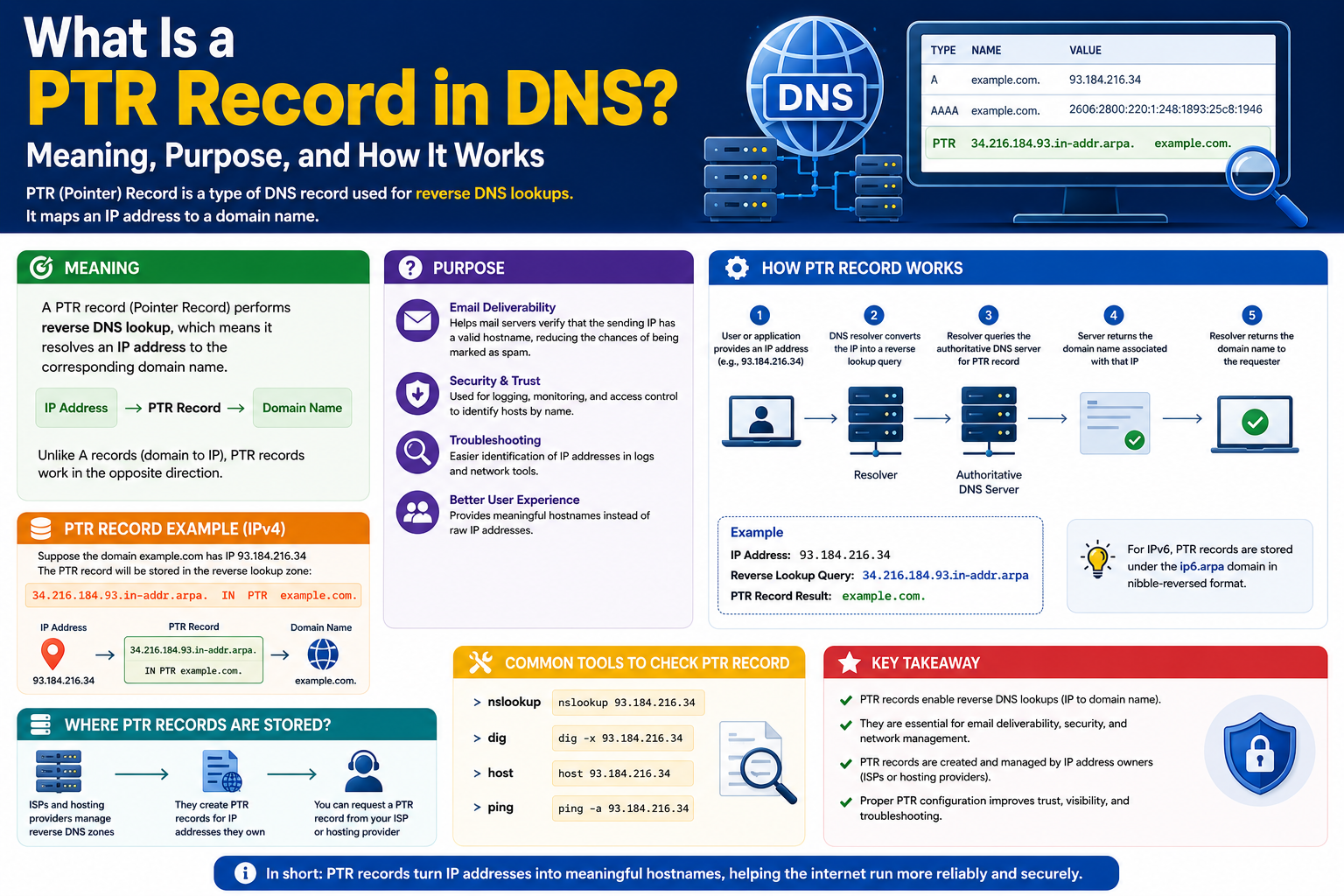
The Domain Name System, commonly known as DNS, is one of the foundational technologies that make the modern internet usable. Without it, users would need to memorize long strings of numbers just to access websites, send emails, or connect to online services. Instead, DNS acts as a distributed naming system that translates human-friendly domain names into machine-readable IP addresses.
When you type a website name into a browser, DNS quietly works in the background to find the corresponding numerical address. This process is fast, automatic, and usually invisible to the user. It involves multiple layers of lookup mechanisms, cached data, and hierarchical servers spread across the world.
At its core, DNS is designed for one primary direction of translation: from names to numbers. However, the internet ecosystem has evolved to require not only forward mapping but also reverse mapping. This is where specialized DNS records, such as PTR records, become important.
PTR records introduce an additional layer of functionality that allows systems to perform the reverse operation—mapping an IP address back to a domain name. This reverse capability is not just a technical curiosity; it plays an important role in security, verification, and trust across network communication.
Understanding PTR records requires first understanding how DNS operates in a broader sense. DNS is structured like a distributed database, organized in a hierarchical tree. At the top are root servers, followed by top-level domains such as .com, .org, and country-specific domains. Beneath these layers are authoritative servers that hold specific domain records.
PTR records exist within this structure but behave differently from typical DNS entries. Instead of being attached directly to a domain name, they are linked to IP addresses through a reverse mapping system.
Forward vs Reverse DNS: The Hidden Relationship
Most people are familiar with forward DNS without realizing it. When a domain name is converted into an IP address, this is known as a forward lookup. It is the standard operation performed when accessing websites, APIs, and cloud services.
Reverse DNS, on the other hand, performs the opposite function. Instead of starting with a name, it starts with an IP address and attempts to determine which domain name is associated with it. This reverse mapping is not always required for basic browsing, but becomes essential in specific networking scenarios.
PTR records are the mechanism that enables reverse DNS lookups. Without PTR records, an IP address would not have a verifiable domain association in reverse queries. This creates a gap in trust validation for systems that rely on identity confirmation.
The relationship between forward and reverse DNS is not always symmetrical. A domain can point to an IP address using an A record, but that same IP address must have a separate PTR record configured independently. This separation exists because IP address management is typically controlled by internet service providers or hosting platforms, while domain management is handled by domain owners.
This separation introduces an interesting dynamic in internet architecture. While domain owners can fully control forward DNS records, they often need coordination with their hosting provider or ISP to configure reverse DNS correctly.
What Exactly Is a PTR Record in Depth
A PTR record, also known as a pointer record, is a type of DNS record used specifically for reverse DNS lookups. Its main purpose is to associate an IP address with a canonical domain name.
Unlike other DNS records that are stored under domain names, PTR records are stored in a special reverse DNS namespace. This means they do not appear in the same zone files as typical domain records. Instead, they are placed in a reverse-structured domain hierarchy.
The primary role of a PTR record is identity mapping. When a system receives a connection from an IP address, it can query the PTR record to determine the domain name associated with that IP. This process helps verify whether the source of the connection is legitimate or potentially suspicious.
PTR records are especially important in environments where trust must be established before communication continues. One of the most common examples is email delivery systems, where servers must decide whether to accept incoming messages.
A correctly configured PTR record strengthens the credibility of a server by confirming that the IP address used to send traffic corresponds to an expected domain name. Without this verification, systems may treat the connection as unverified or potentially unsafe.
How Reverse DNS Structure Works
Reverse DNS operates using a different structural format compared to forward DNS. Instead of reading domain names from left to right in a hierarchical manner, reverse DNS reorganizes IP addresses into a reversed sequence.
This is necessary because of how DNS hierarchies are designed. In forward DNS, the hierarchy moves from general to specific, such as from the top-level domain to the subdomain. Reverse DNS follows a similar logic but is adapted for numerical IP structures.
For IPv4 addresses, reverse DNS uses a special reserved domain space called in-addr.arpa. This domain is specifically designated for reverse mapping of IPv4 addresses.
To create a PTR record, the IP address is reversed and appended to this domain structure. For example, an IP address like 1.2.3.4 is transformed into 4.3.2.1.in-addr.arpa.
This reversal may seem unusual at first, but it aligns with DNS hierarchy rules. DNS systems read from right to left in terms of authority, meaning the most significant part of the domain appears on the right side. By reversing the IP, the structure becomes compatible with this hierarchical design.
IPv6 addresses follow a similar concept but use a different reverse namespace due to their longer and more complex structure. Instead of in-addr.arpa, IPv6 uses the ip6.arpa domain.
The Logic Behind IP Address Reversal
The reversal of IP addresses in PTR records is not arbitrary. It is a design decision rooted in how DNS systems delegate authority.
DNS operates in a hierarchical tree structure, where each level delegates control to the next. By reversing IP addresses, each segment of the IP can be treated as a separate level in this hierarchy.
This allows DNS servers to efficiently locate PTR records by traversing the hierarchy from the most general segment to the most specific. It also ensures consistency with how domain names are resolved.
For example, in a reversed IPv4 address like 4.3.2.1.in-addr.arpa, the DNS system first identifies the in-addr. arpa zone, then moves progressively toward the final octet. This structured approach ensures scalability and efficiency in reverse lookups.
Without this reversal system, reverse DNS would require a completely different lookup mechanism, making it incompatible with existing DNS infrastructure.
PTR Records in Real-World Network Communication
PTR records are not just theoretical components of DNS; they play an active role in real-world internet communication. One of their primary uses is in verifying the identity of servers during network interactions.
When a server receives a connection request, it may perform a reverse DNS lookup to determine the domain associated with the incoming IP address. This information helps the server decide how to handle the connection.
In many cases, PTR records are used as part of a broader trust evaluation system. They are not the only factor in determining legitimacy, but they provide an important signal about the origin of a connection.
For example, if a server receives traffic from an IP address with a properly configured PTR record that matches expected domain patterns, it is more likely to treat the connection as legitimate.
On the other hand, if no PTR record exists or if the record does not match expected values, the system may flag the connection for further scrutiny.
Email Systems and the Trust Mechanism
One of the most important applications of PTR records is in email delivery systems. Email servers rely heavily on reverse DNS checks to reduce spam and prevent abuse.
When an email is received, the receiving server examines the IP address of the sending server. It then performs a PTR lookup to identify the associated domain name. This information is compared against other email authentication data.
If the PTR record matches the expected sending domain, the email is more likely to be accepted. If there is a mismatch or no PTR record exists, the email may be marked as suspicious or rejected entirely.
This mechanism helps prevent spoofing, where malicious actors attempt to send emails pretending to be from legitimate domains. By verifying the reverse DNS identity, email systems add an extra layer of protection.
PTR records, therefore, act as a foundational trust signal in email infrastructure. They do not guarantee legitimacy on their own, but they significantly improve the ability of systems to detect anomalies.
How Servers Use PTR for Identity Verification
Beyond email systems, PTR records are also used in general server authentication processes. Many network services perform reverse DNS checks as part of logging, monitoring, and security analysis.
When a connection is established, servers may log both the IP address and its corresponding PTR record. This allows administrators to trace activity back to domain-level identities rather than just numeric addresses.
In distributed systems, this can be particularly useful for debugging and traffic analysis. If unusual behavior is detected, reverse DNS information can help identify the source system more clearly.
PTR records also help in enforcing access policies. Some systems may allow or deny access based on the domain associated with an IP address, rather than the IP itself. This adds flexibility in managing dynamic environments.
Relationship Between PTR, A, and MX Records
PTR records exist alongside other important DNS record types, such as A and MX records. Each serves a different purpose within the DNS ecosystem.
A records map domain names to IP addresses, enabling forward resolution. MX records define mail exchange servers responsible for handling email delivery for a domain.
PTR records complement these by providing reverse mapping from IP addresses back to domain names. Together, these records form a complete identity and routing system for internet communication.
While A and MX records are configured by domain owners, PTR records require coordination with IP address controllers. This distinction often leads to mismatches if not properly managed.
Why PTR Records Matter for Security and Anti-Spam
PTR records contribute significantly to internet security by helping verify the origin of network traffic. They make it more difficult for malicious actors to disguise their identity when sending requests or emails.
Spam filters often rely on PTR checks as part of their decision-making process. A missing or incorrect PTR record can negatively impact email deliverability and server trust scores.
Security systems also use PTR data to correlate activity across logs. When combined with other verification methods, PTR records help build a more complete picture of network behavior.
Although PTR records alone cannot prevent attacks or spam, they act as an important supporting mechanism in layered security models.
Reverse DNS in Hosting Environments
In hosting environments, PTR record management depends on who controls the IP address space. Unlike standard DNS records, PTR entries are not always managed through the same interface as domain records.
Cloud providers and ISPs typically handle reverse DNS configuration. This separation means that domain administrators often need to coordinate with infrastructure providers to ensure correct PTR setup.
Different environments may have different methods for configuring PTR records, but the underlying principle remains the same: the IP address must be explicitly mapped back to a domain name in reverse DNS space.
Common Misconceptions About PTR Records
A common misunderstanding is that PTR records automatically update when forward DNS records change. In reality, they are completely independent and must be managed separately.
Another misconception is that PTR records are optional in all cases. While many services function without them, certain systems—especially email servers—rely heavily on their presence for trust evaluation.
Some also assume that PTR records directly improve website SEO or search ranking. However, PTR records are not used in search engine indexing or ranking systems; their role is primarily technical and security-focused.
Challenges in Reverse DNS Design
Managing PTR records can be challenging due to the separation of control between domain owners and IP providers. This often leads to coordination issues and misconfigurations.
Another challenge is propagation delay. Like other DNS changes, updates to PTR records may take time to spread across networks, leading to temporary inconsistencies.
Additionally, large-scale infrastructures with dynamic IP allocations can make PTR management more complex, requiring automated systems or careful administrative planning.
How PTR Records Are Managed in Real Network Infrastructure
In real-world networking environments, PTR records are not handled in the same way as standard DNS records like A or CNAME entries. This difference often creates confusion for administrators who are new to reverse DNS management. The key reason for this separation is ownership of IP address space.
IP addresses are assigned and controlled by internet service providers, hosting companies, or cloud platforms. Because PTR records are directly tied to IP addresses rather than domain names, the authority to configure them typically lies with whoever manages the IP allocation.
This means that even if a company fully controls its domain DNS settings, it may still need to request changes to PTR records through a different administrative system. In some cases, this involves control panels provided by cloud platforms, while in others it requires manual requests to network providers.
This separation introduces an important operational reality: reverse DNS is not fully self-managed in most environments. Instead, it is a shared responsibility between infrastructure providers and domain administrators.
In enterprise systems, this division of control requires coordinated workflows. Network teams often work closely with hosting providers to ensure PTR records are properly aligned with production systems, especially for email servers and public-facing APIs.
PTR Record Configuration in Hosting and Cloud Environments
Modern cloud environments have made PTR record management more accessible, but the implementation still varies widely depending on the provider. Each platform has its own method for handling reverse DNS, and understanding these differences is essential for correct configuration.
In some environments, PTR records are automatically generated when an IP address is assigned to a server instance. This automation reduces manual effort but may not always produce the desired hostname mapping, especially in complex architectures.
Other environments require explicit manual configuration. In these cases, administrators must define the hostname associated with each public IP address. This mapping is then used to generate the PTR record in reverse DNS.
There are also hybrid systems where partial automation exists. For example, a PTR record might be created automatically, but must be updated manually if the associated domain name changes.
The variability in implementation highlights an important point: PTR record management is not standardized across platforms. Instead, it is shaped by operational design choices made by infrastructure providers.
For organizations managing multiple servers, this variability means that PTR configuration must be included as part of deployment planning. It cannot be treated as an afterthought, especially in environments where email deliverability or identity verification is critical.
The Role of PTR Records in Email Reputation Systems
Email systems rely heavily on reputation-based filtering to distinguish legitimate communication from unwanted or malicious messages. PTR records are one of the foundational elements used in this evaluation process.
When an email is received, the recipient server evaluates multiple signals to determine trustworthiness. One of these signals is reverse DNS validation. The server checks whether the sending IP address resolves to a valid domain name through its PTR record.
If the PTR record aligns with expected patterns, it contributes positively to the sender’s reputation. If it is missing or inconsistent, it can negatively impact deliverability.
This process is not binary but probabilistic. PTR records are part of a larger scoring system that includes authentication protocols, content analysis, and historical behavior.
In many cases, email providers maintain internal reputation scores for IP addresses. PTR consistency helps stabilize these scores by reinforcing identity continuity over time.
Because of this, organizations that send high volumes of email must ensure their PTR records remain consistent with their sending domains. Even small mismatches can lead to reduced inbox placement or increased filtering.
PTR Records and Reverse DNS in Security Monitoring
Security monitoring systems use PTR records as part of their investigative and correlation processes. When analyzing network traffic, raw IP addresses alone provide limited context. Reverse DNS adds a layer of interpretability.
By resolving IP addresses to domain names, security tools can better categorize traffic sources. This helps in identifying patterns such as repeated connections from known infrastructure or unexpected sources.
PTR data is often combined with other metadata such as geolocation, traffic frequency, and protocol behavior. Together, these signals help security systems distinguish normal activity from suspicious behavior.
In intrusion detection systems, reverse DNS lookups may be performed in real time or during post-event analysis. While not all systems rely heavily on PTR records due to performance considerations, they remain a valuable contextual tool.
Security teams also use PTR information when investigating incidents. For example, if an unauthorized access attempt is detected, reverse DNS can help trace the infrastructure associated with the source IP.
However, it is important to note that PTR records can be manipulated or misconfigured. Therefore, they are not treated as absolute proof of identity but rather as one supporting data point among many.
IPv6 PTR Records and Expanding Address Complexity
The transition from IPv4 to IPv6 introduces additional complexity into reverse DNS systems. IPv6 addresses are significantly longer and more complex, which affects how PTR records are structured and processed.
Instead of using the IPv4 reverse namespace, IPv6 uses the ip6.arpa domain. This structure is designed to accommodate the hexadecimal format of IPv6 addresses while preserving hierarchical DNS principles.
In IPv6 reverse DNS, each character of the address is treated as a separate node in the DNS hierarchy. This results in a much more granular and detailed reverse mapping structure compared to IPv4.
The increased complexity of IPv6 PTR records means that configuration errors are more likely if not carefully managed. Even small mistakes in address formatting can lead to incorrect reverse resolution.
Despite this complexity, the functional purpose remains the same: mapping IP addresses back to domain names for verification and identity purposes.
As IPv6 adoption continues to grow, reverse DNS systems must adapt to handle larger-scale address spaces while maintaining performance and accuracy.
Common PTR Record Misconfigurations and Their Impact
Misconfigurations in PTR records are a frequent cause of network and email issues. One of the most common problems is a mismatch between forward and reverse DNS entries.
This occurs when an IP address resolves to a domain name via PTR, but that domain does not correctly map back to the same IP through an A record. Such inconsistencies can create trust issues in systems that perform cross-validation.
Another common issue is missing PTR records. When no reverse DNS entry exists for an IP address, systems may interpret the connection as unverified. This is particularly problematic in email environments.
Incorrect hostname assignment is also a frequent issue. If the PTR record points to a generic or unrelated domain name, it can reduce trust and trigger filtering mechanisms.
Propagation delays can further complicate troubleshooting. Changes to PTR records may take time to propagate across DNS systems, leading to temporary inconsistencies during updates.
Because of these potential issues, PTR configuration must be carefully validated as part of network setup and maintenance processes.
Troubleshooting Reverse DNS Problems in Practice
When reverse DNS issues arise, troubleshooting typically begins with verification of the PTR record itself. The first step is confirming whether the IP address has an associated reverse DNS entry.
If a PTR record exists, the next step is validating whether it correctly matches the intended domain name. This includes checking for spelling errors, incorrect mappings, or outdated configurations.
If no PTR record is present, the issue usually lies with the IP provider. Since reverse DNS is controlled at the IP allocation level, resolution requires coordination with the entity managing the address space.
Another important troubleshooting step is checking consistency between forward and reverse DNS. Both directions should ideally point to the same canonical identity to maintain trust and integrity.
Propagation timing must also be considered. DNS changes do not update instantly across all systems, so temporary mismatches may occur during updates.
In more complex environments, logs and diagnostic tools may be used to trace how different systems interpret the PTR record. This helps identify whether the issue is local or network-wide.
PTR Records in Load-Balanced and Distributed Systems
In modern distributed architectures, multiple servers often share traffic using load-balancing systems. This introduces additional complexity for reverse DNS configuration.
Each server in a load-balanced pool may have its own IP address, requiring individual PTR records. Alternatively, a shared IP may be used, in which case a single PTR record represents multiple backend systems.
This design choice depends on the architecture of the system. In some cases, maintaining individual PTR records improves traceability and logging accuracy. In others, simplicity is preferred.
Content delivery networks and large-scale distributed systems often abstract reverse DNS behind edge infrastructure. This means PTR records may reflect edge nodes rather than origin servers.
Despite these abstractions, PTR consistency remains important for external communication, particularly in email and authentication workflows.
Careful planning is required to ensure that reverse DNS behavior aligns with system architecture, especially when scaling horizontally across multiple regions or data centers.
PTR Records and Network Logging Practices
Network logging systems frequently incorporate PTR data to enhance readability and analysis. Instead of displaying raw IP addresses, logs may include resolved domain names obtained through reverse DNS.
This makes logs easier for humans to interpret, especially during troubleshooting or monitoring sessions. A domain name provides more contextual information than a numerical IP address alone.
However, relying solely on PTR resolution in logging systems can introduce performance overhead. Reverse DNS lookups add additional network queries, which can slow down log processing if not cached properly.
To mitigate this, many systems cache PTR results temporarily. This balances the need for readability with performance efficiency.
In large-scale environments, logging systems may selectively apply reverse DNS lookups only to specific traffic types or high-priority events.
PTR-based logging also assists in forensic analysis. When investigating incidents, reverse DNS data can help reconstruct the origin and path of network activity.
PTR Records in Compliance and Organizational Policy
In regulated environments, PTR records may play a role in compliance and auditing processes. While they are not typically the primary compliance mechanism, they contribute to identity traceability.
Organizations often establish internal policies requiring consistent reverse DNS configuration for all public-facing servers. This helps maintain standardized network identity practices.
Audit systems may verify PTR consistency as part of infrastructure reviews. Discrepancies between expected and actual reverse DNS entries can indicate configuration drift or unmanaged systems.
In some cases, PTR records are used as part of broader trust frameworks within enterprise networks. They help ensure that systems communicating externally are properly registered and identifiable.
This is particularly relevant in environments where external communication must be traceable and verifiable for operational or regulatory reasons.
Performance Considerations in Reverse DNS Lookups
Although PTR records are lightweight in structure, reverse DNS lookups can introduce performance overhead in high-traffic systems. Each lookup requires querying the DNS infrastructure, which may involve network latency.
To manage this, systems often implement caching strategies. Once a PTR record is resolved, the result is stored temporarily to avoid repeated queries for the same IP address.
Caching improves performance significantly but introduces a trade-off between freshness and speed. If a PTR record changes, cached results may temporarily reflect outdated information.
In high-performance environments, reverse DNS lookups are often performed asynchronously or during non-critical processing stages. This ensures that core system performance is not impacted.
Designing efficient PTR lookup strategies is particularly important in large-scale logging, analytics, and security systems where high volumes of traffic are processed continuously.
Advanced Role of PTR Records in Large-Scale Network Architecture
In complex network environments, PTR records take on a more strategic role than simple reverse mapping. Large organizations, data centers, and cloud-native infrastructures rely on reverse DNS not just for identity verification, but also for operational consistency across distributed systems.
At scale, IP address management becomes a structured discipline known as IP Address Management (IPAM). PTR records are tightly integrated into this system because every public IP must be traceable to a meaningful hostname. Without this mapping, monitoring, logging, and troubleshooting become significantly harder.
In enterprise environments, PTR records are often aligned with naming conventions that reflect server roles, regions, and environments. For example, a server’s reverse DNS entry might encode whether it belongs to production, staging, or development infrastructure.
This structured approach helps teams quickly interpret network traffic without needing to manually correlate IP addresses with internal documentation. It also improves automation workflows, where systems rely on predictable naming patterns for orchestration and scaling decisions.
At scale, PTR consistency becomes a governance issue. Misaligned reverse DNS entries can lead to confusion in incident response scenarios, where rapid identification of system ownership is critical.
PTR Records in Cloud-Native and Containerized Systems
Modern cloud-native architectures introduce additional complexity to reverse DNS management. Unlike traditional static servers, containerized systems often rely on ephemeral infrastructure, where IP addresses can change frequently.
In such environments, maintaining persistent PTR mappings becomes challenging. Containers themselves typically do not have individual PTR records; instead, reverse DNS is associated with underlying virtual machines or network interfaces.
This abstraction means that PTR records often reflect infrastructure layers rather than application layers. For example, a containerized service may appear under the PTR record of a host node rather than its internal service name.
To manage this complexity, orchestration platforms often integrate DNS automation tools. These systems dynamically update DNS records, including reverse mappings, as infrastructure scales up or down.
However, even with automation, reverse DNS in containerized environments remains primarily useful for infrastructure-level visibility rather than application-level identity.
Security Implications of PTR Spoofing and Misuse
While PTR records contribute to trust validation, they are not inherently secure. One important limitation is that reverse DNS entries can be configured incorrectly or misleadingly if administrative control is misused.
PTR spoofing occurs when an IP address is assigned a reverse DNS entry that does not accurately reflect its true origin or ownership. This can be intentional or accidental, depending on the environment.
Because PTR records are not cryptographically verified, they cannot guarantee authenticity. They only provide a mapping that can be used as part of a broader verification process.
Security systems, therefore, treat PTR data as a weak trust signal rather than a definitive identity proof. It must always be combined with other mechanisms such as authentication protocols, encryption, and behavioral analysis.
Despite this limitation, PTR records still play a valuable role in identifying suspicious patterns. For example, mismatches between forward and reverse DNS are often considered indicators of misconfiguration or potential abuse.
Security analysts frequently use these inconsistencies as starting points for deeper investigation rather than conclusions.
Reverse DNS Delegation and Administrative Boundaries
One of the most important structural aspects of PTR records is delegation. Unlike forward DNS, where domain owners have full control over their records, reverse DNS is governed by IP address ownership.
This creates a layered administrative model. Internet registries allocate IP blocks to ISPs or cloud providers, who in turn assign them to customers. Reverse DNS control typically resides at the level of the IP block owner.
This means that end users often cannot directly modify PTR records unless their provider allows delegation or provides management tools.
Some providers offer reverse DNS delegation, where control of PTR records is passed to the customer for specific IP ranges. This is common in dedicated hosting or enterprise cloud services.
Delegation simplifies management for organizations with large-scale infrastructure but requires careful coordination to avoid conflicts or misalignment.
Without proper delegation, organizations may need to submit requests to providers for every PTR change, which can slow down operational workflows.
PTR Records in Hybrid Infrastructure Environments
Hybrid infrastructures, which combine on-premises systems with cloud services, introduce additional challenges for reverse DNS consistency.
In such environments, IP addresses may originate from multiple sources, each with its own PTR management system. This can lead to fragmented reverse DNS configurations if not carefully unified.
Organizations often establish centralized naming policies to maintain consistency across environments. These policies define how hostnames should be structured and how they should map to reverse DNS entries.
Maintaining alignment between on-prem and cloud PTR records is particularly important for systems that span multiple environments, such as hybrid email gateways or distributed authentication services.
Inconsistent reverse DNS behavior across environments can lead to unpredictable trust evaluations, especially in security-sensitive applications.
Impact of PTR Records on Network Diagnostics
PTR records are widely used in network diagnostics because they provide readable context for IP-based data. When troubleshooting connectivity issues, administrators often rely on reverse DNS to quickly identify affected systems.
Instead of working with raw IP addresses, which are difficult to interpret at scale, PTR records allow engineers to associate traffic with meaningful system names.
This becomes especially valuable in distributed systems where hundreds or thousands of nodes may be active simultaneously.
However, PTR-based diagnostics must be interpreted carefully. Since reverse DNS is not always guaranteed to be accurate or up to date, it should be used as a supporting tool rather than a definitive source of truth.
In some cases, stale PTR records can lead to misleading conclusions if infrastructure changes are not fully propagated.
For this reason, diagnostic processes often combine PTR data with real-time telemetry and configuration management databases to ensure accuracy.
PTR Records and Email Authentication Ecosystems
Email systems use multiple layers of authentication, and PTR records function as one of the foundational trust indicators within this ecosystem.
When an email is received, reverse DNS checks are often performed alongside other validation mechanisms such as SPF and DKIM. While SPF validates sending permissions and DKIM verifies message integrity, PTR records validate network identity.
This multi-layered approach helps reduce the risk of spoofing and unauthorized email transmission.
PTR records also influence sender reputation scoring. Email providers maintain reputation databases that evaluate IP behavior over time. Consistent reverse DNS alignment contributes positively to these scores.
However, PTR records alone cannot guarantee deliverability. A properly configured reverse DNS entry must still be supported by consistent sending behavior and authentication alignment.
Inconsistent PTR configuration can significantly impact email performance, even if other authentication methods are correctly implemented.
Operational Challenges in Maintaining PTR Consistency
Maintaining consistent PTR records across dynamic infrastructure is an ongoing operational challenge. One of the most common issues arises during infrastructure scaling events.
When new servers are added or removed, their associated IP addresses must be correctly mapped in reverse DNS. Failure to update PTR records during scaling can result in mismatched or orphaned entries.
Another challenge occurs during migrations. When systems move between providers or regions, IP address changes must be reflected in the PTR configuration. If this step is overlooked, reverse DNS integrity is compromised.
Automation helps reduce these risks, but it does not eliminate them. Automated systems still depend on correct configuration logic and accurate metadata inputs.
Human oversight remains important, especially in environments where network changes are frequent or complex.
PTR Records in Multi-Tenant Hosting Environments
Multi-tenant environments, such as shared hosting platforms or large cloud ecosystems, introduce additional complexity to reverse DNS mapping.
In these systems, multiple customers may share underlying infrastructure. This makes PTR assignment more sensitive, as each IP must correctly represent the intended tenant or service.
Providers often use structured allocation systems to ensure PTR records remain logically consistent across tenants. However, strict isolation requirements can sometimes limit flexibility in reverse DNS customization.
In some cases, shared IP addresses may result in generic PTR entries that do not reflect individual tenant identities. This can affect email deliverability and service verification.
Dedicated IP allocation is often used to resolve this issue, allowing each tenant to maintain a unique reverse DNS identity.
Evolution of PTR Records in Modern Internet Design
As internet architecture continues to evolve, the role of PTR records is also adapting. While their fundamental function remains unchanged, their integration into broader systems is becoming more automated and abstracted.
Modern networking frameworks increasingly rely on orchestration tools that manage DNS, IP allocation, and reverse mappings together as part of unified infrastructure systems.
This reduces manual configuration overhead but increases dependency on automated correctness. Errors in automation logic can propagate across both forward and reverse DNS layers.
At the same time, security systems are becoming more sophisticated in how they interpret PTR data. Instead of relying on simple presence or absence, modern systems analyze consistency patterns over time.
This shift reflects a broader trend in networking: moving from static configuration toward dynamic, context-aware infrastructure intelligence.
PTR Records and Future Networking Paradigms
Looking forward, the relevance of PTR records is likely to remain strong, even as networking technologies evolve. However, their role may become more integrated into automated identity frameworks.
As systems adopt more identity-centric networking models, reverse DNS may serve as one component of a larger identity verification ecosystem rather than a standalone mechanism.
In highly automated environments, PTR records may be generated, validated, and updated dynamically as part of infrastructure provisioning workflows.
This would reduce manual intervention while improving consistency across large-scale systems.
At the same time, the increasing complexity of global internet infrastructure means that reverse DNS will continue to play an important role in maintaining traceability and interpretability across distributed systems.
Even as abstraction layers grow, the need to map IP addresses back to meaningful identities remains a fundamental requirement of network communication.
PTR Records in Network Observability and Traffic Intelligence
In modern network environments, PTR records have become a subtle but valuable component of observability systems that analyze traffic behavior across distributed infrastructures. While raw IP addresses provide the foundational data for monitoring, they often lack contextual meaning for human operators and automated analysis tools.
Reverse DNS resolution through PTR records adds a layer of semantic interpretation to this data. Instead of viewing a stream of numeric addresses, observability platforms can associate traffic with recognizable hostnames or service identifiers. This makes it easier to detect patterns such as repeated access from specific systems, unusual spikes in traffic originating from certain domains, or unexpected communication between services.
In advanced analytics pipelines, PTR data is often combined with flow logs, latency metrics, and protocol-level details to build a more complete picture of network behavior. This enriched context helps identify anomalies that might otherwise be hidden within large volumes of raw telemetry data.
However, PTR-based enrichment is typically treated as optional metadata rather than a primary data source. This is because reverse DNS lookups introduce latency and may not always reflect the most current network state. As a result, many systems perform PTR resolution asynchronously or rely on cached results to balance performance with insight quality.
Despite these limitations, PTR records remain useful in investigative workflows. When engineers analyze historical traffic patterns or trace the origin of an incident, reverse DNS information often provides the first layer of meaningful interpretation before deeper forensic analysis begins.
Conclusion
PTR records play a quiet but essential role in the structure of modern internet communication. While they are often overlooked compared to more commonly discussed DNS records, their function becomes critical whenever trust, verification, and identity matter in network interactions. By enabling reverse DNS lookups, PTR records allow systems to connect an IP address back to a recognizable domain name, helping bridge the gap between raw network data and meaningful identity information.
This reverse mapping is especially important in environments where security and authenticity are priorities. Email systems, for example, rely heavily on PTR records as part of their filtering and validation processes. A properly configured PTR entry helps establish legitimacy, while missing or inconsistent records can raise suspicion and negatively impact communication reliability. In this way, PTR records contribute directly to reducing spam, preventing spoofing, and improving overall trust in digital messaging systems.
Beyond email, PTR records support network diagnostics, logging, monitoring, and security analysis. They help administrators interpret traffic more effectively, making large-scale infrastructure easier to manage and understand. Even though they are not a standalone security mechanism, they enhance other verification systems by adding contextual depth to IP-based activity.
As internet infrastructure continues to evolve toward cloud-native and distributed systems, the importance of consistent and well-managed PTR configuration remains relevant. Whether in traditional hosting environments or modern automated platforms, reverse DNS continues to serve as a foundational element of network identity.
Ultimately, PTR records demonstrate how even small components of DNS architecture contribute significantly to the stability, security, and clarity of global internet communication.