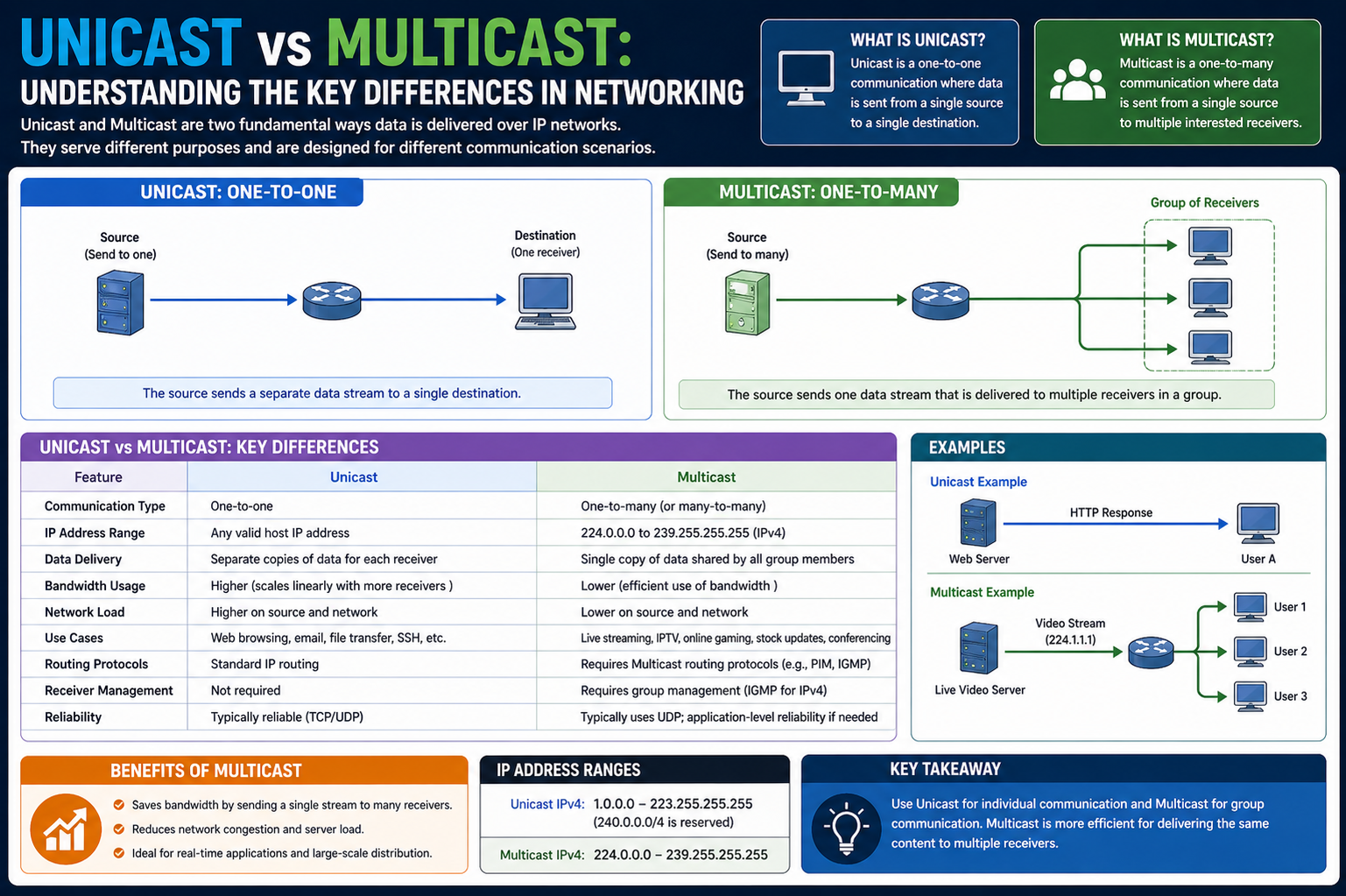
Unicast and multicast represent two fundamental approaches to data communication in modern networking systems, each designed to handle information delivery in distinct ways depending on scale, efficiency, and purpose. At a basic level, unicast is a communication method where data is transmitted from a single sender directly to a single receiver, forming a dedicated one-to-one connection. This approach ensures that every packet of information has a clearly defined destination and follows a specific path across the network to reach that endpoint. In contrast, multicast represents a more distributed model in which data is sent from one sender to multiple receivers simultaneously, creating a one-to-many or even many-to-many communication structure. Instead of duplicating data streams individually for each recipient, multicast allows a single transmission to be shared efficiently among multiple interested devices.
In real-world networking environments, these two methods are not competitors but complementary strategies used depending on application requirements. Unicast is widely used in everyday digital interactions such as browsing websites, sending emails, or making video calls, where communication is personal and directed. Multicast, on the other hand, is more common in systems where the same data must reach many users at once, such as live streaming, corporate broadcasts, or software distribution. Understanding these two methods is essential for grasping how modern networks manage traffic, optimize bandwidth, and ensure data delivery across global systems.
Understanding Unicast Communication in Depth
Unicast communication can be understood as the most direct and personalized form of data exchange in networking. It functions similarly to a private conversation between two individuals where information is exchanged exclusively between the sender and the intended recipient. Every unicast transmission begins at a source device and is addressed specifically to one destination device using its unique network identifier, such as an IP address. This ensures that no other device on the network processes or receives the same data unless explicitly involved in separate communication sessions.
In technical environments, unicast is the default mode of communication for most network applications because it provides clarity, control, and predictability. Each interaction is isolated, meaning that the sender does not need to consider multiple recipients or shared distribution paths. This makes it particularly effective for tasks that require accuracy and direct feedback between two endpoints. For example, when a user opens a website, their device sends a request directly to a server, and the server responds specifically to that device without involving others. This one-to-one structure ensures that communication remains organized and manageable even when millions of such interactions occur simultaneously across the internet.
How Unicast Delivers Data in Networks
The delivery mechanism of unicast communication relies on structured routing systems that guide data packets from source to destination through interconnected networks. Each packet contains header information that includes the destination address, allowing routers and switches along the path to determine the most efficient route for delivery. As the packet moves through the network, each intermediate device examines this address and forwards the packet closer to its final destination until it arrives successfully.
This process is highly dynamic and adaptable, as network conditions such as congestion or failures can influence routing decisions. If a particular path becomes unavailable or inefficient, the network can automatically redirect packets through alternative routes without disrupting the overall communication session. This adaptability ensures that unicast communication remains stable even in complex and large-scale networks like the internet.
Another important aspect of unicast delivery is that each session between two devices is independent. Even if multiple users are accessing the same service at the same time, each connection is treated separately. This separation allows for customized interactions, where responses are tailored specifically to the requesting device. It also means that data privacy is inherently maintained, as information intended for one recipient is not shared with others unless explicitly required.
Reliability and Ordering in Unicast Systems
One of the strongest advantages of unicast communication is its ability to ensure reliable and ordered delivery of data. In many implementations, unicast relies on transport protocols that include mechanisms for acknowledgment, retransmission, and sequencing. These mechanisms work together to guarantee that data reaches its destination accurately and in the correct order.
Reliability in unicast systems is achieved through continuous verification between sender and receiver. When data packets are transmitted, the receiving device acknowledges successful delivery. If a packet is lost or corrupted during transmission, it is retransmitted to ensure completeness. This feedback loop plays a critical role in maintaining data integrity, especially in applications where missing or incorrect information could lead to errors or failures.
Ordering is equally important in unicast communication because many types of data must be reconstructed exactly as they were sent. For example, when streaming a video or downloading a file, packets must arrive in sequence so that the receiving device can reassemble them correctly. Without proper ordering, the output would be incomplete or corrupted. Unicast systems handle this by assigning sequence numbers to packets and reordering them at the destination if they arrive out of order.
Together, reliability and ordering make unicast communication ideal for applications where accuracy and consistency are more important than speed or scalability. This makes it the preferred choice for many critical network operations.
Efficiency and Resource Usage in Unicast
Unicast communication is highly efficient in scenarios where data needs to be delivered to a single recipient. Since each transmission is dedicated to one endpoint, network resources are used in a controlled and predictable manner. This includes bandwidth allocation, processing power, and routing capacity, all of which are utilized specifically for the intended communication session.
However, while unicast is efficient for one-to-one communication, it can become resource-intensive when the same data must be sent to multiple recipients individually. In such cases, the sender must create separate streams for each receiver, which increases bandwidth usage and processing load on the network. Despite this limitation, unicast remains highly effective because it ensures precision and avoids unnecessary data sharing between unrelated devices.
Another aspect of efficiency in unicast systems is traffic management. Since each connection is independent, network administrators can monitor, control, and optimize traffic on a per-session basis. This allows for better quality of service management, especially in environments where different applications compete for limited network resources. By isolating each communication flow, unicast makes it easier to prioritize important data and maintain stable performance across the network.
Real World Applications of Unicast Communication
Unicast communication plays a central role in many everyday digital interactions that require direct and reliable data exchange between two endpoints. One of the most common applications is web browsing, where a user’s device sends requests to a web server and receives responses tailored specifically to that session. Each page load, image request, or form submission is handled through individual unicast connections, ensuring accurate and personalized content delivery.
Another important application is file transfer between devices. Whether downloading software updates, sharing documents, or transferring media files, unicast ensures that data is delivered securely and completely to the intended recipient. This is especially important in environments where data integrity is critical, such as business systems or cloud storage platforms.
Voice and video communication also rely heavily on unicast systems. In real-time conversations, each participant sends and receives data directly, maintaining a stable and private connection. This ensures that communication remains clear, synchronized, and uninterrupted.
Online gaming is another area where unicast is widely used. Player actions are transmitted directly to game servers, which process and respond to each individual input. This allows for real-time interaction and ensures fairness and consistency across all players.
Why Unicast Remains Fundamental in Networking
Unicast continues to be the foundation of most modern network communication because of its simplicity, reliability, and precision. Its one-to-one structure makes it easy to implement, manage, and scale across different types of network environments. Even in highly complex systems like the internet, unicast forms the backbone of most data exchanges, supporting everything from basic browsing to advanced cloud services.
The strength of unicast lies in its ability to provide dedicated communication channels that ensure accuracy and control. Unlike more complex distribution methods, it does not require grouping, synchronization, or shared delivery mechanisms, making it straightforward and dependable. This simplicity is one of the reasons why it remains widely used despite the existence of more scalable alternatives for specific use cases.
As networks continue to evolve, unicast remains essential because it supports the majority of user-driven interactions. Every time a device communicates directly with another device or server, unicast plays a role in ensuring that the connection is stable, secure, and efficient.
Multicast Communication in Modern Networking
Multicast communication is a network transmission method designed to efficiently deliver the same data stream to multiple recipients at the same time without requiring separate individual transmissions for each receiver. Unlike unicast, which creates a dedicated connection between a single sender and a single receiver, multicast operates on a shared delivery model where one data stream can be distributed to a selected group of devices that have expressed interest in receiving it. This makes multicast particularly useful in environments where large amounts of identical data must be delivered simultaneously to many users, such as live video broadcasting, enterprise communication systems, and real-time data distribution platforms.
The core idea behind multicast is efficiency at scale. Instead of sending multiple copies of the same data over the network, the sender transmits a single stream, and the network infrastructure replicates it only when necessary. This reduces bandwidth consumption, lowers server load, and improves overall network performance in scenarios involving large audiences. Multicast is therefore not just an alternative to unicast but a specialized optimization technique for group-based communication.
How Multicast Group Communication Works
Multicast communication is based on the concept of groups rather than individual endpoints. Devices that want to receive a particular data stream join a multicast group, which acts as a logical collection of interested receivers. Once a device becomes part of a group, it automatically receives data sent to that group address without requiring separate transmissions from the sender.
This group-based system is what allows multicast to scale efficiently. Instead of managing thousands or millions of individual connections, the sender only needs to transmit data once to a group address. The network infrastructure, including routers and switches, takes responsibility for distributing the data to all group members. This significantly reduces redundancy and ensures that network resources are used more effectively.
In practical terms, multicast groups function dynamically. Devices can join or leave groups at any time depending on their interest in the data stream. For example, in a live sports broadcast, viewers can join the multicast group at the start of the match and leave once the event ends. The network continuously adapts to these changes without requiring the sender to modify its transmission behavior.
Multicast Addressing and Group Identification
Multicast communication relies on a specialized addressing system that differentiates it from unicast and broadcast traffic. Instead of using individual device addresses, multicast uses a defined range of IP addresses reserved specifically for group communication. These addresses allow networks to identify that a particular data stream is intended for multiple recipients rather than a single endpoint.
Devices interested in receiving multicast traffic use group membership protocols to signal their participation. One of the most widely used protocols for this purpose is IGMP, which allows devices to inform network routers that they want to join a specific multicast group. When a device joins a group, it essentially registers its interest in receiving data associated with that multicast address.
Routers play a critical role in managing multicast traffic. They maintain information about which devices belong to which groups and ensure that data is only forwarded to networks where group members exist. This prevents unnecessary traffic from being sent to unrelated parts of the network, further improving efficiency and reducing congestion.
Efficiency Advantages of Multicast Communication
One of the most significant advantages of multicast is its ability to optimize bandwidth usage. In traditional unicast communication, sending the same data to multiple recipients requires multiple separate transmissions, which increases network load proportionally with the number of receivers. Multicast eliminates this inefficiency by allowing a single transmission to serve multiple recipients simultaneously.
This efficiency becomes especially important in large-scale environments such as media streaming platforms or corporate networks. For example, if a video stream is being delivered to thousands of viewers, multicast ensures that the server only needs to send one stream instead of thousands. The network infrastructure handles replication where necessary, reducing the burden on the source system.
Another efficiency benefit of multicast is reduced server processing overhead. Since the sender does not need to manage individual sessions for each receiver, it can focus on generating and transmitting a single stream. This makes multicast particularly suitable for applications that require real-time data distribution without heavy computational demands on the sender.
Reliability Characteristics of Multicast Systems
Unlike unicast communication, multicast does not inherently guarantee reliable or ordered delivery of data. This is because multicast prioritizes speed and efficiency over strict delivery assurance. In many multicast implementations, there are no built-in mechanisms for acknowledgment or retransmission at the same level as unicast systems.
As a result, multicast is often used in applications where occasional data loss is acceptable. For example, in live video streaming, missing a few packets may result in minor visual glitches, but the overall experience remains uninterrupted. This trade-off allows multicast to maintain high performance even under heavy network loads.
Because multicast does not guarantee perfect delivery, higher-level applications often incorporate their own error-handling mechanisms if reliability is required. These mechanisms may include buffering, forward error correction, or application-level retransmission strategies. However, the underlying multicast system itself remains focused on efficient distribution rather than strict reliability.
Network Infrastructure and Multicast Routing
Multicast communication requires specialized network support to function effectively across larger systems. Routers must be capable of recognizing multicast traffic and determining how to distribute it across different network segments. This is achieved through multicast routing protocols that manage group membership and data forwarding paths.
One important aspect of multicast routing is ensuring that data is only sent where it is needed. Instead of flooding the entire network with traffic, routers create distribution trees that map the most efficient paths to reach all group members. These trees help minimize unnecessary data transmission and ensure that network resources are used optimally.
The structure of multicast routing also allows for scalability. As more devices join a multicast group, the network automatically adjusts the distribution paths without requiring changes to the sender. This dynamic adaptability makes multicast suitable for large and constantly changing environments such as global content distribution systems.
Real World Applications of Multicast Communication
Multicast is widely used in scenarios where the same information must be delivered to many users at the same time. One of the most common applications is live video and audio streaming. In such systems, multicast allows broadcasters to send a single stream that can be received by thousands or even millions of viewers simultaneously.
Enterprise communication systems also make extensive use of multicast. Companies often use it for internal broadcasts such as announcements, training sessions, or virtual meetings. This ensures that all employees receive the same information at the same time without overloading the network infrastructure.
Another important application is software distribution. Large organizations can use multicast to deploy updates or patches to multiple systems simultaneously, reducing deployment time and network congestion. This is especially useful in environments with thousands of devices that require consistent updates.
Multicast is also used in financial systems where real-time data such as stock prices needs to be delivered to multiple traders simultaneously. The ability to distribute time-sensitive information efficiently makes multicast an essential tool in high-performance trading environments.
Multicast IP Range and Group Management Behavior
Multicast communication operates within a specific range of IP addresses that are reserved exclusively for group-based communication. These addresses ensure that multicast traffic is clearly distinguished from unicast and broadcast traffic within the network. Devices that want to participate in multicast communication must join a group associated with one of these addresses.
Group management is handled dynamically through signaling protocols that allow devices to join or leave multicast groups as needed. When a device joins a group, it informs the network that it is interested in receiving data associated with that group address. When it leaves, the network updates its routing information accordingly.
This dynamic behavior allows multicast systems to adapt in real time to changes in group membership. It also ensures that network resources are not wasted on devices that are no longer interested in receiving the data stream.
Multicast Routing and Data Distribution Mechanism
Multicast routing is the backbone that makes large-scale group communication possible in modern networks, ensuring that a single data stream from a sender can efficiently reach multiple receivers without unnecessary duplication of traffic. Unlike unicast routing, where each packet is directed toward a single destination using a straightforward path selection process, multicast routing focuses on building and maintaining distribution structures that allow data to be shared among many recipients simultaneously. This requires the network to maintain awareness of group memberships and dynamically adjust how data flows through routers and switches.
At the core of multicast routing is the concept of distribution trees. These trees represent optimized paths that connect the sender to all receivers who are part of a multicast group. Instead of sending separate copies of data to each receiver, the network creates branching paths where data is replicated only at points where it is necessary. This ensures that bandwidth usage is minimized while still delivering the same content to all intended recipients.
Multicast routing protocols are responsible for building and maintaining these trees. They continuously monitor group membership changes and update routing paths accordingly. If a new device joins a multicast group, the routing structure expands to include it. If a device leaves, the structure adjusts to remove unnecessary branches. This dynamic adaptability is what allows multicast systems to scale efficiently in large and constantly changing networks.
Role of Network Devices in Multicast Communication
Network devices such as routers and switches play a crucial role in enabling multicast communication. These devices must be capable of recognizing multicast traffic and handling it differently from unicast traffic. Instead of treating each packet as a single destination request, they interpret multicast packets as group-based transmissions that may need to be forwarded to multiple interfaces.
Routers are primarily responsible for managing multicast distribution across different network segments. They maintain group membership information and ensure that data is only forwarded to networks where interested receivers exist. This prevents unnecessary traffic from being sent across the entire network, which would otherwise lead to congestion and inefficiency.
Switches, especially those operating in advanced network environments, also support multicast by managing traffic within local network segments. They use group management information to forward multicast packets only to ports where devices have expressed interest in receiving the data. This reduces unnecessary load on devices that are not part of the multicast group and improves overall network performance.
Together, routers and switches form a coordinated system that ensures multicast traffic is delivered efficiently and accurately across both local and wide-area networks.
Group Membership Management in Multicast Systems,
Group membership management is a fundamental component of multicast communication that allows devices to dynamically join or leave multicast groups based on their data requirements. This process is essential because multicast is built around the idea of selective participation, where only interested devices receive specific data streams.
When a device wants to receive multicast traffic, it sends a signal to the network indicating its interest in joining a particular group. This is typically handled through specialized communication protocols that inform routers about the device’s participation. Once the device joins the group, it begins receiving all data sent to the corresponding multicast address.
Leaving a multicast group is equally dynamic. When a device no longer needs the data, it sends a leave signal, and the network updates its routing tables accordingly. This ensures that resources are not wasted sending data to devices that are no longer interested.
This dynamic membership model allows multicast systems to remain flexible and efficient, especially in environments where participants frequently change, such as live streaming platforms or enterprise communication systems.
Scalability Advantages of Multicast Communication
One of the most important strengths of multicast communication is its ability to scale efficiently across large networks. As the number of receivers increases, multicast maintains relatively stable bandwidth usage because the sender transmits only a single stream of data. The network infrastructure handles the replication and distribution process, ensuring that the sender’s workload does not increase significantly with additional recipients.
In contrast, unicast communication scales linearly with the number of receivers, meaning that each additional recipient requires a separate data stream. This can quickly become inefficient in scenarios involving large audiences. Multicast avoids this limitation by distributing replication responsibilities across the network rather than concentrating them at the source.
This scalability makes multicast particularly valuable in environments such as global content distribution, corporate broadcasting, and real-time data dissemination systems. Whether the group consists of ten devices or ten thousand devices, the sender’s workload remains largely unchanged, allowing for consistent performance.
Bandwidth Optimization Through Multicast Design
Bandwidth efficiency is one of the most significant advantages of multicast communication. By sending a single data stream instead of multiple individual streams, multicast drastically reduces the amount of network traffic generated for group-based communication. This optimization becomes increasingly important as the size of the receiver group grows.
In traditional unicast systems, each recipient requires a separate transmission, which consumes additional bandwidth for every new connection. This can lead to network congestion and reduced performance, especially when multiple users are accessing the same content simultaneously. Multicast eliminates this redundancy by allowing the network to replicate data only when necessary, typically at branching points within the routing structure.
This efficient use of bandwidth not only improves performance but also reduces operational costs in large-scale network environments. Organizations that rely on high-volume data distribution benefit significantly from multicast’s ability to minimize unnecessary data duplication.
Limitations and Challenges of Multicast Systems
Despite its advantages, multicast communication also has certain limitations that must be considered when designing network systems. One of the primary challenges is the lack of inherent reliability mechanisms. Unlike unicast, multicast does not guarantee that all packets will arrive at their destination, nor does it ensure that data will be delivered in a specific order.
This means that multicast is not suitable for applications where complete accuracy and strict sequencing are required unless additional mechanisms are implemented at higher layers. Applications must often handle packet loss and reordering themselves if reliability is necessary.
Another challenge is network complexity. Implementing multicast requires specialized routing protocols and support from network infrastructure devices. Not all networks are configured to handle multicast traffic efficiently, which can limit its deployment in certain environments.
Security and control can also be more complex in multicast systems. Since data is delivered to a group rather than a single recipient, managing access and ensuring that only authorized devices join specific groups requires careful configuration and monitoring.
Efficiency Trade-Offs in Multicast Communication
Multicast communication is designed with a clear trade-off between efficiency and reliability. Its primary goal is to maximize data distribution efficiency, even if that means sacrificing guaranteed delivery or strict ordering. This makes it ideal for applications where speed and scalability are more important than perfect accuracy.
In many real-world scenarios, this trade-off is acceptable. For example, in live video streaming, minor packet loss may cause temporary visual artifacts, but the overall experience remains intact. Similarly, in real-time announcements or broadcasts, the focus is on reaching as many recipients as possible as quickly as possible rather than ensuring perfect delivery to every single device.
This efficiency-first approach allows multicast to handle large-scale communication tasks that would be inefficient or impractical using unicast alone. However, it also means that application designers must carefully evaluate whether multicast is suitable for their specific requirements.
Importance of Multicast in Modern Networks
Multicast communication plays a vital role in modern networking environments where large-scale data distribution is required. As digital content consumption continues to grow, the need for efficient broadcast mechanisms becomes increasingly important. Multicast provides a solution that balances performance, scalability, and resource utilization.
It is especially important in industries that rely on real-time information delivery, such as media streaming, finance, education, and enterprise communication. By reducing bandwidth usage and enabling simultaneous data distribution, multicast helps organizations deliver content more efficiently and cost-effectively.
Even though it is not universally applicable to all networking scenarios, multicast remains a critical tool in the broader networking ecosystem, complementing unicast and other communication methods to support a wide range of applications.
Unicast vs Multicast Performance Considerations
When comparing unicast and multicast from a performance perspective, the differences become especially important in how each method behaves under varying network loads and scaling requirements. Unicast performance is highly predictable because each connection is isolated between a single sender and a single receiver. This isolation allows precise control over bandwidth allocation, latency management, and error correction. As a result, unicast performs very well in environments where consistency, reliability, and ordered delivery are critical. However, its performance can degrade when the same data must be delivered to many recipients, because each additional recipient requires a separate stream of data. This leads to increased bandwidth consumption and higher processing demands on both the sender and the network infrastructure.
Multicast performance, in contrast, is designed for scalability rather than individual connection optimization. Its efficiency improves significantly as the number of receivers increases because the sender transmits only one stream regardless of group size. The network handles distribution internally, which reduces duplication of traffic and minimizes the load on the source system. However, multicast performance can vary depending on network support and configuration. If multicast routing is not properly optimized, inefficiencies may arise in how data is replicated and delivered across different network segments. Despite this, in well-configured environments, multicast provides superior performance for large-scale data distribution compared to unicast.
Latency Behavior in Unicast and Multicast Systems
Latency, or the time it takes for data to travel from sender to receiver, behaves differently in unicast and multicast communication models. In unicast systems, latency is generally stable and predictable because each connection follows a dedicated path. This allows for optimized routing decisions that minimize delay for individual sessions. Additionally, because unicast includes acknowledgment mechanisms and retransmissions, any lost or delayed packets can be corrected, although this may introduce slight delays in some cases.
In multicast systems, latency is typically lower when distributing data to multiple recipients because a single transmission is shared across the network rather than repeated multiple times. However, latency can vary between receivers depending on their position in the multicast distribution tree. Some receivers may receive data faster than others based on how network routing paths are structured. Unlike unicast, multicast does not always include retransmission mechanisms, so it prioritizes speed of delivery over uniform timing and correction. This makes it ideal for real-time applications where minor timing differences are acceptable.
Reliability Differences Between Unicast and Multicast
Reliability is one of the most significant distinctions between unicast and multicast communication. Unicast is inherently designed to ensure reliable data delivery through mechanisms such as acknowledgment, retransmission, and sequencing. This ensures that every packet sent from the source is accounted for and correctly delivered to the destination. If any packet is lost or corrupted during transmission, the system automatically requests retransmission, maintaining data integrity throughout the communication process.
Multicast, on the other hand, does not inherently guarantee reliability. It is designed for efficiency and speed rather than guaranteed delivery. Once data is sent into the multicast group, the network does not track whether every recipient successfully received every packet. This means that some receivers may experience packet loss without triggering retransmissions. While this may seem like a disadvantage, it is acceptable in many applications such as live streaming or broadcasting, where occasional data loss does not significantly impact the overall experience.
Because of this difference, applications that require strict reliability often use additional layers or protocols on top of multicast to handle error correction, while unicast handles this functionality by default.
Scalability and Network Load Comparison
Scalability is where multicast and unicast differ most dramatically. Unicast scales linearly with the number of receivers, meaning that each new recipient increases the total network load. If one sender must communicate with thousands of receivers, it must generate thousands of separate data streams. This can quickly overwhelm network resources and reduce performance efficiency.
Multicast solves this scalability challenge by allowing a single data stream to serve multiple receivers simultaneously. Instead of increasing sender load with each additional recipient, multicast shifts the responsibility of duplication to the network itself. This allows multicast systems to scale efficiently even as the number of receivers grows significantly. The sender’s workload remains relatively constant, making multicast far more suitable for large-scale distribution scenarios.
This difference makes multicast highly valuable in environments such as global live streaming, corporate announcements, and distributed system updates, where the same data must be delivered to large audiences simultaneously.
Ordering and Data Consistency Differences
Data ordering refers to whether packets arrive in the same sequence in which they were sent. In unicast communication, ordering is typically guaranteed through sequence control mechanisms. This ensures that data is reconstructed correctly at the destination, which is essential for applications like file transfers, video streaming, and financial transactions.
Multicast does not inherently guarantee ordered delivery. Because data may travel through different network paths to reach multiple receivers, packets may arrive in different orders depending on routing conditions. This lack of strict ordering is acceptable in many multicast applications, especially those where real-time delivery is more important than perfect sequencing. However, applications that require strict ordering must implement additional logic at the application layer to manage sequence reconstruction.
This difference highlights the fundamental design philosophy of both systems: unicast prioritizes accuracy and structure, while multicast prioritizes speed and distribution efficiency.
Security Considerations in Unicast and Multicast
Security plays an important role in determining when to use unicast or multicast communication. Unicast naturally offers stronger security control because each communication session is isolated between two endpoints. This makes it easier to implement encryption, authentication, and access control mechanisms on a per-connection basis. Sensitive data can be securely exchanged between sender and receiver without exposure to other devices.
Multicast security is more complex because data is transmitted to a group rather than an individual. Ensuring that only authorized devices can join a multicast group requires additional access control mechanisms. Without proper configuration, there is a risk that unauthorized devices could potentially join a multicast stream and receive data they should not access. To mitigate this, multicast systems often rely on group management controls and encryption techniques at higher network layers.
Despite these challenges, multicast can still be secured effectively when properly implemented, especially in controlled environments such as enterprise networks.
Choosing Between Unicast and Multicast in Practice
Selecting between unicast and multicast depends heavily on the requirements of the application and the characteristics of the network environment. Unicast is the preferred choice when communication requires high reliability, strict ordering, and secure one-to-one interaction. It is ideal for applications such as file transfers, web browsing, video calls, and online gaming, where each session is independent and requires guaranteed delivery.
Multicast is preferred when the same data must be delivered to many recipients simultaneously with high efficiency. It is best suited for live streaming, enterprise broadcasts, software distribution, and real-time data sharing systems. In these scenarios, scalability and bandwidth efficiency are more important than perfect reliability.
The decision between the two methods ultimately depends on balancing performance, scalability, reliability, and network resource usage. Many modern systems use both approaches depending on the specific function being performed.
Final conclusion
Unicast and multicast are not competing technologies but complementary communication models designed to solve different networking challenges. Unicast focuses on precision, reliability, and direct communication, making it ideal for individualized data exchange. Multicast focuses on efficiency, scalability, and group distribution, making it ideal for broadcasting the same information to multiple receivers simultaneously.
Modern networks rely on both methods to function effectively. Unicast handles personalized and critical communications, while multicast supports large-scale data distribution needs. Together, they form a balanced communication ecosystem that enables the internet and enterprise networks to operate efficiently, reliably, and at scale.