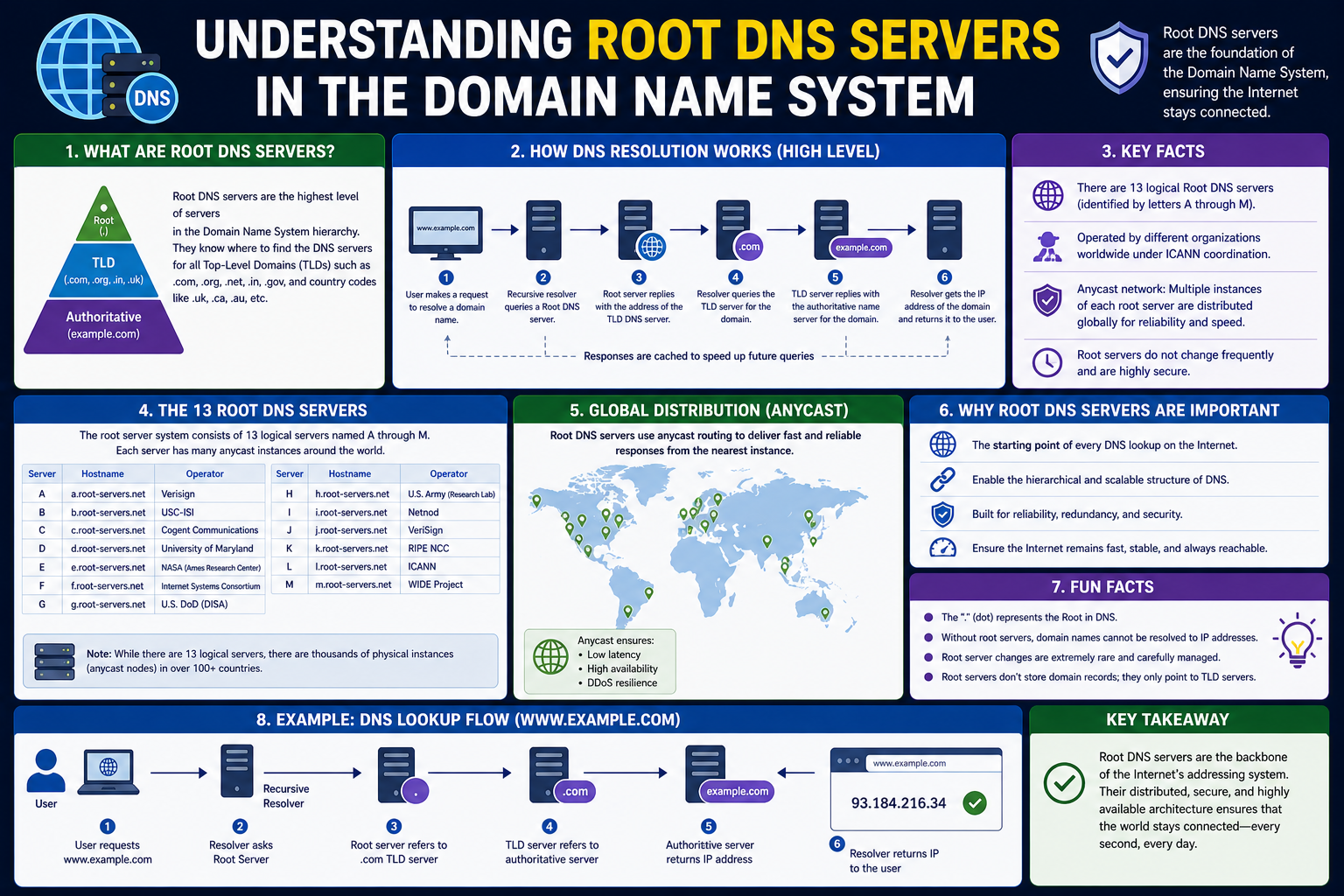
Root DNS servers are the highest level of authority in the Domain Name System, acting as the first step in translating human-friendly domain names into machine-readable IP addresses. They do not store the full address of every website on the internet. Instead, they maintain a critical reference point that guides DNS queries toward the correct direction. Whenever a user tries to access a website, these servers are part of the initial infrastructure that helps locate where that website can be found within the global network. Without them, the process of finding online destinations would become slow, unorganized, and unreliable.
Understanding the Role of DNS Hierarchy
The Domain Name System is structured in a layered hierarchy, similar to an inverted tree. At the top of this structure sit the root DNS servers, followed by top-level domains and then authoritative name servers that contain specific website data. Each layer has a distinct responsibility in narrowing down the search for a domain name. The root DNS servers are responsible for identifying where a request should go next, rather than providing the final answer. This structured flow ensures that internet navigation remains efficient even with billions of active domains.
How Root DNS Servers Fit into Internet Navigation
When a user enters a website address into a browser, the request begins a journey through several DNS layers. The root DNS servers act as the starting point of this journey. They receive queries from DNS resolvers and respond with directions to the appropriate top-level domain servers. This means they function more like a directory assistance system rather than a storage system. Their primary purpose is to ensure that the resolver knows which path to follow next in order to eventually locate the correct website.
Function of the Root Zone in DNS Structure
The root DNS servers rely on a critical dataset known as the root zone. This zone contains information about all recognized top-level domains and the servers responsible for them. When a request reaches a root server, it uses this root zone data to determine where to forward the query. The root zone does not include individual domain records but instead focuses on the highest level of categorization within the DNS system. This makes it a compact but extremely powerful component of internet infrastructure.
Physical Distribution and Global Structure
Although the DNS system refers to a limited number of root server identities, these are not single machines. Instead, each identity represents a large network of distributed servers located across multiple regions worldwide. This distribution ensures that requests can be handled efficiently regardless of user location. The system is designed in such a way that users are always routed to the nearest or most responsive server instance. This global spread improves speed, reduces latency, and strengthens overall system reliability.
Anycast Technology in Root Server Operations
A key reason root DNS servers remain stable under heavy demand is the use of routing technology that allows multiple servers to share the same identity. Through this approach, user requests are automatically directed to the closest or most optimal server location. This not only balances traffic but also protects the system from overload. If one server becomes unavailable, others immediately take over its role without affecting the user experience. This design ensures continuous operation even during extremely high traffic conditions.
Role of DNS Resolvers in Communication with Root Servers
DNS resolvers act as intermediaries between users and the DNS hierarchy. When a user requests a website, the resolver first checks if it already has the information stored locally. If not, it contacts a root DNS server to begin the lookup process. The root server does not provide the final IP address but instead directs the resolver toward the correct top-level domain server. This step-by-step communication ensures that queries move through an organized pathway rather than random searching across the internet.
Step-by-Step Flow of a DNS Request
The process of resolving a domain name involves multiple stages. First, the user initiates a request by entering a web address. The resolver then checks its cache for a stored response. If no data is available, it sends a query to a root DNS server. The root server responds with guidance pointing to the appropriate top-level domain server. From there, the resolver continues the search through authoritative servers until it reaches the exact IP address. This layered approach ensures accuracy and efficiency in every lookup.
Importance of Caching in DNS Efficiency
Caching plays a major role in reducing the workload on root DNS servers. When a resolver successfully retrieves information about a domain, it stores that data temporarily. This means future requests for the same domain can be answered without contacting the root server again. Time-to-live values determine how long this data remains stored before it must be refreshed. By reducing repeated queries, caching significantly improves performance and decreases unnecessary strain on the DNS infrastructure.
Load Handling and Global Traffic Distribution
Root DNS servers handle an extremely large volume of requests originating from all over the world. To manage this load effectively, the system is built with redundancy and distribution in mind. Multiple server instances share the responsibility of handling traffic, ensuring no single point becomes overwhelmed. This design allows the DNS system to function smoothly even during periods of unusually high demand. The distributed nature of the system is one of the key reasons the internet remains stable and responsive.
Security Importance of Root DNS Infrastructure
Because root DNS servers are at the highest level of the internet’s addressing system, they are considered critical infrastructure. Any disruption at this level could affect large portions of online communication. For this reason, multiple protective mechanisms are in place to safeguard their operation. These include traffic filtering, redundancy, and global coordination between operators. The goal is to ensure that the root layer remains stable even under adverse conditions or targeted disruption attempts.
DNS Security Enhancements and Verification Mechanisms
To improve trust in DNS responses, additional security layers are used to verify the authenticity of data being exchanged. These mechanisms ensure that responses received from DNS servers have not been altered or forged. Digital validation techniques help confirm that users are being directed to legitimate destinations. This is especially important at the root level, where incorrect data could cascade into widespread routing issues across the internet.
Why Root DNS Servers Are Essential for Internet Stability
Every online activity depends on accurate and fast domain resolution. Root DNS servers form the foundation of this process by guiding the initial step of every lookup request. Without them, DNS resolvers would have no reliable starting point for navigating the domain system. Their presence ensures that billions of daily internet requests can be processed in an organized and predictable manner. This makes them one of the most important components supporting global connectivity.
Deep Function of Root DNS Servers in Query Processing
Root DNS servers operate as the initial coordination point in every domain name lookup process. When a resolver receives a request for a website, it begins by checking local memory, but if no record exists, the query is forwarded upward. At this stage, the root DNS server evaluates the request and identifies which top-level domain is responsible for handling it. Instead of providing the final destination, it supplies directional guidance that allows the resolver to continue the lookup process efficiently. This structured delegation ensures that no single system is overloaded with complete responsibility for all internet addresses.
Interaction Between Root Servers and Recursive Resolvers
Recursive resolvers are designed to perform the heavy lifting of DNS lookups on behalf of users. They communicate directly with root DNS servers when they lack cached information. The root server’s response is not an IP address of a website but a referral to another set of servers closer to the final destination. This interaction creates a controlled flow of information where each step narrows down the search space. The relationship between resolvers and root servers is essential for maintaining speed and accuracy across global internet activity.
Root Hints and Initial DNS Knowledge
Every DNS resolver must begin with a basic reference set known as root hints. These hints contain the essential addresses of root DNS servers, allowing resolvers to know where to send their first query. Without this initial reference, resolvers would have no starting point for domain resolution. Root hints are periodically updated to reflect changes in server distribution or configuration. This ensures that resolvers always maintain accurate pathways to the root level of the DNS system.
Structural Design of Root DNS Architecture
The architecture of root DNS servers is designed for extreme resilience and redundancy. Instead of relying on a single centralized system, the infrastructure is distributed across many independent physical servers. These servers are strategically placed in multiple geographic locations to ensure global accessibility. Each server instance performs the same function, meaning there is no single point of failure. This distributed structure ensures continuous availability even if some servers become unreachable due to technical or environmental issues.
Role of Anycast Routing in Global Performance
Anycast routing is a key technology that enhances the performance and reliability of root DNS servers. It allows multiple servers to share the same IP identity while being located in different regions. When a DNS query is sent, the network automatically directs it to the nearest or most efficient server instance. This reduces latency and improves response time significantly. It also provides built-in redundancy, as traffic can be rerouted instantly if one server becomes overloaded or unavailable.
Efficiency Through Geographic Distribution
The global distribution of root DNS servers ensures that no matter where a user is located, their query can be resolved quickly. Servers placed in different regions reduce the physical distance that data must travel. This minimizes delays and enhances the responsiveness of the DNS system. Geographic distribution also helps balance traffic loads by spreading requests across multiple locations. This design principle is essential for supporting the massive scale of global internet usage.
Communication Flow Between DNS Layers
The DNS system operates in a layered communication flow where each level has a specific role. When a query reaches the root DNS server, it does not move directly to the final destination. Instead, the root server identifies the appropriate top-level domain server. That server then directs the resolver further down the hierarchy until the authoritative server is reached. This layered communication ensures that each server only handles a specific portion of the resolution process, reducing complexity and improving efficiency.
Handling of High-Volume Query Traffic
Root DNS servers process an enormous number of queries every second from users across the world. To manage this load effectively, the system is designed with scalability in mind. Traffic is distributed across multiple server instances, ensuring that no single node becomes a bottleneck. Load balancing mechanisms help distribute requests evenly, while caching at lower DNS levels reduces repeated queries. This combination of strategies allows the system to maintain stability even during peak usage periods.
Role of Root Zone Management Authority
The root zone is managed through a highly controlled and coordinated process involving multiple authoritative bodies. This ensures that any changes to the DNS root system are carefully reviewed and validated before implementation. The root zone contains essential information about top-level domains and their corresponding servers. Because this data is foundational to the entire internet structure, even small modifications require strict verification procedures. This governance model ensures consistency and trust across the global DNS ecosystem.
Synchronization of Root Zone Data
All root DNS servers must maintain synchronized root zone data to ensure consistent responses worldwide. Whenever updates are made, they are distributed across all server instances. This synchronization process ensures that every root server provides identical responses to identical queries. Consistency is critical because any mismatch could lead to incorrect routing of internet traffic. Automated systems are used to propagate updates quickly and accurately across the entire root server network.
Importance of Redundancy in DNS Stability
Redundancy is a fundamental principle in the design of root DNS infrastructure. Multiple copies of servers and data exist simultaneously to prevent service interruption. If one server fails or becomes unreachable, others immediately take over its role. This redundancy ensures uninterrupted service even in the presence of hardware failures or network disruptions. It also protects the system from targeted overload attempts by distributing traffic across many nodes.
Caching Behavior and Its Impact on Root Queries
Caching plays a significant role in reducing the workload on root DNS servers. Once a resolver receives information about a top-level domain, it stores that data temporarily. Future requests for the same domain can be resolved without contacting the root server again. This reduces unnecessary traffic and improves overall system efficiency. Caching also speeds up user experience by minimizing the time required to complete DNS lookups.
Time-Based Data Expiry in DNS Systems
DNS records are not stored indefinitely in cache systems. Instead, they are assigned expiration values that determine how long they remain valid. Once this time period expires, the resolver must refresh the information by contacting higher-level servers again. This ensures that outdated data does not persist in the system. Time-based expiry mechanisms maintain accuracy while still allowing caching to improve performance.
Load Distribution and Network Optimization
To maintain optimal performance, root DNS traffic is continuously balanced across multiple server locations. Network routing systems evaluate the best available path for each query. This ensures that no single server becomes overwhelmed with requests. Load distribution also improves response times by directing queries to the most efficient server instance. This dynamic optimization is essential for maintaining global DNS performance under varying traffic conditions.
Role of Coordination Among Global Operators
Root DNS infrastructure is maintained through international collaboration among multiple independent organizations. These operators coordinate to ensure that the system remains stable, secure, and up to date. They share operational responsibilities and follow standardized protocols to maintain consistency. This collaborative structure ensures that no single entity has full control over the entire system, reducing the risk of centralized failure or manipulation.
Resilience Against System Disruptions
The root DNS system is designed to withstand various types of disruptions, including hardware failures, network outages, and large-scale traffic spikes. Its distributed architecture ensures that alternative servers can immediately take over if one becomes unavailable. Traffic rerouting mechanisms allow queries to continue flowing without interruption. This resilience is essential for maintaining uninterrupted global internet access.
Importance of Root DNS in Global Connectivity
Root DNS servers form the foundation of all internet communication by enabling domain name resolution at the highest level. Every website visit, application request, and online service depends on this system functioning correctly. Without root DNS servers, users would not be able to navigate the internet using familiar domain names. Instead, they would need to rely on numerical addresses, which would significantly reduce usability and accessibility.
Scalability Challenges in Modern Internet Growth
As the number of connected devices continues to grow, root DNS servers face increasing demand. New technologies and services generate a higher volume of DNS queries than ever before. This requires continuous scaling of infrastructure to ensure consistent performance. The system must evolve to handle not only increased traffic but also more complex routing requirements introduced by modern internet applications.
Adaptation to Emerging Network Technologies
Modern network environments introduce new challenges for DNS infrastructure, including mobile connectivity, cloud-based systems, and distributed computing models. Root DNS servers must remain compatible with these evolving technologies while maintaining stability. Continuous updates and improvements are required to ensure that the DNS system continues to function effectively in increasingly complex network environments.
Foundational Importance of Root DNS Infrastructure
The root DNS layer remains one of the most critical components of global internet architecture. It provides the essential starting point for every domain resolution process, enabling seamless communication between users and online services. Its combination of distributed design, redundancy, and global coordination ensures that the internet remains accessible, stable, and efficient across all regions.
Security Importance of Root DNS Servers
Root DNS servers are a critical component of global internet infrastructure, which makes their security extremely important. Because every domain lookup process begins at this level, any disruption can have widespread effects across the entire network. These servers are frequently targeted by malicious actors attempting to interrupt or manipulate internet traffic. To prevent such risks, multiple layers of protection are implemented, including traffic monitoring, redundancy systems, and globally distributed architecture. The goal is to ensure that even under extreme conditions, the root DNS system continues operating without interruption.
Understanding Potential Threats to DNS Infrastructure
The most common threats to DNS infrastructure include denial-of-service attacks, data interception attempts, and spoofing techniques. In a denial-of-service scenario, attackers flood servers with excessive requests, attempting to overload them. Since root DNS servers are designed to handle massive global traffic, they are resilient, but sustained attacks can still pose challenges. Other threats involve attempting to redirect users to incorrect destinations by manipulating DNS responses. These risks highlight the importance of maintaining strict security protocols at the root level.
Role of DNSSEC in Strengthening Security
DNS Security Extensions play an essential role in protecting the integrity of DNS responses. This system adds a layer of cryptographic validation that ensures the data received from DNS servers has not been altered during transmission. When a resolver receives a response, it can verify its authenticity before trusting the information. This prevents attackers from injecting false data into the resolution process. DNSSEC does not encrypt data but focuses on ensuring its accuracy and legitimacy, which is crucial for maintaining trust in the DNS system.
Validation of Authentic DNS Responses
One of the most important functions of DNS security mechanisms is verifying that responses come from legitimate sources. Each DNS record is digitally signed, allowing resolvers to confirm that the data has not been tampered with. If a response fails validation, it is rejected. This process helps protect users from being redirected to malicious websites. At the root level, this validation is especially important because any incorrect information could affect large portions of internet traffic globally.
Global Collaboration in DNS Security Management
The security of root DNS infrastructure is maintained through international cooperation among multiple technical organizations. These groups work together to monitor threats, update security protocols, and ensure operational stability. This collaborative approach helps distribute responsibility and prevents reliance on a single controlling authority. By sharing knowledge and coordinating responses, these organizations strengthen the overall resilience of the DNS ecosystem against evolving cyber threats.
Anycast-Based Protection Against Attacks
Anycast routing is not only important for performance but also plays a significant role in security. By distributing traffic across multiple server locations, it becomes extremely difficult for attackers to target a single point of failure. Even if one server location is overwhelmed, other instances continue to operate normally. This distributed defense mechanism reduces the effectiveness of large-scale attack attempts and helps maintain continuous availability of root DNS services.
Redundancy as a Core Defense Mechanism
Redundancy is one of the strongest protective measures used in root DNS infrastructure. Multiple servers exist for the same functional role, ensuring that no single failure can disrupt the system. If one server is compromised or goes offline, others immediately take over its responsibilities. This duplication of resources ensures uninterrupted service and significantly reduces vulnerability to both technical failures and malicious attacks.
Monitoring and Detection Systems in DNS Networks
Continuous monitoring systems are used to detect unusual patterns of traffic that may indicate security threats. These systems analyze query volumes, request behavior, and network anomalies in real time. If suspicious activity is detected, automated responses can be triggered to mitigate potential damage. This proactive monitoring approach ensures that threats are identified and addressed before they can escalate into major disruptions.
Importance of Root Zone Integrity
The root zone is a highly sensitive dataset that must remain accurate and secure at all times. It contains essential information about top-level domains and their associated servers. Any unauthorized modification to this data could result in misdirection of internet traffic on a global scale. Therefore, strict validation and approval processes are used before any changes are applied. Maintaining root zone integrity is fundamental to ensuring trust in the entire DNS system.
Controlled Process for Root Zone Modifications
Any changes to the root zone follow a carefully structured process that involves multiple stages of verification. These changes may include adding new top-level domains or updating server information. Before implementation, each modification undergoes detailed review and testing. This ensures that no unintended disruptions occur. Once approved, updates are distributed across all root servers in a synchronized manner to maintain consistency worldwide.
Stability Through Distributed Governance
The governance of root DNS infrastructure is intentionally distributed to prevent centralized control. Multiple organizations share responsibility for different aspects of management, including technical oversight and policy enforcement. This distributed governance model enhances stability by reducing the risk of single-point failure. It also ensures transparency and accountability in decision-making processes related to DNS operations.
Performance Optimization in High-Traffic Environments
Root DNS servers are designed to handle extremely high volumes of traffic efficiently. Performance optimization techniques such as load balancing and intelligent routing are used to distribute requests evenly. These mechanisms ensure that no single server becomes overloaded. By optimizing traffic flow, the system maintains fast response times even during peak global usage periods.
Caching Strategies for Reducing Server Load
Caching is an essential strategy used to minimize direct queries to root DNS servers. Once a resolver obtains information about a domain, it stores that data temporarily for future use. This significantly reduces the number of repeated requests sent to root servers. As a result, overall system efficiency improves, and response times for users become faster. Proper cache management ensures that data remains both accurate and readily accessible.
Time-Based Expiration of DNS Records
DNS data stored in caches is not permanent. Each record is assigned a specific duration after which it becomes invalid. Once this time expires, the resolver must request fresh information from higher-level servers. This ensures that outdated or incorrect data does not persist within the system. Time-based expiration helps maintain a balance between performance optimization and data accuracy.
Traffic Distribution Across Global Networks
Global traffic distribution ensures that DNS queries are handled efficiently regardless of user location. By spreading requests across multiple server regions, the system avoids congestion and reduces latency. This approach allows users to receive faster responses while also maintaining stability under heavy load conditions. Distributed traffic handling is a fundamental principle of modern DNS architecture.
Scalability Requirements in Expanding Internet Usage
As internet usage continues to grow, DNS infrastructure must scale accordingly. The increasing number of connected devices and online services generates a higher volume of domain queries. Root DNS servers must be capable of handling this expansion without performance degradation. Scalability is achieved through distributed infrastructure, advanced routing systems, and continuous optimization of server performance.
Impact of Emerging Digital Technologies on DNS
New technologies such as cloud computing, mobile applications, and distributed systems have increased the complexity of DNS operations. These advancements require DNS infrastructure to adapt continuously to new patterns of usage. Root DNS servers must remain compatible with these evolving environments while maintaining stability and security. This ongoing adaptation ensures that DNS remains effective in modern digital ecosystems.
Resilience Against System Failures and Disruptions
Resilience is a key design principle of root DNS infrastructure. The system is built to continue functioning even when individual components fail. Through redundancy, geographic distribution, and automated failover mechanisms, DNS services remain available under a wide range of conditions. This resilience ensures that global internet access is not disrupted by localized technical issues.
Coordination Between DNS System Layers
The DNS system operates through coordinated interaction between multiple layers, each with a specific role. Root servers provide initial direction, top-level domain servers refine the search, and authoritative servers deliver final answers. This layered coordination ensures that no single system is overloaded with responsibility. It also improves efficiency by dividing the resolution process into manageable stages.
Importance of System Consistency Across Servers
Consistency across all root DNS servers is essential for maintaining accurate internet navigation. Every server must provide identical responses to ensure users receive reliable results regardless of location. Synchronization processes ensure that updates are applied uniformly across all instances. This consistency prevents discrepancies that could otherwise lead to incorrect routing of internet traffic.
Ongoing Evolution of DNS Infrastructure
The DNS system continues to evolve in response to changing technological demands. Improvements in security, performance, and scalability are continuously being developed to keep pace with global internet growth. Root DNS servers remain at the center of this evolution, adapting to new challenges while maintaining their foundational role. Their ongoing development ensures that the internet remains stable, accessible, and efficient for future generations of users.
Challenges in Managing Root DNS Infrastructure
Root DNS servers operate in an environment that demands extreme reliability, but they also face continuous challenges due to the scale and complexity of the internet. One of the biggest difficulties is handling the ever-increasing volume of global DNS queries. As more devices, applications, and services connect to the internet, the number of requests directed toward DNS infrastructure grows exponentially. Even though root servers are not queried for every request, their role at the beginning of the resolution chain means they still experience massive and consistent traffic patterns that require careful balancing and optimization.
Pressure From Global Internet Expansion
The expansion of the internet has introduced new pressures on DNS systems, especially at the root level. Every new website, service, or digital platform ultimately depends on DNS resolution to become accessible. This means the root layer must constantly support an expanding ecosystem of domains and services. The challenge is not only about handling more traffic but also ensuring that the system remains stable as the structure of the internet becomes more complex. This continuous growth requires ongoing improvements in infrastructure design and traffic management strategies.
Impact of Emerging Technologies on DNS Load
Modern technologies such as cloud computing, mobile applications, and distributed systems have significantly increased DNS activity. These technologies generate frequent and dynamic domain lookups, which add additional load to the DNS hierarchy. Although caching helps reduce repeated queries, the initial resolution process still depends on root-level guidance. As applications become more interconnected and real-time in nature, DNS systems must adapt to handle faster and more frequent query patterns without delays or failures.
Role of Internet of Things in DNS Growth
The rise of connected devices has introduced a new dimension of DNS demand. Smart devices, sensors, and automated systems continuously communicate with online services, each requiring domain resolution. This creates a constant stream of background DNS activity that adds to the overall load. Even though individual devices generate small amounts of traffic, the combined global scale significantly increases pressure on DNS infrastructure. Root DNS servers must remain capable of supporting this growing and distributed demand efficiently.
Complexity of Modern Network Environments
Today’s internet environment is far more complex than traditional network structures. Users access services from multiple devices, networks, and locations, often switching between mobile and fixed connections. This dynamic behavior increases DNS query variability and unpredictability. Root DNS servers must remain flexible enough to support these changing conditions while maintaining consistent performance. The system must also integrate smoothly with evolving routing protocols and security frameworks used in modern networks.
Need for Continuous Infrastructure Scaling
Scalability is a constant requirement for root DNS infrastructure. As internet usage increases, the system must expand its capacity without affecting performance or stability. This is achieved through distributed architecture, additional server instances, and improved load-balancing techniques. Scaling is not a one-time process but an ongoing effort that ensures the system remains capable of handling future demands. Without continuous scaling, DNS performance would degrade under growing global usage.
Importance of Operational Redundancy
Redundancy plays a crucial role in ensuring uninterrupted DNS service. Multiple server instances operate simultaneously to provide backup in case of failures. If one server becomes unavailable due to technical issues or external disruption, others automatically take over its responsibilities. This redundancy ensures that users experience no interruption in domain resolution services. It also protects the system from localized failures affecting global connectivity.
Maintaining System Reliability Under Stress
Root DNS servers are designed to remain reliable even under extreme conditions. High traffic spikes, unexpected outages, or malicious attempts to disrupt service must not affect overall system stability. This reliability is achieved through a combination of distributed architecture, intelligent routing, and automated recovery mechanisms. These systems work together to ensure that DNS resolution continues smoothly regardless of external challenges.
Importance of Real-Time Traffic Management
Real-time traffic management is essential for maintaining DNS performance. Network systems continuously monitor query patterns and adjust routing decisions based on current conditions. If a particular server becomes heavily loaded, traffic is redistributed to other available nodes. This dynamic balancing ensures that no single part of the system becomes overwhelmed. It also helps maintain consistent response times for users around the world.
Adaptation to Changing Internet Protocols
As internet protocols evolve, DNS infrastructure must adapt accordingly. New standards and communication methods may introduce changes in how domain resolution requests are processed. Root DNS servers must remain compatible with these updates while preserving backward compatibility with existing systems. This balance ensures that both modern and legacy systems can function together without disruption.
Increasing Importance of Cybersecurity Preparedness
Cybersecurity threats continue to evolve in complexity, requiring constant vigilance in DNS protection strategies. Root DNS servers must be prepared to defend against both large-scale attacks and subtle manipulation attempts. This requires continuous monitoring, rapid response systems, and global coordination between infrastructure operators. Security is not a static feature but an ongoing process that evolves alongside emerging threats.
Role of Automation in DNS Management
Automation plays an important role in maintaining efficiency and stability in DNS operations. Automated systems handle tasks such as traffic routing, load balancing, and anomaly detection. This reduces the need for manual intervention and allows faster responses to changing conditions. Automation also improves accuracy by minimizing human error in critical infrastructure management tasks.
Global Coordination and Shared Responsibility
The management of root DNS infrastructure relies on cooperation between multiple international organizations. These groups share responsibility for maintaining system stability, implementing updates, and responding to security incidents. This shared responsibility model ensures that no single entity controls the entire system. It also strengthens global trust in the DNS infrastructure by distributing operational authority.
Ensuring Consistency Across Distributed Systems
Consistency is essential in a globally distributed DNS environment. All root DNS server instances must provide identical responses to ensure accurate domain resolution. Synchronization systems are used to distribute updates across all servers simultaneously. This prevents inconsistencies that could lead to incorrect routing or service disruptions. Maintaining consistency is a continuous operational priority.
Future Demands on DNS Infrastructure
The future of DNS infrastructure will be shaped by increasing internet usage, new technologies, and evolving digital services. As connectivity expands, the demand for faster, more secure, and more reliable DNS resolution will continue to grow. Root DNS servers will need to evolve further to handle these demands while maintaining their foundational role in internet communication. Their continued development will remain essential for sustaining global digital connectivity.
Conclusion
Root DNS servers form the foundational backbone of the entire internet naming system, ensuring that every website request can be accurately translated into a usable network address. They do not directly provide website data, but instead guide DNS resolvers step by step toward the correct destination through a structured and hierarchical system. This makes them an essential starting point for every online connection, regardless of location, device, or service being accessed.
Their strength lies in their distributed design, global redundancy, and advanced routing systems, which allow them to handle massive levels of traffic while maintaining stability and speed. Technologies like caching, anycast routing, and continuous synchronization further enhance their efficiency and reliability, ensuring that the system remains responsive even under heavy global demand.
At the same time, root DNS servers play a critical role in maintaining security and trust across the internet. With protective mechanisms, verification systems, and global coordination between operators, they help safeguard the integrity of domain name resolution and prevent disruptions or malicious manipulation. Their resilience ensures that the internet remains accessible even in the face of technical failures or cyber threats.
As the internet continues to grow, the importance of root DNS infrastructure increases even further. New technologies, expanding digital ecosystems, and rising user demand place continuous pressure on the system to scale and adapt. Despite these challenges, root DNS servers remain a stable and reliable core component of global connectivity.
In simple terms, they are the unseen but essential guides of the internet—quietly ensuring that every online journey begins on the right path and reaches the correct destination without interruption.