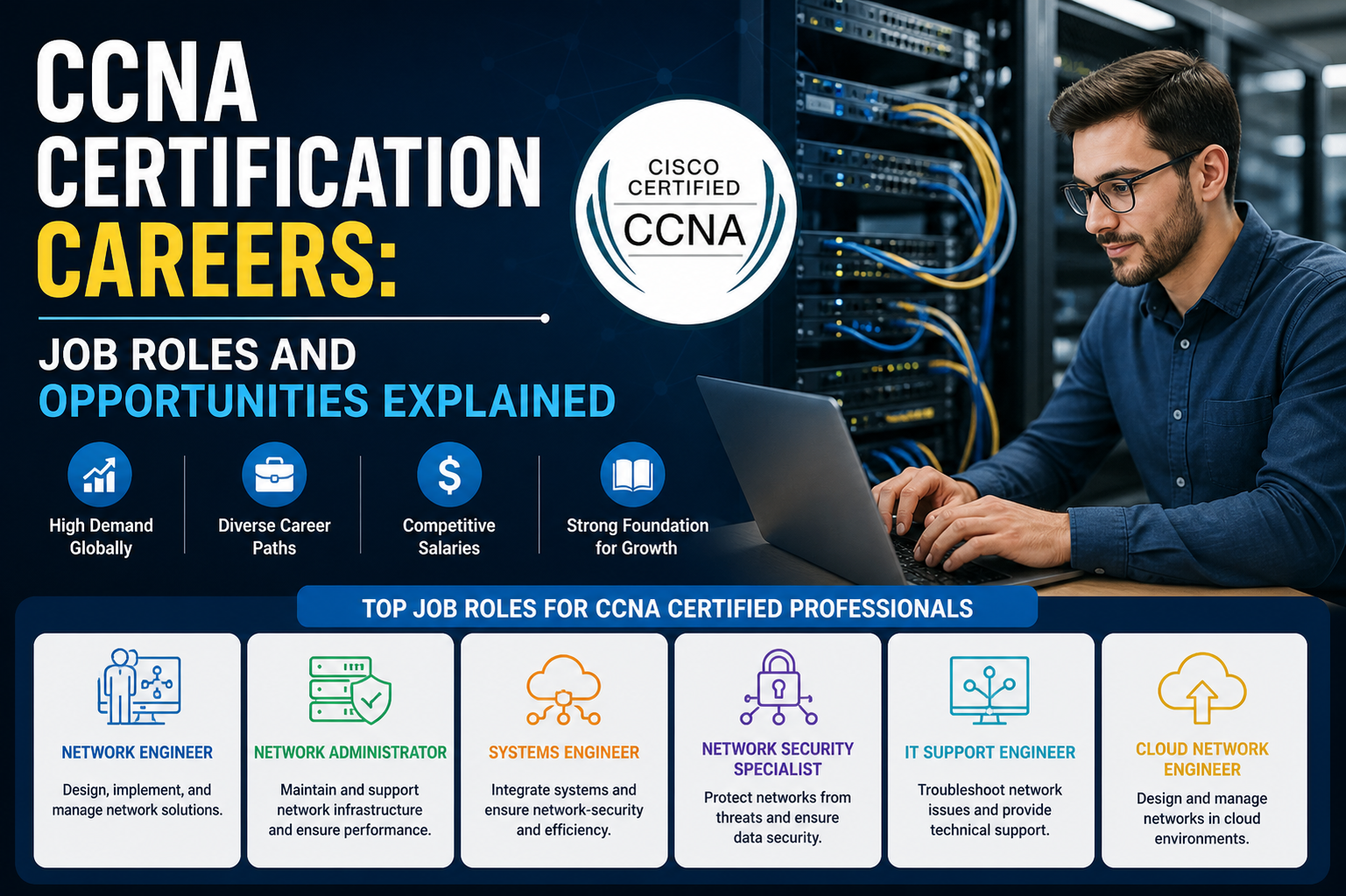
The CCNA certification is widely recognized as one of the most important entry-level qualifications in the networking field. It is designed for individuals who want to build a strong foundation in IT networking and move toward professional roles in system support, infrastructure management, and network engineering. Once you complete this certification, you are essentially signaling to employers that you understand how modern networks operate and that you can handle essential networking tasks in real-world environments.
Many learners pursue CCNA because it opens doors to technical careers that are stable, in-demand, and continuously evolving. Organizations today rely heavily on secure and efficient network systems, which makes certified professionals valuable assets. Whether you are aiming for your first IT job or planning to upgrade your current role, CCNA acts as a stepping stone toward multiple technical career paths.
The value of CCNA does not come from just theory; it comes from practical networking knowledge. Employers look for individuals who can configure devices, troubleshoot connectivity issues, understand routing principles, and maintain network security fundamentals. This makes CCNA holders suitable for a wide range of entry and mid-level positions in the IT industry.
Evolution of Cisco Certification Structure and Career Pathways
Cisco has updated its certification framework over time to better align with modern IT demands. Earlier, there were multiple CCNA certifications focusing on specific areas such as routing and switching, security, collaboration, and cyber operations. This made the certification path more specialized but also more complex for beginners trying to choose a direction.
The current structure is more streamlined and organized into five certification levels, which helps candidates clearly understand their career progression. These levels include Entry, Associate, Professional, Expert, and Architect. Each level represents a deeper stage of technical expertise and responsibility in the IT field.
At the entry level, certifications focus on foundational IT skills such as basic networking and support. The associate level includes certifications like CCNA, which is considered the most important starting point for networking professionals. It provides broad knowledge that applies across multiple job roles rather than focusing on a single specialization.
As professionals move into the professional and expert levels, they begin to specialize in advanced networking areas such as enterprise infrastructure, security systems, data centers, and service provider networks. These roles require more experience and deeper technical knowledge.
The architect level is the highest certification tier and is designed for professionals who are responsible for designing large-scale network systems at an enterprise level. This tier is less about technical troubleshooting and more about strategic design and architecture planning.
Understanding the Modern CCNA Certification Scope
The current CCNA certification is designed as a unified exam that covers a broad range of networking topics. Unlike older versions that focused on specific areas, the modern CCNA aims to prepare candidates for general entry-level networking roles. It is ideal for individuals who have around one year of practical or theoretical experience in IT.
One important aspect of CCNA is that it does not require any formal prerequisite certification. Anyone with interest in networking can attempt it, although having basic IT knowledge is highly recommended. This makes CCNA accessible to students, career changers, and IT support professionals who want to grow in the networking field.
The certification focuses on building a strong foundation in networking concepts, ensuring that candidates can handle real-world tasks in IT environments. It is not just about memorizing theories but understanding how networks function in practical business settings.
CCNA is also globally recognized, meaning it can be useful in many countries and industries. Companies value it because it demonstrates both technical understanding and problem-solving ability in network-related tasks.
Core Networking Fundamentals Covered in CCNA
One of the most important areas in CCNA is networking fundamentals. This section helps learners understand how data moves across networks and how devices communicate with each other. It introduces essential concepts such as IP addressing, subnetting, network topologies, and basic protocols.
Candidates also learn about the structure of local area networks and wide area networks, which are essential for understanding how businesses connect their internal systems with external networks. This knowledge is crucial for roles that involve managing office networks or supporting organizational IT infrastructure.
Another key focus is understanding how devices such as routers and switches operate. These devices are the backbone of any network, and CCNA teaches how they are configured and managed. Learners also explore how data packets travel from one device to another and how network performance can be optimized.
Security fundamentals are also included in this section. Although CCNA is not a dedicated security certification, it introduces basic security principles such as access control, authentication, and protection against common threats. This helps professionals maintain secure network environments.
Network Access and Infrastructure Connectivity Concepts
CCNA also covers network access, which focuses on how devices connect to a network. This includes both wired and wireless technologies. Understanding how users and devices gain access to a network is essential for managing real-world IT systems.
In this area, learners study switching concepts, VLANs, and trunking. These technologies help segment networks and improve performance and security. VLANs, for example, allow organizations to divide large networks into smaller, manageable sections.
Wireless networking is another important topic. With the increasing use of mobile devices and remote work environments, wireless connectivity has become essential. CCNA introduces how wireless networks are configured and secured.
Infrastructure connectivity also includes understanding how different networks communicate with each other using routing protocols. This helps ensure that data is delivered efficiently across different locations within an organization or between multiple systems.
IP Connectivity and Routing Essentials
A major part of CCNA is IP connectivity, which focuses on how devices communicate using IP addresses. This section includes routing concepts that determine how data is sent from one network to another.
Candidates learn how routers make decisions based on routing tables and how different routing protocols help determine the best path for data transmission. These concepts are essential for maintaining efficient network communication.
Subnetting is another critical skill covered in this area. It allows network administrators to divide large networks into smaller segments, improving performance and reducing congestion. Understanding subnetting is often considered one of the most important skills in networking careers.
CCNA also introduces troubleshooting techniques for connectivity issues. This helps professionals identify problems in network communication and apply solutions effectively.
IP Services and Network Optimization Concepts
In addition to connectivity, CCNA includes IP services that support network functionality. These services include DHCP, DNS, NAT, and other essential protocols that help networks operate smoothly.
DHCP is used to automatically assign IP addresses to devices, reducing manual configuration work. DNS helps translate domain names into IP addresses, making it easier for users to access websites and services.
NAT plays an important role in network security and IP address management. It allows multiple devices to share a single public IP address, which is commonly used in home and business networks.
This section also introduces quality of service concepts, which help prioritize network traffic. This ensures that important data, such as voice or video communication, receives higher priority over less critical traffic.
Certification Validity and Professional Expectations
Once earned, the CCNA certification remains valid for a limited period and must be renewed through continuing education or by passing a recertification exam. This ensures that professionals stay updated with evolving networking technologies.
The certification is designed for individuals who are beginning their journey in IT networking but already have some understanding of technical systems. It helps bridge the gap between basic IT knowledge and professional-level networking skills.
Employers expect CCNA-certified professionals to have hands-on knowledge of networking tools, configuration processes, and troubleshooting techniques. This makes the certification highly practical and industry-focused.
At this stage, CCNA serves as a foundation for more advanced certifications and specialized career paths in networking, cybersecurity, and infrastructure management.
Job Market Value of CCNA Certification
The CCNA certification holds strong value in the IT job market because it represents a verified understanding of networking fundamentals that are essential in almost every modern organization. Companies depend heavily on stable and secure networks, and they actively seek professionals who can maintain and troubleshoot these systems efficiently. CCNA helps bridge the gap between theoretical knowledge and practical job-ready skills, which makes certified candidates more attractive to employers.
In many organizations, hiring managers prefer candidates who already understand networking concepts rather than training someone from scratch. CCNA-certified individuals are often seen as prepared for real-world technical environments, which reduces onboarding time for employers. This gives candidates an advantage over applicants who may have general IT knowledge but lack structured networking training.
Another important aspect is that CCNA is not limited to one specific industry. It is relevant in healthcare, education, finance, government, telecom, and almost every sector that relies on digital infrastructure. This wide applicability increases job opportunities and allows professionals to explore multiple career paths.
CCNA also acts as a foundational credential that supports long-term career growth. Many advanced roles in networking and cybersecurity require or prefer CCNA-level knowledge as a starting point. This makes it a stepping stone toward higher-paying and more specialized positions.
How CCNA Skills Translate Into Real Job Responsibilities
The skills gained through CCNA are directly applicable to everyday IT tasks in professional environments. One of the most important abilities is troubleshooting network issues, which is a core responsibility in almost all networking-related roles. Professionals must identify why systems are not communicating properly and apply solutions quickly to reduce downtime.
Another key skill is configuring and managing network devices such as routers and switches. In real-world jobs, this involves setting up network infrastructure, applying security configurations, and ensuring that devices communicate efficiently. These tasks are essential for maintaining business operations.
CCNA also teaches how to manage IP addressing and subnetting, which are critical for organizing large networks. In a job environment, this skill helps ensure that devices are properly assigned addresses and that networks are structured efficiently to avoid congestion or conflicts.
Security awareness is another practical outcome of CCNA training. Professionals are expected to implement basic security measures such as access control lists, secure passwords, and network segmentation. These actions help protect organizations from unauthorized access and cyber threats.
Network Administrator Role and Responsibilities
The network administrator role is one of the most common positions for CCNA-certified professionals. This role focuses on maintaining the daily operation of computer networks within an organization. Network administrators ensure that employees have reliable access to systems, applications, and communication tools.
One of their main responsibilities is installing and configuring network hardware such as routers, switches, and firewalls. They also monitor network performance to detect and resolve issues before they impact users. This requires strong troubleshooting skills and a deep understanding of network behavior.
Network administrators are also responsible for maintaining security protocols. This includes managing user access, updating security configurations, and ensuring that the network is protected from external threats. They may also work closely with cybersecurity teams to implement protective measures.
In addition, they handle routine maintenance tasks such as software updates, system backups, and performance optimization. These responsibilities ensure that the network remains stable and efficient over time.
The role can vary depending on the size of the organization. In smaller companies, a network administrator may handle a wide range of IT tasks, while in larger organizations, the role may be more specialized and focused on specific network segments.
Network Engineer Role and Career Growth Path
The network engineer role is typically a step above network administration and involves more advanced responsibilities. Network engineers are responsible for designing, implementing, and maintaining complex network systems that support business operations.
Unlike administrators who primarily manage existing systems, network engineers focus on building and improving network infrastructure. This includes planning network architecture, selecting appropriate hardware and software, and ensuring scalability for future growth.
They also work on optimizing network performance by analyzing traffic patterns and identifying bottlenecks. This helps improve speed, reliability, and efficiency across the organization’s systems.
Network engineers often participate in major projects such as network upgrades, system migrations, and infrastructure expansion. These tasks require strong technical knowledge and the ability to work with multiple teams.
In many cases, network engineers also handle advanced troubleshooting tasks that go beyond basic connectivity issues. They must understand complex routing protocols, security systems, and enterprise-level networking solutions.
This role offers significant career growth potential because it leads to senior positions such as senior network engineer, network architect, and infrastructure specialist.
Systems Administrator Responsibilities in IT Environments
Systems administrators, often called sysadmins, play a crucial role in managing an organization’s IT infrastructure. While their responsibilities overlap with networking, they focus more broadly on servers, operating systems, and internal IT systems.
A key responsibility of a systems administrator is maintaining server performance. This includes installing operating systems, configuring server environments, and ensuring that applications run smoothly for users.
They also handle system troubleshooting, which involves diagnosing issues related to hardware, software, or network integration. Their goal is to ensure that all systems function efficiently without disruptions.
Systems administrators are also responsible for managing user accounts, permissions, and access control. This ensures that employees can securely access the resources they need while protecting sensitive data.
Backup and recovery management is another important task. Sysadmins regularly create backups of critical data and develop recovery plans to prevent data loss in case of system failures.
Although CCNA is primarily focused on networking, it provides valuable knowledge that supports systems administration roles, especially in environments where systems and networks are closely integrated.
System Engineer Role and Infrastructure Design
The system engineer role is more focused on planning and designing IT systems rather than just maintaining them. System engineers are responsible for creating the structure that supports an organization’s entire IT environment.
They work on designing integrated systems that include servers, networks, storage, and software applications. This requires a strong understanding of how different components interact with each other.
System engineers often collaborate with network engineers and systems administrators to ensure that infrastructure is efficient and scalable. Their decisions impact the long-term performance and reliability of IT systems.
One of their key responsibilities is evaluating new technologies and determining how they can be integrated into existing systems. This helps organizations stay updated with technological advancements.
They also play a major role in implementing large-scale IT projects such as system upgrades, cloud migrations, and infrastructure redesigns. These projects require careful planning and execution.
System engineers must also consider security, performance, and cost efficiency when designing systems. Their role is highly strategic and requires both technical expertise and analytical thinking.
Entry-Level IT Support and Help Desk Roles
Many CCNA-certified professionals begin their careers in IT support or help desk roles. These positions serve as an entry point into the IT industry and provide hands-on experience with real-world technical issues.
Help desk technicians are responsible for assisting users with basic technical problems such as connectivity issues, password resets, and software errors. They act as the first line of support in IT departments.
Although these roles may not be highly specialized, they are important for building foundational knowledge. Working in support environments helps professionals understand common network and system issues.
Over time, individuals in help desk roles often transition into networking positions as they gain experience and additional certifications. CCNA significantly accelerates this transition by providing relevant technical knowledge.
These roles also improve communication skills, problem-solving ability, and customer service experience, which are valuable in advanced IT positions.
Cybersecurity and Network Security Entry Roles
CCNA also provides a foundation for entry-level cybersecurity roles. While it is not a dedicated security certification, it introduces essential security concepts that are useful in security-focused careers.
One common role is security operations center analyst, where professionals monitor networks for suspicious activity and respond to potential threats. This role requires strong attention to detail and understanding of network behavior.
Another role is junior security analyst, where individuals assist in implementing security measures and analyzing potential vulnerabilities. CCNA knowledge helps in understanding how attacks may affect network infrastructure.
These roles often involve working with security tools, monitoring systems, and responding to incidents. Professionals with networking knowledge are highly valued because they understand how data flows through systems.
Cybersecurity careers often require additional certifications and training, but CCNA provides a strong starting point for entering this field.
Managed Service Provider and Technical Support Roles
Many CCNA-certified professionals also work in managed service provider environments. These companies manage IT services for multiple clients, providing networking, security, and support solutions.
In these roles, professionals handle a variety of tasks including network configuration, troubleshooting, and system monitoring across different client environments. This provides broad exposure to different technologies and systems.
Working in managed services helps professionals gain experience quickly because they deal with multiple networks and industries. This accelerates skill development and career growth.
These roles are often fast-paced and require strong problem-solving skills. CCNA training helps professionals adapt to different network environments and technical challenges.
Career Progression and Skill Development Path
CCNA is not just a certification for getting a job; it is also the beginning of a long-term career path in IT networking. Professionals often start in support or junior roles and gradually move into specialized positions.
With experience, individuals can progress into senior network engineering, infrastructure architecture, cybersecurity engineering, and cloud networking roles. Each step requires deeper technical knowledge and hands-on experience.
Continuous learning is essential in this field because networking technologies evolve rapidly. CCNA provides a strong foundation, but professionals must continue developing new skills to stay competitive.
The certification also encourages logical thinking, structured problem-solving, and technical discipline, which are valuable traits in any IT role.
Advanced Networking Career Paths After CCNA Experience
After gaining initial experience with CCNA-level knowledge, professionals often begin moving toward more advanced networking responsibilities that require deeper technical understanding and broader system awareness. At this stage, career growth is no longer limited to basic support or entry-level administration. Instead, individuals start working on more complex network environments where performance, scalability, and security become critical concerns.
One common direction is moving into senior network administration roles. In these positions, professionals are responsible not only for maintaining networks but also for improving them. This includes analyzing network performance, identifying long-term inefficiencies, and planning upgrades that support organizational growth. Senior administrators often guide junior staff and act as technical decision-makers within IT teams.
Another progression path is toward specialized networking roles such as routing specialist or switching specialist. These positions focus deeply on specific areas of network infrastructure, allowing professionals to develop advanced expertise in targeted technologies. This specialization is valuable in large enterprises where networks are complex and require dedicated expertise for different components.
As professionals gain more experience, they may also transition into infrastructure-focused roles. These roles involve working on large-scale systems that integrate networking, servers, cloud environments, and security frameworks. The scope of responsibility becomes broader, requiring not only technical skills but also strategic planning and coordination across departments.
Enterprise Network Engineer Responsibilities and Scope
Enterprise network engineers work in environments where networks are large, distributed, and mission-critical. Their responsibilities extend far beyond basic configuration and troubleshooting. They are involved in designing scalable network systems that can support thousands of users, multiple locations, and high data traffic loads.
A major part of their work involves network architecture planning. This includes deciding how different branches of an organization will connect, how data will flow between systems, and how redundancy will be implemented to avoid downtime. These decisions require a deep understanding of routing protocols, network topology design, and performance optimization techniques.
Enterprise network engineers also handle advanced security integration within network systems. They work closely with cybersecurity teams to implement firewalls, intrusion detection systems, and secure communication channels. This ensures that large-scale networks remain protected against internal and external threats.
Another important responsibility is network optimization. Engineers continuously monitor traffic patterns and system performance to identify bottlenecks or inefficiencies. They then implement improvements to ensure smooth data flow and minimal latency across the network.
In addition to technical responsibilities, enterprise network engineers often participate in project planning and decision-making meetings. They help determine technology investments, upgrade cycles, and infrastructure strategies that align with business goals.
Network Security Roles and Growing Demand
Network security has become one of the most important areas in IT, and CCNA provides an initial foundation for entering this field. As organizations face increasing cyber threats, the demand for professionals who understand both networking and security continues to grow.
Entry-level security roles often involve monitoring network activity for unusual behavior. Professionals in these positions analyze logs, track potential threats, and respond to security alerts. A strong understanding of networking fundamentals is essential because security incidents often involve network traffic analysis.
Another important role is security implementation specialist. These professionals help configure security devices such as firewalls and access control systems. They ensure that only authorized users can access sensitive parts of the network.
As individuals progress further, they may move into roles such as security engineer or cybersecurity analyst. These positions require deeper knowledge of encryption, threat modeling, vulnerability assessment, and incident response planning.
Network security professionals also play a key role in compliance and policy enforcement. They ensure that organizational systems meet industry regulations and internal security standards. This includes regular audits and updates to security configurations.
CCNA helps prepare individuals for these roles by introducing them to basic security principles, but additional certifications and hands-on experience are usually required for advanced security positions.
Cloud Networking and Modern Infrastructure Roles
Modern IT environments are increasingly shifting toward cloud-based infrastructure, creating new opportunities for networking professionals. CCNA provides foundational knowledge that helps individuals transition into cloud networking roles.
Cloud network engineers are responsible for managing and configuring network systems within cloud platforms. This includes setting up virtual networks, managing connectivity between cloud and on-premise systems, and ensuring secure data transfer between environments.
These professionals work with scalable infrastructure, meaning networks can expand or shrink based on demand. This requires a strong understanding of dynamic network configuration and automated provisioning systems.
Another key responsibility is hybrid networking, where organizations use both cloud and traditional on-premise systems. Cloud network engineers ensure that both environments communicate seamlessly and securely.
They also focus on performance optimization within cloud environments. This involves managing bandwidth usage, reducing latency, and ensuring reliable connectivity across global systems.
As more organizations move to cloud computing, professionals with networking backgrounds are increasingly valuable because they understand how traditional network concepts apply in virtual environments.
Telecommunications and Service Provider Careers
Another important career path for CCNA-certified professionals is the telecommunications industry. Service providers manage large-scale networks that support internet, mobile communication, and data services for millions of users.
In these environments, network professionals work with highly complex infrastructure systems. Their responsibilities include maintaining backbone networks, managing traffic distribution, and ensuring uninterrupted service delivery.
One key role is network operations center engineer. These professionals monitor network performance in real time and respond to outages or performance issues immediately. Their work is critical for maintaining service reliability.
Telecommunications engineers also work on upgrading network capacity to support increasing data demand. This includes implementing new technologies, expanding infrastructure, and optimizing routing systems.
Service provider environments often require knowledge of advanced routing protocols and large-scale network design principles. CCNA provides the initial foundation needed to understand these concepts before progressing into more specialized training.
These roles are often high-pressure because even small network issues can impact thousands or millions of users. However, they also offer strong career growth and technical exposure.
Data Center Networking Roles and Responsibilities
Data centers are critical components of modern IT infrastructure, and networking professionals play a major role in their operation. Data center network engineers manage the communication systems that connect servers, storage systems, and applications.
One of their primary responsibilities is ensuring high-speed and reliable internal communication within the data center. This requires advanced knowledge of switching technologies and network architecture design.
They also manage redundancy systems to ensure that services remain available even during hardware or software failures. This involves designing failover systems and backup network paths.
Another key responsibility is load balancing, which distributes traffic evenly across multiple servers. This helps prevent system overload and ensures smooth performance.
Data center environments require strict security measures because they store large amounts of sensitive data. Network engineers implement security protocols to protect against unauthorized access and data breaches.
As organizations increasingly rely on cloud computing and large-scale data processing, data center networking roles continue to grow in importance and demand.
Automation and Programmability in Networking Careers
Modern networking is evolving beyond manual configuration toward automation and programmability. CCNA introduces basic concepts of automation, which serve as a foundation for more advanced roles in this area.
Network automation engineers use scripting and programming tools to manage network systems efficiently. Instead of manually configuring each device, they create automated processes that reduce human error and improve speed.
These professionals work with tools that allow centralized network management. This enables organizations to deploy changes across multiple devices simultaneously.
Automation also plays a key role in network monitoring. Systems can automatically detect issues, generate alerts, and even apply corrective actions without human intervention.
Another important area is network programmability, where professionals use APIs and software-defined networking principles to control network behavior through code. This approach makes networks more flexible and scalable.
As organizations adopt more digital transformation strategies, automation skills are becoming increasingly valuable for networking professionals.
Career Growth Through Continuous Learning and Experience
CCNA is only the beginning of a long-term career journey in networking. Real growth happens when professionals combine certification knowledge with hands-on experience in real environments.
As individuals gain more experience, they often pursue advanced certifications in specialized areas such as security, cloud networking, or enterprise infrastructure. These certifications help them move into higher-paying and more strategic roles.
Practical experience is equally important. Working on real network systems helps professionals understand complex issues that cannot always be learned through theory alone. This includes troubleshooting large-scale outages, optimizing performance, and managing infrastructure changes.
Career advancement in networking is highly dependent on skill development. Professionals who continuously update their knowledge and adapt to new technologies are more likely to move into senior roles.
Over time, CCNA serves as the foundation that supports progression into engineering, architecture, security, and cloud-based careers.
IT Infrastructure Management and Leadership Roles
As networking professionals gain significant experience beyond CCNA-level knowledge, many transition into infrastructure management roles. These positions are less about day-to-day technical troubleshooting and more about overseeing entire IT environments within an organization. At this stage, professionals are expected to understand not only how networks function but also how they support business operations at a strategic level.
IT infrastructure managers are responsible for ensuring that all networking systems, servers, storage, and communication tools work together efficiently. They coordinate between different IT teams and ensure that network performance aligns with organizational goals. This role requires both technical expertise and strong leadership abilities.
One of the key responsibilities in infrastructure management is planning and budgeting for IT resources. Professionals must evaluate current systems, identify future needs, and determine how to scale infrastructure effectively. This involves making decisions about hardware upgrades, software implementation, and network expansion strategies.
They also play a major role in risk management. This includes identifying potential system failures, security vulnerabilities, and performance bottlenecks before they impact business operations. Preventive planning becomes more important than reactive troubleshooting at this level.
Infrastructure leaders often collaborate with senior executives to align IT strategies with business objectives. This ensures that technology investments support long-term organizational growth and efficiency.
Network Architect Career Path and Responsibilities
One of the most advanced career paths in networking is becoming a network architect. This role focuses on designing large-scale, complex network systems that support enterprise-level operations. Unlike engineers or administrators, network architects work at a conceptual and strategic level.
Their primary responsibility is designing network structures that are scalable, secure, and efficient. This includes deciding how data centers, branch offices, cloud systems, and remote users will connect and communicate. Every design decision must support both current needs and future expansion.
Network architects also evaluate new technologies and determine how they can be integrated into existing systems. This may involve cloud migration strategies, software-defined networking, or hybrid infrastructure models.
Another important aspect of this role is standardization. Architects define network policies, protocols, and design frameworks that ensure consistency across the organization. This helps maintain stability and simplifies management for technical teams.
They also work closely with cybersecurity experts to ensure that network designs include strong security foundations. Security is not added later but built into the architecture from the beginning.
This role requires extensive experience and deep technical knowledge, often built over many years of working in network engineering and infrastructure roles.
Consulting and Freelance Networking Careers
CCNA-certified professionals also have the opportunity to work as independent consultants or freelance IT specialists. In these roles, individuals provide networking expertise to multiple clients rather than working for a single organization.
Network consultants are often hired to solve specific problems such as improving network performance, upgrading infrastructure, or resolving security issues. Their job is to analyze existing systems and recommend effective solutions.
Freelance networking professionals may also help small and medium-sized businesses set up their IT infrastructure. This includes configuring routers, setting up wireless networks, and ensuring secure connectivity.
One of the advantages of consulting work is flexibility. Professionals can choose different projects and industries, gaining exposure to a wide variety of network environments. This helps them build broad experience quickly.
However, consulting roles also require strong problem-solving skills and the ability to adapt quickly to different systems and technologies. Each client may have unique requirements and challenges.
Over time, experienced consultants often build strong reputations and may work on high-value enterprise projects or long-term contracts.
Government and Public Sector Networking Roles
CCNA-certified professionals are also in demand in government and public sector organizations. These institutions rely heavily on secure and reliable networks to manage sensitive information and public services.
In government roles, network professionals are responsible for maintaining secure communication systems between departments and agencies. Security and reliability are top priorities because these systems often handle confidential data.
One common role is government network administrator, where professionals manage internal communication networks and ensure system stability. They also monitor security compliance and implement strict access controls.
Another role is public infrastructure IT specialist, where individuals support systems used for public services such as transportation, healthcare, and emergency response systems.
Government networking roles often involve working with strict regulations and compliance standards. Professionals must ensure that systems meet legal and security requirements at all times.
These positions may also involve working with legacy systems, which require specialized knowledge and careful maintenance to ensure continued operation.
Educational Institutions and Academic IT Careers
Educational institutions such as schools, colleges, and universities also employ networking professionals to manage their IT infrastructure. These environments often have large networks that support students, staff, and administrative systems.
Network administrators in academic settings are responsible for maintaining internet access, computer labs, learning management systems, and internal communication networks. They ensure that students and staff can access digital resources without interruptions.
Another responsibility is managing wireless networks across campuses. With increasing reliance on digital learning tools, strong and stable Wi-Fi connectivity has become essential in education environments.
Academic IT professionals also support online learning platforms, ensuring that virtual classrooms and remote learning systems function smoothly. This became especially important as educational institutions expanded digital learning capabilities.
Budget constraints in educational environments often require professionals to find cost-effective networking solutions while maintaining performance and security standards.
Working in education provides a stable career path and opportunities to contribute to learning environments and student development.
Teleworking and Remote Network Support Roles
With the growth of remote work, many networking roles now include responsibilities related to supporting distributed work environments. CCNA knowledge is highly relevant in managing remote connectivity systems.
Remote network support engineers help employees connect securely to organizational systems from different locations. This includes setting up VPNs, managing remote access tools, and ensuring secure communication channels.
They also troubleshoot connectivity issues for remote workers, which may involve diagnosing problems related to internet access, device configuration, or security settings.
Another important responsibility is ensuring secure data transmission between remote users and central systems. This helps prevent data breaches and unauthorized access.
As remote work continues to expand globally, the demand for professionals who understand secure remote networking continues to grow.
Future Career Development and Technology Evolution
Networking careers continue to evolve as technology advances. CCNA provides a strong foundation, but professionals must continuously adapt to new trends such as cloud computing, automation, artificial intelligence, and cybersecurity integration.
One major trend is the shift toward software-defined networking, where networks are controlled through software rather than manual hardware configuration. This requires new skills in programming and automation tools.
Another growing area is cloud-native networking, where infrastructure is built directly in cloud environments rather than traditional physical systems. This changes how networks are designed and managed.
Artificial intelligence is also being used to monitor and optimize network performance automatically. This reduces manual workload and improves efficiency in large-scale environments.
Professionals who continue learning and upgrading their skills can move into highly specialized roles that offer greater responsibility and higher salaries.
CCNA remains the starting point that provides essential networking knowledge, but long-term success depends on continuous development and adaptability.
Final Conclusion
CCNA is more than just an entry-level certification; it is a gateway to a wide range of IT career opportunities. It prepares individuals for roles in networking, system administration, cybersecurity, cloud infrastructure, and enterprise IT environments.
The certification provides both theoretical knowledge and practical skills that are directly applicable in real-world job roles. From basic support positions to advanced engineering and architecture roles, CCNA serves as the foundation for long-term career growth.
As technology continues to evolve, networking professionals remain essential to every organization. CCNA helps individuals enter this field with confidence and build a structured path toward advanced technical and leadership roles.