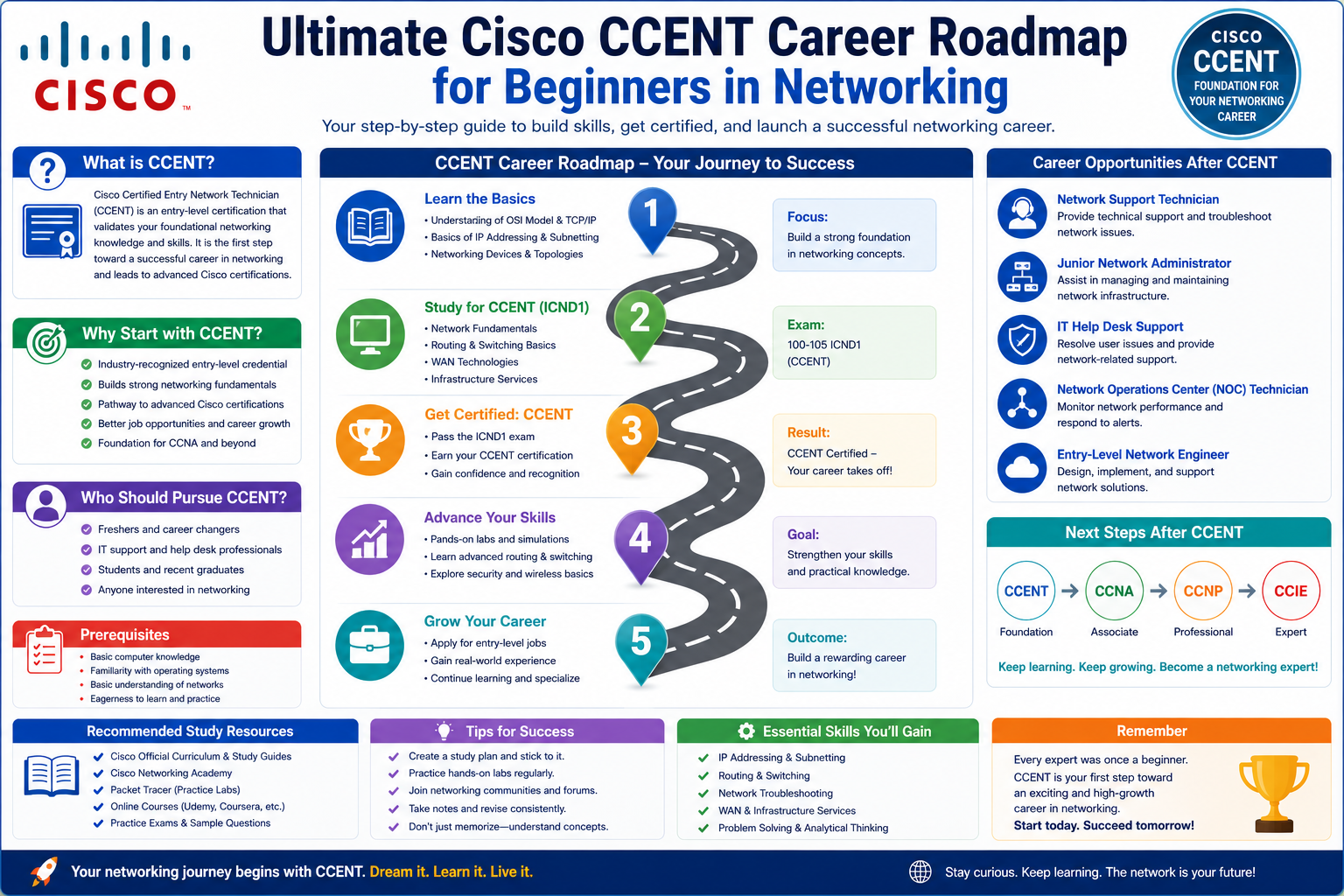
The Cisco Certified Entry-Level Network Technician certification represents one of the most important starting points for anyone entering the field of computer networking. It is designed to introduce learners to the essential principles of how modern networks operate, how devices communicate with each other, and how data moves across local and wide-area infrastructures. For many aspiring IT professionals, this certification acts as a structured gateway into the broader world of Cisco-based technologies and enterprise networking environments.
At its core, CCENT focuses on foundational networking knowledge. This includes understanding how routers and switches function, how IP addressing works, and how different network services interact to maintain communication between devices. Unlike advanced certifications that require deep specialization, CCENT is built to establish clarity on the basic building blocks of networking. It ensures that learners can confidently identify, configure, and troubleshoot small-scale enterprise networks.
In real-world environments, this knowledge is highly valuable. Even entry-level IT roles often require individuals to support users, maintain connectivity, and ensure that small office or branch networks remain functional. CCENT provides the theoretical and practical grounding necessary to handle these responsibilities effectively. It also introduces learners to structured troubleshooting methodologies, helping them develop logical thinking skills that are essential in technical support roles.
One of the most important aspects of CCENT is that it aligns closely with industry expectations for junior networking professionals. Organizations expect entry-level technicians to understand not only how networks operate but also how to maintain stability and resolve common connectivity issues. CCENT prepares individuals for these expectations by focusing on real-world networking scenarios rather than purely theoretical concepts.
Why CCENT is a Strong Starting Point in Cisco Certification Path
The CCENT certification is widely recognized as a foundational step in Cisco’s certification hierarchy. It serves as the first formal milestone in a structured learning path that leads toward more advanced certifications. What makes CCENT particularly valuable is that it introduces learners to essential networking concepts without overwhelming them with advanced complexity.
For beginners, networking can often feel abstract. Concepts such as IP routing, subnetting, and network segmentation may seem difficult to understand at first. CCENT addresses this challenge by breaking these topics into manageable components. It gradually builds a learner’s understanding, starting from basic communication between devices and progressing toward more structured network design principles.
Another key reason CCENT is considered a strong starting point is its relevance to real-world job roles. Many organizations require technicians who can support small office networks, configure basic network devices, and assist in maintaining connectivity across departments. CCENT aligns directly with these requirements by focusing on practical skills that can be applied in day-to-day IT environments.
Additionally, CCENT acts as a stepping stone toward more advanced certifications. It lays the groundwork for deeper networking knowledge, which becomes essential when progressing into roles involving enterprise infrastructure, network security, or advanced routing technologies. Without a strong understanding of CCENT-level concepts, learners often struggle with higher-level certification material.
The certification also helps individuals build confidence in technical environments. By working through structured networking concepts, learners begin to understand how different components interact within a system. This confidence is crucial when transitioning into professional IT roles where troubleshooting and problem-solving are part of daily responsibilities.
Core Networking Concepts You Must Master Before CCENT
Before attempting CCENT-level knowledge, it is essential to become familiar with several fundamental networking concepts. These concepts form the backbone of all networking operations and are critical for understanding how modern communication systems function.
One of the most important areas is IP addressing. Every device connected to a network requires a unique identifier to communicate effectively. Understanding how IP addresses are structured, how subnetting works, and how networks are divided into smaller segments is essential. Subnetting, in particular, is often considered one of the most challenging topics for beginners, but it is also one of the most important skills in networking.
Another key concept is network topologies. These describe how devices are arranged and connected within a network. Whether it is a star, mesh, or hybrid topology, each structure has its own advantages and limitations. Understanding these layouts helps learners visualize how data flows between devices and how network performance can be optimized.
Switching and routing fundamentals are also critical. Switching deals with communication within a local network, while routing focuses on communication between different networks. Knowing how switches forward data using MAC addresses and how routers determine the best path for data transmission is essential for CCENT-level understanding.
Network protocols also play a major role in CCENT preparation. Protocols such as TCP/IP define how data is transmitted and received across networks. These rules ensure that devices can communicate effectively regardless of their manufacturer or operating system. Understanding the basic structure of these protocols helps learners grasp how the internet and internal networks operate.
Finally, basic network security principles are introduced at this level. While CCENT is not a security-focused certification, it still covers essential topics such as access control, basic firewall concepts, and safe configuration practices. These fundamentals ensure that learners are aware of the importance of protecting network infrastructure from unauthorized access or misconfiguration.
Skills Validated by CCENT Certification
The CCENT certification is designed to validate a specific set of technical skills that are essential for entry-level networking roles. These skills are not only theoretical but also practical, allowing individuals to apply their knowledge in real-world environments.
One of the primary skills validated is the ability to install and configure small network systems. This includes setting up routers, switches, and basic network devices in a structured environment. Learners are expected to understand how to establish connectivity between devices and ensure proper communication across the network.
Another important skill is network troubleshooting. CCENT emphasizes the ability to identify, analyze, and resolve common network issues. This includes diagnosing connectivity problems, identifying configuration errors, and applying logical troubleshooting steps to restore network functionality.
Understanding IP services is also a key competency. This includes services such as DHCP, NAT, and basic network address translation techniques. These services are essential for managing IP allocation and ensuring that devices can communicate both within and outside the local network.
Learners are also expected to demonstrate knowledge of network security fundamentals. This includes understanding how to secure network devices, apply basic security configurations, and recognize potential vulnerabilities in small-scale networks.
In addition to technical skills, CCENT also validates problem-solving abilities. Networking is not just about memorizing commands or configurations; it requires analytical thinking. CCENT encourages learners to approach problems systematically, breaking them down into smaller components and identifying root causes.
Exam Structure and What to Expect in CCENT Assessment
The CCENT assessment is designed to evaluate both theoretical understanding and practical application of networking concepts. It includes a variety of question formats that test different aspects of knowledge and problem-solving ability.
The exam typically consists of multiple-choice questions, drag-and-drop exercises, and simulation-based scenarios. Each question type is designed to assess a specific skill set. Multiple-choice questions evaluate conceptual understanding, while simulation questions test practical configuration and troubleshooting abilities.
The duration of the exam is limited, requiring candidates to manage their time effectively. This adds a layer of challenge, as learners must not only understand the material but also apply it efficiently under time constraints.
One of the most important aspects of the exam is its focus on real-world scenarios. Instead of purely theoretical questions, candidates are often presented with practical situations that require logical decision-making. This approach ensures that certified individuals are capable of handling real networking environments.
Topics covered in the assessment include IP connectivity, network fundamentals, routing basics, switching concepts, and network services. Each of these areas contributes to a comprehensive understanding of small-scale network operations.
The exam also evaluates troubleshooting skills through scenario-based questions. Candidates may be required to identify network issues based on given configurations or diagnose connectivity problems within a simulated environment. This ensures that certified individuals are not only knowledgeable but also capable of applying their skills effectively.
Building a Practical Foundation for CCENT Success
Success in CCENT requires more than just theoretical knowledge. It demands a strong practical foundation that allows learners to apply concepts in real-world scenarios. One of the most effective ways to build this foundation is through hands-on practice with networking tools and simulations.
Understanding how devices communicate in a controlled environment helps reinforce theoretical concepts. By observing how data flows between routers and switches, learners can develop a deeper understanding of network behavior. This practical exposure is essential for mastering CCENT-level material.
Another important aspect is practicing IP addressing and subnetting regularly. These skills require repetition and logical thinking. By working through different addressing scenarios, learners can strengthen their ability to quickly determine network ranges and configurations.
Configuration practice is also essential. Setting up basic network devices, applying configurations, and testing connectivity helps reinforce learning. This hands-on experience is crucial for understanding how theoretical concepts translate into real network environments.
Troubleshooting practice is equally important. By intentionally introducing network issues and attempting to resolve them, learners can develop strong analytical skills. This approach helps build confidence in identifying and fixing real-world network problems.
Developing a Study Mindset for Networking Fundamentals
Approaching CCENT preparation requires a structured and disciplined mindset. Networking is a technical field that builds progressively, meaning that each concept depends on a clear understanding of previous topics. Developing consistency in study habits is essential for long-term success.
One effective approach is to focus on understanding rather than memorization. Networking concepts are interconnected, and memorizing commands or definitions without understanding their purpose can lead to confusion. A conceptual approach ensures deeper comprehension and better retention.
Breaking down complex topics into smaller sections also helps in managing learning effectively. Instead of trying to understand everything at once, focusing on individual components such as IP addressing, switching, or routing allows for gradual progression.
Repetition plays a key role in mastering networking fundamentals. Revisiting topics regularly helps reinforce understanding and improve recall ability. This is especially important for technical subjects that require precision and accuracy.
Consistency is equally important. Regular study sessions are more effective than irregular, intensive learning periods. Networking knowledge builds over time, and steady progress ensures better long-term retention.
Common Challenges Beginners Face and How to Overcome Them
Many learners face challenges when starting their CCENT journey, especially when encountering technical concepts for the first time. One of the most common difficulties is understanding subnetting. This topic requires logical reasoning and practice, and it often takes time to become comfortable with it.
Another challenge is grasping the relationship between different network components. Understanding how routers, switches, and protocols interact can initially feel complex. Visualizing these interactions can help simplify the learning process.
Time management during preparation is also a common issue. Learners often struggle to balance theory, practice, and revision. Creating a structured study approach helps ensure that all topics are covered systematically.
Technical terminology can also be overwhelming for beginners. Networking has a large vocabulary, and understanding each term in context is important for building clarity. Gradually learning and applying terms in practical scenarios helps overcome this challenge.
Mapping Your Early Career Direction After CCENT
After gaining foundational knowledge through CCENT-level learning, individuals begin to explore entry-level opportunities in the IT and networking field. These roles often involve supporting network infrastructure, assisting with troubleshooting, and maintaining connectivity in small to medium-sized environments.
At this stage, professionals start developing practical experience that builds upon their certification knowledge. This experience is essential for progressing toward more advanced roles in networking, systems administration, and infrastructure management.
As skills develop, individuals naturally progress toward more specialized areas of networking. This may include network security, cloud infrastructure, or enterprise networking systems. Each of these areas builds upon the foundational knowledge established at the CCENT level.
The early career stage is also a time for continuous learning. Networking technologies evolve constantly, and staying updated with new developments is essential for long-term career growth.
Building Strong Foundations in IP Addressing and Subnetting Mastery
One of the most important skill areas in the CCENT journey is IP addressing and subnetting. These topics form the backbone of all modern networking environments because every device connected to a network must have a properly structured address to communicate effectively. Without a strong understanding of how IP addressing works, it becomes extremely difficult to progress in networking careers.
IP addressing is essentially the method used to identify devices on a network. Each device is assigned a unique numerical label that allows it to send and receive data. However, the real complexity begins when these addresses are divided into networks and sub-networks. This is where subnetting becomes essential.
Subnetting allows a large network to be broken down into smaller, more manageable segments. These segments help improve performance, enhance security, and simplify administration. In enterprise environments, subnetting is not optional—it is a core design requirement. Understanding how to calculate subnets, determine usable IP ranges, and identify network boundaries is a fundamental CCENT skill.
Many beginners struggle with subnetting because it requires logical thinking rather than memorization. It involves binary conversion, mathematical reasoning, and pattern recognition. However, once the logic is understood, subnetting becomes a powerful tool that simplifies network design rather than complicates it.
A strong approach to mastering subnetting is to understand the relationship between network bits and host bits. Every IP address is divided into two parts: one identifies the network, and the other identifies the device. Subnetting adjusts this balance to create multiple smaller networks from a larger address block.
Developing speed and accuracy in subnetting is important for both certification success and real-world job performance. Network technicians often need to quickly determine whether devices are in the same subnet, how many hosts a network can support, or how to allocate IP ranges efficiently.
Understanding Routing Behavior in Small Network Environments
Routing is another essential concept within the CCENT framework. While switching deals with communication within a single network, routing focuses on communication between different networks. This distinction is crucial for understanding how data travels across the internet and enterprise infrastructures.
Routers act as decision-making devices. Their primary function is to determine the best path for data packets to reach their destination. This involves analyzing destination IP addresses and comparing them against routing tables, which contain information about available network paths.
In small network environments, routing is often straightforward. A router may connect a local office network to the internet or link multiple departments within an organization. However, even in these simple setups, routing principles remain the same.
Understanding how routing tables are built is an important part of CCENT learning. These tables may be populated manually or dynamically depending on the network configuration. Static routing involves manually defining paths, while dynamic routing allows devices to share information automatically.
At the CCENT level, learners are introduced to basic routing behavior rather than complex routing protocols. The focus is on understanding how routers make decisions, how they handle unknown destinations, and how default routes are used when no specific path exists.
A strong conceptual understanding of routing helps learners troubleshoot connectivity issues more effectively. For example, if a device cannot access an external network, the issue may lie in routing configuration rather than physical connectivity.
Exploring Switching Mechanisms and Local Network Communication
Switching plays a central role in local area networks. Unlike routers, which connect different networks, switches operate within a single network and are responsible for directing data between devices such as computers, printers, and servers.
Switches use MAC addresses to identify devices. Each network interface has a unique hardware address, and switches maintain a table that maps these addresses to specific ports. This allows data to be forwarded only to the intended recipient rather than being broadcast to all devices.
This process improves network efficiency significantly. Instead of sending data to every device, switches ensure that only relevant devices receive the information. This reduces unnecessary traffic and improves overall performance.
One of the key concepts in switching is learning how MAC address tables are built and maintained. When a device sends data, the switch records its MAC address and the associated port. Over time, this allows the switch to create an intelligent map of the network.
Switching also involves understanding different communication modes such as unicast, broadcast, and multicast. Each mode determines how data is distributed across the network. Understanding these modes helps learners analyze traffic behavior and identify potential issues.
In real-world environments, switching problems are often related to misconfigurations, loop issues, or incorrect VLAN setups. CCENT introduces foundational concepts that help learners identify and resolve such issues in small network environments.
Working with Cisco IOS and Device Configuration Fundamentals
Cisco IOS is the operating system used on most Cisco networking devices. It provides a command-line interface that allows administrators to configure, manage, and troubleshoot network devices. Understanding IOS is essential for anyone pursuing CCENT certification.
The IOS environment is structured and hierarchical. It includes different modes such as user mode, privileged mode, and configuration mode. Each mode provides different levels of access and functionality. Learning how to navigate these modes is a key step in mastering Cisco devices.
Configuration within IOS involves using commands to set up interfaces, assign IP addresses, configure routing, and manage security settings. These commands follow a structured syntax that must be understood clearly to avoid configuration errors.
One of the most important aspects of IOS is interface configuration. Network interfaces must be properly configured with IP addresses and enabled before they can function. Misconfigured interfaces are one of the most common causes of network issues.
Another important area is device management. This includes setting passwords, configuring remote access, and ensuring that devices are securely maintained. Even at the CCENT level, security awareness is emphasized as part of basic configuration practices.
Learning IOS also helps develop troubleshooting skills. By examining device configurations, learners can quickly identify errors and misconfigurations that may be affecting network performance.
Developing Practical Troubleshooting Techniques for Network Issues
Troubleshooting is one of the most valuable skills in networking. In real-world IT environments, network issues are inevitable, and professionals must be able to identify and resolve them efficiently.
A structured troubleshooting approach is essential. Rather than guessing the cause of a problem, network technicians follow a logical process. This typically involves identifying the issue, isolating the cause, testing possible solutions, and verifying resolution.
One common troubleshooting area is connectivity issues. These may occur due to incorrect IP configuration, physical connection problems, or routing errors. Understanding how to systematically eliminate possible causes is crucial.
Another common issue involves DNS resolution. Even if a device is properly connected to the network, it may not be able to access websites if DNS settings are incorrect. Recognizing the difference between connectivity and name resolution issues is an important skill.
Switching problems, such as loop formation or VLAN misconfiguration, can also disrupt network performance. CCENT introduces foundational troubleshooting concepts that help learners identify these issues at an early stage.
A strong troubleshooting mindset involves patience, observation, and logical reasoning. Instead of making random changes, professionals analyze network behavior and use diagnostic tools to gather information before taking action.
Understanding IPv6 and Its Role in Modern Networks
IPv6 is the next-generation Internet Protocol designed to replace IPv4. As the number of connected devices continues to grow globally, IPv6 provides a much larger address space to accommodate future networking needs.
Unlike IPv4, which uses 32-bit addressing, IPv6 uses 128-bit addressing. This allows for an almost unlimited number of unique IP addresses. This expansion is necessary due to the rapid growth of internet-connected devices, including mobile phones, IoT devices, and cloud systems.
IPv6 also introduces improvements in network efficiency and security. It simplifies routing by reducing the complexity of address allocation and eliminating the need for certain technologies like NAT in many cases.
At the CCENT level, learners are introduced to the basic structure of IPv6 addresses. These addresses are written in hexadecimal format and separated into groups, making them visually different from IPv4 addresses.
Understanding IPv6 is important because modern networks increasingly rely on it. While IPv4 is still widely used, IPv6 adoption continues to grow, making it essential for networking professionals to understand both systems.
Exploring Network Services Such as DHCP, NAT, and ACL Basics
Network services play a critical role in maintaining communication between devices. Three of the most important services introduced at the CCENT level are DHCP, NAT, and basic access control mechanisms.
DHCP, or Dynamic Host Configuration Protocol, automatically assigns IP addresses to devices on a network. This eliminates the need for manual configuration and reduces the risk of address conflicts. In most enterprise environments, DHCP is essential for efficient network management.
NAT, or Network Address Translation, allows multiple devices on a private network to share a single public IP address. This is particularly important for conserving IPv4 addresses and enabling internet connectivity for internal networks.
Access control mechanisms help regulate network traffic. Even at the CCENT level, learners are introduced to basic concepts of filtering traffic and controlling access to network resources. These foundational principles later evolve into more advanced security configurations.
Understanding how these services interact helps learners gain a clearer picture of how modern networks operate. They ensure that devices can communicate efficiently while maintaining structure and security.
Strengthening Real-World Lab Practice and Simulation Skills
Practical experience is one of the most important components of CCENT preparation. Networking cannot be fully understood through theory alone; it requires hands-on practice in simulated or real environments.
Lab environments allow learners to configure devices, test network behavior, and experiment with different scenarios. This helps reinforce theoretical knowledge and builds confidence in working with real systems.
Simulations also provide a safe environment for making mistakes. Learners can experiment with configurations, break networks intentionally, and then troubleshoot issues without any real-world consequences.
Working through lab exercises helps develop familiarity with Cisco IOS commands, interface configurations, routing behavior, and switching logic. These skills are essential for both certification exams and professional roles.
Consistency in lab practice is more important than complexity. Even simple exercises repeated regularly can significantly improve understanding and retention of networking concepts.
Avoiding Common Mistakes During CCENT Preparation
Many learners face similar challenges during their CCENT preparation journey. One common mistake is focusing too heavily on memorization rather than understanding. Networking requires conceptual clarity, and memorization alone is not sufficient.
Another mistake is neglecting hands-on practice. Without practical experience, theoretical knowledge becomes difficult to apply in real-world scenarios. Lab work is essential for bridging this gap.
Some learners also struggle with inconsistent study habits. Networking concepts build upon each other, so irregular study patterns can lead to gaps in understanding.
Overlooking troubleshooting practice is another common issue. Many learners focus only on configuration but ignore problem-solving skills, which are equally important.
Developing a balanced approach that includes theory, practice, and review is key to avoiding these mistakes and building strong networking foundations.
Advancing from CCENT Foundations Toward Real Network Engineering Thinking
As learners move deeper into CCENT-level knowledge, the focus gradually shifts from basic concepts to structured thinking patterns used in real network engineering environments. At this stage, understanding individual technologies is no longer enough. What matters more is how those technologies interact inside a working system.
Networking is not a collection of isolated topics. It is a connected ecosystem where routing, switching, addressing, and services all influence each other. A change in one area often impacts another, and professionals must learn to see these relationships clearly. This is where CCENT-level training becomes especially valuable because it teaches learners to think in terms of systems rather than individual commands or configurations.
One of the key transitions at this stage is moving from “what is this feature?” to “why is this feature used here?” For example, instead of simply knowing what DHCP does, learners begin to understand why DHCP is preferred over static addressing in large environments. Similarly, instead of memorizing routing behavior, learners start analyzing why a router selects one path over another.
This shift in mindset is essential for anyone planning to grow in a networking career. Employers do not only look for individuals who can configure devices. They look for professionals who can understand network behavior, predict issues, and design solutions that improve performance and reliability.
Deepening Understanding of Network Architecture and Design Logic
Network architecture refers to the overall structure of how a network is designed and organized. At the CCENT level, learners are introduced to small-scale network design concepts, but even these basic ideas form the foundation for enterprise-level architectures later in their careers.
A typical network architecture includes end devices, switching layers, routing layers, and external connectivity. Each layer has a specific role, and understanding how they interact helps learners visualize the flow of data across the system.
One of the most important principles in network design is segmentation. Networks are often divided into smaller segments to improve performance and security. This segmentation is achieved using technologies like subnetting and VLANs, which ensure that traffic is properly organized and controlled.
Another important design principle is redundancy. Even in small networks, redundancy ensures that the failure of one component does not completely disrupt communication. While CCENT does not go deep into advanced redundancy protocols, it introduces the basic idea that networks should be resilient.
Scalability is also a key concept. A well-designed network should be able to grow without requiring complete restructuring. This is why structured addressing schemes and modular designs are emphasized even at the entry level.
Understanding these architectural principles helps learners transition from device-level thinking to system-level thinking, which is essential for advanced networking roles.
Expanding Knowledge of Network Communication Flows
Network communication is the process by which data travels from one device to another. At a surface level, this may seem simple, but in reality, it involves multiple steps and components working together.
When a device sends data, it first breaks the information into smaller packets. These packets contain source and destination information, allowing them to be routed through the network. Each packet may take a different path depending on network conditions and routing decisions.
Switches handle communication within local networks by forwarding frames based on MAC addresses. Routers handle communication between networks by analyzing IP addresses. This separation of responsibilities is fundamental to understanding how networks operate.
One of the key learning points at this stage is understanding encapsulation. As data moves through the network layers, it is wrapped with additional information. Each layer adds its own header, which helps devices interpret and process the data correctly.
Another important concept is decapsulation, where receiving devices remove these headers layer by layer to extract the original data. This process ensures structured communication between devices, even if they are using different hardware or operating systems.
Understanding communication flow also helps in troubleshooting. If data is not reaching its destination, learners can analyze each stage of the flow to identify where the breakdown is occurring.
Strengthening Logical Troubleshooting and Diagnostic Reasoning
At advanced CCENT-level understanding, troubleshooting becomes less about memorizing steps and more about developing logical reasoning skills. Real-world network issues rarely come with clear instructions. Instead, professionals must interpret symptoms and identify underlying causes.
A structured troubleshooting approach typically begins with identifying the problem. This involves gathering information about what is not working, where the issue occurs, and what has changed in the environment.
The next step is isolating the cause. This may involve checking physical connections, verifying IP configurations, or analyzing routing behavior. Each layer of the network is examined systematically to eliminate possible causes.
Once the issue is isolated, potential solutions are tested. This requires careful implementation to ensure that changes do not create additional problems. After applying a fix, verification is performed to confirm that the issue has been resolved.
One of the most important aspects of troubleshooting is pattern recognition. Many network issues repeat in similar forms, such as misconfigured gateways, incorrect subnet masks, or disabled interfaces. Recognizing these patterns helps speed up diagnosis.
Another key skill is interpreting diagnostic outputs. Network devices provide detailed information about their status, and understanding this output is essential for identifying problems accurately.
Troubleshooting also requires patience and discipline. Rushing through the process often leads to incorrect conclusions. A structured and methodical approach is always more effective.
Exploring Network Security Awareness at Entry Level
Although CCENT is not a dedicated security certification, it introduces essential security concepts that form the foundation for more advanced cybersecurity knowledge.
One of the most important ideas is access control. Networks must be protected from unauthorized access, and basic mechanisms are used to restrict who can connect to devices or access certain resources.
Another important concept is device security. Network devices themselves must be protected through secure passwords, administrative controls, and restricted access configurations. Without proper device security, the entire network can be compromised.
Traffic filtering is also introduced at a basic level. This involves controlling which types of data are allowed to pass through network devices. Even simple filtering rules can significantly improve network safety.
Awareness of threats is another key area. Learners are introduced to common risks such as unauthorized access, misconfiguration, and network misuse. While CCENT does not go deep into attack prevention, it builds awareness of potential vulnerabilities.
Security thinking at this stage is about developing habits rather than mastering tools. Understanding that every network decision has security implications is a critical mindset shift for future professionals.
Understanding the Role of Network Services in System Stability
Network services are essential for maintaining smooth communication between devices. They handle tasks such as address assignment, name resolution, and traffic management.
One of the most important services is automatic IP assignment. In large environments, manually assigning addresses is inefficient and error-prone. Automated systems ensure that devices receive correct configurations without manual intervention.
Another key service is address translation. This allows multiple devices to share a single external address, improving efficiency and conserving address space. It also adds a layer of abstraction between internal and external networks.
Name resolution services translate human-readable names into machine-readable addresses. This allows users to access resources without needing to remember numerical identifiers.
These services work together to ensure that networks operate smoothly. Without them, communication would be slower, more complex, and prone to errors.
Understanding how services interact with routing and switching helps learners see the full picture of network operations.
Building Confidence Through Practical Network Simulation
Practical simulation is one of the most effective ways to reinforce CCENT-level learning. By working in controlled environments, learners can experiment with configurations, observe network behavior, and develop problem-solving skills.
Simulation environments allow learners to build networks from scratch, configure devices, and test connectivity. This hands-on experience is essential for understanding how theoretical concepts apply in real systems.
One of the biggest advantages of simulation is the ability to make mistakes safely. Misconfigurations can be corrected without real-world consequences, allowing learners to explore different scenarios freely.
Through repeated practice, learners begin to develop intuition about how networks behave. They can predict outcomes based on configurations and identify issues more quickly.
Simulation also helps reinforce troubleshooting skills. By creating intentional network problems, learners can practice diagnosing and resolving issues systematically.
Consistency is more important than complexity in simulation practice. Even simple network setups can provide valuable learning experiences when explored thoroughly.
Strengthening Analytical Thinking for Network Problem Solving
Analytical thinking is one of the most important skills in networking. It involves breaking down complex problems into smaller, manageable components and analyzing each part individually.
When a network issue occurs, it is rarely caused by a single factor. Instead, multiple elements may contribute to the problem. Analytical thinking helps identify these contributing factors systematically.
This skill also involves understanding relationships between network components. For example, a routing issue may be caused by a switching problem, or a connectivity issue may be related to incorrect addressing.
Developing analytical thinking requires practice and exposure to different scenarios. Over time, learners become better at recognizing patterns and predicting network behavior.
This ability becomes especially important in professional environments where quick and accurate decision-making is required.
Preparing for Transition into Advanced Cisco Certification Paths
CCENT serves as a foundation for more advanced Cisco certifications. Once learners develop a strong understanding of entry-level concepts, they are better prepared to move into associate-level networking paths.
These advanced paths build on CCENT knowledge and introduce more complex topics such as advanced routing, enterprise switching, network security, and infrastructure design.
The transition from CCENT to higher certifications represents a shift from basic understanding to professional-level expertise. Learners begin to work with larger networks, more complex configurations, and more demanding troubleshooting scenarios.
At this stage, continuous learning becomes essential. Networking technologies evolve constantly, and professionals must stay updated to remain effective in their roles.
CCENT-level knowledge provides the stability needed to support this ongoing growth, ensuring that learners have a strong foundation to build upon as they progress in their careers.
Developing Real-World Network Confidence Through Scenario-Based Thinking
One of the most important steps beyond basic CCENT knowledge is learning how to think in real operational scenarios rather than isolated technical topics. In actual IT environments, problems rarely appear as single, clearly defined issues. Instead, they emerge as combinations of symptoms that require careful interpretation.
Scenario-based thinking helps learners connect multiple networking concepts at once. For example, a single connectivity issue might involve IP addressing errors, incorrect gateway configuration, or a failed switch port. Instead of examining each problem separately, professionals learn to evaluate how each layer of the network contributes to the overall behavior.
This type of thinking is especially valuable in support and administrative roles, where quick diagnosis is required under pressure. A structured mental approach allows technicians to narrow down potential causes efficiently, rather than relying on trial and error.
Another key benefit of scenario-based thinking is improved adaptability. Networks vary widely between organizations, but the underlying principles remain consistent. By training the mind to focus on relationships between systems rather than memorized steps, learners can adjust more easily to different environments.
Over time, this approach builds professional confidence. Instead of feeling overwhelmed by unfamiliar configurations or systems, learners begin to recognize familiar patterns. This recognition significantly reduces troubleshooting time and improves decision-making accuracy.
Ultimately, scenario-based thinking bridges the gap between theoretical knowledge and real-world application. It transforms CCENT-level understanding into practical expertise that can be applied in diverse networking environments, preparing learners for more complex responsibilities in future IT roles.
Conclusion
The CCENT certification journey represents far more than an entry-level credential; it is a structured introduction to the principles that govern modern networking environments. Across its core topics—IP addressing, subnetting, routing, switching, network services, and troubleshooting—it builds a foundation that shapes how learners understand and interact with digital infrastructure. Each concept contributes to a broader picture of how data moves, how devices communicate, and how networks remain stable and efficient in real-world conditions.
As learners progress through CCENT-level material, they develop not only technical knowledge but also a new way of thinking. Networking requires logical reasoning, patience, and the ability to interpret complex systems step by step. These skills are essential for anyone aiming to work in IT support, systems administration, or network operations. The certification encourages learners to move beyond memorization and focus on understanding relationships between network components, which is a critical shift for long-term success in the field.
Another important aspect of the CCENT pathway is its role as a gateway to advanced certifications and career growth. It lays the groundwork for more specialized areas of networking, allowing individuals to explore security, wireless technologies, data center environments, and enterprise infrastructure. Without this foundational stage, progressing into higher-level roles becomes significantly more challenging.
Equally important is the confidence that comes from hands-on practice and scenario-based understanding. When learners apply theoretical concepts in practical environments, they begin to see how networks behave in real time. This experience strengthens decision-making skills and prepares individuals for the unpredictable nature of real IT environments.
Ultimately, CCENT is not just about passing an exam; it is about building a mindset suited for continuous learning and professional development. It introduces the discipline required to analyze problems, design solutions, and maintain reliable systems. For anyone beginning a career in networking, it serves as a crucial stepping stone toward long-term technical expertise and meaningful career opportunities in the ever-evolving world of information technology.