When most people hear the word fabric, they imagine clothing or textiles, but in the world of IT, the term has a completely different meaning. A network fabric refers to a highly interconnected system of devices that communicate through multiple pathways, creating a resilient and efficient data environment. Instead of relying on a single path between devices, a fabric design ensures that multiple routes exist, allowing traffic to flow seamlessly even if one connection fails. This approach improves performance, scalability, and fault tolerance, making it a foundational concept in modern data center architecture.
In advanced environments, especially those built around unified computing systems, the fabric becomes the backbone that ties together servers, storage, and networking components. It is designed to handle high volumes of data traffic while maintaining consistent performance. The visual representation of such a system often resembles woven threads, which is why the term “fabric” is used. Each connection contributes to a dense and structured network that supports dynamic workloads and virtualization.
How Fabric Architecture Enhances Connectivity
Traditional network designs often rely on hierarchical models where traffic flows through defined layers such as access, distribution, and core. While this structure works well in many cases, it can introduce bottlenecks and single points of failure. Fabric-based architectures address these limitations by creating a mesh-like structure where devices are interconnected through multiple redundant links.
This design allows data to take the most efficient path available, reducing latency and improving overall performance. It also simplifies scaling, as new devices can be added without major reconfiguration. In environments where uptime is critical, such as enterprise data centers, this level of resilience is essential. The fabric ensures that even if one link or component fails, traffic is automatically rerouted through alternate paths, maintaining uninterrupted service.
Another advantage of fabric architecture is its compatibility with software-defined networking. By abstracting control from hardware, administrators can manage the entire network through centralized software, making configuration and monitoring more efficient. This integration allows for automation, policy-based management, and rapid deployment of resources.
Introduction to Fabric Interconnects
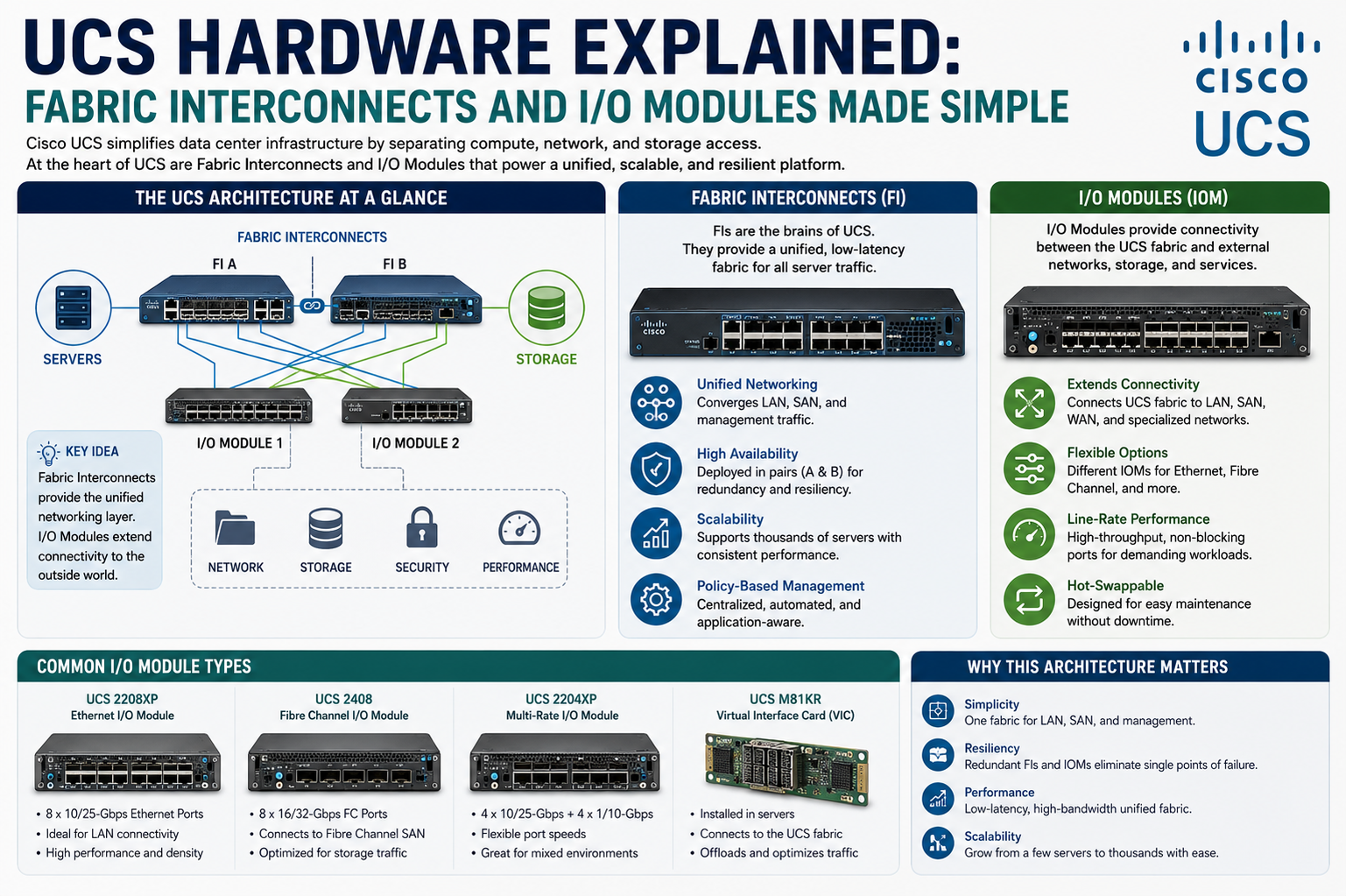
Fabric interconnects play a central role in unified computing environments. They act as the primary point of connectivity between servers and the broader network. While they share similarities with traditional switches, fabric interconnects are far more advanced in both functionality and integration.
At a basic level, a fabric interconnect can be thought of as a high-performance switch that connects multiple devices. However, unlike standard switches, it operates as part of a larger system designed specifically for unified infrastructure. It not only handles data traffic but also manages communication between servers, storage systems, and external networks.
Fabric interconnects are typically positioned at the top of a system architecture, serving as the aggregation point for all connected components. They provide high bandwidth and low latency, ensuring that data flows efficiently across the network. Their design supports simultaneous active connections, which enhances performance and reliability.
Role of Fabric Interconnects in Unified Systems
In unified computing environments, fabric interconnects are responsible for integrating compute, storage, and networking into a single cohesive system. This integration simplifies management and reduces the complexity associated with traditional data center setups. Instead of configuring each component separately, administrators can manage the entire system through a unified interface.
One of the key benefits of fabric interconnects is their ability to centralize control. They act as the brain of the network, coordinating communication between different components and enforcing policies. This centralized approach allows for consistent configuration and easier troubleshooting.
Fabric interconnects also support virtualization at a deep level. They enable the creation of virtual network interfaces, allowing multiple virtual machines to share physical resources without conflict. This capability is essential in modern environments where virtualization and cloud computing are standard practices.
Built-In Redundancy and High Availability
Reliability is a critical requirement in any network, and fabric interconnects are designed with redundancy in mind. Typically, they are deployed in pairs, ensuring that if one unit fails, the other can take over without disrupting operations. This dual configuration provides continuous availability and minimizes downtime.
Each connection within the fabric is also redundant. Devices are usually connected to multiple interconnects, creating multiple pathways for data transmission. If one path becomes unavailable, traffic is automatically rerouted through another, maintaining seamless communication.
This level of redundancy extends beyond hardware to include software features such as failover mechanisms and load balancing. These features ensure that the network can adapt to changing conditions and continue operating efficiently under stress.
Management Capabilities of Fabric Interconnects
One of the standout features of fabric interconnects is their advanced management capabilities. They are equipped with integrated software platforms that allow administrators to configure, monitor, and manage the entire system from a single interface.
This centralized management approach reduces the need for manual configuration and minimizes the risk of errors. Administrators can define policies that automatically apply to all connected devices, ensuring consistency across the network.
Automation is another key advantage. Routine tasks such as provisioning new servers or updating configurations can be performed quickly and efficiently. This not only saves time but also allows IT teams to focus on more strategic initiatives.
Understanding IOMs and Fabric Extenders
Input/Output Modules, commonly referred to as IOMs, are essential components in unified computing environments. They serve as the connection point between servers and fabric interconnects, enabling communication within the network. IOMs are often called fabric extenders because they extend the capabilities of the interconnects to individual servers.
Unlike traditional switches, IOMs do not operate independently. Instead, they function as remote line cards controlled by the fabric interconnects. This design simplifies management, as all configuration and control are handled centrally rather than at each individual module.
IOMs are typically installed within server chassis, providing connectivity for all servers housed within that chassis. They distribute network and storage traffic from the servers to the fabric interconnects, ensuring efficient communication across the system.
How IOMs Function Within the Architecture
IOMs act as intermediaries between servers and the broader network. When a server sends data, it passes through the IOM, which then forwards it to the fabric interconnect. The interconnect processes the data and routes it to its destination.
This streamlined process reduces latency and improves performance. Because IOMs are tightly integrated with the interconnects, they can operate with minimal overhead, allowing for faster data transmission.
Another important aspect of IOMs is their role in virtualization. They support the creation of multiple virtual network interfaces, enabling servers to host numerous virtual machines. Each virtual machine can have its own network identity, allowing for greater flexibility and scalability.
Virtualization and Network Efficiency
Modern data centers rely heavily on virtualization to maximize resource utilization. IOMs play a crucial role in this process by enabling the creation of virtual network interfaces directly within the hardware.
This capability allows a single physical server to support multiple virtual environments, each with its own network configuration. It eliminates the need for additional hardware, reducing costs and simplifying management.
By handling virtualization at the hardware level, IOMs also improve performance. They reduce the overhead associated with software-based solutions, allowing for more efficient use of resources. This is particularly important in high-demand environments where performance is critical.
Redundancy and Resilience in IOM Design
Just like fabric interconnects, IOMs are designed with redundancy in mind. Typically, each server chassis includes multiple IOMs, ensuring that there are always alternative paths for data transmission.
Servers are connected to more than one IOM, creating a fail-safe mechanism. If one module fails, the other continues to operate, maintaining connectivity. This redundancy is essential for ensuring high availability and preventing disruptions.
The combination of redundant IOMs and fabric interconnects creates a highly resilient network. It ensures that even in the event of hardware failures, the system continues to function without significant impact.
Integration Between Fabric Interconnects and IOMs
The relationship between fabric interconnects and IOMs is what makes unified computing systems so powerful. Fabric interconnects provide centralized control and high-level connectivity, while IOMs extend that connectivity to individual servers.
Together, they create a seamless network fabric that supports high performance, scalability, and reliability. This integration eliminates the need for multiple layers of switching, simplifying the overall architecture.
By working in tandem, these components enable efficient communication across the entire system. They ensure that data flows smoothly between servers, storage, and external networks, supporting a wide range of applications and workloads.
Scalability and Future Growth
One of the key advantages of this architecture is its ability to scale. As demand increases, additional servers and IOMs can be added without disrupting existing operations. The fabric interconnects can handle the increased load, ensuring consistent performance.
This scalability makes the system suitable for a variety of environments, from small deployments to large enterprise data centers. It allows organizations to grow their infrastructure gradually, without the need for major redesigns.
The modular nature of the system also simplifies upgrades. Components can be replaced or expanded as needed, ensuring that the network remains up to date with evolving technology.
Final Conclusion
Fabric-based architecture transforms the way modern data centers are designed and managed by replacing rigid, layered networking models with a flexible and highly interconnected system. At the core of this design, fabric interconnects and IOMs work together to deliver a unified, efficient, and resilient infrastructure. Fabric interconnects provide centralized intelligence, high-speed connectivity, and simplified management, while IOMs extend that connectivity directly to servers, acting as streamlined access points within the chassis.
This combination eliminates unnecessary complexity, reduces hardware overhead, and enables seamless scalability. With built-in redundancy at every level, the architecture ensures continuous operation even in the face of component failures. At the same time, deep integration with virtualization technologies allows organizations to maximize resource utilization and adapt quickly to changing workload demands.
Ultimately, understanding how fabric interconnects and IOMs function together provides a clear view of how modern unified systems achieve high performance, reliability, and operational simplicity. This approach not only supports current infrastructure needs but also lays a strong foundation for future growth, making it a critical concept for anyone working in advanced networking and data center environments.