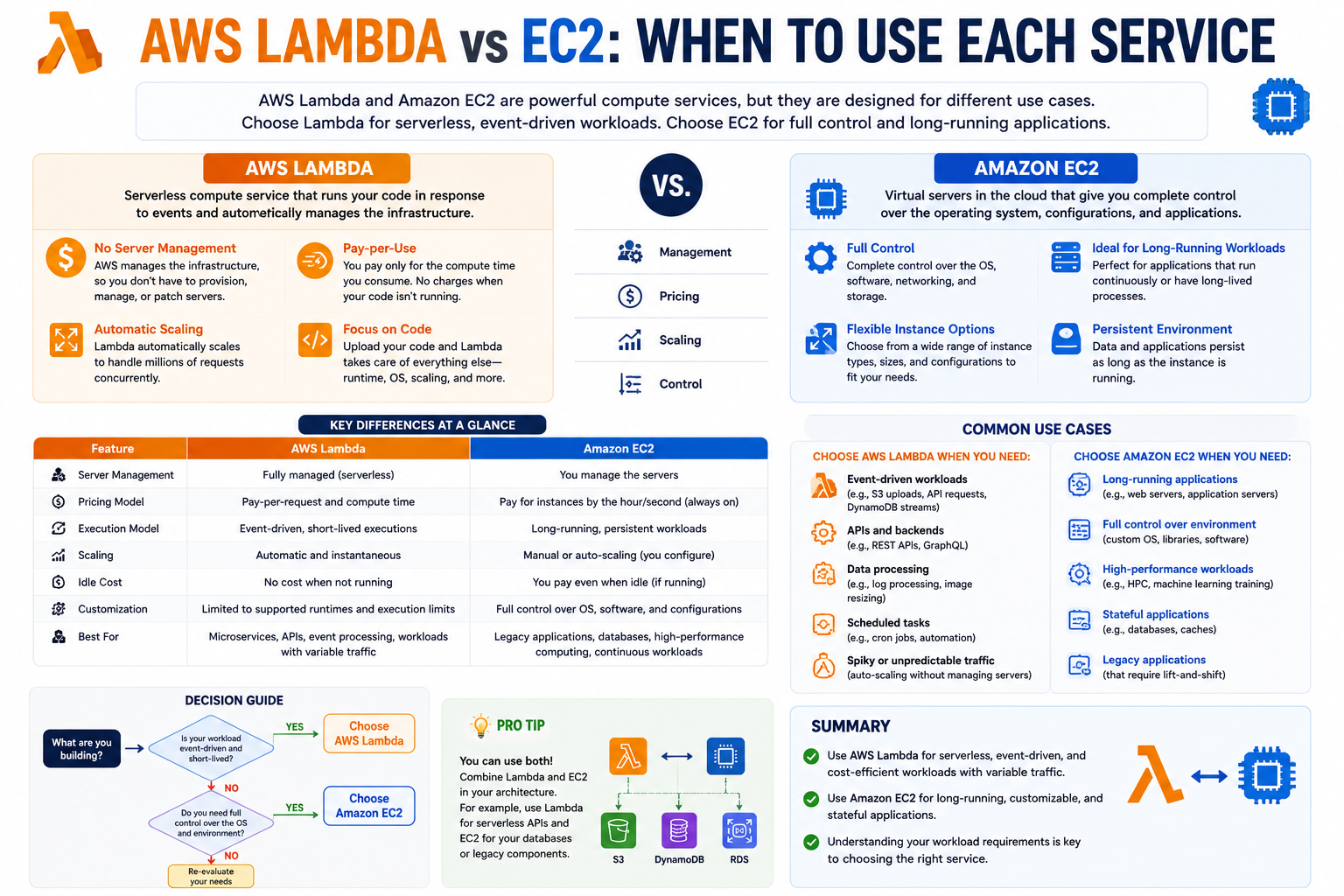
Cloud computing has fundamentally changed how applications are built, deployed, and scaled, and within this transformation, Amazon Web Services has emerged as a dominant force. With an extensive portfolio of services designed to meet nearly every computing need, AWS provides developers and organizations with unmatched flexibility. However, that flexibility often introduces complexity, especially when deciding which service best fits a particular use case. Among the most widely used and often compared services are AWS Lambda and Amazon EC2. Both offer scalable compute capabilities, yet they operate on very different principles and are suited for different scenarios. Understanding these differences is essential for making efficient architectural decisions in the cloud.
The Challenge of Choosing the Right Compute Model
When entering the AWS ecosystem, many users feel overwhelmed by the sheer number of available services. Each service is built to solve a specific problem, and choosing the wrong one can lead to inefficiencies, increased costs, and operational challenges. Compute services, in particular, are at the core of most applications, making their selection even more critical. AWS Lambda and EC2 represent two distinct approaches to computing: serverless and server-based. While both provide scalability and elasticity, the way they deliver these features differs significantly, which directly impacts how applications are designed and managed.
Understanding the Problem AWS Lambda Solves
To truly grasp the value of AWS Lambda, it is important to focus on the problem it addresses rather than just its functionality. Traditional application deployment requires provisioning servers, managing operating systems, handling scaling, and ensuring uptime. This approach can become increasingly complex as traffic fluctuates. For example, consider an application that processes uploaded files. During peak times, demand may surge, overwhelming the server and causing failures. During off-peak hours, resources remain underutilized, leading to inefficiency. This imbalance between demand and resource allocation is precisely the issue Lambda aims to solve.
The Concept of Serverless Computing
AWS Lambda introduces a serverless computing model, which abstracts away the need to manage servers entirely. Developers simply upload their code, define triggers, and let the platform handle execution. There is no need to worry about provisioning infrastructure, scaling resources, or maintaining operating systems. This model allows teams to focus purely on application logic rather than infrastructure management. Serverless computing does not mean there are no servers involved; rather, it means that server management is completely handled by the provider, making it invisible to the user.
Event-Driven Architecture and Lambda
One of the defining characteristics of AWS Lambda is its event-driven nature. In this model, code execution is triggered by specific events rather than running continuously. These events can originate from various sources, such as file uploads, API calls, database updates, or scheduled tasks. This approach is particularly useful for applications that do not require constant processing but instead respond to discrete actions. By executing code only when needed, Lambda ensures efficient resource usage and cost optimization.
Practical Example of Lambda in Action
Imagine a scenario where users upload images to a cloud storage system. Each image needs to be processed, resized, and converted into a standard format before being stored. Instead of maintaining a dedicated server to handle these tasks, a Lambda function can be triggered automatically whenever a new file is uploaded. The function processes the image and completes its task within seconds, after which it shuts down. This eliminates the need for continuous server operation and ensures that resources are used only when required.
Scalability Without Manual Intervention
One of the most compelling advantages of AWS Lambda is its ability to scale automatically. When multiple events occur simultaneously, Lambda can execute multiple instances of the same function in parallel. This ensures that applications can handle sudden spikes in demand without manual intervention. Unlike traditional systems where scaling requires configuring load balancers or adding servers, Lambda handles scaling seamlessly in the background. This level of automation significantly reduces operational overhead and simplifies application management.
Cost Efficiency in Serverless Environments
Cost management is a critical factor in cloud computing, and AWS Lambda offers a unique pricing model that aligns closely with actual usage. Instead of paying for idle resources, users are billed based on the number of requests and the duration of execution. This makes Lambda particularly cost-effective for workloads with unpredictable or intermittent traffic. Applications that experience occasional bursts of activity can benefit greatly from this model, as they avoid the expense of maintaining always-on infrastructure.
Limitations of AWS Lambda
Despite its advantages, AWS Lambda is not suitable for every use case. It is designed for short-lived, stateless functions, which means it may not be ideal for long-running processes or applications that require persistent connections. Additionally, there are limitations on execution time, memory allocation, and resource control. These constraints can make Lambda less suitable for complex applications that require fine-grained control over the environment. Understanding these limitations is essential when deciding whether Lambda is the right choice.
Introduction to Amazon EC2
Amazon EC2, or Elastic Compute Cloud, represents a more traditional approach to cloud computing. It provides virtual servers that can be configured and managed according to specific requirements. Unlike Lambda, which abstracts infrastructure, EC2 gives users full control over the operating system, software stack, and network configuration. This makes it a versatile option for a wide range of applications, from simple websites to complex enterprise systems.
The Flexibility of Virtual Servers
EC2 allows users to create virtual machines with varying levels of CPU, memory, storage, and networking capabilities. This flexibility enables organizations to tailor their infrastructure to match the exact needs of their applications. Whether running a lightweight application or a resource-intensive workload, EC2 provides the necessary tools to build a customized environment. This level of control is particularly valuable for applications that require specific configurations or dependencies.
Scaling in EC2 Environments
Like Lambda, EC2 supports scalability, but the approach is different. Scaling in EC2 typically involves adding or removing instances based on demand. This can be achieved manually or through automated scaling policies. While this method provides greater control, it also requires more planning and management. Users must define scaling rules, monitor performance, and ensure that resources are allocated efficiently. Although this adds complexity, it also allows for more precise control over application behavior.
Persistent Infrastructure and Long-Running Applications
One of the key advantages of EC2 is its ability to support long-running applications. Unlike Lambda functions, which are designed for short execution times, EC2 instances can run indefinitely. This makes them suitable for applications that require continuous processing, such as web servers, databases, and enterprise software systems. The persistent nature of EC2 ensures that applications remain available and responsive at all times.
Custom Operating Systems and Software Control
EC2 provides the ability to choose and configure operating systems, including various distributions of Linux and Windows. Users can install custom software, configure security settings, and optimize performance according to their needs. This level of control is essential for applications that rely on specific environments or require advanced configurations. It also allows organizations to maintain consistency across development, testing, and production environments.
Amazon Machine Images and Reusability
A powerful feature of EC2 is the use of Amazon Machine Images, which allow users to create preconfigured templates of their instances. These images can be reused to launch new instances with the same configuration, ensuring consistency and reducing setup time. This capability is particularly useful for scaling applications or implementing disaster recovery strategies. By maintaining standardized images, organizations can quickly replicate environments and recover from failures.
Comparing Lambda and EC2 at a Conceptual Level
At a high level, the primary difference between AWS Lambda and EC2 lies in the level of abstraction. Lambda abstracts infrastructure completely, allowing developers to focus solely on code execution. EC2, on the other hand, provides full control over infrastructure, enabling detailed customization. This distinction influences every aspect of application design, from deployment to scaling and cost management. Choosing between the two requires a clear understanding of application requirements and operational priorities.
When Simplicity Matters More Than Control
AWS Lambda is ideal for scenarios where simplicity and speed of development are priorities. Applications that rely on event-driven processes, such as data transformation, automation, and microservices, benefit greatly from Lambda’s streamlined approach. By eliminating the need for server management, developers can focus on building features and delivering value بسرعة. This makes Lambda particularly attractive for startups and teams looking to innovate quickly.
When Control and Customization Are Essential
EC2 becomes the preferred choice when applications require a high degree of control and customization. Complex systems that involve multiple components, persistent storage, or specialized configurations are better suited for EC2. This includes applications such as enterprise software, large-scale web platforms, and systems with strict compliance requirements. The ability to manage every aspect of the environment ensures that these applications can meet their specific needs.
Balancing Performance and Operational Overhead
Performance considerations also play a role in the decision-making process. Lambda functions may experience latency during initial execution, especially after periods of inactivity. While this is often negligible, it can impact applications that require consistently low response times. EC2, with its always-on nature, provides more predictable performance. However, this comes at the cost of increased operational overhead, as users must manage and maintain the infrastructure.
The Role of Hybrid Architectures
In many cases, the choice between Lambda and EC2 is not binary. Modern cloud architectures often combine both services to leverage their respective strengths. For example, an application might use EC2 for its core infrastructure while relying on Lambda for background tasks and event-driven processes. This hybrid approach מאפשר organizations to optimize performance, cost, and scalability by using the right tool for each component of the system.
Understanding the Learning Curve
Both AWS Lambda and EC2 come with their own learning curves. Lambda requires an understanding of event-driven design and stateless programming, while EC2 demands knowledge of system administration and infrastructure management. Developers must evaluate their skill sets and the complexity of their applications عندما choosing between these services. Investing time in understanding both models can lead to more effective and flexible cloud solutions.
Final Conclusion
Choosing between AWS Lambda and Amazon EC2 ultimately comes down to understanding the nature of your workload and the level of control you need over your environment. Both services are powerful in their own right, but they are designed with different philosophies in mind. Lambda embraces simplicity, automation, and efficiency by removing the need to manage infrastructure, making it an excellent fit for event-driven tasks, lightweight processing, and applications that benefit from on-demand execution. EC2, on the other hand, offers depth, flexibility, and full control, making it the better option for complex systems, long-running applications, and environments that require customization at every layer.
Rather than viewing them as competing solutions, it is more practical to see them as complementary tools within the same ecosystem. Modern cloud architectures often achieve the best results by combining both approaches, using Lambda for responsive, event-based operations and EC2 for stable, persistent workloads. This balance allows organizations to optimize performance, reduce costs, and maintain scalability without compromising on functionality.
A thoughtful approach to selecting the right service not only improves efficiency but also simplifies long-term maintenance and growth. By aligning the choice of compute service with application requirements, development teams can build systems that are both resilient and adaptable, fully leveraging the strengths of cloud computing without unnecessary complexity.