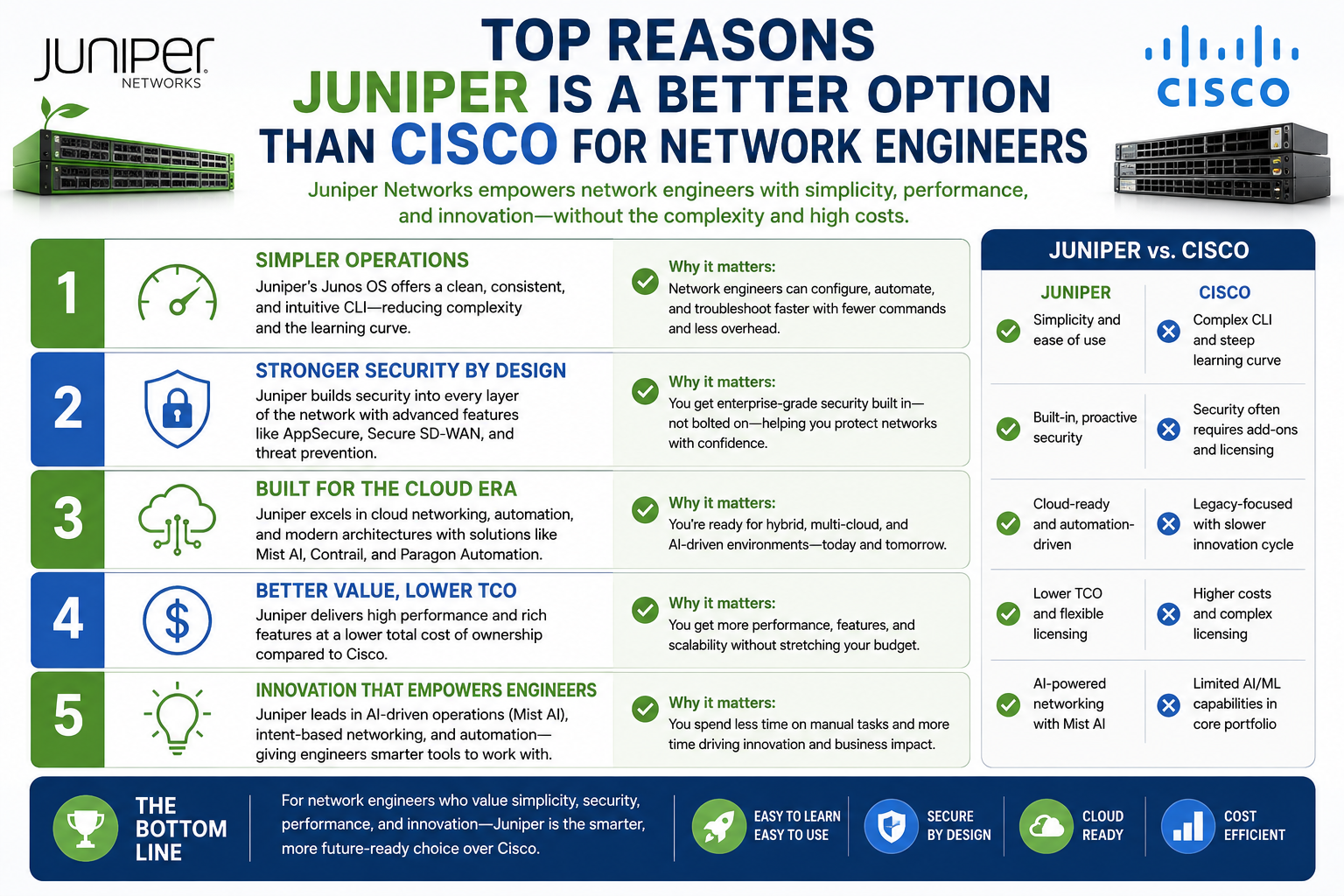
In enterprise networking, Cisco and Juniper consistently appear as the two most recognized names shaping how organizations design, secure, and scale their infrastructure. Both vendors have established themselves through decades of innovation, reliability, and widespread global adoption. However, their philosophies differ in ways that significantly influence how networks are built and managed in real-world environments.
Cisco is often associated with a broad ecosystem approach, offering tightly integrated hardware, software, collaboration tools, security platforms, and cloud services. This ecosystem is designed to provide end-to-end solutions under one umbrella, which can be appealing for organizations that prefer a single vendor strategy. On the other hand, Juniper takes a more streamlined and focused approach, emphasizing high-performance networking, simplified operations, and efficiency-driven architecture.
The contrast between these two philosophies is not just technical—it also affects cost structure, operational complexity, scalability, and long-term adaptability. As organizations move toward cloud-first, automation-driven environments, many are reassessing whether a fully integrated ecosystem or a more modular, performance-centered approach better aligns with their needs.
Juniper has increasingly positioned itself as a strong alternative, especially for enterprises that prioritize performance efficiency, reduced operational overhead, and advanced automation capabilities. Rather than expanding into every possible IT domain, Juniper concentrates on core networking excellence, including routing, switching, security, and AI-driven network operations.
This difference in strategic focus is one of the key reasons Juniper is often considered a compelling option in modern enterprise environments.
Juniper’s Value Proposition in Enterprise Networking
One of the strongest arguments in favor of Juniper is its value proposition, particularly in terms of cost efficiency and operational simplicity. Organizations often find that networking infrastructure represents a significant portion of IT spending, not only in terms of initial procurement but also ongoing maintenance, training, and support.
Juniper’s product philosophy tends to reduce unnecessary complexity by focusing on essential networking capabilities rather than bundling extensive auxiliary features that may or may not be required by every organization. This allows businesses to invest more precisely in what they actually need, rather than adopting a large suite of interconnected systems.
In contrast, Cisco’s ecosystem-driven approach can sometimes introduce additional layers of licensing, integration requirements, and management overhead. While this can be beneficial for organizations seeking unified management across multiple domains, it may also increase both cost and operational complexity.
Juniper’s routers and switches are widely recognized for delivering high performance at competitive pricing. This does not simply mean lower upfront costs; it also extends to long-term operational efficiency. Networks built on Juniper infrastructure often require fewer resources to manage, troubleshoot, and scale, which can translate into reduced total cost of ownership over time.
Another aspect of Juniper’s value lies in its design philosophy. Instead of attempting to solve every IT problem within a single ecosystem, Juniper focuses on optimizing core networking performance. This includes improving packet forwarding efficiency, minimizing latency, and ensuring consistent throughput across large-scale environments.
For enterprises that prioritize speed, reliability, and predictable performance, this focused approach can be particularly appealing. It allows network engineers to design architectures that are both scalable and efficient without being constrained by unnecessary complexity.
Simplified Architecture and Operational Efficiency
Modern enterprise networks are increasingly complex, often spanning on-premises infrastructure, multi-cloud environments, remote users, and distributed applications. Managing this complexity requires tools and systems that reduce friction rather than add layers of abstraction.
Juniper’s architecture is designed with this challenge in mind. Instead of overwhelming administrators with excessive configuration layers, Juniper systems emphasize clarity and streamlined control. The underlying operating system used in Juniper devices is known for its structured and consistent configuration model, which helps reduce human error and simplifies troubleshooting.
This design approach is especially important in large-scale environments where even small configuration mistakes can lead to significant network disruptions. By maintaining a more predictable and standardized configuration structure, Juniper helps network teams maintain stability and operational consistency.
Another important advantage is how Juniper handles network segmentation and routing logic. Its systems are designed to support high-scale routing environments without requiring excessive manual intervention. This becomes particularly valuable in service provider networks and large enterprise backbones where performance and stability are critical.
In addition, Juniper emphasizes automation-ready infrastructure. Rather than relying heavily on manual configuration, its systems are designed to integrate with automation frameworks and orchestration tools. This enables organizations to deploy changes faster, reduce human error, and improve overall agility.
As IT environments continue to evolve toward automation-first operations, this design philosophy aligns well with long-term industry trends.
Security Approach and Built-In Protection Mechanisms
Security remains one of the most important considerations in any networking decision. Both Cisco and Juniper offer strong security capabilities, but their approaches differ in implementation and emphasis.
Juniper integrates security directly into its networking architecture rather than treating it as a separate layer. This means that routing, switching, and security functions are designed to work closely together, enabling faster detection and response to threats.
A key component of Juniper’s security framework is its operating system-level security design. The system supports multiple authentication methods, centralized access control mechanisms, and granular policy enforcement. This allows administrators to define precise access rules for users and devices across the network.
Juniper devices also support protection against distributed denial-of-service attacks by incorporating mechanisms that detect abnormal traffic patterns and mitigate potential disruptions. These protections are designed to maintain network availability even under adverse conditions.
Another important aspect of Juniper’s security model is its firewall technology. Its next-generation firewall capabilities provide deep inspection of network traffic, allowing organizations to apply application-aware policies. This means access control is not limited to IP addresses or ports but can extend to specific applications and services.
This level of control is particularly useful in environments where application-level security is critical, such as financial services, healthcare, and large enterprise networks with sensitive data flows.
However, like all networking systems, security effectiveness depends heavily on proper configuration and operational discipline. Misconfigurations, weak credentials, or outdated systems can still expose vulnerabilities regardless of vendor strength. Juniper environments require consistent security hygiene, including regular updates, strong authentication practices, and continuous monitoring.
Role of AI and Automation in Juniper Networking
One of the most significant developments in modern networking is the integration of artificial intelligence and machine learning into network operations. Juniper has invested heavily in this area, aiming to simplify network management and improve operational visibility.
AI-driven networking allows systems to analyze traffic patterns, detect anomalies, and provide recommendations for optimization. Instead of relying solely on manual troubleshooting, network administrators can leverage automated insights to identify and resolve issues more efficiently.
Juniper’s AI-native approach integrates these capabilities directly into its networking platform. This enables real-time analysis of network behavior and proactive identification of potential issues before they escalate into outages or performance degradation.
A key benefit of this approach is improved user experience. By continuously analyzing network conditions, AI systems can help ensure consistent performance for applications and end users. This is especially important in environments where application availability directly impacts business operations.
Another important aspect is automated troubleshooting. Instead of manually analyzing logs across multiple systems, AI-driven tools can correlate data from different sources and highlight likely root causes. This reduces mean time to resolution and allows IT teams to focus on higher-value tasks.
AI also plays a role in network optimization. By analyzing historical and real-time data, systems can recommend configuration adjustments that improve performance or efficiency. Over time, this leads to more stable and predictable network behavior.
Cloud Integration and Distributed Network Environments
As organizations continue to adopt cloud computing, networking requirements have evolved significantly. Traditional on-premises models are no longer sufficient to support distributed applications, remote users, and multi-cloud architectures.
Juniper has adapted to this shift by developing cloud-ready networking solutions that integrate seamlessly with distributed environments. These solutions are designed to provide consistent performance and security across on-premises infrastructure, public cloud platforms, and edge environments.
One of the key advantages of Juniper’s cloud strategy is centralized visibility. Network administrators can monitor and manage distributed systems from a unified perspective, reducing complexity and improving control.
This is particularly important in hybrid environments where workloads are spread across multiple platforms. Without centralized visibility, managing such environments can become fragmented and error-prone.
Juniper also emphasizes secure cloud connectivity. As data moves between different environments, maintaining consistent security policies becomes essential. Juniper’s systems are designed to enforce security rules across all network segments, ensuring that policy enforcement remains consistent regardless of location.
In addition, automation plays a major role in cloud networking. As cloud environments are highly dynamic, manual configuration becomes impractical. Juniper’s tools support automated provisioning and configuration, enabling networks to adapt quickly to changing demands.
Performance Efficiency and Scalability Considerations
Performance remains a core factor when evaluating networking solutions. Juniper’s architecture is designed to deliver high throughput, low latency, and consistent performance across a wide range of deployment scenarios.
This performance efficiency is achieved through optimized hardware design and streamlined software architecture. By reducing unnecessary overhead, Juniper devices are able to process network traffic more efficiently.
Scalability is another important consideration. Modern enterprises often need to expand their networks rapidly to support growth, new applications, or increased user demand. Juniper systems are designed to scale horizontally, allowing organizations to expand capacity without redesigning their entire infrastructure.
This scalability is particularly valuable in service provider environments and large enterprises where network demands can fluctuate significantly.
Juniper’s routing architecture is also designed to handle large-scale deployments efficiently. It supports high-density routing tables and complex network topologies without compromising performance.
Industry Positioning and Market Evolution
The networking industry continues to evolve as organizations adopt new technologies such as cloud computing, edge computing, and AI-driven operations. Within this evolving landscape, both Cisco and Juniper continue to play significant roles.
Juniper’s market presence has been steadily growing, particularly in segments that prioritize automation, performance efficiency, and simplified operations. While Cisco maintains a dominant overall market position, Juniper’s focused strategy has allowed it to gain traction in specific enterprise and service provider environments.
A notable development in recent years has been Juniper’s alignment with broader technology ecosystems through strategic partnerships and acquisitions. This has strengthened its ability to compete in areas such as AI-driven networking and cloud infrastructure.
As the industry continues to shift toward software-defined and intelligent networking, Juniper’s emphasis on automation and AI integration positions it strongly for future growth.
The ongoing evolution of networking requirements ensures that competition between vendors remains dynamic. Organizations must carefully evaluate not only current capabilities but also long-term adaptability when selecting infrastructure solutions.
Juniper’s continued focus on streamlined design, performance optimization, and intelligent automation suggests that it will remain a relevant and competitive option in the evolving networking landscape.
Juniper Operating System Design and Its Impact on Network Control
One of the most defining elements of Juniper’s networking approach is its operating system design philosophy, which directly influences how engineers interact with devices, deploy configurations, and troubleshoot issues across large-scale infrastructures. Unlike systems that rely heavily on fragmented feature layers, Juniper’s operating environment is structured around consistency, predictability, and modular control.
This operating model is built to reduce ambiguity in configuration behavior. In large enterprise networks, ambiguity often leads to configuration drift, where different devices behave inconsistently due to small variations in manual setup. Juniper’s approach minimizes this by enforcing a more uniform configuration hierarchy, which makes it easier for engineers to anticipate how changes will behave across the network.
A key advantage of this design is operational transparency. Network engineers can trace configuration changes more easily because the system maintains a clear separation between candidate configurations and active configurations. This separation allows changes to be reviewed, validated, and committed in a controlled manner rather than applied instantly without verification.
In environments where uptime is critical, this controlled workflow reduces the risk of unintended disruptions. It also supports safer change management practices, especially in organizations with large or distributed IT teams.
Another important aspect of Juniper’s operating system design is its emphasis on structured automation integration. Instead of treating automation as an external layer, the system is built to interact naturally with scripts, APIs, and orchestration platforms. This allows organizations to implement Infrastructure-as-Code principles more effectively.
By enabling automation at the core level, Juniper helps reduce manual intervention, which is often a major source of configuration errors in complex networks. This becomes particularly valuable in environments where rapid scaling or frequent updates are required.
Routing Intelligence and High-Performance Data Handling
Routing is at the core of any networking solution, and Juniper has consistently focused on optimizing how data is processed, forwarded, and managed across complex infrastructures. The company’s routing architecture is designed to prioritize efficiency and deterministic performance, particularly in large-scale deployments.
One of the key strengths of Juniper’s routing design is its ability to handle high-density routing tables without degradation in performance. This is especially important for service provider environments and large enterprises that manage global traffic flows.
In such environments, routing decisions must be made quickly and accurately, even under heavy load conditions. Juniper’s architecture is optimized to ensure that forwarding decisions remain consistent, even as network size and complexity increase.
Another important factor is how routing updates are processed. In traditional systems, large-scale routing changes can create temporary instability or convergence delays. Juniper’s approach is designed to minimize these disruptions by ensuring that routing updates are handled efficiently and propagated in a controlled manner.
This contributes to overall network stability, particularly in environments where downtime or packet loss can have significant operational consequences.
Juniper’s routing systems are also designed to support advanced policy-based routing. This allows organizations to define traffic behavior based on application requirements, business priorities, or security policies. Instead of relying solely on static routing paths, traffic can be dynamically influenced based on real-time conditions.
This flexibility is especially valuable in modern enterprise networks where applications may span multiple environments, including on-premises data centers and cloud platforms.
Security Architecture Beyond Perimeter Protection
While traditional network security often focused on perimeter-based defense models, modern environments require more dynamic and layered approaches. Juniper’s security architecture reflects this shift by integrating protection mechanisms directly into multiple layers of the network.
Rather than relying solely on external security appliances, Juniper incorporates security functions within routing, switching, and gateway devices. This distributed approach allows threats to be detected and mitigated closer to their source.
One of the key advantages of this model is reduced response time. When security controls are embedded directly into network infrastructure, malicious activity can be identified and contained more quickly, reducing the potential impact on the broader system.
Juniper’s security framework also emphasizes application awareness. Instead of treating all traffic equally, the system can differentiate between applications and apply tailored security policies accordingly. This allows organizations to enforce more granular control over how applications interact within the network.
For example, critical business applications can be prioritized and protected more aggressively, while less sensitive traffic can be treated with different policies. This level of control improves both security and performance efficiency.
Another important aspect is identity-based security enforcement. Rather than relying solely on IP-based rules, policies can be tied to user identities or device characteristics. This is particularly useful in environments where users access resources from multiple locations or devices.
By combining identity awareness with application-level inspection, Juniper enables a more adaptive security posture that aligns with modern distributed work environments.
Advanced Threat Detection and Network Resilience
Modern cyber threats are increasingly sophisticated, often designed to bypass traditional detection mechanisms. Juniper addresses this challenge by integrating advanced threat detection capabilities directly into its networking infrastructure.
These systems are designed to identify unusual traffic patterns, detect anomalies, and respond to potential security incidents in real time. Instead of relying only on predefined signatures, behavior-based analysis is used to detect suspicious activity.
This approach allows the system to identify previously unknown threats by analyzing deviations from normal network behavior. When anomalies are detected, automated mitigation actions can be triggered to reduce risk exposure.
Network resilience is another critical aspect of Juniper’s design philosophy. Even under attack conditions, systems are designed to maintain core functionality. This is achieved through redundancy mechanisms, traffic isolation, and intelligent failover strategies.
For example, when certain parts of the network experience abnormal load or malicious traffic, routing systems can redirect traffic to maintain service continuity. This ensures that critical services remain available even under adverse conditions.
Juniper’s approach to resilience is not limited to security events. It also extends to hardware and software reliability. Systems are designed to detect failures early and initiate recovery processes automatically where possible.
This contributes to higher uptime and more predictable network behavior, which is essential for enterprise operations that depend on continuous connectivity.
AI-Driven Network Operations and Predictive Insights
The integration of artificial intelligence into networking has significantly changed how infrastructure is managed. Juniper’s AI-driven approach focuses on reducing manual troubleshooting and improving decision-making through predictive insights.
Instead of reacting to problems after they occur, AI systems continuously analyze network behavior to identify potential issues before they impact users. This proactive approach shifts network management from reactive troubleshooting to preventive optimization.
One of the key benefits of AI integration is the correlation of data across multiple sources. In traditional environments, network logs, performance metrics, and event data are often analyzed separately. AI systems can combine these data streams to provide a more complete picture of network health.
This allows administrators to identify root causes more quickly and accurately. For example, a performance issue affecting an application may be traced back to a configuration change, a routing anomaly, or a hardware constraint.
AI also plays a role in capacity planning. By analyzing usage trends over time, systems can predict when additional resources may be required. This helps organizations scale infrastructure more efficiently and avoid performance bottlenecks.
Another important application is automated recommendations. Instead of requiring engineers to manually interpret complex data sets, AI systems can suggest configuration changes or optimizations based on observed patterns.
These recommendations can then be reviewed and applied by administrators, reducing the time required for decision-making while still maintaining human oversight.
Cloud-Native Networking and Distributed Architecture Support
As organizations continue transitioning toward cloud-native architectures, networking requirements have become more distributed and dynamic. Juniper’s solutions are designed to support this shift by providing consistent control and visibility across hybrid environments.
In cloud-native environments, workloads are often ephemeral, meaning they can be created, modified, or removed dynamically. Traditional static networking models are not well-suited to this level of flexibility.
Juniper addresses this challenge by enabling network configurations that adapt dynamically to changing workloads. This ensures that connectivity, security, and performance policies remain consistent even as infrastructure evolves.
Centralized visibility is another important capability in cloud environments. Without a unified view of network behavior, managing distributed systems becomes significantly more complex. Juniper’s architecture provides consolidated insights across on-premises and cloud environments, improving operational clarity.
Security consistency is also a key requirement in hybrid environments. As workloads move between different platforms, maintaining uniform security policies becomes essential. Juniper’s systems are designed to enforce consistent rules regardless of where workloads reside.
This reduces security gaps that can occur when policies are applied inconsistently across environments.
Automation at Scale and Infrastructure Efficiency
Automation has become a core requirement in modern networking, especially as organizations scale their infrastructure. Manual configuration and management are no longer practical in environments with thousands of devices and rapidly changing workloads.
Juniper’s approach to automation focuses on embedding programmability directly into network systems. This allows infrastructure to be controlled through APIs, scripts, and orchestration platforms without requiring manual device-level intervention.
One of the key benefits of this approach is consistency. Automated systems apply configurations uniformly across devices, reducing the risk of human error and configuration drift.
Automation also improves deployment speed. New services, applications, or network segments can be provisioned quickly, allowing organizations to respond faster to business needs.
Another important aspect is lifecycle management. Automation can be used to manage not only deployment but also updates, monitoring, and decommissioning of network components.
This end-to-end automation reduces operational overhead and allows IT teams to focus on strategic initiatives rather than repetitive tasks.
Operational Visibility and Network Observability
Understanding what is happening within a network at any given time is essential for maintaining performance and reliability. Juniper emphasizes observability as a core component of its networking architecture.
Observability goes beyond simple monitoring by providing deep insights into how systems behave under different conditions. This includes analyzing traffic flows, device performance, application behavior, and user experience metrics.
By combining these data points, administrators can gain a comprehensive understanding of network health. This makes it easier to identify performance bottlenecks, diagnose issues, and optimize configurations.
Real-time visibility is particularly important in large-scale environments where issues can escalate quickly. Juniper’s systems are designed to provide continuous feedback on network conditions, enabling faster response times.
Historical analysis is also valuable. By examining past performance trends, organizations can identify recurring issues and make informed decisions about infrastructure improvements.
Observability also supports better capacity planning and resource allocation. By understanding how network resources are used over time, organizations can optimize infrastructure investment and avoid unnecessary expansion.
Enterprise Adoption Scenarios and Practical Deployment Considerations
Different organizations have different networking requirements depending on their size, industry, and operational complexity. Juniper’s flexibility allows it to be deployed in a wide range of environments, from small enterprise networks to large-scale service provider infrastructures.
In enterprise environments, Juniper is often used to build core network backbones, data center connectivity, and secure access layers. Its focus on performance and stability makes it suitable for mission-critical applications.
In service provider environments, scalability and routing efficiency are key requirements. Juniper’s architecture is well-suited for handling large volumes of traffic and complex routing topologies.
In cloud-driven organizations, Juniper’s automation and observability capabilities provide significant advantages in managing distributed infrastructure. The ability to maintain consistent policies across hybrid environments is particularly valuable.
Deployment considerations often include integration with existing systems, migration strategies, and operational training. Because Juniper emphasizes structured configuration and automation, organizations may need to adapt their operational processes to fully leverage its capabilities.
However, once integrated, the system’s consistency and efficiency often result in long-term operational improvements.
Juniper vs Cisco Ecosystems: Structural Differences in Enterprise Adoption
When organizations evaluate networking platforms at scale, the decision rarely comes down to hardware specifications alone. Instead, it is heavily influenced by ecosystem design, integration depth, operational philosophy, and long-term adaptability. Cisco and Juniper represent two distinct approaches to building and maintaining enterprise networking ecosystems, and these differences have a direct impact on how organizations evolve their IT infrastructure over time.
Cisco’s ecosystem is intentionally broad. It spans networking hardware, enterprise collaboration tools, data center technologies, security platforms, and cloud management services. This wide coverage creates an interconnected environment where multiple components are designed to work seamlessly together under a unified architecture. For many enterprises, this reduces integration friction because most solutions come from a single vendor stack.
Juniper, however, takes a more focused approach. Instead of attempting to dominate every IT category, it concentrates on core networking, automation, security, and AI-driven operations. This results in a leaner ecosystem that prioritizes performance efficiency and operational simplicity over breadth of product coverage.
The difference between these two approaches becomes particularly visible in large-scale enterprise deployments. Cisco environments often rely on tightly coupled systems that require coordinated upgrades and synchronized lifecycle management. Juniper environments, in contrast, allow for more modular adoption, where components can be deployed, upgraded, or replaced with less dependency on a single unified stack.
This modularity can be especially beneficial for organizations that already operate hybrid infrastructures or prefer multi-vendor strategies. It reduces vendor lock-in risk and allows enterprises to evolve their networks incrementally rather than through large-scale architectural overhauls.
Total Cost of Ownership and Long-Term Operational Economics
Cost is one of the most critical factors in enterprise networking decisions, but it extends far beyond initial hardware pricing. Total cost of ownership includes procurement, licensing, training, maintenance, energy consumption, downtime risk, and long-term scalability requirements.
Juniper is often perceived as a cost-efficient alternative due to its streamlined product philosophy. Instead of bundling multiple layers of software services and licensing tiers, Juniper focuses on delivering core networking functionality with fewer dependencies. This can reduce both upfront and ongoing operational costs.
Cisco, on the other hand, frequently operates through a layered licensing model, where additional features, security capabilities, and management tools may require separate subscriptions. While this provides flexibility in building highly customized solutions, it can also increase complexity in cost planning and budget forecasting.
Beyond licensing, operational efficiency plays a significant role in long-term cost evaluation. Networks that require less manual intervention, fewer troubleshooting cycles, and reduced configuration overhead naturally result in lower operational expenditure. Juniper’s emphasis on automation and standardized configuration models contributes positively in this area.
Energy efficiency is another often overlooked factor. Large-scale networking environments consume substantial power, and hardware efficiency can influence long-term operational expenses. Juniper devices are designed with performance-per-watt optimization in mind, which can contribute to lower energy costs in dense deployments.
However, cost efficiency is not purely about minimizing spending. It also involves maximizing return on investment. Organizations must evaluate whether the chosen platform enables faster deployment, reduced downtime, and improved scalability, all of which contribute to long-term value.
Vendor Lock-In and Architectural Flexibility
Vendor lock-in is a significant concern for enterprises planning long-term infrastructure investments. Once a network is built around a specific vendor ecosystem, transitioning away can become expensive, complex, and operationally risky.
Cisco’s ecosystem approach can sometimes increase the risk of lock-in due to deep integration between hardware, software, and management platforms. While this integration provides operational consistency, it can also make it more difficult to replace individual components without impacting the broader system.
Juniper’s architecture, by contrast, is generally considered more modular. Its systems are designed to operate effectively within multi-vendor environments, which allows organizations to integrate Juniper solutions into existing infrastructures without requiring complete architectural replacement.
This flexibility is particularly valuable in enterprises that have grown through mergers, acquisitions, or gradual technology evolution. In such environments, network infrastructure is often heterogeneous, requiring compatibility across multiple vendors.
By supporting open standards, APIs, and interoperability-focused design, Juniper enables organizations to maintain flexibility in their long-term architecture strategy. This reduces dependency on a single vendor roadmap and allows IT teams to adopt best-of-breed solutions across different technology domains.
That said, vendor lock-in is not inherently negative in all cases. Some organizations prefer tightly integrated ecosystems because they simplify management and reduce integration complexity. The choice depends on organizational strategy, risk tolerance, and operational maturity.
Migration Strategies Between Cisco and Juniper Environments
Transitioning from one networking vendor to another is a complex process that requires careful planning, phased execution, and deep operational understanding. Whether migrating from Cisco to Juniper or vice versa, organizations must consider compatibility, downtime risk, staff training, and application dependencies.
A common migration approach involves parallel deployment, where both systems operate simultaneously during a transition period. This allows organizations to gradually shift workloads while maintaining service continuity. In this model, specific network segments are migrated incrementally rather than replacing the entire infrastructure at once.
One of the key challenges in migration is configuration translation. Cisco and Juniper use different configuration models and command structures, which means direct mapping is not always straightforward. Engineers must often redesign portions of the network to align with the target architecture’s operational logic.
Another important consideration is routing protocol alignment. While both vendors support industry-standard protocols, their implementation details and optimization techniques may differ. Careful testing is required to ensure consistent routing behavior during transition phases.
Security policy migration is equally important. Firewall rules, access control policies, and segmentation strategies must be carefully replicated to maintain protection levels. Any inconsistency during migration can create temporary security gaps.
Operational training is also a major factor. Network engineers must become familiar with new command structures, troubleshooting methodologies, and monitoring tools. Without adequate training, migration projects can experience delays or operational errors.
Despite these challenges, migration can provide long-term benefits when executed properly. Organizations may achieve improved performance, reduced costs, or enhanced automation capabilities depending on the target platform.
Automation Maturity and DevOps Alignment in Networking
Modern networking is increasingly influenced by DevOps principles, where infrastructure is treated as code and systems are managed through automation pipelines. Both Cisco and Juniper have made advancements in this area, but their approaches differ in maturity and design philosophy.
Juniper places strong emphasis on automation-first design. Its systems are built to integrate naturally with APIs, scripting tools, and orchestration frameworks. This allows network configurations to be managed programmatically, reducing reliance on manual intervention.
In DevOps-driven environments, this capability is critical. It enables continuous integration and continuous deployment practices to extend into networking infrastructure, aligning network changes with application deployment cycles.
Cisco also supports automation and programmability, but its broader ecosystem approach can sometimes introduce additional layers of abstraction. While this provides flexibility, it may also increase complexity in certain deployment scenarios.
Automation maturity is not just about tooling; it also involves operational culture. Organizations must adopt standardized processes, version control systems, and automated validation workflows to fully benefit from programmable networking.
Juniper’s structured configuration model supports this transition by making network state more predictable and easier to automate. This reduces the likelihood of configuration drift and improves consistency across environments.
As enterprises continue moving toward agile infrastructure models, automation capability becomes a key differentiator in networking platform selection.
SD-WAN, Edge Networking, and Distributed Connectivity
The rise of distributed workforces and cloud applications has transformed how organizations design wide-area networks. Traditional WAN architectures are increasingly being replaced by software-defined approaches that offer greater flexibility, visibility, and control.
Juniper’s approach to SD-WAN emphasizes integration with AI-driven insights and centralized management. This allows organizations to optimize traffic routing based on real-time network conditions, application requirements, and performance metrics.
One of the key advantages of SD-WAN is its ability to reduce dependency on expensive dedicated circuits by intelligently routing traffic across multiple transport options, including broadband, MPLS, and LTE.
Cisco also provides strong SD-WAN capabilities, often tightly integrated with its broader networking and security ecosystem. This integration can simplify deployment for organizations already invested in Cisco infrastructure.
Juniper’s SD-WAN strategy is closely aligned with its broader AI-native networking vision. By combining automation, observability, and intelligent routing, it aims to simplify edge network management while improving performance consistency.
Edge networking has become increasingly important as applications move closer to end users. Latency-sensitive workloads such as video conferencing, real-time analytics, and cloud applications require optimized routing at the network edge.
Juniper’s architecture supports distributed edge deployments by enabling centralized policy control with local execution. This ensures consistent behavior across geographically dispersed locations while maintaining responsiveness.
Network Observability and Operational Intelligence
As networks grow in complexity, traditional monitoring tools are no longer sufficient to provide deep operational insight. Modern observability goes beyond simple metrics collection and focuses on understanding system behavior holistically.
Juniper’s observability approach integrates telemetry, analytics, and AI-driven correlation to provide a comprehensive view of network health. This allows engineers to understand not only what is happening but also why it is happening.
One of the key strengths of this model is real-time data correlation. Instead of analyzing isolated data points, observability platforms combine multiple data streams to identify patterns and anomalies.
This is particularly useful in large-scale environments where issues may span multiple devices, layers, or services. By correlating data across the entire network stack, root cause analysis becomes significantly faster and more accurate.
Another important aspect is user experience visibility. Rather than focusing solely on device-level metrics, observability systems can measure application performance and end-user experience.
This shift from infrastructure-centric monitoring to experience-centric observability reflects broader industry trends in IT operations.
Historical analysis also plays a key role. By reviewing past performance trends, organizations can identify recurring issues, predict future risks, and optimize infrastructure planning.
Workforce Skills, Training, and Operational Readiness
Technology adoption is not solely dependent on infrastructure; it also depends heavily on workforce readiness. The effectiveness of any networking platform is influenced by how well engineers understand and manage it.
Cisco’s long-standing market presence has resulted in a large global talent pool familiar with its technologies. This makes hiring and training relatively straightforward for organizations already using Cisco systems.
Juniper, while widely adopted in enterprise and service provider environments, has a smaller but highly specialized engineering community. Engineers working with Juniper often develop deep expertise in routing, automation, and high-performance networking.
From a training perspective, Juniper’s structured configuration model can be easier to learn for engineers who prefer consistent and logical system behavior. However, transitioning from Cisco environments may require adjustment due to differences in command structure and operational philosophy.
Organizations must invest in proper training programs when adopting new networking platforms. Without adequate skill development, even advanced systems may be underutilized or misconfigured.
Operational readiness also includes documentation practices, change management processes, and troubleshooting methodologies. These factors collectively determine how effectively a network can be managed over time.
Industry Trends and Future Direction of Networking Platforms
The networking industry is undergoing a significant transformation driven by cloud adoption, AI integration, and automation-first architectures. These trends are reshaping how vendors design products and how organizations deploy infrastructure.
Juniper’s focus on AI-native networking aligns closely with these trends. By embedding intelligence directly into network operations, it aims to reduce complexity and improve efficiency.
Cisco continues to expand its ecosystem approach, integrating networking with security, collaboration, and cloud services. This broad strategy supports organizations seeking unified platforms across multiple IT domains.
The future of networking is likely to involve a combination of both philosophies. Some organizations will prefer tightly integrated ecosystems, while others will prioritize modular, automation-driven architectures.
As networks continue to evolve, factors such as observability, automation maturity, security integration, and cloud adaptability will play increasingly important roles in platform selection.
The competition between Cisco and Juniper will likely remain a defining feature of enterprise networking, driving continuous innovation and shaping how global infrastructure evolves.
Conclusion
The comparison between Cisco and Juniper highlights more than just a rivalry between two networking vendors; it reflects two fundamentally different philosophies in how modern networks are designed, operated, and evolved. Cisco represents an ecosystem-driven model that emphasizes breadth, integration, and end-to-end solutions across networking, security, collaboration, and cloud services. Juniper, on the other hand, focuses on precision, efficiency, and intelligence within core networking domains, placing strong emphasis on automation, performance, and operational simplicity.
For many organizations, the decision is not about which vendor is universally “better,” but rather which approach aligns more closely with their operational priorities and long-term IT strategy. Enterprises that value a unified ecosystem and prefer tightly integrated tools across multiple IT layers may find Cisco’s model appealing. Its extensive product portfolio and widespread adoption also provide a large talent pool and mature support structure, which can be critical for large-scale global deployments.
Juniper, however, presents a compelling alternative for organizations that prioritize agility, cost efficiency, and streamlined operations. Its architecture is designed to reduce unnecessary complexity while maintaining high levels of performance and scalability. This makes it especially attractive for service providers, cloud-driven enterprises, and organizations moving toward automation-first infrastructure models. The emphasis on AI-native networking and observability further strengthens its position in environments where proactive management and real-time insights are essential.
Security considerations also play a major role in the evaluation process. While both vendors offer strong security capabilities, Juniper’s approach of embedding security within the networking fabric provides a more integrated defense model. At the same time, Cisco’s broader ecosystem allows for extensive multi-domain security integration, which can be beneficial in highly diversified IT environments.
Ultimately, both Cisco and Juniper are evolving alongside industry demands such as cloud adoption, SD-WAN expansion, and AI-driven operations. The gap between traditional networking and intelligent, automated infrastructure is narrowing, and both vendors are investing heavily in shaping that future.
Choosing between them requires a careful assessment of organizational needs, including scalability requirements, budget considerations, operational complexity, and long-term digital transformation goals. In many cases, the best decision may not be purely about technology superiority, but about alignment with strategic direction and operational maturity.
As networking continues to evolve, organizations will increasingly prioritize flexibility, automation, and intelligence. In this shifting landscape, both Cisco and Juniper will remain influential, but their value will depend on how effectively they support the changing demands of modern digital infrastructure.