Over the past two decades, the role of data inside organizations has changed dramatically. In the early stages of digital transformation, companies focused primarily on collecting as much information as possible. The prevailing idea was simple: more data would naturally lead to better decisions. This belief fueled massive investments in storage systems, databases, and analytics tools, resulting in an explosion of structured and unstructured data across industries.
However, as organizations matured in their digital capabilities, a new challenge emerged. Instead of struggling to gather enough data, companies began struggling to make sense of what they already had. Data warehouses grew larger, dashboards multiplied, and reporting systems became more complex, yet decision-making did not always improve at the same pace. Businesses discovered that having data is not the same as understanding it.
This shift marked the beginning of a new era where the emphasis moved from data collection to data interpretation. Companies started recognizing that raw data alone holds little value unless it can be transformed into meaningful insights. The ability to clean, analyze, and communicate data effectively became a critical organizational skill. As a result, the demand for professionals who could bridge the gap between data and decision-making increased significantly.
In this environment, certifications like CompTIA Data+ gained relevance because they focus on validating the skills needed to handle real-world data challenges rather than just theoretical knowledge.
The Growing Importance of Data Literacy in the Workplace
Data literacy has become one of the most important competencies in the modern workplace. It refers to the ability to read, understand, analyze, and communicate data in a meaningful way. Unlike traditional technical skills that are limited to specific job roles, data literacy is now expected across multiple departments, including marketing, finance, operations, and even human resources.
Organizations are increasingly data-driven, meaning that decisions are no longer based solely on intuition or experience. Instead, leaders rely on evidence extracted from datasets to guide strategy, optimize processes, and measure performance. However, this shift creates a significant challenge: not every employee is naturally equipped to interpret complex data structures or statistical outputs.
This is where structured learning and certification frameworks become valuable. A certification like CompTIA Data+ helps establish a baseline of knowledge that ensures professionals can engage with data responsibly and effectively. It reinforces the ability to understand different data types, identify relevant datasets, and apply basic analytical techniques to conclude.
As companies continue to integrate analytics into everyday operations, the need for employees who can translate raw data into actionable insights becomes even more essential. Data literacy is no longer a specialized skill reserved for analysts alone; it is becoming a universal workplace requirement.
The Role of Entry-Level Data Certifications in Career Development
For individuals entering the field of data analytics, the learning curve can feel overwhelming. The field spans multiple disciplines, including statistics, database management, visualization techniques, and business communication. Without a structured pathway, it can be difficult to determine which skills should be learned first or how they connect to real-world job roles.
Entry-level certifications serve as a roadmap in this process. They break down complex topics into manageable domains and provide a clear structure for skill development. Instead of learning tools or concepts in isolation, learners are guided through a comprehensive framework that covers the entire data lifecycle.
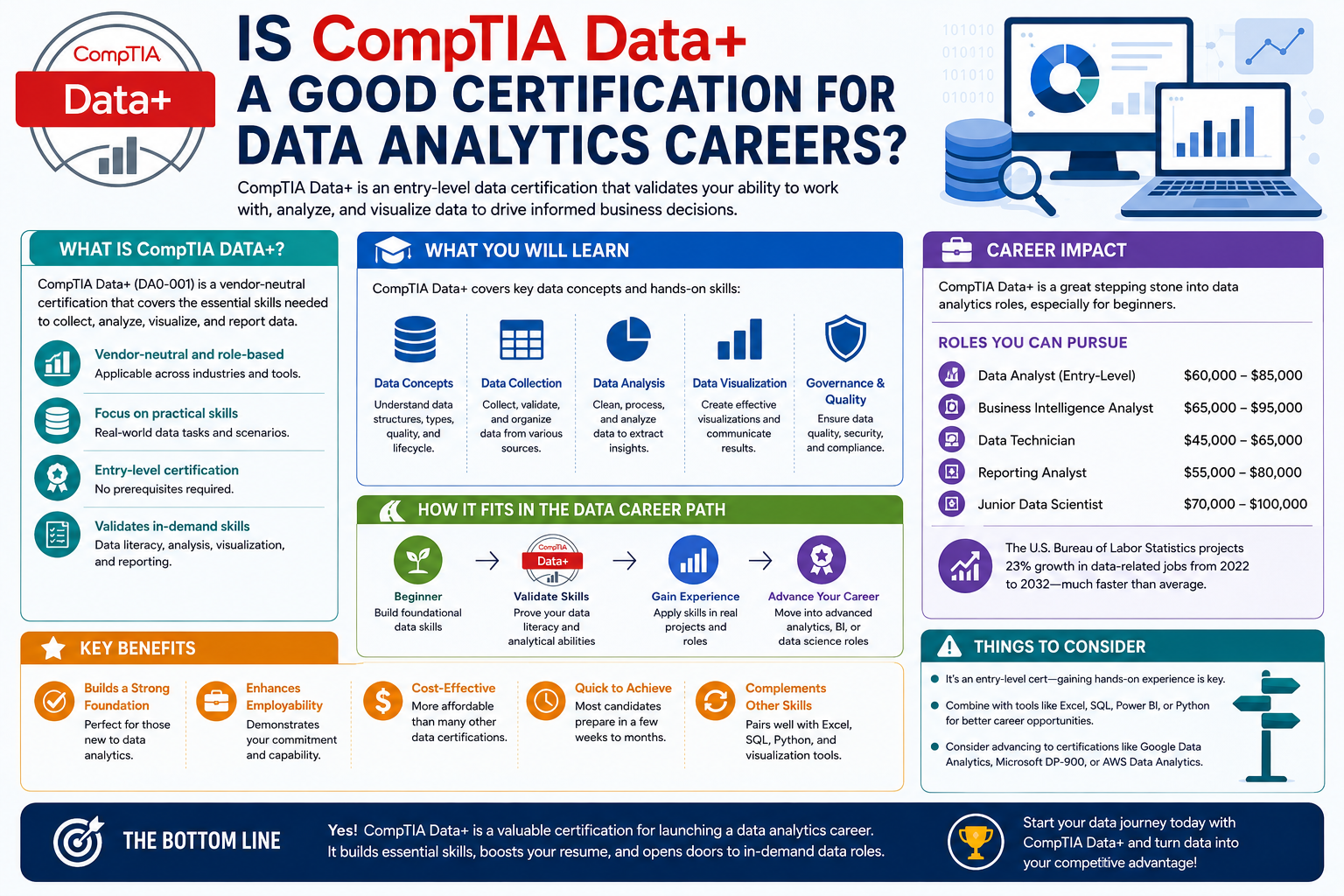
CompTIA Data+ is designed specifically with this purpose in mind. It focuses on foundational skills such as data collection, cleaning, analysis, visualization, and governance. These areas represent the core responsibilities of many entry-level data professionals. By mastering these fundamentals, learners build a strong base that can later be expanded into more advanced areas such as machine learning or predictive analytics.
Unlike highly specialized certifications that focus on a single platform or tool, foundational certifications emphasize transferable skills. This means the knowledge gained can be applied across different industries, software environments, and job roles. For early-career professionals, this flexibility is particularly valuable because it keeps career options open.
Understanding What CompTIA Data+ Represents
CompTIA Data+ is positioned as a certification that validates the ability to work with data in practical business environments. Rather than focusing on advanced mathematical theory or complex programming techniques, it emphasizes real-world application. The goal is to ensure that individuals can take raw datasets and convert them into useful insights that support decision-making.
At its core, the certification evaluates a candidate’s ability to identify relevant data sources, prepare datasets for analysis, apply basic statistical methods, and communicate findings effectively. It also places significant importance on understanding data governance principles, which ensure that data is handled ethically, securely, and in compliance with organizational standards.
One of the defining characteristics of this certification is its vendor-neutral approach. This means it does not focus on any specific software platform or technology ecosystem. Instead, it teaches universal principles that can be applied regardless of whether a company uses cloud-based tools, on-premises databases, or hybrid systems.
This approach reflects the reality of modern workplaces, where data professionals are often required to work across multiple tools and environments. By focusing on core concepts rather than specific technologies, the certification ensures long-term relevance even as software platforms continue to evolve.
Core Skill Areas Covered in Data+ Preparation
The structure of CompTIA Data+ is built around several key skill domains that represent the typical workflow of a data analyst. Each domain focuses on a different stage of the data lifecycle, ensuring that candidates develop a well-rounded understanding of how data moves from raw input to actionable insight.
The first area focuses on data concepts and environments. This includes understanding different types of data structures, file formats, and storage systems. It also involves recognizing how data is organized and accessed within various environments. This foundational knowledge is essential because it determines how efficiently data can be retrieved and processed.
The second area involves data acquisition and preparation. In real-world scenarios, raw data is rarely clean or ready for analysis. It often contains inconsistencies, missing values, or irrelevant information. This domain teaches how to identify useful data sources, extract relevant information, and prepare datasets for analysis by cleaning and transforming them.
The third area focuses on data analysis techniques. This includes basic statistical methods, trend identification, and pattern recognition. The goal is to enable professionals to interpret data accurately and draw meaningful conclusions that support business objectives.
The fourth area emphasizes visualization and reporting. Data becomes significantly more valuable when it can be communicated effectively. This domain focuses on selecting appropriate visualization methods, designing reports, and presenting insights in a way that is clear and actionable for stakeholders who may not have technical backgrounds.
The final area covers data governance. As organizations become more data-driven, ensuring data quality, privacy, and compliance has become increasingly important. This domain focuses on understanding policies, ethical considerations, and regulatory requirements that govern how data should be managed.
Together, these domains create a complete framework that reflects the real-world responsibilities of data professionals.
The Practical Nature of Data+ in Real Work Environments
One of the strengths of CompTIA Data+ is its focus on practical application rather than theoretical complexity. Many individuals entering the data field assume that advanced mathematics or programming knowledge is required from the beginning. While these skills are important in more specialized roles, entry-level data work often revolves around interpretation, organization, and communication.
In many organizations, data professionals spend a significant portion of their time preparing datasets rather than performing advanced modeling. They clean data, remove inconsistencies, and ensure that information is structured correctly for analysis. This foundational work is essential because inaccurate or poorly prepared data can lead to misleading insights.
Similarly, communication plays a major role in data-related jobs. It is not enough to generate insights; those insights must be presented in a way that decision-makers can understand. This requires the ability to translate technical findings into clear business language, often supported by visual representations.
CompTIA Data+ aligns closely with these responsibilities. It prepares individuals to operate in environments where data must be interpreted and communicated effectively rather than simply processed technically.
How Data+ Fits Into Early Career Growth
For individuals at the beginning of their careers, choosing the right certification can significantly influence long-term direction. Entry-level professionals often face uncertainty about which skills are most valuable or which roles to pursue. A structured certification can help clarify these choices by providing exposure to core industry expectations.
Data+ is particularly suited for those who are exploring roles in data analytics, business intelligence, or reporting. It helps build confidence in working with datasets and introduces foundational analytical thinking. This early exposure is important because it allows individuals to determine whether they enjoy working with data and whether they want to pursue more advanced specializations later.
In many cases, early-career certifications also serve as a bridge between academic learning and professional experience. While academic programs may cover theoretical concepts, certifications focus more on applied knowledge. This combination helps individuals transition more smoothly into the workforce.
As organizations continue to rely on data for decision-making, having validated skills at the entry level can make candidates more competitive in job markets where employers expect practical ability from day one.
The Increasing Relevance of Data Governance Awareness
One of the most significant shifts in the data landscape is the growing importance of governance. As data volumes increase, so do concerns about privacy, security, and ethical usage. Organizations must ensure that data is handled responsibly, not only to comply with regulations but also to maintain trust with customers and stakeholders.
Data governance involves establishing rules and processes for how data is collected, stored, accessed, and used. It also includes ensuring that data remains accurate, consistent, and secure throughout its lifecycle. For data professionals, understanding these principles is essential because they directly impact how data can be used for analysis.
CompTIA Data+ introduces candidates to these concepts at a foundational level. It helps build awareness of why governance matters and how it influences day-to-day data operations. Even at an entry level, professionals are expected to recognize the importance of data integrity and ethical handling practices.
As organizations continue to face increasing scrutiny over data usage, professionals who understand governance principles are becoming more valuable across industries.
The Shift Toward Vendor-Neutral Skill Validation
In the past, many certifications were closely tied to specific technologies or software platforms. While this approach is useful for specialized roles, it can limit flexibility in a rapidly changing technological landscape. As companies adopt multiple tools and platforms, professionals are increasingly expected to adapt quickly to different environments.
Vendor-neutral certifications address this challenge by focusing on universal principles rather than specific tools. This ensures that the skills learned remain relevant even as technology evolves. It also allows professionals to work across different systems without needing to relearn fundamental concepts.
CompTIA Data+ follows this model by emphasizing core data principles that apply across industries and technologies. This makes it particularly valuable for individuals who want to build a broad foundation before specializing later in their careers.
By focusing on transferable skills, vendor-neutral certifications help create more adaptable professionals who can respond effectively to changing workplace demands.
Understanding How the Certification Evaluates Data Skills
To understand the value of CompTIA Data+ more clearly, it is important to look at how the certification evaluates a candidate’s ability rather than simply what topics it covers. Unlike academic exams that often focus on memorization, this certification is designed to reflect real workplace tasks that data professionals encounter in daily operations.
The assessment is structured around scenario-based questions that require candidates to apply knowledge rather than recall definitions. For example, instead of asking what a dataset is, the exam may present a situation where a professional must choose the most appropriate dataset for a specific business question. This type of evaluation mirrors the actual responsibilities of entry-level data analysts who must constantly make decisions about data relevance and accuracy.
Another important aspect of the evaluation approach is the inclusion of performance-oriented tasks. These are designed to simulate real data environments where candidates must interpret information, identify patterns, or determine the best approach to solve a problem. The goal is to measure not only theoretical understanding but also practical judgment.
This method of assessment reflects a broader shift in the IT industry toward competency-based validation. Employers increasingly want professionals who can demonstrate applied skills rather than just academic knowledge, and the certification structure aligns with that expectation.
The Logical Flow of Data Work Assessed in the Certification
One of the most important aspects of the certification is that it mirrors the natural flow of data work inside an organization. Data professionals typically follow a structured process that begins with identifying a data requirement and ends with communicating insights to stakeholders.
The first stage involves understanding the problem or business question. In real-world environments, data work always begins with a need. This could be a question about customer behavior, sales performance, or operational efficiency. A data professional must first interpret what is being asked before selecting the appropriate data sources.
The next stage involves locating and acquiring relevant data. This step is often more complex than it appears because data is usually stored in multiple systems, formats, and locations. Professionals must determine which sources are reliable and relevant to the problem at hand.
Once the data is collected, it must be prepared for analysis. This includes cleaning inconsistencies, handling missing values, and ensuring that datasets are structured correctly. This stage is critical because poor-quality data can lead to incorrect conclusions regardless of how advanced the analysis techniques are.
After preparation, the data is analyzed using basic statistical and analytical methods. This stage focuses on identifying patterns, trends, and relationships within the dataset. The goal is not to perform advanced predictive modeling but to extract meaningful insights that support decision-making.
Finally, the results must be communicated effectively. This often involves creating reports or visual representations that make the findings understandable to non-technical stakeholders. Communication is a key part of the process because insights only become valuable when they can influence decisions.
CompTIA Data+ aligns closely with this workflow, ensuring that candidates are familiar with each stage of the data lifecycle.
The Role of Analytical Thinking in Data+ Success
Analytical thinking is one of the most important skills evaluated indirectly through this certification. While technical knowledge is essential, the ability to interpret data logically and draw meaningful conclusions is equally important.
Analytical thinking involves breaking down complex problems into smaller components, identifying relationships between variables, and evaluating possible outcomes. In the context of data work, this means understanding not just what the data shows but why it shows it.
For example, if a dataset reveals a sudden increase in customer activity, an analytical thinker would not stop at recognizing the trend. Instead, they would explore potential causes such as marketing campaigns, seasonal effects, or changes in product offerings. This deeper level of reasoning is what transforms raw data into actionable insight.
The certification encourages this type of thinking by presenting scenarios that require interpretation rather than memorization. Candidates must evaluate information critically and choose the most appropriate analytical approach for each situation.
This emphasis on reasoning skills is one of the reasons why the certification is considered valuable for early-career professionals. It helps develop a mindset that is essential for long-term success in data-related roles.
Data Preparation as the Foundation of Reliable Insights
One of the most underestimated aspects of data work is preparation. In many cases, data professionals spend significantly more time cleaning and organizing data than performing actual analysis. This is because the quality of insights depends heavily on the quality of input data.
Data preparation involves several key steps, including removing duplicates, correcting errors, standardizing formats, and handling missing values. It also includes transforming data into a structure that is suitable for analysis.
Without proper preparation, even the most advanced analytical techniques can produce misleading results. For example, inconsistent date formats or missing entries can distort trends and lead to incorrect conclusions.
CompTIA Data+ places strong emphasis on this stage because it reflects real-world responsibilities. Entry-level data professionals are often tasked with ensuring that datasets are reliable before they are used for reporting or analysis.
Understanding data preparation also requires familiarity with different types of data sources. Structured data, such as tables in databases, is easier to work with than unstructured data, such as text or images. Professionals must be able to recognize these differences and apply appropriate techniques accordingly.
Visualization as a Communication Tool in Data Work
Data visualization plays a crucial role in transforming complex datasets into understandable insights. While raw numbers can provide detailed information, they are often difficult for non-technical stakeholders to interpret. Visualization bridges this gap by presenting data in graphical formats such as charts, graphs, and dashboards.
The goal of visualization is not only to display information but also to highlight patterns and trends that might not be immediately obvious in raw data. A well-designed visualization can reveal relationships between variables, identify outliers, and simplify complex datasets.
However, effective visualization requires more than just selecting the right chart type. It also involves understanding the audience. Different stakeholders require different levels of detail and clarity. For example, executives may prefer high-level summaries, while operational teams may need more detailed breakdowns.
CompTIA Data+ evaluates this skill by testing candidates’ ability to choose appropriate visualization methods based on specific scenarios. This reflects the real-world expectation that data professionals must communicate insights clearly and effectively to diverse audiences.
Governance and Ethical Responsibility in Data Handling
As organizations continue to rely more heavily on data, the importance of governance and ethical responsibility has increased significantly. Data governance ensures that data is accurate, secure, and used appropriately throughout its lifecycle.
This includes establishing rules for data access, defining quality standards, and ensuring compliance with legal and regulatory requirements. It also involves protecting sensitive information from unauthorized access or misuse.
Ethical considerations are equally important. Data professionals must ensure that data is used in a way that respects privacy and avoids bias. This is particularly relevant in areas such as customer analytics, hiring processes, and predictive modeling.
CompTIA Data+ introduces these concepts at a foundational level to ensure that professionals understand their responsibilities when working with data. Even at an entry level, individuals are expected to recognize the importance of handling data responsibly.
As data continues to play a central role in decision-making, governance, and ethics are becoming essential components of every data-related role.
Career Pathways Supported by Foundational Data Skills
A strong foundation in data skills can open doors to multiple career pathways across industries. While the most obvious role is that of a data analyst, there are several related positions that also rely heavily on similar skill sets.
Business intelligence roles focus on transforming data into strategic insights that support decision-making at the organizational level. These professionals often work closely with dashboards and reporting systems to track performance metrics.
Operations analysis roles involve examining internal processes to identify inefficiencies and improve productivity. This requires a strong understanding of data interpretation and process evaluation.
Marketing analysis roles focus on customer behavior, campaign performance, and market trends. These professionals use data to guide marketing strategies and optimize engagement.
Even roles that are not traditionally considered data-focused, such as project management or business administration, increasingly require data literacy. The ability to interpret reports and make data-driven decisions is becoming a universal workplace skill.
Foundational certifications like Data+ help individuals build the skills needed to enter these diverse roles and adapt as their careers evolve.
The Learning Curve and Skill Progression in Data Careers
Starting a career in data can feel overwhelming due to the wide range of skills involved. However, most successful professionals follow a gradual learning progression that begins with foundational concepts and builds toward more advanced techniques.
At the beginning stage, the focus is on understanding data types, basic analysis techniques, and simple visualization methods. This stage is primarily about building confidence and familiarity with data workflows.
As professionals gain experience, they begin to work with more complex datasets and analytical methods. This may include statistical modeling, predictive analysis, or advanced visualization techniques.
Eventually, some professionals move into specialized areas such as data engineering, machine learning, or artificial intelligence. These roles require deeper technical expertise and often involve programming and advanced mathematics.
CompTIA Data+ fits into the early stage of this progression. It provides the foundational knowledge needed to move confidently into more advanced areas without overwhelming learners with unnecessary complexity.
Industry Demand for Data-Oriented Skills
The demand for data-related skills continues to grow across industries. Organizations in healthcare, finance, retail, education, and technology all rely on data to guide decisions and improve outcomes.
This demand is driven by the increasing availability of data and the growing recognition of its value. However, having data alone is not enough. Organizations need professionals who can interpret and apply it effectively.
This creates a strong demand for individuals who possess foundational data skills. Entry-level professionals who can work with data, interpret results, and communicate findings are highly valuable in modern organizations.
As a result, certifications that validate these skills are becoming more relevant in job markets. They help employers identify candidates who have demonstrated a baseline level of competency in data-related tasks.
Challenges Faced by New Data Professionals
While the field of data offers many opportunities, it also presents several challenges for newcomers. One of the most common difficulties is dealing with messy or incomplete data. Real-world datasets are rarely clean, and professionals must learn how to handle inconsistencies effectively.
Another challenge is understanding how to translate technical findings into business insights. Many new professionals struggle with communication because they focus too heavily on technical details rather than business relevance.
Time management is also a common issue. Data analysis can be time-consuming, especially when working with large or complex datasets. Learning how to prioritize tasks and focus on key insights is an important skill.
Finally, adapting to different tools and environments can be challenging. Since organizations use a variety of systems, professionals must be flexible and willing to learn new technologies as needed.
Foundational certifications help address these challenges by providing structured learning that builds both technical and conceptual understanding.
Building Long-Term Competence in Data Roles
Long-term success in data-related careers depends on continuous learning and skill development. While foundational certifications provide an important starting point, they are only the beginning of the journey.
Professionals must continue to expand their knowledge as technologies evolve and industry demands change. This may involve learning new tools, exploring advanced analytical methods, or gaining deeper expertise in specific domains.
Equally important is the development of soft skills such as communication, problem-solving, and critical thinking. These skills are essential for translating technical insights into meaningful business impact.
Over time, professionals who combine technical expertise with strong communication and analytical abilities are more likely to advance into senior roles and leadership positions within data-driven organizations.
Transitioning from Certification Knowledge to Workplace Reality
Moving from a certification framework into a real working environment is often the point where many early-career data professionals experience their first major shift in expectations. While structured learning provides clarity and direction, workplace data environments are far less predictable. Data rarely arrives in clean, well-organized formats, and business questions are often incomplete, changing, or ambiguous.
In a professional setting, data work begins with uncertainty rather than instructions. Instead of being given clearly defined datasets and questions, analysts are often presented with broad objectives such as improving customer retention, reducing operational costs, or increasing marketing performance. These goals must then be translated into measurable questions that data can answer.
This transition requires a shift in mindset. Rather than focusing on completing predefined tasks, professionals must learn to interpret intent, define analytical scope, and determine what data is actually relevant. The structured knowledge gained through foundational certification helps, but real-world application demands flexibility and judgment.
Another major difference is the pace of work. In training environments, individuals typically have time to carefully analyze datasets and explore different approaches. In contrast, workplace environments often involve deadlines, competing priorities, and stakeholder expectations. This creates pressure to deliver insights quickly without sacrificing accuracy.
As a result, success in data roles depends not only on technical understanding but also on the ability to manage ambiguity, prioritize tasks, and communicate effectively under time constraints.
What Employers Actually Expect From Entry-Level Data Professionals
Employers hiring entry-level data professionals are generally not expecting advanced statistical modeling or complex machine learning expertise. Instead, they are looking for individuals who can demonstrate reliability in handling foundational tasks that support broader decision-making processes.
One of the most important expectations is accuracy in data handling. Employers need assurance that candidates can work with datasets without introducing errors or misinterpretations. This includes understanding how to clean data, identify inconsistencies, and validate results before reporting them.
Another key expectation is problem interpretation. Entry-level professionals must be able to take a business question and translate it into a structured analytical approach. This involves identifying what data is needed, where it can be found, and how it should be processed.
Communication is equally important. Data insights must be explained in a way that non-technical stakeholders can understand. Employers value candidates who can summarize findings clearly, highlight key insights, and avoid unnecessary technical complexity when presenting results.
Finally, adaptability is highly valued. Since tools and systems vary widely across organizations, employers prefer candidates who understand underlying principles rather than relying on a single platform or software environment. This is where foundational certifications become useful, as they emphasize transferable skills rather than tool-specific expertise.
How Data Work Supports Business Decision-Making Processes
In modern organizations, data is deeply integrated into decision-making at every level. From strategic planning to daily operations, decisions are increasingly supported by quantitative evidence rather than intuition alone.
Data professionals play a critical role in this ecosystem by transforming raw information into structured insights. This process typically begins with identifying key performance indicators that align with business objectives. These indicators help organizations measure success and track progress over time.
Once relevant metrics are identified, data professionals collect and organize information from various sources. This may include customer databases, transaction records, website analytics, or operational logs. The challenge lies in consolidating this information into a coherent structure that can be analyzed effectively.
After preparation, data is analyzed to identify trends, patterns, and anomalies. These insights are then translated into reports or visual dashboards that support decision-making. However, the role of the data professional does not end with analysis. They must also ensure that insights are understood and applied correctly by stakeholders.
In many cases, data professionals act as intermediaries between raw data and business strategy. Their work ensures that decisions are based on evidence rather than assumptions, reducing uncertainty and improving outcomes.
Comparing Foundational Data Knowledge Across Industry Paths
While CompTIA Data+ represents one structured approach to foundational data skills, it exists within a broader ecosystem of data-focused learning paths. Different certifications and training frameworks emphasize different aspects of data work depending on industry needs and technological focus.
Some pathways emphasize platform-specific skills, focusing heavily on tools used in business intelligence environments. These approaches are often valuable in organizations that rely on standardized software ecosystems, where employees must quickly become proficient in specific tools.
Other pathways emphasize statistical analysis or programming-based approaches. These are more common in roles that require deeper technical expertise, such as data science or machine learning. In these environments, professionals are expected to work with complex models and large-scale datasets.
Foundational certifications, by contrast, focus on universal concepts that apply across all environments. This includes understanding how data is structured, how it can be interpreted, and how insights can be communicated effectively. The advantage of this approach is flexibility, as professionals are not limited to a single tool or methodology.
This flexibility becomes particularly important in organizations that use multiple systems or frequently change their technology stacks. Professionals with strong foundational knowledge can adapt more easily to new environments without requiring extensive retraining.
The Broader Skill Stack Required for Modern Data Professionals
While technical knowledge is essential in data roles, it is only one component of a broader skill stack. Modern data professionals must combine technical abilities with analytical thinking, communication skills, and business awareness.
Analytical thinking enables professionals to break down complex problems and identify meaningful patterns in data. Without this ability, even technically accurate analysis may fail to produce useful insights.
Communication skills are equally important. Data insights must be translated into clear, actionable recommendations. This requires the ability to simplify complex ideas without losing their meaning or accuracy.
Business awareness helps professionals understand the context in which data is being used. This includes understanding organizational goals, industry trends, and stakeholder priorities. Without this context, data analysis may become disconnected from practical decision-making needs.
Technical skills remain foundational, but they must be integrated with these broader capabilities. The most effective data professionals are those who can bridge the gap between technical analysis and business strategy.
Common Mistakes Made by Early Data Professionals
New professionals entering the data field often encounter several common challenges that can impact the quality of their work. One frequent mistake is focusing too heavily on tools rather than understanding underlying concepts. While software proficiency is important, relying solely on tools without conceptual understanding can limit long-term growth.
Another common issue is overcomplicating analysis. Early professionals sometimes assume that more complex methods produce better insights, when in reality simpler approaches may be more effective and easier to communicate.
Misinterpreting data context is another challenge. Without a clear understanding of business objectives, it is easy to draw conclusions that are technically correct but practically irrelevant.
Poor communication is also a frequent problem. Even accurate insights lose value if they are not presented clearly to decision-makers. Many new professionals underestimate the importance of storytelling in data analysis.
Finally, insufficient attention to data quality can lead to flawed results. Failing to properly clean or validate data can undermine the entire analytical process, regardless of technical skill level.
Industry-Specific Applications of Data Skills
Data skills are used across a wide range of industries, each with its own unique requirements and challenges. In retail environments, data is often used to understand customer behavior, optimize inventory levels, and improve sales strategies. Analysts in this sector focus heavily on transactional data and consumer trends.
In healthcare, data is used to improve patient outcomes, manage resources, and support medical research. Accuracy and compliance are particularly important in this field due to strict regulatory requirements.
In finance, data analysis is used to assess risk, detect fraud, and support investment decisions. Professionals in this industry often work with large volumes of structured financial data.
In manufacturing, data is used to optimize production processes, reduce waste, and improve efficiency. Operational data plays a key role in identifying bottlenecks and improving performance.
Each industry applies data differently, but the foundational skills required remain consistent. Understanding how to interpret, analyze, and communicate data is valuable across all sectors.
The Strategic Role of Visualization in Data Interpretation
Visualization is one of the most powerful tools in data communication. It allows complex datasets to be represented in a visual format that is easier to interpret and understand. However, effective visualization is not simply about creating charts or graphs. It requires thoughtful design and clear intent.
The primary purpose of visualization is to highlight patterns and relationships that may not be immediately visible in raw data. For example, trends over time can be difficult to detect in tables but become clear when displayed graphically.
However, poor visualization choices can distort understanding. Incorrect chart types, misleading scales, or unnecessary complexity can lead to misinterpretation. This is why visualization must be approached carefully, with consideration for both data accuracy and audience understanding.
Different audiences require different visualization approaches. Executives may prefer high-level summaries, while analysts may require more detailed breakdowns. Effective data professionals must be able to tailor visual outputs to suit the needs of their audience.
Data Quality Challenges in Real Organizational Environments
One of the most persistent challenges in data work is maintaining data quality. In real organizational environments, data is often collected from multiple sources, each with its own structure and level of reliability.
Inconsistencies in data entry, missing values, duplication, and outdated records are common issues that must be addressed before analysis can begin. Without proper quality control, insights derived from data may be misleading or incorrect.
Data quality management involves continuous monitoring and validation. It is not a one-time task but an ongoing process that ensures data remains accurate and usable over time.
Professionals working in data roles must develop a strong awareness of these challenges and understand how to mitigate them through proper preparation and validation techniques.
Collaboration Between Data Teams and Business Units
Data work rarely occurs in isolation. Instead, it involves collaboration between technical teams and business units. Data professionals must work closely with stakeholders to understand requirements, define objectives, and interpret results.
This collaboration ensures that data analysis remains aligned with business needs. Without clear communication between teams, there is a risk that analysis may become disconnected from practical decision-making.
Effective collaboration requires both technical understanding and interpersonal skills. Data professionals must be able to explain complex concepts in simple terms while also understanding the priorities and constraints of business teams.
This interaction between technical and non-technical teams is one of the defining characteristics of modern data environments.
Career Development Pathways Beyond Entry-Level Roles
As professionals gain experience in data roles, they often move into more specialized or advanced positions. These may include roles focused on advanced analytics, data engineering, or strategic decision-making.
Some professionals choose to specialize in visualization or business intelligence, focusing on creating dashboards and reporting systems that support organizational decision-making.
Others move toward more technical roles that involve building data pipelines, managing databases, or developing analytical models.
There are also strategic roles that focus on interpreting data at a higher level and guiding organizational decisions based on long-term trends.
Each of these pathways builds on foundational knowledge, but they require additional skills and experience to fully develop.
The Evolving Nature of Data Work in a Technology-Driven World
Data work continues to evolve as technology advances. Automation, artificial intelligence, and cloud computing are transforming how data is collected, processed, and analyzed.
Many routine data tasks are becoming automated, allowing professionals to focus more on interpretation and strategy. However, this does not reduce the importance of foundational skills. Instead, it increases the need for professionals who can understand and guide automated systems effectively.
As data becomes more integrated into everyday business operations, the role of data professionals is expanding. They are no longer just analysts but also advisors, interpreters, and decision-support specialists.
This evolution ensures that data skills will remain highly relevant, even as tools and technologies continue to change over time.
Conclusion
CompTIA Data+ sits at an interesting point in the data career landscape because it focuses on something many organizations struggle with today: turning overwhelming volumes of raw data into meaningful, usable insight. As companies continue to expand their digital systems, the challenge is no longer about collecting information but about understanding it, structuring it properly, and using it to guide decisions that actually matter.
The real value of Data+ lies in its emphasis on foundational, transferable skills. Instead of locking learners into a specific software ecosystem or advanced technical niche, it builds a practical understanding of how data flows through an organization—from collection and cleaning to analysis, visualization, and governance. These are the exact skills that entry-level and early-career professionals are expected to apply in real workplace environments.
Another important takeaway is that data roles are not limited to traditional analysts. Marketing teams, operations departments, finance units, and even project management roles increasingly rely on data-driven decision-making. This means the relevance of a certification like Data+ extends beyond a single job title and applies to a wide range of professional contexts.
However, it is also important to recognize that Data+ is not an endpoint. It is a starting foundation. The certification helps build confidence, structure, and clarity, but long-term success in data careers depends on continued learning, hands-on experience, and the development of both technical and communication skills.
In a world where data continues to grow in scale and importance, professionals who can interpret it responsibly and communicate it effectively will remain in high demand. Data+ helps establish that baseline capability, making it a useful stepping stone for anyone aiming to enter or grow within the modern data-driven workforce.