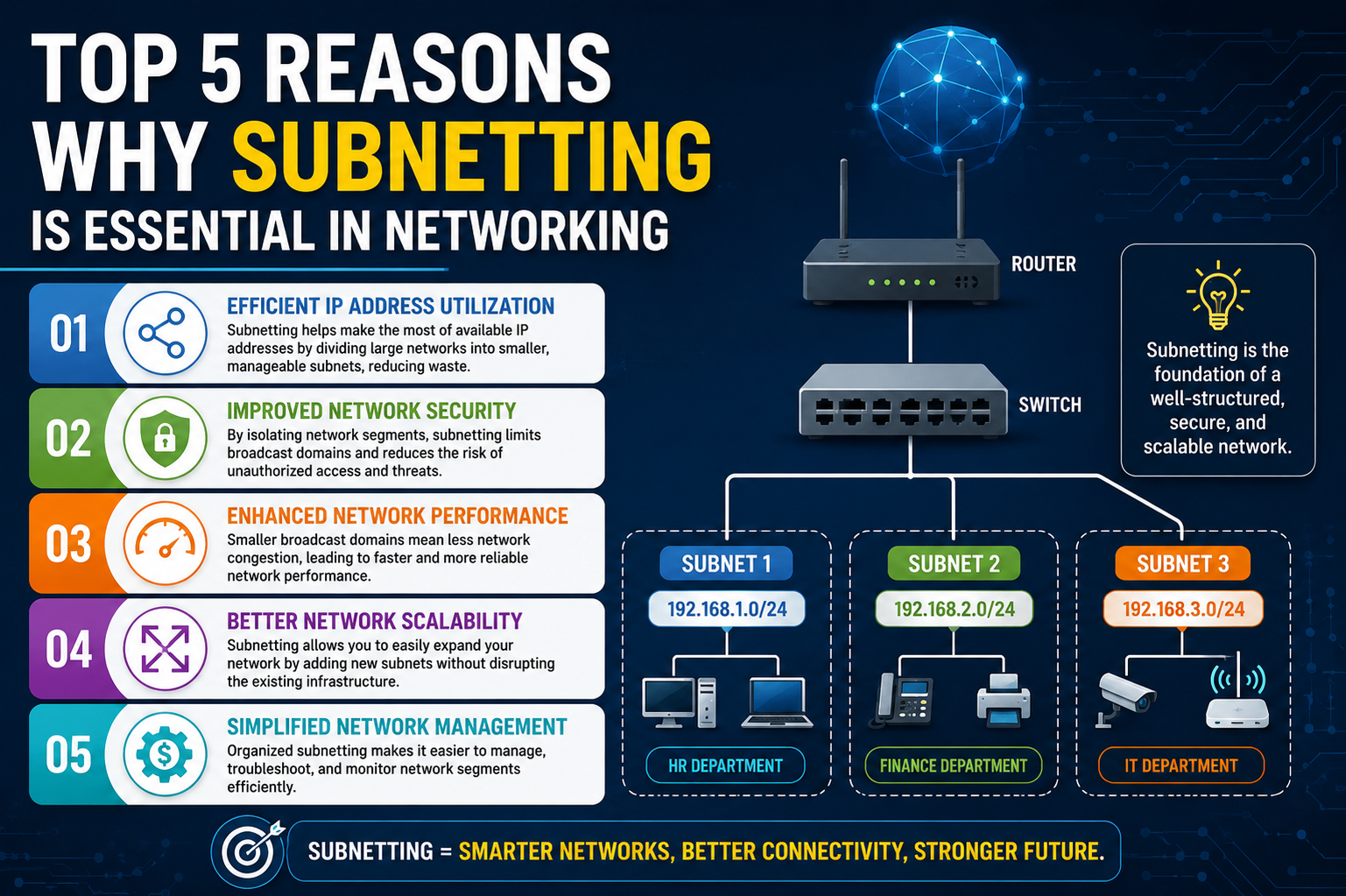
Subnetting is one of the most practical and essential skills in networking, especially when dealing with growing infrastructures and increasing data traffic. At its core, subnetting allows you to divide a larger network into smaller, more manageable segments. This approach is not just about organization—it directly impacts performance, security, scalability, and operational efficiency. When networks grow without structure, they tend to become chaotic, slow, and vulnerable. Subnetting introduces a clear structure that helps administrators design networks with purpose and control. By planning how devices are grouped and how communication flows, subnetting transforms a complex system into a streamlined and efficient environment that is easier to maintain and optimize.
Improved Network Security Through Segmentation
One of the strongest arguments in favor of subnetting is the enhanced security it provides. In a flat network where all devices reside within a single subnet, every device can potentially communicate with every other device. This creates a major vulnerability because if one device becomes compromised, the attacker can easily scan, access, and exploit other systems across the entire network. Subnetting addresses this issue by dividing the network into isolated segments, effectively limiting the reach of any potential threat.
With subnetting, administrators can implement strict access controls between segments. Traffic can be filtered and monitored using access control lists, routing policies, and prioritization mechanisms. This ensures that only authorized communication is allowed between different parts of the network. For example, sensitive systems such as financial servers or internal databases can be placed in restricted subnets where access is tightly controlled. Regular users or guest devices can be placed in separate subnets with limited permissions, preventing unauthorized access to critical resources.
This segmentation also improves visibility. When suspicious activity occurs, it becomes easier to identify its source and contain it quickly. Instead of shutting down an entire network, administrators can isolate the affected subnet and take corrective action without disrupting the rest of the system. Subnetting essentially creates controlled boundaries, reducing the attack surface and strengthening the overall security posture of the network.
Enhanced Network Performance and Speed
Performance is another critical area where subnetting delivers significant benefits. In a network without subnetting, broadcast traffic is sent to every device connected to that network. Broadcasts are necessary for certain types of communication, but when too many devices are present, they can overwhelm the network. Every device must process these broadcast messages, even if they are irrelevant, which consumes resources and slows down performance.
As networks grow larger, this broadcast traffic increases exponentially, leading to congestion and inefficiencies. Devices spend more time handling unnecessary data, and network hardware such as switches and routers must work harder to manage the load. This can result in slower response times, reduced throughput, and in extreme cases, network failure due to excessive collisions and traffic overload.
Subnetting solves this problem by limiting broadcast domains. Each subnet operates as its own broadcast domain, meaning that broadcast traffic is confined within that specific segment. Devices in one subnet do not receive broadcast messages from another subnet, which significantly reduces unnecessary traffic. This allows each segment of the network to operate more efficiently and at higher speeds.
By keeping traffic localized, subnetting ensures that only relevant data reaches each device. This reduces the processing burden on endpoints and networking equipment, leading to improved overall performance. Networks become more responsive, applications run more smoothly, and users experience fewer delays. In high-demand environments where performance is critical, subnetting is not just beneficial—it is essential.
Simplified Network Administration and Management
Managing a large network without subnetting can quickly become overwhelming. When all devices are part of a single network, tracking issues, assigning addresses, and maintaining order becomes increasingly difficult. Subnetting introduces structure, making network administration far more manageable.
One of the key advantages is the ability to allocate IP addresses more efficiently. Instead of being restricted by traditional address class limitations, subnetting allows administrators to create networks that match the actual size and needs of their environment. This prevents the waste of IP addresses and ensures that resources are used effectively. Networks can be designed with precise host limits, avoiding both shortages and excessive unused capacity.
Subnetting also improves troubleshooting. When an issue arises, it is easier to narrow down the problem to a specific subnet rather than searching across the entire network. This targeted approach reduces the time required to identify and resolve issues. Administrators can quickly determine which segment is affected and focus their efforts সেখানে, minimizing downtime and disruption.
Additionally, subnetting enables better organization. Devices can be grouped based on function, department, or location. For example, servers, workstations, and wireless devices can each have their own subnet. This logical grouping simplifies policy enforcement and monitoring, as each subnet can have its own rules and configurations tailored to its purpose.
Although subnetting requires careful planning and initial setup, the long-term benefits far outweigh the effort. Once implemented, it creates a structured environment where management tasks become more predictable, efficient, and less prone to errors.
Controlled and Scalable Network Growth
Growth is inevitable in most networks, whether due to business expansion, increased user demand, or the addition of new technologies. Without proper planning, this growth can lead to inefficiencies, address shortages, and performance issues. Subnetting provides a framework for controlled and scalable expansion.
When designing a subnetted network, administrators can anticipate future growth and allocate address space accordingly. By understanding how many devices are currently in use and estimating future requirements, they can create subnets that accommodate expansion without requiring major redesigns. This proactive approach ensures that the network remains stable and efficient as it grows.
Subnetting also allows flexibility in how address space is distributed. Networks can be divided into smaller subnets with fewer hosts or larger subnets with more hosts, depending on the needs of each segment. This adaptability makes it easier to adjust to changing requirements without disrupting existing operations.
A key concept in planning subnet growth is determining the number of hosts needed within each subnet. By calculating the available host addresses based on the subnet mask, administrators can ensure that each segment has sufficient capacity. This prevents situations where a subnet runs out of addresses and requires immediate restructuring, which can be both time-consuming and disruptive.
By implementing subnetting with growth in mind, organizations can avoid the pitfalls of unmanaged expansion. The network remains organized, scalable, and capable of supporting new devices and services without compromising performance or stability.
Reduced Network Congestion and Improved Traffic Flow
Network congestion is a common issue in large environments, especially when traffic is not properly managed. When all devices share the same network space, data packets must compete for bandwidth, leading to delays and inefficiencies. Subnetting helps alleviate this problem by dividing the network into smaller, more manageable segments.
In a subnetted environment, traffic destined for a device within a specific subnet remains داخل that subnet. This localized communication reduces the amount of traffic that needs to traverse the entire network. As a result, bandwidth is used more efficiently, and congestion is minimized.
Routers play a crucial role in this process by controlling how traffic moves between subnets. They ensure that only necessary data is routed from one subnet to another, preventing unnecessary traffic from spreading across the network. Broadcast traffic, in particular, is not forwarded between subnets, which significantly reduces overall congestion.
This structured flow of traffic leads to faster response times and improved performance. Devices spend less time waiting for data, and applications can operate more efficiently. In environments with high data demands, such as enterprise networks or data centers, reducing congestion is critical for maintaining optimal performance.
Subnetting also allows administrators to strategically design the network to minimize traffic bottlenecks. By placing related devices within the same subnet, they can ensure that most communication occurs locally rather than across the entire network. This not only improves efficiency but also enhances reliability, as localized traffic is less likely to be affected by issues in other parts of the network.
Building a Strong Foundation for Networking Skills
Beyond its practical benefits, subnetting is a foundational skill that strengthens overall networking knowledge. Understanding how to divide networks, allocate addresses, and manage traffic provides valuable insight into how networks function at a deeper level. It enhances problem-solving abilities and prepares individuals for more advanced networking concepts.
Learning subnetting also reinforces key principles such as routing, addressing, and network design. These concepts are essential for anyone working with modern networks, whether in small businesses or large enterprises. As networks continue to evolve, the ability to design efficient and scalable infrastructures becomes increasingly important.
Mastering subnetting not only improves technical expertise but also builds confidence in handling complex networking scenarios. It enables professionals to approach challenges with a structured mindset, making it easier to design, implement, and maintain reliable network systems.
Conclusion
Subnetting stands as a fundamental technique that transforms how networks are designed, managed, and optimized. By dividing a large network into smaller, structured segments, it introduces clarity and control that would otherwise be difficult to achieve in a flat environment. Each subnet becomes a manageable unit, allowing administrators to enforce policies, monitor activity, and allocate resources with precision. This structured approach not only simplifies operations but also creates a more resilient and adaptable network architecture.
From a security perspective, subnetting reduces risk by isolating systems and limiting unnecessary access. It ensures that sensitive resources remain protected while still allowing essential communication where needed. In terms of performance, it minimizes unnecessary traffic and keeps communication localized, which leads to faster response times and more efficient use of network resources. These improvements directly impact user experience and system reliability, especially in environments with heavy data demands.
Subnetting also brings long-term value through better planning and scalability. Networks are no longer forced into rigid structures; instead, they can grow in a controlled and predictable way. Administrators can anticipate future needs, allocate address space wisely, and avoid costly redesigns. This forward-thinking approach ensures that the network remains stable and efficient even as it expands.
Ultimately, subnetting is more than just a technical skill—it is a strategic advantage. It enables better decision-making, stronger security, improved performance, and easier management. For anyone working with networks, understanding and applying subnetting is essential for building systems that are not only functional but also efficient, scalable, and secure.