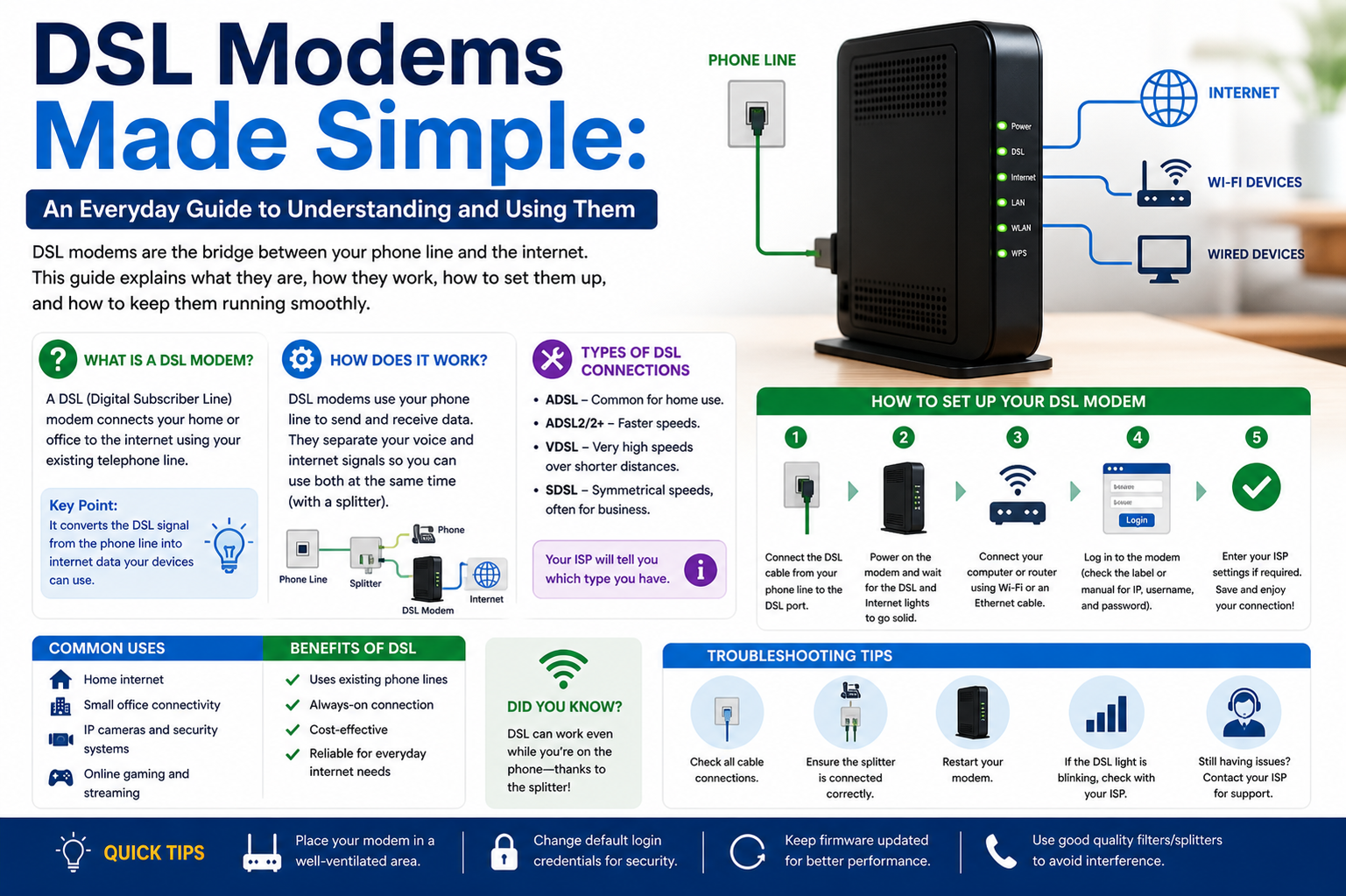
A DSL modem is a networking device that allows homes, offices, and small organizations to connect to the internet using traditional telephone lines. It works by converting digital data from computers and other devices into signals that can travel over copper phone wiring and then converting incoming signals back into digital form. This conversion process is essential because computers understand only digital signals, while telephone lines were originally designed to carry analog voice communication.
Even with modern internet technologies becoming more widespread, DSL modems remain in use in many regions where older telephone infrastructure is still the primary means of connectivity. They provide a practical solution for areas where fiber-optic or high-speed cable networks are not available. This makes DSL technology an important part of global internet access, especially in rural communities and regions with limited infrastructure upgrades.
At its core, a DSL modem acts as a bridge between two different communication systems. On one side, it connects to your computer or router using digital signals. On the other side, it connects to a telephone line that carries modulated analog signals. By managing this transformation smoothly, the modem ensures that data can move back and forth between your devices and the internet service provider without interruption.
DSL modems are especially useful in environments where users still rely on existing telephone wiring. Instead of requiring new infrastructure, they use the copper lines already installed in buildings and neighborhoods. This reuse of infrastructure is one of the main reasons DSL technology has remained relevant for so long.
How DSL Modems Work in Simple Terms
A DSL modem functions by translating data between digital and analog formats. When you send a request from your device, such as opening a website or streaming a video, the modem takes that digital request and converts it into a format suitable for transmission over telephone lines. This process is known as modulation.
Once the signal reaches the internet service provider’s equipment, it is converted back into digital data through a process called demodulation. The same process happens in reverse when data is sent back to your device. This continuous conversion allows two-way communication over a medium that was originally not designed for internet traffic.
The key advantage of DSL technology is that it can transmit internet data and voice signals simultaneously over the same telephone line. This is made possible by separating the frequency ranges used for voice calls and internet data. Voice communication uses lower frequencies, while internet data is transmitted using higher frequencies. This separation ensures that both services can function at the same time without interfering with each other.
Because DSL operates over existing copper telephone lines, it does not require major infrastructure changes. Instead, it uses specialized equipment at both the user’s end and the service provider’s end to manage signal conversion and routing.
The Role of Telephone Lines in DSL Connectivity
Telephone lines play a central role in DSL technology. These lines consist of copper wires that were originally designed to carry analog voice signals. DSL technology repurposes these same wires to carry high-frequency digital data in addition to voice communication.
The ability to share a single line for both internet and phone service is one of the key strengths of DSL systems. It allows users to stay connected to the internet without losing access to traditional landline services. This dual functionality is made possible through frequency separation, where different types of signals operate within distinct frequency bands.
However, the quality and speed of a DSL connection depend heavily on the condition and length of the telephone line. The farther a user is from the service provider’s central equipment, the weaker the signal becomes. This is because copper lines naturally experience signal degradation over long distances. As a result, users closer to the provider typically receive faster and more stable connections than those located farther away.
Despite these limitations, DSL remains a reliable option in many areas. It continues to serve users who may not have access to modern fiber networks or high-speed cable connections.
Digital and Analog Signal Conversion Process
One of the most important functions of a DSL modem is signal conversion. Digital signals, which are used by computers and digital devices, consist of binary data made up of zeros and ones. These signals cannot travel directly over traditional telephone lines, which were designed for analog voice signals.
To solve this problem, the DSL modem converts digital signals into analog waveforms. These waveforms can travel efficiently over copper wiring. Once the signal reaches the receiving end, it is converted back into digital form so that computers and devices can understand and process the information.
This process happens continuously and in real time. Every time you click a link, send a message, or stream content, the modem is actively converting and transmitting data in both directions. This constant conversion is what enables seamless internet connectivity over older infrastructure.
The efficiency of this process depends on the quality of the modem and the condition of the telephone line. Advanced modulation techniques are used to maximize data transfer rates while minimizing interference and signal loss.
Basic Architecture of a DSL Connection
A typical DSL setup consists of several key components working together to provide internet access. The first component is the DSL modem, which connects directly to the telephone line. The second component is usually a router, which distributes internet access to multiple devices within a home or office.
The modem handles communication with the internet service provider, while the router manages local network traffic. In some cases, both functions are combined into a single device, simplifying setup and reducing hardware requirements.
On the provider’s side, DSL connections are managed through specialized equipment that aggregates and routes data from multiple users. This infrastructure is typically located at a telephone exchange or central office. From there, data is connected to the broader internet.
This architecture allows multiple users to share the same infrastructure while maintaining individual connections. Each user has a dedicated communication path that ensures privacy and consistent data delivery.
Why DSL Technology Still Exists Today
Despite the rise of faster technologies such as fiber-optic and advanced wireless networks, DSL continues to be used in many parts of the world. One of the main reasons is infrastructure availability. Installing new fiber-optic cables requires significant investment and time, especially in remote or less populated areas.
DSL technology offers a cost-effective alternative by using existing telephone lines. This reduces the need for large-scale construction and allows service providers to deliver internet access more quickly and affordably.
Another reason for its continued use is reliability. In areas where modern infrastructure is limited, DSL provides a stable and consistent connection for basic internet usage such as browsing, email, and communication services.
DSL also remains relevant in small businesses and residential buildings that have not yet upgraded their networking systems. Its simplicity and compatibility with existing wiring make it a practical choice in many situations.
Limitations of DSL Connectivity in Practical Use
While DSL has many advantages, it also comes with certain limitations. One of the most significant drawbacks is speed. Compared to modern fiber-optic connections, DSL is considerably slower. This can affect activities that require high bandwidth, such as video streaming, online gaming, or large file transfers.
Another limitation is distance sensitivity. The farther a user is from the provider’s central office, the weaker the signal becomes. This leads to reduced performance and lower internet speeds for users in remote locations.
Signal interference can also affect DSL performance. Since the technology relies on copper wiring, it is more vulnerable to electrical noise and line degradation over time. Poor wiring conditions can result in unstable connections or reduced quality.
Additionally, DSL technology has limited scalability compared to newer systems. As internet demand continues to grow, DSL may struggle to meet the requirements of high-speed, high-capacity applications.
Importance of Understanding DSL Fundamentals
Understanding how DSL modems work is important for anyone working with networking systems or managing internet connectivity. Even though newer technologies are becoming more common, DSL remains widely used in many environments.
Knowing the basic principles of signal conversion, telephone line usage, and modem operation helps users troubleshoot connectivity issues more effectively. It also provides a foundation for understanding more advanced networking technologies.
DSL modems represent an important stage in the evolution of internet connectivity. They demonstrate how existing infrastructure can be adapted to support modern communication needs without requiring complete system replacement.
By studying how DSL works at a fundamental level, it becomes easier to understand the broader principles of data transmission, network communication, and internet architecture.
Key Components That Make a DSL Modem Work
A DSL modem is not a single-function device but a combination of several internal components working together to manage data transmission over telephone lines. These components handle signal processing, error correction, synchronization with the service provider, and conversion between digital and analog formats. Each part plays a role in ensuring that data moves efficiently and remains stable during transmission.
Inside the modem, a digital signal processor is responsible for handling complex calculations required for encoding and decoding signals. This processor ensures that data is properly prepared before being sent over the line and correctly reconstructed when it is received. Memory components store temporary data during transmission, helping maintain smooth communication even during high traffic conditions.
The modem also includes line interface circuitry that connects directly to the telephone line. This circuitry is designed to handle electrical signals safely and efficiently while protecting the internal system from voltage fluctuations. Together, these components allow the modem to maintain a stable connection between your local network and the internet service provider.
Understanding DSL Technology Families
DSL technology is not a single unified system but a group of related standards designed to optimize internet delivery over copper telephone lines. Each standard is developed to serve different environments, distances, and speed requirements. The choice of DSL type depends largely on infrastructure availability and distance from the provider’s central equipment.
One of the most widely used versions is ADSL, which stands for Asymmetric Digital Subscriber Line. This version prioritizes download speeds over upload speeds, making it ideal for typical home internet usage such as browsing, streaming, and downloading content. ADSL is commonly used in residential areas where users consume more data than they upload.
Another important variant is VDSL, which stands for Very High Bitrate Digital Subscriber Line. VDSL provides significantly faster speeds compared to ADSL but is limited to shorter distances. It is often used in urban environments where infrastructure density allows users to be closer to service provider equipment. This proximity enables higher performance and more stable connections.
A more advanced version known as G.fast is designed for ultra-high-speed data transmission over very short copper lines. It is typically used in modern buildings where fiber connections reach close to the premises, and copper wiring is only used for the final connection. G.fast is capable of delivering speeds that approach fiber-like performance under ideal conditions.
Each of these DSL technologies is designed with specific use cases in mind. The selection depends on balancing speed requirements, distance limitations, and existing infrastructure availability.
How DSL Standards Affect Internet Performance
Different DSL standards directly influence the quality and speed of internet connections. The main factors that determine performance include distance from the provider, line quality, and the specific DSL technology being used. As distance increases, signal strength decreases, which can reduce overall speed and stability.
ADSL typically provides stable performance over longer distances but at lower speeds compared to newer standards. It is suitable for general internet usage where ultra-high speeds are not required. VDSL offers much higher performance but only works effectively within shorter ranges, making it more suitable for densely populated areas.
G.fast delivers the highest speeds among DSL technologies but is extremely sensitive to distance. Even small increases in line length can significantly reduce performance. This makes it best suited for environments where fiber infrastructure is already partially deployed.
The performance of DSL connections is also influenced by environmental factors such as electrical interference and the condition of copper wiring. Poor wiring or external noise can reduce signal quality, leading to slower speeds and occasional connection instability.
Signal Modulation in DSL Communication
Signal modulation is a fundamental process that allows DSL modems to transmit digital data over analog telephone lines. Since digital devices use binary data and telephone lines were originally designed for analog voice signals, modulation acts as the bridge between these two systems.
One of the most commonly used modulation techniques is Quadrature Amplitude Modulation. This method works by changing both the strength and phase of a signal to represent multiple bits of data simultaneously. By combining these two properties, QAM increases the amount of information that can be transmitted within a limited frequency range.
QAM is widely used in earlier DSL standards such as ADSL and VDSL for handling download traffic. However, it can be sensitive to interference, which means signal quality must remain relatively stable for optimal performance. Any noise on the line can reduce its efficiency.
Another advanced technique used in modern DSL systems is Orthogonal Frequency Division Multiplexing. This method divides the available frequency spectrum into multiple smaller channels that operate independently. Each channel carries a portion of the data, allowing multiple streams to be transmitted at the same time.
OFDM is highly resistant to interference and signal degradation because if one channel is affected, the others can continue functioning normally. This makes it ideal for high-speed DSL technologies such as VDSL2 and G.fast, where stability and performance are critical.
Role of Frequency Bands in DSL Systems
DSL technology relies heavily on the use of frequency separation to transmit different types of data over the same physical line. Telephone lines carry both voice communication and internet data by dividing the available frequency range into distinct sections.
Lower frequency bands are reserved for voice calls, while higher frequency bands are used for internet data transmission. This separation ensures that both services can operate simultaneously without interfering with each other. It also allows users to make phone calls while staying connected to the internet.
The allocation of frequency bands is carefully managed to maximize efficiency. DSL systems use filters to separate voice and data signals, ensuring that each type of communication remains clear and uninterrupted. These filters are often installed at the user’s end to improve signal quality and reduce interference.
The ability to share a single line for multiple services is one of the key advantages of DSL technology. It reduces infrastructure costs and makes efficient use of existing telephone networks.
Physical Interfaces Found in DSL Modems
DSL modems are equipped with several physical interfaces that allow them to connect to different types of devices and networks. The most important interface is the DSL port, which connects directly to the telephone line. This port is typically designed to fit standard telephone connectors and serves as the primary link to the service provider.
Another common interface is the Ethernet port, which allows the modem to connect to computers, routers, or network switches. Ethernet connections provide stable and high-speed data transfer within local networks. In most modern setups, the modem connects to a router through this port to distribute internet access across multiple devices.
Some DSL modems also include a USB port, although this feature is less common in modern devices. USB connections were previously used to connect directly to computers or provide power in certain setups. However, Ethernet has largely replaced USB for networking purposes due to its higher performance and reliability.
In addition to physical ports, many DSL modems include wireless capabilities. These built-in wireless systems allow devices to connect to the internet without the need for cables, providing greater flexibility and convenience in home and office environments.
Interaction Between Modem and Router Systems
In most modern networks, a DSL modem works alongside a router to provide full internet connectivity. The modem is responsible for establishing a connection with the internet service provider, while the router distributes that connection to multiple devices within a local network.
When used together, the modem acts as the entry point for internet data, converting signals from the telephone line into digital form. The router then takes this data and manages how it is shared across devices such as computers, smartphones, and smart appliances.
In some cases, both functions are combined into a single device known as a modem-router combo. This simplifies installation and reduces the number of devices required for internet access. However, separate devices can offer more flexibility and better performance in certain network setups.
The interaction between modem and router systems is essential for maintaining stable and efficient internet connectivity in multi-device environments.
Importance of Line Quality and Installation
The performance of a DSL connection depends heavily on the quality of the telephone line and how it is installed. Copper wiring must be in good condition to ensure strong and stable signal transmission. Any damage, corrosion, or poor connections can lead to reduced performance.
Proper installation is also important for minimizing interference. Incorrect wiring or poor placement of filters can result in signal noise, which affects both speed and stability. Professional installation is often recommended to ensure optimal performance.
Environmental factors such as electrical interference from nearby devices can also impact DSL performance. Keeping modem cables organized and away from potential sources of interference can help improve connection quality.
Regular maintenance and inspection of telephone lines can help prevent long-term issues and ensure consistent internet performance.
Basic Role of DSL Modems in Network Communication
DSL modems serve as a critical link between local devices and the broader internet. They manage the conversion of signals, maintain communication with the service provider, and ensure that data flows smoothly in both directions.
Without a modem, devices would not be able to interpret or transmit data over telephone lines. The modem acts as a translator that enables communication between fundamentally different systems.
This role makes DSL modems an essential part of internet infrastructure in areas where traditional telephone lines are still in use. They provide a reliable and cost-effective way to maintain connectivity across a wide range of environments.
DSL Modem Setup Workflow Overview
Setting up a DSL modem involves a structured process that ensures proper communication between your home network and the internet service provider. Although modern devices often simplify installation with automatic configuration, understanding each step helps you identify issues more effectively and optimize performance. The setup process typically includes physical connection, authentication with the provider, network configuration, and security adjustments.
When done correctly, the modem establishes a stable link with the provider’s DSL equipment and begins translating data for your connected devices. Even small mistakes during setup, such as incorrect cable placement or missing configuration details, can result in connection failures or unstable internet performance.
Physical Connection and Line Preparation
The first stage in DSL modem setup is connecting the device to the telephone line using a DSL cable. This connection is usually made through a standard telephone wall socket. In many cases, a splitter is used to separate voice and internet signals, ensuring that phone calls and internet data do not interfere with each other.
Proper line preparation is important for maintaining signal quality. Any loose connections, damaged cables, or improperly installed splitters can introduce noise into the line. This noise can reduce speed, increase latency, or even prevent the modem from establishing a connection.
Once the physical connection is established, the modem begins detecting the DSL signal from the provider. This process is known as synchronization. During synchronization, the modem and the provider’s equipment negotiate signal strength, speed limits, and communication parameters.
DSL Synchronization and Line Training Process
Synchronization is one of the most important stages in DSL operation. It refers to the process where the modem and the provider’s system establish a stable communication link. During this phase, both sides test the quality of the line and adjust transmission settings accordingly.
This process is often referred to as line training. The modem measures factors such as signal-to-noise ratio, line attenuation, and available bandwidth. Based on these measurements, it determines the highest stable speed that the line can support.
If the line quality is poor, the modem may reduce speed to maintain stability. If the line quality is strong, higher speeds can be achieved. This adaptive behavior ensures that the connection remains stable even under varying conditions.
Internet Authentication Methods Used in DSL Networks
After synchronization, the modem must authenticate with the internet service provider. This step ensures that only authorized users can access the network. One of the most commonly used authentication methods in DSL systems is PPPoE, which stands for Point-to-Point Protocol over Ethernet.
PPPoE requires a username and password provided by the internet service provider. When entered correctly, the modem establishes a secure session with the provider’s network. This session allows data to flow between your local network and the internet.
In some configurations, authentication may be handled automatically by the provider, eliminating the need for manual login details. However, PPPoE remains widely used due to its security and compatibility with legacy systems.
IP Address Assignment and Network Initialization
Once authentication is complete, the modem receives an IP address from the internet service provider. This IP address acts as a unique identifier for your connection on the internet. It allows data to be routed correctly between your network and external servers.
In most DSL systems, IP addresses are assigned dynamically. This means that the address may change periodically depending on the provider’s network policies. Dynamic assignment helps manage large numbers of users efficiently.
After receiving an IP address, the modem completes network initialization. At this stage, your devices can begin accessing the internet either directly through the modem or through a connected router.
Bridge Mode and Routing Mode Configuration
DSL modems can operate in different modes depending on the network setup. Two of the most common modes are bridge mode and routing mode. Each mode determines how the modem handles network traffic and interacts with other devices.
In routing mode, the modem performs multiple functions including signal conversion, authentication, IP assignment, and local network management. This mode is commonly used in simple home setups where the modem also acts as a router.
In bridge mode, the modem only handles signal conversion and passes the internet connection directly to a separate router. The router then takes full responsibility for managing the network. This setup is often preferred in advanced configurations where more control over network settings is required.
Choosing the correct mode depends on the complexity of the network and the performance requirements of connected devices.
Understanding Signal Quality Metrics in DSL Connections
DSL performance is heavily influenced by signal quality metrics that determine how well data can be transmitted over telephone lines. Two of the most important metrics are signal-to-noise ratio and line attenuation.
Signal-to-noise ratio measures the strength of the internet signal compared to background noise on the line. A higher ratio indicates a cleaner and more stable connection, while a lower ratio suggests interference or poor line quality.
Line attenuation measures how much signal strength is lost as data travels along the copper wire. Longer distances between the user and the provider result in higher attenuation, which reduces overall performance.
Monitoring these metrics helps identify potential issues and allows for adjustments to improve stability and speed.
Common DSL Connection Issues and Their Causes
DSL connections can experience several common issues that affect performance and stability. One frequent problem is loss of synchronization, where the modem fails to maintain a stable connection with the provider. This can be caused by poor wiring, damaged cables, or line interference.
Another common issue is slow internet speed, which may result from distance limitations, network congestion, or outdated modem hardware. In some cases, incorrect configuration settings can also reduce performance.
Intermittent disconnections are often caused by unstable line conditions or faulty splitters. Electrical interference from nearby devices can also disrupt signal quality.
Identifying the root cause of these issues requires systematic troubleshooting, including checking physical connections, reviewing modem logs, and testing line quality.
Built-In Diagnostic Tools in DSL Modems
Most modern DSL modems include built-in diagnostic tools that help users monitor and troubleshoot connection problems. These tools provide information about signal strength, connection status, error rates, and synchronization details.
One commonly used diagnostic feature is the error log, which records connection failures, authentication issues, and signal interruptions. Reviewing these logs can help identify recurring problems and guide troubleshooting efforts.
Another useful feature is real-time signal monitoring, which displays metrics such as noise levels and line stability. This information helps users understand how their connection is performing under different conditions.
Some modems also include automatic troubleshooting functions that attempt to reset connections or adjust settings to restore stability.
Role of Quality of Service in DSL Networks
Quality of Service is a feature found in many DSL modems and routers that helps manage network traffic more efficiently. It allows users to prioritize certain types of data over others, ensuring that important applications receive sufficient bandwidth.
For example, real-time applications such as voice calls or video streaming can be prioritized over background downloads. This helps reduce lag and improves overall user experience.
Quality of Service settings can be configured manually or automatically depending on the modem’s capabilities. Proper configuration ensures balanced bandwidth distribution across multiple devices.
Without proper traffic management, network congestion can occur, leading to slower speeds and inconsistent performance during peak usage times.
Firmware Updates and System Stability
DSL modem performance can be improved through firmware updates provided by the manufacturer or internet service provider. Firmware is the internal software that controls how the modem operates.
Updates often include performance improvements, security patches, and compatibility enhancements. Installing the latest firmware helps ensure that the modem operates efficiently and securely.
Outdated firmware can lead to performance issues, connection instability, or security vulnerabilities. Regular updates help maintain long-term reliability and compatibility with provider networks.
In many cases, firmware updates are installed automatically, but manual checks may be required in some setups.
Security Considerations in DSL Modem Configuration
Security is an important aspect of DSL modem configuration. Since the modem acts as a gateway between your local network and the internet, it must be properly secured to prevent unauthorized access.
One of the first steps in securing a modem is changing default login credentials. Default usernames and passwords are widely known and can be exploited if not updated.
Enabling encryption for wireless connections is also essential. Modern security protocols help protect data from interception and unauthorized access.
Firewall settings provide an additional layer of protection by filtering incoming and outgoing traffic. Proper configuration of these settings helps prevent malicious activity and unauthorized network access.
Long-Term Stability and Maintenance of DSL Systems
Maintaining a stable DSL connection requires regular monitoring and occasional maintenance. This includes checking physical cables, reviewing modem diagnostics, and ensuring that firmware is up to date.
Environmental factors such as temperature changes, moisture, and electrical interference can affect long-term performance. Keeping the modem in a stable environment helps reduce these risks.
Periodic restarts of the modem can also help clear temporary issues and refresh the connection with the provider’s network. While DSL systems are generally stable, proactive maintenance helps ensure consistent performance over time.
Real-World Use of DSL Networks in Modern Environments
DSL networks continue to operate in a variety of real-world environments where newer infrastructure has not fully replaced legacy systems. These environments often include rural communities, older residential buildings, and small-scale business setups. In such areas, the existing copper telephone infrastructure still provides the backbone for internet connectivity.
In rural regions, the cost of deploying fiber-optic cables across long distances can be extremely high. DSL offers a practical alternative by using infrastructure that is already in place. This allows service providers to deliver internet access without major physical upgrades, making connectivity more accessible to users in remote locations.
In older urban buildings, especially multi-dwelling units, rewiring for fiber may not always be feasible due to structural limitations. DSL systems allow these buildings to maintain internet access using existing telephone lines, which reduces installation complexity and cost.
DSLAM Role in Internet Service Provider Infrastructure
A key component in DSL networks is the DSL Access Multiplexer, commonly known as DSLAM. This equipment is installed at the service provider’s central office and plays a critical role in managing multiple DSL connections simultaneously.
The DSLAM aggregates signals from multiple users and directs them into a high-capacity backbone connection that leads to the broader internet. It also performs signal conversion, ensuring that analog signals received from customer lines are converted into digital data for processing.
Each user’s DSL line connects individually to the DSLAM, which helps maintain separation between different connections. This architecture ensures that each subscriber receives a dedicated communication path, improving reliability and reducing interference between users.
The performance of a DSL connection is closely tied to the quality and capacity of the DSLAM equipment, as well as the distance between the user and the provider’s infrastructure.
Distance Limitations and Signal Degradation Effects
One of the most significant factors affecting DSL performance is the distance between the user and the service provider’s equipment. As the signal travels through copper wiring, it gradually weakens due to resistance and environmental interference.
This weakening of the signal is known as attenuation. Higher attenuation levels result in reduced internet speeds and lower connection stability. Users located closer to the DSLAM typically experience stronger signals and higher performance levels.
As distance increases, the modem may automatically adjust transmission speeds to maintain a stable connection. While this ensures reliability, it can also limit maximum achievable speeds for users located farther away from the provider’s central infrastructure.
Signal degradation is one of the primary reasons DSL performance varies across different geographic locations, even when using the same service plan.
Noise Interference and Crosstalk in Copper Lines
DSL connections are also affected by electrical noise and interference within copper wiring. Noise can originate from nearby electrical devices, poor wiring conditions, or external environmental factors. This interference can disrupt data transmission and reduce overall connection quality.
Another important issue is crosstalk, which occurs when signals from adjacent copper lines interfere with each other. In densely packed cable bundles, multiple DSL lines run close together, increasing the likelihood of signal overlap.
Crosstalk becomes more noticeable in high-density areas where many users share the same physical infrastructure. This can lead to reduced speeds and inconsistent performance during peak usage times.
Modern DSL technologies use advanced signal processing techniques to minimize the impact of noise and crosstalk, but these factors cannot be completely eliminated in copper-based systems.
Error Correction Techniques in DSL Communication
To maintain stable communication over imperfect copper lines, DSL systems use error correction techniques. These methods help detect and correct data errors that occur during transmission.
One commonly used technique is Forward Error Correction. This method adds extra data to the transmission, allowing the receiving end to identify and fix errors without needing to resend the original data. This improves reliability, especially on noisy or long-distance connections.
Another method involves interleaving, where data is rearranged before transmission and then reassembled at the receiving end. This process spreads out potential errors, making them easier to correct and reducing the impact of temporary signal disturbances.
While error correction improves stability, it can also introduce slight delays in data transmission. This trade-off between speed and reliability is an important aspect of DSL performance optimization.
Latency Behavior in DSL Networks
Latency refers to the time it takes for data to travel from one point to another in a network. In DSL systems, latency is influenced by several factors, including distance, signal processing, and error correction methods.
Because DSL relies on copper wiring and multiple conversion processes, it generally has higher latency compared to fiber-optic connections. Each stage of signal modulation, transmission, and demodulation introduces small delays.
In addition, error correction techniques such as interleaving can further increase latency. While these methods improve stability, they may slightly delay real-time communication.
Latency is an important consideration for applications that require fast response times, such as online gaming or real-time communication services.
Fast Path Mode and Interleaved Mode in DSL
DSL systems often operate in two main transmission modes: interleaved mode and fast path mode. Each mode balances speed, stability, and latency differently depending on user requirements.
Interleaved mode uses error correction and data rearrangement techniques to improve stability. This mode is more resistant to noise and signal disruption but introduces additional latency due to processing overhead.
Fast path mode reduces or eliminates interleaving to minimize latency. This allows for faster response times but makes the connection more sensitive to errors and noise.
Service providers may select the appropriate mode based on line quality and user requirements. Stable lines may support fast path mode, while less stable connections may require interleaved mode for consistent performance.
Bandwidth Allocation and Traffic Distribution
DSL networks manage bandwidth through structured allocation methods that determine how data is distributed among users. Each connection is assigned a portion of available bandwidth based on service plans and network capacity.
During peak usage times, bandwidth may become limited, leading to reduced speeds for some users. This is particularly common in shared infrastructure environments where multiple users access the network simultaneously.
To manage traffic efficiently, DSL systems may implement prioritization techniques that allocate more bandwidth to critical services. This ensures that essential applications maintain performance even during periods of high demand.
Proper bandwidth management is essential for maintaining fairness and stability across the network.
Small Business Applications of DSL Technology
Small businesses often continue to use DSL connections due to their affordability and ease of installation. In environments where high-speed fiber is not necessary, DSL provides a reliable and cost-effective solution.
Many small offices use DSL for basic operations such as email communication, web browsing, and cloud-based applications. The stability of DSL connections makes them suitable for consistent daily use.
Additionally, DSL systems can support multiple users within a small office through routers and local networks. This allows businesses to share a single connection across multiple devices without requiring complex infrastructure.
While not designed for extremely high bandwidth demands, DSL remains practical for businesses with moderate internet usage requirements.
Multi-Dwelling Units and Shared DSL Infrastructure
In apartment buildings and multi-dwelling units, DSL connections are often shared across existing telephone wiring systems. This allows multiple residents to access internet services without requiring individual infrastructure upgrades.
Service providers typically manage these environments using centralized equipment that distributes connections to individual units. Each user receives a separate logical connection while sharing the same physical infrastructure.
This setup reduces installation costs and simplifies network management for building operators. However, performance can vary depending on overall usage levels within the building.
High demand during peak hours may lead to reduced speeds due to shared bandwidth limitations.
Legacy Systems and Continued DSL Dependence
Many organizations and regions continue to rely on DSL technology as part of legacy network systems. These systems were built before modern fiber infrastructure became widely available and often remain in operation due to cost and compatibility considerations.
Replacing legacy systems can require significant investment in new hardware, rewiring, and infrastructure upgrades. As a result, many service providers continue to support DSL connections alongside newer technologies.
This dual-support approach allows users to maintain connectivity while gradually transitioning to modern systems. It also ensures that older devices and networks remain functional during infrastructure evolution.
DSL continues to serve as a transitional technology in many parts of the global internet ecosystem.
Advanced Troubleshooting Techniques for DSL Networks
Troubleshooting DSL connections often involves analyzing multiple layers of the network, including physical wiring, modem configuration, and provider-side infrastructure. Identifying the root cause of issues requires a systematic approach.
One of the first steps is checking physical connections for damage or looseness. Even minor issues in cabling can significantly impact performance. Inspecting filters, splitters, and wall sockets is also important in identifying potential faults.
Modem diagnostic tools provide valuable information about signal quality, error rates, and synchronization status. Reviewing these metrics helps identify whether issues are related to line quality or configuration errors.
In some cases, resetting the modem or re-establishing synchronization with the provider can resolve temporary issues caused by network instability.
Optimization Techniques for Improved DSL Performance
Several techniques can be used to optimize DSL performance and improve overall connection quality. One important method is reducing interference by keeping modem cables away from electrical devices and power sources.
Using high-quality filters and splitters helps separate voice and data signals more effectively, reducing noise on the line. Proper placement of the modem in a central and well-ventilated location can also improve stability.
Regular firmware updates ensure that the modem operates with the latest performance improvements and security enhancements. Service providers may also adjust line settings to optimize speed and stability based on current conditions.
Network optimization is an ongoing process that depends on both user-side configuration and provider-side management.
Environmental Factors Affecting DSL Stability
Environmental conditions can have a significant impact on DSL performance. Temperature changes, humidity, and physical wear on copper lines can all influence signal quality.
Extreme weather conditions may cause temporary disruptions in outdoor wiring infrastructure, leading to connectivity issues. Similarly, aging infrastructure can degrade over time, resulting in reduced performance.
Electrical storms and power fluctuations can also introduce noise into the system, affecting signal stability. Proper grounding and surge protection help reduce these risks.
Maintaining stable environmental conditions around networking equipment contributes to more reliable long-term performance.
Ongoing Role of DSL in Internet Infrastructure Evolution
DSL technology continues to play a supporting role in global internet infrastructure, particularly in areas where newer technologies are not fully deployed. It serves as a bridge between older communication systems and modern high-speed networks.
While newer technologies offer significantly higher performance, DSL remains relevant due to its accessibility and cost-effectiveness. It provides essential connectivity in environments where alternatives are not yet practical.
Its continued use highlights the importance of adaptable infrastructure that can evolve gradually while maintaining service continuity across different regions and user needs.
Conclusion
DSL modems continue to play an important role in internet connectivity, especially in areas where modern fiber or high-speed cable infrastructure is not fully available. Despite being based on older telephone line technology, DSL systems remain functional, reliable, and widely used due to their ability to deliver stable internet access without requiring major infrastructure changes.
Throughout their operation, DSL modems perform complex tasks such as signal conversion, synchronization with service provider equipment, authentication, and continuous data transmission management. These processes allow users to access the internet using existing copper telephone lines, making DSL one of the most practical solutions for underserved regions and legacy network environments.
Although DSL technology has limitations in terms of speed, distance sensitivity, and interference susceptibility, it still provides a dependable connection for everyday tasks such as browsing, communication, and basic online services. Its affordability and wide availability ensure that it remains a relevant option for many users around the world.
As internet technology continues to evolve, DSL is gradually being replaced in many regions. However, it still serves as a critical transitional technology, bridging the gap between traditional communication systems and modern high-speed networks. Understanding DSL modems, their functionality, and their limitations helps build a clearer picture of how global internet infrastructure has developed and continues to operate.