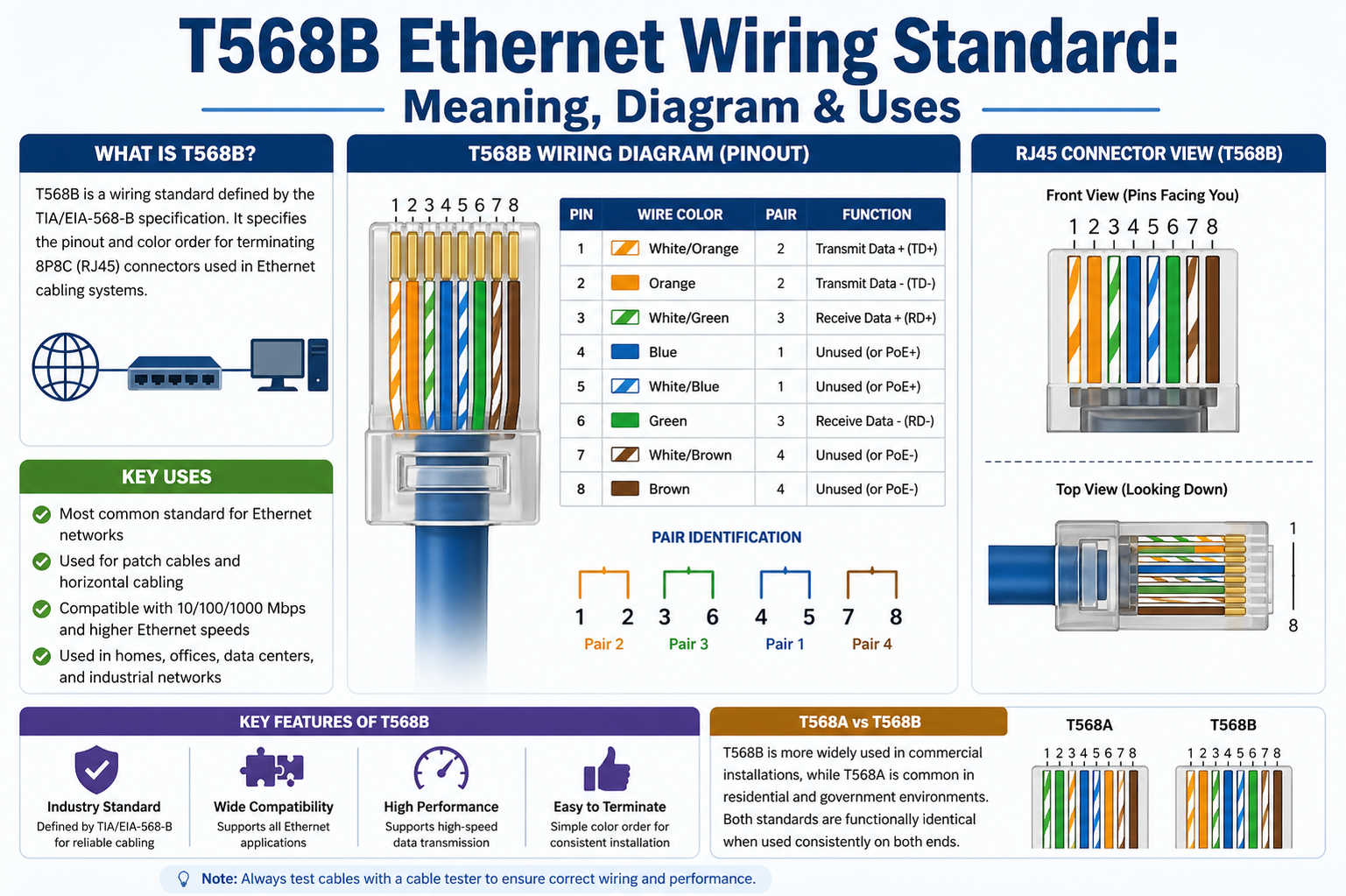
T568B wiring is a standardized method used to arrange the four twisted pairs inside Ethernet cables before they are connected to an RJ45 connector or network port. This specific arrangement ensures reliable and consistent communication between network devices such as computers, switches, and patch panels. By following a defined wire order, T568B helps maintain uniform cable termination, which is essential for proper data transmission across networks.
Understanding the T568B Standard
T568B is one of two wiring standards defined by the Telecommunications Industry Association (TIA) and the Electronic Industries Alliance (EIA). It specifies how the eight wires within an Ethernet cable should be organized. Compared to its counterpart T568A, T568B was introduced later and has become widely used in many networking environments.
How T568B Works Internally
Inside an Ethernet cable, there are four pairs of twisted wires, making a total of eight individual conductors. In the T568B configuration, these wires are arranged in a precise order before termination. Maintaining this order is critical because it allows signals to travel correctly between connected devices. Even a small mismatch in wire placement can disrupt communication.
T568B Color Code Explained
Each of the four wire pairs is identified by a color: green, blue, orange, and brown. Every pair consists of one solid-colored wire and one wire striped with white. These colors help technicians maintain the correct sequence when terminating cables, ensuring the wiring follows the T568B standard accurately.
Cable Structure in T568B Wiring
Beyond the wires themselves, Ethernet cables often include a plastic insert known as a star filler. This component reduces interference between the wire pairs and strengthens the cable structure. The entire assembly is enclosed in a protective outer sheath that shields the internal components from physical damage and environmental factors.
Pin Assignments in T568B
Each of the eight wires connects to a specific pin in an RJ45 connector. The correct sequence for T568B wiring is: white/orange, orange, white/green, blue, white/blue, green, white/brown, and brown. This exact order must be followed to ensure compatibility and proper network communication.
Common Uses of T568B Wiring
T568B is commonly used in Ethernet networking to connect different types of devices. For example, it is widely applied when linking a computer’s network interface card to a switch or connecting devices through a patch panel. Its consistent structure makes it a reliable choice for many installations.
T568B and TIA/EIA-568B
TIA/EIA-568B and T568B refer to the same standard. The shorter term T568B is simply a commonly used abbreviation for the full designation.
T568A vs T568B
T568A is another wiring standard that closely resembles T568B, but the green and orange wire pairs are swapped. Because of this difference, the two standards are not interchangeable within the same cable run. Mixing them incorrectly can result in failed communication between devices. However, as long as a single standard is used consistently across a network, both options can work effectively.
Interchangeability and Consistency
Using different wiring standards at opposite ends of the same connection can lead to signal mismatches. Consistency is the most important factor in network cabling. Whether T568A or T568B is chosen, applying the same standard throughout ensures reliable performance and avoids connectivity issues.
Crossover Cables and Their Role
In certain situations, a crossover cable is used to connect similar devices directly. A standard cable with identical wiring on both ends is called a straight-through cable. In contrast, a crossover cable uses T568B on one end and T568A on the other. This setup allows signals to cross over between pins, enabling communication between devices that would not normally connect directly.
Advanced Overview of T568B Wiring
T568B wiring continues to play a foundational role in structured cabling systems, especially in environments where consistency, performance, and scalability are critical. While the basic concept focuses on arranging wires in a defined order, the deeper importance of T568B lies in how it supports modern networking standards, minimizes signal interference, and ensures compatibility across a wide range of devices. As networks grow more complex, understanding the finer details of T568B wiring becomes increasingly valuable for both professionals and learners in the networking field.
Signal Integrity and Performance in T568B
One of the key advantages of using the T568B standard is its contribution to signal integrity. Ethernet communication relies on balanced signal transmission across twisted pairs of wires. These twists are not random; they are carefully designed to reduce electromagnetic interference (EMI) and crosstalk between adjacent pairs. By maintaining the correct wire order defined by T568B, the cable preserves these properties, allowing data signals to travel with minimal distortion.
When wires are incorrectly arranged, the twists no longer align as intended, which can increase interference and degrade performance. This may result in slower network speeds, packet loss, or unstable connections. T568B helps prevent these issues by enforcing a uniform structure that supports high-speed data transmission standards such as Gigabit Ethernet and beyond.
Compatibility with Networking Standards
T568B wiring is fully compatible with widely used Ethernet standards, including Fast Ethernet (100 Mbps), Gigabit Ethernet (1 Gbps), and even higher-speed technologies like 10 Gigabit Ethernet over copper. This compatibility makes it a practical choice for both legacy systems and modern network installations.
As networking technologies evolve, the physical cabling infrastructure must remain reliable. T568B ensures that cables can handle increased bandwidth demands without requiring constant rewiring. This future-ready aspect is one of the reasons why many organizations continue to rely on this standard.
Installation Best Practices for T568B
Proper installation is just as important as following the correct wiring sequence. Even when using T568B, poor termination techniques can lead to performance issues. For example, untwisting the wire pairs too much before inserting them into an RJ45 connector can reduce the cable’s ability to resist interference. It is recommended to keep the twists as close to the connector as possible.
Additionally, using high-quality connectors and tools ensures a secure and accurate termination. Crimping tools should apply even pressure to all pins, ensuring each wire makes proper contact. A poorly crimped connector can cause intermittent connectivity problems that are difficult to diagnose.
Cable management is another important factor. Keeping cables organized and avoiding sharp bends or excessive tension helps maintain their structural integrity. Labeling cables can also make future maintenance easier, especially in large network setups.
Testing and Verification of T568B Cables
After terminating a cable using the T568B standard, testing is essential to confirm that it functions correctly. Cable testers can verify continuity, wire mapping, and signal quality. These tools check whether each wire is connected to the correct pin and whether there are any faults such as shorts or open circuits.
Advanced testers can also measure performance characteristics like attenuation and crosstalk. These metrics are important for ensuring that the cable meets the requirements for high-speed data transmission. Testing not only confirms proper installation but also helps identify potential issues before the cable is put into use.
Common Mistakes in T568B Wiring
Despite its straightforward structure, several common mistakes can occur when working with T568B wiring. One frequent error is mixing up the wire order, especially between the green and orange pairs. This can result in a miswired cable that fails to transmit data correctly.
Another mistake is inconsistent use of standards within the same network. For example, using T568B on one end of a cable and T568A on the other unintentionally creates a crossover cable. While this may work in specific scenarios, it can cause confusion and connectivity issues if not planned.
Improper stripping of the cable jacket can also damage the internal wires, affecting performance. Care should be taken to remove only the necessary amount of insulation without nicking the conductors.
Applications in Structured Cabling Systems
T568B is widely used in structured cabling systems found in offices, data centers, and residential buildings. These systems are designed to provide a flexible and organized approach to network connectivity. By using a consistent wiring standard like T568B, technicians can easily manage and expand the network without compatibility concerns.
Patch panels, wall jacks, and horizontal cabling all rely on standardized wiring to function effectively. T568B ensures that each connection point follows the same configuration, making it easier to troubleshoot and maintain the network.
Role in Data Centers and Enterprise Networks
In large-scale environments such as data centers, T568B wiring supports high-density connectivity and reliable performance. Data centers often require thousands of cable connections, and even a small inconsistency can lead to significant issues. Using a standardized approach like T568B simplifies installation and reduces the risk of errors.
Enterprise networks also benefit from the predictability of T568B wiring. IT teams can quickly identify and resolve problems because they know exactly how each cable is configured. This consistency is especially important in mission-critical systems where downtime must be minimized.
T568B in Residential Networking
Although T568A is often recommended for residential installations, T568B is still commonly used in home networks. Many pre-made Ethernet cables available in the market follow the T568B standard, making it a convenient choice for connecting devices like routers, gaming consoles, and smart TVs.
For homeowners setting up their own network, using T568B can simplify the process, especially when working with existing cables. As long as the same standard is used consistently, the network will function effectively.
Understanding Crosstalk and Interference
Crosstalk occurs when signals from one wire pair interfere with another. This is a major concern in high-speed networking, where even small amounts of interference can impact performance. T568B wiring helps minimize crosstalk by maintaining the correct pairing and twist ratios of the wires.
There are different types of crosstalk, including near-end crosstalk (NEXT) and far-end crosstalk (FEXT). Proper adherence to the T568B standard reduces both types, ensuring clearer signal transmission. Shielded cables can provide additional protection, but even unshielded cables perform well when terminated correctly using T568B.
Future Relevance of T568B Wiring
As technology continues to advance, the demand for faster and more reliable networks will only increase. While new cabling technologies may emerge, the principles behind T568B wiring remain relevant. Standardization, consistency, and proper cable management will always be essential for effective networking.
T568B has proven its reliability over time and continues to be a trusted standard in various applications. Its compatibility with modern Ethernet technologies ensures that it will remain in use for years to come.
Deep Technical Insights into T568B Wiring
T568B wiring continues to be a cornerstone of Ethernet networking, especially when examining its deeper technical implications. Beyond simple wire arrangement, this standard influences how electrical signals behave within a cable. Each twisted pair in an Ethernet cable carries balanced signals, meaning one wire transmits a positive signal while the other carries a negative version of the same signal. This balance helps cancel out external interference. By strictly following the T568B configuration, the physical relationship between these pairs is preserved, ensuring that signal cancellation works effectively and communication remains stable even in electrically noisy environments.
Electrical Characteristics of Twisted Pair Cabling
The effectiveness of T568B wiring is closely tied to the electrical properties of twisted pair cables. These cables are designed with specific impedance, typically around 100 ohms, which must remain consistent throughout the cable length. Maintaining this impedance is essential for preventing signal reflections, which can occur when there is a mismatch in the transmission path.
T568B ensures that each wire pair is connected correctly to maintain this impedance balance. If the wiring order is altered, it can disrupt the electrical characteristics, leading to return loss and degraded signal quality. This is particularly important in high-speed networks where even minor imperfections can affect performance.
Impact on High-Speed Data Transmission
As network speeds increase, the margin for error decreases significantly. Standards like Gigabit and multi-gigabit Ethernet rely on all four wire pairs simultaneously for data transmission. In such cases, maintaining the exact T568B configuration becomes even more critical.
Incorrect wiring can lead to increased latency, reduced throughput, or complete communication failure. T568B provides a reliable framework that supports these high-speed requirements by ensuring that signal paths remain consistent and interference is minimized. This is why professional network installations place strong emphasis on adhering to established wiring standards.
Advanced Troubleshooting Techniques
When issues arise in a network using T568B wiring, advanced troubleshooting techniques are often required. Network technicians may use specialized tools such as time-domain reflectometers (TDRs) to analyze cable performance. These tools can detect faults like impedance mismatches, breaks, or improper terminations.
Another method involves using certification testers that measure parameters such as insertion loss, return loss, and crosstalk. These detailed diagnostics help identify whether a cable meets the required performance standards. In many cases, problems can be traced back to incorrect adherence to the T568B wiring order or poor termination practices.
Environmental Considerations in T568B Installations
Environmental factors can also influence the performance of T568B wiring. Temperature variations, humidity, and physical stress on cables can all impact their longevity and reliability. For example, excessive heat can degrade the insulation around the wires, while moisture can lead to corrosion.
Proper installation techniques, such as using protective conduits and avoiding exposure to harsh conditions, can help mitigate these risks. T568B wiring, when combined with good environmental practices, ensures long-term stability and performance of the network infrastructure.
Integration with Modern Networking Hardware
Modern networking devices are designed with standardized interfaces that expect consistent wiring configurations like T568B. Switches, routers, and network interface cards all rely on predictable pin assignments to function correctly.
By using T568B wiring, compatibility with these devices is ensured without the need for additional configuration. This plug-and-play compatibility simplifies deployment and reduces the likelihood of connectivity issues. It also allows for seamless upgrades, as new devices can be integrated into the existing network without requiring changes to the cabling.
Role in Power over Ethernet (PoE)
T568B wiring also supports technologies like Power over Ethernet (PoE), which allows electrical power to be transmitted alongside data over the same cable. PoE is commonly used for devices such as IP cameras, wireless access points, and VoIP phones.
The correct pairing and pin assignments defined by T568B are essential for safe and efficient power delivery. Improper wiring could result in uneven power distribution or even damage to connected devices. By adhering to the standard, both data and power can be transmitted reliably.
Cable Categories and T568B Compatibility
Different categories of Ethernet cables, such as Cat5e, Cat6, and Cat6a, are all compatible with T568B wiring. These categories differ in terms of bandwidth and performance capabilities, but the underlying wiring standard remains the same.
This consistency allows network designers to upgrade cable categories without changing the wiring scheme. For example, replacing older Cat5e cables with Cat6 can improve network performance while still using the T568B configuration. This flexibility makes T568B a practical choice for evolving network needs.
Security Considerations in Cabling
While cabling itself is not typically associated with cybersecurity, proper wiring practices can contribute to overall network security. Organized and well-documented cabling makes it easier to identify unauthorized connections or tampering.
Using a consistent standard like T568B helps maintain clear documentation and labeling, which is important for security audits and maintenance. In complex networks, this level of organization can prevent accidental misconfigurations that might expose vulnerabilities.
Global Adoption and Industry Practices
T568B wiring has been widely adopted across various industries, including telecommunications, IT infrastructure, and commercial construction. Its popularity is partly due to its compatibility with existing systems and the availability of pre-terminated cables that follow the same standard.
Although some regions or organizations may prefer T568A for specific applications, T568B remains a common choice in many professional environments. Its widespread use ensures that technicians and engineers are familiar with the standard, making it easier to implement and maintain.
Training and Skill Development
Learning T568B wiring is an essential skill for anyone entering the field of networking. It provides a practical understanding of how physical connections impact data communication. Hands-on experience with cable termination, testing, and troubleshooting helps build confidence and competence.
Training programs often include exercises that require students to create and test cables using the T568B standard. These activities reinforce the importance of accuracy and attention to detail, which are critical in real-world networking scenarios.
Long-Term Maintenance and Scalability
Maintaining a network over time requires careful planning and consistent practices. T568B wiring supports scalability by providing a uniform structure that can be easily expanded. New cables can be added without disrupting existing connections, as long as the same standard is followed.
Regular inspections and testing can help identify wear and tear before it leads to failures. By maintaining high standards in cabling, organizations can reduce downtime and ensure continuous operation of their networks.
Comprehensive Mastery of T568B Wiring in Modern Networking
T568B wiring remains one of the most widely recognized and implemented standards in Ethernet networking, and its importance becomes even more apparent when examined through the lens of large-scale, high-performance, and future-ready infrastructures. At its core, T568B is not simply about arranging wires in a connector; it represents a disciplined approach to physical network design that ensures reliability, repeatability, and efficiency. As networks continue to expand in complexity, the ability to depend on a consistent wiring methodology like T568B becomes essential for maintaining operational stability across diverse environments.
The Role of Standardization in Network Reliability
Standardization is the backbone of any successful networking system, and T568B exemplifies this principle. When every cable in a network follows the same wiring scheme, it eliminates ambiguity and reduces the likelihood of human error. This consistency allows technicians to quickly identify issues, perform maintenance, and scale the network without confusion.
In environments where hundreds or even thousands of cables are deployed, even a small inconsistency can lead to significant troubleshooting challenges. T568B provides a uniform blueprint that ensures each connection behaves predictably. This predictability is critical in maintaining uptime and ensuring that data flows smoothly between devices without interruption.
Detailed Signal Flow and Pair Utilization
To fully understand the value of T568B wiring, it is important to consider how signals travel through Ethernet cables. Each twisted pair is responsible for carrying specific signals, and in modern Ethernet standards, all four pairs are actively used. The arrangement defined by T568B ensures that these pairs are positioned correctly to minimize interference and maintain signal clarity.
The pairing structure also plays a role in how differential signaling works. By transmitting opposite signals on each wire in a pair, the system can effectively cancel out noise that is picked up along the cable. T568B preserves the integrity of these pairs, allowing this noise-canceling mechanism to function as intended.
Advanced Cable Termination Techniques
Achieving a high-quality T568B termination requires precision and attention to detail. Professionals often follow strict procedures to ensure that each wire is properly aligned and secured within the connector. This includes carefully stripping the cable jacket, aligning the wires in the correct order, and inserting them fully into the connector before crimping.
One critical factor is maintaining the twist of each pair as close to the termination point as possible. Excessive untwisting can increase susceptibility to crosstalk and degrade performance. Additionally, ensuring that the connector pins make solid contact with the conductors is essential for reliable connectivity.
Using professional-grade tools and connectors can significantly improve the quality of the termination. Poor-quality components may lead to inconsistent connections, which can cause intermittent network issues that are difficult to diagnose.
Impact of T568B on Network Scalability
Scalability is a key consideration in modern network design, and T568B wiring supports this by providing a consistent framework for expansion. When new devices or segments are added to a network, technicians can rely on the existing wiring standard to integrate these additions seamlessly.
This scalability is particularly important in environments such as corporate offices, educational institutions, and data centers, where network demands can grow rapidly. By maintaining a consistent wiring approach, organizations can expand their infrastructure without needing to redesign or reconfigure existing connections.
Interoperability with Global Networking Equipment
Networking equipment from different manufacturers is designed to work with standardized cabling systems. T568B ensures that cables are compatible with a wide range of devices, including switches, routers, servers, and endpoints. This interoperability simplifies procurement and deployment, as there is no need to customize cables for specific hardware.
The widespread adoption of T568B also means that pre-terminated cables and patch cords are readily available. These factory-made cables are typically tested for quality and performance, providing a reliable option for quick installations.
Minimizing Latency and Maximizing Throughput
In high-performance networks, latency and throughput are critical metrics. T568B wiring contributes to optimizing these factors by maintaining consistent signal paths and reducing interference. Properly terminated cables ensure that data packets can travel بسرعة and without errors, which is essential for applications such as video streaming, online gaming, and real-time communication.
Even small inconsistencies in wiring can introduce delays or cause retransmissions, which negatively impact performance. By adhering to the T568B standard, network designers can minimize these risks and achieve optimal data transfer rates.
Integration with Emerging Technologies
As new technologies emerge, the underlying cabling infrastructure must be able to support them. T568B wiring is compatible with advancements such as Internet of Things (IoT) devices, smart building systems, and high-speed internet connections.
These technologies often require reliable and consistent connectivity, which T568B provides. Whether connecting sensors, cameras, or automation systems, the standard ensures that data and power can be delivered efficiently across the network.
Power Delivery and Efficiency in PoE Systems
Power over Ethernet continues to grow in popularity, and T568B wiring plays a crucial role in its implementation. By following the correct pin assignments, PoE systems can deliver power safely and efficiently to connected devices.
This eliminates the need for separate power cables, simplifying installation and reducing costs. In large deployments, such as security systems or wireless networks, the ability to deliver both data and power through a single cable is a significant advantage.
Cable Management and Organizational Strategies
Effective cable management is essential for maintaining a clean and efficient network environment. T568B wiring supports organized cabling by providing a consistent structure that can be easily labeled and documented.
Using color-coded cables, labeling systems, and structured pathways helps technicians quickly identify connections and perform maintenance tasks. This level of organization is particularly important in data centers, where large volumes of cables can become difficult to manage without a standardized approach.
Long-Term Durability and Maintenance
Durability is another important aspect of T568B wiring. High-quality cables and proper installation techniques can ensure that the network infrastructure remains reliable over time. Regular inspections and testing can help identify potential issues before they lead to failures.
Environmental factors such as temperature, humidity, and physical stress should also be considered. Protecting cables from harsh conditions and avoiding excessive bending or tension can extend their lifespan and maintain performance.
Training, Certification, and Professional Standards
For networking professionals, mastering T568B wiring is often a fundamental requirement. Training programs and certifications emphasize the importance of understanding and applying wiring standards correctly.
Hands-on practice with cable termination, testing, and troubleshooting helps build the skills needed to work effectively in real-world environments. By adhering to professional standards, technicians can ensure that their work meets industry expectations and delivers reliable results.
Economic Benefits of Standardized Wiring
Using a standardized wiring system like T568B can also provide economic advantages. Consistency reduces the time required for installation and troubleshooting, which can lower labor costs. Additionally, the availability of compatible components and pre-made cables can reduce material costs.
In large-scale projects, these savings can be significant. By investing in a reliable and standardized approach, organizations can achieve long-term cost efficiency while maintaining high performance.
Adapting T568B for Future Network Demands
As network requirements continue to evolve, T568B wiring remains adaptable. While new cable categories and technologies may emerge, the fundamental principles of twisted pair cabling and standardized wiring are likely to remain relevant.
Future networks may demand higher speeds, greater bandwidth, and increased reliability, but these requirements can still be supported by a well-designed cabling infrastructure based on T568B. By planning for scalability and maintaining consistent practices, organizations can ensure that their networks are prepared for future advancements.
Strategic Importance of T568B Wiring in Network Architecture
T568B wiring continues to serve as a fundamental building block in network architecture, especially when designing systems that must balance performance, reliability, and scalability. At an advanced level, this wiring standard is not just about following a color code—it represents a structured approach to physical layer design that aligns with broader networking principles. By maintaining uniformity in cable termination, T568B allows network architects to create predictable and stable infrastructures that can support a wide variety of applications and workloads.
Physical Layer Consistency and OSI Model Relevance
Within the context of the OSI model, T568B operates at the physical layer, which is responsible for transmitting raw bits over a communication medium. Although higher layers handle routing, addressing, and data formatting, the physical layer determines whether data can move at all.
T568B ensures that this foundational layer functions correctly by standardizing how electrical signals are transmitted through copper cabling. Without this consistency, even the most advanced networking protocols would fail to deliver reliable communication. This highlights the importance of proper cable termination as a critical component of overall network performance.
Designing Structured Cabling Systems with T568B
Structured cabling systems rely heavily on standards like T568B to maintain organization and efficiency. These systems are designed to support multiple hardware uses and provide a flexible infrastructure that can adapt to changing requirements.
In such environments, T568B wiring is applied across horizontal cabling, backbone connections, and work area components. This unified approach ensures that all parts of the network are aligned, making it easier to manage and troubleshoot. When every connection follows the same standard, identifying and resolving issues becomes significantly more straightforward.
Patch Panels and Cross-Connect Systems
Patch panels play a vital role in structured cabling, acting as central points where cables are terminated and managed. T568B wiring is commonly used in patch panels to ensure consistent pin assignments across all ports.
Cross-connect systems, which allow connections to be rerouted without modifying the permanent cabling, also benefit from this standardization. By using T568B, technicians can confidently make changes to the network without worrying about mismatched wiring configurations. This flexibility is essential in dynamic environments where network layouts frequently change.
Network Expansion and Modular Design
Modern networks are often designed with modularity in mind, allowing components to be added or replaced without disrupting the entire system. T568B wiring supports this approach by providing a consistent interface for all connections.
When new modules or devices are introduced, they can be integrated بسهولة into the existing infrastructure as long as the same wiring standard is maintained. This reduces downtime and simplifies the process of upgrading or expanding the network.
Impact on Data Transmission Efficiency
Efficiency in data transmission is influenced by several factors, including cable quality, termination accuracy, and adherence to standards. T568B wiring contributes to this efficiency by ensuring that signal paths are optimized and interference is minimized.
Properly terminated cables reduce the likelihood of errors, which in turn decreases the need for retransmissions. This improves overall network performance and allows bandwidth to be used more effectively. In high-demand environments, even small improvements in efficiency can have a significant impact.
Maintaining Signal Balance and Noise Reduction
One of the key technical benefits of T568B wiring is its ability to maintain signal balance across twisted pairs. Balanced signals are less susceptible to external noise, as interference tends to affect both wires equally and can be canceled out.
By preserving the correct pairing and alignment of wires, T568B ensures that this noise-canceling effect remains effective. This is particularly important in environments with high levels of electromagnetic interference, such as industrial settings or areas with dense electrical equipment.
Role in Network Documentation and Management
Accurate documentation is essential for managing complex networks, and T568B wiring supports this by providing a clear and consistent reference point. When all cables follow the same standard, documentation can be simplified, making it easier to track connections and configurations.
This clarity is valuable during maintenance, upgrades, and troubleshooting. Technicians can quickly understand the network layout and identify potential issues without needing to verify each cable individually. Over time, this leads to more efficient network management and reduced operational costs.
Integration with Automation and Smart Systems
As automation and smart technologies become more prevalent, the need for reliable network infrastructure continues to grow. T568B wiring provides the stability required to support these systems, ensuring that data can be transmitted بسرعة and accurately between devices.
From smart lighting and climate control to advanced security systems, many modern applications depend on consistent network connectivity. By using a standardized wiring approach, these systems can operate seamlessly and respond effectively to user inputs and environmental changes.
Challenges and Considerations in Large Deployments
While T568B wiring offers many advantages, large-scale deployments can present challenges that require careful planning. Managing thousands of cable connections requires strict adherence to standards and thorough quality control प्रक्रures.
Even a small percentage of improperly terminated cables can lead to significant issues in a large network. To address this, organizations often implement rigorous testing and certification processes to ensure that all connections meet performance requirements.
Training and supervision are also important factors. Ensuring that all technicians understand and follow the T568B standard helps maintain consistency and reduces the risk of errors during installation.
Future Trends and the Role of T568B
Looking ahead, the role of T568B wiring is likely to remain strong, even as new technologies emerge. While fiber optic cabling is becoming more common in certain applications, copper cabling continues to be widely used due to its cost-effectiveness and versatility.
T568B provides a reliable framework for copper-based networks, ensuring that they can support current and future demands. As technologies such as higher-speed Ethernet and advanced PoE systems विकसित, the importance of proper wiring standards will only increase.
Sustainability and Energy Efficiency
Sustainability is an increasingly important consideration in network design, and T568B wiring can contribute to energy efficiency by supporting optimized data transmission. Efficient networks require less power to operate, reducing overall energy consumption.
Additionally, the durability and longevity of properly installed cables mean that they do not need to be replaced as frequently, which reduces waste. By following best practices in cabling, organizations can create networks that are both high-performing and environmentally responsible.
Professional Expertise and Continuous Learning
As networking technologies evolve, professionals must continue to develop their skills and knowledge. Mastery of T568B wiring is a foundational competency that supports further learning in areas such as network design, security, and performance optimization.
Continuous training and hands-on experience help professionals stay up to date with industry standards and best practices. This commitment to learning ensures that they can design and maintain networks that meet the demands of modern applications.
Final Reflections
T568B wiring has stood the test of time as a reliable and effective standard for Ethernet cabling. Its influence extends across all aspects of network design, from physical connectivity to overall system performance.
By maintaining consistency, supporting scalability, and enabling efficient data transmission, T568B continues to be an essential tool for building robust networks. As technology advances, the principles behind this standard will remain relevant, guiding the development of future networking solutions and ensuring that communication systems operate smoothly and efficiently.