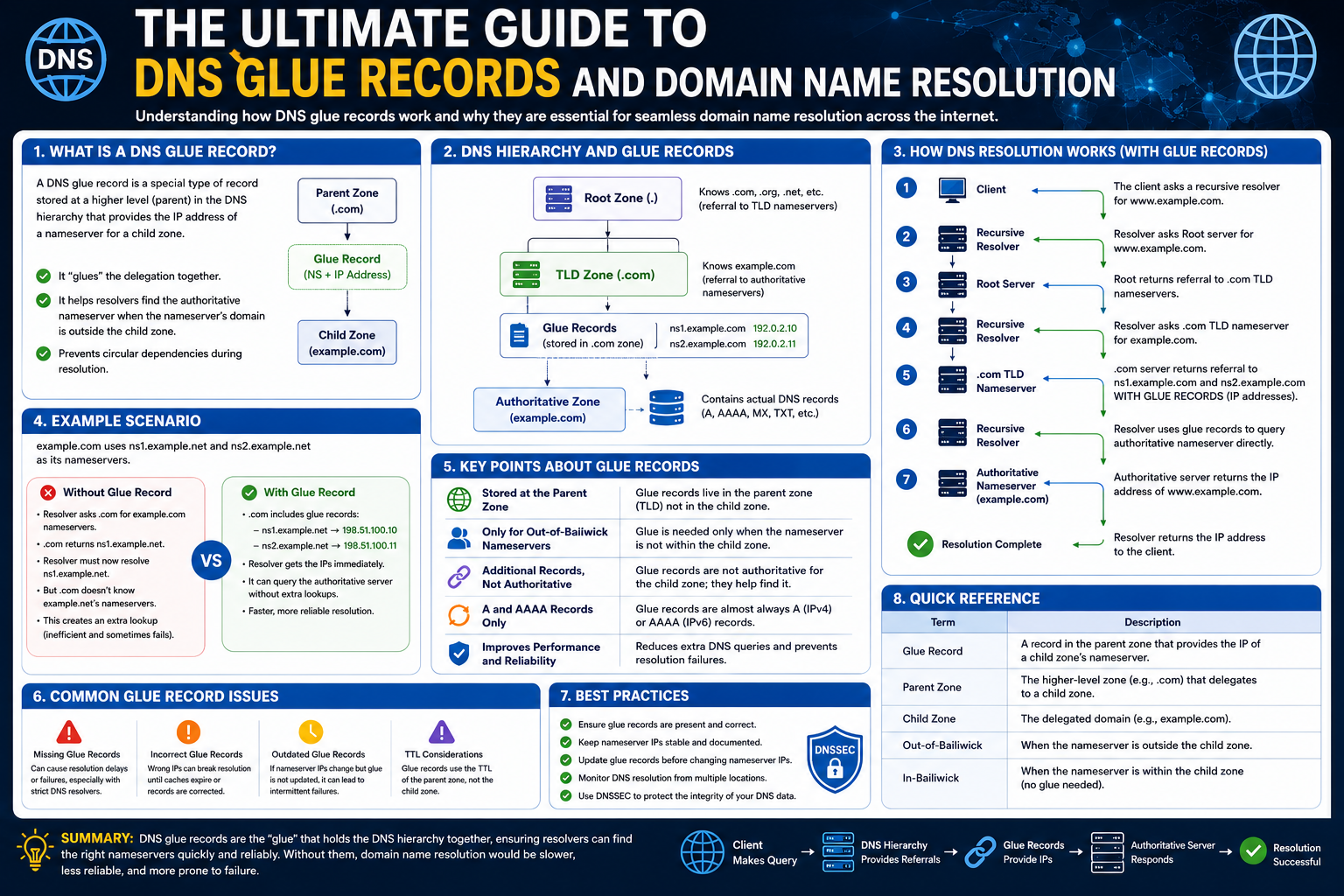
The Domain Name System (DNS) is one of the most essential yet invisible components of the modern internet. Every time you type a website address into your browser, DNS works behind the scenes to translate that human-friendly domain name into a machine-readable IP address. While this process usually happens in milliseconds, the system that supports it is layered, interconnected, and sometimes surprisingly complex. One of the lesser-known but critically important components in this system is something called a DNS glue record.
At its core, a DNS glue record is a special type of DNS entry that helps ensure smooth and uninterrupted name resolution, particularly in situations where a domain’s nameserver is located within the same domain it is responsible for resolving. Without glue records, certain DNS lookups could fail or fall into infinite loops, making parts of the internet unreachable. Although the concept may sound technical, understanding glue records becomes easier when you first understand how DNS resolution works in general and why circular dependencies can occur.
DNS operates in a hierarchical structure. At the top are root servers, followed by top-level domain (TLD) servers such as those responsible for “.com,” “.net,” or “.org.” Below them are authoritative nameservers, which hold the actual DNS records for specific domains. When you request a website, your query travels through this hierarchy until it reaches the authoritative source that provides the correct IP address.
However, problems arise when a domain’s authoritative nameserver is itself part of the same domain it serves. This is where DNS glue records become necessary. They act as a foundational support mechanism to prevent logical loops in DNS queries and ensure that the resolution process can continue without interruption.
To fully appreciate why glue records matter, it is important to understand how DNS resolution can potentially fail without them.
The Structure of DNS Resolution and Where Problems Begin
When a user enters a domain like exampledomain.com, the DNS resolver begins a step-by-step process to find its IP address. First, it checks whether the information is stored in a local cache. If not, it queries a root DNS server. The root server does not know the exact IP address but directs the request to the appropriate TLD server. The TLD server then points to the domain’s authoritative nameserver.
Under normal circumstances, this process is straightforward. The authoritative nameserver responds with the correct IP address, and the browser loads the website. However, complications occur when the nameserver itself is hosted under the same domain it is supposed to resolve.
For example, imagine a domain called mywebsite.com. This domain uses nameservers such as ns1.mywebsite.com and ns2.mywebsite.com. When a DNS resolver tries to locate ns1.mywebsite.com, it must first resolve mywebsite.com to find where ns1.mywebsite.com exists. But to resolve mywebsite.com, it again needs to contact ns1.mywebsite.com. This creates a circular dependency, often described as a DNS resolution loop.
Without a mechanism to break this loop, the system would continue querying endlessly without reaching a final answer. This is where glue records intervene to stabilize the process.
What DNS Glue Records Actually Do
A DNS glue record is essentially a pre-resolved mapping of a nameserver’s hostname to its IP address, stored at the parent zone level. Instead of forcing the resolver to look up the nameserver using the same domain it is trying to resolve, the glue record provides the necessary IP address upfront.
In simpler terms, glue records act like a shortcut or an external reference point that prevents DNS from getting stuck in a loop. They ensure that even if a nameserver belongs to the same domain it serves, the system still has a way to locate it directly.
These records are typically stored in the parent zone of the domain. For instance, if ns1.mywebsite.com is the nameserver, the glue record would be stored at the .com TLD level. This allows the resolver to bypass the circular dependency entirely.
It is important to note that glue records are not separate DNS record types in the same sense as A or AAAA records. Instead, they are additional supporting information attached to the nameserver records. This is why they are sometimes referred to as “additional records.”
Why Glue Records Are Necessary in Modern DNS Architecture
The internet’s DNS system is designed to be distributed, scalable, and resilient. However, with flexibility comes complexity. One of the design choices that enables flexibility is allowing domains to use their own subdomains as nameservers. While this is practical for branding and administrative control, it introduces technical challenges that require glue records.
Without glue records, the DNS system would not be able to reliably resolve domains that depend on self-referential nameservers. This would affect countless websites that use custom nameserver setups, particularly organizations that manage their own DNS infrastructure.
Glue records ensure continuity in such setups by providing a stable reference point that bypasses dependency loops. They are especially critical in large-scale systems where DNS resolution must happen rapidly and reliably across global networks.
Even though they operate silently in the background, glue records are essential for maintaining the integrity of internet navigation. Without them, even a simple website lookup could become unstable or fail under certain configurations.
How DNS Glue Records Fit Into the Hierarchical DNS System
To understand glue records more deeply, it helps to place them within the broader DNS hierarchy. At the highest level, root servers delegate responsibility to TLD servers. These TLD servers maintain records of authoritative nameservers for each domain under their extension.
When a domain uses a nameserver within itself, the TLD server must ensure that the resolver can still reach that nameserver without needing to resolve the domain first. This is where glue records are embedded into the TLD zone file.
For example, when a resolver queries a TLD server for mywebsite.com, the response includes not only the nameserver information but also the corresponding IP addresses of those nameservers. These IP addresses are the glue records.
This embedded structure ensures that the resolver does not need to perform additional DNS lookups to locate the nameserver. Instead, it already receives all necessary information in a single response.
The Relationship Between Glue Records and DNS Stability
DNS stability depends heavily on eliminating ambiguity and circular dependencies. Glue records contribute directly to this stability by ensuring that nameservers are always reachable, even when their domain relationships are complex.
Without glue records, DNS resolution could become unpredictable in certain configurations. For example, if a nameserver becomes temporarily unreachable due to resolution delays, the entire domain could fail to resolve, even if all other DNS records are correctly configured.
By providing direct IP mappings, glue records reduce reliance on recursive resolution during critical lookup stages. This improves both reliability and performance across the DNS ecosystem.
They also help prevent misconfigurations from cascading into larger outages. Since DNS is foundational to nearly all internet activity, even small disruptions can have widespread consequences. Glue records act as a preventive safeguard against such failures.
The Invisible but Critical Role of Glue Records
Despite their importance, DNS glue records are largely invisible to everyday users. Most people will never interact with them directly, yet they are constantly in use whenever a website relies on self-referential nameservers.
This invisibility is part of what makes DNS such a powerful system. It handles complexity behind the scenes, allowing users to interact with simple domain names while the infrastructure manages intricate resolution logic in the background.
Glue records are a perfect example of this hidden complexity. They solve a very specific technical problem, but their impact is felt across the entire internet ecosystem.
They ensure that DNS remains reliable even as configurations become more flexible and decentralized.
Deep Dive Into DNS Glue Record Creation, Behavior, and Real-World Operations
Building on the foundational understanding of DNS glue records, it becomes important to explore how these records are actually created, where they live within the DNS ecosystem, and how they behave during real-world DNS resolution. While glue records may appear simple in concept, their operational role involves multiple layers of coordination between domain registries, registrars, and authoritative DNS infrastructure. Understanding this deeper layer reveals why glue records are not just a theoretical safeguard but an essential operational requirement in modern internet architecture.
How DNS Glue Records Are Created and Where They Reside
DNS glue records are not typically created by end users in the same way standard DNS records are managed. Instead, they are generated and stored at the parent zone level of a domain, usually by the domain registry or registrar responsible for managing the top-level domain.
When a domain owner configures nameservers that belong to the same domain, such as ns1.exampledomain.com and ns2.exampledomain.com, the system recognizes that these nameservers are “in-bailiwick.” This means they exist inside the domain they are meant to serve. In such cases, the DNS infrastructure requires additional information to avoid circular dependencies.
This is where the registry intervenes. During delegation, when a domain is assigned to its authoritative nameservers, the registry checks whether those nameservers fall within the same domain. If they do, the registry includes glue records in the parent zone file, typically at the top-level domain level, such as .com, .net, or .org.
These glue records consist of IP address mappings that correspond directly to the in-domain nameservers. By placing this information in the parent zone, the DNS system ensures that resolvers can access the nameserver addresses without needing to resolve the domain itself first.
The DNS Delegation Process and Glue Record Integration
To understand glue records in action, it is necessary to examine the DNS delegation process in detail. When a domain is registered, it is delegated from the top-level domain registry to the authoritative nameservers specified by the domain owner.
This delegation process involves storing NS records that indicate which nameservers are responsible for the domain. However, NS records alone are not sufficient when those nameservers belong to the same domain. Without additional information, resolvers would attempt to locate the nameserver using the domain it is supposed to resolve, creating a dependency loop.
During delegation, if the registry detects that the nameservers are subdomains of the domain being delegated, it requires corresponding IP addresses to be provided. These IP addresses are then stored as glue records.
The glue record becomes part of the delegation response from the parent zone. This ensures that when a resolver queries the top-level domain server, it receives both the nameserver information and the direct IP addresses required to reach those nameservers.
This integration into the delegation process is what makes glue records fundamentally different from standard DNS records. They are not queried independently but are instead embedded into the resolution pathway at a structural level.
In-Bailiwick Nameservers and Why They Require Special Handling
Nameservers are described as in-bailiwick when they belong to the same domain they serve. For example, ns1.example.com is in-bailiwick for example.com. This design is common for organizations that want full control over their DNS infrastructure or prefer branded nameserver identities.
However, this configuration introduces a paradox. The DNS resolver needs to find ns1.example.com in order to resolve example.com, but it also needs to resolve example.com in order to find ns1.example.com. This circular dependency is precisely the scenario glue records are designed to solve.
Glue records break this dependency by providing a direct mapping between the nameserver hostname and its IP address at the parent zone level. This allows the resolver to bypass the need for recursive resolution of the nameserver itself.
Without this mechanism, in-bailiwick nameservers would create an unsolvable loop, making it impossible for DNS queries to complete successfully.
Step-by-Step DNS Resolution With Glue Records in Play
When a DNS resolver begins processing a query for a domain that uses in-bailiwick nameservers, the resolution process unfolds in a very specific sequence.
First, the resolver contacts a root DNS server, which directs it to the appropriate top-level domain server. The TLD server then provides the NS records for the domain, indicating which nameservers are authoritative.
At this stage, if the nameservers are external, the resolver would proceed to query them directly. However, when the nameservers belong to the same domain, the TLD server includes glue records in its response.
These glue records contain the IP addresses of the in-bailiwick nameservers. With this information, the resolver can directly contact the nameserver without needing to resolve its hostname separately.
Once the resolver reaches the authoritative nameserver, it retrieves the requested DNS record, such as an A record or AAAA record, and returns the final IP address to the user.
This entire process happens in milliseconds, but the inclusion of glue records ensures that it completes without logical deadlocks or circular dependencies.
The Role of Registrars and Registries in Glue Record Management
Domain registrars act as intermediaries between domain owners and the registry. When a domain owner configures nameservers through a registrar, the registrar communicates this information to the registry responsible for the top-level domain.
The registry maintains the authoritative zone file for the TLD and is responsible for ensuring that DNS delegation is correctly configured. If in-bailiwick nameservers are detected, the registry requires corresponding IP addresses to be provided before the delegation can be finalized.
These IP addresses are then stored as glue records within the TLD zone file. The registrar may also provide tools for domain owners to input or update these IP addresses, but the actual storage and enforcement occur at the registry level.
This separation of responsibilities ensures consistency across the global DNS system and prevents individual misconfigurations from affecting broader DNS stability.
Glue Records, Caching, and DNS Propagation Behavior
DNS relies heavily on caching to improve performance and reduce query load across the network. Glue records are no exception to this behavior. Once a resolver receives glue records from a TLD server, it caches them for a period defined by TTL (time to live) values.
This caching ensures that repeated queries do not require constant re-fetching of glue records, improving resolution speed and reducing load on DNS infrastructure.
However, caching also introduces propagation delays when changes are made. If a glue record is updated, it may take time for all resolvers to receive the updated information. During this period, some systems may still use outdated IP addresses.
This is why DNS changes involving glue records can sometimes take significant time to fully propagate across the internet. The delay is not due to inefficiency but rather the distributed nature of DNS caching.
Proper TTL configuration is essential in managing this balance between performance and update responsiveness. Lower TTL values allow faster propagation but increase query load, while higher values reduce load but slow down updates.
IPv4 and IPv6 Glue Records in Modern DNS
Glue records can exist for both IPv4 and IPv6 addresses. IPv4 glue records use A records, while IPv6 glue records use AAAA records. As the internet transitions toward broader IPv6 adoption, both formats are increasingly important.
When a nameserver supports dual-stack connectivity, both IPv4 and IPv6 glue records may be stored. This ensures compatibility across different network environments and allows resolvers to choose the most efficient route for connectivity.
The presence of both record types does not change the fundamental role of glue records. They still serve to provide direct IP mappings for in-bailiwick nameservers, but they expand compatibility across modern networking standards.
In environments where IPv6 is preferred or required, AAAA glue records become especially important for maintaining resolution efficiency.
DNSSEC Interaction With Glue Records
DNS Security Extensions (DNSSEC) adds a layer of verification to DNS responses by digitally signing records to ensure authenticity. Glue records uniquely interact with DNSSEC.
Because glue records exist primarily for resolution purposes rather than authoritative data integrity, they are not always signed in the same way as standard DNS records. Instead, they are treated as additional data provided by the parent zone.
This distinction is important because it means glue records are trusted based on the authority of the parent zone rather than cryptographic validation alone.
In DNSSEC-enabled environments, the integrity of the overall delegation chain is still maintained, but glue records function as supportive infrastructure rather than primary signed data.
This separation ensures that DNSSEC can enhance security without disrupting the operational necessity of glue records.
Common Misconfigurations and Their Impact on DNS Resolution
Although glue records are designed to prevent DNS failures, misconfigurations can still cause serious issues. One common problem occurs when incorrect IP addresses are assigned to glue records. If a nameserver’s IP changes but the glue record is not updated, DNS resolution may fail or become inconsistent.
Another issue arises when glue records are missing entirely in situations where they are required. Without glue records for in-bailiwick nameservers, resolvers may become stuck in resolution loops or fail to reach the authoritative nameserver.
In some cases, outdated caching can also cause inconsistencies between updated DNS records and stale glue record data. This can lead to intermittent accessibility issues that are difficult to diagnose without careful analysis of DNS resolution paths.
These risks highlight the importance of accurate configuration and regular validation of DNS infrastructure.
Troubleshooting Glue Record Issues in Real-World Networks
When DNS resolution problems occur, glue records are often one of the first areas to investigate if in-bailiwick nameservers are involved. Troubleshooting typically involves verifying that the IP addresses associated with nameservers match their current network configuration.
Network administrators also examine whether changes to nameserver IPs have been properly propagated through the DNS hierarchy. Since glue records are stored at the parent zone level, updates must be reflected at the registry level rather than only within the domain’s internal DNS settings.
Another common troubleshooting step involves checking whether resolvers are caching outdated glue information. In such cases, waiting for TTL expiration or flushing resolver caches may be necessary to restore correct resolution behavior.
Understanding the interaction between glue records, caching, and delegation is essential for diagnosing complex DNS issues effectively.
Operational Importance in Large-Scale Infrastructure
In large-scale enterprise environments, DNS glue records play a critical role in maintaining infrastructure reliability. Organizations that operate their own DNS servers often rely on in-bailiwick nameservers for branding, redundancy, and administrative control.
In these environments, glue records ensure that DNS resolution remains stable even as infrastructure scales across multiple regions and data centers. They provide a foundational reference point that keeps name resolution consistent across distributed systems.
As internet infrastructure continues to grow in complexity, glue records remain a quiet but essential component that ensures continuity and reliability in global DNS operations.
Advanced DNS Glue Record Behavior, Security Implications, and Real-World Engineering Considerations
DNS glue records may look like a small technical detail inside a massive global system, but in practice, they sit at an important intersection of reliability, security, and infrastructure design. Once you move beyond basic definitions and delegation flow, glue records start to reveal their deeper role in shaping how modern networks are engineered and how failures are prevented before they even happen. In real-world systems, they are not just “helper records” but critical pieces of DNS architecture that influence performance, trust boundaries, and operational design choices.
To understand their advanced behavior, it helps to shift perspective: instead of thinking of glue records as simple IP mappings, it is more accurate to see them as infrastructure-level shortcuts that exist specifically to preserve continuity in an otherwise recursive system.
How Glue Records Influence DNS Resolution Performance at Scale
DNS is designed to be fast, distributed, and heavily cached. Most users never notice the number of steps involved in resolving a domain because caching reduces repeated lookups. However, in scenarios involving in-bailiwick nameservers, glue records directly influence how quickly resolution can complete.
Without glue records, a resolver would need to perform additional recursive queries just to locate the nameserver. This would add multiple extra hops to the resolution chain, increasing latency and dependency on intermediate DNS servers. In worst-case scenarios, it could even prevent resolution entirely if intermediate lookups fail.
Glue records eliminate this overhead by providing immediate IP-level access to nameservers at the delegation stage. This reduces the resolution path from multiple recursive steps down to a direct query. In high-traffic environments, this reduction in lookup complexity translates into measurable performance improvements.
At scale, even small latency reductions per query become significant. Large content networks, cloud providers, and enterprise systems handle millions of DNS queries per second. In such environments, glue records help reduce cumulative load on recursive resolvers by preventing unnecessary upstream queries.
This performance optimization is not just about speed but also about stability. Fewer recursive dependencies mean fewer points of potential failure during peak traffic conditions.
Glue Records and Dependency Resolution in Distributed Systems
Modern internet infrastructure is deeply distributed. Services are often spread across multiple geographic regions, and DNS plays a central role in directing traffic between them. Glue records support this distribution model by ensuring that name server discovery remains deterministic even in complex configurations.
When systems rely on in-bailiwick nameservers, dependency chains can become fragile. A single unresolved hostname can block the entire resolution process. Glue records break this fragility by anchoring nameserver resolution to fixed IP addresses at the delegation level.
This creates what can be described as a “resolution safety net.” Even if the internal DNS infrastructure is partially misconfigured or temporarily unreachable, glue records provide a fallback mechanism that keeps the resolution chain intact long enough for recovery or retry mechanisms to engage.
In distributed architectures, this stability is crucial. Systems that rely on microservices, multi-region deployments, or hybrid cloud configurations depend heavily on DNS consistency. Glue records help maintain that consistency by ensuring nameserver accessibility does not depend on recursive resolution of the domain itself.
The Subtle Role of Glue Records in DNS Trust Boundaries
One of the most overlooked aspects of DNS glue records is their position in the trust hierarchy. DNS is structured around delegation, where each level of the hierarchy delegates authority downward. However, glue records blur this structure slightly because they introduce externally supplied data into the delegation response.
Unlike standard DNS records that originate from authoritative zone files, glue records are inserted at the parent zone level. This means the trust boundary shifts: instead of trusting the domain’s own authoritative servers for nameserver IP information, resolvers trust the parent zone (such as a TLD registry) to provide accurate glue data.
This shift is intentional and necessary, but it introduces important security considerations. Since glue records are not always cryptographically signed in the same way as authoritative DNS records, their integrity depends heavily on the trustworthiness of the registry infrastructure.
In practice, this is not a weakness because TLD registries operate under strict governance and operational controls. However, it does highlight how DNS trust is layered rather than uniform.
Understanding this structure is important for network engineers because it explains why glue records behave differently from standard DNS entries during validation and resolution.
DNSSEC Interaction and Why Glue Records Occupy a Special Space
DNS Security Extensions (DNSSEC) were designed to protect DNS responses from tampering by adding cryptographic signatures to DNS records. However, glue records occupy a special category within this system because they are not part of the authoritative zone’s signed dataset.
Instead, glue records exist as supplemental data provided by the parent zone. This means they are not validated in the same way as signed A, AAAA, or NS records. Instead, DNSSEC validation focuses on ensuring that the delegation chain itself is secure, rather than independently verifying glue record content.
This design choice exists because glue records are not meant to be authoritative sources of truth. Their purpose is purely operational: to break resolution loops and provide immediate access to nameservers.
From a security perspective, this separation is important. It ensures that DNSSEC can enforce integrity on authoritative data while still allowing the DNS system to function efficiently with necessary operational shortcuts.
However, this also means that incorrect glue records can still cause operational issues even in DNSSEC-enabled environments. DNSSEC protects against tampering, but it does not prevent misconfiguration.
Glue Record Consistency and the Risk of Stale Data
One of the most common operational challenges with glue records is maintaining consistency between the actual nameserver IP addresses and the stored glue information. Because glue records are stored at the registry level, updates must be carefully synchronized whenever infrastructure changes occur.
If a nameserver’s IP address changes but the glue record is not updated accordingly, DNS resolution may continue directing traffic to the outdated address. This can result in intermittent failures, especially if the old IP no longer responds.
This issue is particularly relevant in dynamic environments such as cloud infrastructure, where IP addresses may change due to scaling, failover, or migration events. In such cases, glue record updates must be treated as part of the deployment process, not as an optional administrative task.
Another challenge arises from caching. Even after glue records are updated, recursive resolvers may continue using cached versions until TTL expiration. This creates a temporary inconsistency between updated infrastructure and observed DNS behavior.
These factors make glue record management an ongoing operational responsibility rather than a one-time configuration step.
Glue Records in High-Availability and Failover Architectures
High-availability DNS systems often rely on multiple redundant nameservers distributed across different geographic regions. In these environments, glue records play an important role in ensuring that each nameserver remains reachable independently of the others.
When properly configured, glue records allow resolvers to reach nameservers even if parts of the DNS infrastructure are degraded. This improves resilience during partial outages or network disruptions.
In failover scenarios, glue records help maintain continuity by ensuring that alternative nameserver IPs remain accessible even if primary resolution paths are affected. However, this requires careful coordination between DNS updates and infrastructure monitoring systems.
If failover systems change nameserver IPs dynamically, glue records must be updated accordingly to reflect the new state. Otherwise, resolvers may attempt to reach outdated endpoints, reducing the effectiveness of the failover mechanism.
In large-scale architectures, glue records are therefore integrated into broader infrastructure automation systems that handle DNS updates alongside server provisioning and scaling operations.
Operational Challenges in Cloud and Virtualized Environments
Cloud computing has introduced additional complexity into DNS management. Many cloud-based systems use dynamically assigned IP addresses, load balancers, and distributed service endpoints. In such environments, maintaining accurate glue records becomes more challenging.
When nameservers are hosted in cloud environments, their underlying IP addresses may change due to scaling events or infrastructure reallocation. This requires glue records to be updated in sync with cloud orchestration systems.
Failure to maintain this synchronization can result in resolution failures or inconsistent routing behavior. In some cases, DNS queries may resolve successfully but direct traffic to outdated or non-functional endpoints.
To address this, modern infrastructure systems often integrate DNS management into automated deployment pipelines. This ensures that glue records are updated whenever underlying infrastructure changes occur.
Despite automation, the conceptual importance of glue records remains unchanged: they still serve as the foundational bridge that allows DNS resolution to function correctly in self-referential configurations.
Debugging Complex DNS Issues Involving Glue Records
When DNS issues arise in systems that use in-bailiwick nameservers, glue records are often part of the diagnostic process. However, debugging them requires understanding multiple layers of the DNS hierarchy.
A common debugging approach involves tracing the full resolution path from root servers to TLD servers and finally to authoritative nameservers. This helps identify whether glue records are being correctly served at the delegation stage.
Another important step is verifying consistency between registered nameserver IP addresses and actual server configurations. If discrepancies exist, they often point to outdated glue records or misaligned infrastructure updates.
Network engineers also examine caching behavior at recursive resolvers to determine whether outdated glue data is being used. In some cases, flushing DNS caches or waiting for TTL expiration is necessary to observe updated behavior.
Because glue records operate at the intersection of delegation and resolution, debugging them often requires coordination across registry data, authoritative DNS configuration, and local resolver behavior.
Long-Term Role of Glue Records in Internet Infrastructure Evolution
As internet infrastructure continues to evolve, DNS remains a foundational system that must balance flexibility, performance, and reliability. Glue records are a key part of this balance because they enable complex naming configurations without compromising resolution stability.
Even as new technologies such as decentralized DNS models, encrypted DNS protocols, and edge-based resolution systems emerge, the fundamental problem glue records solve remains relevant: breaking circular dependencies in hierarchical resolution systems.
Their design is simple, but their impact is long-lasting. They allow administrators to design flexible naming architectures while preserving the deterministic behavior required for global internet functionality.
In this sense, glue records are not just a legacy feature of DNS—they are an essential architectural component that continues to support modern internet scale and complexity.
Operational Edge Cases and Failure Scenarios in DNS Glue Record Systems
Even though DNS glue records are designed to stabilize name resolution, real-world systems often expose edge cases where their behavior becomes more complex than expected. These situations typically appear in large distributed infrastructures, hybrid cloud environments, or during rapid DNS changes, where timing, caching, and synchronization all interact in unpredictable ways.
One of the most common edge cases occurs during rapid infrastructure migration. When a company shifts its nameservers from one hosting provider to another, the underlying IP addresses may change instantly, but glue records at the parent zone do not always update at the same speed. This creates a temporary mismatch where resolvers are still directed to old IP addresses while authoritative DNS records already point to the new infrastructure. During this window, users may experience intermittent resolution failures or inconsistent connectivity.
Another failure scenario involves partial DNS propagation. Because glue records are stored at the registry level and distributed globally through DNS hierarchy replication, updates do not reach every resolver simultaneously. Some regions may continue using outdated glue information while others already reflect the new configuration. This inconsistency can lead to geographically dependent DNS behavior, where a domain resolves correctly in one part of the world but fails in another.
Timing Sensitivity and the Role of TTL in Glue Record Stability
Time-to-live (TTL) values play a crucial role in how glue records behave in dynamic environments. While glue records themselves are stored at the registry level, resolvers cache them based on TTL settings. This caching improves performance but introduces a delay when changes occur.
If TTL values are set too high, outdated glue records may persist long after infrastructure changes have been made. This can result in prolonged routing issues, especially if nameserver IPs have changed. On the other hand, very low TTL values increase query frequency and place additional load on the DNS infrastructure, potentially affecting performance.
Balancing TTL values becomes a strategic decision in systems that rely heavily on in-bailiwick nameservers. Engineers must weigh the trade-off between stability and responsiveness, ensuring that glue record updates propagate efficiently without overwhelming DNS resolvers.
In highly dynamic environments, TTL tuning is often paired with automation systems that update glue records in real time, reducing the risk of stale data.
Interaction Between Glue Records and Load-Balanced Nameservers
Modern DNS infrastructure often uses load balancing at the nameserver level to distribute query traffic across multiple servers. While this improves resilience and performance, it introduces additional complexity for glue record management.
When a nameserver resolves to multiple IP addresses, each of those IPs may need to be represented in glue records. However, glue records do not dynamically adapt to load-balancing changes. This means that if backend IPs change frequently, glue records can quickly become outdated unless actively maintained.
This limitation makes glue records less suitable for highly dynamic load-balanced systems unless they are supported by automation. In many enterprise environments, glue record updates are integrated into configuration management systems to ensure consistency with live infrastructure.
Without such coordination, mismatches between glue records and actual server states can lead to uneven traffic distribution or partial resolution failures.
Security Risks Associated With Misconfigured Glue Records
Although glue records are not typically considered a direct security vulnerability, misconfiguration can indirectly create exploitable conditions. One such risk arises when outdated glue records point to IP addresses that are no longer controlled by the domain owner.
If an attacker gains control of an abandoned IP address that still appears in glue records, they could potentially intercept DNS traffic intended for the domain. While this scenario is rare, it highlights the importance of maintaining accurate and up-to-date glue information.
Another security concern involves DNS cache poisoning at intermediate resolvers. If a resolver caches incorrect glue data, it may continue directing traffic to malicious or unintended endpoints until the cache expires. Although DNSSEC reduces the risk of tampering with authoritative data, glue records remain partially outside this validation model.
Because of these risks, infrastructure teams treat glue record management as part of broader DNS security hygiene rather than a standalone configuration task.
Multi-Region DNS Architectures and Glue Record Synchronization
In globally distributed systems, DNS infrastructure is often replicated across multiple regions to reduce latency and improve availability. Each region may host its own set of nameservers, but glue records must still be consistent across the entire system.
Synchronization becomes challenging when regional infrastructure updates occur at different times. If one region updates nameserver IPs while another still uses legacy values, glue record inconsistencies can emerge. This can result in uneven DNS resolution behavior depending on which resolver a user’s request passes through.
To mitigate this, organizations often centralize glue record management or integrate it into global orchestration systems. These systems ensure that any change in nameserver configuration is simultaneously reflected in all relevant DNS layers, including glue records at the registry level.
Without this synchronization, multi-region DNS setups can become fragmented, reducing reliability and increasing troubleshooting complexity.
Observability and Monitoring of Glue Record Health
Unlike many other DNS components, glue records are not directly visible in standard DNS queries unless explicitly traced. This makes monitoring their health more challenging.
Advanced DNS monitoring systems often include specific checks to verify that glue records match expected nameserver configurations. These systems compare registered IP addresses against actual server endpoints and flag inconsistencies.
Monitoring also extends to propagation behavior. Engineers track how quickly glue record changes propagate across different resolvers and geographic regions. Propagation delays can indicate caching issues or registry-level delays that require investigation.
Observability tools may also simulate DNS resolution paths to ensure that glue records are correctly integrated into the delegation chain. This helps detect potential loop risks before they impact production systems.
The Subtle Engineering Trade-Off Behind Glue Record Design
Glue records represent a deliberate engineering compromise within DNS architecture. On one hand, they introduce an exception to the pure hierarchical nature of DNS by embedding external IP data into delegation responses. On the other hand, this exception is necessary to prevent circular dependencies that would otherwise break resolution entirely.
This trade-off reflects a broader principle in distributed system design: strict theoretical purity often must be relaxed to achieve practical reliability at scale. DNS is not a perfectly clean hierarchy; it is a pragmatic system built to function across billions of devices and networks.
Glue records embody this pragmatism. They are not elegant in a theoretical sense, but they are essential in ensuring that DNS remains functional under real-world constraints.
Their continued presence in modern DNS architecture demonstrates how foundational design decisions made decades ago still shape the behavior of the internet today.
Conclusion
DNS glue records play a quiet but essential role in keeping the Internet’s naming system functional and stable. They exist to solve a very specific problem: preventing circular dependencies when a domain’s nameserver is hosted within the same domain it serves. Without glue records, DNS resolution could easily become trapped in infinite loops, breaking the ability to locate websites reliably.
By providing direct IP address mappings at the parent zone level, glue records ensure that resolvers can reach authoritative nameservers without needing to resolve them first. This simple mechanism significantly improves both reliability and efficiency across the global DNS infrastructure.
Beyond their basic function, glue records also influence performance, security trust boundaries, and large-scale network design. They interact with caching, DNSSEC, and distributed architectures in ways that require careful management, especially in modern cloud-based environments.
Although often invisible to everyday users, glue records are a foundational part of DNS stability. They demonstrate how small technical mechanisms can have a large impact on the resilience of the internet.