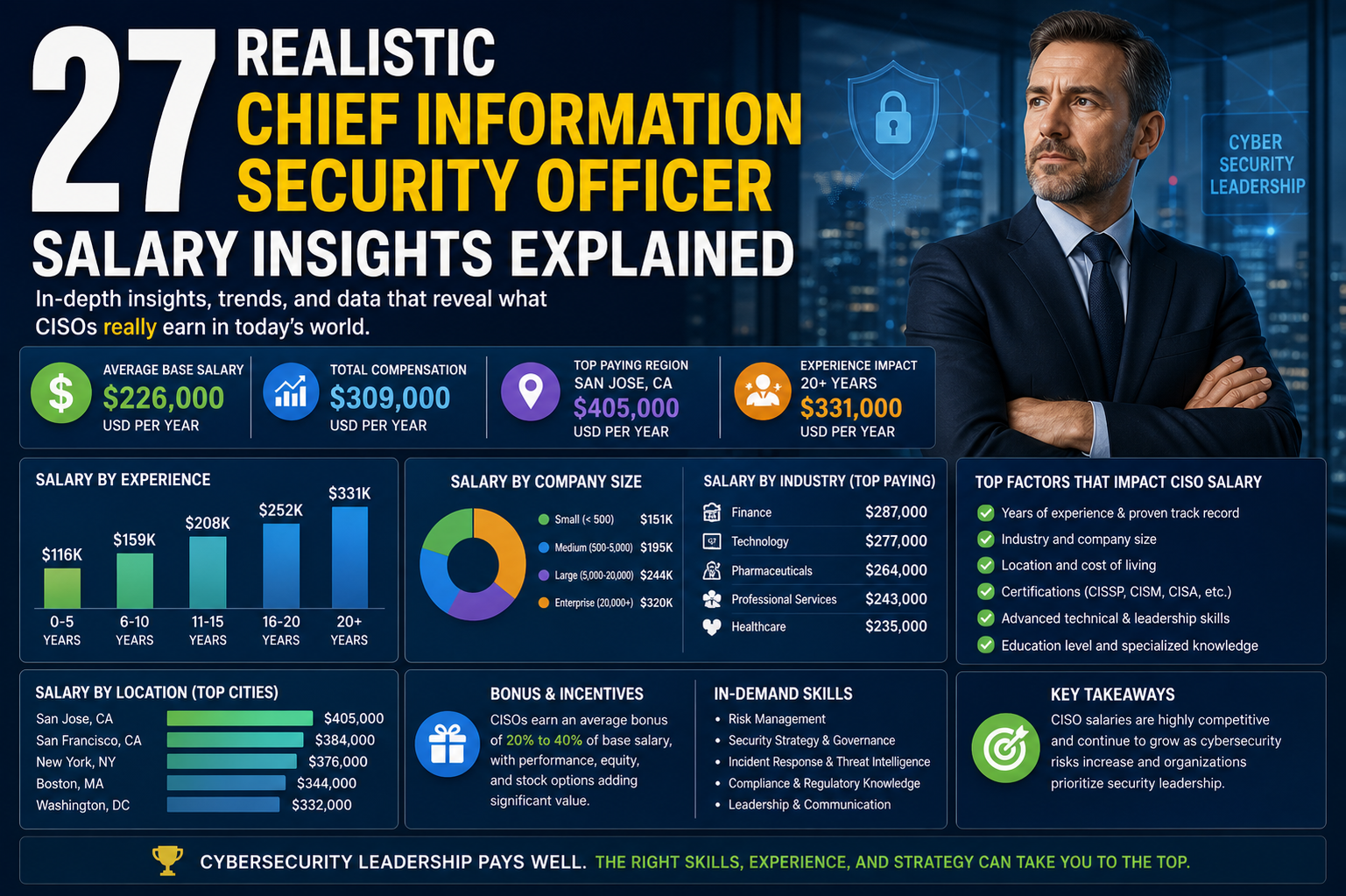
A Chief Information Security Officer plays a critical leadership role in modern organizations where digital systems, data protection, and cyber risk management have become essential to business survival. As cyber threats continue to evolve in complexity, organizations increasingly depend on senior security leaders who can design strategy, manage risk, and protect sensitive information assets. This growing responsibility has made the CISO position one of the most influential and highly compensated roles in the cybersecurity industry.
In today’s professional landscape, compensation for this role is not fixed or uniform. Instead, it varies widely based on industry type, organizational scale, geographic region, regulatory exposure, and the individual’s level of expertise. Some CISOs working in highly regulated industries or large global enterprises can earn significantly higher compensation compared to those in smaller organizations or less regulated sectors. This variation reflects the increasing importance of cybersecurity leadership in protecting business continuity and corporate reputation.
Understanding salary expectations for this role is not only important for professionals seeking advancement but also for organizations trying to attract and retain top-tier talent. With demand for cybersecurity leadership rising, salary benchmarking has become an essential part of hiring strategy and career planning in this field.
Role and Strategic Importance of a Chief Information Security Officer
A Chief Information Security Officer is primarily responsible for shaping and executing an organization’s cybersecurity vision. This role extends far beyond technical security management and into strategic decision-making at the executive level. A CISO ensures that security initiatives align with business objectives while maintaining a strong defense against evolving cyber risks.
At its core, the role focuses on safeguarding digital infrastructure, protecting sensitive customer and corporate data, and ensuring operational resilience. This includes identifying vulnerabilities across systems, implementing controls to mitigate threats, and continuously improving the organization’s security posture. CISOs are also responsible for preparing the organization to respond effectively to cyber incidents, minimizing financial loss and reputational damage.
In many organizations, CISOs actively collaborate with executive leadership and board members to communicate security risks in business terms. This requires the ability to translate technical issues into strategic insights that influence investment decisions and corporate planning. As a result, the role demands a unique combination of technical depth and executive-level communication ability.
Core Responsibilities and Leadership Expectations
The responsibilities of a Chief Information Security Officer span across multiple domains of cybersecurity governance and enterprise risk management. One of the most important responsibilities is defining the organization’s overall security strategy. This involves aligning cybersecurity initiatives with business goals, ensuring that security is integrated into every level of operations rather than treated as a separate function.
Risk management is another major responsibility. A CISO must continuously identify potential threats, assess vulnerabilities, and implement safeguards that reduce the likelihood and impact of cyber incidents. This requires a deep understanding of both internal systems and external threat landscapes.
Compliance oversight is also a critical function of the role. Many organizations must adhere to strict regulatory frameworks depending on their industry. A CISO ensures that security practices align with these requirements and that the organization remains audit-ready at all times. Failure to meet compliance standards can lead to legal penalties and reputational harm.
Incident response leadership is another key expectation. When a security breach occurs, the CISO is responsible for guiding the response process, coordinating teams, and ensuring rapid containment and recovery. This requires strong crisis management skills and the ability to make high-pressure decisions.
Additionally, CISOs manage security teams by hiring, training, and mentoring professionals across various cybersecurity disciplines. They are also responsible for advising executives and stakeholders on security investments, risk exposure, and long-term cybersecurity planning.
Skills, Expertise, and Technical Knowledge Required
The Chief Information Security Officer role requires a blend of technical expertise, strategic thinking, and leadership capability. A strong understanding of cybersecurity frameworks such as NIST, ISO-based security models, and enterprise risk management structures is essential. These frameworks provide the foundation for building structured and scalable security programs.
CISOs must also be familiar with modern security technologies used to detect and respond to threats. These include security information and event management systems, endpoint protection platforms, and threat intelligence solutions. While CISOs may not operate these tools directly, they must understand how they function to guide security teams effectively.
As organizations continue migrating to cloud environments, knowledge of cloud security platforms and identity management systems has become increasingly important. Managing access control, authentication systems, and cloud-based security configurations is a major part of modern cybersecurity leadership.
Soft skills are equally important. Strong leadership, decision-making ability, and communication skills are essential for managing teams and interacting with executive leadership. The ability to explain complex security risks in a clear and business-focused manner is one of the defining traits of successful CISOs.
Analytical thinking and risk assessment capabilities are also critical. CISOs must evaluate threats not only from a technical perspective but also in terms of business impact. This requires a balance between technical knowledge and strategic judgment.
Understanding Salary Expectations and Market Distribution
Compensation for Chief Information Security Officers reflects the high level of responsibility associated with the role. Salaries can range significantly depending on multiple influencing factors, but the overall trend shows strong earning potential across most regions.
In major metropolitan areas and technology hubs, compensation tends to be at the higher end of the spectrum due to increased demand for cybersecurity leadership and higher operational risk exposure. Organizations in these regions often compete aggressively to secure experienced security executives, resulting in elevated salary offerings.
Mid-level markets also show strong compensation growth as more organizations recognize the importance of cybersecurity leadership. Businesses in these regions are increasingly investing in dedicated security executives to manage rising cyber threats and regulatory requirements.
Even in smaller cities and less traditional tech markets, salaries remain competitive. Industries such as healthcare, education, government contracting, and financial services continue to drive demand for experienced CISOs, ensuring that compensation levels remain strong even outside major tech centers.
One of the most notable aspects of CISO compensation is the wide variation within the same region. Factors such as company size, industry type, security maturity, and executive experience can create significant differences in pay. A CISO at a multinational enterprise may earn substantially more than one at a mid-sized regional organization, even within the same city.
Key Factors That Influence Compensation Levels
Several factors play a major role in determining how much a Chief Information Security Officer earns. One of the most significant is organizational size and complexity. Larger organizations with more complex infrastructure and higher risk exposure typically offer higher compensation to attract experienced security leadership.
Industry type is another important factor. Highly regulated sectors such as finance, healthcare, and critical infrastructure tend to offer higher salaries due to strict compliance requirements and elevated security risks. These industries require CISOs who can manage both technical defenses and regulatory obligations simultaneously.
Experience level also has a direct impact on earning potential. CISOs with extensive leadership backgrounds, particularly those who have managed large-scale security programs or handled major incidents, are generally compensated at higher levels. Experience in executive communication and board-level reporting further increases value.
Educational background and professional certifications also contribute to salary potential. Advanced cybersecurity certifications and leadership-focused credentials demonstrate expertise and commitment to the field, often leading to stronger compensation packages.
Another influencing factor is familiarity with modern cybersecurity challenges. Expertise in cloud security, zero trust architecture, and emerging threat landscapes significantly enhances market value, especially in organizations undergoing digital transformation.
Experience Progression and Career Growth Path
CISO compensation typically increases with experience, but not just in terms of years worked. The complexity of previous roles, leadership exposure, and strategic responsibilities all contribute to career progression.
Early-stage security leaders transitioning into executive roles often manage mid-sized teams and focus on building foundational security programs. At this stage, they are heavily involved in both technical operations and leadership development.
Mid-level CISOs typically oversee broader organizational security strategies, managing cross-functional teams and working closely with executive leadership. They are responsible for enterprise-wide risk management and often participate in high-level decision-making processes.
Senior CISOs at large enterprises operate at the highest strategic level. They interact directly with boards and executive committees, shape corporate risk strategies, and influence long-term business planning. These professionals often have experience managing large-scale incidents, regulatory investigations, and organizational transformations.
As responsibility increases, so does compensation, reflecting the growing strategic importance of cybersecurity leadership in business operations.
Final Section for Part One Continuation Perspective
The role of a Chief Information Security Officer continues to evolve alongside the increasing complexity of digital threats and business environments. Organizations are no longer viewing cybersecurity as a purely technical function but as a core component of strategic business management. This shift has elevated the importance of CISOs and significantly expanded their influence within executive leadership structures.
Understanding the responsibilities, skills, and market expectations of this role provides a clearer picture of why compensation levels are structured the way they are. As organizations continue to invest heavily in cybersecurity leadership, the demand for highly skilled and strategically minded CISOs is expected to remain strong across industries and regions.
Market Trends in Chief Information Security Officer Compensation
Chief Information Security Officer compensation trends reflect how quickly cybersecurity has moved from a technical concern to a board-level priority. Organizations now treat security leadership as a core investment rather than an optional function, which has significantly influenced how salaries are structured. The demand for experienced security executives continues to rise as cyber risks become more frequent, more complex, and more financially damaging.
One of the strongest trends in this market is the widening gap between entry-level security leadership and highly experienced executive roles. As organizations scale their digital operations, they require CISOs who can manage enterprise-wide risk rather than just technical security operations. This shift has created stronger competition for senior talent and has pushed compensation upward in many sectors.
Tech Hubs and High Paying Regions
Major technology hubs consistently offer the highest compensation levels for Chief Information Security Officers. These regions are typically home to large enterprises, global technology firms, and fast-growing digital companies that operate in highly competitive environments. The combination of innovation, scale, and constant threat exposure increases the need for top-tier security leadership.
In these locations, organizations are often dealing with large volumes of sensitive data and complex cloud infrastructures. As a result, they are willing to invest heavily in experienced CISOs who can design advanced security programs and lead global teams. Compensation in these regions reflects both the cost of talent and the urgency of cybersecurity readiness.
Another factor influencing higher salaries in these areas is the frequency of targeted cyberattacks. Companies in technology-driven regions are more likely to face sophisticated threats, making security leadership a critical business function. This demand creates a competitive hiring environment where organizations offer premium compensation packages.
Mid Tier Cities and Expanding Opportunities
Mid-tier cities are becoming increasingly important in the cybersecurity job market. Many organizations in these regions are expanding their digital infrastructure and adopting cloud-based systems, which has increased the need for strong security leadership. As a result, CISO roles in these cities are growing in both number and importance.
These markets often offer a balance between competitive compensation and a lower cost of living. Companies in these regions may not match the highest-paying tech hubs, but they provide strong career growth opportunities and leadership roles with significant responsibility. This makes them attractive for professionals seeking executive experience without relocating to highly expensive urban centers.
Another key factor in mid-tier cities is the growth of regional enterprises and mid-sized corporations. These organizations are scaling rapidly and require CISOs who can build security programs from the ground up, often giving professionals more influence and ownership over security strategy.
Smaller Markets and Unexpected Salary Strength
Smaller cities and less recognized technology markets still offer competitive compensation for Chief Information Security Officers. While these regions may not be known for large tech industries, they often host important institutions such as healthcare systems, universities, and government contractors that require strong cybersecurity leadership.
In these environments, CISOs play a critical role in protecting sensitive data and ensuring compliance with strict regulatory requirements. Although the organizational scale may be smaller, the responsibility remains significant, which supports strong salary levels even in non-metropolitan areas.
These markets also provide opportunities for CISOs to take on broader roles that combine security leadership with IT governance and operational oversight. This expanded scope of responsibility can increase the overall value of the position within the organization.
Salary Variation Within the Same Organization
One of the most notable aspects of Chief Information Security Officer compensation is the variation that exists even within similar roles in the same organization type or region. This variation is often driven by experience level, strategic responsibility, and the complexity of the security environment.
For example, a CISO in a smaller enterprise may focus primarily on operational security management, while a CISO in a global corporation may be responsible for multi-region risk strategy and regulatory compliance across multiple jurisdictions. These differences significantly impact compensation structures.
Another factor contributing to variation is reporting structure. CISOs who report directly to the CEO or board of directors typically command higher compensation compared to those who report within IT departments. This is because executive-level visibility increases both responsibility and influence over business decisions.
Cost of Living and Real Income Value
Cost of living plays an important role in evaluating Chief Information Security Officer compensation, but it does not always provide a complete picture of financial value. Higher salaries in expensive cities may appear attractive on paper, but purchasing power can be significantly reduced due to living costs, taxes, and housing expenses.
In contrast, CISOs working in lower-cost regions may earn slightly less in absolute terms but retain more disposable income. This creates a situation where overall quality of life may be higher even with a lower nominal salary.
Professionals in this role often evaluate compensation not only based on salary figures but also on long-term financial stability, lifestyle preferences, and career development opportunities. This makes location a strategic decision rather than just a financial one.
Industry Based Differences in Compensation
Industry type is one of the most influential factors in determining Chief Information Security Officer salaries. Different industries face varying levels of cyber risk, regulatory pressure, and data sensitivity, all of which directly impact compensation levels.
Industries that handle sensitive financial or personal data typically require stronger security leadership. These sectors often allocate larger budgets to cybersecurity because the cost of breaches can be extremely high. As a result, CISOs in these environments are often among the highest paid.
Other industries, such as manufacturing or retail, may not face the same level of regulatory pressure but are still increasingly targeted by cyber threats. As digital transformation expands across all sectors, even traditionally low-risk industries are increasing investment in cybersecurity leadership.
Finance and Banking Security Leadership
The financial sector is one of the highest-paying industries for Chief Information Security Officers. Banks, investment firms, and financial service providers handle large volumes of sensitive financial data, making them prime targets for cyberattacks. This level of risk requires highly experienced security leadership.
In this industry, CISOs are responsible for ensuring compliance with strict financial regulations while also protecting against advanced fraud attempts and cyber intrusions. The combination of regulatory complexity and high financial risk results in strong compensation packages.
Financial institutions also tend to have mature cybersecurity programs, which means CISOs in this sector often operate at a highly strategic level. They are deeply involved in enterprise risk management and regularly interact with executive leadership and regulatory bodies.
Healthcare and Regulatory Driven Compensation
Healthcare is another major industry where Chief Information Security Officer roles are critical. Hospitals, insurance providers, and healthcare networks manage highly sensitive personal and medical data, making them frequent targets for cyber threats.
In this sector, CISOs must ensure compliance with strict privacy regulations while maintaining secure access to patient systems. The complexity of healthcare environments, combined with regulatory pressure, increases the demand for experienced security leadership.
Compensation in healthcare reflects both the sensitivity of data and the operational risks associated with system downtime or data breaches. Even smaller healthcare organizations often prioritize cybersecurity leadership due to the potential impact on patient safety and legal liability.
Government and Public Sector CISO Roles
Government and public sector organizations also employ Chief Information Security Officers to manage national security risks, citizen data protection, and critical infrastructure security. These roles are often structured differently compared to private sector positions but remain highly important.
In many cases, public sector CISOs are responsible for coordinating security across multiple agencies or departments. This requires strong leadership, coordination skills, and deep understanding of regulatory frameworks and national cybersecurity policies.
While compensation in government roles may vary compared to private sector positions, these roles often provide stability, influence over policy, and opportunities to work on large-scale national security initiatives.
Technology Companies and Startup Environments
Technology companies and startups represent another important segment of the CISO job market. In these environments, security leadership is closely tied to product development, innovation, and rapid scaling.
Startups may offer different compensation structures, often combining base salary with equity or performance-based incentives. While base salaries may sometimes be lower than large enterprises, long-term compensation potential can be significant depending on company growth.
In larger technology companies, CISOs often operate at a global scale, managing complex cloud infrastructure, large engineering teams, and advanced security ecosystems. These roles require deep technical knowledge and strong strategic leadership capabilities.
Security leaders in technology companies are often involved in shaping product security, privacy frameworks, and customer trust strategies, making their role central to business success.
Career Progression Path of a Chief Information Security Officer
The career path toward becoming a Chief Information Security Officer is rarely linear. It typically involves years of progressive experience across multiple cybersecurity disciplines, leadership roles, and exposure to enterprise risk environments. Most CISOs begin their careers in technical roles where they gain foundational knowledge of systems, networks, and security operations before moving into managerial and strategic positions.
As professionals advance, they transition from hands-on technical responsibilities to broader leadership roles that involve team management, policy development, and risk oversight. This shift is critical because the CISO role is not just about technical expertise but also about guiding organizational security strategy at the highest level.
Over time, individuals accumulate experience in areas such as incident response, compliance management, infrastructure security, and security architecture. Each of these areas contributes to the development of a well-rounded security leader capable of managing complex enterprise environments.
The final stage of this progression often involves executive leadership experience where professionals interact directly with senior management and board members. This exposure is essential because CISOs must be able to communicate risk and security strategy in business terms rather than purely technical language.
Transition from Technical Roles to Executive Leadership
One of the most important transformations in a cybersecurity career is the shift from technical execution to executive decision-making. Early in their careers, professionals often focus on tasks such as configuring security systems, analyzing threats, and responding to incidents. These responsibilities build the technical foundation required for higher-level roles.
As they move into leadership positions, the focus gradually shifts toward managing teams, defining security policies, and aligning cybersecurity initiatives with organizational objectives. This stage requires a deeper understanding of business operations and how security impacts overall performance.
Eventually, CISOs are expected to operate at a strategic level where they influence organizational direction rather than just implementing security measures. This includes participating in board meetings, shaping risk appetite, and advising on major business decisions that involve cybersecurity considerations.
This transition is often challenging because it requires a change in mindset from technical problem-solving to strategic leadership and communication. However, it is essential for professionals aiming to reach executive-level compensation and responsibility.
Leadership Skills That Influence CISO Compensation
Leadership ability is one of the most significant factors influencing Chief Information Security Officer compensation. While technical expertise is important, the ability to lead teams, influence decision-makers, and drive organizational change has a direct impact on salary potential.
Effective CISOs must be capable of managing diverse teams that include security analysts, engineers, compliance specialists, and risk professionals. This requires strong communication skills, emotional intelligence, and the ability to motivate teams under high-pressure situations.
Decision-making ability is also critical. CISOs are often required to make high-impact decisions involving risk acceptance, security investments, and incident response strategies. These decisions can have significant financial and operational consequences for the organization.
Another important leadership skill is stakeholder management. CISOs must work closely with executives, legal teams, auditors, and external partners. The ability to build trust and communicate effectively with these groups enhances organizational confidence in the security function, which often translates into higher compensation.
Impact of Regulatory Compliance on Salary Growth
Regulatory compliance plays a major role in shaping the responsibilities and compensation of Chief Information Security Officers. Organizations operating in regulated industries must adhere to strict security standards, which significantly increases the complexity of the CISO role.
Compliance frameworks often require continuous monitoring, auditing, and reporting to ensure that security controls are properly implemented. CISOs are responsible for ensuring that their organizations meet these requirements while also maintaining operational efficiency.
Experience with compliance programs such as data protection regulations, financial auditing standards, and industry-specific security frameworks adds significant value to a CISO’s profile. Professionals who have successfully led compliance initiatives are often viewed as lower-risk hires, which can lead to higher salary offers.
In many cases, regulatory compliance is not just a technical requirement but a strategic business function. Organizations that fail to comply with regulations may face financial penalties and reputational damage, making experienced CISOs highly valuable.
Role of Certifications in Career Advancement
Professional certifications are an important component of career development for Chief Information Security Officers. These credentials validate technical knowledge, risk management skills, and leadership capabilities in cybersecurity.
Certifications focused on security management and governance are particularly relevant for CISOs because they demonstrate an understanding of enterprise-level security strategy. These qualifications are often used by employers as benchmarks when evaluating candidates for executive roles.
In addition to technical certifications, business and leadership education also play an important role in career advancement. Many CISOs pursue advanced education in business management or executive leadership to strengthen their strategic decision-making abilities.
Certifications and formal education together help professionals bridge the gap between technical expertise and business leadership. This combination is highly valued in executive cybersecurity roles and often contributes to higher compensation levels.
Evolving Threat Landscape and Its Effect on CISO Roles
The cybersecurity threat landscape continues to evolve rapidly, and this has a direct impact on the responsibilities of Chief Information Security Officers. Modern cyber threats are more sophisticated, targeted, and persistent than ever before.
Organizations now face risks such as ransomware attacks, supply chain vulnerabilities, cloud misconfigurations, and advanced persistent threats. These challenges require CISOs to continuously adapt their strategies and stay informed about emerging risks.
As threats become more complex, the demand for experienced security leadership increases. CISOs must not only respond to incidents but also anticipate potential vulnerabilities and design proactive defense strategies.
This evolving environment has elevated the importance of cybersecurity leadership within organizations. Security is no longer viewed as a support function but as a critical business priority that directly affects operational continuity and financial stability.
Importance of Communication and Board-Level Interaction
One of the defining aspects of the Chief Information Security Officer role is the ability to communicate effectively with executive leadership and board members. This responsibility requires translating complex technical risks into clear business implications.
Boards and executives are primarily focused on business performance, financial outcomes, and organizational risk exposure. CISOs must therefore present cybersecurity information in a way that supports informed decision-making at this level.
Strong communication skills help CISOs build trust with leadership teams and ensure that security initiatives receive appropriate funding and support. This ability to influence strategic decisions is one of the reasons why experienced CISOs command higher compensation.
In many organizations, CISOs are now expected to participate in regular board discussions, providing updates on security posture, incident response readiness, and risk mitigation strategies. This level of visibility increases both responsibility and professional value.
Industry Competition for Cybersecurity Leadership Talent
The demand for experienced Chief Information Security Officers continues to grow across all industries. As organizations expand their digital operations, competition for skilled cybersecurity leaders has intensified significantly.
Companies are not only competing within their own industries but also across sectors to attract top security talent. This competition has led to increased salary offerings, improved benefits, and more flexible compensation structures.
In many cases, organizations are willing to offer additional incentives such as bonuses, equity, and performance-based rewards to secure experienced CISOs. These compensation structures reflect the high value placed on cybersecurity leadership in protecting business assets.
The shortage of qualified cybersecurity executives has also contributed to upward pressure on salaries. As the complexity of cyber threats increases, the demand for skilled leadership continues to outpace supply.
Organizational Security Maturity and Its Influence on Pay
The maturity of an organization’s cybersecurity program also plays a role in determining CISO compensation. Organizations with advanced security frameworks often require leaders who can maintain and enhance existing systems rather than build them from scratch.
In contrast, organizations with less mature security programs may require CISOs who can establish foundational security policies, implement governance structures, and build security teams from the ground up. These responsibilities can significantly influence compensation levels.
Highly mature organizations often expect CISOs to focus on continuous improvement, risk optimization, and strategic innovation. This requires advanced leadership capabilities and deep industry knowledge, which are reflected in higher compensation packages.
Less mature organizations may offer lower base salaries but provide opportunities for rapid career growth and broader responsibilities. This creates a trade-off between immediate compensation and long-term career development.
Must-Have Tools and Technologies Used by Chief Information Security Officers
A Chief Information Security Officer is not expected to operate every security tool directly, but a strong understanding of enterprise security technologies is essential for making strategic decisions. These tools form the foundation of an organization’s cybersecurity ecosystem, and the CISO is responsible for ensuring they work together effectively to reduce risk and improve visibility.
Modern security environments are complex and distributed across cloud, on-premise, and hybrid systems. Because of this, CISOs must be familiar with a wide range of technologies that support monitoring, detection, response, identity management, and governance. Understanding how these systems interact allows CISOs to evaluate security posture and guide investment decisions.
Security information and event management platforms are among the most important categories. These systems collect and analyze security data from across the organization to detect potential threats. CISOs rely on insights from these platforms to understand risk trends and incident patterns at a high level.
Endpoint protection and detection tools are also critical. These systems monitor devices such as laptops, servers, and mobile devices for malicious activity. As remote work becomes more common, endpoint visibility has become a major focus area for security leadership.
Identity and access management systems play a central role in controlling who has access to organizational resources. CISOs must ensure that authentication systems, multi-factor verification, and access control policies are properly implemented to prevent unauthorized access.
Cloud security platforms are increasingly important as organizations move workloads to cloud environments. These tools help monitor cloud configurations, detect misconfigurations, and enforce compliance standards across distributed infrastructure.
Reporting and visualization tools are also essential for executive communication. CISOs often use dashboards to present security posture, risk levels, and incident trends to executive teams and boards in a clear and business-focused manner.
Strategic Value of Security Frameworks and Governance Models
Security frameworks provide structured approaches to managing cybersecurity programs, and they are a key part of a CISO’s responsibility. These frameworks help organizations establish consistent policies, controls, and risk management practices.
Frameworks such as enterprise risk management models and cybersecurity governance structures allow CISOs to align security initiatives with business objectives. This ensures that security is not treated as an isolated function but as an integrated part of organizational strategy.
Governance frameworks also support compliance efforts by providing standardized approaches to auditing and reporting. CISOs use these frameworks to demonstrate accountability and ensure that security controls meet regulatory expectations.
Understanding how to implement and maintain these frameworks is essential for long-term security maturity. Organizations with strong governance structures are better positioned to respond to threats and adapt to changing regulatory environments.
Importance of Incident Response and Crisis Management Skills
Incident response is one of the most critical responsibilities within a Chief Information Security Officer’s scope. When a cybersecurity incident occurs, the CISO is responsible for coordinating the organization’s response, minimizing damage, and restoring normal operations.
Effective incident response requires clear communication, rapid decision-making, and coordination across multiple teams. CISOs must ensure that incident response plans are well-documented, tested regularly, and updated to reflect emerging threats.
Crisis management goes beyond technical response and includes communication with executives, stakeholders, customers, and sometimes regulatory bodies. How a CISO handles a crisis can significantly impact an organization’s reputation and financial stability.
Organizations value CISOs who can remain calm under pressure and lead structured responses during high-impact security events. This ability often contributes to higher compensation and greater executive trust.
Executive Reporting and Business Communication
One of the most important non-technical responsibilities of a Chief Information Security Officer is communicating security posture to business leaders. CISOs must translate complex technical risks into clear, actionable insights that support executive decision-making.
Board-level communication typically focuses on risk exposure, financial impact, compliance status, and strategic security investments. CISOs must be able to explain these topics in a way that aligns with business priorities rather than technical details.
Strong executive communication skills help build trust between security teams and leadership. When executives understand cybersecurity risks clearly, they are more likely to support security initiatives and allocate appropriate resources.
This ability to bridge the gap between technical and business language is one of the key differentiators among CISOs and plays a major role in salary growth and career advancement.
Emerging Cybersecurity Trends Impacting CISO Roles
The cybersecurity landscape continues to evolve rapidly, and Chief Information Security Officers must stay ahead of emerging trends to remain effective in their roles. One of the most significant trends is the increasing adoption of cloud-native architectures, which introduces new security challenges and responsibilities.
Another major trend is the rise of advanced persistent threats and highly coordinated cyberattacks. These attacks often target critical infrastructure and require sophisticated detection and response strategies.
Artificial intelligence and automation are also transforming cybersecurity operations. While these technologies help improve threat detection and response speed, they also introduce new risks that CISOs must manage carefully.
Third-party and supply chain security has become another major focus area. Organizations increasingly rely on external vendors, making it essential for CISOs to assess and manage risks beyond their internal environment.
Zero trust architecture is also gaining widespread adoption. This model assumes that no user or system is automatically trusted, requiring continuous verification and strict access controls across all systems.
Future Outlook for Chief Information Security Officer Careers
The future of the Chief Information Security Officer role is expected to become even more strategic and business-integrated. As cyber threats continue to evolve, organizations will increasingly rely on CISOs not just for protection but for guiding digital transformation securely.
Security leadership will likely become more embedded in executive decision-making processes, with CISOs playing a larger role in business planning, mergers and acquisitions, and technology investment strategies.
The demand for experienced cybersecurity executives is expected to remain strong due to ongoing talent shortages in the industry. This imbalance between supply and demand will continue to support competitive compensation levels.
CISOs who continuously update their skills and adapt to new technologies will be best positioned for long-term success. The ability to combine technical expertise with strategic leadership will remain the defining factor in career advancement.
Final Conclusion
Chief Information Security Officers represent one of the most important leadership roles in modern organizations. Their responsibilities extend across cybersecurity, risk management, compliance, and executive decision-making, making them essential to organizational stability and growth.
Salary levels for CISOs reflect the high level of responsibility and expertise required for the role. Compensation varies based on industry, experience, location, and organizational complexity, but overall earning potential remains strong across all markets.
Beyond salary, the role offers significant influence over business strategy and long-term organizational resilience. CISOs are no longer viewed as purely technical leaders but as executive decision-makers who shape how organizations manage risk in a digital world.
As cybersecurity continues to evolve, the importance of strong security leadership will only increase, reinforcing the value and compensation of the Chief Information Security Officer role in the global job market.