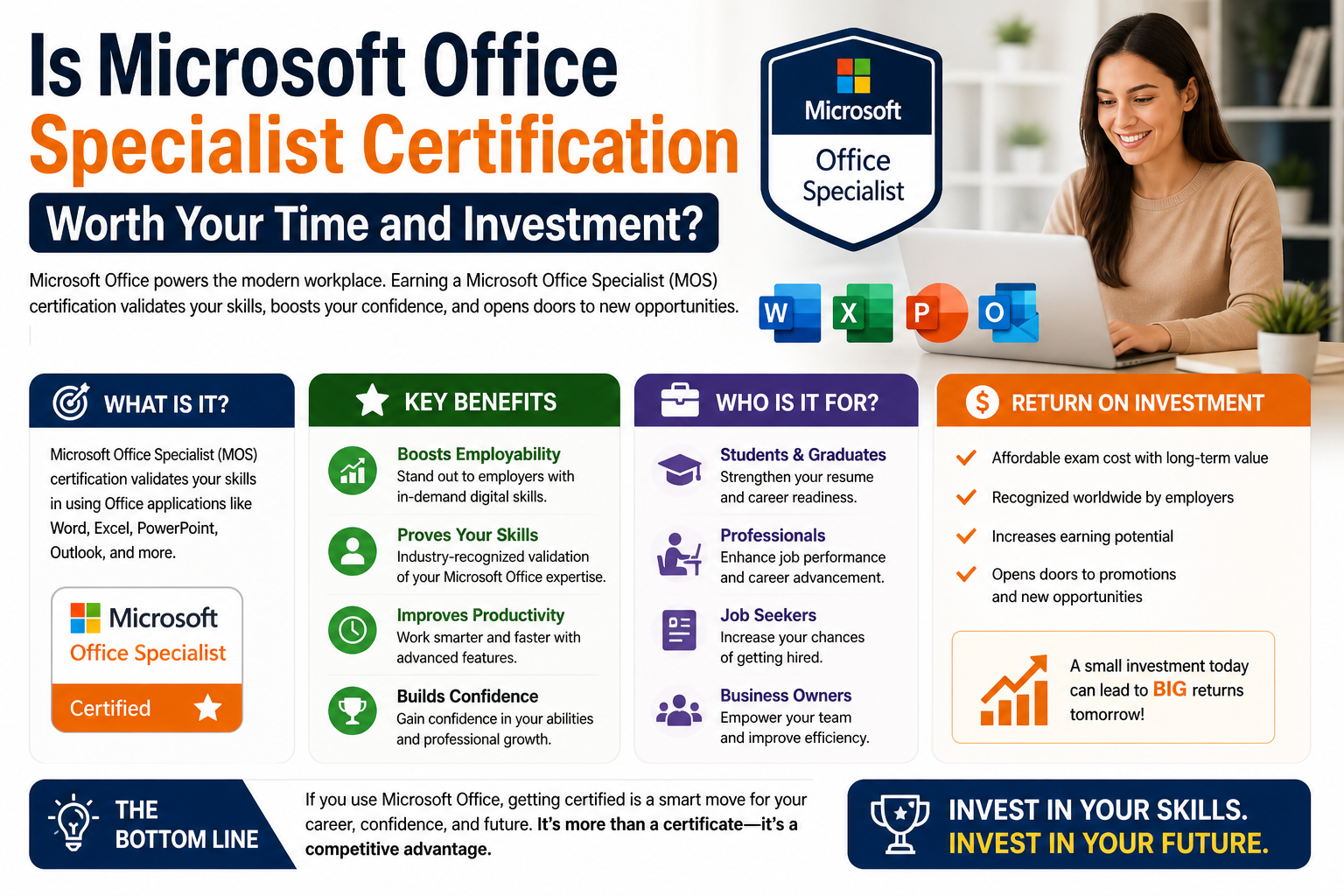
Microsoft Office Specialist certification may not always grab headlines like advanced technical credentials, but dismissing it would be a mistake. In modern workplaces where digital tools shape productivity, this certification represents something highly practical—verified ability. It proves that you can do more than just open applications; you can use them effectively to produce polished, efficient, and professional results. In environments where time, accuracy, and presentation quality matter, this distinction carries real weight.
Understanding the Core Purpose of MOS Certification
At its core, the Microsoft Office Specialist certification validates hands-on expertise in widely used productivity applications. Rather than focusing on abstract IT knowledge, it targets tools that professionals interact with daily. This includes word processing, data analysis, presentations, and communication management. The emphasis is not on theory but on execution—demonstrating that you can perform tasks that mirror real workplace scenarios with confidence and precision.
A Certification Built Around Real-World Application
What makes this certification particularly valuable is its alignment with actual job requirements. Instead of testing memorized concepts, it evaluates your ability to perform tasks in a simulated environment that reflects real work situations. Whether it is formatting a detailed report, analyzing data trends, or creating a visually engaging presentation, the certification ensures that your skills are directly transferable to your job role. This practical focus is what sets it apart from many traditional exams.
Different Levels for Different Skill Sets
The Microsoft Office Specialist program is structured to accommodate a range of skill levels. The Associate level focuses on foundational abilities, ensuring you can handle everyday tasks efficiently. The Expert level, on the other hand, dives deeper into advanced features, enabling you to tackle complex workflows and optimize processes. This tiered structure allows individuals to progress at their own pace and build a certification path that aligns with their career goals.
Flexibility to Choose Relevant Applications
One of the strongest advantages of this certification is its flexibility. You are not forced into a rigid path. Instead, you can choose specific applications that match your professional needs. For instance, someone working in marketing might focus on presentation tools, while a data analyst would prioritize spreadsheet capabilities. This modular approach ensures that your effort is invested in areas that provide the highest return in your daily work.
The Role of Presentation Skills in Modern Workplaces
In today’s professional environment, communication is often visual. Presentations are no longer optional; they are essential tools for conveying ideas, pitching strategies, and delivering insights. A certification that validates your ability to create structured, visually appealing, and impactful presentations can significantly enhance your professional image. It signals that you understand not just the technical side, but also the communication aspect of digital tools.
Developing Efficiency Through Structured Learning
Preparing for certification naturally improves your workflow. As you study and practice, you uncover features and shortcuts that you may not have used before. Tasks that once took hours can often be completed in minutes. This increase in efficiency is not just about saving time; it also reduces errors and improves the overall quality of your work. Over time, these improvements compound, making you more reliable and productive in your role.
Moving Beyond Basic Tool Usage
Many professionals use office applications at a surface level. They know enough to get by, but not enough to excel. The certification process pushes you beyond this basic level. It encourages you to explore advanced features, understand best practices, and apply techniques that elevate your work. This transition from basic usage to professional mastery can make a noticeable difference in both output and confidence.
Building Confidence Through Verified Skills
Confidence in the workplace often comes from knowing that your skills are solid. When you have a recognized certification backing your abilities, you approach tasks with greater assurance. You are less likely to second-guess your decisions and more likely to take initiative. This confidence can influence how colleagues and supervisors perceive you, positioning you as someone who can be trusted with important responsibilities.
Why Employers Value Verified Competence
Employers are constantly looking for ways to differentiate between candidates. While many resumes claim proficiency in office tools, few provide concrete proof. Certification bridges this gap by offering a standardized measure of skill. It reassures employers that you have met a recognized benchmark and can perform tasks effectively without extensive training. This can be particularly valuable in competitive job markets.
A Credential That Supports Career Growth
Career advancement often depends on both performance and perception. While strong work speaks for itself, credentials can accelerate recognition. A certification demonstrates commitment to self-improvement and professional development. It shows that you are willing to invest time in refining your skills, which can make you a stronger candidate for promotions or new opportunities.
Adapting to Evolving Workplace Technology
Workplace tools are constantly evolving, introducing new features and capabilities. Staying updated can be challenging without structured learning. Certification preparation helps you keep pace with these changes, ensuring that your skills remain relevant. This adaptability is crucial in environments where technology plays a central role in daily operations.
Enhancing Collaboration in Digital Environments
Modern workplaces often rely on collaboration, whether in physical offices or remote setups. Effective use of digital tools is essential for smooth communication and teamwork. Certification equips you with the knowledge to use these tools efficiently, making it easier to share information, coordinate tasks, and contribute to group projects. This can improve not only your performance but also the overall productivity of your team.
A Valuable Asset for Students and Early Professionals
For those entering the workforce, standing out can be challenging. A certification provides a tangible advantage by demonstrating practical skills that employers value. It signals readiness for professional environments and reduces the gap between academic learning and workplace expectations. This can be particularly helpful for individuals looking to secure their first job or internship.
Supporting Productivity Across Multiple Roles
The usefulness of office tools spans across industries and job roles. From administrative tasks to strategic planning, these applications are deeply integrated into daily operations. Certification ensures that you can use them effectively regardless of your role. This versatility makes it a valuable investment for a wide range of professionals.
Balancing Time Investment with Practical Benefits
One of the appealing aspects of this certification is its relatively low time commitment compared to other professional credentials. The preparation process is manageable, and the exams are designed to be completed within a short duration. Despite this, the benefits—improved efficiency, stronger credentials, and enhanced confidence—can have a lasting impact on your career.
A Practical Step Toward Professional Excellence
Ultimately, the Microsoft Office Specialist certification is about practical improvement. It is not about adding another line to your resume without substance. Instead, it represents a measurable enhancement in your ability to perform everyday tasks. This focus on real-world application makes it a worthwhile consideration for anyone looking to strengthen their professional toolkit.
Strengthening Workplace Performance Through Specialized Skills
As professionals progress in their careers, expectations around efficiency and output quality naturally increase. Basic familiarity with office tools is no longer enough when roles demand precision, speed, and adaptability. This is where specialized certification begins to show its true value. By refining your understanding of digital tools, you transition from simply completing tasks to optimizing them. This shift directly impacts how your work is perceived and how effectively you contribute to organizational goals.
Deepening Application Knowledge for Real Impact
A significant advantage of structured certification preparation is the depth of knowledge it provides. Instead of relying on scattered learning or trial and error, you gain a comprehensive understanding of each application’s capabilities. This includes not only common functions but also lesser-known features that can dramatically improve productivity. Mastering these capabilities allows you to approach tasks with a strategic mindset, choosing the most efficient methods rather than defaulting to familiar but slower approaches.
Transforming Data Into Meaningful Insights
In many professional roles, handling data is a daily responsibility. However, the ability to transform raw data into meaningful insights is what truly sets individuals apart. Certification training emphasizes techniques that help you analyze, organize, and present data effectively. This includes creating structured datasets, applying calculations accurately, and visualizing information in a way that supports decision-making. Such skills are highly valued in environments where informed choices drive success.
Elevating Document Quality and Professional Presentation
Documents often serve as the first impression of your work. Whether it is a report, proposal, or internal communication, clarity and professionalism are essential. Certification helps you develop a structured approach to document creation, ensuring consistency in formatting, readability, and overall design. By applying these principles, you can produce documents that not only convey information but also reflect attention to detail and professionalism.
Mastering the Art of Visual Communication
Visual communication plays a crucial role in conveying complex ideas effectively. Presentations, charts, and graphics are powerful tools when used correctly. Certification training focuses on designing visuals that are both engaging and informative. This involves understanding layout principles, selecting appropriate visual elements, and maintaining a balance between aesthetics and clarity. When done well, visual communication can significantly enhance the impact of your message.
Improving Workflow Through Automation and Efficiency
One of the most overlooked aspects of office tools is their ability to automate repetitive tasks. Certification preparation introduces you to features that streamline workflows, reducing manual effort and minimizing errors. By leveraging automation, you can focus on higher-value activities rather than routine processes. This not only improves efficiency but also contributes to a more organized and productive work environment.
Adapting Skills to Different Professional Contexts
The versatility of office applications means that their use varies across industries and roles. Certification equips you with adaptable skills that can be applied in different contexts. Whether you are managing administrative tasks, analyzing business data, or creating marketing materials, the principles you learn remain relevant. This adaptability enhances your ability to transition between roles or take on new responsibilities with confidence.
Bridging the Gap Between Knowledge and Execution
Many professionals possess theoretical knowledge of office tools but struggle with practical implementation. Certification addresses this gap by focusing on execution. Through hands-on practice, you develop the ability to apply concepts in real scenarios. This practical experience ensures that your skills are not just understood but also effectively utilized in your daily work.
Enhancing Accuracy and Reducing Errors
Accuracy is a critical factor in professional environments, especially when dealing with data, financial information, or formal documentation. Certification training emphasizes precision, helping you develop habits that reduce errors. By understanding the correct use of formulas, formatting rules, and validation techniques, you can produce reliable outputs that build trust with colleagues and stakeholders.
Building a Structured Approach to Problem Solving
Problem-solving is an essential skill in any role. Certification encourages a structured approach to tackling challenges within office applications. Instead of relying on guesswork, you learn to analyze problems, identify appropriate tools, and implement effective solutions. This methodical approach not only improves outcomes but also enhances your ability to handle complex tasks independently.
Increasing Productivity in High-Pressure Situations
Work environments often involve tight deadlines and high expectations. In such situations, efficiency becomes even more important. Certification preparation helps you develop the skills needed to work quickly without compromising quality. By mastering shortcuts, advanced features, and best practices, you can handle demanding tasks with greater ease and confidence.
Supporting Professional Growth Through Continuous Learning
The process of preparing for certification fosters a mindset of continuous learning. As you explore different features and techniques, you become more curious and proactive in expanding your knowledge. This mindset is valuable beyond certification, as it encourages ongoing skill development and adaptability in a constantly evolving workplace.
Enhancing Collaboration and Team Contribution
Effective collaboration relies on clear communication and efficient use of shared tools. Certification equips you with the skills to contribute more effectively in team settings. Whether it is creating shared documents, organizing data, or presenting ideas, your ability to use tools efficiently can improve overall team performance. This makes you a valuable asset in collaborative environments.
Strengthening Professional Credibility
Credibility is built through consistent performance and demonstrated expertise. Certification adds an extra layer of validation to your skills, reinforcing your professional reputation. It shows that your abilities have been tested and verified, which can increase trust among colleagues, managers, and clients. This credibility can play a significant role in career advancement.
Preparing for Evolving Workplace Demands
As workplaces continue to evolve, the demand for digital proficiency is only expected to grow. Certification helps you stay prepared for these changes by ensuring that your skills remain relevant. By keeping up with new features and best practices, you can adapt to shifting requirements and maintain your effectiveness in different roles.
Maximizing the Value of Everyday Tools
Office applications are often underutilized, with many users relying on only a fraction of their capabilities. Certification encourages you to explore these tools more fully, unlocking features that can significantly enhance your work. By maximizing the value of these applications, you can achieve better results with less effort, making your daily tasks more efficient and impactful.
Understanding the Certification Process and Exam Structure
Gaining a clear understanding of how the certification process works can remove much of the uncertainty that holds people back. The exams are designed to reflect real workplace scenarios rather than abstract questioning. Instead of selecting answers from multiple-choice lists, you are required to complete tasks within a simulated environment. This structure ensures that your ability to perform actions is measured directly, making the certification both practical and relevant.
A Task-Based Approach That Mirrors Real Work
The exam format focuses heavily on task execution. You might be asked to format a document, organize data, or design a presentation using specific instructions. Each task represents something you could realistically encounter in your job. This approach eliminates the gap between learning and application, ensuring that the skills you demonstrate during the exam can be immediately used in a professional setting.
Time Management Within the Exam Environment
Although the exam duration is relatively short, managing your time effectively is essential. Each task requires attention to detail, and rushing can lead to mistakes. At the same time, spending too long on a single question may prevent you from completing the entire exam. Developing a balanced pace during preparation helps you approach the test with confidence and control.
Preparing Through Consistent Hands-On Practice
Preparation for certification is most effective when it involves regular, hands-on practice. Reading about features or watching demonstrations can provide a foundation, but true understanding comes from applying those concepts yourself. By actively working within the applications, you build muscle memory and familiarity, which are crucial during the exam. This consistent practice also helps reinforce problem-solving skills.
Choosing the Right Learning Resources
There are multiple ways to prepare for certification, and selecting the right resources can make a significant difference. Some individuals prefer self-paced learning through guides and tutorials, while others benefit from structured courses that provide a clear path. Interactive learning methods, such as practice exercises and simulations, are particularly useful because they replicate the exam environment and allow you to test your skills in real time.
Developing a Study Strategy That Fits Your Routine
A well-planned study strategy can improve both efficiency and retention. Instead of trying to cover everything at once, it is more effective to break down topics into manageable sections. Focusing on one area at a time allows you to build a strong foundation before moving on to more advanced concepts. Consistency is key, as regular practice sessions help reinforce learning and prevent knowledge gaps.
Balancing Theory and Practical Application
While the certification emphasizes practical skills, a basic understanding of underlying concepts is still important. Knowing why certain features are used can help you apply them more effectively. However, the primary focus should remain on execution. Striking the right balance between theory and practice ensures that you are both knowledgeable and capable of performing tasks efficiently.
Overcoming Common Challenges During Preparation
Many candidates face challenges such as unfamiliar features or difficulty remembering specific steps. These obstacles are a natural part of the learning process. The key is to approach them with patience and persistence. Revisiting difficult topics, practicing repeatedly, and seeking clarification when needed can help you overcome these challenges and build confidence in your abilities.
Building Familiarity With Exam Objectives
Understanding the scope of the exam is an important part of preparation. Each certification has defined objectives that outline the skills being tested. Reviewing these objectives helps you focus your efforts on relevant areas, ensuring that your study time is used effectively. It also provides a clear roadmap, making the preparation process more structured and less overwhelming.
Simulating Real Exam Conditions for Better Readiness
Practicing under conditions مشابه to the actual exam can significantly improve your performance. This includes setting time limits, working without interruptions, and completing tasks independently. Such simulations help you become comfortable with the format and reduce anxiety on exam day. They also allow you to identify areas where you need further improvement.
The Importance of Accuracy in Task Execution
Accuracy plays a crucial role in certification exams. Even small mistakes can affect your overall performance. Developing a habit of double-checking your work can help minimize errors. This attention to detail not only improves your chances of passing the exam but also translates into higher-quality work in your professional life.
Maintaining Focus and Reducing Exam Stress
Staying focused during the exam is essential for success. Distractions or stress can impact your ability to think clearly and complete tasks efficiently. Preparing thoroughly is one of the best ways to reduce anxiety, as it builds confidence in your skills. Approaching the exam with a calm and focused mindset allows you to perform at your best.
Understanding Retake Options and Flexibility
Not every candidate passes on the first attempt, and that is completely normal. The certification process allows for retakes, giving you the opportunity to learn from your experience and improve. This flexibility reduces pressure and encourages a growth-oriented approach, where setbacks are seen as part of the learning journey rather than failures.
Applying Learned Skills Beyond the Exam
The value of certification extends beyond passing the test. The skills you develop during preparation can be applied immediately in your work. Whether it is improving document formatting, analyzing data more effectively, or creating engaging presentations, these abilities contribute to better performance and productivity. This practical benefit is one of the strongest reasons to pursue certification.
Integrating Certification Into Long-Term Career Planning
Certification should be viewed as part of a broader career strategy rather than a standalone achievement. By aligning your certification choices with your professional goals, you can maximize their impact. Whether you aim to specialize in a particular area or build a diverse skill set, certification can support your long-term growth and development.
Creating a Foundation for Advanced Skill Development
For those who wish to continue advancing their skills, certification provides a solid starting point. The knowledge and experience gained during preparation can serve as a foundation for more advanced learning. As you become more comfortable with the tools, you can explore additional features and techniques that further enhance your capabilities and expand your professional potential.
Evaluating the Long-Term Value of Certification
When considering any professional credential, the long-term value often matters more than the immediate outcome. The Microsoft Office Specialist certification offers benefits that extend well beyond passing an exam. It contributes to sustained professional growth by reinforcing skills that are used daily across countless roles. Because these tools remain central to workplace operations, the value of mastering them does not diminish quickly. Instead, it continues to support efficiency, adaptability, and performance over time.
Standing Out in a Competitive Job Market
In a crowded job market, differentiation becomes essential. Many candidates claim to be proficient in office tools, but few can prove it with recognized validation. Certification provides that proof. It helps your profile stand out by demonstrating that your skills have been tested against a standardized benchmark. This distinction can influence hiring decisions, especially when employers are comparing candidates with similar educational or professional backgrounds.
Strengthening Your Professional Profile
A well-rounded professional profile includes both experience and verified skills. Certification enhances this profile by adding credibility to your existing abilities. It signals that you are not only capable but also committed to maintaining a high standard of work. This perception can positively impact how you are viewed within your organization and in external opportunities. Over time, such recognition can contribute to career progression and increased responsibility.
Increasing Opportunities Across Industries
The versatility of office applications means that certification is not limited to a single industry. From finance and healthcare to education and marketing, these tools are widely used in various professional environments. This broad applicability increases your opportunities, allowing you to explore different career paths without needing to relearn fundamental skills. It also makes you more adaptable to changes in job roles or industries.
Supporting Career Advancement and Promotions
Advancement often depends on demonstrating both capability and initiative. Certification reflects a proactive approach to skill development, which can be appealing to employers. It shows that you are willing to invest in your own growth and bring additional value to the organization. This initiative can support your case for promotions, salary increases, or expanded responsibilities.
Improving Daily Work Efficiency and Output Quality
One of the most immediate benefits of certification is the improvement in how you perform everyday tasks. By mastering features and best practices, you can complete work more efficiently and with greater accuracy. This not only saves time but also enhances the quality of your output. Over time, these improvements can lead to increased productivity and a stronger reputation for reliability.
Enhancing Confidence in Professional Settings
Confidence plays a crucial role in professional success. When you are confident in your abilities, you are more likely to take initiative, contribute ideas, and handle challenges effectively. Certification reinforces this confidence by providing formal recognition of your skills. Knowing that your abilities have been validated allows you to approach tasks and responsibilities with greater assurance.
Adapting to Technological Changes in the Workplace
Technology continues to evolve, and staying relevant requires ongoing learning. Certification helps you build a foundation that makes it easier to adapt to new features and updates. Instead of feeling overwhelmed by changes, you can approach them with a structured understanding of how the tools work. This adaptability is essential in environments where technology plays a central role in daily operations.
Demonstrating Commitment to Professional Development
Employers often look for individuals who are committed to continuous improvement. Certification is a clear indicator of this commitment. It shows that you are not satisfied with basic proficiency and are willing to invest time in developing your skills further. This attitude can enhance your professional reputation and open doors to new opportunities.
Maximizing Return on a Manageable Investment
Compared to many other certifications, the investment required for this credential is relatively modest. The preparation time is manageable, and the exam process is straightforward. Despite this, the potential return in terms of improved skills, career opportunities, and professional recognition can be significant. This balance makes it an attractive option for individuals looking to enhance their capabilities without a substantial time or financial commitment.
Integrating Certification Into Your Career Strategy
To gain the most value from certification, it should be integrated into your broader career strategy. This means aligning your choice of applications with your professional goals and focusing on areas that will have the greatest impact on your work. By taking a strategic approach, you can ensure that your efforts contribute directly to your long-term objectives.
Recognizing the Practical Benefits in Everyday Work
Beyond career advancement, certification offers practical benefits that can be felt immediately. Tasks become easier to manage, workflows become more efficient, and the quality of your work improves. These everyday advantages contribute to a more positive and productive work experience, reinforcing the value of the certification.
Building a Strong Foundation for Future Growth
Certification is not an endpoint but a starting point for further development. The skills you gain provide a foundation that can be expanded as your career progresses. Whether you choose to pursue advanced certifications or explore new areas of expertise, the knowledge and experience gained here will support your continued growth.
Comparing MOS Certification With Other Professional Credentials
When evaluating whether to invest your time in a certification, it helps to compare it with other options available in the professional landscape. Many certifications focus on specialized or technical domains, requiring extensive preparation and deep theoretical understanding. In contrast, the Microsoft Office Specialist certification stands out for its practical nature. It does not demand months of intense study or prior technical expertise. Instead, it builds on tools that professionals already use, making the learning curve more approachable while still delivering meaningful results.
Accessibility for a Wide Range of Learners
One of the defining strengths of this certification is its accessibility. It is designed for individuals at مختلف stages of their careers, from students to experienced professionals. There are no strict prerequisites, which means anyone willing to learn and practice can pursue it. This openness makes it an attractive option for those who want to enhance their skills without navigating complex entry requirements or committing to long-term programs.
Affordability and Cost Effectiveness
Cost is often a major consideration when choosing a certification. Compared to many professional credentials, the investment required here is relatively low. This affordability reduces financial risk while still offering tangible benefits. For individuals who are cautious about spending on professional development, this balance between cost and value makes it a practical choice. In some cases, organizations may also support certification efforts, further reducing the financial burden.
Short Preparation Time With Lasting Benefits
Another advantage is the relatively short preparation time. Unlike certifications that require extended periods of study, this one can often be prepared for within a manageable timeframe. Despite the shorter duration, the skills gained have long-lasting relevance. Because office applications are integral to daily work, the knowledge you acquire continues to be useful long after the exam is completed.
Immediate Application of Skills in the Workplace
A key factor that sets this certification apart is the immediacy of its impact. The skills you learn can be applied directly to your daily tasks. There is no delay between learning and implementation. This immediate application reinforces your understanding and allows you to see tangible improvements in your work. It also increases motivation, as you can clearly observe the benefits of your efforts.
Addressing Common Misconceptions About MOS
Some professionals underestimate the value of this certification, assuming that basic familiarity with office tools is sufficient. However, there is a significant difference between basic usage and professional-level proficiency. Certification highlights this distinction by demonstrating advanced capabilities and best practices. It challenges the misconception that these tools are simple, revealing the depth and potential they offer when used effectively.
The Role of Certification in Building Discipline
Preparing for certification requires consistency and focus. This process helps build discipline, which is a valuable trait in any professional setting. By setting goals, following a study plan, and committing to regular practice, you develop habits that extend beyond certification. These habits can improve your overall approach to work and learning, contributing to long-term success.
Creating Opportunities for Recognition and Visibility
Recognition is an important aspect of career growth. Certification provides a formal acknowledgment of your skills, which can increase your visibility within your organization. It may lead to new opportunities, such as participating in important projects or taking on leadership roles. This visibility can play a crucial role in shaping your career trajectory.
Leveraging Certification for Personal Branding
In addition to workplace recognition, certification can enhance your personal brand. It allows you to present yourself as a skilled and dedicated professional. When included in your professional profiles or resumes, it communicates your commitment to excellence and continuous improvement. This can make a strong impression on potential employers or collaborators.
Encouraging a Growth-Oriented Mindset
Pursuing certification often sparks a broader interest in learning. Once you experience the benefits of structured skill development, you may be more inclined to explore additional opportunities for growth. This mindset is essential in a rapidly changing professional environment, where adaptability and continuous learning are key to staying relevant.
Balancing Certification With Practical Experience
While certification is valuable, it is most effective when combined with practical experience. Applying your skills in real-world scenarios reinforces your learning and deepens your understanding. This combination of knowledge and experience creates a strong foundation for professional success. It ensures that your abilities are not only recognized but also consistently demonstrated in your work.
Making an Informed Decision Based on Your Goals
Ultimately, the decision to pursue certification should align with your personal and professional goals. Consider how often you use office tools, the level of proficiency required in your role, and the potential benefits for your career. By evaluating these factors, you can determine whether the investment of time and effort is justified in your specific situation.
Recognizing the Broader Impact on Career Development
Beyond immediate benefits, certification can influence your overall career path. It can open doors to new opportunities, enhance your credibility, and support your progression into more advanced roles. This broader impact highlights its value as more than just a short-term achievement. It becomes a stepping stone toward long-term professional development.
Conclusion
The Microsoft Office Specialist certification offers a practical, accessible, and valuable way to enhance your professional skills. It focuses on tools that are essential in modern workplaces, ensuring that the knowledge you gain is immediately relevant and widely applicable. By validating your abilities, it strengthens your professional profile and increases your confidence in handling everyday tasks.
For those who rely on office applications as part of their daily work, the benefits are clear. Improved efficiency, stronger credibility, and greater opportunities for growth make it a worthwhile investment. While it may not carry the prestige of more advanced certifications, its real-world impact should not be underestimated.
If your goal is to work smarter, present yourself more effectively, and stand out in a competitive environment, this certification provides a solid foundation. It is a practical step toward improving both your performance and your career prospects, making it a decision that can deliver lasting value.