Cybersecurity has become one of the most essential pillars of modern digital infrastructure. As organizations continue to expand their operations across cloud platforms, remote work environments, mobile devices, and interconnected systems, the attack surface for cyber threats has grown significantly. This shift has made security expertise not just a technical advantage but a core business requirement.
Enterprises today face constant pressure to defend against increasingly sophisticated attackers who target weaknesses in systems, networks, and human behavior. These attackers do not operate randomly; they exploit predictable gaps in security awareness, outdated infrastructure, and misconfigured systems. As a result, organizations require professionals who can understand both the technical and strategic aspects of security.
This demand has elevated cybersecurity roles across all levels of IT. Organizations are no longer looking only for high-level security architects. They also need administrators who can manage daily security operations, analysts who can detect and respond to incidents, and engineers who can build resilient systems from the ground up. In this environment, validated skills have become extremely valuable.
Why Security Certifications Matter in Today’s Job Market
Security certifications play a key role in helping employers evaluate technical expertise in a standardized way. Unlike informal experience claims, certifications provide a structured benchmark of knowledge and skill. They demonstrate that a professional understands core security concepts and can apply them in real-world scenarios.
For employers, certifications reduce uncertainty when hiring or promoting candidates. In a field where mistakes can lead to data breaches, financial loss, or operational disruption, verified skills are highly valued. For professionals, certifications provide a way to structure learning and demonstrate readiness for security responsibilities.
Among the many certifications available, CompTIA Security+ stands out because it is vendor-neutral and widely recognized. This means it is not tied to any specific technology provider, making it applicable across different environments. It focuses on foundational security concepts that apply broadly across industries, systems, and platforms.
The Role of CompTIA Security+ in Building Foundational Skills
CompTIA Security+ is designed to validate baseline cybersecurity knowledge. It is often considered an entry point into professional security roles, especially for individuals transitioning from general IT support, networking, or system administration.
The certification covers a broad range of security topics, including threats, vulnerabilities, risk management, architecture, identity management, and incident response. Instead of focusing on one narrow specialization, it provides a comprehensive overview of essential security domains.
This makes Security+ particularly useful for professionals who are early in their cybersecurity journey. It helps build a strong conceptual foundation that can later support more advanced certifications and specialized roles.
Over time, the certification has gained strong recognition in both the private industry and the government sectors. In many cases, it is used as a baseline requirement for security-related positions. This widespread acceptance is one of the key reasons it continues to evolve.
Why Certification Updates Are Necessary in Cybersecurity
Cybersecurity is one of the fastest-changing fields in technology. New threats emerge regularly, and existing threats evolve in complexity. Attack techniques that were relevant a few years ago may become outdated, while new methods such as cloud-based attacks, automation-based exploitation, and AI-driven threats continue to grow.
Because of this constant change, certifications must be updated regularly to remain relevant. CompTIA follows a structured update cycle for its certifications, typically revising them every few years. This ensures that the content reflects current industry practices, technologies, and threat landscapes.
Without updates, certifications risk becoming outdated and less valuable. Employers would no longer see them as accurate indicators of real-world skills. Updating certification exams helps maintain their credibility and ensures that certified professionals are prepared for modern security challenges.
Transition from SY0-501 to SY0-601: A Natural Evolution
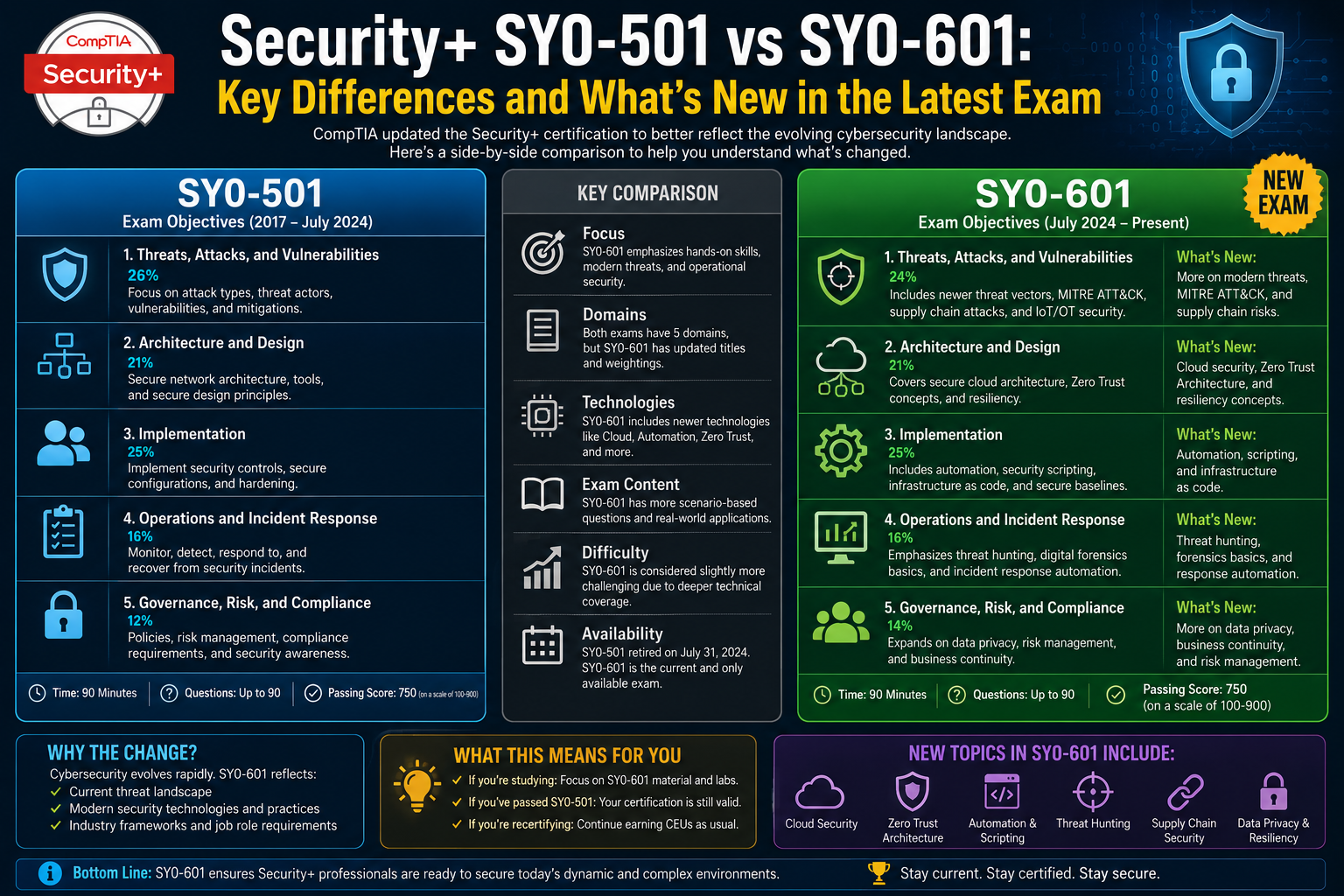
The shift from SY0-501 to SY0-601 represents a significant evolution in how cybersecurity skills are defined and evaluated. Rather than simply adding new content, the updated version refines the focus of the exam to better align with current industry needs.
SY0-501 was built around a traditional view of cybersecurity, with a strong emphasis on foundational concepts and established security practices. While still relevant, it did not fully reflect the rapid expansion of cloud computing, hybrid environments, and modern threat vectors that have become central to today’s IT ecosystems.
SY0-601 was introduced to address this gap. It shifts focus toward more practical, real-world scenarios and places greater emphasis on operational security, risk management, and emerging technologies. The goal is to ensure that certified professionals are not only knowledgeable but also capable of applying their skills in dynamic environments.
Increased Emphasis on Real-World Security Scenarios
A key shift in SY0-601 is its stronger focus on applied knowledge. Rather than relying heavily on theoretical concepts, the exam introduces more scenario-based understanding. This means candidates are expected to interpret situations and determine appropriate responses.
For example, understanding an attack is no longer limited to identifying its definition. Instead, candidates must be able to analyze how it might occur in a hybrid cloud environment, what systems it could affect, and how it should be mitigated in real time.
This approach better reflects actual job responsibilities. Security professionals rarely deal with isolated textbook problems. Instead, they face complex environments where multiple systems interact, and security decisions must be made quickly and accurately.
Expansion of Cloud and Hybrid Environment Coverage
One of the most significant updates in SY0-601 is the increased focus on cloud computing and hybrid infrastructures. Organizations today rarely rely on purely on-premises systems. Instead, they use combinations of cloud services, virtualized environments, and distributed networks.
This shift introduces new security challenges. Traditional perimeter-based security models are no longer sufficient. Instead, professionals must understand identity-based access control, cloud configuration security, and shared responsibility models.
SY0-601 reflects this reality by placing greater emphasis on securing cloud environments, understanding virtualization risks, and managing security across distributed systems. This makes the certification more aligned with modern IT infrastructure.
Growing Importance of Incident Response and Threat Detection
Incident response has become a central component of cybersecurity operations. Organizations must be able to detect, analyze, and respond to security incidents quickly to minimize damage.
SY0-601 places increased importance on these operational skills. Candidates are expected to understand how to identify indicators of compromise, analyze security events, and follow structured response procedures.
This shift highlights the importance of proactive security management. Instead of simply preventing attacks, professionals must also be capable of responding effectively when incidents occur. This reflects the reality that no system is completely immune to breaches.
Integration of Risk Management and Governance Concepts
Another important change in SY0-601 is the deeper integration of risk management and governance. Cybersecurity is no longer viewed purely as a technical discipline. It is now closely tied to business strategy, compliance requirements, and organizational risk tolerance.
Professionals are expected to understand how security decisions impact business operations. This includes evaluating risks, implementing controls, and ensuring compliance with relevant policies and standards.
By including governance and risk management as a core domain, SY0-601 reinforces the idea that cybersecurity is not just about technology but also about decision-making and accountability within organizations.
Changes in Depth and Complexity of Exam Content
Although SY0-601 reduces the number of domains compared to SY0-501, it increases the depth of coverage within each area. This means candidates are expected to have a more detailed understanding of fewer topics rather than a surface-level understanding of many topics.
The exam also introduces a greater number of examples and practical applications. This approach helps assess not just what candidates know, but how well they can apply that knowledge in different contexts.
As a result, preparation for SY0-601 requires a stronger focus on comprehension and analysis rather than memorization. Candidates must understand how different security concepts interact in real-world environments.
The Shift Toward a More Unified Security Skillset
One of the underlying goals of SY0-601 is to create a more unified view of cybersecurity skills. Instead of separating knowledge into isolated categories, the exam encourages an integrated understanding of security architecture, operations, and governance.
This reflects how modern security teams operate in practice. Security professionals often work across multiple domains, collaborating with different teams to ensure overall system protection. The ability to connect concepts across domains is therefore essential.
By redesigning the exam structure, SY0-601 encourages candidates to think more holistically about security challenges and solutions.
Expanding Role Expectations for Security Professionals
The changes in SY0-601 also reflect evolving expectations for security professionals in the workplace. Modern security roles require a combination of technical knowledge, analytical thinking, and operational awareness.
Professionals are expected to not only identify threats but also understand system architecture, evaluate risk, and implement appropriate controls. This requires a broader skillset than earlier versions of the exam emphasized.
As organizations continue to adopt complex IT environments, the need for adaptable and well-rounded security professionals continues to grow. SY0-601 aligns with this trend by emphasizing practical, multi-domain knowledge.
Preparing for the Shift in Cybersecurity Mindset
The transition from SY0-501 to SY0-601 is not just a change in exam content. It represents a broader shift in how cybersecurity is understood and practiced.
Earlier approaches focused heavily on static knowledge and predefined threats. Modern cybersecurity, however, requires adaptability, continuous learning, and the ability to respond to unknown or evolving risks.
SY0-601 reflects this mindset by emphasizing scenario-based understanding, operational readiness, and integrated security thinking. This makes it more relevant to today’s dynamic digital environments.
A Shift Toward Domain-Based Cybersecurity Mastery
The transition to SY0-601 introduced a more structured and refined domain model that reflects how cybersecurity is practiced in real environments. Instead of treating security as a collection of unrelated topics, the updated exam organizes knowledge into interconnected domains that mirror the workflow of security professionals.
This change is significant because cybersecurity is no longer a fragmented discipline. Modern professionals must understand how threats, infrastructure, operations, governance, and implementation all interact within a single ecosystem. SY0-601 reflects this reality by reducing the number of domains while increasing their depth and practical relevance.
Each domain is designed to test not only theoretical knowledge but also decision-making ability in realistic scenarios. This shift marks a move away from memorization and toward applied understanding.
Attacks, Threats, and Vulnerabilities: Understanding the Modern Threat Landscape
One of the most critical domains in SY0-601 focuses on identifying and analyzing attacks, threats, and vulnerabilities. This domain reflects the reality that cybersecurity begins with understanding what you are defending against.
Modern threat landscapes are highly diverse. Attackers use a combination of technical exploits, social engineering tactics, and automated tools to gain unauthorized access to systems. This domain ensures that candidates understand both the technical and human elements of cyber threats.
A key aspect of this domain is the identification of social engineering techniques. These include methods that manipulate human behavior rather than exploiting technical weaknesses. Attackers often rely on psychological manipulation because it is easier to trick users than to break strong encryption systems.
Candidates are expected to recognize how different attack vectors operate. These include malware infections, phishing campaigns, denial-of-service attacks, credential harvesting, and advanced persistent threats. Each of these techniques can be deployed individually or combined as part of larger attack strategies.
The domain also emphasizes understanding vulnerabilities across different environments. This includes traditional systems, cloud platforms, mobile devices, and application layers. Vulnerabilities can arise from misconfigurations, outdated software, weak authentication systems, or insecure APIs.
A major evolution in SY0-601 is the inclusion of emerging threat types. These include cloud-specific attacks, adversarial artificial intelligence techniques, and API exploitation methods. These additions reflect how modern infrastructure has expanded beyond traditional network boundaries.
Architecture and Design: Building Secure Systems from the Ground Up
The Architecture and Design domain focuses on how secure systems are structured and implemented. This is one of the most strategically important areas in cybersecurity because strong architecture reduces the likelihood of successful attacks.
In SY0-601, candidates are expected to understand how security principles are applied during system design. This includes concepts such as segmentation, redundancy, secure configuration, and defense-in-depth strategies.
Modern IT environments are highly distributed, often combining on-premises infrastructure with cloud services. This hybrid nature requires careful architectural planning to ensure consistent security across all components.
Security professionals must also understand how data flows through systems. Improperly managed data flows can create vulnerabilities that attackers exploit to move laterally within networks or access sensitive information.
Another important aspect of this domain is secure system design principles. These include least privilege access, zero trust architecture, and secure default configurations. These principles are essential for reducing attack surfaces and limiting potential damage from breaches.
Virtualization and containerization are also key components of modern architecture. SY0-601 places increased emphasis on understanding how virtual machines and container environments introduce both benefits and risks. While these technologies improve efficiency, they also require careful security management to prevent isolation failures or misconfigurations.
Implementation: Applying Security Controls in Real Environments
The Implementation domain focuses on how security solutions are deployed and configured in real-world environments. This is one of the most practical areas of the exam because it directly relates to daily security operations.
Security professionals must understand how to implement controls such as firewalls, intrusion detection systems, encryption mechanisms, and identity management systems. Each of these tools plays a specific role in protecting systems and data.
In SY0-601, implementation is not limited to basic configuration. Candidates must understand how different controls interact and how they can be optimized for specific environments. For example, implementing encryption is not just about enabling a feature but also about selecting appropriate algorithms and managing keys securely.
Identity and access management is a major focus within this domain. Proper authentication and authorization mechanisms are critical for preventing unauthorized access. This includes multi-factor authentication, role-based access control, and secure credential storage.
Wireless security is also an important component. As organizations increasingly rely on wireless networks, securing these connections becomes essential. Candidates must understand encryption protocols, secure configuration practices, and potential vulnerabilities in wireless systems.
Cloud implementation is another key area. Security professionals must know how to configure cloud services securely, manage access permissions, and monitor cloud environments for suspicious activity. This reflects the growing importance of cloud infrastructure in modern IT systems.
Operations and Incident Response: Managing Security in Action
The Operations and Incident Response domain focuses on the ongoing management of security systems and the handling of security incidents when they occur. This is one of the most dynamic areas of cybersecurity because it deals with real-time threats and responses.
Security operations involve continuous monitoring of systems to detect unusual activity. This requires familiarity with logging systems, monitoring tools, and alerting mechanisms. Professionals must be able to interpret security events and distinguish between normal behavior and potential threats.
Incident response is a structured process that includes preparation, detection, containment, eradication, recovery, and post-incident analysis. SY0-601 emphasizes the importance of following this structured approach to minimize damage and restore normal operations efficiently.
Candidates must understand how to identify indicators of compromise. These indicators help detect when a system has been breached or is under attack. Early detection is critical for reducing the impact of security incidents.
Forensics is also an important aspect of this domain. Security professionals may need to analyze compromised systems to determine how an attack occurred, what data was affected, and how to prevent future incidents. This requires careful evidence collection and analysis techniques.
Automation plays an increasing role in incident response. Many organizations now use automated tools to detect and respond to threats more quickly. SY0-601 reflects this trend by incorporating concepts related to automated security operations and orchestration.
Governance, Risk, and Compliance: Aligning Security with Business Objectives
The Governance, Risk, and Compliance domain highlights the strategic side of cybersecurity. It focuses on how security aligns with organizational policies, legal requirements, and risk management frameworks.
Governance involves defining security policies and ensuring that they are consistently applied across the organization. This includes establishing roles, responsibilities, and procedures for managing security.
Risk management is a critical component of this domain. Security professionals must be able to identify risks, evaluate their potential impact, and implement controls to mitigate them. Risk is not eliminated but managed within acceptable levels defined by the organization.
Compliance refers to adherence to laws, regulations, and industry standards. Organizations must comply with various requirements depending on their industry and location. Failure to comply can result in legal penalties and reputational damage.
SY0-601 emphasizes the importance of understanding how security decisions impact business operations. Security is not isolated from business strategy; it is integrated into decision-making processes.
How SY0-601 Changes the Way Security Is Understood
One of the most important shifts introduced by SY0-601 is the move toward integrated thinking. Instead of viewing security as separate technical topics, candidates are encouraged to understand how different domains interact.
For example, implementing a security control is not just a technical task. It also involves understanding architectural design, operational impact, and compliance requirements. This interconnected approach reflects real-world cybersecurity challenges.
This integration helps prepare candidates for roles that require cross-functional knowledge. Security professionals often work with networking teams, developers, system administrators, and business leaders. Understanding how all these areas connect is essential for effective security management.
Increased Focus on Hybrid and Cloud Environments
Modern organizations rarely rely on a single infrastructure model. Instead, they operate across hybrid environments that combine cloud services, on-premises systems, and remote access technologies.
SY0-601 reflects this shift by placing greater emphasis on cloud security and hybrid architecture management. Candidates must understand how security controls operate in distributed environments and how data moves across different platforms.
This includes understanding shared responsibility models, where security responsibilities are divided between service providers and customers. Misunderstanding these responsibilities can lead to security gaps.
The Role of Automation in Modern Security Operations
Automation has become a key component of cybersecurity operations. As organizations deal with increasing volumes of security data, manual analysis is no longer sufficient.
SY0-601 introduces concepts related to automated threat detection, response orchestration, and security monitoring tools. Automation helps reduce response times and improve accuracy in identifying threats.
However, automation also introduces new challenges. Security professionals must ensure that automated systems are properly configured and do not generate false positives or overlook critical threats.
Expanding Expectations for Security Professionals
The updated exam reflects evolving expectations for cybersecurity professionals. It is no longer enough to understand isolated technical concepts. Professionals must be able to apply knowledge across multiple domains and adapt to changing environments.
This includes understanding business requirements, managing risk, implementing technical controls, and responding to incidents effectively. The role of a security professional is increasingly multidisciplinary.
SY0-601 prepares candidates for this reality by emphasizing practical application over theoretical knowledge. It encourages a mindset of continuous learning and adaptation.
Practical Thinking Over Memorization
One of the defining characteristics of SY0-601 is its focus on practical thinking. Candidates are expected to analyze scenarios, evaluate options, and choose appropriate responses based on context.
This approach reflects real-world cybersecurity work, where decisions must be made quickly and based on incomplete information. Memorizing definitions is not enough; professionals must understand how concepts apply in dynamic situations.
This shift makes preparation more challenging but also more valuable. It ensures that certified individuals are better prepared for real job responsibilities.
Strengthening the Foundation for Advanced Cybersecurity Roles
SY0-601 is designed not only as a certification but also as a foundation for advanced cybersecurity roles. It builds the core knowledge required for positions such as security analyst, security administrator, and junior security engineer.
By covering a broad range of domains in depth, the certification prepares professionals for specialization in areas such as penetration testing, cloud security, or incident response.
The structured knowledge gained through SY0-601 serves as a stepping stone for more advanced learning and career development in cybersecurity.
Understanding the Practical Impact of the SY0-501 to SY0-601 Transition
The transition from SY0-501 to SY0-601 is not simply an administrative update in certification numbering. It represents a shift in how cybersecurity competency is measured and applied in real professional environments. While both versions aim to validate foundational security knowledge, the newer exam reflects a more modern interpretation of what security professionals actually do in today’s organizations.
SY0-501 was more aligned with traditional IT security structures, where systems were largely on-premises and security roles were more clearly segmented. Professionals often focus on specific areas such as network security, endpoint protection, or basic incident handling. The exam reflected this separation of responsibilities.
SY0-601, however, aligns with a more integrated and fluid security landscape. Professionals are now expected to understand how different systems interact across cloud platforms, hybrid infrastructures, and remote environments. Security is no longer confined to a single department or function. Instead, it is embedded across all layers of IT operations.
This transition has a direct impact on how candidates prepare, how organizations evaluate talent, and how professionals plan their careers. Understanding this shift is essential for anyone entering or progressing within cybersecurity.
How the New Exam Reflects Real Industry Expectations
Modern cybersecurity roles demand adaptability. Organizations no longer operate in static environments, and threats no longer follow predictable patterns. As a result, SY0-601 emphasizes situational understanding rather than isolated knowledge.
In real workplaces, security professionals are expected to respond to evolving threats, interpret complex system behavior, and make decisions based on incomplete or rapidly changing information. The updated exam reflects this reality by focusing on applied knowledge and scenario-based thinking.
For example, instead of simply identifying what a specific type of attack is, candidates are expected to understand how that attack might manifest in a cloud environment, how it could spread across hybrid systems, and what mitigation strategies would be most effective in that specific context.
This shift ensures that certified individuals are better prepared for actual job responsibilities rather than just theoretical exam conditions.
Changing Nature of Exam Difficulty and Cognitive Demand
One of the most noticeable differences between SY0-501 and SY0-601 is the increase in cognitive complexity. While the total number of domains has been reduced, the depth and integration of topics have increased significantly.
SY0-601 requires candidates to think across multiple domains simultaneously. A single scenario may involve elements of architecture design, threat analysis, incident response, and compliance considerations all at once. This requires a more holistic understanding of cybersecurity principles.
Rather than focusing on memorizing definitions or isolated facts, candidates must develop analytical reasoning skills. They must evaluate situations, identify risks, and determine appropriate responses based on context.
This makes SY0-601 more challenging for candidates who rely heavily on rote memorization. However, it also makes the certification more valuable in professional environments where decision-making and critical thinking are essential.
The Importance of Structured Preparation in SY0-601 Success
Preparing for SY0-601 requires a strategic and structured approach. Because the exam emphasizes applied knowledge, preparation must go beyond reading material and focus on understanding how concepts interact in real environments.
A strong preparation strategy begins with understanding the exam domains in depth. Each domain represents a different aspect of cybersecurity practice, and candidates must be comfortable moving between technical, operational, and governance-related topics.
Instead of studying topics in isolation, effective preparation involves connecting concepts. For example, understanding how a security control implemented in the architecture domain impacts incident response procedures or compliance requirements.
This interconnected approach helps candidates develop the type of thinking required for scenario-based questions.
Building Conceptual Understanding Instead of Memorization
One of the most important changes in preparation strategy for SY0-601 is the shift away from memorization. While basic terminology is still important, success in the exam depends more on conceptual understanding.
Candidates must understand why security principles exist and how they are applied in different environments. For example, understanding the principle of least privilege is not just about defining it but also about knowing how it affects system design, access management, and operational workflows.
This deeper understanding allows candidates to adapt their knowledge to different scenarios rather than relying on fixed answers.
Conceptual learning also improves long-term retention. Security professionals often encounter unfamiliar situations in real work environments. Those who understand underlying principles are better equipped to adapt and respond effectively.
Scenario-Based Thinking as a Core Skill Requirement
SY0-601 places strong emphasis on scenario-based evaluation. This means candidates must analyze descriptions of real-world situations and determine appropriate actions based on context.
These scenarios often include multiple variables, such as system type, threat behavior, organizational constraints, and compliance requirements. Candidates must evaluate all these factors before selecting or recommending solutions.
This type of thinking closely mirrors real cybersecurity work. Security professionals rarely deal with isolated problems. Instead, they must consider how different systems, users, and processes interact.
Developing scenario-based thinking requires practice and exposure to diverse examples. It also requires the ability to eliminate incorrect options based on logical reasoning rather than guesswork.
Adapting to the Broader Scope of Cloud and Hybrid Systems
One of the most significant changes in SY0-601 is the increased focus on cloud and hybrid environments. This reflects the widespread adoption of cloud services across industries.
In traditional IT environments, security was often centered around physical infrastructure and internal networks. However, in modern environments, data and applications are distributed across multiple platforms and service providers.
This introduces new security challenges. Professionals must understand how to secure data in transit, manage identity across platforms, and ensure consistent security policies across hybrid systems.
SY0-601 reflects these challenges by requiring knowledge of cloud architecture, shared responsibility models, and cloud-specific security risks.
Understanding these concepts is essential not only for passing the exam but also for performing effectively in modern IT roles.
The Role of Incident Response in Professional Readiness
Incident response is a critical skill in cybersecurity operations. SY0-601 places significant emphasis on the ability to detect, respond to, and recover from security incidents.
In real-world environments, incidents can range from minor anomalies to full-scale breaches. Security professionals must be able to assess the severity of an incident quickly and take appropriate action.
This includes identifying indicators of compromise, isolating affected systems, preserving evidence, and coordinating recovery efforts.
The updated exam reflects this reality by integrating incident response into multiple domains rather than treating it as a standalone topic. This reinforces the idea that incident response is not an isolated activity but part of a broader security lifecycle.
Risk Awareness and Decision-Making in Security Operations
Risk management plays an increasingly important role in cybersecurity decision-making. Organizations must constantly balance security requirements with operational efficiency and business objectives.
SY0-601 emphasizes the importance of understanding risk in context. This means evaluating not only technical vulnerabilities but also business impact, likelihood of exploitation, and potential consequences.
Security professionals must be able to prioritize risks and recommend appropriate mitigation strategies based on organizational needs.
This requires both technical understanding and business awareness. A purely technical solution may not always be feasible if it disrupts business operations or exceeds resource constraints.
How SY0-601 Aligns with Modern Job Roles
The structure of SY0-601 aligns closely with modern cybersecurity job roles. Security analysts, administrators, and junior engineers are expected to perform a wide range of tasks that span multiple domains.
For example, a security analyst may need to monitor systems, investigate alerts, analyze logs, respond to incidents, and report findings to management. Each of these tasks requires knowledge from different areas of the exam.
By integrating these domains, SY0-601 prepares candidates for the multifaceted nature of cybersecurity roles.
This alignment also improves employability. Employers value candidates who can adapt to different responsibilities and contribute to multiple aspects of security operations.
Transition Strategy for Candidates Moving from SY0-501 Knowledge
Candidates who previously studied SY0-501 content may find that much of their foundational knowledge remains relevant. However, the way this knowledge is applied has changed significantly.
The transition strategy involves updating understanding rather than starting from scratch. Core security principles such as authentication, encryption, risk management, and network security remain important, but their application has evolved.
For example, encryption is no longer viewed only in the context of data protection on local systems. It must now be understood in cloud storage, distributed systems, and communication across hybrid environments.
Similarly, network security concepts must now include virtual networks, cloud segmentation, and software-defined infrastructure.
Updating this perspective is essential for aligning with SY0-601 expectations.
Expanding Analytical Skills for Security Problem Solving
SY0-601 requires strong analytical skills. Candidates must be able to break down complex scenarios into manageable components, identify key issues, and determine appropriate solutions.
This involves understanding relationships between different systems and recognizing how a change in one area can impact others.
Analytical thinking also helps in troubleshooting security issues. Instead of reacting to symptoms, professionals must identify root causes and implement long-term solutions.
Developing these skills requires practice and exposure to diverse security scenarios.
Career Growth Opportunities After SY0-601 Certification
Completing SY0-601 certification opens the door to a wide range of cybersecurity roles. These include entry-level positions such as security analyst, security administrator, and IT security specialist.
The certification also serves as a foundation for more advanced roles in penetration testing, cloud security, and security engineering.
Because SY0-601 focuses on practical skills, it helps professionals transition more easily into real-world environments.
Employers value candidates who can demonstrate not only knowledge but also the ability to apply that knowledge effectively in operational settings.
Long-Term Value of SY0-601 in a Changing Industry
Cybersecurity continues to evolve rapidly, and certifications must evolve alongside it. SY0-601 represents a step toward more adaptive and practical skill validation.
Its focus on integrated knowledge, scenario-based thinking, and real-world application ensures that certified professionals remain relevant in modern IT environments.
As organizations continue to adopt cloud technologies, automation, and distributed systems, the skills validated by SY0-601 will remain highly relevant.
This long-term alignment with industry needs makes the certification a strong foundation for ongoing career development in cybersecurity.
Practical Challenges Candidates Face When Moving to SY0-601
One of the less discussed aspects of transitioning to SY0-601 is the adjustment candidates must make in how they interpret exam questions. Many learners who were comfortable with SY0-501 content initially find SY0-601 more demanding, not because the topics are entirely new, but because the framing of questions is more complex and situational.
Instead of asking direct factual questions, SY0-601 often presents layered scenarios where multiple security issues exist simultaneously. This requires careful reading and the ability to identify the most relevant issue among several distractions. Candidates who rush through questions or rely on keyword spotting often struggle in this format.
Another challenge is the increased expectation of judgment-based answers. There is rarely a single obvious solution. Instead, candidates must evaluate trade-offs between security strength, usability, cost, and operational impact. This reflects real-world cybersecurity decisions but can feel unfamiliar in an exam environment.
Importance of Hands-On Exposure in Security Learning
A major advantage for SY0-601 candidates is hands-on exposure to security tools and environments. While theoretical understanding is important, practical familiarity significantly improves comprehension of exam concepts.
Working with simulated environments, even at a basic level, helps reinforce how security controls behave in real systems. For example, understanding how firewall rules affect traffic flow becomes much clearer when observed in a live or virtual environment rather than only reading about it.
Similarly, interacting with identity management systems, log analysis tools, and network monitoring dashboards helps candidates connect abstract concepts to real operational workflows. This type of exposure reduces confusion during scenario-based questions.
Even without enterprise-level access, lab environments and practice simulations can help bridge the gap between theory and application. The more familiar a candidate becomes with system behavior, the easier it becomes to interpret exam scenarios accurately.
Common Misconceptions About the SY0-601 Exam
A frequent misconception is that SY0-601 is simply a harder version of SY0-501 with more content. In reality, the difference is not just difficulty but direction. SY0-601 is structured to reflect modern cybersecurity workflows rather than expanding traditional exam topics.
Another misconception is that memorizing definitions is sufficient for success. While terminology remains important, the exam increasingly prioritizes interpretation and application. Candidates who rely solely on memorization often find themselves unprepared for scenario-based reasoning.
Some also assume that cloud and hybrid topics are optional or secondary. In SY0-601, these are central components of the exam structure. Ignoring them can create significant knowledge gaps that affect performance across multiple domains.
Understanding these misconceptions early helps candidates adjust their preparation strategy and avoid ineffective study habits.
Performance-Based Questions and Their Role in Evaluation
Performance-based questions (PBQs) are a critical part of SY0-601 and are designed to test applied skills in simulated environments. These questions go beyond traditional multiple-choice formats and require candidates to perform tasks such as configuring settings, analyzing logs, or identifying vulnerabilities in a scenario.
The purpose of PBQs is to assess how well candidates can apply knowledge in practical situations. This reflects real cybersecurity work, where professionals must actively interact with systems rather than simply recall information.
These questions often require multi-step reasoning. A candidate may need to interpret a scenario, identify the problem, and then take appropriate action within a simulated interface. This makes time management an important factor during the exam.
Because PBQs can appear more complex, they are often placed at the beginning of the exam. However, candidates are allowed to skip and return to them later, which can be a useful strategy for managing exam pressure.
Developing a Security Mindset for SY0-601 Success
One of the most important shifts required for SY0-601 is the development of a security-first mindset. This means thinking like a defender rather than simply a learner of concepts.
A security mindset involves constantly evaluating systems for potential weaknesses, considering how attackers might exploit them, and understanding how different layers of defense interact. This type of thinking becomes essential when answering scenario-based questions.
Instead of focusing only on what is explicitly stated in a question, candidates must also consider what is implied. For example, a system described as “slow or unresponsive” may indicate a denial-of-service condition, even if not directly mentioned.
Developing this mindset takes time and exposure. It involves practicing critical thinking, analyzing different attack scenarios, and understanding how security failures occur in real environments.
How SY0-601 Reflects the Future of Cybersecurity Roles
SY0-601 is not just an exam update; it reflects broader changes in the cybersecurity industry. Roles are becoming more integrated, with professionals expected to understand multiple areas of security rather than specializing narrowly at the entry level.
Modern security teams often work collaboratively across architecture, operations, and compliance functions. This means professionals must understand how their decisions affect other parts of the system.
For example, a change in access control policy may impact user productivity, compliance requirements, and incident response procedures. SY0-601 reflects this interconnected reality by encouraging cross-domain understanding.
As organizations continue to adopt advanced technologies such as automation, artificial intelligence, and distributed cloud systems, the need for adaptable security professionals will continue to grow. SY0-601 helps prepare candidates for this evolving landscape.
Conclusion
The transition from SY0-501 to SY0-601 represents more than a routine certification update; it reflects the broader transformation of cybersecurity itself. As organizations shift toward cloud-first strategies, hybrid infrastructures, and highly interconnected systems, the expectations placed on security professionals have evolved significantly. The newer exam is designed to align with these realities by emphasizing applied knowledge, scenario-based thinking, and a more integrated understanding of security domains.
Unlike earlier approaches that focused heavily on memorization and isolated concepts, SY0-601 requires candidates to think holistically. Security is no longer a single function but a continuous process that spans architecture, implementation, operations, and governance. This interconnected structure ensures that certified professionals are better prepared to handle real-world challenges where multiple factors influence decision-making.
The updated exam also highlights the growing importance of adaptability. Cyber threats are constantly changing, and professionals must be able to respond to new attack methods, technologies, and operational environments. SY0-601 reinforces this need by encouraging analytical thinking and practical problem-solving skills rather than relying solely on theoretical knowledge.
Ultimately, the value of SY0-601 lies in its alignment with modern cybersecurity roles. It prepares individuals not just to pass an exam, but to contribute effectively in dynamic security environments. For those entering the field or advancing their careers, it serves as a strong foundation for long-term professional growth in an industry that continues to evolve at a rapid pace.