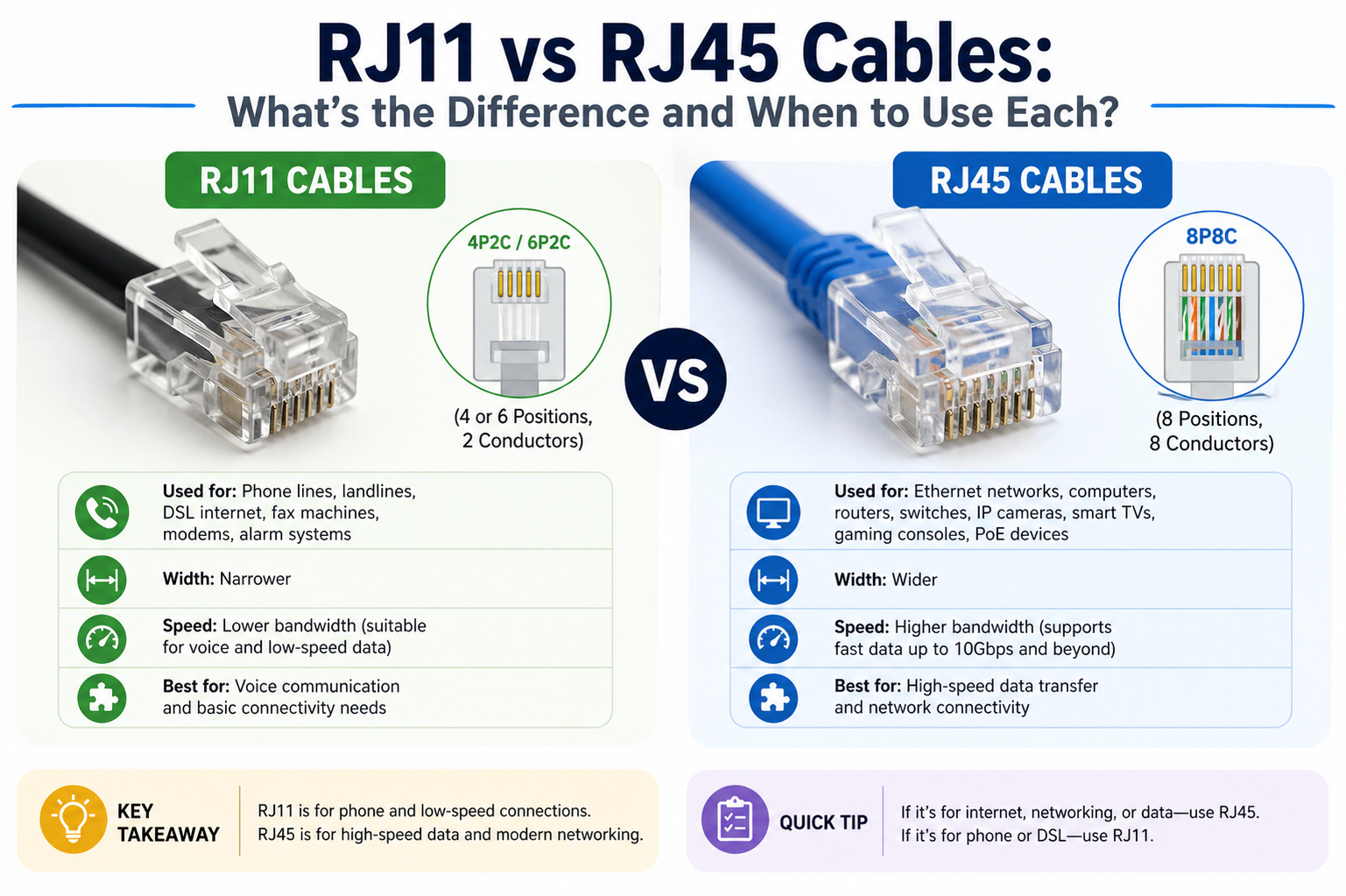
RJ11 and RJ45 connectors are among the most commonly used communication interfaces in networking and telecommunication systems, yet they are often misunderstood due to their similar appearance. At a glance, both connectors look alike because they share a modular plug design with transparent plastic housing and visible metal contacts. However, their internal structure, purpose, and performance capabilities are very different. RJ11 is primarily designed for analog communication, especially traditional telephone systems, while RJ45 is built for digital data transmission in modern computer networks. Understanding the difference between these two connectors is essential for anyone working with networking hardware, studying IT certifications, or simply trying to set up home or office communication systems correctly.
Basic Definition and Core Purpose
RJ11, short for Registered Jack-11, is a standardized connector used mainly for telephone lines. Its primary function is to transmit analog voice signals over copper wires, making it a staple in landline communication systems. On the other hand, RJ45, or Registered Jack-45, is a connector used in Ethernet networking to transmit digital data. While RJ11 is associated with voice communication, RJ45 is tied to internet connectivity and local area networks. The key distinction lies in the type of data each carries—RJ11 handles analog signals, whereas RJ45 handles digital signals. This fundamental difference defines their roles in communication infrastructure and explains why they are not interchangeable in most cases.
Physical Appearance and Structural Differences
Although RJ11 and RJ45 connectors may look similar at first glance, a closer inspection reveals clear physical differences. RJ11 connectors are smaller and typically contain four or six contact pins, though usually only two or four are actively used. In contrast, RJ45 connectors are larger and feature eight pins, all of which are used in Ethernet communication. The extra pins in RJ45 allow for more complex data transmission, including higher speeds and better signal integrity. Because of these differences, an RJ45 connector will not fit into an RJ11 port, while an RJ11 plug may loosely fit into an RJ45 socket but will not function properly and may even cause damage in some cases.
Understanding Analog Communication in RJ11
Analog communication, which is the foundation of RJ11 functionality, involves transmitting continuous electrical signals that represent sound waves. When a person speaks into a telephone, the microphone converts the sound waves into electrical signals that mirror the frequency and amplitude of the voice. These signals travel through copper wires connected via RJ11 connectors to reach the receiving end, where they are converted back into audible sound. This process is simple and effective for voice communication but lacks the efficiency and speed required for modern data transmission. Analog signals are also more susceptible to noise and interference, which can degrade call quality over long distances.
Digital Communication and the Role of RJ45
RJ45 connectors are designed to support digital communication, which involves transmitting data in binary form—ones and zeros. Unlike analog signals, digital signals are discrete and can be easily processed, stored, and transmitted with minimal loss of quality. In Ethernet networks, RJ45 connectors link devices such as computers, routers, and switches using twisted-pair cables like Cat5e or Cat6. These cables carry data packets that represent everything from web pages to video streams. The digital nature of RJ45 communication allows for high-speed data transfer, improved reliability, and better resistance to interference, making it the standard for modern networking environments.
Historical Context and Evolution
The development of RJ11 and RJ45 connectors reflects the evolution of communication technology over time. RJ11 became widely adopted during the era when landline telephones were the primary means of communication. It was simple, cost-effective, and perfectly suited for voice transmission. As technology advanced and the need for faster data communication grew, RJ45 connectors emerged as part of Ethernet networking standards. They enabled the creation of local area networks and eventually supported global internet connectivity. While RJ11 still exists today, its usage has significantly declined as digital communication methods have taken over. RJ45, however, continues to evolve alongside networking technologies, supporting higher speeds and more advanced applications.
Applications of RJ11 in Modern Use
Despite being considered outdated in many contexts, RJ11 connectors are still used in certain applications. Traditional landline telephones rely on RJ11 connections, especially in regions where digital infrastructure is limited or where landlines are still preferred for reliability. Fax machines also commonly use RJ11 connectors, although many modern devices have transitioned to digital alternatives. Additionally, some DSL internet connections use RJ11 ports to deliver internet through telephone lines. However, this method is much slower compared to fiber or cable internet and is gradually being phased out in favor of more advanced technologies.
Applications of RJ45 in Networking
RJ45 connectors are essential in today’s digital world, forming the backbone of Ethernet networking. They are used to connect a wide range of devices, including computers, routers, switches, printers, and gaming consoles. In both residential and commercial environments, RJ45 cables provide stable and high-speed internet connections. They are also used in structured cabling systems within buildings, enabling efficient data distribution across multiple devices. Furthermore, RJ45 connectors support technologies like Power over Ethernet (PoE), which allows electrical power to be transmitted alongside data, powering devices such as IP cameras and wireless access points without the need for separate power cables.
Internal Wiring and Signal Transmission
The internal wiring of RJ11 and RJ45 connectors further highlights their differences. RJ11 cables typically consist of one or two twisted pairs of copper wires, which are sufficient for voice communication. RJ45 cables, however, contain four twisted pairs, totaling eight wires. These pairs are carefully arranged and color-coded to reduce electromagnetic interference and ensure accurate data transmission. The twisting of wires helps maintain signal integrity by minimizing crosstalk and external noise. This design is crucial for maintaining high-speed data transfer in Ethernet networks, where even minor interference can impact performance.
Compatibility and Misuse Considerations
One common misconception is that RJ11 and RJ45 connectors can be used interchangeably due to their similar appearance. In reality, they serve different purposes and are not designed to work together. Attempting to use an RJ11 connector in an RJ45 port may result in poor connectivity or potential hardware damage. Similarly, RJ45 connectors cannot be used in RJ11 ports due to their larger size. It is important to use the correct connector for the intended application to ensure proper functionality and avoid unnecessary issues. Understanding these compatibility limitations is especially important for technicians and individuals setting up communication systems.
Relevance in IT Certifications and Practical Knowledge
RJ11 and RJ45 connectors are frequently covered in IT certification exams because they represent fundamental concepts in networking and telecommunications. Knowing the differences between analog and digital communication, as well as understanding how these connectors function, is essential for building a strong foundation in IT. Beyond exams, this knowledge is also valuable in real-world scenarios, such as troubleshooting connectivity issues, installing network infrastructure, or upgrading communication systems. As technology continues to evolve, RJ45 remains highly relevant, while RJ11 serves as a reminder of the earlier days of communication technology.
Signal Transmission Mechanisms in RJ11 and RJ45
The way RJ11 and RJ45 connectors transmit signals reflects the broader divide between analog and digital communication systems. RJ11 operates using continuous electrical waveforms that directly represent sound. These signals fluctuate smoothly, carrying variations in pitch, tone, and volume. Because the signal is continuous, any interference or noise along the line can distort the waveform, which is why older telephone systems sometimes produce static or unclear audio. RJ45, in contrast, transmits discrete digital signals. These signals are encoded as electrical pulses representing binary values, which can be interpreted accurately even if minor noise is present. This makes RJ45 far more reliable for transmitting complex data such as files, videos, and real-time communication streams across networks.
Role of Twisted Pair Cabling in Both Connectors
Both RJ11 and RJ45 connectors rely on twisted pair copper wiring, but the complexity and purpose of these wires differ significantly. In RJ11 cables, the twisted pair is relatively simple, usually consisting of one or two pairs of wires. The twisting helps reduce electromagnetic interference, ensuring that analog voice signals remain as clear as possible during transmission. RJ45 cables, however, use four twisted pairs, each carefully engineered to handle high-frequency digital signals. The twisting pattern in RJ45 cables is more precise and varies between pairs to minimize crosstalk, which is interference caused by adjacent wires. This design enables Ethernet cables to support high-speed data transmission over longer distances without significant signal degradation.
Pin Configuration and Contact Points
A crucial technical difference between RJ11 and RJ45 connectors lies in their pin configuration. RJ11 connectors typically use either two or four pins, depending on the application. These pins are sufficient for basic voice communication because only a limited number of channels are needed. RJ45 connectors, on the other hand, feature eight pins, each corresponding to one wire in the four twisted pairs inside the cable. This expanded pin configuration allows for simultaneous transmission and reception of data, increasing both speed and efficiency. The precise arrangement of these pins follows standardized wiring schemes, ensuring compatibility across networking devices and systems.
Wiring Standards in RJ45 Connectors
RJ45 connectors follow specific wiring standards that determine how the internal wires are arranged. The two most common standards are T568A and T568B. These standards define the order of colored wires within the connector, ensuring consistent communication between devices. While both standards achieve the same result, it is important to use the same configuration on both ends of a cable to maintain proper connectivity. Incorrect wiring can lead to network issues or complete failure of communication. RJ11 connectors, by comparison, do not require such complex standards due to their simpler design and limited functionality.
Data Speed and Bandwidth Capabilities
One of the most significant differences between RJ11 and RJ45 connectors is their ability to handle data speed and bandwidth. RJ11 connectors are limited to low-speed transmission, making them suitable only for voice communication and basic DSL internet connections. Their design does not support the high-frequency signals required for modern data applications. RJ45 connectors, however, are capable of supporting a wide range of speeds, from basic Ethernet connections to gigabit and even multi-gigabit networks. This makes them ideal for handling large volumes of data, including streaming media, online gaming, and cloud-based applications. The superior bandwidth capacity of RJ45 is a key reason why it has become the standard in networking.
Use in DSL Internet Connections
RJ11 connectors have played an important role in the development of early internet technologies, particularly DSL connections. DSL allows internet data to be transmitted over existing telephone lines, enabling users to access the internet without requiring entirely new infrastructure. In this setup, RJ11 connectors link the telephone line to a DSL modem, which then converts the analog signal into digital data for use by computers. While this was a revolutionary advancement at the time, DSL speeds are relatively slow compared to modern broadband options. As a result, RJ11-based internet connections are now considered outdated in most urban environments, though they may still be used in remote areas where newer technologies are not available.
Ethernet Networking and RJ45 Dominance
RJ45 connectors are the foundation of Ethernet networking, which is the most widely used method for connecting devices in a local area network. Ethernet cables equipped with RJ45 connectors enable devices to communicate with each other and access shared resources such as printers, servers, and internet connections. These connectors are used in both home and enterprise environments, supporting everything from simple network setups to complex data centers. The reliability and speed of RJ45 connections make them essential for modern communication, and they continue to evolve alongside advancements in networking technology.
Impact of Interference and Signal Quality
Signal quality is a critical factor in any communication system, and RJ11 and RJ45 connectors handle interference in different ways. RJ11 connections, due to their analog nature, are more vulnerable to interference from external sources such as electrical devices and environmental noise. This can result in degraded audio quality or dropped connections. RJ45 connections, however, are designed to minimize interference through the use of twisted pair wiring and shielding techniques. Digital signals are also more resilient, as they can be corrected or retransmitted if errors occur. This makes RJ45 connections more stable and reliable, especially in environments with high levels of electromagnetic activity.
Installation and Crimping Process
The installation process for RJ11 and RJ45 connectors involves attaching the connector to the end of a cable using a crimping tool. While the basic concept is similar, the complexity differs between the two. RJ11 connectors are relatively easy to install due to their simpler wiring and fewer pins. This makes them suitable for basic telecommunication setups. RJ45 connectors require more precision, as each of the eight wires must be correctly aligned according to the chosen wiring standard before crimping. Improper installation can lead to connectivity issues or reduced performance. As a result, working with RJ45 connectors often requires more skill and attention to detail.
Use in Residential and Commercial Environments
In residential settings, RJ11 connectors are mostly found in older homes with traditional telephone systems. They may also be present in DSL setups, though these are becoming less common. RJ45 connectors, on the other hand, are widely used in both homes and offices for internet connectivity. Modern buildings often include structured cabling systems with RJ45 wall ports, allowing for easy connection of devices to the network. In commercial environments, RJ45 connectors are essential for supporting large-scale networks, enabling efficient communication and data transfer across multiple departments and systems.
Transition from Analog to Digital Communication
The shift from RJ11 to RJ45 reflects a broader transition from analog to digital communication technologies. As the demand for faster and more reliable data transmission grew, digital systems became the preferred choice. RJ45 connectors, with their ability to handle high-speed data and support advanced networking features, became the standard for modern communication. RJ11 connectors, while still functional, are now largely limited to legacy systems. This transition highlights the rapid pace of technological advancement and the need for communication infrastructure to evolve accordingly.
Device Compatibility and Ecosystem Differences
RJ11 and RJ45 connectors exist in entirely different technological ecosystems, which is why their compatibility with devices varies so widely. RJ11 is closely tied to legacy telecommunication systems, meaning it is primarily found in devices that rely on analog communication. These include traditional landline telephones, older fax machines, and some alarm systems that still depend on dial-up communication. RJ45, by contrast, is deeply integrated into modern digital infrastructure. It is used in computers, routers, switches, network-attached storage devices, printers, and even smart home systems. This difference in ecosystem highlights how RJ45 has become a universal standard for connectivity, while RJ11 remains confined to niche or legacy use cases.
Role in Local Area Networks and Infrastructure
RJ45 connectors play a central role in building and maintaining local area networks. In any structured network environment, Ethernet cables terminated with RJ45 connectors are used to connect endpoints such as computers and servers to networking equipment like switches and routers. This creates a reliable and high-speed communication pathway within a building or campus. RJ11 connectors, on the other hand, do not participate in local area networks in the same way. Their function is limited to point-to-point communication over telephone lines, which lacks the flexibility and scalability required for modern networking. As a result, RJ45 is essential for any environment that requires multiple devices to communicate efficiently within a shared network.
Use in Voice Communication Technologies
Voice communication has evolved significantly, and this evolution is clearly reflected in the transition from RJ11 to RJ45 connectors. Traditional voice communication relied entirely on RJ11 connectors and analog signals. However, modern voice systems increasingly use Voice over Internet Protocol technology, which converts voice into digital data packets. These packets are transmitted over Ethernet networks using RJ45 connectors. This means that many modern office phones now use RJ45 connections instead of RJ11. The shift allows voice communication to integrate seamlessly with data networks, enabling features like video calls, call forwarding, and cloud-based communication services.
Durability and Build Quality Considerations
The physical durability of RJ11 and RJ45 connectors also differs due to their intended use. RJ11 connectors are generally simpler and less robust, as they are designed for low-frequency analog signals and minimal handling. They are sufficient for static installations like telephone wall jacks but may not withstand frequent plugging and unplugging. RJ45 connectors are built to endure more demanding environments, including offices and data centers where cables are regularly connected and disconnected. The larger size and more complex structure of RJ45 connectors contribute to their durability, making them better suited for high-usage scenarios.
Cable Categories and Performance Levels
RJ45 connectors are closely associated with different categories of Ethernet cables, each offering varying levels of performance. These include Cat5, Cat5e, Cat6, Cat6a, and higher categories, each designed to support specific data speeds and bandwidth requirements. The connector itself remains the same, but the cable quality determines the overall performance. RJ11 connectors do not have such a wide range of cable categories because their use is limited to basic voice communication. This difference further emphasizes the versatility of RJ45 in adapting to evolving technological demands, while RJ11 remains relatively static in its capabilities.
Security Implications in Networking
Security is another area where RJ45 connectors play a more significant role compared to RJ11. In modern networks, data transmitted through RJ45 cables can be encrypted, monitored, and managed using advanced security protocols. This is essential for protecting sensitive information in both personal and professional environments. RJ11 connections, being analog, do not support such advanced security measures. Conversations transmitted over RJ11 lines can be more easily intercepted, which is one reason why digital communication methods have largely replaced analog systems in secure environments.
Power Over Ethernet and Advanced Features
One of the most important advancements associated with RJ45 connectors is the ability to deliver power alongside data through a technology known as Power over Ethernet. This allows a single Ethernet cable to supply both electrical power and network connectivity to devices such as IP cameras, wireless access points, and VoIP phones. This feature simplifies installation and reduces the need for additional power sources. RJ11 connectors do not support such capabilities, as they are not designed to handle the power requirements or the complexity of modern networked devices.
Global Standards and Interoperability
RJ45 connectors are governed by strict international standards that ensure interoperability between devices from different manufacturers. This standardization is crucial for maintaining compatibility in global networking environments. Whether a device is produced in one country or another, it can connect seamlessly to a network using RJ45. RJ11 connectors also follow standards, but their scope is much narrower due to their limited application. The widespread adoption of RJ45 standards has contributed to the growth of the internet and global communication networks, making it a cornerstone of modern connectivity.
Cost and Accessibility Factors
Cost considerations also play a role in the usage of RJ11 and RJ45 connectors. RJ11 connectors and cables are generally less expensive due to their simpler design and lower performance requirements. This made them an attractive option during the early days of telecommunication. RJ45 connectors, while slightly more expensive, offer significantly greater value due to their versatility and performance. The widespread production and demand for Ethernet cables have also made RJ45 solutions highly accessible, reducing the cost difference over time. Today, the benefits of RJ45 far outweigh the initial investment, especially in environments that require reliable and high-speed connectivity.
Maintenance and Troubleshooting Differences
Maintaining and troubleshooting systems that use RJ11 and RJ45 connectors involves different approaches. RJ11 systems are relatively straightforward, with fewer components and simpler wiring. Issues are often related to line noise or physical damage to the cable. RJ45 networks, however, can be more complex due to the number of devices and connections involved. Troubleshooting may require specialized tools such as cable testers and network analyzers to identify issues like packet loss, latency, or incorrect wiring. Despite this complexity, RJ45 networks offer better diagnostic capabilities, allowing technicians to quickly locate and resolve problems.
Future Outlook of RJ11 and RJ45 Technologies
Looking ahead, the relevance of RJ11 connectors is expected to continue declining as analog communication systems are gradually phased out. While they may still be used in specific scenarios, their role in mainstream technology is diminishing. RJ45 connectors, on the other hand, are likely to remain a key component of networking infrastructure for the foreseeable future. Even as wireless technologies advance, wired Ethernet connections continue to offer unmatched reliability and speed. This ensures that RJ45 connectors will remain an essential part of both current and future communication systems.
Direct Comparison of RJ11 and RJ45 in Practical Scenarios
When comparing RJ11 and RJ45 in real-world situations, the differences become even more apparent. RJ11 connectors are primarily suited for simple, low-bandwidth communication tasks such as voice calls over traditional telephone lines. They are effective in environments where only basic communication is required and where infrastructure has not been upgraded to modern standards. RJ45 connectors, however, are designed for environments where speed, reliability, and scalability are essential. In a typical office setup, RJ45 cables connect multiple devices simultaneously, enabling seamless communication between computers, servers, and network equipment. This makes RJ45 indispensable in workplaces, educational institutions, and data-driven industries where uninterrupted connectivity is critical.
Performance Comparison in Everyday Use
In everyday use, the performance gap between RJ11 and RJ45 is significant. RJ11 connections, when used for DSL internet, often struggle to support modern online activities such as high-definition streaming, video conferencing, and large file downloads. Speeds are limited, latency is higher, and the overall experience can feel outdated. RJ45 connections, on the other hand, deliver consistent high-speed performance capable of handling demanding applications. Whether it is online gaming, cloud computing, or streaming ultra-high-definition content, RJ45-based Ethernet connections provide the stability and bandwidth required for a smooth experience. This performance difference is one of the main reasons why RJ45 has become the standard in modern networking.
Scalability and Network Expansion
Scalability is a major factor when evaluating communication technologies. RJ11 systems are inherently limited in their ability to scale. Adding more devices or expanding a network using RJ11 connections is impractical because the technology is not designed for multi-device communication. RJ45 networks, however, are highly scalable. By using switches, routers, and structured cabling systems, organizations can expand their networks to accommodate hundreds or even thousands of devices. This flexibility allows businesses to grow without needing to completely replace their existing infrastructure. RJ45 connectors support this scalability by providing a standardized and reliable interface for network expansion.
Installation Environments and Use Cases
The environments in which RJ11 and RJ45 connectors are installed further highlight their differences. RJ11 connectors are typically found in residential settings, particularly in older homes where landline telephones are still in use. They may also appear in rural areas where DSL connections remain a primary source of internet access. RJ45 connectors are used in a much wider range of environments, including modern homes, corporate offices, data centers, and industrial facilities. Their versatility allows them to support a variety of applications, from basic internet access to complex enterprise networking systems. This broad range of use cases makes RJ45 far more relevant in today’s technology landscape.
Integration with Modern Technologies
Modern technology relies heavily on digital communication, and RJ45 connectors are designed to integrate seamlessly with these advancements. Devices such as smart TVs, gaming consoles, security systems, and cloud-based services all depend on high-speed internet connections provided through Ethernet networks. RJ45 connectors enable these devices to communicate efficiently, ensuring reliable performance. RJ11 connectors, by contrast, have limited integration with modern technologies. While they can still be used for basic communication, they do not support the advanced features and high-speed requirements of today’s digital ecosystem.
Reliability and Stability in Communication
Reliability is a crucial aspect of any communication system, and RJ45 connectors excel in this area. Ethernet connections using RJ45 are known for their stability, with minimal interference and consistent performance. This is especially important in professional environments where downtime can result in significant losses. RJ11 connections, being analog, are more prone to interference and signal degradation. Factors such as distance, electrical noise, and environmental conditions can affect the quality of the connection. As a result, RJ45 is the preferred choice for applications that require dependable and uninterrupted communication.
Limitations and Challenges of RJ11
RJ11 connectors face several limitations that restrict their use in modern systems. Their inability to handle high-speed data transmission makes them unsuitable for most internet applications. Additionally, the analog nature of RJ11 communication makes it more vulnerable to noise and less efficient in terms of data handling. Maintenance of RJ11 systems can also be challenging in areas where infrastructure is aging. These limitations have led to a gradual decline in the use of RJ11 connectors, as more efficient and reliable alternatives like RJ45 have become widely available.
Advantages That Keep RJ45 Relevant
RJ45 connectors continue to dominate the networking world due to their numerous advantages. They support high-speed data transfer, offer excellent reliability, and are compatible with a wide range of devices. Their standardized design ensures interoperability, while their ability to support advanced features like Power over Ethernet adds to their versatility. RJ45 connectors also benefit from continuous technological improvements, allowing them to keep pace with increasing data demands. These advantages make RJ45 an essential component of modern communication systems and ensure its continued relevance in the future.
Choosing the Right Connector for Your Needs
Selecting between RJ11 and RJ45 depends entirely on the intended application. If the goal is to set up or maintain a traditional telephone system, RJ11 remains the appropriate choice. However, for any form of internet connectivity or network communication, RJ45 is the clear option. Understanding the differences between these connectors helps prevent compatibility issues and ensures that the correct infrastructure is used for the task at hand. In most modern scenarios, RJ45 is the preferred choice due to its superior performance and versatility.
Advanced Technical Differences in Signal Handling and Encoding
A deeper look into RJ11 and RJ45 reveals that their differences extend far beyond simple analog versus digital classification. RJ11 operates using basic electrical signaling that mirrors sound waves in real time, meaning the signal is directly influenced by physical conditions such as line quality and distance. There is no complex encoding or error correction mechanism involved. RJ45, however, relies on sophisticated encoding techniques that allow data to be transmitted efficiently and accurately. Ethernet standards use methods such as pulse amplitude modulation and advanced error detection protocols to ensure that even if part of the signal is disrupted, the data can still be reconstructed correctly. This capability dramatically improves reliability and is one of the reasons why RJ45 networks are trusted for critical applications like financial systems, cloud computing, and enterprise communication.
Distance Limitations and Transmission Efficiency
Distance plays a crucial role in communication performance, and RJ11 and RJ45 behave very differently in this regard. RJ11 connections can carry analog signals over relatively long distances, which is why telephone systems historically worked across entire cities. However, as the distance increases, signal quality degrades, leading to noise and reduced clarity. RJ45 Ethernet cables, while typically limited to around 100 meters for optimal performance, maintain consistent signal quality within that range. This limitation is offset by the use of network devices such as switches and repeaters, which extend the reach without compromising performance. The efficiency of RJ45 in maintaining high-speed data transfer within its optimal range makes it far more suitable for structured network environments.
Impact on Modern Work Environments
In today’s work environments, the role of RJ45 connectors is far more significant than RJ11. Offices rely on fast and stable internet connections for daily operations such as video conferencing, cloud collaboration, and data sharing. RJ45 Ethernet connections provide the low latency and high bandwidth required for these tasks, ensuring productivity is not disrupted. RJ11 connections, by contrast, are rarely used in modern offices except for legacy telephone systems. As businesses continue to adopt digital transformation strategies, the reliance on RJ45 infrastructure continues to grow, further reducing the relevance of RJ11 in professional settings.
Integration with Networking Hardware
RJ45 connectors are deeply integrated with a wide range of networking hardware, making them essential for building complete communication systems. Routers, switches, modems, and patch panels all depend on RJ45 interfaces to function effectively. These devices work together to manage data flow, prioritize traffic, and ensure efficient communication across networks. RJ11 connectors do not have the same level of integration with modern hardware. They are typically limited to direct connections between a telephone line and a device, without the ability to interact with complex network management systems. This difference highlights the versatility and adaptability of RJ45 in supporting modern networking needs.
Energy Efficiency and Power Considerations
Energy efficiency is another area where RJ45 technology offers clear advantages. With features like Power over Ethernet, RJ45 cables can deliver both data and electrical power through a single connection. This reduces the need for additional wiring and power supplies, making installations more efficient and cost-effective. It also simplifies maintenance and reduces clutter in network setups. RJ11 connectors do not support such capabilities, as they are not designed to handle significant power transmission. This limitation further restricts their use in modern environments where efficiency and simplicity are highly valued.
Adaptability to Future Technologies
The adaptability of RJ45 connectors ensures their continued relevance as technology evolves. Newer Ethernet standards continue to increase data speeds and improve performance, all while maintaining compatibility with the same RJ45 interface. This means that existing infrastructure can often be upgraded without replacing connectors, saving time and resources. RJ11 connectors lack this adaptability, as their design is tied to outdated analog systems. As communication technologies continue to advance, RJ45 is well-positioned to support future innovations, while RJ11 will likely remain limited to legacy applications.
User Experience and Practical Convenience
From a user perspective, RJ45 connections offer a far superior experience. Plugging an Ethernet cable into a device provides instant, stable connectivity without the fluctuations often associated with wireless or analog systems. This reliability is particularly important for tasks that require consistent performance, such as online meetings or large data transfers. RJ11 connections, while simple to use, do not offer the same level of convenience or performance. Their role is largely limited to basic communication, and they lack the flexibility needed for modern digital lifestyles.
Industry Adoption and Global Usage Trends
Global trends clearly show a decline in the use of RJ11 connectors and a continued rise in the adoption of RJ45. Telecommunications companies are gradually phasing out traditional landline services in favor of digital and internet-based communication solutions. At the same time, the demand for high-speed internet and connected devices is increasing, driving the widespread use of RJ45 Ethernet connections. This shift is evident in both developed and developing regions, where investments in digital infrastructure are prioritizing modern networking technologies over legacy systems.
Environmental and Infrastructure Considerations
Modern infrastructure planning also favors RJ45 due to its efficiency and scalability. Structured cabling systems using RJ45 connectors are easier to manage, upgrade, and maintain compared to older telephone-based systems. They require fewer materials for expanded functionality and support a wide range of applications within a single network. RJ11 systems, being more limited, often require separate infrastructure for different types of communication, which can increase complexity and resource usage. As sustainability becomes a priority, the streamlined nature of RJ45-based networks offers a more environmentally efficient solution.
Final Thoughts on RJ11 vs RJ45
RJ11 and RJ45 connectors illustrate the transformation of communication technology from simple analog voice transmission to complex digital networking. RJ11 served as a foundational technology that enabled global telephone communication, but its capabilities are no longer sufficient for the demands of the modern world. RJ45, with its ability to support high-speed data, advanced networking features, and scalable infrastructure, has become the standard for connectivity in both personal and professional environments. Understanding these differences not only helps in choosing the right connector but also provides insight into how communication systems have evolved and where they are heading in the future.