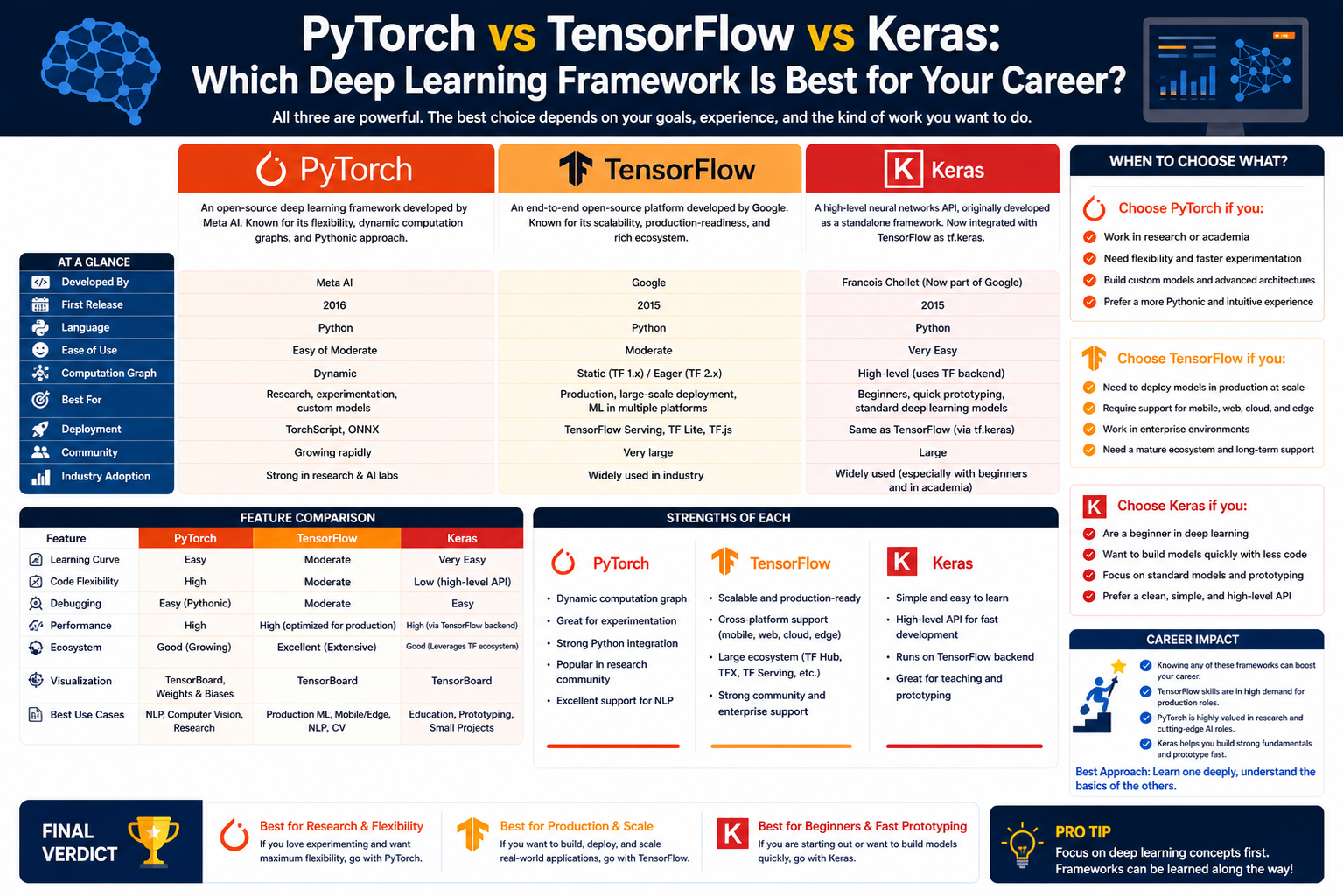
Deep learning has become one of the most influential technologies shaping modern artificial intelligence systems. From speech recognition to autonomous systems and advanced data analytics, neural networks are the foundation behind these innovations. However, building and training such models manually is complex and time-consuming. This is where deep learning frameworks come into play, offering developers structured environments to design, train, and deploy neural networks efficiently. Among the most widely used frameworks in the industry, PyTorch, TensorFlow, and Keras stand out as the leading choices. Each one brings its own philosophy, workflow style, and level of flexibility, making them suitable for different career paths and technical needs.
The Growing Importance of Framework Skills in AI Careers
As artificial intelligence continues to expand across industries, companies are increasingly prioritizing candidates who have hands-on experience with deep learning frameworks. These tools are not just programming libraries; they represent complete ecosystems that define how AI models are built and deployed. Employers often look for candidates who can not only understand machine learning theory but also implement scalable solutions using industry-standard frameworks. This makes choosing the right framework an important step for anyone aiming to enter fields like machine learning engineering, data science, or AI research. Understanding how each framework aligns with job roles can significantly influence long-term career growth.
How PyTorch, TensorFlow, and Keras Shape AI Development
PyTorch, TensorFlow, and Keras each serve the same fundamental purpose—simplifying deep learning model development—but they approach the task differently. PyTorch is known for its flexibility and dynamic nature, allowing developers to adjust models during runtime, which makes experimentation easier. TensorFlow, on the other hand, focuses on scalability and production readiness, making it suitable for deploying large-scale AI systems across cloud and mobile platforms. Keras prioritizes simplicity and user-friendliness, offering a high-level interface that reduces coding complexity. These differences shape how developers interact with AI systems and influence the types of jobs where each framework is preferred.
What Makes PyTorch a Favorite in Research and Innovation
PyTorch is widely appreciated for its intuitive design and developer-friendly structure. It allows models to be built using a dynamic computation graph, meaning changes can be made instantly during execution. This flexibility is especially useful in research environments where experimentation is constant and models frequently evolve. Developers working in academic settings or AI research labs often prefer PyTorch because it closely resembles standard Python programming, making it easier to debug and understand complex architectures. Its growing popularity among startups is also driven by its ability to support rapid prototyping, where speed and adaptability are more important than large-scale deployment optimization.
Core Strengths That Define PyTorch’s Popularity
One of the strongest advantages of PyTorch is its seamless integration with GPU acceleration, which significantly speeds up model training. It also provides a rich ecosystem of tools designed for computer vision and natural language processing tasks, making it a versatile choice for multiple AI domains. The framework encourages an experimental mindset, allowing developers to test new ideas without rigid structural constraints. This makes it especially useful for projects involving cutting-edge research or prototype development. However, while PyTorch is excellent for innovation, it traditionally required additional effort for production deployment compared to more enterprise-focused frameworks.
Limitations That Affect PyTorch in Enterprise Environments
Despite its strengths, PyTorch does have certain limitations that influence its adoption in large-scale business environments. Historically, it was not as optimized for production deployment as some competing frameworks, requiring extra tools or additional configurations to move models from development to production. Although this gap has reduced over time, some organizations still prefer more established production pipelines. Additionally, while its community is growing rapidly, it has traditionally been smaller compared to other frameworks used in enterprise ecosystems. These factors can impact its suitability for companies prioritizing stability and long-term infrastructure support.
Why TensorFlow Dominates Enterprise AI Systems
TensorFlow is widely recognized as a powerful framework designed for large-scale and production-grade machine learning systems. It is built with scalability in mind, allowing models to be deployed across different environments such as servers, mobile devices, and cloud platforms. This makes it a preferred choice for major technology companies that handle massive amounts of data and require reliable AI systems. TensorFlow also provides a structured workflow that supports model optimization, deployment, and monitoring, making it highly suitable for enterprise applications where performance and reliability are critical.
Key Functional Strengths of TensorFlow in Real-World Applications
TensorFlow offers a comprehensive ecosystem that extends beyond model building. It includes tools for serving models in production environments, managing machine learning pipelines, and integrating with various programming languages. This versatility allows organizations to build end-to-end AI solutions within a single framework. Its static computation graph design also contributes to performance optimization, ensuring efficient execution of complex models. These capabilities make TensorFlow particularly valuable in industries such as finance, healthcare, and cloud computing, where AI systems must operate at scale without compromising stability or accuracy.
Challenges Associated with Learning TensorFlow
While TensorFlow is powerful, it comes with a steeper learning curve compared to other frameworks. Its architecture is more complex, requiring developers to understand multiple layers of abstraction before building effective models. Beginners often find it less intuitive due to its structured approach and detailed configuration requirements. However, this complexity is balanced by extensive documentation, tutorials, and community support provided by a large global developer base. Once mastered, TensorFlow offers significant advantages in terms of scalability and professional opportunities, especially in enterprise-focused roles.
Understanding Keras as a Simplified Deep Learning Interface
Keras serves as a high-level interface designed to simplify the process of building neural networks. Its primary goal is to make deep learning more accessible by reducing the amount of code required to construct and train models. This simplicity makes it an ideal starting point for beginners who are new to artificial intelligence and machine learning. Keras allows users to quickly experiment with different architectures without dealing with the complexity of low-level operations. It is often used in combination with TensorFlow, which provides the backend computational power for executing models efficiently.
Why Keras is Preferred for Rapid Prototyping
One of the biggest advantages of Keras is its ability to speed up development cycles. Developers can build functional neural networks with minimal coding effort, making it highly suitable for prototyping and early-stage experimentation. This allows teams to test ideas quickly and iterate on model designs without spending excessive time on configuration. Keras is also widely appreciated in educational environments because it helps learners focus on understanding core machine learning concepts rather than struggling with technical complexity. However, its simplicity also limits flexibility when dealing with highly customized or advanced AI architectures.
Limitations of Keras in Advanced AI Development
Although Keras excels in ease of use, it is not always suitable for complex machine learning tasks that require deep customization. Its high-level abstraction can restrict control over low-level model behavior, which may be necessary in research or specialized applications. As a result, advanced developers often transition from Keras to more flexible frameworks when their projects become more sophisticated. While it remains a powerful tool for beginners and rapid development, it is generally viewed as a stepping stone toward more advanced deep learning frameworks rather than a standalone solution for complex AI systems.
How Industry Trends Influence Framework Demand
The demand for specific deep learning frameworks is strongly influenced by industry requirements and job market trends. Organizations working on large-scale production systems tend to prefer TensorFlow due to its robustness and deployment capabilities. Research institutions and AI labs often favor PyTorch for its flexibility and experimental strengths. Meanwhile, startups and small teams frequently rely on Keras for quick development and testing of ideas. These preferences shape hiring patterns and determine which skills are most valuable in different professional environments. Understanding these trends can help candidates align their learning paths with real-world job opportunities.
Early Career Direction in AI and Framework Selection
Choosing the right framework early in a career can significantly impact long-term professional growth. Developers interested in research-driven roles may benefit more from focusing on PyTorch due to its adaptability and ease of experimentation. Those aiming for enterprise-level positions may find TensorFlow more relevant due to its strong deployment ecosystem. Beginners who want to quickly enter the field may start with Keras to build foundational understanding before transitioning to more advanced tools. Each framework serves a different purpose, and selecting the right one depends on individual career goals and industry focus.
Expanding PyTorch in Real-World AI Development
PyTorch has steadily grown from a research-focused tool into a widely adopted framework in both academic and industry settings. One of the reasons behind this growth is its ability to bridge the gap between experimentation and implementation. Developers working on complex AI systems often require a framework that does not restrict their creativity while still offering powerful computational capabilities. PyTorch fulfills this requirement by providing a dynamic execution environment that adapts to changes during runtime, allowing engineers to fine-tune models in a highly interactive manner. This makes it particularly useful in scenarios where models need constant refinement, such as natural language processing or computer vision research.
Role of PyTorch in Startups and Fast-Moving Projects
Startups often operate in environments where speed of innovation is more important than long-term infrastructure optimization. In such settings, PyTorch becomes a preferred choice because it allows teams to build and test machine learning models quickly. The ability to modify neural network structures on the fly means that developers can experiment with multiple approaches without restarting entire workflows. This flexibility reduces development time and encourages experimentation, which is essential for early-stage product development. Many startups in AI-driven industries rely on PyTorch to validate ideas before scaling them into production-ready systems.
PyTorch Ecosystem and Developer Productivity
The ecosystem surrounding PyTorch plays a significant role in enhancing developer productivity. It includes a wide range of libraries and extensions that simplify tasks such as image recognition, sequence modeling, and reinforcement learning. These tools reduce the need to build everything from scratch and allow developers to focus on solving domain-specific problems. Additionally, PyTorch integrates well with Python’s scientific computing stack, making it easier for data scientists to combine traditional data analysis with deep learning workflows. This seamless integration improves efficiency and reduces the learning barrier for new developers entering the field.
TensorFlow’s Evolution into a Production Powerhouse
TensorFlow was designed with a strong emphasis on scalability and production readiness, and over time it has evolved into one of the most comprehensive machine learning ecosystems available. Unlike frameworks that focus primarily on experimentation, TensorFlow prioritizes the entire lifecycle of a machine learning model, from development to deployment and monitoring. This makes it particularly suitable for organizations that require stable and high-performance AI systems running in real-world environments. Its architecture is built to handle large-scale data processing, making it ideal for companies dealing with massive user bases and complex data pipelines.
TensorFlow in Large-Scale Industrial Applications
In enterprise environments, reliability and consistency are critical factors when deploying machine learning models. TensorFlow excels in these areas by providing tools that support distributed computing and optimized performance across different hardware platforms. Organizations use it to power recommendation systems, fraud detection models, and real-time analytics engines. Its ability to scale across cloud infrastructures ensures that AI systems can handle increasing workloads without performance degradation. This scalability is one of the main reasons why TensorFlow remains a dominant choice among large technology companies and global enterprises.
Deployment Advantages of TensorFlow in Production Systems
One of the strongest advantages of TensorFlow lies in its deployment capabilities. It provides specialized tools that allow models to be deployed across multiple platforms, including mobile applications, web services, and edge devices. This flexibility enables organizations to integrate AI functionality into a wide range of products without rewriting core logic. Additionally, TensorFlow supports optimized inference, which ensures that trained models can make predictions quickly and efficiently in real-time environments. These deployment features make it a preferred framework for companies focused on delivering AI-powered solutions at scale.
Challenges Faced by Developers Using TensorFlow
Despite its strengths, TensorFlow is often considered more complex compared to other frameworks. Its architecture includes multiple layers of abstraction, which can make it difficult for beginners to understand how different components interact. Developers need to invest time in learning concepts such as computational graphs, session management, and model optimization techniques. While these complexities contribute to its power and flexibility, they also increase the initial learning curve. However, experienced developers often find that this complexity is justified by the level of control and performance optimization TensorFlow offers.
Keras as a Bridge Between Simplicity and Deep Learning Power
Keras plays a unique role in the deep learning ecosystem by acting as a simplified interface for building neural networks. It is designed to reduce complexity and make machine learning more accessible to a wider audience. By providing high-level abstractions, Keras allows developers to construct models using minimal code, which significantly speeds up the development process. This makes it particularly useful for educational purposes, where the focus is on understanding concepts rather than dealing with technical implementation details. It also serves as a practical tool for professionals who need to quickly test ideas before moving to more advanced frameworks.
Keras in Educational and Beginner-Friendly Environments
Many educational institutions and online learning platforms use Keras as an introduction to deep learning because of its simplicity. Students can quickly build and train neural networks without needing to understand the underlying mathematical complexities. This hands-on approach helps learners grasp fundamental concepts such as layers, activation functions, and optimization techniques. By reducing the technical barrier, Keras enables beginners to focus on building intuition about how machine learning models work, which is essential for progressing into more advanced studies.
Integration of Keras with Advanced Machine Learning Workflows
Although Keras is often seen as a beginner-friendly tool, it is also used in professional environments when combined with more powerful backend frameworks. Its integration with TensorFlow allows developers to take advantage of TensorFlow’s performance and scalability while still benefiting from Keras’ simplicity. This combination creates a balanced workflow where developers can prototype quickly and later transition to more complex implementations if needed. This hybrid approach is commonly used in organizations that require both speed and scalability in their machine learning pipelines.
Comparing Flexibility Across PyTorch, TensorFlow, and Keras
Flexibility is one of the most important factors when evaluating deep learning frameworks. PyTorch offers the highest level of flexibility due to its dynamic computation graph, allowing developers to modify models during execution. TensorFlow provides moderate flexibility but compensates with strong optimization and deployment capabilities. Keras, while the least flexible, excels in simplicity and ease of use. This trade-off between flexibility and usability plays a crucial role in determining which framework is suitable for a given task or career path.
Impact of Framework Choice on Career Development
The choice of deep learning framework can significantly influence career opportunities in the artificial intelligence field. Employers often evaluate candidates based on their familiarity with industry-standard tools. Those who specialize in TensorFlow may find more opportunities in enterprise environments, while PyTorch expertise is highly valued in research and innovation-driven roles. Keras, while useful for entry-level positions, is typically not sufficient on its own for advanced machine learning engineering roles. Therefore, understanding multiple frameworks can provide a competitive advantage in the job market.
Balancing Practical Skills with Industry Expectations
In the AI job market, practical experience often matters more than theoretical knowledge. Employers prefer candidates who can demonstrate real-world application of machine learning frameworks. This includes building models, optimizing performance, and deploying solutions in production environments. PyTorch, TensorFlow, and Keras each contribute differently to these skill sets, and mastering their practical applications can significantly enhance employability. Developers who can adapt to different frameworks based on project requirements are often seen as more versatile and valuable in professional settings.
How Companies Decide Between Frameworks for Projects
Organizations choose deep learning frameworks based on project requirements, scalability needs, and team expertise. Startups may prioritize speed and flexibility, leading them to adopt PyTorch or Keras for rapid development. Large enterprises often choose TensorFlow due to its robust deployment infrastructure and ability to handle large-scale systems. In research environments, PyTorch is favored for its experimental flexibility. These decisions are driven by practical considerations rather than popularity alone, highlighting the importance of understanding each framework’s strengths in real-world contexts.
Transitioning Between Frameworks in a Professional Career
It is common for professionals in the AI field to work with multiple frameworks throughout their careers. Transitioning between PyTorch, TensorFlow, and Keras becomes easier once the fundamental concepts of deep learning are well understood. Since all frameworks are built on similar principles, learning one often makes it easier to adapt to others. This adaptability is highly valued in the job market, as it allows professionals to work on a wider range of projects and technologies without being restricted to a single ecosystem.
Real-World Industry Adoption of PyTorch, TensorFlow, and Keras
The adoption of deep learning frameworks in real-world industries is driven by practical needs such as scalability, performance, flexibility, and ease of deployment. Companies working with artificial intelligence rarely choose a framework based on popularity alone. Instead, they evaluate how well a framework integrates into their existing systems and whether it supports long-term production goals. PyTorch, TensorFlow, and Keras each serve distinct roles within this ecosystem, and their adoption patterns reflect the different priorities of research labs, startups, and large enterprises.
PyTorch in Research Labs and Experimental AI Systems
PyTorch continues to be the preferred framework in research environments because of its dynamic nature and ease of experimentation. Researchers often need to test new ideas quickly, modify architectures on the fly, and debug complex neural networks without rigid structural limitations. PyTorch supports this workflow by allowing real-time computation changes, which makes it easier to explore innovative model designs. This flexibility is especially important in fields such as natural language processing, reinforcement learning, and generative AI, where experimentation is a core part of development.
Why Academic Institutions Prefer PyTorch for Innovation
Academic institutions focus heavily on innovation and theoretical advancement, which aligns well with PyTorch’s design philosophy. Students and researchers can implement advanced neural network architectures without being constrained by overly complex configuration systems. This encourages deeper exploration of machine learning concepts and faster prototyping of research ideas. As a result, many published AI research papers now rely on PyTorch as the primary framework for model development, further strengthening its position in the academic world.
TensorFlow’s Dominance in Enterprise-Grade AI Solutions
TensorFlow has established itself as the backbone of enterprise-level artificial intelligence systems. Its strong emphasis on scalability and deployment makes it ideal for companies that require stable, high-performance models running in production environments. Large organizations often deal with massive datasets and real-time user interactions, and TensorFlow provides the infrastructure needed to manage these demands efficiently. Its ability to integrate with cloud platforms and distributed systems makes it a reliable choice for mission-critical applications.
TensorFlow in Cloud Computing and Large Data Systems
One of the key strengths of TensorFlow is its compatibility with cloud-based infrastructures. Many enterprises deploy machine learning models across distributed servers, requiring frameworks that can handle parallel processing and large-scale computations. TensorFlow supports these requirements through optimized performance engines and distributed training capabilities. This allows companies to scale their AI systems without compromising speed or accuracy, making it essential for industries like e-commerce, banking, and telecommunications.
Keras in Rapid Development and Lightweight AI Projects
Keras plays a unique role in the AI ecosystem by simplifying the process of building neural networks. It is especially popular in projects where speed of development is more important than deep customization. Developers can quickly construct models using a minimal amount of code, which significantly reduces development time. This makes Keras highly effective for proof-of-concept projects, educational applications, and small-scale AI systems where simplicity is a priority over complexity.
Keras in Startups and Small Development Teams
Startups and small development teams often operate under tight deadlines and limited resources, making Keras an attractive choice. Its user-friendly interface allows developers to focus on solving business problems rather than managing complex machine learning infrastructure. Teams can rapidly test different model architectures and iterate quickly based on performance results. This agility is crucial in competitive markets where product validation and speed to market determine success.
Comparing Model Customization Across Frameworks
Model customization is an important factor when selecting a deep learning framework. PyTorch offers the highest level of customization due to its dynamic computation graph, which allows developers to modify model behavior during execution. TensorFlow provides structured customization options but requires more configuration compared to PyTorch. Keras, while the simplest to use, offers limited customization capabilities, making it less suitable for highly specialized AI research or advanced model engineering tasks.
Flexibility vs Stability in Framework Selection
A key trade-off in choosing a framework lies between flexibility and stability. PyTorch provides maximum flexibility, making it ideal for experimentation and innovation. TensorFlow prioritizes stability and performance optimization, which is essential for production environments. Keras focuses on simplicity, offering stability in basic workflows but limited control over advanced configurations. Understanding this balance is essential for developers aiming to align their skills with industry expectations and job requirements.
How Frameworks Influence Machine Learning Workflows
The choice of framework directly impacts the structure and efficiency of machine learning workflows. PyTorch encourages an iterative workflow where models are continuously tested and refined. TensorFlow promotes a more structured pipeline approach, where models are carefully designed, optimized, and deployed. Keras simplifies the workflow by reducing technical overhead, allowing developers to focus on rapid experimentation. These differences shape how teams collaborate and how projects evolve over time.
Performance Considerations in Production Environments
Performance is a critical factor in production AI systems, especially when handling real-time data processing. TensorFlow is widely recognized for its optimized performance in large-scale environments, making it suitable for applications that require high throughput and low latency. PyTorch has made significant improvements in performance optimization, but it is still more commonly used in research rather than high-demand production systems. Keras relies on backend frameworks for performance, meaning its efficiency depends on the underlying engine it is built upon.
Scalability Challenges in Deep Learning Systems
Scalability is one of the most important challenges in modern AI development. As datasets grow larger and models become more complex, frameworks must be able to scale efficiently across multiple devices and servers. TensorFlow addresses this challenge through distributed computing and cloud integration features. PyTorch also supports scalability but often requires additional configuration. Keras, being a high-level interface, relies on its backend for scalability, making it less independent in large-scale systems.
Integration with Machine Learning Pipelines
Modern AI systems are rarely standalone models; they are part of larger machine learning pipelines that include data preprocessing, model training, evaluation, and deployment. TensorFlow provides a complete ecosystem for managing these pipelines efficiently. PyTorch offers flexibility in pipeline design but may require external tools for full pipeline management. Keras simplifies integration but is generally used as part of a TensorFlow-based pipeline rather than a standalone solution.
Framework Choice Based on Project Complexity
The complexity of a project plays a significant role in determining which framework is most suitable. Simple classification or regression tasks can be efficiently handled using Keras due to its ease of use. More complex systems involving deep neural networks, reinforcement learning, or generative models are often better suited for PyTorch due to its flexibility. Large-scale production systems with strict performance requirements typically rely on TensorFlow for its stability and scalability.
Industry Skill Requirements for AI Professionals
Employers in the AI industry often look for candidates who are not limited to a single framework. Instead, they value professionals who understand the strengths and limitations of multiple tools and can choose the right one based on project needs. While TensorFlow expertise is highly valued in enterprise roles, PyTorch skills are essential for research-oriented positions. Keras is often considered a foundational skill that helps beginners transition into more advanced frameworks.
Building Versatility Through Multi-Framework Knowledge
Developers who learn more than one deep learning framework gain a significant advantage in the job market. Understanding both PyTorch and TensorFlow allows professionals to work across different industries and project types. Keras serves as an entry point that helps build confidence before moving into more complex systems. This multi-framework knowledge increases adaptability, making developers more attractive to employers looking for flexible and skilled AI engineers.
Advanced Career Impact of Deep Learning Framework Mastery
Mastering PyTorch, TensorFlow, and Keras is not just about learning tools; it directly influences the type of career opportunities available in the artificial intelligence field. Employers evaluate candidates based on how effectively they can translate machine learning concepts into real-world applications. Framework expertise becomes a practical measure of readiness for roles in research, engineering, and production environments. As AI continues to expand into every industry, professionals who understand multiple frameworks gain a noticeable advantage in hiring processes and long-term career growth.
PyTorch in Cutting-Edge AI Research and Innovation Roles
PyTorch continues to dominate environments where innovation and experimentation are the primary focus. Many AI research teams rely on it to explore new neural network architectures and advanced learning techniques. Its dynamic computation model allows researchers to modify models instantly, which is essential when testing new hypotheses. This adaptability supports rapid iteration cycles, making PyTorch highly suitable for fields such as generative AI, reinforcement learning, and advanced natural language processing systems where experimentation drives progress.
TensorFlow as the Backbone of Production AI Systems
TensorFlow plays a critical role in powering large-scale production systems across global industries. Companies that handle millions of users depend on its ability to deploy stable, efficient, and scalable machine learning models. Its ecosystem is designed to support end-to-end workflows, from data preprocessing to model monitoring in production environments. This makes TensorFlow essential for applications like recommendation engines, fraud detection systems, and predictive analytics platforms where reliability and performance are non-negotiable requirements.
Keras in Fast-Paced Learning and Development Environments
Keras continues to serve as an essential tool for beginners and developers who prioritize simplicity and speed. Its high-level abstraction allows users to build neural networks without dealing with complex configurations or low-level operations. This makes it especially useful in educational settings and early-stage development environments where understanding core concepts is more important than system optimization. Keras helps bridge the gap between theoretical learning and practical implementation, making it a valuable entry point into deep learning.
Evolving Industry Preferences for AI Frameworks
Industry preferences for deep learning frameworks are continuously evolving based on technological advancements and business requirements. While TensorFlow remains dominant in enterprise systems, PyTorch is rapidly gaining ground in both research and production environments. Keras maintains its relevance in rapid prototyping and educational use cases. Companies increasingly adopt hybrid approaches, combining multiple frameworks to leverage their individual strengths. This shift highlights the importance of adaptability in modern AI development careers.
Hybrid Framework Usage in Modern AI Pipelines
Many organizations no longer rely on a single framework for all machine learning tasks. Instead, they design hybrid pipelines where different frameworks are used for different stages of development. For example, PyTorch may be used for research and model experimentation, while TensorFlow handles deployment and scaling. Keras may be used during early prototyping to quickly validate ideas. This multi-framework strategy allows teams to balance speed, flexibility, and performance across complex AI systems.
Career Path Selection Based on Framework Expertise
Choosing a career path in artificial intelligence often depends on the frameworks a developer is most comfortable with. Those who specialize in PyTorch tend to move toward research-heavy roles or innovation-focused startups. Developers with TensorFlow expertise often pursue positions in large enterprises where system reliability and scalability are critical. Keras users typically begin in entry-level roles or educational environments before transitioning into more advanced frameworks as their skills grow. Understanding these pathways helps individuals align their learning with long-term career goals.
Real-World Skills Beyond Framework Syntax
While knowing framework syntax is important, employers also value broader machine learning skills such as data preprocessing, feature engineering, model evaluation, and deployment strategies. Frameworks like PyTorch and TensorFlow are tools that support these processes, but true expertise comes from understanding how to apply them effectively in real-world scenarios. Professionals who can combine theoretical knowledge with practical implementation are often more competitive in the job market than those who only focus on coding aspects.
Performance Optimization in Machine Learning Systems
Performance optimization is a crucial skill in AI development, especially when working with large datasets or real-time applications. TensorFlow provides built-in optimization tools that enhance model efficiency during deployment. PyTorch offers increasing support for performance improvements, especially with GPU acceleration and distributed training. Keras relies heavily on its backend framework for optimization. Understanding how to tune models for speed, accuracy, and resource efficiency is a key factor in building production-ready AI systems.
Scalability and Future-Proofing AI Skills
Scalability remains one of the most important considerations in modern machine learning systems. As data volumes continue to grow, frameworks must support distributed computing and cloud integration. TensorFlow leads in this area due to its strong production ecosystem. PyTorch is rapidly improving its scalability features, making it more competitive in enterprise environments. Keras, while simple, depends on backend systems for scaling. Professionals who understand scalability concepts are better prepared for future advancements in AI infrastructure.
The Importance of Continuous Learning in AI Careers
The artificial intelligence field evolves rapidly, and frameworks continue to update with new features and improvements. Staying relevant requires continuous learning and adaptation. Developers who rely on a single framework risk limiting their career opportunities, while those who explore multiple tools remain flexible and competitive. Learning PyTorch, TensorFlow, and Keras together provides a strong foundation for adapting to future technologies and emerging AI trends.
Final Comparison of Framework Strengths in Career Context
Each framework offers distinct advantages depending on career goals and industry focus. PyTorch excels in research, experimentation, and innovation-driven roles. TensorFlow dominates enterprise-level production systems where scalability and reliability are essential. Keras provides an accessible entry point for beginners and supports rapid prototyping in early development stages. Together, they form a complete ecosystem that supports the full lifecycle of machine learning development.
Strategic Learning Approach for Maximum Employability
To maximize employability in the AI job market, a strategic learning approach is essential. Starting with Keras helps build foundational understanding of neural networks without overwhelming complexity. Progressing to TensorFlow or PyTorch allows developers to gain advanced skills required for professional roles. Learning multiple frameworks not only improves technical ability but also increases flexibility in choosing job opportunities across different industries. This layered learning strategy ensures long-term career stability in the rapidly growing AI sector.
Conclusion
PyTorch, TensorFlow, and Keras each play an important role in shaping modern artificial intelligence development. PyTorch drives innovation and research, TensorFlow powers scalable enterprise systems, and Keras simplifies entry into deep learning. The best choice depends on individual career goals, but understanding all three frameworks provides a significant competitive advantage. In a job market where AI skills are in high demand, versatility, adaptability, and practical experience matter more than ever. By mastering these tools and applying them in real-world projects, developers can position themselves strongly for future opportunities in the evolving world of artificial intelligence.