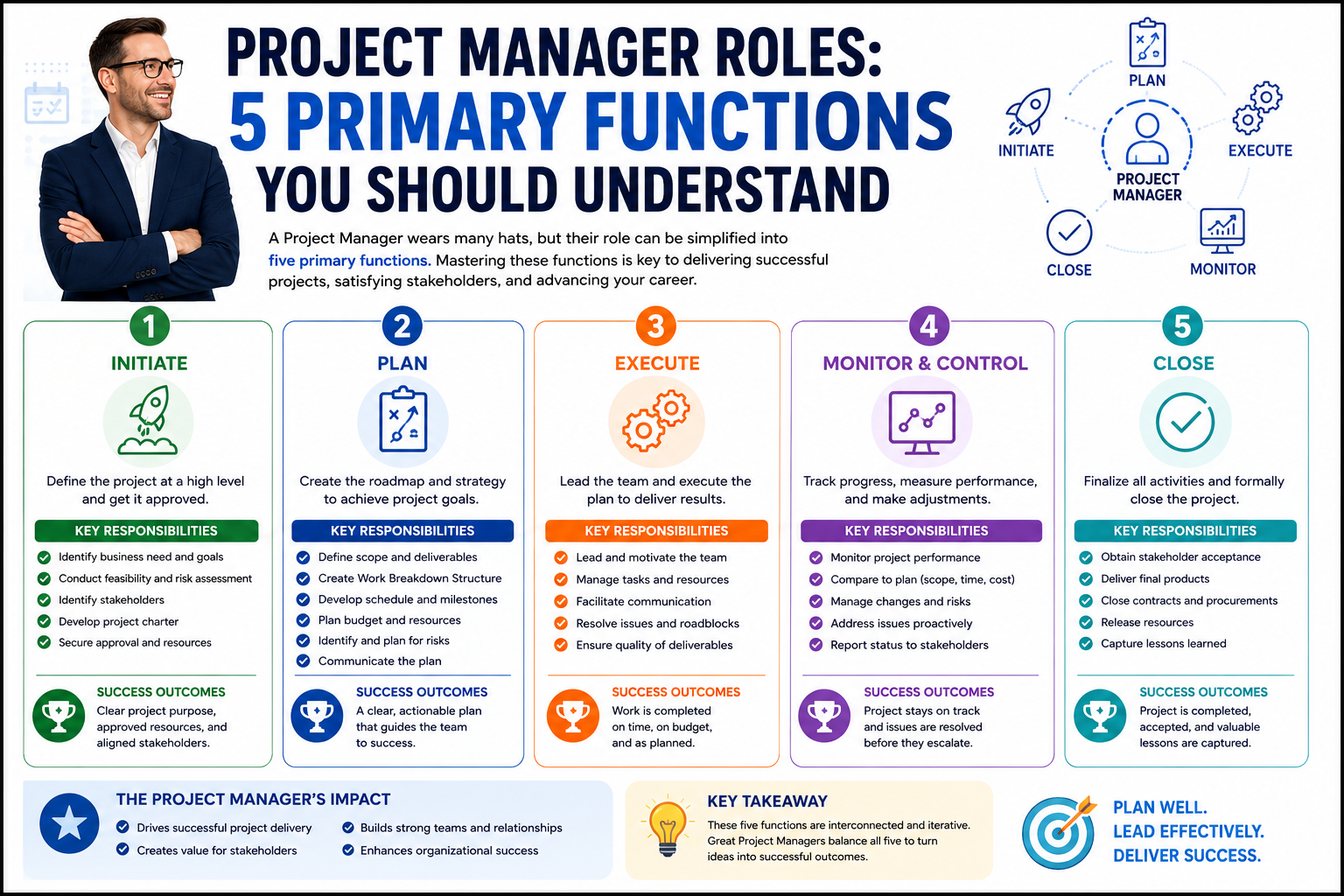
A project manager operates at the centre of almost every modern organisational initiative, whether it involves building a new software system, launching a product, upgrading infrastructure, or rolling out a service improvement program. The role is not defined by a single responsibility but by a combination of leadership, coordination, decision-making, and communication tasks that must work together seamlessly.
At its core, the project manager’s job is to ensure that a defined piece of work moves from an idea to a completed outcome in a structured, predictable, and controlled way. This requires balancing competing expectations, managing uncertainty, and maintaining alignment between different groups who may all view the project from different perspectives.
Unlike roles that focus on a single function, the project manager must constantly shift attention between strategic goals and operational details. They must think about the big picture—why the project exists and what it should achieve—while also tracking day-to-day activities that determine whether the project is on track.
Every project exists within constraints. Time, cost, scope, and quality are always limited in some way, and the project manager is responsible for managing those constraints so that the outcome remains aligned with expectations. This balancing act makes the role both complex and highly influential within any organisation.
Balancing Stakeholder Expectations and Organisational Goals
One of the most challenging aspects of project management is dealing with stakeholders who may have different priorities, expectations, and definitions of success. Stakeholders can include senior executives, clients, end users, technical teams, operational staff, and external partners. Each group may view the same project through a different lens.
For example, executives may focus on financial return, efficiency, and strategic alignment. End users may prioritise usability, performance, and reliability. Technical teams may be concerned with feasibility, system architecture, and resource availability. The project manager must bring all these perspectives together into a unified direction.
This requires more than communication. It demands interpretation, negotiation, and sometimes conflict resolution. The project manager must ensure that expectations are realistic and clearly defined from the beginning, reducing the risk of misunderstandings later in the project lifecycle.
A successful project manager does not simply pass messages between groups. Instead, they actively shape understanding by clarifying goals, aligning priorities, and ensuring that everyone involved shares a consistent vision of what the project is meant to deliver.
This alignment begins at the earliest stage of the project and continues throughout its duration. Without it, even well-executed technical work can fail to meet stakeholder expectations, leading to dissatisfaction regardless of the effort invested.
Function 1: Initiating the Project
The initiation phase is where a project officially begins its journey from concept to structured work. This stage is critical because it defines whether a project should exist at all and what it is expected to achieve. A project manager plays a central role in transforming an idea into a clearly defined and justified initiative.
During initiation, the project manager works closely with stakeholders to understand the problem or opportunity that the project is intended to address. This involves asking fundamental questions such as what outcome is expected, why it matters, and how success will be measured.
At this stage, clarity is essential. Without a clear understanding of purpose, a project can quickly become misaligned or unfocused. The project manager ensures that the original idea is refined into a structured objective that can be realistically planned and executed.
Initiation is not about execution but about evaluation. It determines whether the proposed work is worth pursuing and whether the organisation has the capacity to support it. This includes examining resources, risks, constraints, and expected benefits.
Assessing Feasibility and Project Viability
A major responsibility during initiation is assessing whether the project is feasible. Feasibility is not just about whether something can be done technically, but whether it should be done given the available time, budget, skills, and organisational priorities.
The project manager evaluates multiple dimensions of feasibility. Technical feasibility examines whether the required solution can be built or implemented using existing or attainable technology. Financial feasibility considers whether the cost of the project is justified by the expected benefits.
Operational feasibility focuses on whether the organisation can support the outcome once the project is completed. For example, a new system may be technically possible to build, but if the organisation lacks the capacity to maintain it, the long-term value may be limited.
Another important dimension is schedule feasibility. Even if a project is possible in theory, it may not be practical if the required timeline is unrealistic. Deadlines must be achievable without compromising quality or overloading resources.
Risk assessment is also a key part of feasibility analysis. Every project carries uncertainty, and the project manager must identify potential risks early. These risks may include technical challenges, resource shortages, budget constraints, or stakeholder misalignment.
By evaluating these factors, the project manager helps decision-makers determine whether the project is worth pursuing or whether adjustments are needed before moving forward.
Defining the Business Case and Expected Value
A project does not begin simply because an idea exists. It begins because there is a justified reason for investment. The business case is a structured explanation of why the project should be undertaken and what benefits it is expected to deliver.
The project manager plays a key role in developing and refining this business case. This involves gathering information from stakeholders, analysing potential outcomes, and presenting a clear justification for proceeding.
The business case typically includes expected benefits such as increased revenue, cost savings, improved efficiency, enhanced customer satisfaction, or reduced risk. It also includes an estimate of the investment required, including time, money, and human resources.
One of the project manager’s responsibilities is to ensure that the business case is realistic and evidence-based. Overly optimistic assumptions can lead to disappointment later, while overly conservative estimates may prevent valuable projects from being approved.
The business case is not static. It may evolve as more information becomes available, but it serves as the foundation for decision-making at the initiation stage. Without a strong business case, a project lacks justification and is unlikely to receive approval from senior stakeholders.
Establishing Project Scope and Boundaries
Once the project is deemed viable, the next step is defining what is included and what is excluded. This is known as establishing project scope. Scope definition is one of the most important tasks in the initiation phase because it sets clear boundaries for the work ahead.
The project manager ensures that all stakeholders have a shared understanding of what the project will deliver. This includes defining the final outputs, deliverables, and outcomes expected at completion.
Equally important is defining what is not included. Many project failures occur because scope boundaries are unclear, leading to expectations that expand over time. This phenomenon is often referred to as scope creep, where additional requirements are introduced without proper evaluation.
By clearly defining the scope early, the project manager reduces uncertainty and creates a stable foundation for planning and execution. Stakeholders are less likely to develop conflicting expectations when boundaries are clearly documented and agreed upon.
Scope definition also helps with resource planning. When the boundaries of a project are known, it becomes easier to estimate the time, cost, and effort required to complete it.
Understanding Stakeholder Influence During Initiation
Stakeholders play a particularly important role during project initiation because they help define both expectations and constraints. The project manager must identify all relevant stakeholders and understand their level of influence and interest in the project.
Some stakeholders have decision-making authority, while others may be affected by the outcome but not directly involved in planning. Understanding these relationships helps the project manager manage communication effectively.
Engaging stakeholders early reduces the risk of resistance later in the project. When stakeholders feel involved in shaping the project from the beginning, they are more likely to support its objectives and contribute constructively.
However, stakeholder management is not only about agreement. It also involves managing differences in opinion and ensuring that competing priorities are addressed in a balanced way. The project manager must navigate these dynamics carefully to maintain alignment.
Selecting an Appropriate Project Approach
Another key decision made during initiation is selecting the project methodology or approach. This determines how the project will be planned, executed, and controlled.
Different types of projects require different approaches. Some projects benefit from structured, sequential planning where each phase is completed before the next begins. Others require flexibility and iterative development where changes are expected and incorporated throughout the process.
The project manager evaluates factors such as complexity, uncertainty, stakeholder involvement, and technical requirements when selecting an approach. The chosen methodology influences how teams work, how progress is measured, and how decisions are made.
This decision has long-term implications because it shapes the entire project lifecycle. A mismatch between project type and methodology can lead to inefficiencies, delays, or miscommunication.
Establishing Governance and Initial Structure
Initiation also involves setting up the basic structure of project governance. This includes defining how decisions will be made, how progress will be reviewed, and how issues will be escalated.
The project manager ensures that there is clarity around roles and responsibilities, even before the full team is assembled. This early structure helps prevent confusion once the project moves into active execution.
Governance also includes defining reporting expectations. Stakeholders need visibility into progress, risks, and changes, and the project manager must establish how this information will be shared.
Although detailed planning happens later, initiation lays the foundation for control and accountability. Without this structure, projects can become disorganised and difficult to manage as they grow in complexity.
Moving from Idea to Structured Commitment
The initiation phase ultimately transforms an idea into a structured commitment supported by evidence, stakeholder agreement, and organisational approval. It is the point where uncertainty begins to shift in a direction.
The project manager plays a critical role in ensuring that this transition is smooth, informed, and aligned with organisational priorities. By carefully evaluating feasibility, defining scope, building a business case, and aligning stakeholders, they create the conditions necessary for successful execution in later stages.
This phase does not involve building or delivering outcomes yet, but it determines whether the project has a strong foundation on which everything else will be built.
Building the Project Team Structure
Once a project moves beyond approval and initial definition, the focus shifts toward building the human structure that will actually deliver the work. A project does not succeed through planning alone; it depends heavily on the people responsible for executing each task. This makes team formation one of the most influential responsibilities of a project manager.
At this stage, the project manager begins by understanding what kind of team structure is needed. Some projects require a tightly integrated, cross-functional team working closely daily. Others involve distributed contributors who work independently on specialised tasks. The structure depends on the size, complexity, timeline, and technical requirements of the project.
The project manager must also decide whether the team will be fully dedicated or shared across multiple projects. Dedicated teams allow higher focus and faster coordination, while shared teams require more careful scheduling and communication management.
Another key consideration is whether all required skills exist internally or whether external resources are needed. Some projects can be completed entirely with in-house talent, while others require contractors, consultants, or temporary specialists.
At this stage, the project manager is not just assembling individuals but designing a working system of collaboration. The structure they create will directly influence how efficiently the project moves forward and how effectively challenges are handled.
Identifying Skills and Resource Requirements
Before selecting individuals for the team, the project manager must clearly understand the types of skills the project demands. This involves breaking down the project scope into work components and identifying what expertise is required for each component.
For example, a digital transformation project may require software developers, system architects, cybersecurity specialists, business analysts, and quality assurance professionals. A construction project may require engineers, safety officers, procurement specialists, and site supervisors.
The project manager creates a skills map that connects project tasks with required capabilities. This ensures that no critical skill is overlooked and that all necessary roles are accounted for before recruitment begins.
Resource requirements go beyond technical skills. They also include availability, experience level, communication ability, and adaptability. A highly skilled individual may not be suitable if they are not available when needed or if they struggle to work in collaborative environments.
Another important factor is workload balance. The project manager must ensure that team members are not overloaded, as this can lead to burnout, reduced quality, and missed deadlines.
By carefully defining resource requirements, the project manager reduces uncertainty during execution and ensures that the team is capable of delivering the project objectives effectively.
Recruiting and Selecting Team Members
Once requirements are clearly defined, the project manager moves into the selection phase. This process involves identifying individuals who best match the skills, experience, and behavioural traits needed for the project.
In many organisations, the project manager does not have full control over hiring decisions. Instead, they work with functional managers or resource managers who allocate staff based on availability and suitability. This requires negotiation and prioritisation skills.
Selection is not only about technical ability. The project manager must also consider how individuals will work together as a team. Collaboration, communication style, and problem-solving approach are all important factors.
A technically strong team member who cannot collaborate effectively may slow down progress, while a moderately skilled but highly cooperative individual may significantly improve team performance.
The project manager also considers diversity of thought and experience. Teams with varied perspectives often perform better because they approach problems from multiple angles and generate more innovative solutions.
Recruitment at this stage is about building balance. The goal is not simply to gather skilled individuals, but to create a cohesive group capable of working toward a shared objective under time and resource constraints.
Defining Roles, Responsibilities, and Accountability
Once the team is formed, clarity becomes essential. Every team member must understand exactly what is expected of them, what they are responsible for, and how their work contributes to the overall project.
Without a clear role definition, confusion can arise quickly. Tasks may be duplicated, overlooked, or delayed, leading to inefficiencies and frustration. The project manager ensures that responsibilities are clearly distributed across the team.
Each role is linked to specific deliverables and outcomes. This helps individuals understand not only what they need to do, but also why their work matters in the broader context of the project.
Accountability is another critical aspect. Team members must understand how their performance will be measured and what standards they are expected to meet. This does not mean creating pressure, but establishing clarity.
The project manager ensures that accountability is balanced. It should encourage ownership and responsibility without creating fear or excessive control.
A clear role definition also supports decision-making. When responsibilities are well understood, team members can act independently within their areas of authority, reducing delays caused by unnecessary approvals.
Onboarding and Early Team Integration
Bringing a team together is not just about assigning tasks. It requires structured onboarding to ensure that every member understands the project environment, goals, and expectations.
During onboarding, the project manager introduces the project vision and explains how each role contributes to the overall outcome. This helps team members see the bigger picture and understand the importance of their contributions.
Onboarding also includes familiarisation with tools, processes, and communication channels. Every project has its own working environment, and team members must quickly adapt to it to be effective.
Early integration is crucial because it sets the tone for collaboration. If team members feel disconnected or unclear in the beginning, it can take much longer to build cohesion later.
The project manager ensures that early interactions are structured and supportive. This may involve kickoff meetings, initial workshops, or collaborative planning sessions where team members begin working together.
A strong onboarding process reduces uncertainty and accelerates productivity, allowing the team to transition smoothly into active project work.
Establishing Communication Norms
Communication is one of the most important factors in project success. Without clear communication practices, even skilled teams can struggle to coordinate effectively.
The project manager defines how, when, and where communication will take place. This includes regular meetings, progress updates, reporting formats, and informal check-ins.
Different types of communication serve different purposes. Formal communication is used for structured reporting and decision-making, while informal communication supports collaboration and problem-solving.
Communication must be consistent but not overwhelming. Too many meetings or excessive reporting can slow down progress and reduce efficiency.
The project manager also ensures that communication channels are accessible to all team members. Everyone should know where to find information, how to report issues, and how to escalate concerns when needed.
Clear communication norms reduce misunderstandings and ensure that information flows smoothly across the team.
Aligning the Team with Project Objectives
Alignment goes beyond understanding tasks; it involves ensuring that every team member shares the same understanding of project goals and priorities.
The project manager reinforces alignment by continuously connecting daily work to the broader objectives. This helps prevent situations where team members focus on individual tasks without understanding their impact on the overall project.
Alignment also involves ensuring consistency in decision-making. When team members understand priorities, they are better able to make decisions independently without waiting for constant direction.
Misalignment often leads to inefficiency, duplication of effort, and conflicting outputs. The project manager actively monitors alignment throughout the project and addresses gaps when they arise.
This ongoing reinforcement ensures that the team remains focused on delivering outcomes that match stakeholder expectations.
Leadership Styles in Project Environments
Project managers must adapt their leadership approach depending on the situation, team composition, and project phase. There is no single leadership style that works in all circumstances.
In some cases, a directive approach is needed, especially when decisions must be made quickly or when team members require clear guidance. In other cases, a collaborative style is more effective, allowing team members to contribute ideas and share responsibility.
A supportive leadership style helps build confidence and encourages team engagement, particularly when dealing with complex or unfamiliar tasks.
The project manager must also know when to step back and allow the team to operate independently. Micromanagement can reduce motivation and slow down progress.
Effective leadership in project environments is flexible. It adapts to changing needs while maintaining focus on project objectives and team well-being.
Managing Team Dynamics and Motivation
Every team develops its own dynamics over time. These dynamics influence how individuals interact, how decisions are made, and how conflicts are resolved.
The project manager observes these interactions and works to maintain a healthy team environment. Positive dynamics lead to better collaboration, while negative dynamics can reduce productivity and increase tension.
Motivation is closely linked to team dynamics. When individuals feel valued, supported, and aligned with the project’s purpose, they are more likely to perform effectively.
The project manager supports motivation by recognising contributions, providing feedback, and ensuring that work is meaningful. Clear goals and visible progress also help maintain engagement.
A motivated team is more resilient in the face of challenges and more likely to maintain performance under pressure.
Handling Conflict and Misalignment
Conflict is a natural part of team environments, especially in complex projects with multiple stakeholders and competing priorities. The project manager must be prepared to address conflict constructively.
Conflict may arise due to misunderstandings, resource constraints, personality differences, or unclear responsibilities. If left unresolved, it can negatively impact performance and morale.
The project manager addresses conflict by identifying its root cause rather than focusing only on symptoms. Open communication and structured discussion often help resolve disagreements.
In some cases, compromise is necessary. In others, decisions must be made based on project priorities and organisational goals.
The key is to ensure that conflict does not escalate or disrupt team cohesion. When managed effectively, conflict can even lead to improved understanding and better solutions.
Building Collaboration and Trust Within the Team
Collaboration is essential for project success, especially in environments where tasks are interdependent. The project manager fosters collaboration by encouraging shared problem-solving and open communication.
Trust is the foundation of collaboration. Without trust, team members may hesitate to share ideas, raise concerns, or rely on each other’s work.
The project manager builds trust by being consistent, transparent, and fair in decision-making. When team members feel that processes are reliable and expectations are clear, trust naturally develops.
Collaborative environments also benefit from psychological safety, where individuals feel comfortable expressing ideas without fear of criticism.
A strong collaborative culture improves efficiency, reduces errors, and enhances innovation within the project.
Ensuring Integration Between Team and Stakeholders
The project team does not operate in isolation. It must remain connected to stakeholders throughout the project lifecycle. The project manager ensures that this connection is maintained effectively.
Stakeholders provide direction, feedback, and approval at key stages. The project manager acts as the bridge between stakeholders and the team, ensuring that communication flows in both directions.
This integration helps prevent misunderstandings and ensures that the project remains aligned with expectations. It also allows stakeholders to stay informed about progress and challenges.
By maintaining strong integration between the team and stakeholders, the project manager ensures that the project evolves in a controlled and aligned manner, reducing the risk of surprises or misalignment later in the process.
Establishing a Structured Approach to Project Timelines
After the project team is formed and aligned, the focus naturally shifts toward how the work will actually be organised over time. Time is one of the most critical constraints in any project, and managing it effectively determines whether a project succeeds or falls behind expectations. The project manager is responsible for turning abstract goals into a structured timeline that guides execution from start to finish.
Creating a timeline is not simply about listing tasks in order. It involves understanding dependencies, estimating effort accurately, and ensuring that the sequence of work is logical and achievable. Every task in a project is connected to others in some way, and delays in one area can affect multiple downstream activities.
The project manager begins by breaking down the entire scope of work into smaller, manageable components. This process helps make complex objectives more understandable and easier to schedule. Each component is then analysed in terms of duration, resource requirements, and dependency relationships.
Once this breakdown is complete, the project manager can begin building a structured timeline that reflects how work will progress over time. This timeline becomes the backbone of project execution, guiding both the team and stakeholders.
Breaking Down Work Through Task Decomposition
Task decomposition is the process of dividing a large project into smaller, clearly defined activities. Without this step, projects remain too abstract to manage effectively. By breaking work into smaller parts, the project manager creates clarity and improves control.
Each task must be specific enough that it can be assigned to an individual or small group, and it must have a clear output or deliverable. Vague or overly broad tasks lead to confusion and inconsistent progress tracking.
The project manager ensures that tasks are logically structured and aligned with project objectives. This involves identifying all necessary steps required to move from project initiation to completion.
During decomposition, hidden complexities often emerge. Tasks that initially appear simple may require multiple sub-steps, coordination between different roles, or additional approvals. Recognising these complexities early helps prevent delays later in the project.
A well-structured breakdown of work also improves communication. When everyone understands exactly what needs to be done, coordination becomes easier and more efficient.
Understanding Task Dependencies and Sequencing
Once tasks are defined, the next step is understanding how they relate to one another. Most project activities cannot be completed independently. Instead, they depend on the completion of other tasks before they can begin.
The project manager identifies these dependencies and uses them to create a logical sequence of work. Some tasks must be completed before others can start, while some can run in parallel.
Understanding dependencies is crucial because it directly affects the overall project duration. If tasks are incorrectly sequenced, the project may experience unnecessary delays or inefficiencies.
There are different types of dependencies, including finish-to-start relationships, where one task must finish before another begins, and parallel dependencies, where tasks can proceed simultaneously but must align at certain points.
By mapping these relationships, the project manager gains a clear view of how work flows through the project lifecycle.
Estimating Time and Effort Accurately
One of the most challenging aspects of project scheduling is estimating how long each task will take. Time estimation requires both experience and careful analysis of available information.
The project manager collaborates with team members who will perform the work to develop realistic estimates. This is important because those closest to the task often have the best understanding of how long it will take.
Estimation is influenced by multiple factors, including task complexity, available resources, skill levels, and external constraints. Uncertainty is always present, so estimates must include a degree of flexibility.
Overly optimistic estimates can lead to missed deadlines, while overly conservative estimates may reduce efficiency. The project manager must strike a balance between realism and efficiency.
Accurate estimation is not a one-time activity. It is refined as the project progresses and more information becomes available.
Creating the Project Schedule
Once tasks, dependencies, and estimates are defined, the project manager builds the project schedule. This schedule represents the planned timeline for completing all project activities.
The schedule organises tasks into a logical sequence and assigns start and end dates. It also identifies critical milestones that mark key points of progress.
A well-structured schedule provides visibility into how the project will unfold over time. It helps stakeholders understand when key deliverables will be completed and how long the overall project will take.
The schedule also serves as a reference point for tracking progress. As work is completed, the project manager compares actual progress against the planned timeline.
This comparison helps identify delays early and allows corrective action to be taken before issues escalate.
Identifying the Critical Path
Within every project schedule, there are certain tasks that have a direct impact on the overall completion date. These tasks form what is known as the critical path.
The critical path represents the longest sequence of dependent tasks that determines the minimum time required to complete the project. If any task on this path is delayed, the entire project will be delayed.
The project manager pays special attention to the critical path because it highlights the most important areas of focus. Managing these tasks effectively is essential for ensuring on-time delivery.
Non-critical tasks have some flexibility, meaning they can be delayed slightly without affecting the overall project timeline. However, critical tasks require constant monitoring and careful management.
Understanding the critical path helps the project manager prioritise resources and attention where they are needed most.
Assigning Work and Distributing Responsibilities
Once the schedule is established, tasks must be assigned to team members. This step connects planning with execution and ensures that each part of the project has clear ownership.
The project manager considers individual skills, availability, and workload when assigning tasks. The goal is to ensure that work is distributed fairly and efficiently.
Assignments are not just about allocating work but also about empowering team members to take ownership of their responsibilities. Clear ownership improves accountability and motivation.
The project manager ensures that each team member understands what is expected of them, when their tasks are due, and how their work contributes to the overall project.
Proper task assignment reduces confusion and improves coordination across the team.
Monitoring Progress Against the Timeline
Once execution begins, the project manager continuously monitors progress to ensure that work is proceeding according to plan. This involves comparing actual performance against the scheduled timeline.
Progress monitoring helps identify delays, bottlenecks, or unexpected issues early. Early detection is critical because it allows corrective action to be taken before problems escalate.
The project manager tracks task completion, milestone achievement, and overall schedule adherence. This information provides a real-time view of project health.
Monitoring is not just about identifying problems. It also helps recognise areas where the project is ahead of schedule or performing better than expected.
Regular progress tracking ensures that the project remains aligned with its planned timeline and objectives.
Managing Delays and Schedule Adjustments
Despite careful planning, delays are common in most projects. Unexpected challenges, resource shortages, or changes in requirements can all affect timelines.
When delays occur, the project manager must assess their impact and determine the best course of action. This may involve adjusting the schedule, reallocating resources, or revising priorities.
Not all delays have the same impact. Some may affect non-critical tasks, while others may threaten the overall project deadline. Understanding this distinction is essential for effective decision-making.
In some cases, the project manager may need to compress the schedule by overlapping tasks or increasing resource allocation. In other cases, extending deadlines may be the most realistic option.
The key is to manage delays in a controlled and transparent manner while minimising their impact on project outcomes.
Maintaining Focus on Deliverables and Milestones
Milestones are important checkpoints that mark progress within a project. They help break large projects into smaller, more manageable stages.
The project manager uses milestones to track progress and maintain momentum. Each milestone represents a significant achievement, such as completing a phase of work or delivering a key component.
Focusing on milestones helps the team stay motivated and provides stakeholders with clear visibility into progress.
Milestones also serve as decision points where project direction can be reviewed and adjusted if necessary.
By maintaining focus on deliverables and milestones, the project manager ensures that the project moves forward in a structured and controlled manner.
Managing Resource Allocation Over Time
Time management is closely connected to resource management. As the project progresses, resource needs may change depending on workload and task complexity.
The project manager ensures that resources are allocated efficiently throughout the project lifecycle. This may involve shifting team members between tasks or adjusting workloads to match project priorities.
Resource balancing is essential for maintaining productivity. Overloading certain team members while others remain underutilised can lead to inefficiency and burnout.
The project manager continuously evaluates resource utilisation and makes adjustments as needed to maintain balance and efficiency.
Ensuring Coordination Across Parallel Activities
Many projects involve multiple activities happening at the same time. Coordinating these parallel tasks is essential for maintaining overall progress.
The project manager ensures that parallel workstreams remain aligned and do not conflict with each other. This requires clear communication and careful scheduling.
Dependencies between parallel tasks must be managed carefully to avoid delays or misalignment. Even when tasks are independent, they often converge at certain points in the project.
Effective coordination ensures that all parallel activities contribute smoothly to the outcome.
Maintaining Adaptability in Scheduling
Although schedules are carefully planned, they must remain flexible enough to adapt to changing conditions. Projects rarely proceed exactly as initially planned.
The project manager maintains adaptability by regularly reviewing progress and updating the schedule when necessary. This ensures that the project remains realistic and achievable.
Adaptability does not mean lack of control. Instead, it reflects the ability to respond to change while maintaining structure and direction.
A flexible schedule helps the project absorb unexpected changes without losing overall momentum.
Keeping the Team Focused on Time Objectives
Time management is not only a technical function but also a behavioural one. The project manager plays an important role in keeping the team focused on deadlines and priorities.
This involves reinforcing expectations, providing reminders, and ensuring that time-related goals remain visible throughout the project.
When teams understand the importance of deadlines and how their work contributes to overall timing, they are more likely to stay focused and productive.
Maintaining time awareness helps prevent delays and ensures steady progress toward project completion.
Strengthening Schedule Control Through Continuous Forecasting
An important extension of project timeline management is the ability to continuously forecast future progress rather than relying only on the original plan. In real project environments, conditions rarely remain stable. Work complexity, resource availability, and stakeholder priorities can shift, which means the project manager must regularly reassess how current performance will influence future outcomes.
Forecasting allows the project manager to anticipate delays before they fully materialise. Instead of waiting for missed deadlines, they analyse current progress trends and estimate whether the remaining work can still be completed within the planned timeframe. This proactive approach is essential for maintaining control over complex projects.
Forecasting also helps identify early warning signs. For example, if task completion rates begin to slow or if certain dependencies consistently create bottlenecks, the project manager can predict potential schedule risks. These insights allow for timely adjustments such as reallocating resources, revising task sequences, or adjusting workload distribution.
Unlike static planning, forecasting is dynamic and evolves throughout the project lifecycle. Each update provides a clearer picture of how the project is likely to perform in the future based on current realities rather than original assumptions.
This ongoing evaluation strengthens decision-making because it replaces guesswork with evidence-based projections. It also enhances communication with stakeholders by providing realistic expectations about delivery timelines.
Ultimately, continuous forecasting ensures that timeline management remains responsive, adaptive, and aligned with actual project performance rather than fixed plans that may no longer reflect current conditions.
Enhancing Schedule Reliability Through Risk-Aware Timeline Planning
A well-managed project timeline is not only built on task sequencing and estimates but also on how effectively risks are integrated into planning. Every project activity carries uncertainty, and ignoring that uncertainty can make even a carefully designed schedule unreliable. This is why project managers incorporate risk-aware thinking into timeline planning from the earliest stages of execution.
Risk-aware scheduling involves identifying potential disruptions that could impact specific tasks or entire phases of the project. These disruptions may come from external factors such as supplier delays, regulatory changes, or market shifts, or from internal factors such as resource shortages, technical limitations, or skill gaps within the team. By anticipating these possibilities, the project manager can build a more resilient schedule.
Instead of assuming ideal conditions, risk-aware planning introduces buffers and contingency strategies into the timeline. These buffers are not signs of inefficiency; rather, they act as protective layers that absorb unexpected delays without immediately affecting the critical path. This approach reduces the likelihood of cascading failures where a single delay disrupts multiple downstream tasks.
Another important aspect of risk-aware scheduling is prioritisation under uncertainty. Not all risks have the same level of impact on the project timeline. The project manager evaluates which risks are most likely to affect key milestones and focuses attention on those areas. This ensures that effort is directed toward protecting the most time-sensitive components of the project.
Communication also plays a key role in risk-aware timeline planning. The project manager ensures that the team understands potential risks associated with their tasks so they can act proactively rather than reactively. When team members are aware of what could go wrong, they are more likely to identify early warning signs and respond quickly.
By integrating risk awareness into schedule management, the project manager creates a timeline that is not only structured but also adaptable. This improves the overall reliability of the project plan and increases the likelihood of meeting deadlines even when unexpected challenges arise.
Conclusion
Project management is fundamentally about turning ideas into structured outcomes, and the five core functions of initiating the project, building and aligning the team, managing timelines, controlling budgets, and monitoring performance form a continuous cycle rather than isolated tasks. Each function supports the others, creating a system that guides work from early concept through to successful completion.
Initiation sets the direction by defining purpose and feasibility, while team alignment ensures the right people are in place and working cohesively. Timeline management brings structure to execution by organising tasks, dependencies, and milestones into a clear path forward. Budget management keeps the project financially controlled and aligned with stakeholder expectations, and performance monitoring ensures transparency, accountability, and timely adjustments throughout the lifecycle.
When these functions are executed effectively, projects become more predictable, efficient, and aligned with organisational goals. However, success still depends heavily on adaptability, communication, and leadership. A skilled project manager does not simply follow a plan but continuously refines it in response to real-world conditions. This balance of structure and flexibility is what ultimately drives successful project outcomes in complex environments.