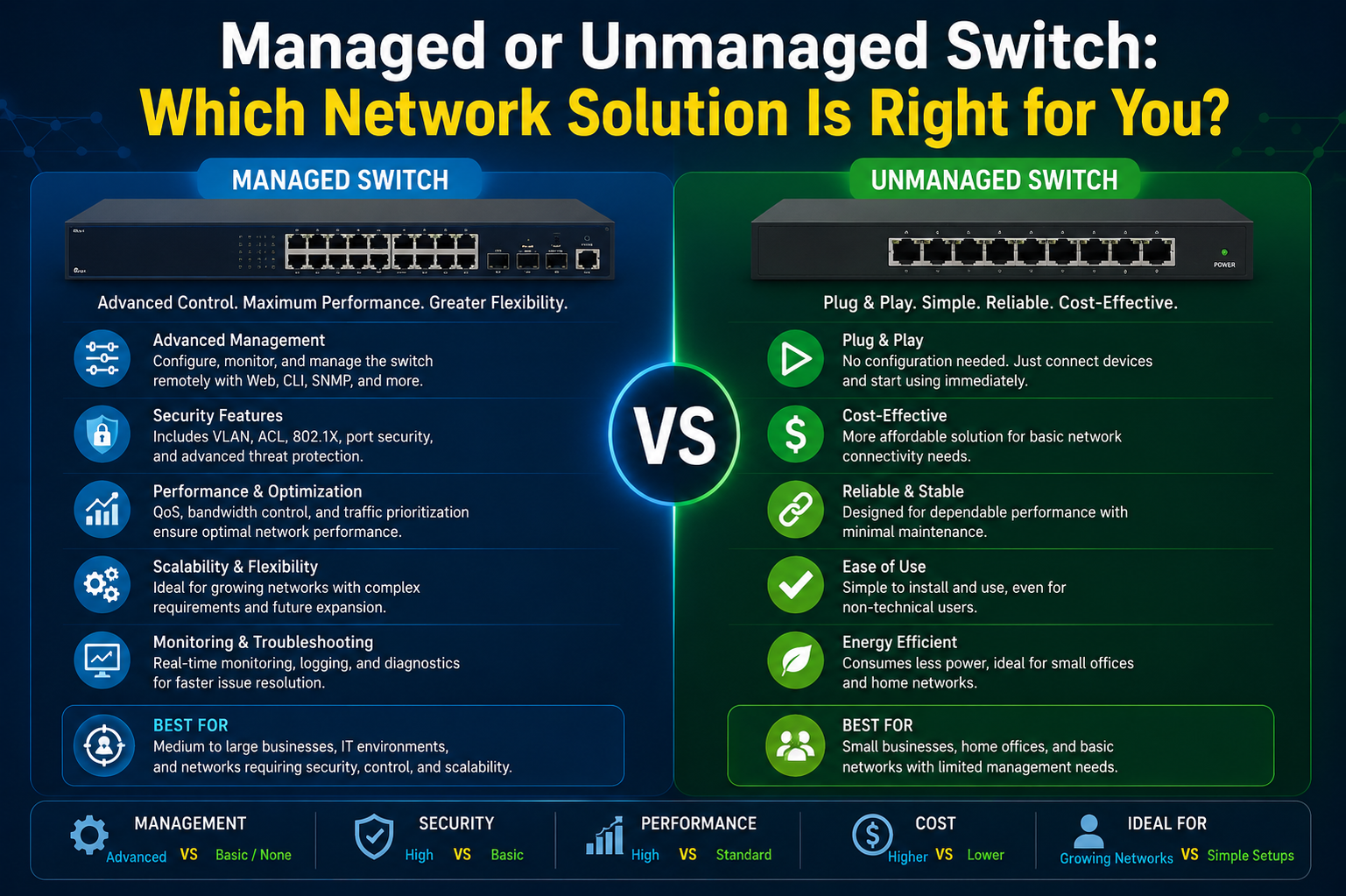
Switches are the foundation of modern networking, responsible for connecting devices within a local area network and ensuring smooth data transfer between them. When comparing managed and unmanaged switches, the key difference lies in the level of control and configuration available. Managed switches are designed for environments where administrators need full visibility and control over network traffic, while unmanaged switches focus on simplicity and ease of use. Both serve the same fundamental purpose, but they are built for very different networking needs and skill levels. Understanding their differences is essential for designing efficient, scalable, and secure networks.
Role of Switches in Network Communication
Switches operate at the data link layer of the networking model and are responsible for forwarding data frames between devices within the same network. They learn the MAC addresses of connected devices and intelligently direct traffic only to the intended destination rather than broadcasting it to all ports. This improves efficiency and reduces unnecessary traffic. Whether managed or unmanaged, all switches perform this basic function, but the way they enhance or extend this capability differs significantly depending on their type and feature set.
What Defines a Managed Switch
A managed switch is a highly configurable networking device that provides administrators with detailed control over how data flows within a network. It includes a management interface that allows configuration through web-based dashboards, command-line tools, or dedicated management software. This control enables advanced customization of network behavior, including traffic prioritization, segmentation, and monitoring. Managed switches are typically used in environments where performance optimization, security enforcement, and scalability are critical requirements.
Advanced Configuration and Administrative Control
One of the most important characteristics of managed switches is the ability to configure and control every aspect of network behavior. Administrators can enable or disable ports, set bandwidth limits, and control traffic flow based on specific rules. This level of control ensures that network resources are used efficiently and that critical applications receive the necessary priority. The ability to remotely manage switches also makes troubleshooting and maintenance significantly easier, especially in large or distributed networks.
VLAN Segmentation for Network Isolation
Virtual LANs, commonly known as VLANs, are one of the most powerful features found in managed switches. VLANs allow a physical switch to be divided into multiple logical networks, each isolated from the others. This means devices within one VLAN cannot directly communicate with devices in another unless routing is configured. VLANs are widely used to improve security, reduce broadcast traffic, and organize networks logically based on departments, functions, or security levels. This segmentation is essential in enterprise environments where data separation is critical.
Quality of Service and Traffic Prioritization
Managed switches also support Quality of Service, which allows certain types of network traffic to be prioritized over others. This is particularly important in environments where latency-sensitive applications such as voice calls, video conferencing, or real-time data systems are used. By assigning priority levels to specific traffic types, managed switches ensure that important data is transmitted smoothly even during periods of high network congestion. This improves performance consistency and user experience across the network.
Spanning Tree Protocol and Loop Prevention
Network loops can cause serious disruptions by creating endless data circulation within a network, leading to congestion and potential failure. Managed switches use Spanning Tree Protocol to prevent such loops by intelligently blocking redundant paths while maintaining backup connections. If the primary path fails, the protocol automatically activates an alternative route. This ensures both stability and redundancy, making managed switches highly reliable for complex network infrastructures where uptime is essential.
Network Monitoring and Diagnostics Capabilities
Another key advantage of managed switches is their ability to monitor network activity in real time. Administrators can access detailed statistics about traffic flow, port usage, error rates, and device connections. This visibility allows for proactive troubleshooting and performance optimization. Logs and diagnostic tools help identify issues such as bottlenecks, misconfigurations, or unauthorized access attempts. This level of insight is crucial for maintaining secure and efficient network operations.
Security Enhancements in Managed Switches
Security is a major concern in modern networking, and managed switches provide several features to enhance protection. Administrators can implement port security, restrict access based on MAC addresses, and create isolated network segments using VLANs. Some managed switches also support access control lists, which define rules for filtering traffic. These features help prevent unauthorized access and reduce the risk of internal threats, making managed switches suitable for enterprise-grade security environments.
What Defines an Unmanaged Switch
An unmanaged switch is a simple networking device designed for immediate use without any configuration. It operates on a plug-and-play basis, meaning devices can be connected directly and will automatically begin communicating with each other. There are no management interfaces, customization options, or advanced features. This simplicity makes unmanaged switches ideal for users who need basic connectivity without technical complexity or administrative overhead.
Ease of Use and Plug-and-Play Functionality
The primary advantage of unmanaged switches is their ease of deployment. Since no configuration is required, they can be installed quickly and used immediately. This makes them especially suitable for home networks, small offices, or temporary setups where advanced control is not necessary. The absence of configuration reduces the chances of setup errors and ensures that even users with minimal networking knowledge can operate them effectively.
Cost Efficiency and Accessibility
Unmanaged switches are generally more affordable compared to managed switches due to their limited feature set. They provide a cost-effective solution for basic networking needs without requiring investment in advanced management capabilities. This makes them accessible to individuals and small businesses that only need simple device connectivity. Despite their simplicity, they still perform the essential function of connecting devices within a local network efficiently.
Limitations of Unmanaged Switch Functionality
While unmanaged switches are simple and cost-effective, they lack advanced features that are often required in larger or more complex networks. There is no ability to configure traffic prioritization, segment networks, or monitor performance in detail. Additionally, they offer no visibility into network activity, which can make troubleshooting difficult. As network demands increase, these limitations can become significant obstacles to scalability and performance optimization.
Typical Use Cases for Unmanaged Switches
Unmanaged switches are best suited for environments where simplicity and affordability are more important than advanced control. They are commonly used in home networks to connect computers, printers, and smart devices. Small businesses may also use them in environments where network traffic is light and security requirements are minimal. Their straightforward nature makes them ideal for situations where users want reliable connectivity without ongoing management needs.
Understanding When Each Switch Type is Appropriate
Choosing between managed and unmanaged switches depends largely on the size, complexity, and goals of the network. Managed switches are ideal for environments that require high performance, strong security, and detailed control over traffic behavior. Unmanaged switches are better suited for basic connectivity needs where simplicity and low cost are priorities. Many larger networks use a combination of both, placing managed switches at the core and unmanaged switches at the edge to balance control and efficiency.
Conclusion
Selecting between a managed and an unmanaged switch ultimately comes down to understanding the requirements of your network and the level of control you need. Managed switches are built for environments where performance, security, and scalability are critical. They provide deep visibility into network traffic, allow precise configuration, and support advanced features like VLANs, Quality of Service, and loop prevention. These capabilities make them suitable for enterprise networks, data centers, and organizations that rely on stable, optimized, and secure communication between large numbers of devices. However, this power comes with added complexity, requiring technical expertise and ongoing administration to fully utilize their potential.
Unmanaged switches, on the other hand, prioritize simplicity and ease of use. They are designed for situations where devices simply need to be connected without any advanced configuration or monitoring. Their plug-and-play nature makes them ideal for home networks, small offices, and basic setups where network demands are minimal. While they lack the advanced features of managed switches, they still perform the essential task of forwarding data efficiently between connected devices. Their affordability and straightforward operation make them a practical choice for users who do not require granular control over their network.
In many real-world scenarios, the most effective approach is a hybrid one, where both types of switches are used together within the same network infrastructure. Managed switches are often placed at the core to handle critical traffic, enforce policies, and maintain security, while unmanaged switches extend connectivity to end devices in less demanding areas. This combination allows organizations to balance cost, complexity, and performance effectively without compromising essential network functionality.
Ultimately, the right choice depends on evaluating current needs as well as future growth. A small network may start with unmanaged switches, but as demands increase, upgrading to managed solutions may become necessary to support expansion, security requirements, and performance optimization. Making an informed decision ensures that the network remains reliable, efficient, and capable of adapting to changing technological demands over time.