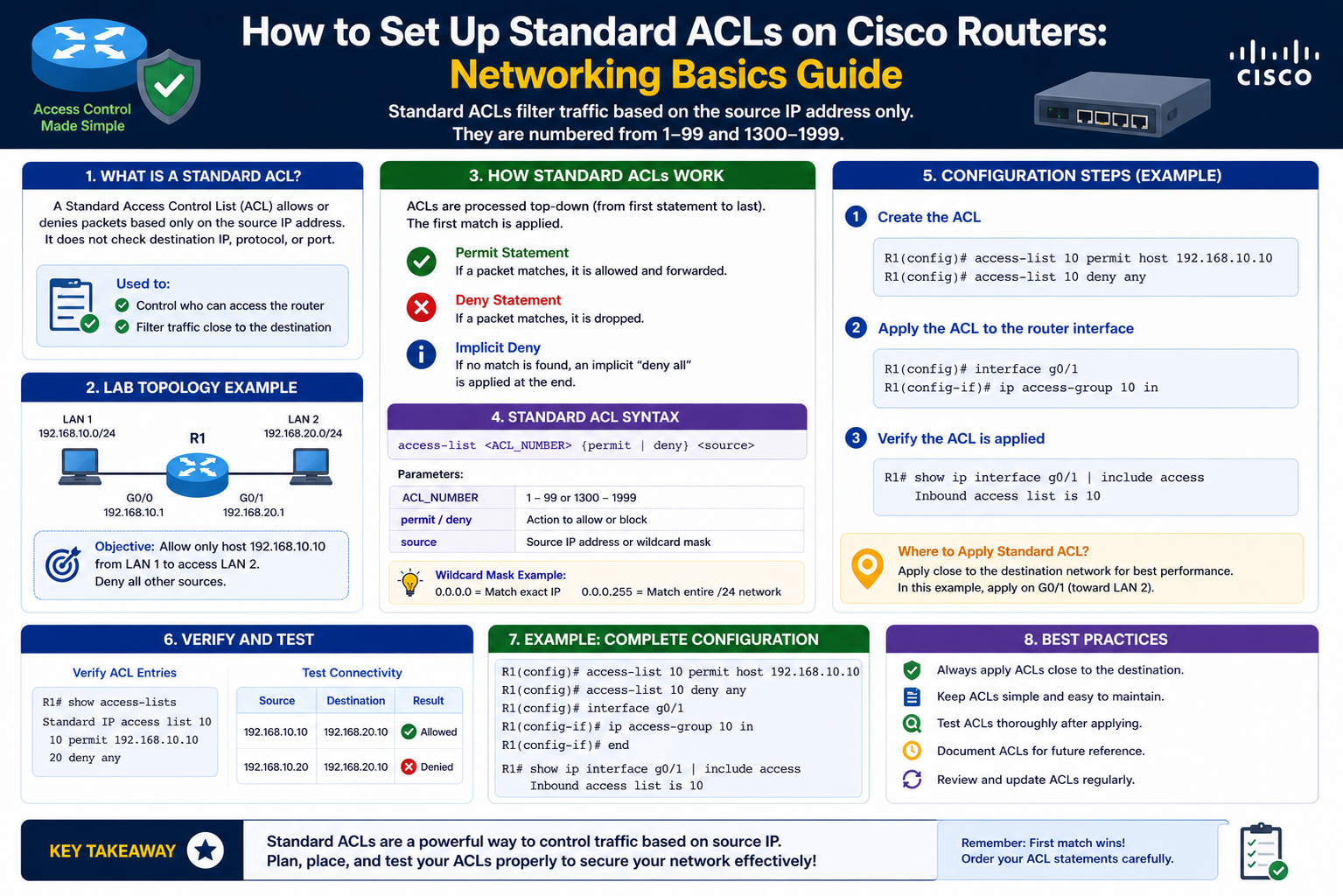
An access control list is a structured set of rules designed to manage and control network traffic flow. These rules define which data packets are allowed to pass through a router and which packets should be blocked. Every packet entering or leaving a router is evaluated against these rules in a sequential manner. The router checks each rule one by one, starting from the top of the list, until a matching condition is found. Once a match occurs, the action defined in that rule determines whether the packet is allowed or denied. If no rule matches the packet, it is automatically rejected by default behavior. This default rejection is an important security mechanism that ensures unwanted traffic does not pass through the network.
The decision-making process inside a router is based on examining packet headers, especially the source and destination IP addresses. These addresses help the router understand where the traffic is coming from and where it is trying to go. Based on this information, the router compares the packet details with ACL rules and takes the appropriate action. This method allows network administrators to maintain strict control over traffic movement across different network segments.
Understanding Packet Filtering and Rule Matching
When a packet reaches a router interface, it carries important information such as the source IP address and the destination IP address. The router reads this information and compares it against the configured access control list. Each rule in the ACL is checked in order until a match is found. If the packet satisfies the condition of a rule, the router immediately applies the action specified in that rule. This action can either be permitting the packet to continue or denying it completely.
The sequential checking process is important because the order of rules directly affects traffic behavior. A rule placed at the top of the list has higher priority compared to rules placed below it. This means network administrators must carefully design the order of ACL entries to ensure correct traffic handling. If rules are not structured properly, legitimate traffic may get blocked or unwanted traffic may be allowed.
The filtering mechanism is highly efficient because it allows routers to make quick decisions without requiring complex processing. By using simple match conditions, routers can handle large volumes of traffic while still enforcing security policies effectively.
Implicit Deny Behavior in ACL Processing
A key concept in access control lists is the implicit deny rule. This rule is not explicitly written in the configuration but is always present at the end of every ACL. It acts as a hidden default rule that blocks any packet that does not match any of the configured permit rules.
This behavior ensures that only explicitly allowed traffic is permitted to pass through the router. If a packet does not meet any condition in the ACL, it is automatically dropped. This makes ACLs a powerful security tool because they follow a default-deny approach rather than a default-allow approach.
The implicit deny rule is especially important in environments where strict security is required. It prevents unexpected or unauthorized traffic from passing through simply because it was not mentioned in the rule set. Even though it is not visible in the configuration, its effect is always active and must be considered when designing ACL policies.
Overview of Standard Access Control Lists
Access control lists are generally categorized into different types based on their filtering capabilities. Standard access control lists are the simplest form and are used primarily for basic traffic filtering. These ACLs focus only on the source IP address of packets and do not consider destination information.
Because of this limitation, standard ACLs are typically used in situations where broad filtering is sufficient. They are often applied closer to the destination network rather than the source network to avoid unnecessary restrictions on traffic flow. Standard ACLs are effective for basic security requirements but lack the flexibility needed for complex filtering scenarios.
Despite their simplicity, they remain widely used because they are easy to configure and require minimal processing resources. Their primary function is to allow or deny traffic based solely on where the traffic originates from, making them suitable for straightforward access control tasks.
Packet Evaluation in Standard ACLs
In standard access control lists, packet evaluation is based only on the source IP address. When a packet arrives at a router, the system checks whether the source IP matches any entry in the ACL. If a match is found, the corresponding action is applied immediately.
This process does not involve checking the destination address, which means all traffic from a permitted source will be allowed regardless of where it is going. Similarly, if a source is denied, all traffic from that source is blocked regardless of its destination.
This simplified filtering approach makes standard ACLs fast and efficient. However, it also limits control over traffic behavior, which is why they are often used in combination with other security methods in more advanced network setups.
Inbound and Outbound Traffic Direction Concept
ACLs can be applied in two directions: inbound and outbound. Understanding these directions is essential for proper configuration.
Inbound traffic refers to packets entering a router interface from an external or internal source. When an ACL is applied in the inbound direction, it filters packets before they are processed by the router. This means the decision to allow or deny traffic is made as soon as the packet arrives at the interface.
Outbound traffic refers to packets that have already been processed by the router and are leaving an interface. When an ACL is applied in the outbound direction, it filters packets after routing decisions have been made.
Choosing the correct direction is important because it affects how early or late in the routing process the filtering occurs. Inbound filtering helps reduce unnecessary processing load, while outbound filtering ensures control over traffic leaving a network segment.
Basic Configuration Mode for ACL Setup
Configuring access control lists begins in the global configuration mode of a router. This mode allows administrators to define system-wide settings, including security policies like ACLs. Once in this mode, specific commands are used to create and manage ACL entries.
The configuration process involves selecting a range of numbers for standard ACLs and then defining rules using permit or deny statements. Each rule includes a source IP address that determines which traffic is affected. Multiple rules can be added to a single ACL, allowing flexible control over network traffic.
Even though multiple entries can exist, each rule must be carefully planned to avoid conflicts or unintended behavior. Proper configuration ensures that only intended traffic is allowed while maintaining network security and performance.
Structure of Standard ACL Rules
Each rule in a standard ACL follows a simple structure that includes the ACL identifier, the action type, and the source IP address. The action type specifies whether the traffic is permitted or denied. The source IP address defines which traffic the rule applies to.
Rules are evaluated in the order they are written, which means placement is critical. A misconfigured rule order can lead to incorrect traffic filtering. Network administrators must therefore carefully design ACL structures to match their intended security policies.
The simplicity of rule structure makes standard ACLs easy to understand and implement. However, this simplicity also requires careful planning to ensure accuracy and effectiveness in real-world networks.
Wildcard Mask Concept in Access Control Lists
Wildcard masks are used in ACL configuration to define ranges of IP addresses. Unlike subnet masks, wildcard masks work in the opposite manner. They help specify which parts of an IP address should be matched exactly and which parts can vary.
A wildcard mask is calculated by subtracting the subnet mask from a fixed value of all ones in binary form. This results in a flexible matching system that allows administrators to define broader or narrower address ranges.
Wildcard masks are essential when configuring ACLs for networks that require group-based filtering. They allow a single rule to apply to multiple IP addresses instead of configuring individual entries for each address.
Applying Wildcard Masks in Standard ACLs
When using wildcard masks in ACL configuration, the administrator specifies both the IP address and the corresponding mask. This combination allows the router to match a range of addresses instead of a single host.
For example, a network range can be defined using a wildcard mask so that all devices within that range are affected by the same rule. This reduces configuration complexity and improves scalability in larger networks.
Correct use of wildcard masks ensures efficient traffic control and minimizes the need for repetitive configuration entries. It also helps in maintaining organized and manageable ACL structures in complex environments.
Assigning Access Control Lists to Interfaces
After creating an ACL, it must be applied to a router interface to become active. This step links the defined rules to actual network traffic flow. Without assignment, the ACL remains inactive and does not affect any traffic.
The assignment process involves selecting the interface and specifying whether the ACL should operate in inbound or outbound mode. This determines where in the traffic flow the filtering will take place.
Proper assignment is crucial because it ensures that the ACL is applied to the correct network segment. Incorrect assignment may result in traffic not being filtered as intended or unnecessary blocking of legitimate traffic.
Standard Named Access Control Lists Introduction
Standard named access control lists provide an alternative to numbered ACLs. Instead of using numeric identifiers, administrators can assign descriptive names to ACLs. This improves readability and makes configuration easier to manage.
Named ACLs function in the same way as numbered ACLs but offer better clarity, especially in large networks where multiple ACLs are used. The naming approach helps administrators quickly identify the purpose of each ACL without remembering numeric values.
This method is particularly useful in environments where configuration documentation and readability are important for network management and troubleshooting.
Introduction to Access Control Lists in Networking
An access control list is a structured set of rules used to control and filter network traffic passing through a router. These rules define whether specific packets are allowed or denied based on defined conditions. Every packet that enters or leaves a router interface is examined against the ACL rules in a sequential order. The router begins checking from the first rule and continues until a matching rule is found. Once a match occurs, the action defined in that rule is immediately applied to the packet. If no rule matches the packet, it is automatically denied by default behavior, which plays an important role in network security by preventing unauthorized access.
The decision-making process relies heavily on packet header information, especially the source and destination IP addresses. These addresses indicate where the packet originates and where it is intended to go. The router uses this information to compare against ACL entries and determine the correct action. This process ensures that only approved traffic is allowed to move across the network, while unwanted or suspicious traffic is blocked efficiently.
Understanding Packet Evaluation and Rule Matching
When a packet arrives at a router interface, it carries essential addressing information that is used for decision-making. The router reads the source IP address and compares it against the configured ACL rules. Each rule is evaluated one by one in order, and the first matching rule determines the outcome for that packet. If the packet matches a permit rule, it is allowed to proceed. If it matches a deny rule, it is immediately blocked.
The order of ACL rules is extremely important because rules at the top of the list are processed first. This means higher priority is given to earlier entries. If rules are not arranged correctly, important traffic may be blocked unintentionally or unauthorized traffic may be allowed. Proper planning and organization of ACL entries is therefore essential for effective traffic control.
This sequential evaluation method allows routers to make fast decisions without complex processing. It also ensures predictable traffic behavior when ACLs are properly configured.
Implicit Deny Concept in Access Control Lists
A key feature of access control lists is the implicit deny rule, which exists at the end of every ACL without being explicitly written. This hidden rule automatically blocks any packet that does not match any of the defined permit rules in the list. It ensures a default-deny security model, meaning only explicitly allowed traffic is permitted.
This mechanism is important because it prevents unintended traffic from passing through the network. Even if a packet does not match any rule, it will still be denied due to this implicit behavior. Network administrators must always keep this in mind when designing ACL configurations because missing permit rules can lead to unexpected traffic blocking.
The implicit deny rule strengthens network security by ensuring that only approved traffic is allowed while everything else is automatically rejected.
Overview of Standard Access Control Lists
Standard access control lists are one of the simplest forms of ACLs used in networking. They focus only on filtering traffic based on the source IP address of packets. Unlike more advanced ACL types, they do not consider destination addresses or protocol types. This makes them lightweight and easy to configure but limited in control capability.
Because of their simplicity, standard ACLs are usually applied closer to the destination network rather than the source. This helps avoid unnecessarily blocking traffic that might be legitimate for other destinations. Standard ACLs are mainly used when basic filtering is sufficient to meet security requirements.
They are widely used in smaller or less complex network environments where advanced filtering is not required. Their simplicity also makes them easier to troubleshoot and maintain.
Packet Processing in Standard ACLs
In standard ACL processing, the router focuses only on the source IP address of each packet. When a packet reaches the router, the system checks whether its source matches any entry in the ACL. If a match is found, the corresponding action is executed immediately.
Since destination information is not considered, all traffic from an allowed source is permitted regardless of where it is going. Similarly, if a source is denied, all traffic from that source is blocked completely. This makes standard ACLs broad in scope but limited in precision.
This approach allows faster processing because fewer checks are required. However, it also reduces flexibility, which is why standard ACLs are often combined with other security methods in more complex network environments.
Inbound and Outbound Traffic Direction
Access control lists can be applied in two directions: inbound and outbound. Understanding these directions is essential for proper configuration and traffic control.
Inbound ACLs filter packets as they enter a router interface. This means decisions are made before the router processes the packet further. Inbound filtering is useful for blocking unwanted traffic early, reducing processing load on the router.
Outbound ACLs filter packets after they have been processed by the router and are leaving an interface. This allows control over traffic that is exiting the network. Outbound filtering is often used to enforce policies on outgoing data.
Choosing the correct direction ensures that traffic is filtered at the appropriate stage of routing, improving efficiency and control.
Basic Configuration of Standard ACLs
Standard ACL configuration begins in global configuration mode on a router. This mode allows administrators to define system-wide settings, including security policies. Once in this mode, ACL rules are created using permit and deny statements.
Each ACL is identified by a number within a specific range. Rules within the ACL define which source IP addresses are allowed or blocked. Multiple rules can be added, allowing administrators to build structured filtering policies.
Proper planning is important during configuration to ensure rules are ordered correctly. Incorrect ordering can lead to unintended network behavior, such as blocking valid traffic or allowing unwanted traffic.
Structure of ACL Rules
Each ACL rule follows a simple structure that includes an identifier, an action, and a source IP address. The action determines whether the traffic is permitted or denied. The source IP address specifies which traffic the rule applies to.
Rules are processed sequentially, meaning the order of entries directly impacts how traffic is handled. This makes careful rule placement essential for proper functionality. A well-structured ACL ensures efficient and accurate traffic filtering.
This simple structure allows network administrators to quickly configure and understand ACL behavior without requiring complex syntax or commands.
Wildcard Mask Concept in ACLs
Wildcard masks are used in ACL configuration to define IP address ranges. They work opposite to subnet masks by indicating which parts of an IP address should be ignored and which should be matched exactly. This allows flexible matching of multiple addresses using a single rule.
Wildcard masks are calculated by subtracting the subnet mask from a full-range value. This creates a pattern that defines which bits are significant and which are not. This method is useful for grouping multiple IP addresses under one rule.
Using wildcard masks helps reduce configuration complexity and improves scalability in larger networks where multiple devices need to be controlled under a single policy.
Applying Wildcard Masks in Configuration
When configuring ACL rules, wildcard masks are added alongside IP addresses to define address ranges. This allows a single rule to cover multiple devices or subnets. It simplifies configuration and reduces the number of entries required in an ACL.
This method is especially useful in enterprise environments where managing individual IP addresses would be inefficient. Wildcard masks help administrators apply consistent policies across entire network segments.
Correct use of wildcard masks ensures efficient traffic filtering and reduces configuration errors.
Assigning ACLs to Interfaces
After creating an ACL, it must be applied to a router interface to become active. This step connects the defined rules to actual network traffic flow. Without assignment, the ACL remains inactive and has no effect.
The ACL can be applied in either inbound or outbound direction depending on the desired filtering location. Proper assignment ensures that traffic is controlled at the correct point in the network.
This step is essential because it activates the ACL and enforces the defined security rules on live traffic.
Standard Named ACLs Overview
Standard named ACLs provide an alternative to numbered ACLs by allowing descriptive names instead of numeric identifiers. This improves readability and makes configuration easier to manage, especially in large networks.
Named ACLs function the same way as numbered ACLs but offer better organization. They help administrators quickly identify the purpose of each ACL without needing to remember numbers.
This approach improves clarity and simplifies network management, especially when multiple ACLs are used across different interfaces.
Configuration of Standard Named ACLs
Standard named ACLs are created using a naming method instead of numeric identifiers. Once created, rules are added in a similar way using permit and deny statements with source IP addresses.
This method provides better structure and improves readability in configuration files. It is especially useful in environments where multiple ACLs are used for different purposes.
Named ACLs maintain the same functionality as numbered ACLs while offering improved manageability.
Assigning Standard Named ACLs
Once a named ACL is created, it must be assigned to an interface just like a numbered ACL. The only difference is that the name is used instead of a number during assignment.
This step activates the ACL and applies it to network traffic passing through the selected interface. Direction must still be specified as inbound or outbound depending on the filtering requirement.
Proper assignment ensures that the named ACL effectively controls traffic as intended.
Working Logic of Standard ACL Evaluation in Routers
The working process of standard access control lists is based on a simple but strict evaluation method. When a packet arrives at a router interface, the router immediately begins comparing the packet’s source IP address with the entries defined in the ACL. This comparison is done in a sequential manner, meaning the router checks each rule from top to bottom until it finds a match.
If a matching rule is found early in the list, the router stops further checking and applies the action defined in that rule. This immediate decision-making process helps improve performance and reduces processing time. However, it also means that rule placement is extremely important because earlier entries have higher priority than later ones.
This evaluation mechanism ensures predictable traffic behavior as long as the ACL is structured correctly. It also provides a reliable method for controlling network access without requiring complex logic or processing overhead.
Importance of Rule Ordering in ACL Design
The order in which ACL rules are written has a direct impact on how traffic is handled. Since the router processes rules from top to bottom, the first matching rule determines the outcome. This means that more specific rules should always be placed before general rules.
If a general rule is placed first, it may match a wide range of traffic and prevent more specific rules from being evaluated. This can lead to unintended network behavior, such as blocking legitimate traffic or allowing unwanted access.
Proper rule ordering ensures that critical traffic is handled correctly and security policies are enforced as intended. It also helps in maintaining clarity and reducing configuration errors, especially in larger network environments where multiple rules are used.
Common Mistakes in Standard ACL Configuration
One of the most common mistakes in configuring standard ACLs is incorrect rule placement. Since the evaluation process is sequential, even a small mistake in order can lead to significant traffic issues. Another frequent mistake is not considering the implicit deny rule, which can unintentionally block important traffic if permit rules are missing.
Network administrators may also forget that standard ACLs only filter based on source IP addresses. This limitation can lead to overly broad filtering decisions if not properly understood. In some cases, administrators may apply ACLs in the wrong direction, which can cause traffic to be filtered at the wrong stage of processing.
Avoiding these mistakes requires careful planning, proper documentation, and a clear understanding of how ACLs operate within the network.
Advanced Behavior of Implicit Deny in Traffic Flow
The implicit deny rule plays a critical role in how traffic is handled when no matching rule is found in an ACL. This hidden rule ensures that any packet not explicitly permitted is automatically blocked. It acts as a final security layer that enforces a strict default-deny policy.
In practical terms, this means that even if an ACL does not contain any deny statements, traffic will still be blocked if it does not match a permit rule. This behavior is essential for maintaining network security and preventing unauthorized access.
Because the implicit deny rule is always active, administrators must ensure that all required traffic is explicitly permitted in the ACL configuration. Failure to do so can result in unexpected connectivity issues.
Impact of ACL Placement on Network Performance
The placement of an ACL within a network topology can significantly impact both performance and security. When ACLs are applied closer to the source of traffic, unwanted packets are filtered early, reducing unnecessary processing on downstream devices. This improves overall network efficiency.
When ACLs are placed closer to the destination, they allow more flexibility in traffic handling but may result in increased processing load on intermediate devices. Choosing the correct placement depends on the specific network design and security requirements.
Proper placement ensures that traffic is filtered at the most efficient point, balancing performance and security effectively.
Standard ACL Filtering Limitations in Real Networks
Standard ACLs are limited in functionality because they only examine the source IP address of packets. They do not provide control over destination addresses, protocols, or port numbers. This limitation makes them less suitable for complex filtering scenarios.
In real-world networks, this means standard ACLs are often used for basic access control rather than detailed security policies. They are effective for restricting traffic from specific sources but cannot differentiate between different types of applications or services.
Due to these limitations, standard ACLs are usually combined with other security mechanisms to achieve more granular control over network traffic.
Traffic Direction Strategy in ACL Deployment
Choosing between inbound and outbound ACL deployment is an important design decision. Inbound ACLs are typically used to block unwanted traffic early in the process, preventing it from entering the network. This reduces unnecessary load on the router and improves performance.
Outbound ACLs are used to control traffic leaving the network. This is useful for enforcing policies on data transmission, ensuring that only approved traffic exits the network infrastructure.
A well-designed network often uses a combination of both inbound and outbound ACLs to achieve balanced traffic control and security enforcement.
Scalability Considerations in ACL Configuration
As networks grow, ACL configuration becomes more complex. Standard ACLs must be carefully managed to ensure they remain scalable and easy to maintain. Poorly designed ACLs can become difficult to manage over time, especially when multiple rules are added without proper structure.
Using clear rule definitions and consistent formatting helps improve scalability. Administrators must also regularly review and update ACLs to ensure they reflect current network requirements.
Scalability is an important factor in maintaining long-term network performance and security, especially in environments with frequent changes.
Role of ACLs in Basic Network Security
Access control lists play a fundamental role in securing networks by controlling traffic flow between devices and networks. Standard ACLs provide a basic level of protection by filtering traffic based on source IP addresses.
This helps prevent unauthorized devices from accessing sensitive network areas. Even though they are simple in design, they form an important part of a layered security approach.
When combined with other security measures, ACLs help create a more secure and controlled networking environment.
Understanding Traffic Flow Decision Process
The decision process in ACL evaluation follows a structured path. First, the packet enters the router interface. Next, the router checks the ACL rules sequentially. If a match is found, the corresponding action is applied immediately. If no match is found, the implicit deny rule blocks the packet.
This structured flow ensures consistent and predictable behavior in network traffic management. It also allows administrators to design precise traffic control policies based on specific network requirements.
Understanding this flow is essential for effective ACL configuration and troubleshooting.
Effect of Multiple ACL Entries on Processing
When multiple entries are present in an ACL, each rule adds to the decision-making process. The router must evaluate each rule in sequence until a match is found. While modern routers are optimized for performance, poorly structured ACLs with too many unnecessary entries can still impact efficiency.
Organizing rules logically helps reduce processing time and improves readability. Grouping similar rules together also makes it easier to manage and update configurations when needed.
Efficient ACL design ensures that performance remains stable even as the number of rules increases.
Relationship Between ACLs and Routing Decisions
ACLs work alongside routing decisions but serve a different purpose. Routing determines where a packet should go, while ACLs determine whether the packet is allowed to move at all. This separation of functions allows routers to both direct and control traffic effectively.
ACLs are applied after routing decisions in some cases, but their primary role is to filter traffic based on defined policies. This ensures that only authorized traffic follows routing paths within the network.
Understanding this relationship is important for designing efficient and secure network infrastructures.
Security Benefits of Standard ACL Implementation
Standard ACLs provide essential security benefits by restricting traffic based on source IP addresses. This helps prevent unauthorized access from known or unknown sources. Even though they are simple, they are effective in controlling basic access to network resources.
They also help reduce exposure to unwanted traffic by limiting which devices can communicate within the network. This adds an extra layer of protection when combined with other security tools.
Proper implementation of ACLs contributes significantly to overall network security and stability.
Operational Behavior in Real-Time Traffic Filtering
In real-time network environments, ACLs continuously evaluate incoming and outgoing packets. This constant processing ensures that only authorized traffic is allowed to pass through the network at any given moment.
The router performs these checks quickly to avoid delays in data transmission. Even under heavy traffic conditions, ACLs maintain consistent behavior as long as they are properly optimized.
This real-time filtering capability makes ACLs a fundamental component of network traffic management systems.
Troubleshooting Standard ACL Configuration Issues
Troubleshooting standard access control lists requires a clear understanding of how traffic is being filtered and where the issue might be occurring. When network connectivity problems arise, one of the first areas to check is the ACL configuration on relevant interfaces. Since ACLs evaluate traffic based on source IP addresses, even a small mistake in an entry can block legitimate communication.
A common troubleshooting step is verifying whether the correct ACL is applied to the intended interface and in the correct direction. If an ACL is applied inbound when it should be outbound, or vice versa, traffic behavior will not match expectations. Another important check involves reviewing the order of rules, since the first matching rule determines the result. A misplaced deny rule above a permit rule can unintentionally block valid traffic.
It is also essential to confirm that all necessary source IP addresses are explicitly permitted. Due to the implicit deny behavior, any missing permit statement can lead to unexpected traffic blockage. Careful inspection of each rule helps identify where the filtering logic is failing.
Verifying ACL Operation and Packet Flow
Verification of ACL operation involves checking how packets are actually being processed by the router. Administrators often review interface configurations to confirm whether ACLs are correctly attached. Monitoring tools can also help observe whether packets are being permitted or denied as expected.
Understanding packet flow through the router is critical. A packet enters an interface, is checked against ACL rules in order, and then either allowed or dropped based on the first match. If troubleshooting shows that packets are being dropped unexpectedly, it usually indicates either a missing permit rule or incorrect rule placement.
Proper verification ensures that ACL behavior aligns with network security policies and intended traffic flow design.
Best Practices for Standard ACL Configuration
Following best practices when configuring standard ACLs helps ensure efficiency, security, and maintainability. One important practice is placing ACLs as close to the destination as possible when using standard ACLs. Since they only filter based on source IP address, placing them too close to the source may unintentionally block traffic to multiple destinations.
Another best practice is maintaining clear documentation of each ACL entry. This includes understanding why each rule exists and what traffic it is meant to control. Without proper documentation, ACLs can become difficult to manage over time.
It is also recommended to keep ACLs as simple as possible. Overly complex rule sets can increase the risk of configuration errors and make troubleshooting more difficult. Regular review and cleanup of unused rules help maintain a clean and efficient configuration.
Security Role of Standard ACLs in Network Design
Standard ACLs play an important role in foundational network security. They provide a basic method of restricting access to network resources by controlling traffic based on source IP addresses. This helps prevent unauthorized systems from communicating with sensitive parts of the network.
Although they are not advanced filtering tools, they are still effective in controlling general access patterns. They are often used as part of a layered security strategy, where multiple security mechanisms work together to protect the network.
By limiting access at a basic level, standard ACLs reduce exposure to unnecessary traffic and help maintain a more controlled network environment.
Performance Considerations in ACL Usage
The performance impact of ACLs depends on how they are configured and where they are applied. Standard ACLs are generally lightweight, but inefficient configurations can still affect router performance. Large ACLs with many entries require more processing as each packet must be evaluated against multiple rules.
Optimizing ACL structure helps reduce processing overhead. Placing frequently matched rules at the top of the list improves efficiency because fewer comparisons are needed for most traffic. This reduces latency and improves overall network responsiveness.
Properly designed ACLs ensure that security does not come at the cost of performance degradation.
Real-World Use Cases of Standard ACLs
In real-world networking environments, standard ACLs are commonly used for basic traffic control tasks. One typical use case is restricting access to specific network segments based on source IP addresses. This helps control which devices can communicate with sensitive systems.
They are also used in scenarios where simple filtering is sufficient, such as limiting administrative access to network devices. In smaller networks, standard ACLs may be the primary method of traffic control due to their simplicity.
Although more advanced ACL types exist, standard ACLs remain relevant because they provide a quick and efficient way to implement basic security policies.
Interaction Between ACLs and Network Policies
Access control lists are often used to enforce network policies defined by an organization. These policies determine which users or systems are allowed to access specific resources. Standard ACLs help translate these policies into technical rules that routers can enforce.
For example, a policy may require that only certain internal systems are allowed to access a server. A standard ACL can enforce this by permitting traffic only from approved source IP addresses.
This relationship between policy and configuration ensures that business rules are effectively implemented at the network level.
Maintenance and Updates of ACL Configurations
Maintaining ACL configurations is an ongoing process that involves regular updates and reviews. As network environments change, ACL rules must be adjusted to reflect new requirements. Devices may be added or removed, and security policies may evolve over time.
Failing to update ACLs can result in outdated rules that either block legitimate traffic or allow unwanted access. Regular audits help ensure that ACLs remain accurate and effective.
Maintenance also includes removing redundant or unused rules to keep configurations clean and efficient. This reduces complexity and improves manageability.
Impact of ACL Misconfiguration on Network Behavior
Misconfigured ACLs can have significant effects on network behavior. Incorrect rule placement, missing permit statements, or wrong interface assignments can lead to service disruptions. In some cases, entire sections of a network may become unreachable due to ACL errors.
Because of the implicit deny rule, even small mistakes can cause major connectivity issues. This makes careful configuration and testing extremely important before applying ACLs in production environments.
Understanding the potential impact of misconfiguration helps administrators take preventive steps to avoid network downtime.
Role of Standard ACLs in Access Control Strategy
Standard ACLs form the foundation of access control strategies in many networks. They provide a simple yet effective way to restrict traffic based on source identity. While they may not offer advanced filtering options, they are still valuable in controlling basic access.
In combination with extended ACLs and other security tools, they contribute to a multi-layered security approach. This layered approach enhances overall network protection by addressing different types of threats at different levels.
Standard ACLs remain a key component of this strategy due to their simplicity and efficiency.
Efficiency of Sequential Packet Processing
The sequential processing model used by ACLs ensures straightforward decision-making. Each packet is evaluated step by step against the rule list until a match is found. This eliminates the need for complex computations and allows routers to handle traffic efficiently.
However, this also means that poorly structured ACLs can slow down processing if too many unnecessary rules are included. Efficient rule design ensures that most traffic matches early in the list, reducing processing time.
This balance between simplicity and performance is one of the reasons ACLs remain widely used in networking.
Importance of Consistent ACL Design
Consistency in ACL design is essential for maintaining clarity and reliability. Using standardized naming conventions, structured rule ordering, and clear documentation helps ensure that configurations are easy to understand.
Consistent design also reduces the likelihood of errors during updates or troubleshooting. When multiple administrators manage the same network, consistency becomes even more important for collaboration and maintenance.
A well-structured ACL design improves long-term manageability and reduces operational complexity.
Conclusion
Standard access control lists are a fundamental part of network security and traffic management. They provide a simple yet powerful method for controlling access based on source IP addresses. Through sequential evaluation, implicit deny behavior, and flexible configuration options, they allow administrators to enforce basic security policies effectively. When properly designed, applied, and maintained, standard ACLs contribute significantly to stable and secure network operations.