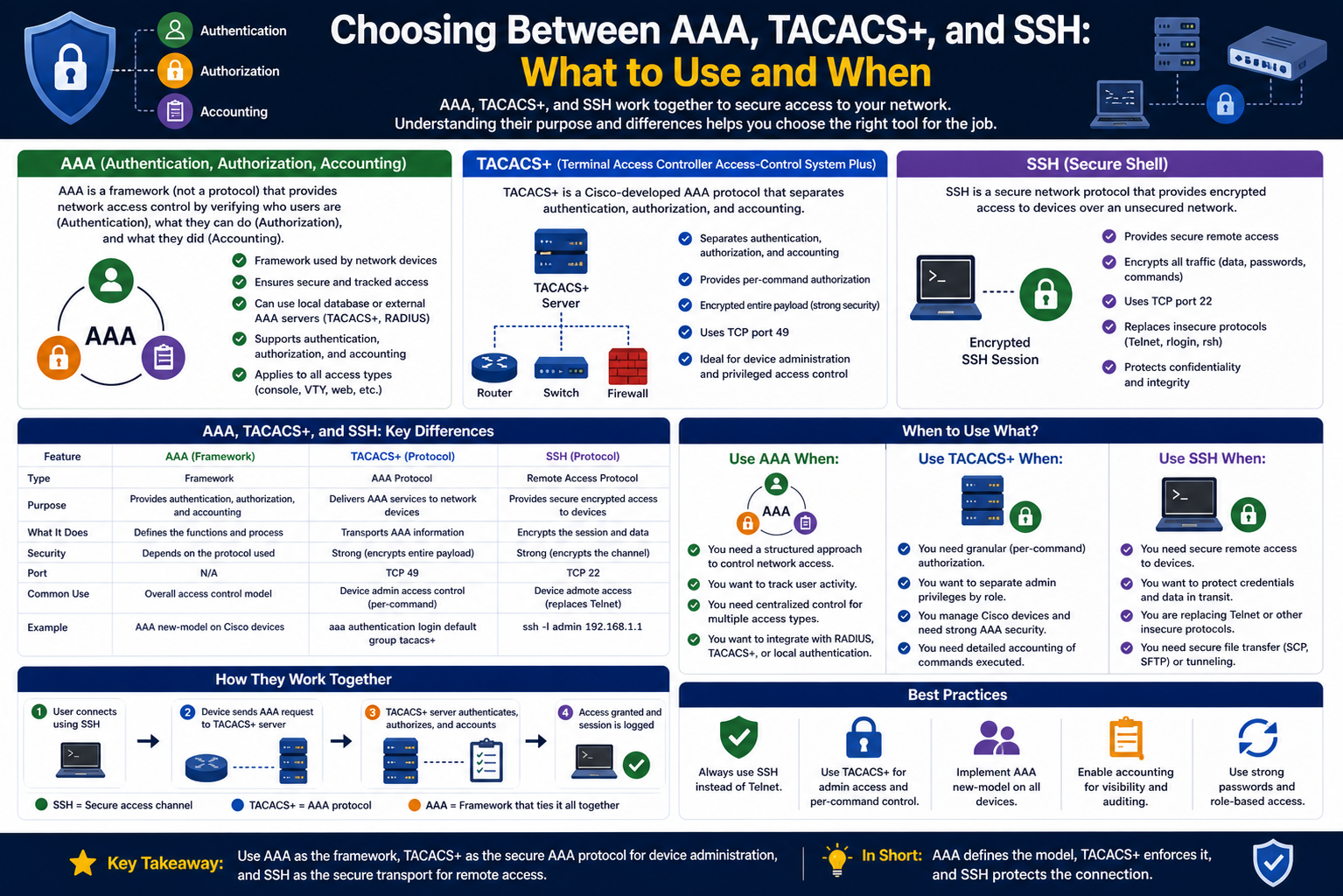
In any structured network environment, controlling who can access devices and what they can do is not optional—it is essential. Organizations rely on layered security approaches to ensure that only verified users gain entry, their actions are limited to approved tasks, and every activity is recorded for accountability. This is where the combined use of AAA, TACACS+, and SSH becomes highly relevant. These technologies are not isolated solutions but interconnected components that strengthen administrative control and secure communication across network devices. When implemented correctly, they transform a vulnerable infrastructure into a controlled and auditable environment.
Breaking Down AAA and Its Importance
AAA stands for Authentication, Authorization, and Accounting, and it forms the backbone of access control in networking. Authentication ensures that users are who they claim to be by validating credentials such as usernames and passwords. Authorization determines what an authenticated user is allowed to do, defining permissions and access levels. Accounting tracks user activity, creating logs that can be used for auditing, monitoring, and troubleshooting. Together, these three functions provide a comprehensive framework that not only protects systems from unauthorized access but also enforces operational discipline across the network.
Centralized Control with AAA Servers
An AAA server acts as the central authority that enforces authentication, authorization, and accounting policies. Instead of configuring access rules on every individual device, administrators can manage everything from a single point. This centralization reduces configuration errors, improves scalability, and enhances security consistency across the infrastructure. When a user attempts to access a device, the request is forwarded to the AAA server, which verifies credentials, applies policies, and logs the activity. This streamlined process simplifies administration while ensuring strict control over network access.
Introduction to TACACS+ and Its Purpose
TACACS+ is a protocol designed to support AAA services with a strong focus on security and flexibility. It enables centralized management of user access to network devices such as routers and switches. Unlike earlier protocols, TACACS+ was built to address the growing need for detailed control and secure communication in complex environments. Its design allows administrators to define precise access rules, making it particularly suitable for organizations that require strict command-level control over user actions.
Evolution from Legacy Protocols to TACACS+
The development of TACACS+ represents an evolution from older access control methods that lacked robust security features. Earlier protocols provided basic authentication but often fell short in terms of encryption and flexibility. TACACS+ improved upon these limitations by introducing full-packet encryption and separating the AAA functions. This evolution reflects the increasing demand for more secure and manageable network access solutions as infrastructures became larger and more complex.
Enhanced Security Through Full Encryption
One of the defining characteristics of TACACS+ is its ability to encrypt the entire communication packet. This means that not only user credentials but also all associated data are protected during transmission. This level of encryption significantly reduces the risk of interception and unauthorized access. In environments where sensitive administrative commands are transmitted, full encryption ensures that even if traffic is captured, it cannot be easily interpreted or misused.
Granular Authorization and Command Control
TACACS+ provides a high level of control by allowing administrators to specify exactly which commands a user can execute. This granular authorization is particularly useful in environments where different users have different responsibilities. For example, a junior administrator might be allowed to view configurations but not modify them, while a senior administrator has full access. By enforcing such detailed permissions, TACACS+ minimizes the risk of accidental or malicious changes to critical systems.
Separation of Authentication, Authorization, and Accounting
Unlike some other protocols, TACACS+ separates the three components of AAA. This separation provides greater flexibility in how access control is implemented. Each function can be managed independently, allowing organizations to tailor their security policies according to specific requirements. This modular approach enhances both control and clarity, making it easier to troubleshoot issues and refine access policies over time.
Scalability for Expanding Network Environments
As networks grow, managing access across multiple devices becomes increasingly challenging. TACACS+ addresses this challenge by supporting centralized control, which scales efficiently with the size of the network. Whether managing a small setup or a large enterprise infrastructure, administrators can apply consistent policies without the need for repetitive configurations on individual devices. This scalability makes TACACS+ a practical choice for evolving network environments.
Detailed Logging and Activity Monitoring
Accounting is a critical aspect of network security, and TACACS+ excels in this area by providing detailed logs of user activity. Every command executed by a user can be recorded, creating a comprehensive audit trail. These logs are invaluable for troubleshooting, compliance, and forensic analysis. In the event of a security incident, administrators can review logs to identify what actions were taken, by whom, and at what time.
Centralized Management for Operational Efficiency
Managing access from a single point not only improves security but also enhances operational efficiency. Administrators can quickly update policies, add or remove users, and enforce changes across the entire network without manual intervention on each device. This centralized approach reduces administrative overhead and ensures that security policies are applied consistently.
How TACACS+ Communicates Within the Network
TACACS+ operates using a client-server model. Network devices such as routers act as clients, while the TACACS+ server performs the AAA functions. When a user attempts to log in, the device sends a request to the server, which processes the authentication and returns a response. This communication typically occurs over a reliable transport protocol, ensuring that data is transmitted accurately and securely between the client and server.
Step-by-Step Flow of TACACS+ Operations
The process begins with authentication, where user credentials are verified. Once the user is authenticated, the server moves to authorization, determining what actions the user is permitted to perform. Finally, accounting records the user’s activities, creating logs for future reference. This structured flow ensures that access is not only granted securely but also monitored continuously.
The Role of SSH in Secure Remote Access
SSH, or Secure Shell, is a protocol used to securely access and manage network devices over an unsecured network. It encrypts the entire session, protecting both login credentials and command execution. SSH is widely used for remote administration because it provides a secure alternative to older protocols that transmit data in plain text. By integrating SSH with AAA and TACACS+, organizations can ensure that remote access is both secure and controlled.
Why SSH Is Preferred Over Legacy Protocols
Older remote access methods lack encryption, making them vulnerable to interception. SSH addresses this weakness by encrypting all communication between the client and the device. This ensures that sensitive information, such as passwords and configuration commands, cannot be easily captured or exploited. As a result, SSH has become the standard for secure remote management.
Combining TACACS+ and SSH for Maximum Security
When TACACS+ and SSH are used together, they create a powerful security framework. SSH secures the communication channel, while TACACS+ manages authentication, authorization, and accounting. This combination ensures that only authorized users can access devices, their actions are restricted according to policy, and all activities are logged. Together, they provide both security and accountability.
Preparing a Device for Secure Integration
Integrating a new device into a secure network requires careful preparation. The device must be configured to support secure access methods and communicate with the AAA server. This includes setting up authentication credentials, enabling secure protocols, and defining access policies. Proper preparation ensures that the device can be integrated quickly and securely without exposing vulnerabilities.
Establishing Initial Access Controls
Before connecting a device to a centralized system, it is important to establish basic access controls. This includes creating a secure administrative account and setting strong credentials. These initial controls act as a safety net, allowing administrators to access the device even if the centralized system is temporarily unavailable.
Importance of Backup Authentication Methods
Relying solely on a centralized server can create risks if the server becomes unreachable. To mitigate this, a backup authentication method is often configured locally on the device. This ensures that administrators can still access and manage the device during outages, maintaining operational continuity.
Setting the Foundation for Secure Communication
Secure communication requires the establishment of cryptographic keys and domain settings. These elements enable encrypted protocols like SSH to function properly. Without them, secure remote access cannot be established. Setting up this foundation is a critical step in preparing a device for integration into a secure network environment.
Transitioning from an Unsecured to a Secured State
A newly deployed device often starts with minimal or no security configuration. Transitioning it into a secured state involves enabling AAA, configuring TACACS+, and restricting access to secure protocols like SSH. This transformation can be achieved efficiently when the process is well understood and properly executed.
Ensuring Controlled Access Through Policy Enforcement
Once integrated, the device must enforce access policies defined by the AAA server. These policies determine who can log in, what actions they can perform, and how their activities are recorded. Consistent policy enforcement is essential for maintaining security and preventing unauthorized actions.
Building Confidence Through Testing and Verification
After configuration, testing is crucial to ensure that everything works as expected. This includes verifying authentication, confirming that authorization policies are enforced, and checking that accounting logs are generated. Testing provides confidence that the system is secure and functioning correctly.
Monitoring and Debugging for Ongoing Reliability
Even after successful deployment, continuous monitoring is necessary to maintain reliability. Debugging tools can be used to observe authentication processes and identify potential issues. Regular monitoring helps detect anomalies վաղ and ensures that the system continues to operate securely.
Creating a Strong Security Posture with Integrated Technologies
The integration of AAA, TACACS+, and SSH creates a comprehensive security framework that addresses multiple aspects of network protection. By combining centralized control, detailed authorization, secure communication, and thorough logging, organizations can achieve a high level of security and operational efficiency. This integrated approach not only protects network resources but also simplifies management and enhances overall reliability.
Strengthening Access Control with Method Lists and Policy Design
Once AAA is enabled on a network device, the next critical step is defining how authentication should actually occur. This is achieved through method lists, which act as instructions that tell the device where and how to verify user credentials. A method list can prioritize a centralized server such as TACACS+ while keeping a local database as a fallback option. This layered approach ensures resilience, allowing administrators to maintain access even if the external authentication server becomes temporarily unreachable. By carefully structuring method lists, organizations can balance security with availability, ensuring uninterrupted administrative control.
Designing Authentication Flows for Reliability
Authentication should never depend on a single point of failure. A well-designed authentication flow typically begins with a centralized TACACS+ server, followed by a fallback to local credentials. This sequence ensures that users benefit from centralized control under normal conditions while retaining access during outages. Such redundancy is essential in enterprise environments where downtime can lead to operational disruption. Properly designed authentication flows provide both security and continuity, making them a fundamental aspect of network design.
Defining Authorization Policies for User Roles
Authorization determines what an authenticated user is allowed to do, and this is where TACACS+ truly stands out. Administrators can create policies that align with organizational roles, granting different levels of access based on responsibilities. For example, network engineers may have full configuration privileges, while support staff are limited to monitoring tasks. By aligning authorization policies with job functions, organizations can enforce the principle of least privilege, reducing the risk of accidental or intentional misuse of network resources.
Command-Level Control for Enhanced Security
One of the most powerful features of TACACS+ is its ability to enforce command-level authorization. Instead of granting broad access, administrators can specify exactly which commands a user can execute. This level of precision is particularly valuable in sensitive environments where even a single incorrect command can cause significant disruption. Command-level control ensures that users operate within clearly defined boundaries, enhancing both security and operational stability.
Accounting as a Tool for Visibility and Compliance
Accounting is often overlooked, but it plays a crucial role in maintaining visibility within the network. By logging every user action, TACACS+ provides a detailed record of administrative activity. These logs can be used for auditing, compliance reporting, and forensic investigations. In regulated industries, maintaining accurate records of user actions is not just a best practice but a requirement. Accounting transforms network activity into actionable data, enabling organizations to monitor behavior and identify anomalies.
Securing Management Access with SSH-Only Policies
After configuring AAA and TACACS+, it is essential to restrict management access to secure protocols. SSH is the preferred choice because it encrypts all communication between the administrator and the device. By allowing only SSH and disabling insecure alternatives, organizations can significantly reduce their attack surface. This approach ensures that all administrative interactions are protected from interception and unauthorized access.
Eliminating Insecure Protocols from the Network
Legacy protocols that transmit data in plain text pose a serious security risk. Attackers can easily capture credentials and gain unauthorized access if such protocols are left enabled. Removing these insecure options is a critical step in hardening the network. By enforcing SSH-only access, administrators ensure that all management traffic is encrypted, aligning with modern security standards and best practices.
Controlling Access Through Specific Interfaces
In addition to restricting protocols, it is also important to control where management access is allowed. Limiting access to a specific interface reduces exposure and simplifies monitoring. This approach ensures that administrative traffic flows through a controlled entry point, making it easier to apply security measures and detect suspicious activity. Interface-level control adds another layer of defense, reinforcing the overall security posture.
Integrating New Devices into an Existing AAA Environment
Bringing a new device into a secured network can seem complex, but with a structured approach, it becomes manageable. The process involves preparing the device, enabling secure communication, and linking it to the AAA server באמצעות TACACS+. Once connected, the device inherits centralized policies, ensuring consistent access control across the network. This integration process highlights the efficiency of centralized management, allowing new devices to be secured quickly and effectively.
Establishing Trust Between Devices and Servers
For TACACS+ to function correctly, a trust relationship must be established between the network device and the AAA server. This is achieved through shared keys and proper configuration. The shared key ensures that communication between the client and server is authenticated and secure. Without this trust mechanism, the integrity of the authentication process could be compromised. Establishing and maintaining this trust is a foundational requirement for secure AAA operations.
Testing Authentication to Validate Configuration
After completing the configuration, testing is essential to confirm that the system behaves as expected. Authentication tests verify that the device can communicate with the TACACS+ server and that user credentials are processed correctly. Successful testing indicates that the integration is functioning properly, while failures provide an opportunity to identify and resolve issues before they impact production environments.
Understanding the Value of Debugging Tools
Debugging tools provide insight into the inner workings of authentication and authorization processes. By enabling debugging, administrators can مشاهده detailed information about each step in the AAA workflow. This visibility is invaluable for troubleshooting, as it allows administrators to pinpoint the exact stage where a problem occurs. Effective use of debugging tools enhances both understanding and efficiency in managing network security.
Analyzing Authentication Transactions خطوة بخطوة
When debugging is enabled, each authentication attempt generates a sequence of messages that describe the interaction between the device and the TACACS+ server. These messages reveal how credentials are processed, how responses are generated, and whether access is granted or denied. By analyzing these transactions, administrators can gain a deeper understanding of the system and quickly identify misconfigurations or policy conflicts.
Verifying Local Configuration for Backup Access
While centralized authentication is the primary method, local configuration remains an important fallback. Verifying that a local administrative account exists ensures that access is not lost if the AAA server becomes unavailable. This backup mechanism is a critical safeguard, allowing administrators to maintain control during unexpected পরিস্থিত situations.
Simulating Real-World Access Scenarios
Testing should not be limited to command-line checks; it should also include real-world scenarios. Simulating user access from a client device provides a more accurate representation of how the system will perform in production. By logging in through SSH and observing the authentication process, administrators can confirm that policies are applied correctly and that the user experience aligns with expectations.
Observing Live Authentication Behavior
During live testing, observing the interaction between the client, device, and TACACS+ server provides valuable insights. Administrators can see how credentials are requested, how responses are handled, and how access is granted. This real-time observation reinforces understanding and helps ensure that the system operates as intended under actual conditions.
Ensuring Consistency Across Network Devices
Consistency is key in network security. Once a configuration is validated on one device, it should be replicated across others to maintain uniform policies. Centralized AAA systems make this process easier by allowing policies to be defined once and applied everywhere. Consistency reduces the likelihood of security gaps and simplifies ongoing management.
Balancing Security and Usability
While strict security measures are important, they should not hinder usability. A well-designed system provides strong protection without creating unnecessary complexity for administrators. By combining centralized authentication, granular authorization, and secure communication, organizations can achieve a balance that supports both security and efficiency.
Adapting to Different Network Environments
Not all networks are the same, and access control strategies must be adapted accordingly. Smaller environments may require simpler configurations, while larger networks demand more advanced policies and scalability. TACACS+ and AAA provide the flexibility needed to accommodate these differences, making them suitable for a wide range of use cases.
Maintaining Long-Term Security Through Continuous Improvement
Network security is not a one-time effort but an ongoing process. Regular reviews of authentication policies, authorization rules, and accounting logs help ensure that the system remains effective. As networks evolve, configurations should be updated to address new challenges and requirements. Continuous improvement is essential for maintaining a strong security posture over time.
Building Confidence in Secure Network Operations
By implementing AAA, TACACS+, and SSH effectively, organizations can build confidence in their network operations. Administrators gain clear visibility into user activity, enforce precise access controls, and secure all communication channels. This comprehensive approach not only protects critical resources but also supports efficient and reliable network management.
Comparing TACACS+ with Other AAA Protocols
When evaluating access control solutions, it is important to understand how TACACS+ differs from other commonly used protocols. While multiple options exist for implementing AAA, each comes with its own strengths and limitations. TACACS+ stands out بسبب its focus on security, flexibility, and administrative control. Unlike alternatives that prioritize simplicity, TACACS+ is designed for environments where detailed policy enforcement and strict command-level access are essential. This distinction makes it particularly valuable in complex infrastructures that demand precision and accountability.
Understanding the Differences in Encryption Approaches
One of the most significant differences between TACACS+ and other protocols lies in how data is protected during transmission. TACACS+ encrypts the entire communication packet, ensuring that every piece of information exchanged between the client and server remains confidential. In contrast, some protocols only encrypt specific elements, such as user credentials, leaving other parts of the communication exposed. Full encryption provides a stronger security posture, especially in environments where sensitive administrative commands are transmitted across the network.
Flexibility Through Separation of AAA Functions
TACACS+ separates authentication, authorization, and accounting into distinct processes. This separation allows administrators to design highly customized access control policies. Other protocols may combine certain functions, which can simplify configuration but reduce flexibility. With TACACS+, each component can be adjusted independently, enabling organizations to fine-tune their security strategies according to operational needs. This modular approach is particularly useful when managing diverse user roles and responsibilities.
Use Cases Where TACACS+ Excels
TACACS+ is especially well-suited for environments that require strict administrative control over network devices. Large enterprises, service providers, and organizations with dedicated network teams often rely on TACACS+ to enforce detailed access policies. Its ability to control individual commands and maintain comprehensive logs makes it ideal for scenarios where accountability and precision are critical. In such environments, even minor configuration changes can have significant consequences, making granular control a necessity rather than a luxury.
When Simpler Protocols May Be Preferred
Despite its advantages, TACACS+ is not always the best choice for every situation. In environments where simplicity and broad compatibility are more important than granular control, alternative protocols may be more appropriate. For example, networks that support a wide range of devices from different vendors may benefit from solutions that are easier to integrate across platforms. In such cases, the decision often comes down to balancing control with convenience.
The Role of Network Size and Complexity in Decision Making
The size and complexity of a network play a major role in determining which AAA protocol to use. Smaller networks with limited administrative requirements may not need the advanced features offered by TACACS+. However, as networks grow and become more complex, the need for centralized control and detailed policy enforcement increases. TACACS+ provides the scalability and flexibility required to manage large infrastructures effectively, making it a strong candidate for enterprise environments.
Integrating AAA with Broader Security Strategies
AAA does not operate in isolation; it is part of a larger security framework that includes firewalls, intrusion detection systems, and endpoint protection. Integrating AAA with these components enhances overall security by ensuring that access control policies align with other الدفاع mechanisms. For example, restricting administrative access through TACACS+ while securing communication with SSH creates a layered defense that protects both access and data transmission.
Enhancing Accountability Through Detailed Logging
One of the key benefits of TACACS+ is its ability to provide detailed accounting logs. These logs capture every action performed by users, creating a comprehensive record of network activity. This level of detail is invaluable for auditing and compliance purposes, as it allows organizations to demonstrate that proper controls are in place. Additionally, detailed logs can help identify suspicious behavior, enabling administrators to respond quickly to potential security threats.
Improving Troubleshooting with Centralized Logs
Centralized logging simplifies troubleshooting by providing a single location where all user activity is recorded. Instead of searching through individual devices, administrators can مراجعة logs from the AAA server to identify issues. This streamlined approach reduces the time required to diagnose problems and improves overall operational efficiency. By having a clear view of user actions, administrators can quickly determine whether an issue is related to configuration, authorization, or user behavior.
The Importance of Consistent Policy Enforcement
Consistency is essential in maintaining a secure network environment. When policies are applied uniformly across all devices, the risk of security gaps is significantly reduced. TACACS+ enables this consistency by centralizing policy management, ensuring that every device enforces the same rules. This uniformity simplifies administration and enhances security by eliminating inconsistencies that could be exploited.
Balancing Granularity and Administrative Overhead
While granular control is a major advantage of TACACS+, it can also introduce additional complexity. Defining detailed policies requires careful planning and ongoing management. Organizations must strike a balance between achieving precise control and maintaining manageable administrative overhead. By designing policies that align with organizational needs, administrators can maximize the benefits of TACACS+ without creating unnecessary complexity.
Leveraging SSH for Secure Administrative Access
SSH plays a critical role in securing administrative access to network devices. By encrypting all communication, it ensures that sensitive information cannot be intercepted أثناء transmission. When combined with TACACS+, SSH provides a secure channel through which authenticated and authorized users can interact with devices. This combination reinforces the overall security framework, protecting both access control and data integrity.
Restricting Access to Approved Management Channels
Limiting access to specific management channels is an effective way to reduce risk. By allowing only SSH and blocking other protocols, organizations can السيطرة on how devices are accessed. This restriction minimizes exposure to potential attacks and ensures that all administrative activity проходит through a secure and monitored channel. Controlled access points also make it easier to लागू additional security measures, such as monitoring and filtering.
Adapting Access Control to Organizational Policies
Every organization has unique security requirements, and access control strategies must reflect these differences. TACACS+ provides the flexibility needed to adapt policies to specific organizational needs. Whether enforcing strict command restrictions or allowing broader access for certain roles, administrators can tailor configurations to match operational priorities. This adaptability ensures that security measures support business objectives rather than hinder them.
Ensuring High Availability of AAA Services
Reliability is just as important as security when it comes to AAA services. If the authentication server becomes unavailable, it can disrupt administrative access and impact operations. To address this, organizations often deploy multiple AAA servers to provide redundancy. This ensures that authentication requests can still be processed even if one server fails. High availability is a key consideration in designing a robust access control system.
Preparing for Failure Scenarios with Fallback Mechanisms
In addition to server redundancy, fallback mechanisms play a crucial role in maintaining access during failures. Local authentication serves as a backup when centralized systems are unreachable. This ensures that administrators can still access devices and perform ضروری tasks. Planning for failure scenarios is an essential part of building a resilient network infrastructure.
Monitoring and Maintaining AAA Infrastructure
Once deployed, AAA infrastructure requires ongoing monitoring and maintenance. नियमित reviews of logs, policies, and configurations help ensure that the system remains effective. Administrators should also monitor performance to identify potential bottlenecks or نقاط ضعف. नियमित maintenance not only improves security but also ensures that the system continues to meet evolving organizational needs.
Training and Awareness for Effective Implementation
The effectiveness of any security system depends on the people who manage it. Proper training ensures that administrators understand how to configure, monitor, and troubleshoot AAA systems. Awareness of best practices helps prevent misconfigurations that could compromise security. Investing in training is essential for maximizing the benefits of TACACS+ and related technologies.
Evolving with Changing Security Requirements
Network security is constantly evolving, and access control systems must adapt to new challenges. As threats become more sophisticated, organizations need to تحديث their policies and أدوات to stay protected. TACACS+, AAA, and SSH provide a strong foundation, but continuous improvement is necessary to maintain effectiveness. By staying proactive, organizations can ensure that their access control strategies remain robust and relevant.
Final Integration of AAA, TACACS+, and SSH in Real-World Networks
As networks mature and expand, the true value of combining AAA, TACACS+, and SSH becomes evident in day-to-day operations. These technologies are not just theoretical concepts but practical tools that shape how administrators interact with infrastructure. When fully integrated, they create a secure environment where every access request is verified, every action is controlled, and every activity is recorded. This final stage of implementation reflects a shift from basic configuration to a disciplined and policy-driven security model that supports long-term operational stability.
Establishing a Secure Baseline Across All Devices
A strong network begins with consistency. Every router, switch, and administrative endpoint should follow a standardized security baseline that includes AAA configuration, TACACS+ integration, and SSH-only access. Establishing this baseline ensures that no device becomes a weak point in the network. By applying uniform configurations, organizations reduce the risk of misconfigurations and simplify future maintenance. Consistency also improves auditing processes, as all devices follow the same security framework.
Operational Efficiency Through Centralized Administration
Centralized management is one of the most powerful advantages of using TACACS+ within an AAA framework. Instead of managing user access individually on each device, administrators can control everything from a central server. This reduces repetitive tasks, minimizes errors, and allows for rapid policy updates. When a user’s role changes or access needs to be revoked, administrators can make the adjustment once and have it reflected across the entire network. This efficiency becomes increasingly valuable as the network grows in size and complexity.
Reducing Risk with Least Privilege Access
Implementing the principle of least privilege is critical for minimizing risk. Users should only have access to the commands and resources necessary for their roles. TACACS+ enables this by allowing precise control over user permissions, ensuring that unnecessary privileges are not granted. This approach limits the potential damage caused by accidental mistakes or malicious actions. Over time, enforcing least privilege becomes a cornerstone of a secure and well-managed network environment.
Strengthening Audit and Compliance Capabilities
Detailed accounting logs generated through AAA and TACACS+ provide a clear record of user activity. These logs are essential for meeting compliance requirements and conducting internal audits. Organizations can demonstrate accountability by showing exactly who accessed a device, what actions were taken, and when those actions occurred. This level of transparency not only supports regulatory compliance but also builds trust in the network’s security posture.
Enhancing Incident Response and Forensic Analysis
In the event of a security incident, having detailed logs and controlled access mechanisms significantly improves response capabilities. Administrators can quickly trace actions back to specific users, identify the sequence of events, and determine the root cause of the issue. This ability to reconstruct events is invaluable for both immediate response and long-term improvement. By learning from incidents, organizations can refine their policies and strengthen their defenses.
Maintaining Secure Remote Access Practices
Remote access is a necessity in modern network management, but it also introduces potential vulnerabilities. SSH addresses this challenge by providing an encrypted channel for communication. When combined with AAA and TACACS+, SSH ensures that remote sessions are both secure and controlled. Administrators can confidently manage devices from remote locations without exposing sensitive information or compromising security standards.
Adapting Security Policies to Organizational Growth
As organizations evolve, their network requirements and security policies must adapt accordingly. The flexibility of AAA and TACACS+ allows administrators to update access controls as roles change, new devices are added, and new services are introduced. This adaptability ensures that the security framework remains aligned with business objectives. A static approach to security is insufficient; continuous refinement is necessary to keep pace with growth and change.
Ensuring High Availability and Redundancy
A reliable network must remain accessible even during failures. To achieve this, organizations often deploy multiple AAA servers to provide redundancy. If one server becomes unavailable, another can take over without interrupting authentication services. This high-availability design ensures that administrative access is maintained at all times. Redundancy is not just a convenience but a critical component of a resilient network architecture.
Balancing Security with Performance Considerations
While strong security measures are essential, they must be implemented in a way that does not negatively impact performance. Encryption, logging, and centralized authentication all introduce some level of overhead. However, with proper configuration and resource planning, this impact can be minimized. The goal is to achieve a balance where security is robust without hindering operational efficiency. Careful design ensures that both objectives are met.
Simplifying Troubleshooting Through Structured Logging
When issues arise, structured and centralized logs make troubleshooting far more efficient. Instead of investigating multiple devices individually, administrators can مراجعة logs from the AAA server to identify patterns and pinpoint problems. This streamlined approach reduces downtime and improves response times. Effective logging transforms troubleshooting from a reactive process into a proactive one, enabling faster resolution of issues.
Promoting Best Practices in Network Administration
The implementation of AAA, TACACS+, and SSH encourages adherence to industry best practices. Administrators are guided toward secure configurations, disciplined access control, and consistent monitoring. Over time, these practices become ingrained in the organization’s operational culture. This cultural shift is just as important as the technical implementation, as it ensures that security remains a priority in every aspect of network management.
Building a Culture of Accountability and Responsibility
With detailed accounting and controlled access, every action taken within the network is traceable. This transparency fosters a culture of accountability, where users are aware that their actions are monitored and recorded. Such awareness encourages responsible behavior and reduces the likelihood of unauthorized or careless actions. Accountability is a powerful tool for maintaining order and discipline within complex network environments.
Evaluating Long-Term Benefits of Integrated Security
The long-term benefits of integrating AAA, TACACS+, and SSH extend beyond immediate security improvements. Organizations gain better control over their infrastructure, improved operational efficiency, and enhanced visibility into network activity. These advantages contribute to a more stable and manageable environment, where risks are minimized and resources are used effectively. Over time, the investment in these technologies pays off through reduced incidents and improved reliability.
Addressing Challenges in Implementation and Management
Despite their benefits, these technologies require careful planning and expertise to implement effectively. Misconfigurations can lead to access issues or security gaps. Organizations must invest in proper training and documentation to ensure successful deployment. Regular reviews and updates are also necessary to keep the system aligned with evolving requirements. Addressing these challenges proactively ensures that the benefits of the system are fully realized.
Encouraging Continuous Monitoring and Improvement
Security is not a one-time setup but an ongoing process. Continuous monitoring of authentication attempts, authorization policies, and accounting logs helps identify potential issues before they escalate. Regular audits and updates ensure that the system remains effective נגד emerging threats. By adopting a mindset of continuous improvement, organizations can maintain a strong security posture over time.
Aligning Access Control with Business Objectives
Effective security should support, not hinder, business operations. AAA, TACACS+, and SSH provide the tools needed to enforce security while maintaining flexibility. By aligning access control policies with organizational goals, administrators can ensure that users have the access they need to perform their tasks without compromising security. This alignment is essential for achieving both operational efficiency and protection.
Preparing for Future Network Security Demands
As technology continues to evolve, so do the challenges associated with securing network infrastructure. The principles behind AAA, TACACS+, and SSH provide a solid foundation for مواجهة future threats. By building on this foundation and adapting to new developments, organizations can remain resilient in the face of changing security landscapes. तैयारी for the future begins with establishing strong, flexible, and scalable security practices today.
Choosing the Right Approach
Selecting when and how to use AAA, TACACS+, and SSH ultimately depends on the specific needs of the network. Environments that require strict control, detailed logging, and centralized management will benefit greatly from TACACS+ integrated with AAA. SSH remains essential for securing communication and ensuring safe remote access. Together, these technologies form a comprehensive solution that addresses both access control and data protection.
Conclusion
A well-secured network is built on clear policies, reliable authentication, controlled authorization, and detailed accountability. AAA provides the framework, TACACS+ delivers precision and centralized control, and SSH ensures secure communication. When used together, they create a powerful and cohesive security model that protects network resources while enabling efficient management. Organizations that implement these technologies thoughtfully can achieve a balance between security, usability, and scalability, ensuring long-term success in an increasingly complex digital environment.