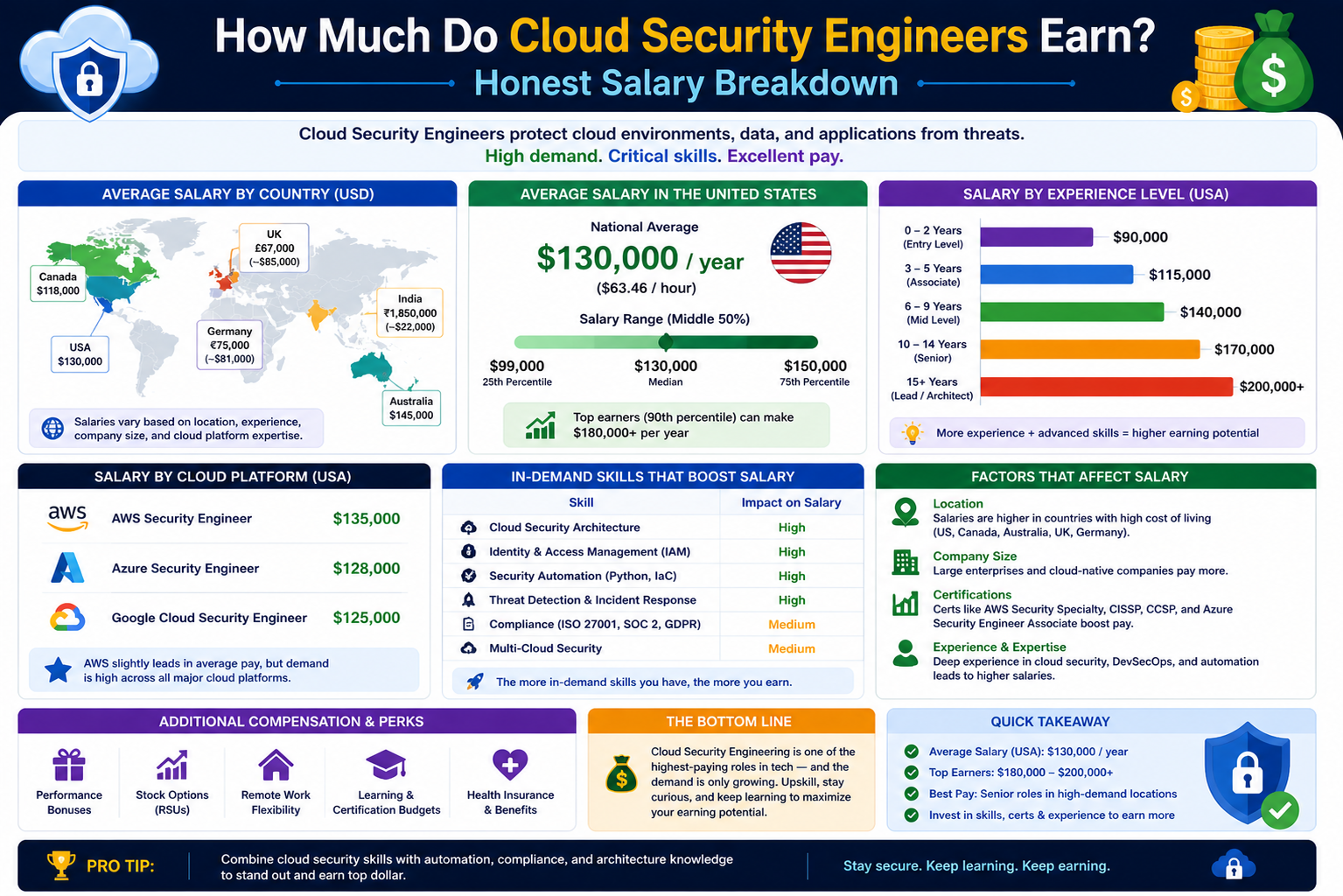
Cloud security engineering has become one of the most critical disciplines in modern information technology because organizations are increasingly relying on cloud platforms to store, process, and manage sensitive data. As cyber threats become more advanced and frequent, companies are no longer treating security as an optional layer but as a core requirement. This shift has created strong demand for professionals who can secure cloud environments effectively while maintaining performance and scalability.
Cloud security engineers are now considered essential members of IT and cybersecurity teams. Their role goes beyond traditional security work because they operate in dynamic environments such as AWS, Azure, Google Cloud, and hybrid infrastructures. These environments require constant monitoring, configuration management, and proactive defense strategies. As a result, organizations across finance, healthcare, retail, government, and technology sectors are actively competing to hire skilled engineers in this field, leading to highly competitive compensation packages.
The increasing reliance on remote systems, distributed applications, and cloud-native architectures has further intensified the need for strong cloud security expertise. Businesses are not only concerned about external attacks but also internal misconfigurations, compliance violations, and unauthorized access risks. This combination of technical responsibility and strategic importance is one of the key reasons why cloud security engineering roles command strong salaries across different regions and industries.
Role of a Cloud Security Engineer in Modern IT Environments
A cloud security engineer is responsible for designing, implementing, and maintaining secure cloud infrastructures that protect organizational data and applications. Their primary objective is to ensure that cloud systems remain secure against threats while supporting business operations without disruption. Unlike general IT security roles, cloud security engineers specialize in cloud-native tools, architectures, and services, making them highly specialized professionals.
These engineers act as a bridge between cloud architecture teams and cybersecurity operations. They ensure that cloud deployments follow security best practices from the design stage through deployment and maintenance. This includes configuring identity and access management systems, enforcing encryption standards, and monitoring network traffic for suspicious behavior. Their work is deeply integrated into every layer of the cloud ecosystem.
In many organizations, cloud security engineers are also responsible for aligning cloud infrastructure with compliance requirements. They ensure that systems meet regulatory standards related to data protection, privacy, and industry-specific guidelines. This requires both technical expertise and a strong understanding of governance frameworks. Because of this dual responsibility, their role is often considered both technical and strategic in nature.
Core Responsibilities Across Cloud Security Operations
Cloud security engineers handle a wide range of responsibilities that collectively ensure the safety and reliability of cloud environments. One of their primary tasks is building secure cloud architectures that follow best practices for scalability, resilience, and protection against unauthorized access. This involves designing systems that minimize vulnerabilities while supporting high availability and performance.
Another key responsibility is implementing security controls across cloud platforms. This includes configuring identity and access management policies, setting up network security groups, managing firewall rules, and ensuring encryption of sensitive data at rest and in transit. These controls form the foundation of a secure cloud environment and must be continuously updated as systems evolve.
Monitoring and incident response are also critical aspects of the role. Cloud security engineers actively monitor logs, alerts, and system behavior to detect unusual activity. When potential threats are identified, they investigate incidents, determine their scope, and implement corrective measures. This requires strong analytical skills and the ability to respond quickly under pressure.
In addition, cloud security engineers collaborate closely with development and DevOps teams. They integrate security into continuous integration and continuous deployment pipelines, ensuring that vulnerabilities are identified early in the development process. This approach, often referred to as DevSecOps, helps organizations reduce risks before applications reach production environments.
Growing Importance of Cloud Security in Digital Infrastructure
The importance of cloud security engineering continues to grow as organizations transition away from traditional on-premise systems. Cloud computing offers flexibility, scalability, and cost efficiency, but it also introduces new security challenges that require specialized expertise. Misconfigurations, insecure APIs, and identity breaches are among the most common risks in cloud environments, making skilled engineers essential.
Businesses are also handling larger volumes of sensitive data than ever before. This includes financial records, healthcare information, customer databases, and intellectual property. Protecting this data requires advanced security strategies that go beyond basic firewall configurations. Cloud security engineers play a crucial role in ensuring that data remains protected regardless of where it is stored or processed.
Another factor driving demand is the increasing adoption of multi-cloud and hybrid cloud strategies. Many organizations now use multiple cloud providers simultaneously to avoid vendor lock-in and improve redundancy. However, this also increases complexity, requiring engineers who understand how to secure different platforms consistently. Professionals with multi-cloud expertise are particularly valuable in the job market.
Regulatory pressure is also contributing to the growing importance of cloud security. Governments and industry bodies are enforcing stricter compliance requirements related to data protection and privacy. Organizations that fail to meet these standards face financial penalties and reputational damage. Cloud security engineers help businesses meet these obligations by implementing compliant architectures and monitoring systems for adherence.
Overview of Cloud Security Engineer Salary Expectations
Salaries for cloud security engineers are generally higher than many other IT roles due to the specialized nature of the work and the high demand for skilled professionals. Compensation varies based on several factors, including experience level, geographic location, industry type, and technical expertise. In general, cloud security engineering is considered a high-paying career path within the cybersecurity field.
Entry-level professionals typically begin with competitive salaries that reflect their foundational knowledge of cloud platforms and security principles. As they gain experience and develop advanced skills, their earning potential increases significantly. Mid-level engineers often see substantial salary growth as they take on more complex responsibilities such as architecture design, threat modeling, and compliance management.
Senior-level cloud security engineers command some of the highest salaries in the IT security domain. These professionals are often responsible for leading security strategies, managing teams, and making critical decisions that affect entire cloud infrastructures. Their expertise is highly valued because they combine deep technical knowledge with strategic oversight capabilities.
Location also plays a significant role in salary differences. Engineers working in major technology hubs or regions with high demand for cloud expertise tend to earn higher compensation compared to those in smaller markets. However, remote work opportunities have started to reduce this gap, allowing skilled professionals to access higher-paying roles regardless of location.
Skill Requirements and Technical Expertise in Cloud Security
Cloud security engineers require a strong foundation in both cybersecurity principles and cloud computing technologies. They must understand how cloud platforms operate, including compute services, storage systems, networking components, and identity management frameworks. This knowledge allows them to design secure and efficient cloud architectures.
Technical proficiency in major cloud providers is essential. Engineers typically specialize in platforms such as AWS, Azure, or Google Cloud, although multi-cloud expertise is increasingly valuable. Each platform has its own security tools and services, and engineers must be able to configure and manage these systems effectively.
Networking knowledge is another critical requirement. Cloud security engineers must understand how data flows across networks, how virtual private clouds operate, and how to secure communication between services. This includes configuring firewalls, load balancers, and access control mechanisms to prevent unauthorized access.
Automation skills are also highly important in modern cloud environments. Engineers often use infrastructure-as-code tools to manage configurations and ensure consistency across deployments. Automation helps reduce human error, improves efficiency, and enhances overall security posture by enforcing standardized configurations.
Industry Demand and Competitive Job Market Conditions
The demand for cloud security engineers continues to grow rapidly as more organizations migrate to cloud-based infrastructures. This demand is driven by the increasing frequency of cyberattacks, the complexity of cloud systems, and the need for continuous security monitoring. As a result, companies are actively competing to attract and retain skilled professionals in this field.
Industries that handle sensitive data, such as finance, healthcare, and government, have particularly high demand for cloud security expertise. These sectors require strict compliance with regulatory standards, making security a top priority. Organizations in these industries often offer higher compensation to attract experienced engineers who can meet these requirements.
Technology companies also contribute significantly to demand, especially those operating large-scale cloud platforms or providing software-as-a-service solutions. These companies require engineers who can secure highly distributed systems and maintain uptime while preventing security breaches. The complexity of these environments increases the value of skilled professionals.
The competitive nature of the job market means that employers are not only offering higher salaries but also additional benefits such as bonuses, stock options, and flexible work arrangements. This reflects the critical importance of cloud security engineers in maintaining business continuity and protecting organizational assets.
Cloud Security Engineer Salary Across U.S. Cities and Regional Differences
Cloud security engineer salaries vary significantly across different cities because compensation is strongly influenced by local demand, cost of living, industry concentration, and competition for skilled professionals. In major technology hubs, salaries tend to be much higher because companies are aggressively competing for talent and often manage large-scale cloud infrastructures that require advanced security expertise.
In cities like San Francisco, Seattle, and New York, cloud security engineers typically receive the highest compensation packages in the country. These regions host global technology companies, cloud service providers, and large enterprise organizations that rely heavily on secure cloud environments. The high concentration of tech-driven businesses increases competition for experienced engineers, which naturally drives salaries upward.
At the same time, the cost of living in these metropolitan areas is also significantly higher, which contributes to elevated salary ranges. Employers in these regions not only compensate for skill level but also adjust pay structures to attract and retain talent in expensive housing and lifestyle markets. As a result, cloud security engineers in these cities often receive both strong base salaries and additional benefits such as stock options and performance bonuses.
In contrast, mid-sized cities and emerging tech hubs are showing steady growth in cloud security salaries. Cities such as Denver, Portland, Boston, and Raleigh are becoming increasingly attractive for both employers and professionals. These regions offer a balance between competitive salaries and lower living costs, making them appealing alternatives to traditional tech hubs.
Many organizations in these growing markets are expanding their cloud infrastructure and cybersecurity teams due to remote work adoption and digital transformation efforts. This expansion has created new opportunities for cloud security engineers, leading to salary levels that are gradually closing the gap with larger cities.
Salary Distribution and Experience-Based Variations Across Regions
One of the most noticeable trends in cloud security engineer compensation is the wide salary range within each city. Even in the same geographic location, salaries can differ dramatically based on experience level, technical expertise, and industry specialization. This variation reflects the complexity and depth of skills required in modern cloud security roles.
Entry-level professionals typically earn lower salaries as they build foundational experience in cloud platforms, security tools, and incident response procedures. These engineers usually focus on assisting senior team members, monitoring systems, and handling routine security tasks. However, even at the entry level, cloud security roles tend to offer higher pay compared to many other IT positions due to the specialized nature of the work.
Mid-level engineers experience a significant jump in compensation as they begin to take ownership of security architecture, threat analysis, and compliance management. At this stage, professionals are expected to operate independently, make technical decisions, and collaborate with development and DevOps teams to integrate security into cloud workflows.
Senior-level cloud security engineers command the highest salaries across all regions. These professionals are responsible for designing enterprise-wide security strategies, leading incident response efforts, and ensuring that cloud environments align with organizational goals. Their expertise often extends beyond technical implementation into leadership and strategic planning, which justifies their higher compensation.
The difference between low-end and high-end salaries in many cities can exceed tens of thousands of dollars, reflecting the importance of advanced certifications, automation expertise, and multi-cloud knowledge. Engineers who continuously upgrade their skills tend to move into higher salary brackets more quickly than those with limited specialization.
Industry Influence on Cloud Security Engineer Compensation
Industry type plays a major role in determining cloud security engineer salaries across different regions. Certain sectors place a much higher emphasis on security due to the sensitive nature of the data they handle and the regulatory requirements they must follow. These industries are often willing to pay premium salaries to attract top-tier security talent.
The financial services industry is one of the highest-paying sectors for cloud security engineers. Banks, investment firms, and fintech companies manage large volumes of sensitive financial data and are frequent targets of cyberattacks. As a result, they require highly secure cloud infrastructures and experienced engineers capable of preventing breaches and ensuring compliance with strict regulations.
The healthcare industry is another major driver of demand for cloud security professionals. Hospitals, insurance companies, and healthcare technology providers must comply with strict data protection regulations related to patient information. Cloud security engineers in this sector are responsible for securing electronic health records, managing access controls, and ensuring compliance with privacy laws.
Government and defense-related organizations also offer competitive salaries due to the sensitive nature of their operations. These roles often require additional security clearances and involve securing critical infrastructure systems. Engineers working in these environments typically receive higher compensation due to increased responsibility and security requirements.
Technology companies and cloud service providers also offer strong salaries, especially for engineers working on large-scale infrastructure platforms. These organizations require highly skilled professionals who can secure distributed systems, manage global cloud environments, and respond to sophisticated cyber threats in real time.
Impact of Remote Work on Cloud Security Salary Structures
The rise of remote work has significantly influenced cloud security engineer salaries and hiring trends. Many organizations are no longer restricted to hiring talent within specific geographic locations, which has expanded the talent pool and changed compensation strategies across the industry.
Remote work has allowed companies to access highly skilled professionals from different regions while also offering competitive salaries that are not strictly tied to local cost-of-living standards. This shift has created more opportunities for engineers in smaller cities or lower-cost regions to earn salaries comparable to those in major tech hubs.
However, this flexibility has also increased competition among professionals. Cloud security engineers are now competing on a national or even global level rather than within a single city. As a result, continuous skill development has become even more important for maintaining and increasing earning potential.
Employers are also restructuring compensation packages to include performance-based incentives, remote work benefits, and flexible schedules. These additional perks often complement base salaries and contribute to overall job satisfaction and retention.
Despite the benefits of remote work, some organizations still adjust salaries based on geographic location. This means that engineers living in high-cost cities may receive higher compensation compared to those in lower-cost regions, even if they perform the same role. This hybrid approach continues to evolve as remote work becomes more established across industries.
Relationship Between Skills, Certifications, and Salary Growth
Technical skills and certifications play a crucial role in determining salary levels for cloud security engineers. Employers place high value on professionals who can demonstrate verified expertise in cloud platforms, security frameworks, and automation tools.
Certifications related to major cloud providers are particularly important. Credentials that validate knowledge of AWS, Azure, or Google Cloud security services often lead to higher salary offers. These certifications demonstrate that an engineer understands platform-specific security tools and can implement best practices effectively.
Multi-cloud expertise is another factor that significantly increases earning potential. Engineers who can secure workloads across multiple cloud platforms are highly valuable because they can operate in complex environments that require integration between different systems. This versatility is especially important for large enterprises with diverse cloud strategies.
Automation and DevSecOps skills are also strongly linked to salary growth. Engineers who can automate security processes, integrate scanning tools into CI/CD pipelines, and manage infrastructure through code are considered more efficient and valuable. These capabilities reduce operational risk and improve deployment speed, making them highly desirable in modern IT environments.
Soft skills also contribute to career advancement and salary progression. Cloud security engineers often collaborate with developers, IT teams, and leadership, so strong communication and problem-solving abilities are essential. Professionals who can translate technical risks into business terms are often better positioned for leadership roles and higher compensation.
Regional Market Maturity and Its Effect on Compensation Levels
The maturity of regional technology markets has a direct impact on cloud security engineer salaries. Established tech hubs tend to offer higher compensation due to the concentration of large enterprises, advanced infrastructure, and experienced talent pools. These environments create strong competition for skilled engineers, which drives salaries upward.
In contrast, emerging tech markets are experiencing rapid growth but may not yet match the salary levels of more established regions. However, this gap is gradually narrowing as companies expand their operations and adopt cloud-first strategies. As demand continues to grow, salaries in these regions are expected to increase steadily over time.
Some regions also offer unique advantages beyond salary. Lower living costs, improved work-life balance, and growing tech ecosystems make these areas attractive for professionals seeking long-term career stability. As remote work continues to evolve, regional salary differences may become less pronounced.
The overall trend indicates that cloud security engineering is becoming a globally competitive field, where compensation is influenced not only by location but also by specialization, adaptability, and continuous learning.
Salary Trends and Market Growth in Cloud Security Engineering
Cloud security engineering salaries continue to show strong upward momentum as organizations deepen their reliance on cloud infrastructure. The demand for professionals who can secure distributed systems, protect sensitive data, and ensure compliance has created a highly competitive job market. This demand is not limited to traditional technology companies but extends across nearly every industry undergoing digital transformation.
One of the most important trends shaping salary growth is the global shift toward cloud-first strategies. Businesses are migrating applications, databases, and entire infrastructures to cloud environments at a rapid pace. This transition has increased the complexity of security requirements, making cloud security engineers essential for both deployment and ongoing operations. As complexity rises, so does the value placed on skilled professionals.
Another key factor influencing salary trends is the increasing frequency and sophistication of cyberattacks. Organizations are investing heavily in preventive security measures rather than reactive solutions. Cloud security engineers play a central role in building these proactive defenses, which include real-time monitoring, automated threat detection, and secure architecture design. This responsibility has elevated their importance within IT teams and contributed to higher compensation levels.
The expansion of remote work has also reshaped salary expectations. Companies are no longer limited to hiring talent in specific geographic regions, which has broadened the talent pool but also intensified competition among professionals. Engineers who continuously upgrade their skills and certifications are better positioned to negotiate higher salaries in this global job market.
How Industry Demand Shapes Compensation Levels
Different industries place varying levels of importance on cloud security, and this directly influences salary structures. Sectors that handle sensitive data or operate under strict regulatory frameworks tend to offer higher compensation due to increased risk and compliance requirements.
The financial sector is one of the strongest drivers of high salaries in cloud security engineering. Banks, insurance companies, and fintech organizations manage large volumes of financial transactions and customer data. A single security breach in this sector can lead to significant financial and reputational damage, making skilled cloud security engineers extremely valuable.
Healthcare is another industry where salaries tend to be above average. Hospitals, pharmaceutical companies, and healthcare technology providers must comply with strict data protection regulations while managing sensitive patient information. Cloud security engineers in this sector are responsible for ensuring secure storage, access control, and data privacy across cloud systems.
Government and defense sectors also offer competitive compensation due to the sensitive nature of their operations. These roles often involve securing critical infrastructure, classified data, and national systems. Engineers working in these environments may require additional security clearances, which further increases their market value.
Technology companies and cloud service providers continue to offer some of the most competitive salary packages. These organizations operate large-scale cloud platforms and require engineers who can secure complex, high-traffic environments. The technical demands in these roles often justify higher pay ranges compared to other industries.
Experience-Based Salary Progression in Cloud Security
Experience plays a major role in determining how much a cloud security engineer earns over time. As professionals gain more hands-on experience with cloud platforms, security frameworks, and incident response, their earning potential increases significantly.
At the early stage of their careers, cloud security engineers typically focus on foundational tasks such as monitoring cloud environments, assisting with security configurations, and responding to basic alerts. During this phase, salaries are competitive but reflect the learning curve associated with mastering cloud technologies and security principles.
As engineers progress into mid-level roles, they begin taking on more responsibility in designing secure architectures, conducting risk assessments, and implementing security policies. They also collaborate more closely with development and DevOps teams to ensure security is integrated into every stage of the software lifecycle. This increased responsibility leads to noticeable salary growth.
Senior-level engineers operate at a strategic level, often leading security initiatives across entire organizations. They are responsible for defining security policies, managing complex cloud environments, and guiding incident response efforts. Their decisions directly impact organizational risk and business continuity, which justifies significantly higher compensation.
Beyond technical expertise, senior professionals are also expected to mentor junior engineers and contribute to long-term security planning. Their combination of leadership and technical depth places them in some of the highest-paying roles within the cybersecurity field.
Role of Certifications in Increasing Salary Potential
Certifications are one of the most effective ways for cloud security engineers to increase their earning potential. They serve as proof of expertise and demonstrate a professional’s ability to work with specific cloud platforms and security frameworks.
Certifications focused on major cloud providers are particularly valuable. These credentials validate skills in securing cloud environments, managing access controls, and implementing best practices for data protection. Employers often prioritize candidates with these certifications when hiring for advanced roles.
Multi-platform certifications or vendor-neutral credentials are also highly respected in the industry. These certifications indicate that an engineer has broad knowledge across different cloud environments rather than being limited to a single provider. This versatility is especially valuable for organizations operating in multi-cloud or hybrid environments.
Advanced certifications also open the door to leadership and architecture roles. Professionals with higher-level credentials are often considered for positions involving strategic planning, security design, and enterprise-wide risk management. These roles typically come with significantly higher salaries compared to standard engineering positions.
Certifications also help professionals stand out in competitive job markets. As more engineers enter the field, having validated credentials becomes an important differentiator that can influence hiring decisions and salary negotiations.
Technology Skills That Drive Higher Salaries
Technical skills are one of the strongest determinants of salary levels in cloud security engineering. Employers prioritize candidates who can demonstrate practical expertise in securing cloud infrastructures and automating security processes.
Cloud platform expertise is essential. Engineers who understand services such as identity management, networking, and security monitoring within major cloud providers are highly valued. The ability to configure and manage these systems effectively is critical for maintaining secure environments.
Automation skills significantly enhance earning potential. Engineers who can implement infrastructure-as-code solutions and automate security workflows reduce manual effort and improve consistency across environments. This efficiency is highly valued in large-scale cloud deployments.
DevSecOps practices are increasingly important in modern cloud environments. Engineers who can integrate security into continuous integration and deployment pipelines help organizations detect vulnerabilities early in the development process. This proactive approach reduces risk and improves software quality.
Networking and system architecture knowledge also play a key role in salary growth. Understanding how cloud networks are structured and how data flows between services allows engineers to design more secure systems and prevent unauthorized access.
Threat detection and incident response skills are equally important. Engineers who can quickly identify, analyze, and respond to security incidents help organizations minimize damage and recover faster from attacks. This ability is highly valued in high-risk environments.
Geographic Influence on Salary Growth and Opportunities
Geographic location continues to play an important role in cloud security engineer salaries, although its impact is gradually changing due to remote work adoption. Traditionally, major tech hubs have offered higher salaries due to higher demand and cost of living adjustments.
Cities with strong technology ecosystems tend to offer more competitive compensation packages. These regions attract large enterprises, startups, and cloud service providers, all of which require skilled security professionals. The concentration of opportunities creates a competitive environment that drives salaries upward.
Mid-sized cities are also experiencing growth in cloud security roles. As companies expand their operations and adopt remote or hybrid work models, they are no longer limited to hiring in traditional tech centers. This shift has created new opportunities in regions that previously had limited access to high-paying tech roles.
Remote work has further blurred geographic boundaries in salary determination. Many organizations now offer flexible compensation models that consider both skill level and location. This allows engineers in lower-cost regions to access higher-paying roles than would have been possible in the past.
Despite these changes, location still influences salary in certain industries, particularly those with strict regulatory or security requirements. However, the overall trend indicates a gradual move toward more skill-based compensation rather than purely location-based pay structures.
Evolving Career Opportunities in Cloud Security Engineering
The career path for cloud security engineers continues to expand as cloud technologies evolve. Professionals in this field are no longer limited to traditional engineering roles but can move into architecture, consulting, and leadership positions.
One emerging opportunity is cloud security architecture, where professionals design large-scale security frameworks for organizations. This role requires a deep understanding of both technical systems and business requirements, making it one of the highest-paying career paths in the field.
Another growing area is security consulting. Experienced engineers are increasingly working as advisors for multiple organizations, helping them design secure cloud strategies and implement best practices. This type of work often offers flexible arrangements and higher earning potential.
Leadership roles in security operations are also becoming more common. Engineers who transition into management positions oversee entire security teams and are responsible for aligning technical strategies with business goals. These roles typically come with significant salary increases.
As cloud technologies continue to evolve, new career opportunities are expected to emerge, particularly in areas such as artificial intelligence security, automated threat detection, and zero-trust architecture design. These advancements will continue to shape the demand and compensation for cloud security professionals.
Long-Term Salary Growth Outlook for Cloud Security Engineers
Cloud security engineering continues to show strong long-term salary growth because organizations are increasingly dependent on cloud infrastructure for core business operations. As this dependency expands, the responsibility placed on cloud security professionals also grows, making their expertise more valuable over time. Companies are not only investing in cloud adoption but also in strengthening their security posture, which directly increases demand for skilled engineers.
One of the most important drivers of long-term salary growth is the continuous evolution of cyber threats. Attackers are constantly developing new methods to exploit vulnerabilities in cloud environments, including misconfigurations, weak identity controls, and insecure APIs. This evolving threat landscape ensures that cloud security engineers remain essential in protecting critical systems, which supports sustained salary growth across the industry.
Another factor contributing to long-term compensation increases is the expansion of enterprise cloud ecosystems. Organizations are no longer using cloud platforms for isolated applications; instead, they are building entire digital infrastructures on cloud services. This includes storage systems, machine learning platforms, databases, and global application networks. The complexity of these environments requires highly skilled engineers, which drives up compensation levels.
The shift toward automation and artificial intelligence in security operations is also influencing salary trends. Cloud security engineers who can work with automated security tools, machine learning-based threat detection systems, and advanced monitoring platforms are becoming more valuable. As automation reduces manual tasks, engineers are expected to focus on strategic decision-making and complex problem-solving, which increases their market worth.
Advanced Skills That Shape Future Salary Potential
Future salary growth in cloud security engineering will be heavily influenced by advanced technical and strategic skills. Engineers who continuously upgrade their capabilities are more likely to move into higher-paying roles and leadership positions.
One of the most valuable advanced skills is multi-cloud security management. Organizations increasingly use multiple cloud providers to avoid vendor lock-in and improve resilience. Engineers who can design and secure environments across different platforms are in high demand because they provide flexibility and reduce operational risk.
Another important skill is zero-trust architecture implementation. Modern security strategies are moving away from traditional perimeter-based models and adopting zero-trust principles, where every access request is verified continuously. Engineers who understand how to implement these frameworks are highly sought after, especially in large enterprises.
Security automation is also a critical skill for future growth. Engineers who can build automated workflows for threat detection, incident response, and compliance monitoring significantly improve efficiency and reduce response times. This capability is especially important in large-scale environments where manual processes are no longer practical.
Cloud-native application security is another area that is gaining importance. As organizations build applications directly on cloud platforms, engineers must understand how to secure containers, serverless functions, and microservices. This specialized knowledge is increasingly linked to higher compensation levels.
Leadership Roles and Their Impact on Earnings
As cloud security engineers gain experience, many transition into leadership roles that significantly increase their earning potential. These positions involve not only technical expertise but also strategic decision-making and team management responsibilities.
Security architects represent one of the highest-paying career paths in this field. These professionals design overall security frameworks for cloud environments and ensure that all systems align with organizational goals. Their decisions have a long-term impact on security posture, making them highly valuable to enterprises.
Cloud security managers and directors also command high salaries. These roles involve leading teams of engineers, managing security operations, and coordinating responses to security incidents. In addition to technical knowledge, these professionals must have strong leadership and communication skills.
Chief information security officer (CISO) roles represent the highest level of career advancement in this field. While not limited to cloud security alone, many CISOs have strong backgrounds in cloud environments. They are responsible for defining overall security strategy, managing enterprise risk, and ensuring compliance across all systems.
Leadership roles often include additional compensation benefits such as bonuses, stock options, and long-term incentives. These benefits can significantly increase total earnings beyond base salary alone, making leadership positions highly attractive for experienced professionals.
Global Demand and International Salary Influence
Cloud security engineering is not limited to any single region, and global demand for these professionals continues to rise. As organizations expand internationally, they require engineers who can secure cloud environments across different regulatory and operational landscapes.
Developed economies with strong technology sectors typically offer the highest salaries due to advanced infrastructure and high demand for skilled professionals. However, emerging markets are also experiencing rapid growth in cloud adoption, creating new opportunities for engineers worldwide.
International companies often hire cloud security engineers remotely, which allows professionals to access global job markets without relocating. This trend has increased competition but also expanded earning potential for skilled engineers who can demonstrate strong expertise.
Regulatory differences between countries also influence salary structures. Regions with strict data protection laws require more advanced security implementations, which increases demand for experienced engineers. Professionals who understand global compliance frameworks are particularly valuable in multinational organizations.
Economic Factors Affecting Cloud Security Salaries
Broader economic conditions also influence cloud security engineer compensation. During periods of digital expansion, organizations invest heavily in cloud infrastructure and cybersecurity, leading to increased hiring and higher salaries. Conversely, during economic slowdowns, hiring may stabilize, but security roles tend to remain more stable than many other IT positions.
Inflation and cost-of-living adjustments also impact salary trends. In regions with rising living costs, employers often increase compensation to retain skilled professionals. This is particularly noticeable in major metropolitan areas where technology companies compete for talent.
Investment in cybersecurity continues to grow regardless of economic cycles because security is considered a critical business function. Unlike some IT roles that may fluctuate with market conditions, cloud security engineering remains a priority due to the constant threat of cyberattacks.
Government regulations and compliance requirements also play a role in shaping salary trends. As new laws are introduced to protect digital data and privacy, organizations must invest in stronger security systems and skilled professionals to meet these standards. This regulatory pressure supports long-term demand for cloud security engineers.
Career Mobility and Salary Advancement Opportunities
Cloud security engineering offers strong career mobility, allowing professionals to move between industries, roles, and technical specializations. This flexibility contributes to long-term salary growth because engineers can continuously seek higher-paying opportunities as their skills evolve.
Many professionals begin their careers in general IT or cybersecurity roles before transitioning into cloud security. This transition often results in significant salary increases due to the specialized nature of cloud environments. As engineers gain experience, they can move into more advanced positions with greater responsibility.
Career advancement is often tied to continuous learning and certification. Engineers who regularly update their skills and stay current with cloud technologies are more likely to progress into senior roles. Employers value professionals who can adapt to rapidly changing environments and implement modern security practices.
Switching between industries is another common path for salary growth. Engineers may move from smaller organizations to large enterprises or from general tech companies to high-security industries such as finance or healthcare. Each transition often comes with increased compensation due to higher responsibility levels.
Final Conclusion
The overall outlook for cloud security engineer salaries remains highly positive due to sustained demand, evolving technology landscapes, and increasing security requirements across industries. As cloud adoption continues to grow, the need for skilled professionals who can secure these environments will remain strong.
Salaries are expected to continue rising as organizations invest more in cybersecurity, automation, and advanced cloud infrastructure. Professionals who focus on developing specialized skills, gaining certifications, and building hands-on experience will be best positioned to benefit from this growth.
Cloud security engineering is no longer just a technical role; it has become a strategic function that directly impacts business continuity and organizational success. This elevated importance ensures that compensation levels will remain competitive and continue to grow alongside technological advancement.