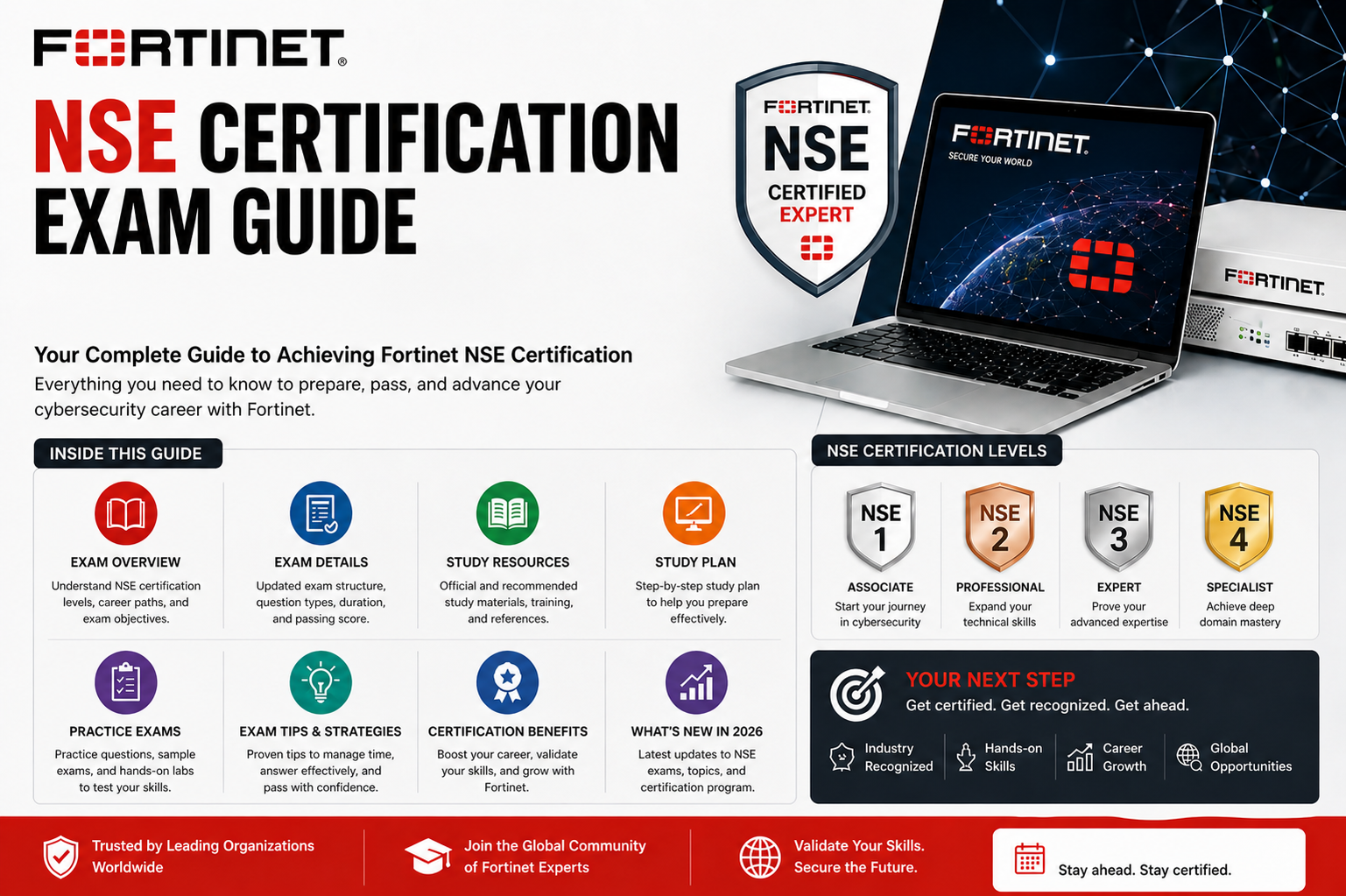
Fortinet’s Network Security Expert certification program continues to be one of the most structured and widely recognized learning paths in cybersecurity. It is designed to guide learners from basic security awareness to highly advanced enterprise-level expertise. The program is carefully aligned with modern job roles, allowing professionals to build skills in a logical progression that reflects real-world cybersecurity responsibilities rather than isolated exam preparation.
The updated structure maintains the well-known NSE 1 through NSE 8 framework, but it has been refined to better connect certifications with professional development stages. This makes it easier for learners to understand where they currently stand and what skills they need to advance further in their careers. The program is not only about passing exams but also about developing practical knowledge that can be directly applied in security operations, network protection, and threat management environments.
Fortinet has also emphasized role-based learning paths, ensuring that each certification level corresponds to specific job functions. This alignment helps organizations identify talent more effectively while allowing professionals to demonstrate competence in clearly defined technical areas.
Growing Importance of Fortinet Skills in Cybersecurity
Cybersecurity threats have become more advanced, persistent, and widespread, increasing the demand for professionals who understand enterprise-grade security solutions. Fortinet technologies are widely used in organizations to protect networks, secure applications, and manage security infrastructure. As a result, individuals with validated Fortinet skills are highly valued in both entry-level and senior positions.
The NSE certification path provides a structured way to develop these skills. Instead of random learning, candidates progress through a carefully designed system that builds foundational knowledge first and gradually introduces complex technical concepts. This ensures that learners are not overwhelmed and can develop confidence step by step.
The increasing reliance on secure digital infrastructure across industries such as finance, healthcare, education, and government has further strengthened the relevance of Fortinet certifications. Professionals who understand how to deploy and manage Fortinet solutions are better positioned to handle modern cybersecurity challenges.
Structure of the Fortinet NSE Certification Path
The certification framework is divided into multiple levels, ranging from introductory awareness to expert-level mastery. Each level builds upon the previous one, ensuring a continuous learning experience. The structure can be broadly understood as a progression from foundational cybersecurity concepts to advanced system design and troubleshooting.
At the base are the introductory levels that focus on awareness and basic understanding of cybersecurity principles. As learners progress, they move into technical certifications that involve configuration, management, and operational responsibilities. The higher levels focus on specialization, advanced architecture, and expert troubleshooting in complex environments.
This structured approach ensures that learners develop both theoretical understanding and practical hands-on skills. It also allows professionals to choose a specialization path depending on their career goals, whether in network security, threat analysis, or system architecture.
Foundational Cybersecurity Awareness Level NSE 1
The first stage of the certification journey introduces basic cybersecurity concepts. This level is designed for individuals who are new to the field and need an understanding of how digital threats operate and how security systems help prevent them.
At this stage, learners are introduced to fundamental ideas such as common cyber threats, basic security principles, and the importance of protecting information systems. The content is kept simple and accessible, making it suitable even for individuals without prior technical experience.
This level is particularly useful for beginners, students, or professionals from non-technical backgrounds who want to gain awareness of cybersecurity. It helps build a strong conceptual foundation that will support further learning in more advanced stages of the certification path.
Technical Awareness Expansion NSE 2
The second level builds upon the foundational knowledge introduced earlier and adds more technical depth. It helps learners understand how cybersecurity concepts are applied in real-world environments and introduces them to the broader ecosystem of security technologies.
At this stage, learners begin to explore how security solutions function within networks and how different components interact to protect digital assets. The focus shifts from general awareness to applied understanding, helping candidates connect theory with practical implementation.
This level also helps learners become familiar with Fortinet’s approach to cybersecurity solutions at a conceptual level. It bridges the gap between beginner knowledge and more technical operational skills that will be required in later stages of the certification path.
Introduction to Fortinet Ecosystem NSE 3
The third level introduces learners to Fortinet products and solutions at a high level. This stage is often associated with associate-level understanding and is designed for individuals who may already be working in IT environments where Fortinet technologies are used.
At this level, candidates gain an overview of how Fortinet solutions are structured and how they support network security operations. The focus is on understanding product capabilities rather than deep configuration or advanced technical tasks.
This certification level is especially useful for professionals in support roles, junior administrators, or IT staff who need to interact with Fortinet systems in their daily work. It helps them develop confidence in navigating security environments and understanding basic operational workflows.
Building Career Foundations Through Early Certification Levels
Completing the initial stages of the NSE pathway provides a strong foundation for entering the cybersecurity field. These early certifications help individuals demonstrate awareness of key security concepts and familiarity with industry-standard technologies.
Employers often view these certifications as indicators of a candidate’s commitment to learning and professional development. While they may not represent advanced technical expertise, they are valuable for entry-level positions and internships in IT and cybersecurity domains.
These foundational levels also serve as a stepping stone toward more advanced certifications. They ensure that learners are prepared for technical challenges by equipping them with essential background knowledge.
Core Network Security Skills NSE 4
The fourth level marks a significant transition into professional-grade technical skills. At this stage, candidates are expected to have a solid understanding of network security operations and the ability to configure and manage security devices effectively.
This level focuses heavily on practical skills related to firewall configuration, security policy implementation, and day-to-day network protection tasks. Learners are expected to demonstrate their ability to manage secure network environments using Fortinet technologies.
This certification is highly valued in the industry because it reflects hands-on operational capability. Professionals who achieve this level are often qualified for roles involving network administration, security operations, and infrastructure management.
Expanding Operational Expertise NSE 5
The fifth level focuses on advanced operational analysis and management within Fortinet environments. At this stage, learners go beyond basic configuration and begin to work with more complex security monitoring and management tools.
Candidates typically explore specialized systems used for analyzing network behavior, managing security events, and maintaining visibility across enterprise infrastructures. This level often requires passing multiple specialized assessments depending on the chosen focus area.
Professionals at this stage are expected to understand how different security tools interact and how to interpret data for effective decision-making. This level plays a critical role in strengthening analytical and operational cybersecurity skills.
Advanced Network Security Knowledge NSE 6
The sixth level introduces advanced specialization across various Fortinet technologies beyond traditional firewall management. It covers areas such as secure wireless systems, email security, network access control, and advanced threat protection solutions.
At this stage, learners are expected to understand how different security components integrate within complex enterprise environments. The focus is on specialized knowledge that supports broader security architecture and operational resilience.
This level is ideal for professionals who want to deepen their technical expertise in specific areas of cybersecurity. It prepares them for higher responsibilities involving system design, integration, and advanced troubleshooting tasks.
Transition Toward Advanced Security Roles NSE 7
The seventh level represents a shift into advanced cybersecurity expertise. It is designed for experienced professionals such as senior engineers, security architects, and solution designers who work with complex enterprise systems.
At this stage, candidates focus on highly specialized domains such as advanced threat protection, cloud security environments, or large-scale network architecture. The emphasis is on solving complex technical challenges and designing secure infrastructures.
Professionals at this level are expected to have strong analytical skills and deep technical understanding of Fortinet solutions. This certification is often pursued by individuals who already have significant industry experience and are looking to validate their advanced expertise.
Expert-Level Mastery NSE 8
The final stage of the certification path represents the highest level of achievement within the Fortinet ecosystem. It is intended for professionals with extensive experience in designing, implementing, and troubleshooting highly complex network environments.
This level includes both theoretical evaluation and practical hands-on assessments, ensuring that candidates can demonstrate real-world mastery of cybersecurity systems. It is one of the most challenging certifications, requiring deep technical knowledge and extensive field experience.
Professionals who reach this level are often involved in high-level security architecture design, consulting, and strategic cybersecurity planning. It represents the pinnacle of Fortinet certification achievement and demonstrates elite-level capability in the field of network security.
Fortinet NSE Certification Program Structure and Learning Approach
The Fortinet certification ecosystem is built around a structured learning philosophy that emphasizes progressive skill development rather than isolated exam preparation. Each level is designed to expand both theoretical understanding and hands-on capability, ensuring that learners develop practical cybersecurity competence. The framework is intentionally layered so that foundational concepts naturally evolve into technical expertise and eventually into advanced architectural thinking.
This approach reflects how cybersecurity roles function in real environments. Professionals rarely deal with single isolated tasks; instead, they manage interconnected systems, respond to evolving threats, and maintain continuous security operations. The certification structure mirrors this reality by gradually increasing complexity and responsibility at each stage of the journey.
The learning model also encourages long-term skill retention. Instead of focusing only on passing exams, candidates are expected to understand how security concepts apply in enterprise environments. This makes the certification path valuable not only for career advancement but also for building genuine technical confidence.
Exam Design Philosophy and Skill Validation
Each Fortinet certification exam is designed to validate real-world skills rather than purely theoretical knowledge. The questions and scenarios are structured to reflect practical challenges faced by cybersecurity professionals. This includes configuration tasks, troubleshooting scenarios, and conceptual problem-solving exercises.
The goal is to ensure that certified individuals can apply their knowledge effectively in operational environments. For example, instead of simply recalling definitions, candidates may be asked to interpret security logs, identify misconfigurations, or determine appropriate responses to network threats.
This performance-based approach ensures that certification holders are not only familiar with Fortinet technologies but are also capable of using them in real deployments. It strengthens the credibility of the certification program and makes it widely respected across industries.
FortiOS and Core Technology Understanding
A significant part of the certification path revolves around understanding FortiOS, the core operating system used in Fortinet security devices. FortiOS forms the foundation for many practical tasks such as firewall configuration, policy management, and network security enforcement.
As learners progress through intermediate and advanced levels, they develop deeper familiarity with how FortiOS manages traffic flow, applies security policies, and integrates with other Fortinet solutions. This understanding is essential for professionals working in network security roles where configuration accuracy directly impacts organizational security.
The ability to navigate and manage FortiOS effectively is considered a core competency within the Fortinet ecosystem. It serves as a bridge between theoretical knowledge and real-world implementation skills.
Security Fabric Concept and Integration Awareness
One of the key architectural concepts within Fortinet’s ecosystem is the Security Fabric, which represents an integrated approach to cybersecurity. Instead of treating security tools as separate entities, the Security Fabric connects multiple components into a unified system.
As candidates progress through the certification levels, they are introduced to how different Fortinet solutions interact within this integrated environment. This includes understanding how threat intelligence is shared, how policies are enforced across systems, and how visibility is maintained across the entire network.
This integration-focused mindset is critical in modern cybersecurity environments where isolated tools are no longer sufficient. Professionals must understand how systems work together to detect, prevent, and respond to threats efficiently.
Operational Tools and Management Platforms
Beyond core firewall technologies, the certification path also introduces learners to various operational tools such as centralized management and analytics platforms. These tools are essential for managing large-scale network environments where manual configuration is not practical.
Candidates learn how to use these platforms to monitor network activity, generate reports, and analyze security events. This helps organizations maintain visibility over their infrastructure and respond quickly to potential threats.
Understanding these tools is especially important at intermediate and advanced certification levels, where professionals are expected to manage complex environments involving multiple devices and security policies.
Role-Based Certification Mapping
One of the strengths of the updated Fortinet certification structure is its alignment with job roles. Each certification level corresponds to specific professional responsibilities, making it easier for employers to identify suitable candidates.
Entry-level certifications are typically associated with support roles or junior IT positions, where basic understanding of cybersecurity concepts is sufficient. Intermediate certifications align with network administrators and security analysts who manage operational tasks.
Advanced certifications are linked to roles such as security engineers, architects, and consultants who design and implement complex security solutions. This role-based mapping ensures that certification progress directly supports career development.
Hands-On Lab Experience and Practical Learning
Practical experience plays a central role in the Fortinet certification journey. Many candidates use lab environments to simulate real-world network configurations and security scenarios. These labs allow learners to experiment with firewall rules, network segmentation, and threat detection mechanisms.
Hands-on practice is essential because it reinforces theoretical knowledge and builds confidence in applying skills under realistic conditions. It also helps learners understand how different configurations impact network behavior.
As candidates move into higher certification levels, lab scenarios become more complex, requiring advanced troubleshooting and multi-system integration skills.
Preparation Strategies for Certification Success
Effective preparation for Fortinet certifications involves a combination of theoretical study and practical application. Candidates are encouraged to understand not only how systems work but also why certain configurations are used in specific scenarios.
A structured study approach often includes reviewing core concepts, practicing configuration tasks, and analyzing sample scenarios. This balanced method ensures that learners are well-prepared for both conceptual and practical exam components.
Time management and consistent practice are also important factors in successful preparation. Since the exams are designed to test applied knowledge, regular exposure to real-world scenarios significantly improves performance.
Career Opportunities Across Certification Levels
Each level of the certification path opens different career opportunities within the cybersecurity field. Entry-level certifications can lead to roles such as technical support specialists or junior security analysts. These positions focus on basic monitoring and support tasks.
Intermediate certifications often lead to roles involving network administration and security operations. Professionals at this stage are responsible for maintaining system performance, configuring security policies, and responding to incidents.
Advanced certifications enable access to high-level positions such as security architect, senior engineer, or cybersecurity consultant. These roles involve designing secure infrastructures and leading security strategy development.
Importance of Continuous Skill Development
Cybersecurity is a constantly evolving field, and Fortinet certifications are designed to support continuous learning. As new threats emerge and technologies evolve, professionals must regularly update their skills to remain effective.
The certification structure encourages ongoing development by providing clear pathways for advancement. Each level builds on the previous one, ensuring that learners can continuously expand their expertise.
This approach helps professionals stay relevant in a competitive job market while also ensuring that organizations benefit from up-to-date security knowledge.
Intermediate Certification Challenges and Expectations
As learners progress into intermediate levels, the complexity of certification exams increases significantly. Candidates are expected to demonstrate not only technical knowledge but also analytical thinking and problem-solving abilities.
These exams often include scenario-based questions that require candidates to evaluate network behavior, identify security risks, and propose appropriate solutions. This reflects real-world responsibilities where quick and accurate decision-making is essential.
The increased difficulty at this stage ensures that only individuals with strong practical understanding advance to higher levels of certification.
Advanced Specialization Paths and Focus Areas
At higher certification levels, professionals are given the opportunity to specialize in specific areas of cybersecurity. These may include threat protection, cloud security, secure networking, or advanced system integration.
Specialization allows candidates to focus on areas that align with their career goals and industry demands. It also enables deeper expertise in specific technologies, making professionals more valuable in specialized roles.
This flexibility is one of the key strengths of the certification program, as it allows individuals to tailor their learning path according to their interests and professional aspirations.
Enterprise Security Environment Understanding
A major focus of the certification program is understanding how security systems function within enterprise environments. Large organizations often have complex infrastructures that require coordinated security strategies across multiple systems.
Candidates learn how to manage these environments by integrating different security tools and ensuring consistent policy enforcement. This includes understanding how data flows through networks and how threats can be detected and mitigated at various points.
This enterprise-level perspective is essential for professionals working in large-scale IT environments where security must be maintained across distributed systems.
Bridging Knowledge Between Theory and Practice
One of the defining characteristics of the Fortinet certification path is its emphasis on bridging theoretical knowledge with practical application. Learners are not only expected to understand concepts but also to apply them in real-world situations.
This balance ensures that certification holders are well-prepared for professional roles that require both analytical thinking and technical execution. It also reduces the gap between learning environments and workplace expectations.
By reinforcing this connection throughout the certification journey, Fortinet ensures that candidates develop meaningful and usable cybersecurity skills.
Evolving Industry Relevance of Certification Pathways
The Fortinet certification ecosystem continues to evolve in response to changes in the cybersecurity landscape. As threats become more sophisticated and infrastructures become more complex, the need for skilled professionals increases.
The certification program adapts by refining its structure and ensuring that learning outcomes remain aligned with industry requirements. This ongoing evolution helps maintain the relevance and value of the certification in a competitive global market.
Professionals who engage with this evolving structure benefit from staying current with emerging technologies and security practices.
Progression Mindset in Cybersecurity Careers
A key takeaway from the Fortinet certification journey is the importance of a progression mindset. Each certification level is designed to build upon the previous one, encouraging continuous improvement and long-term skill development.
Rather than viewing certifications as isolated achievements, professionals are encouraged to see them as part of a broader career development path. This mindset supports sustained growth and deeper expertise over time.
By following this structured progression, individuals can systematically advance from foundational understanding to expert-level mastery in cybersecurity.
Intermediate Security Operations and Analyst Skill Development
As candidates move beyond foundational cybersecurity awareness, the Fortinet certification path increasingly focuses on operational competence and analytical skill development. At this stage, the emphasis shifts from learning basic concepts to actively managing security environments, interpreting system behavior, and responding to real-world network events. This transition is important because cybersecurity professionals are expected to operate in dynamic environments where threats evolve continuously and decisions must be made quickly and accurately.
In practical terms, this stage develops the ability to understand how security incidents unfold across a network infrastructure. Learners begin to analyze logs, identify abnormal behavior patterns, and correlate events across multiple systems. This analytical capability is essential for security operations roles where monitoring and response are part of daily responsibilities.
The certification structure ensures that candidates are gradually introduced to these responsibilities. Instead of overwhelming learners with complex scenarios immediately, the program builds confidence through incremental exposure to operational tasks, allowing skills to develop naturally over time.
Deepening Expertise in Network Security Management
As professionals advance, they begin working more directly with enterprise-level network security management tools. These tools are essential for maintaining visibility and control across large infrastructures that may include multiple sites, cloud environments, and remote users.
At this stage, learners are expected to understand how security policies are deployed, enforced, and monitored across distributed systems. They must also develop the ability to troubleshoot configuration issues and optimize performance without compromising security.
This level of expertise requires a combination of technical knowledge and situational awareness. Professionals must understand not only how systems function individually but also how they interact within a larger ecosystem. This holistic understanding is a key differentiator between intermediate and advanced cybersecurity practitioners.
Fortinet Certified Professional Skill Expectations
At the professional level, candidates are expected to demonstrate practical mastery of Fortinet technologies in real operational environments. This includes configuring security devices, managing centralized platforms, and analyzing security data to make informed decisions.
Professionals at this stage are often responsible for maintaining network stability and ensuring that security policies align with organizational requirements. They must be able to respond to incidents efficiently while minimizing disruption to business operations.
The certification structure at this level is designed to validate these abilities through scenario-based assessments that closely resemble real-world challenges. This ensures that certified professionals are capable of performing effectively in demanding enterprise environments.
Specialized Security Domains and Technical Focus Areas
As learners progress further, the certification path introduces specialized domains that allow professionals to focus on specific areas of cybersecurity. These domains include advanced threat protection, secure access management, cloud security integration, and network optimization.
Each specialization requires deeper technical understanding and the ability to work with complex system configurations. Professionals are expected to not only implement solutions but also evaluate their effectiveness and make adjustments based on evolving security requirements.
This specialization approach allows individuals to tailor their career development according to their interests and industry demands. It also ensures that organizations can access professionals with highly targeted expertise in critical security areas.
Advanced Network Monitoring and Threat Analysis
At higher levels of certification, network monitoring becomes significantly more complex. Professionals are required to analyze large volumes of data generated by multiple systems and identify potential security threats in real time.
This involves understanding how different types of logs and alerts relate to each other and how they can be used to detect malicious activity. Candidates must develop strong analytical skills to distinguish between normal system behavior and potential security incidents.
Threat analysis also involves understanding attacker behavior patterns and recognizing early indicators of compromise. This proactive approach is essential in modern cybersecurity environments where prevention is just as important as response.
Security Architecture and System Design Thinking
One of the most important aspects of advanced certification levels is the development of security architecture thinking. At this stage, professionals are expected to design secure systems rather than simply manage existing ones.
This involves planning network structures, defining security zones, and ensuring that policies are implemented in a way that supports both security and operational efficiency. Professionals must also consider scalability, performance, and resilience when designing security solutions.
Security architecture requires a deep understanding of how different technologies interact and how vulnerabilities can be minimized through proper system design. This level of thinking is essential for senior cybersecurity roles.
Integration of Cloud and Hybrid Environments
Modern cybersecurity environments often involve a combination of on-premises infrastructure and cloud-based systems. As a result, advanced certification levels place significant emphasis on understanding hybrid environments.
Professionals must learn how to extend security policies across cloud platforms while maintaining consistency and visibility. This includes managing secure connections between environments and ensuring that data remains protected during transfer and storage.
The ability to secure hybrid environments is increasingly important as organizations adopt cloud-first strategies. Cybersecurity professionals must be able to adapt traditional security principles to modern distributed architectures.
Incident Response and Troubleshooting Expertise
At advanced levels, incident response becomes a critical skill area. Professionals are expected to respond quickly and effectively to security breaches or system anomalies.
This involves identifying the source of the problem, understanding its impact, and implementing corrective actions. Troubleshooting requires both technical knowledge and structured problem-solving abilities.
Candidates are trained to follow logical investigation processes that help isolate issues and restore system integrity. This skill is essential in minimizing downtime and reducing the impact of security incidents on business operations.
Fortinet Certified Solution Specialist Competency Areas
At the solution specialist level, professionals are expected to demonstrate deep expertise across multiple Fortinet technologies. This includes advanced configuration, integration, and optimization of security systems.
Candidates must be able to design solutions that meet complex organizational requirements while ensuring security, performance, and scalability. This requires a strong understanding of both technical and business considerations.
Solution specialists often work in consulting or senior engineering roles where they are responsible for implementing large-scale security projects. Their expertise is critical in ensuring that enterprise environments remain secure and efficient.
Real-World Simulation and Practical Exam Scenarios
As certification levels increase, exam scenarios become more realistic and complex. Candidates are presented with situations that mimic real-world security challenges, requiring them to apply their knowledge in practical contexts.
These scenarios may involve diagnosing network issues, responding to security alerts, or optimizing system configurations. The goal is to evaluate not only theoretical understanding but also practical decision-making ability.
This simulation-based approach ensures that certified professionals are prepared for the demands of real cybersecurity roles, where quick and accurate responses are essential.
Security Policy Optimization and Governance
Advanced certification levels also focus on security governance and policy optimization. Professionals must understand how to design and enforce policies that balance security requirements with operational efficiency.
This includes managing access controls, defining user permissions, and ensuring compliance with organizational standards. Policy optimization requires continuous evaluation and adjustment based on changing security conditions.
Effective governance ensures that security systems remain aligned with organizational objectives while minimizing risk exposure. This is a critical responsibility in enterprise environments.
Performance Tuning and Infrastructure Efficiency
Another important area of advanced cybersecurity practice is performance optimization. Security systems must be configured in a way that ensures high performance without compromising protection.
Professionals learn how to identify bottlenecks, optimize resource usage, and fine-tune system configurations. This requires a deep understanding of how security processes impact overall network performance.
Performance tuning is especially important in large-scale environments where multiple systems operate simultaneously. Efficient configuration ensures that security measures do not negatively affect business operations.
Multi-Layer Security Strategy Implementation
Modern cybersecurity relies on layered defense strategies that combine multiple security technologies. At advanced certification levels, professionals are expected to design and implement these multi-layer strategies.
This involves integrating firewalls, intrusion prevention systems, endpoint protection, and other security tools into a cohesive defense structure. Each layer plays a specific role in detecting and preventing threats.
Understanding how these layers interact is essential for building resilient security architectures that can withstand complex attack scenarios.
Enterprise Risk Management Understanding
Cybersecurity is closely tied to risk management, especially in enterprise environments. Professionals at advanced certification levels must understand how to assess and mitigate security risks effectively.
This involves evaluating potential vulnerabilities, estimating their impact, and implementing controls to reduce exposure. Risk management also includes ongoing monitoring and reassessment as environments evolve.
A strong understanding of risk management helps organizations make informed decisions about security investments and priorities.
Continuous Monitoring and Security Intelligence
Continuous monitoring is a key component of modern cybersecurity operations. Professionals must be able to track system activity in real time and identify potential threats as they emerge.
This requires familiarity with security intelligence tools that provide insights into network behavior and threat patterns. Candidates learn how to interpret this data and use it to enhance security posture.
Security intelligence plays a critical role in proactive defense strategies, allowing organizations to respond to threats before they cause significant damage.
Advanced Troubleshooting in Complex Environments
Troubleshooting at advanced levels involves working in highly complex environments with multiple interconnected systems. Professionals must be able to isolate issues across distributed networks and identify root causes quickly.
This requires strong analytical thinking and a structured approach to problem-solving. Candidates are trained to evaluate multiple variables and consider how different systems influence each other.
Advanced troubleshooting skills are essential for maintaining system stability in large-scale enterprise environments.
Evolving Professional Expectations in Cybersecurity Roles
As cybersecurity continues to evolve, professional expectations are also changing. Organizations now expect security professionals to have both technical expertise and strategic thinking abilities.
This includes the ability to contribute to long-term security planning, evaluate emerging threats, and recommend improvements to existing systems. Certification at higher levels reflects this broader skill set.
The Fortinet certification path is designed to support this evolution by gradually developing both technical and strategic competencies in learners.
Bridging Advanced Skills with Industry Demands
The advanced stages of the certification program are closely aligned with industry demands for highly skilled cybersecurity professionals. Organizations require experts who can manage complex systems, respond to sophisticated threats, and design secure infrastructures.
The certification structure ensures that learners develop these capabilities in a structured and measurable way. This alignment between training and industry needs enhances the value of certification in the global job market.
Professionals who complete these advanced levels are well-positioned to take on leadership roles in cybersecurity teams and contribute to strategic decision-making processes.
Fortinet NSE Expert Level Mastery and Real-World Expectations
At the highest tier of the Fortinet certification structure, the focus shifts entirely toward expert-level mastery of cybersecurity systems. This stage is not about learning individual features or isolated configurations anymore, but about demonstrating complete command over complex, interconnected enterprise environments. Professionals at this level are expected to understand not only how systems function but also how they behave under stress, failure conditions, and targeted attacks.
The expert stage represents the point where theoretical knowledge, hands-on technical skill, and real-world experience converge. Candidates are evaluated on their ability to design secure infrastructures, troubleshoot deeply embedded issues, and optimize large-scale security environments that may span multiple locations, cloud platforms, and hybrid systems.
At this level, cybersecurity becomes less about reacting to problems and more about anticipating them. Professionals are expected to think several steps ahead, identifying potential vulnerabilities before they are exploited and ensuring that systems are resilient by design rather than by correction.
Deep Architectural Thinking in Enterprise Security
One of the most important skills at the expert level is architectural thinking. This involves designing entire security ecosystems rather than simply managing existing systems. Professionals must consider how different components interact, how data flows across networks, and how security controls can be implemented without disrupting performance or scalability.
Architectural decision-making requires balancing multiple priorities at once. Security must be strong enough to resist attacks, flexible enough to support business operations, and efficient enough to avoid performance degradation. This requires a deep understanding of both technical systems and organizational needs.
Experts are often involved in planning security frameworks for large enterprises, where even small design decisions can have significant long-term consequences. Their role is strategic, ensuring that security systems are not only functional but also sustainable and adaptable to future changes.
Complex Troubleshooting and Root Cause Analysis
At the expert level, troubleshooting becomes significantly more complex. Issues are rarely isolated and often involve multiple layers of infrastructure. A single problem may originate from misconfigured policies, network routing issues, integration failures, or even external threats.
Professionals must be able to analyze these situations systematically, breaking them down into smaller components to identify the root cause. This requires advanced analytical thinking and the ability to correlate information from different sources such as logs, system alerts, and performance metrics.
Root cause analysis at this level is not just about fixing immediate issues but also about understanding why they occurred in the first place. This allows professionals to implement long-term solutions that prevent recurrence and strengthen overall system resilience.
Enterprise-Level Security Integration Challenges
Large organizations often use a wide range of security technologies that must work together seamlessly. At the expert level, professionals are responsible for ensuring that these systems integrate properly and function as a unified security framework.
This includes managing compatibility between different platforms, ensuring consistent policy enforcement, and maintaining visibility across all connected systems. Integration challenges can arise from differences in system architecture, communication protocols, or configuration standards.
Experts must be able to resolve these challenges while maintaining system stability and minimizing operational disruption. Their role is critical in ensuring that security infrastructure operates as a cohesive whole rather than a collection of separate tools.
Advanced Threat Landscape Understanding
Cybersecurity experts must have a deep understanding of the evolving threat landscape. Modern cyberattacks are highly sophisticated, often involving multiple stages such as reconnaissance, exploitation, persistence, and data exfiltration.
Professionals at this level are expected to recognize these patterns and understand how attackers operate across different environments. This includes analyzing attack vectors, identifying vulnerabilities, and understanding the motivations behind different types of cyber threats.
This knowledge allows experts to design proactive defense strategies that anticipate attacker behavior rather than simply reacting to incidents after they occur. It also helps organizations prioritize security investments based on real-world risk exposure.
Fortinet Certified Expert NSE 8 Expectations
The highest certification within the Fortinet ecosystem represents complete mastery of cybersecurity principles and technologies. This level is designed for professionals who already have extensive industry experience and are capable of handling highly complex environments.
At this stage, candidates must demonstrate both theoretical understanding and practical expertise. The certification typically includes rigorous evaluation methods that test problem-solving abilities, technical knowledge, and real-world application skills.
Professionals at this level are often involved in designing enterprise security architectures, leading cybersecurity teams, and advising organizations on strategic security decisions. Their expertise is considered advanced enough to influence organizational security direction at a high level.
Hands-On Practical Mastery and Real Environment Simulation
Expert-level certification is heavily focused on practical application. Candidates are expected to demonstrate their ability to work in simulated or real-world environments that closely mirror enterprise infrastructures.
These scenarios often include complex network configurations, multi-site deployments, and advanced threat simulations. Professionals must be able to diagnose issues, implement solutions, and optimize systems under realistic constraints.
This hands-on focus ensures that certified experts are not only knowledgeable but also capable of performing under pressure in real operational environments where mistakes can have significant consequences.
Strategic Security Decision-Making
At the expert level, cybersecurity becomes closely tied to strategic decision-making. Professionals are often involved in shaping organizational security policies, determining risk tolerance levels, and planning long-term infrastructure development.
This requires the ability to evaluate technical information in the context of business objectives. Decisions must balance security requirements with cost considerations, operational efficiency, and future scalability.
Strategic thinking is what distinguishes expert-level professionals from those at lower certification levels. It reflects the ability to see beyond immediate technical issues and focus on long-term organizational security goals.
Security Automation and Efficiency Optimization
Modern enterprise environments rely heavily on automation to manage security at scale. At the expert level, professionals must understand how to implement and optimize automated security processes.
This includes automating threat detection, incident response, policy enforcement, and system monitoring. Automation helps reduce manual workload and ensures faster response times to security incidents.
However, designing effective automation requires careful planning. Experts must ensure that automated systems are accurate, reliable, and adaptable to changing conditions without introducing new risks or vulnerabilities.
High-Scale Network Environment Management
Expert-level professionals often work with extremely large and complex network environments. These may include thousands of connected devices, multiple data centers, cloud integrations, and remote user access points.
Managing such environments requires advanced planning and coordination. Professionals must ensure that security policies remain consistent across all systems while maintaining performance and reliability.
Scaling security infrastructure effectively is one of the most challenging aspects of enterprise cybersecurity. It requires both technical expertise and strong organizational understanding.
Incident Response Leadership and Crisis Management
At the highest level, incident response is not just about technical resolution but also about leadership during critical situations. Experts are often responsible for coordinating response efforts during major security incidents.
This includes managing teams, prioritizing actions, and ensuring clear communication across stakeholders. Effective crisis management requires calm decision-making, structured response strategies, and deep technical understanding.
The ability to lead during high-pressure situations is a key characteristic of expert-level cybersecurity professionals.
Long-Term Security Strategy Development
Expert professionals play a key role in shaping long-term cybersecurity strategies for organizations. This involves forecasting future threats, evaluating emerging technologies, and planning infrastructure improvements.
Strategic planning requires a combination of technical knowledge and forward-thinking analysis. Professionals must anticipate how cyber threats will evolve and ensure that security systems are prepared to adapt.
This long-term perspective ensures that organizations remain resilient in an ever-changing threat environment.
Continuous Evolution of Cybersecurity Expertise
Cybersecurity is not a static field, and expert-level professionals must continuously update their knowledge and skills. New technologies, attack methods, and security solutions emerge regularly, requiring ongoing learning and adaptation.
At this level, learning becomes self-driven and experience-based. Professionals often engage in research, advanced training, and real-world experimentation to stay current.
This continuous evolution ensures that expert-level professionals remain effective even as the cybersecurity landscape changes rapidly.
Integration of Advanced Technologies and Emerging Trends
Expert cybersecurity professionals must also stay aware of emerging technologies such as artificial intelligence, machine learning, and advanced analytics. These technologies are increasingly being integrated into security systems to enhance threat detection and response capabilities.
Understanding how these technologies function and how they can be applied in security environments is essential for maintaining modern cybersecurity infrastructures.
Experts must evaluate these technologies critically, ensuring that they are implemented effectively and securely without introducing new vulnerabilities.
Professional Impact and Industry Recognition
Achieving expert-level certification represents a significant milestone in a cybersecurity career. It demonstrates not only technical proficiency but also the ability to operate at a strategic level within enterprise environments.
Professionals at this stage are often recognized as leaders in their field. They may take on advisory roles, lead security teams, or contribute to large-scale infrastructure projects.
This level of recognition reflects both the depth of knowledge and the practical experience required to reach the highest certification tier.
Career Advancement and Leadership Opportunities
Expert-level certification opens the door to senior leadership positions within cybersecurity organizations. Professionals may move into roles such as security architects, directors of cybersecurity, or chief information security officers.
These roles involve significant responsibility, including managing teams, developing security strategies, and making high-level decisions that impact organizational security posture.
Career advancement at this stage is closely tied to both technical expertise and leadership capability.
Final Understanding of the Fortinet Certification Journey
The Fortinet certification pathway represents a structured and progressive approach to cybersecurity education and professional development. It begins with foundational awareness and gradually builds toward advanced technical expertise and expert-level mastery.
Each stage is designed to develop specific skills that align with real-world job roles, ensuring that professionals are well-prepared for the demands of the cybersecurity industry. The structured progression allows individuals to grow at their own pace while continuously building practical and theoretical knowledge.
The journey from foundational learning to expert-level certification is not just about passing exams but about developing a deep understanding of cybersecurity principles and their real-world application.
Conclusion
The Fortinet certification ecosystem provides a clear and structured pathway for individuals aiming to build or advance their cybersecurity careers. It supports continuous learning, practical skill development, and professional growth across all levels of expertise.
From basic cybersecurity awareness to expert-level mastery, each stage plays a critical role in shaping competent and capable professionals. The progression ensures that learners develop both technical skills and strategic thinking abilities needed in modern security environments.
Ultimately, the certification journey is not just a collection of exams but a comprehensive development framework that prepares individuals for real-world cybersecurity challenges. It equips professionals with the knowledge, confidence, and experience required to protect complex digital infrastructures in an ever-evolving threat landscape.