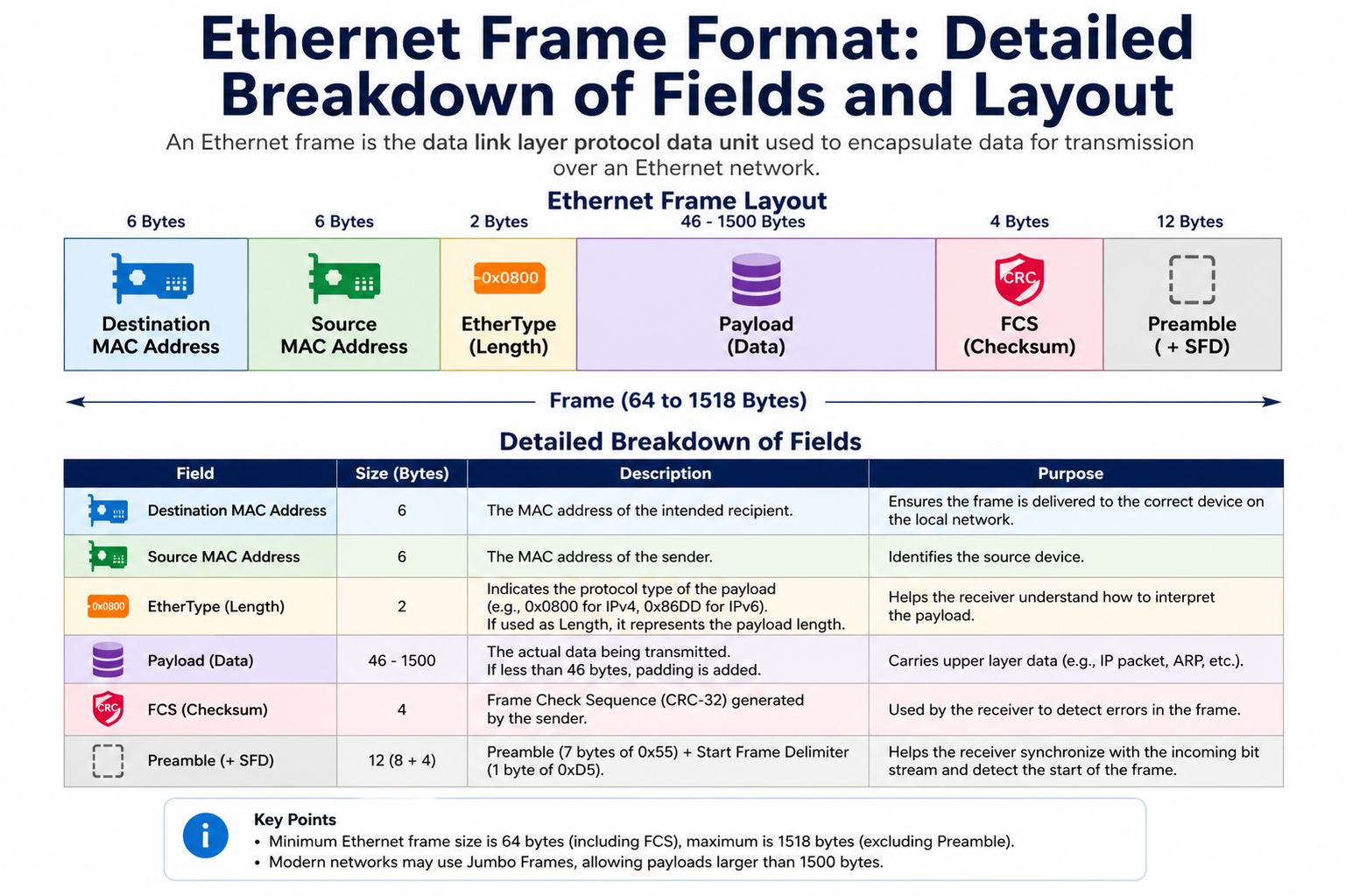
Ethernet frame format refers to the standardized structure used to package and transmit data across Ethernet-based networks. This structure ensures that all devices participating in communication follow a consistent method for sending and receiving information. By organizing data into a defined layout, Ethernet frames enable reliable, efficient, and predictable communication between network nodes. Each frame contains specific fields that serve unique purposes, such as identifying the sender and receiver, carrying the actual data, and verifying whether the data arrived intact. Without this structured format, communication between devices would become chaotic, leading to errors, misinterpretation, and failed transmissions.
The concept of Ethernet frames is fundamental to modern networking because it operates at the Data Link Layer of the OSI model. This layer is responsible for node-to-node data transfer and ensures that data moves correctly across physical connections. Ethernet frames act as the vehicles that carry information between devices like computers, switches, and routers within a local network. By adhering to a consistent format, these frames make it possible for devices from different manufacturers and configurations to communicate seamlessly.
Conceptualizing an Ethernet Frame Through a Simple Analogy
To better understand Ethernet frames, it helps to compare them to something familiar. Imagine sending a physical postcard through the mail. A postcard has a defined layout that includes the recipient’s address, the sender’s address, a message section, and postage markings. Each of these elements plays a role in ensuring the postcard reaches its destination successfully. If any part is missing or incorrect, the postcard may be delayed or never delivered.
Similarly, an Ethernet frame functions as a digital version of that postcard. It carries data from one device to another, but it must follow a strict structure so that the receiving device knows how to interpret it. The frame includes addressing information, control data, and the actual message being sent. Just as postal systems rely on standardized formats, network communication depends on Ethernet frames to maintain order and reliability.
Unlike postcards, which have fixed physical dimensions, Ethernet frames have a size range. The minimum size of an Ethernet frame is 64 bytes, while the maximum size typically reaches around 1518 bytes, though slight variations can occur depending on specific implementations. This size constraint ensures efficient use of network resources while maintaining reliable communication.
The Role of Ethernet Frames in Data Transmission
Ethernet frames serve as the foundation of data exchange within local area networks. Every piece of information transmitted across an Ethernet network is encapsulated within a frame before being sent. Encapsulation refers to the process of wrapping data with the necessary headers and trailers that provide context and control information. Once the frame reaches its destination, the receiving device removes these additional layers in a process known as de-encapsulation, allowing it to access the original data.
This process ensures that data is delivered accurately and in the correct sequence. The structured format of Ethernet frames also allows devices to detect errors, identify intended recipients, and process incoming data efficiently. Without this level of organization, network communication would lack the reliability required for modern applications.
Another important aspect of Ethernet frames is their reliance on MAC addresses rather than IP addresses. A MAC address is a unique identifier assigned to a network interface card, making it specific to the physical device. Because Ethernet operates at the Data Link Layer, it uses these physical addresses to deliver frames within a local network. This distinction is crucial, as it separates the responsibilities of different layers within the OSI model and ensures efficient data handling.
Breaking Down the Core Components of an Ethernet Frame
An Ethernet frame is composed of several key components, each contributing to the overall functionality of data transmission. These components work together to ensure that data is delivered accurately and efficiently. Understanding each part provides deeper insight into how network communication operates at a fundamental level.
The structure begins with synchronization information, followed by addressing fields, control data, the payload, and finally an error-checking mechanism. Each field has a specific size and purpose, and together they form a cohesive unit that enables seamless communication between devices.
Preamble and Its Importance in Synchronization
The preamble is the first component of an Ethernet frame and plays a critical role in preparing the receiving device for incoming data. It consists of a sequence of alternating bits, typically represented as a pattern of ones and zeros. This pattern allows the receiving device to synchronize its internal clock with the incoming signal, ensuring that it can accurately interpret the data that follows.
Without proper synchronization, the receiving device might misread the data, leading to errors and failed communication. The preamble essentially acts as a warm-up phase, giving the receiver time to adjust and align itself with the transmission. This step is essential for maintaining the integrity of data exchange in high-speed networks.
Start Frame Delimiter and Frame Identification
Following the preamble is the Start Frame Delimiter, commonly referred to as SFD. This field marks the end of the synchronization phase and signals the beginning of the actual frame data. It uses a specific bit pattern that distinguishes it from the preamble, allowing the receiving device to recognize that the meaningful portion of the frame is about to begin.
The SFD serves as a clear boundary between the synchronization sequence and the rest of the frame. By providing this distinction, it ensures that the receiving device can correctly identify where the frame starts, reducing the likelihood of misinterpretation.
Destination MAC Address and Data Targeting
One of the most critical components of an Ethernet frame is the destination MAC address. This field specifies the intended recipient of the frame, ensuring that the data reaches the correct device. Each network interface has a unique MAC address, which allows frames to be directed precisely within a local network.
When a frame is transmitted, all devices on the network may receive it, but only the device with the matching MAC address processes the data. This selective processing helps maintain efficiency and prevents unnecessary workload on other devices. The destination MAC address is essential for accurate data delivery and plays a central role in network communication.
Source MAC Address and Sender Identification
Complementing the destination address is the source MAC address, which identifies the device that sent the frame. This information allows the receiving device to know where the data originated, enabling proper communication and response if necessary.
The source MAC address is particularly useful for troubleshooting and network management. By examining this field, network administrators can trace the origin of data, identify potential issues, and monitor traffic patterns. It also ensures that responses can be directed back to the correct sender, maintaining the flow of communication.
Understanding the Type or Length Field
Another important component of the Ethernet frame is the Type or Length field. This field provides information about the nature of the data contained within the frame. In some cases, it indicates the protocol being used, such as IPv4 or IPv6, allowing the receiving device to process the payload accordingly.
In other cases, this field specifies the length of the payload, helping the receiving device determine how much data to expect. This dual functionality makes the Type or Length field a versatile and essential part of the Ethernet frame structure. It ensures that the data is interpreted correctly and efficiently.
The Data Field as the Core of the Frame
At the heart of the Ethernet frame lies the data field, also known as the payload. This is where the actual information being transmitted is stored. The payload can contain various types of data, depending on the protocol specified in the Type field.
The size of the payload is flexible within defined limits, typically ranging from 46 to 1500 bytes. If the data is smaller than the minimum size, padding may be added to meet the required length. This ensures consistency in frame size and helps maintain network efficiency.
The data field is the most meaningful part of the frame, as it carries the information that the sender intends to deliver. All other components serve to support and facilitate the transmission of this data, making it the focal point of the Ethernet frame.
Error Detection with Frame Check Sequence
To ensure data integrity, Ethernet frames include a Frame Check Sequence at the end. This field is used for error detection and helps identify whether the frame was transmitted correctly. It is based on a mathematical calculation performed on the contents of the frame before transmission.
When the frame reaches its destination, the receiving device performs the same calculation and compares the result with the received value. If the two match, the frame is considered valid. If they differ, it indicates that an error occurred during transmission, and the frame may be discarded.
This error-checking mechanism is crucial for maintaining reliable communication. It helps detect issues such as signal interference, data corruption, and transmission errors, ensuring that only accurate data is processed.
Expanding the Understanding of Ethernet Frame Functionality
The Ethernet frame format is more than just a collection of fields; it represents a carefully designed system that enables efficient and reliable communication. Each component plays a specific role, and together they create a robust framework for data transmission.
By standardizing the structure of data, Ethernet frames allow devices to communicate regardless of their internal configurations or manufacturers. This universality is one of the key reasons Ethernet has become the dominant technology for local area networking.
As networks continue to evolve, the principles underlying Ethernet frames remain relevant. They provide the foundation for more advanced technologies and ensure that data can be transmitted accurately and efficiently across increasingly complex systems.
The detailed understanding of Ethernet frames not only helps in grasping networking fundamentals but also builds a strong base for exploring more advanced concepts in data communication.
Deeper Insight into Ethernet Frame Structure and Its Binary Nature
When examining Ethernet frames more closely, it is important to move beyond conceptual analogies and understand how these frames exist in their actual form. While they are often described using readable labels such as addresses and fields, in reality, Ethernet frames are nothing more than sequences of binary digits—streams of zeros and ones transmitted as electrical signals, light pulses, or radio waves depending on the medium. These signals represent voltage changes across a cable or variations in light intensity in fiber optics. The structured format of an Ethernet frame ensures that even though the transmission medium may vary, the interpretation of the data remains consistent across all devices.
Each field within the frame is carefully positioned in a predefined order so that the receiving device can parse the incoming stream without confusion. This strict ordering eliminates ambiguity and allows hardware components like network interface cards to process data at extremely high speeds. The binary nature of Ethernet frames also highlights the importance of synchronization, timing, and precise formatting, as even a small deviation can lead to data corruption or communication failure.
How Devices Interpret and Process Incoming Frames
When an Ethernet frame arrives at a device, it undergoes a systematic process of interpretation. The network interface card begins by detecting the incoming signal and identifying the preamble. Once synchronization is achieved, the device recognizes the Start Frame Delimiter and understands that the meaningful data portion is about to begin. From there, it reads each field in sequence, extracting the destination and source MAC addresses, determining the type or length of the payload, and finally accessing the data itself.
If the destination MAC address does not match the device’s own address or a broadcast address, the frame is typically ignored. This selective processing is essential for maintaining efficiency in a network where multiple devices share the same communication medium. Only frames intended for a specific device—or for all devices in the case of broadcasts—are processed further.
After extracting the payload, the device performs error checking using the Frame Check Sequence. If the calculated value matches the one included in the frame, the data is accepted and passed up to higher layers of the network stack. If not, the frame is discarded, ensuring that corrupted data does not propagate through the system.
The Relationship Between Ethernet Frames and Network Performance
Ethernet frame structure plays a direct role in determining network performance. The size of frames, the efficiency of encapsulation, and the accuracy of error detection all contribute to how effectively data is transmitted across a network. Smaller frames may result in increased overhead because each frame requires its own headers and trailers, while larger frames can carry more data but may introduce delays if retransmission is needed due to errors.
This balance between frame size and efficiency is a critical consideration in network design. Standard Ethernet frames are designed to provide an optimal compromise, ensuring that data is transmitted quickly while minimizing the risk of errors. In some environments, specialized configurations such as jumbo frames are used to increase the payload size, allowing more data to be transmitted in a single frame. However, this requires compatibility across all devices in the network to function correctly.
The structured format of Ethernet frames also contributes to low latency and high throughput. By providing clear boundaries and well-defined fields, the format allows devices to process frames rapidly, reducing delays and improving overall network performance.
Understanding VLAN Tagging in Ethernet Frames
In more advanced networking scenarios, Ethernet frames can include additional information to support segmentation and organization. One such enhancement is Virtual Local Area Network tagging, commonly known as VLAN tagging. This involves inserting an extra field into the Ethernet frame that identifies the specific virtual network to which the frame belongs.
VLAN tagging allows a single physical network to be divided into multiple logical networks, improving security, performance, and manageability. By assigning frames to specific VLANs, network administrators can control traffic flow, isolate sensitive data, and reduce broadcast domains. This is particularly useful in large organizations where different departments or user groups require separate network environments.
The inclusion of a VLAN tag slightly modifies the standard Ethernet frame structure by adding extra bytes between the source MAC address and the Type field. Despite this modification, the overall integrity and functionality of the frame remain intact. Devices that support VLAN tagging can read this additional information and route the frame accordingly, while devices that do not support it may ignore or drop such frames.
Exploring the Role of Padding in Ethernet Frames
One often overlooked aspect of Ethernet frames is the concept of padding. Since Ethernet frames have a minimum size requirement, any payload that is too small must be padded with additional bytes to meet this minimum length. This ensures that frames are long enough to be properly detected and processed by network devices.
Padding does not carry meaningful information and is typically filled with zeros or arbitrary data. Its sole purpose is to maintain the structural integrity of the frame and ensure compatibility with Ethernet standards. Without padding, very small frames could cause synchronization issues or be misinterpreted by receiving devices.
This requirement highlights the importance of consistency in network communication. By enforcing minimum and maximum frame sizes, Ethernet standards ensure that all devices operate within predictable parameters, reducing the likelihood of errors and improving overall reliability.
Broadcast and Multicast Behavior in Ethernet Communication
Ethernet frames are not always sent to a single destination. In some cases, frames are broadcast to all devices on the network or multicast to a specific group of devices. These communication methods rely on special MAC addresses that indicate how the frame should be handled.
A broadcast frame uses a destination MAC address consisting of all ones, signaling that every device on the network should process the frame. This is commonly used for tasks such as address resolution and network discovery. While broadcasts are useful, excessive broadcasting can lead to network congestion, making it important to manage them carefully.
Multicast frames, on the other hand, are sent to a subset of devices that belong to a specific group. This allows efficient distribution of data to multiple recipients without overwhelming the entire network. Multicast communication is often used in applications such as streaming and group collaboration.
The ability to support different communication modes demonstrates the flexibility of Ethernet frames and their adaptability to various networking needs.
Error Handling Beyond Basic Frame Checking
While the Frame Check Sequence provides a primary mechanism for detecting errors, Ethernet networks often rely on additional methods to handle transmission issues. When a frame is found to be corrupted, it is simply discarded, and higher-level protocols are responsible for retransmitting the data if necessary.
This layered approach to error handling ensures that the network remains efficient. Instead of attempting to correct errors at the Data Link Layer, Ethernet focuses on detection and relies on protocols at higher layers, such as those in the transport layer, to manage recovery. This separation of responsibilities simplifies the design of each layer and improves overall performance.
In environments with high levels of interference or noise, error rates may increase, leading to more discarded frames and retransmissions. This can impact network performance, highlighting the importance of maintaining high-quality physical connections and minimizing sources of interference.
The Evolution and Adaptability of Ethernet Frame Standards
Ethernet frame formats have evolved over time to accommodate new technologies and requirements. While the core structure has remained largely consistent, enhancements such as VLAN tagging and support for larger frame sizes have been introduced to meet the demands of modern networks.
These adaptations demonstrate the flexibility of Ethernet as a technology. By maintaining a stable foundation while allowing for incremental improvements, Ethernet has remained relevant in an ever-changing technological landscape. This balance between stability and innovation is a key factor in its widespread adoption.
As networks continue to grow in complexity, the Ethernet frame format will likely continue to evolve. However, its fundamental principles—structured data, reliable transmission, and efficient communication—will remain at the core of its design.
The Importance of Understanding Frame-Level Communication
Gaining a deeper understanding of Ethernet frames provides valuable insight into how networks operate at a fundamental level. While higher-level protocols and applications often receive more attention, the efficiency and reliability of these systems depend heavily on the underlying frame structure.
By studying Ethernet frames, one can better understand how data moves through a network, how devices communicate, and how errors are detected and managed. This knowledge is essential for troubleshooting, optimizing performance, and designing robust network architectures.
A strong grasp of frame-level communication also serves as a foundation for learning more advanced networking concepts. It bridges the gap between physical transmission and higher-level data processing, providing a comprehensive view of how modern communication systems function.
Detailed Examination of the EtherType Field and Protocol Identification
The EtherType field plays a crucial role in defining how the payload within an Ethernet frame should be interpreted. This field acts as a signal to the receiving device, informing it about the protocol encapsulated in the data section. Without this identifier, the device would not know how to process the incoming information, leading to confusion and potential data misinterpretation. The value stored in this field corresponds to specific protocols, allowing seamless interaction between different layers of the networking stack.
For instance, when a frame carries IPv4 data, the EtherType field contains a specific hexadecimal value that indicates this protocol. Similarly, different values are used for IPv6, ARP, and other protocols. This design ensures that once the frame reaches its destination, it can be handed off to the appropriate protocol handler without delay. The efficiency of this mechanism contributes significantly to the speed and reliability of modern network communications.
In some variations of Ethernet standards, this field may represent the length of the payload instead of the protocol type. This dual-purpose functionality highlights the adaptability of Ethernet framing, allowing it to support different operational modes while maintaining compatibility across devices.
The Payload as the Core Carrier of Information
At the center of every Ethernet frame lies the payload, which carries the actual data intended for transmission. This portion is the primary reason the frame exists, as it contains the meaningful information that the sender wishes to deliver to the recipient. The payload can include anything from simple text data to complex multimedia streams, depending on the application and protocol being used.
The size of the payload is carefully regulated to ensure consistency and efficiency. Standard Ethernet frames require the payload to fall within a specific range, typically between 46 and 1500 bytes. If the data to be transmitted is smaller than the minimum requirement, padding is added to meet the necessary size. This ensures that all frames maintain a uniform structure, which is essential for proper detection and processing.
The payload does not operate in isolation; it is tightly coupled with the EtherType field, which dictates how the data should be interpreted. Together, these components form the essence of the Ethernet frame, delivering information in a structured and predictable manner.
In-Depth Understanding of Frame Check Sequence and Data Integrity
The Frame Check Sequence, often referred to as FCS, is a critical component responsible for maintaining data integrity during transmission. It is based on a mathematical algorithm that generates a checksum value derived from the contents of the frame. This value is appended to the end of the frame before transmission begins.
When the frame arrives at its destination, the receiving device performs the same calculation on the received data. It then compares the result with the checksum included in the frame. If the two values match, the data is considered intact and free from errors. If they differ, it indicates that the frame has been corrupted during transmission.
This process is essential for detecting issues such as noise, interference, or signal degradation. By identifying corrupted frames, the network can prevent inaccurate data from being processed, ensuring the reliability of communication. The simplicity and effectiveness of this mechanism make it a fundamental part of Ethernet frame design.
Step-by-Step Breakdown of the CRC Validation Process
The Cyclic Redundancy Check process involves several distinct steps that work together to ensure data accuracy. Before transmission, the sending device calculates a CRC value based on the entire frame content, excluding the FCS field itself. This calculation uses a predefined polynomial algorithm that produces a unique checksum for the given data.
Once the CRC value is generated, it is appended to the frame as the FCS. The frame is then transmitted across the network to its destination. Upon arrival, the receiving device recalculates the CRC using the same algorithm and compares the result with the received checksum.
If the values match, the frame is accepted and processed further. If they do not match, the frame is discarded, as it is assumed to be corrupted. This approach ensures that only accurate data is delivered to higher layers of the network stack, maintaining the integrity of communication.
The CRC process is highly efficient and can detect a wide range of errors, making it a reliable method for ensuring data quality in Ethernet networks.
How Ethernet Frames Support Interoperability Across Devices
One of the most significant advantages of Ethernet frame format is its ability to support interoperability between devices from different manufacturers. Because the format is standardized, all devices adhere to the same structure when sending and receiving data. This eliminates compatibility issues and allows networks to be built using a wide variety of hardware components.
Interoperability is a cornerstone of modern networking, enabling seamless communication across diverse environments. Whether it is a personal computer, a network switch, or an industrial device, each component can participate in the network without requiring custom configurations. The Ethernet frame format acts as a common language that all devices understand.
This universality has contributed to the widespread adoption of Ethernet technology, making it the dominant choice for local area networking. By providing a consistent framework for data transmission, Ethernet frames ensure that communication remains efficient and reliable across different platforms.
The Impact of Frame Encapsulation on Network Layering
Encapsulation is a key concept in networking that involves wrapping data with additional information as it moves down the layers of the OSI model. Ethernet frames play a vital role in this process by encapsulating data from higher layers into a structured format suitable for transmission over physical media.
When data is generated by an application, it passes through various layers of the network stack, each adding its own headers and control information. By the time it reaches the Data Link Layer, it is encapsulated within an Ethernet frame, which adds MAC addresses, error-checking data, and other necessary fields.
This layered approach allows each level of the network stack to perform its specific function without interfering with others. It also makes the system more modular and easier to manage. Ethernet frames serve as the bridge between higher-level protocols and the physical transmission medium, ensuring that data is delivered accurately and efficiently.
Handling Collisions and Network Behavior in Ethernet
In traditional Ethernet networks, especially those using shared media, collisions can occur when multiple devices attempt to transmit data simultaneously. While modern switched networks have largely eliminated this issue, understanding how Ethernet frames interact with collision detection mechanisms provides valuable insight into network behavior.
In earlier Ethernet implementations, a protocol known as Carrier Sense Multiple Access with Collision Detection was used to manage access to the network. Devices would listen to the network before transmitting and detect collisions if they occurred. When a collision was detected, the devices involved would stop transmitting, wait for a random period, and then attempt to resend their frames.
The structure of Ethernet frames plays a role in this process by ensuring that collisions can be detected within a specific time frame. The minimum frame size is designed to guarantee that a transmitting device can detect a collision before it finishes sending the frame. This design consideration highlights the importance of frame structure in maintaining network stability.
The Significance of Minimum and Maximum Frame Sizes
Ethernet frames are defined by strict size limits that ensure consistent performance and reliable communication. The minimum frame size is set to 64 bytes, which includes all headers, payload, and error-checking fields. This minimum size is necessary to support collision detection in traditional Ethernet networks.
On the other hand, the maximum frame size is typically 1518 bytes for standard Ethernet frames. This limit helps prevent any single frame from occupying the network for too long, ensuring fair access for all devices. It also reduces the impact of errors, as smaller frames are easier to retransmit if corruption occurs.
These size constraints are carefully chosen to balance efficiency, reliability, and performance. They ensure that Ethernet networks can operate smoothly under a wide range of conditions, providing a stable foundation for data communication.
Advanced Frame Variations and Modern Networking Needs
As networking technology has evolved, new variations of Ethernet frames have been introduced to meet emerging requirements. These include support for higher data rates, improved efficiency, and enhanced features such as quality of service. While the core structure remains consistent, these variations demonstrate the adaptability of Ethernet framing.
For example, jumbo frames allow for larger payload sizes, enabling more data to be transmitted in a single frame. This can improve performance in high-speed networks by reducing overhead and increasing throughput. However, the use of jumbo frames requires careful configuration and compatibility across all devices in the network.
Other enhancements include additional tagging mechanisms and priority fields that help manage traffic more effectively. These features enable networks to handle diverse workloads, from real-time communication to large-scale data transfers, while maintaining efficiency and reliability.
The Role of Ethernet Frames in Modern Network Infrastructure
Ethernet frames continue to serve as the backbone of modern network infrastructure, supporting a wide range of applications and technologies. From small home networks to large enterprise environments, the principles of Ethernet framing remain consistent, providing a reliable method for data transmission.
As networks become more complex, the importance of understanding Ethernet frames becomes even greater. They form the foundation upon which advanced technologies are built, enabling seamless communication across different systems and platforms.
By mastering the details of Ethernet frame structure and functionality, one gains a deeper appreciation for the mechanisms that drive modern communication. This knowledge not only enhances technical expertise but also provides a solid basis for exploring future innovations in networking.
Practical Applications of Ethernet Frame Format in Real Networks
Ethernet frame format is not just a theoretical concept; it plays a direct and continuous role in real-world networking environments. Every time a device connects to a local network—whether it is a computer accessing a website, a printer receiving a job, or a server responding to a request—Ethernet frames are actively involved in carrying that data. These frames enable devices to communicate efficiently within offices, data centers, educational institutions, and even home networks.
In a typical local area network, switches rely heavily on Ethernet frames to make forwarding decisions. When a frame enters a switch, the device examines the destination MAC address and determines the appropriate port through which the frame should be sent. This process happens in microseconds, allowing networks to handle massive volumes of traffic with minimal delay. The structured nature of Ethernet frames ensures that switches can process and route data accurately without needing to interpret higher-layer protocols.
Another practical example can be seen in network troubleshooting. Tools like packet analyzers capture Ethernet frames and display their contents for inspection. By analyzing these frames, network engineers can identify issues such as incorrect addressing, malformed packets, or transmission errors. This makes Ethernet frames an essential component not only for communication but also for maintaining and diagnosing network health.
How Switching and Forwarding Depend on Frame Structure
Switching is one of the most important functions in Ethernet-based networks, and it relies entirely on the structure of Ethernet frames. When a frame arrives at a switch, the device reads the source MAC address and updates its internal table, associating that address with the port on which the frame was received. This process, known as MAC address learning, allows the switch to build a map of the network.
Once the switch knows where devices are located, it uses the destination MAC address in incoming frames to determine where to forward them. If the destination address is known, the frame is sent directly to the appropriate port. If it is unknown, the frame may be broadcast to all ports except the one it arrived on. This behavior ensures that communication can still occur even when the network topology is not fully known.
The efficiency of this process depends on the consistent format of Ethernet frames. Because every frame follows the same structure, switches can quickly extract the necessary information and make forwarding decisions without delay. This contributes to the high performance and scalability of Ethernet networks.
Security Considerations Related to Ethernet Frames
While Ethernet frames are designed for efficient communication, they also introduce certain security considerations. Since frames are broadcast within a local network segment, there is potential for unauthorized devices to capture and analyze them. This can lead to issues such as data interception or network sniffing.
To address these concerns, various security mechanisms are implemented at different layers of the network. For example, switches can use features like port security to restrict which devices are allowed to connect. Encryption protocols at higher layers can protect the payload within Ethernet frames, ensuring that even if the frame is intercepted, the data remains unreadable.
Another security concern involves spoofing, where a malicious device impersonates another by using its MAC address. This can disrupt network communication and lead to unauthorized access. Understanding the structure of Ethernet frames helps network administrators detect and mitigate such threats by analyzing patterns and identifying anomalies in frame data.
The Role of Ethernet Frames in Wireless and Hybrid Networks
Although Ethernet frames are traditionally associated with wired networks, their influence extends into wireless and hybrid environments as well. In wireless networks, data is transmitted using different protocols, but it is often converted to Ethernet frames when it reaches the wired portion of the network. This ensures compatibility and seamless integration between different types of network infrastructure.
Access points act as bridges between wireless devices and wired networks, translating wireless frames into Ethernet frames and vice versa. This allows devices such as smartphones, laptops, and tablets to communicate with servers and other network resources using the same underlying structure. The consistency of Ethernet framing makes this integration possible, enabling diverse technologies to work together effectively.
In hybrid networks that combine wired and wireless components, Ethernet frames serve as the common format that unifies communication. This demonstrates the versatility and enduring relevance of Ethernet in modern networking environments.
Common Misconceptions About Ethernet Frame Format
Despite its importance, there are several misconceptions surrounding Ethernet frame format. One common misunderstanding is that Ethernet frames carry IP addresses directly. In reality, they use MAC addresses for local delivery, while IP addresses are handled at a higher layer. This distinction is essential for understanding how data moves through different layers of the network.
Another misconception is that Ethernet frames are always the same size. While they do follow minimum and maximum size constraints, the actual size of a frame can vary depending on the payload. This flexibility allows Ethernet to accommodate different types of data while maintaining efficiency.
Some also believe that error correction is handled entirely within Ethernet frames. In truth, Ethernet primarily focuses on error detection rather than correction. When an error is detected, the frame is discarded, and higher-level protocols are responsible for retransmission. This layered approach ensures that each part of the network stack performs its specific function effectively.
The Importance of Ethernet Frames in Certification and Learning
For individuals pursuing careers in networking, understanding Ethernet frame format is a fundamental requirement. Certification programs often include detailed questions about frame structure, field sizes, and functionality. This knowledge is essential for both theoretical understanding and practical application.
Learning about Ethernet frames provides a strong foundation for more advanced topics such as routing, switching, and network security. It helps learners understand how data is transmitted at the most basic level, which is crucial for troubleshooting and optimizing network performance.
Beyond certifications, this knowledge is valuable in real-world scenarios. Network professionals frequently encounter situations where a deep understanding of frame structure is necessary to diagnose issues or design efficient systems. Mastery of this concept can significantly enhance one’s ability to work effectively in the field of networking.
Future Trends and the Continued Relevance of Ethernet Frames
As technology continues to evolve, Ethernet remains a dominant force in networking. Advances in speed, capacity, and efficiency have allowed Ethernet to adapt to new demands, from cloud computing to the Internet of Things. Despite these changes, the fundamental structure of Ethernet frames has remained largely consistent, demonstrating its robustness and adaptability.
Emerging technologies may introduce new enhancements or variations, but the core principles of Ethernet framing are likely to persist. This stability provides a reliable foundation for innovation, allowing new technologies to build upon an established framework.
The continued relevance of Ethernet frames highlights their importance in both current and future networking environments. Understanding this structure ensures that professionals are well-prepared to navigate the evolving landscape of technology.
Final Thoughts
Ethernet frame format stands as one of the most essential concepts in networking, forming the backbone of data communication within local networks. Its structured design ensures that data is transmitted reliably, efficiently, and consistently across a wide range of devices and environments. By defining clear rules for encapsulation, addressing, and error detection, Ethernet frames enable seamless interaction between network components.
From basic communication to advanced network architectures, Ethernet frames play a vital role in maintaining connectivity and performance. Their adaptability has allowed them to remain relevant even as technology has advanced, making them a cornerstone of modern networking.
A comprehensive understanding of Ethernet frame format not only enhances technical knowledge but also provides practical benefits in troubleshooting, design, and optimization. As networks continue to grow in complexity, the principles underlying Ethernet frames will remain a critical part of the foundation that supports global communication.