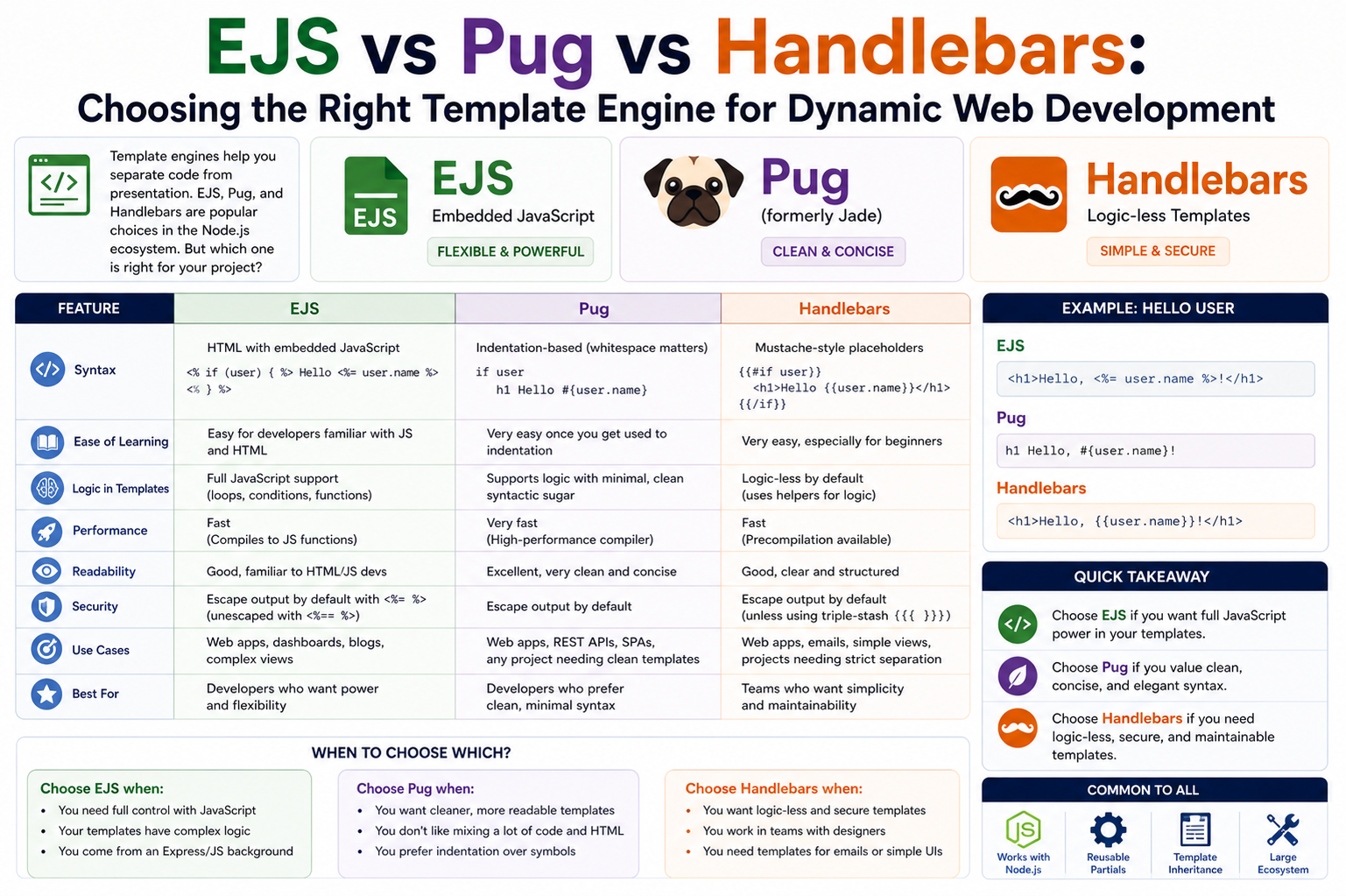
When modern websites are built, they rarely consist of static HTML alone. Most applications today rely on dynamic content that changes based on user input, database information, or real-time updates. To handle this efficiently, developers use template engines, which allow HTML pages to be generated dynamically using data. EJS, Pug, and Handlebars are three widely used tools in this category, each offering a different approach to building and structuring dynamic web pages. They simplify the process of inserting logic into HTML while keeping code maintainable and reusable across projects.
Why Template Engines Matter in Data-Driven Web Development
In data-backed websites, content is not fixed. For example, an e-commerce site displays products from a database, a blog shows articles, and a dashboard updates statistics in real time. Writing raw HTML for every possible variation would be inefficient and unmanageable. Template engines solve this by allowing developers to define a structure once and inject dynamic data where needed. This makes development faster, reduces repetition, and improves scalability. Instead of manually updating HTML files, developers can rely on templates that automatically adjust based on data changes.
Overview of EJS, Pug, and Handlebars in Simple Terms
EJS, Pug, and Handlebars all serve the same purpose but differ in how they are written and how they handle logic. EJS is the most straightforward because it blends JavaScript directly into HTML-like syntax, making it familiar to most developers. Pug takes a more minimal and abstract approach by removing traditional HTML tags and replacing them with indentation-based structure. Handlebars focuses on simplicity and separation of logic, using placeholders inside HTML to inject dynamic content while keeping templates clean and readable. These differences influence how developers choose between them depending on project needs.
Quick Understanding of How These Three Engines Differ
Although all three engines generate dynamic HTML, they follow different philosophies. EJS allows developers to embed JavaScript directly inside templates, which makes it highly flexible but sometimes less structured. Pug reduces visual clutter by eliminating closing tags and relying on indentation, which leads to cleaner but initially unfamiliar code. Handlebars keeps logic minimal inside templates and encourages separation between business logic and presentation, which is ideal for large-scale applications. Each tool has strengths depending on whether a project prioritizes flexibility, readability, or structure.
EJS Syntax and How It Feels Like Standard HTML with JavaScript
EJS, short for Embedded JavaScript, is designed to feel familiar to developers who already understand HTML and JavaScript. It uses standard HTML structure and allows JavaScript code to be inserted using special tags. This means developers can loop through data, use conditions, and display dynamic values without leaving the HTML environment. Because of this approach, EJS is often considered beginner-friendly. It does not require learning a completely new syntax, which makes it easier for developers transitioning from static web pages to dynamic applications.
Working Style of EJS in Real Development Scenarios
In practical use, EJS templates behave like regular HTML files with added dynamic sections. Developers can display variables, iterate through lists, and conditionally render content directly inside the template. This flexibility makes it suitable for applications where quick integration of logic and design is needed. Since JavaScript is already part of the syntax, developers do not need additional abstraction layers. However, this also means that complex logic inside templates can sometimes become harder to manage if not structured properly.
Pug Syntax and Its Minimal, Indentation-Based Structure
Pug takes a completely different approach compared to traditional HTML. Instead of using opening and closing tags, it relies on indentation to define structure. This results in significantly shorter and cleaner code. For developers who prefer minimal syntax, Pug offers a refreshing experience. It removes repetitive elements and focuses on readability through hierarchy rather than tags. While it may look unusual at first, especially for those used to HTML, it becomes very efficient once understood.
Developer Experience When Writing Templates in Pug
Using Pug feels more like writing structured text than coding traditional HTML. Elements are defined by their indentation level, and attributes are written in a compact format. This reduces visual clutter and makes templates easier to scan once the syntax is mastered. Developers often appreciate how quickly they can build large layouts without writing repetitive markup. However, the learning curve can be challenging initially because even small mistakes in indentation can affect the entire structure of the page.
Handlebars Syntax and Its Focus on Clean Separation of Logic
Handlebars uses a different philosophy by keeping templates as clean and logic-free as possible. It uses double curly braces to insert dynamic values into HTML, making it easy to identify where data is being displayed. Instead of embedding complex logic directly into templates, Handlebars encourages the use of helper functions defined separately. This separation helps maintain clarity, especially in large projects where mixing logic and design can lead to confusion.
How Handlebars Maintains Simplicity in Template Design
One of the strongest aspects of Handlebars is its ability to keep templates simple and organized. Developers can focus on layout and presentation while handling logic elsewhere in the application. This approach is particularly useful in team environments where designers and developers work together. Designers can modify templates without worrying about breaking complex JavaScript logic. The result is a cleaner workflow and better maintainability in larger applications.
Comparing Readability Across EJS, Pug, and Handlebars
Readability plays a major role when choosing a template engine. EJS offers familiarity because it looks like standard HTML with added JavaScript, making it easy for most developers to read and understand. Pug offers extreme simplicity but requires adjusting to indentation-based structure, which can feel unusual at first. Handlebars provides a balanced approach by keeping templates clean and separating logic, making it easy to read even in large projects. Each engine prioritizes readability differently depending on its design philosophy.
How Syntax Choice Impacts Development Workflow
The syntax of a template engine directly affects how developers write and maintain code. EJS allows quick implementation but can become cluttered if too much logic is included. Pug improves speed of writing and reduces file size but requires discipline in indentation. Handlebars enforces structure and clarity by limiting logic inside templates. These differences influence not only coding style but also long-term maintainability of projects. Choosing the right syntax depends on whether the focus is speed, cleanliness, or structured separation of concerns.
Transitioning Between Template Engines in Real Projects
Switching between EJS, Pug, and Handlebars is possible but requires adjustment in mindset. Developers moving from EJS to Pug often need to adapt to indentation-based coding. Those switching to Handlebars must learn to separate logic from templates more strictly. While all three achieve the same goal of dynamic HTML generation, their approaches differ enough that experience in one does not fully translate to another. Understanding these differences early helps avoid confusion during development.
Why Understanding Syntax Differences is Important Before Choosing
Before selecting a template engine for a project, it is important to understand how each one handles structure and logic. Syntax affects not just coding speed but also readability, debugging, and collaboration. A developer comfortable with JavaScript-heavy templates may prefer EJS, while someone focused on clean structure may lean toward Handlebars. Pug appeals to those who prefer minimal and compact code. These preferences play a key role in long-term productivity and project success.
EJS vs. Pug vs. Handlebars: Learning Curve and Developer Experience
When developers choose a template engine, one of the most important factors is how easy it is to learn and how it feels in day-to-day use. Even powerful tools can become frustrating if the learning process is too complex or unintuitive. EJS, Pug, and Handlebars each offer a different developer experience, ranging from beginner-friendly simplicity to more structured but slightly steeper learning paths. Understanding how each one feels in real usage helps in deciding which tool fits a developer’s workflow and project style.
Getting Started Experience with EJS
EJS is often considered the easiest entry point for beginners because it closely resembles standard HTML with JavaScript embedded inside it. Developers who already understand web fundamentals can start using it almost immediately without needing to learn a new syntax system. This familiarity reduces friction when building dynamic pages for the first time. The ability to write JavaScript directly inside templates also helps beginners experiment with logic without switching contexts, making the learning process smooth and intuitive.
How EJS Builds Confidence for New Developers
One of the strongest advantages of EJS is how quickly it builds confidence. Since developers can immediately see results by combining HTML and JavaScript, they get fast feedback on their code. This encourages experimentation and helps reinforce core programming concepts like loops, conditions, and data rendering. For beginners working on small to medium projects, this direct approach makes EJS feel approachable and practical. It acts as a bridge between static HTML and fully dynamic web applications.
Learning Curve of Pug and Its Unique Structure
Pug introduces a different mindset compared to traditional HTML-based templates. Instead of tags and closing elements, it uses indentation to define structure. This means developers must think in terms of hierarchy rather than markup. At first, this can feel unfamiliar and even challenging for those used to HTML. However, once the structure becomes clear, Pug allows developers to write significantly less code, which increases efficiency and reduces repetition in large templates.
Adjustment Period When Learning Pug
The learning curve in Pug is not about complexity of features but about adapting to its syntax style. Small mistakes in indentation can lead to unexpected output, which means attention to detail is important. Developers often need a short adjustment period to become comfortable with its structure. After that, writing templates becomes faster and more streamlined. Many developers eventually appreciate the clean and minimal nature of Pug once they overcome the initial learning phase.
Handlebars Learning Experience and Mental Model
Handlebars sits between EJS and Pug in terms of difficulty. It is easy to understand at a basic level because it uses familiar HTML combined with double curly braces for dynamic content. However, its true strength lies in how it enforces separation between logic and presentation. Developers must think differently by moving complex logic out of templates and into helper functions. This encourages cleaner architecture but requires a shift in mindset, especially for those used to embedding logic directly in templates.
Why Handlebars Feels Structured but Restrictive
While Handlebars is simple to read, it can feel slightly restrictive when developers try to add complex logic inside templates. Instead of writing JavaScript directly, they must rely on helpers or external functions. This design choice improves maintainability but can feel limiting during rapid development. However, in larger applications, this restriction actually becomes an advantage because it prevents templates from becoming cluttered with business logic.
Comparing Developer Comfort Across All Three Engines
Developer comfort depends heavily on prior experience and project expectations. EJS feels the most natural for those familiar with JavaScript and HTML because it does not introduce many new concepts. Pug offers a more abstract experience that becomes highly efficient once mastered but may feel unusual at first. Handlebars provides a balanced approach where simplicity is maintained while encouraging clean architecture. Each engine creates a different development rhythm that affects productivity and coding style.
How Experience Level Influences Template Engine Choice
Beginners often prefer EJS because it allows them to start building applications without learning new syntax rules. Intermediate developers may explore Pug to improve speed and reduce repetitive code writing. Advanced developers and teams often choose Handlebars for its structured approach, especially in large-scale applications where maintainability is a priority. The choice is less about capability and more about comfort level and long-term project needs.
Debugging Experience in EJS, Pug, and Handlebars
Debugging is another important part of developer experience. EJS is relatively easy to debug because it uses familiar JavaScript patterns, making errors easier to trace. Pug can sometimes make debugging more complex due to its abstraction and reliance on indentation, where a small mistake can affect the entire layout. Handlebars is generally easier to debug because templates remain clean and logic is separated, but issues in helper functions may require checking outside the template itself.
Error Handling and Common Challenges
Each template engine has its own common challenges. In EJS, excessive logic inside templates can make debugging harder over time. In Pug, indentation errors are one of the most frequent issues developers face. In Handlebars, misunderstandings around helpers or missing data can cause rendering problems. Despite these challenges, all three tools provide enough stability for production use when used correctly and consistently.
Learning Resources and Community Support Influence
The learning experience is also shaped by available resources and community support. EJS benefits from its simplicity, which makes tutorials and examples widely understandable. Pug has a strong but slightly more specialized community due to its unique syntax. Handlebars has extensive documentation and widespread adoption, especially in structured development environments. These resources help reduce the learning curve and provide solutions to common problems.
Developer Productivity After Mastering Each Engine
Once developers become comfortable with any of these template engines, productivity increases significantly. EJS allows fast implementation of dynamic features without switching mental models. Pug speeds up template writing due to reduced syntax overhead. Handlebars improves long-term productivity by keeping code clean and maintainable. The real difference appears not in what they can do, but in how quickly and clearly developers can achieve results.
Team Collaboration and Learning Consistency
In team environments, consistency in learning and usage becomes important. EJS is easy for new team members to understand quickly, which reduces onboarding time. Pug requires more training initially but leads to consistent and clean templates once adopted. Handlebars is often preferred in larger teams because its strict separation of logic and design reduces confusion and improves collaboration between developers and designers.
Long-Term Developer Experience Considerations
Over time, developer experience is influenced by how maintainable and scalable the templates are. EJS offers flexibility but can become messy if not structured properly. Pug offers speed and cleanliness but requires discipline in writing correct indentation-based code. Handlebars provides long-term stability by enforcing clear separation of concerns, making it easier to manage large projects over time.
EJS vs. Pug vs. Handlebars: Performance and Flexibility in Real Web Applications
When building data-backed websites, performance and flexibility are just as important as syntax and ease of learning. A template engine must not only generate dynamic HTML but also handle large datasets, repeated rendering, and scalable application structures efficiently. EJS, Pug, and Handlebars each approach performance differently, and their flexibility varies depending on how they integrate with Node.js applications and dynamic content rendering systems.
Performance Behavior of EJS in Dynamic Rendering
EJS performs well in most standard web applications where content is moderately dynamic. Since it compiles templates into JavaScript functions, it can render pages quickly in typical server-side environments. However, when handling very large datasets or highly complex rendering logic directly inside templates, performance can start to degrade slightly. This usually happens when too much JavaScript logic is embedded in the template instead of being handled in the backend. Despite this, EJS remains efficient for small to medium-sized applications and is widely used because of its balance between simplicity and performance.
Flexibility of EJS in Real Development Scenarios
One of the strongest advantages of EJS is its flexibility. It allows developers to write JavaScript directly inside templates, which makes it extremely adaptable for dynamic rendering needs. Developers can easily loop through data, apply conditions, and inject variables without additional configuration. This makes EJS suitable for projects where requirements frequently change or where rapid development is needed. However, this same flexibility can sometimes lead to messy templates if not properly structured, especially in larger applications.
Performance Characteristics of Pug in Template Rendering
Pug is designed with performance efficiency in mind. By removing unnecessary HTML syntax and relying on indentation-based structure, it reduces file size and simplifies parsing. Pug templates are compiled into optimized JavaScript functions, which allows fast rendering on the server side. In many cases, Pug can perform slightly faster than other template engines due to its minimalistic structure and reduced overhead. This makes it suitable for applications where rendering speed and efficiency are important.
How Pug Improves Efficiency Through Minimal Syntax
The minimal syntax of Pug plays a major role in its performance benefits. Since there are fewer characters and no closing tags, the template structure is lightweight and easier for the engine to process. This reduces parsing complexity and improves rendering speed in large-scale applications. Additionally, Pug encourages cleaner template design, which indirectly improves performance by discouraging unnecessary logic inside views. However, developers must be careful with indentation errors, which can affect output structure.
Flexibility Limitations and Strengths of Pug
While Pug is fast and efficient, it is slightly less flexible when compared to EJS. Its strict syntax rules mean developers must follow a specific structure, which reduces freedom in writing inline logic. However, this limitation is also a strength because it encourages better separation of concerns. Pug supports mixins, includes, and reusable components, which allow developers to build modular templates. This makes it highly effective in projects where structure and consistency are more important than unrestricted flexibility.
Performance Efficiency of Handlebars in Large Applications
Handlebars is designed to handle large-scale applications with complex data structures. It focuses on logic-less templates, meaning most processing happens outside the template itself. This separation improves maintainability and ensures consistent performance even in complex applications. Handlebars compiles templates into optimized functions, allowing fast rendering times. While it may not always be the fastest in very small applications, it performs extremely well when scaling to large datasets and multi-layered UI structures.
How Handlebars Handles Data-Heavy Websites
In data-heavy applications such as dashboards, reporting systems, or content management platforms, Handlebars performs efficiently because it avoids heavy logic inside templates. Instead of processing data within the view layer, it relies on helper functions and external logic. This reduces rendering complexity and keeps templates lightweight. As a result, performance remains stable even when dealing with large volumes of dynamic content. This makes Handlebars particularly suitable for enterprise-level applications.
Flexibility of Handlebars Through Helpers and Partials
Handlebars achieves flexibility not through inline logic but through helpers and partials. Helpers allow developers to define reusable logic outside the template, while partials enable reuse of template sections across different pages. This modular approach ensures that templates remain clean while still being adaptable to complex requirements. Although it may require more initial setup compared to EJS, it provides a scalable structure that is easier to maintain in long-term projects.
Comparing Flexibility Across All Three Engines
Flexibility varies significantly across EJS, Pug, and Handlebars. EJS offers the highest flexibility because it allows direct JavaScript execution inside templates. Pug offers moderate flexibility with structured constraints that encourage cleaner design. Handlebars offers controlled flexibility by separating logic from templates entirely. Each approach has advantages depending on whether a project values freedom, structure, or maintainability more.
Performance Differences in Small vs Large Applications
In small applications, performance differences between EJS, Pug, and Handlebars are almost negligible. All three engines can render pages quickly without noticeable delays. However, as applications scale, differences become more visible. EJS may slow down if templates become overly complex. Pug maintains consistent performance due to its lightweight syntax. Handlebars remains stable in large applications due to its strict separation of logic and presentation. This makes it particularly strong for enterprise-level systems.
Rendering Speed and Template Compilation Behavior
All three template engines rely on compilation before rendering. EJS compiles templates into JavaScript functions that execute on the server. Pug compiles its minimal syntax into optimized HTML-generating functions. Handlebars compiles templates into reusable rendering functions that rely on external logic. The efficiency of these compiled functions determines overall rendering speed. While differences exist, modern Node.js environments handle all three efficiently in most real-world scenarios.
Scalability Considerations for Growing Projects
Scalability is an important factor when choosing a template engine. EJS scales well for projects that maintain good code organization but can become harder to manage if logic is heavily embedded in templates. Pug scales effectively due to its structured and modular design, which reduces repetition. Handlebars scales the best in large teams and enterprise systems because it enforces strict separation between logic and presentation, making maintenance easier as projects grow.
Impact of Flexibility on Long-Term Maintenance
Flexibility directly affects how easy a project is to maintain over time. EJS’s high flexibility can sometimes lead to inconsistent structure if not carefully managed. Pug’s controlled flexibility ensures cleaner templates but requires discipline. Handlebars’ restricted flexibility improves long-term maintainability by enforcing clear boundaries between logic and UI. This makes it easier for teams to collaborate and update code without introducing errors.
EJS vs. Pug vs. Handlebars: Template Structure, Maintainability, and Code Organization
Beyond syntax, learning curve, and performance, one of the most important aspects of any template engine is how well it supports long-term code organization and maintainability. In real-world data-backed websites, projects often grow over time, involve multiple developers, and require frequent updates. This is where the internal structure of EJS, Pug, and Handlebars becomes a major deciding factor. Each engine handles organization differently, and these differences can significantly impact how clean and manageable a project remains as it scales.
Code Organization Approach in EJS Templates
EJS follows a flexible structure where developers can organize code freely. This makes it easy to start quickly, but over time templates can become messy if JavaScript logic is heavily mixed with HTML. EJS supports partials and includes, which help break pages into reusable sections like headers and footers, but overall structure depends on developer discipline rather than strict rules.
Maintainability Challenges in EJS Projects
Because EJS does not enforce strict architecture, maintainability depends on how carefully the project is written. If logic is placed inside templates without structure, files can become difficult to manage in large applications. However, when used properly with partials and clean separation of logic, EJS can still remain organized and scalable.
Template Organization Style in Pug
Pug enforces structure through indentation-based syntax. This naturally creates a hierarchical and clean layout. Developers are guided toward writing organized templates because the syntax itself discourages clutter. Features like mixins and includes allow reusable components, making it easier to manage large template systems without repetition.
Maintainability Strength of Pug
Pug improves maintainability by reducing unnecessary HTML repetition and enforcing consistent structure. However, indentation sensitivity means small formatting mistakes can affect output. Once developers become comfortable with its structure, it becomes one of the cleanest ways to manage templates in medium-sized projects.
Handlebars and Separation of Concerns
Handlebars is designed to keep templates clean by removing business logic from HTML. Instead of writing logic inside templates, developers use helpers and external functions. This ensures that templates remain focused only on presentation, which improves readability and long-term maintainability.
Maintainability Advantage of Handlebars
Handlebars works best in large applications because it enforces clear separation between logic and UI. This makes collaboration easier in teams, as developers and designers can work independently without interfering with each other’s code. The use of partials also helps maintain consistent UI structure across the application.
Reusability Across All Three Engines
All three engines support reusable components. EJS uses partials, Pug uses mixins and includes, and Handlebars uses partials and helpers. However, Pug and Handlebars encourage more structured reuse, while EJS gives more freedom but requires better discipline to stay organized.
Real-World Usage Scenarios and Performance Suitability
In real-world usage, EJS is often chosen for quick projects, prototypes, and small to medium websites where speed of development matters. Pug is commonly used in applications where clean structure and performance optimization are priorities. Handlebars is widely used in large-scale applications, dashboards, and enterprise systems where maintainability and structured design are critical. Each engine performs well within its ideal use case.
EJS vs. Pug vs. Handlebars: Community Support, Ecosystem, and Real-World Use Cases
When choosing a template engine for data-backed websites, technical features are important, but long-term success also depends heavily on community support, ecosystem maturity, and real-world adoption. Even the most efficient tool can become difficult to use if it lacks documentation, examples, or active developer support. EJS, Pug, and Handlebars each have strong communities, but they differ in size, focus, and how they support developers across different types of projects.
Community Strength and Adoption of EJS
EJS has a long-standing presence in the Node.js ecosystem, which contributes to its stable and reliable community support. Because it is simple and widely used in beginner and intermediate projects, there are countless tutorials, guides, and examples available online. This makes it easy for developers to find solutions to common problems. EJS is often recommended in learning environments because its community is approachable and beginner-friendly. Its widespread adoption also means it is well-tested in real-world applications, from small personal projects to production-level websites.
Ecosystem Support and Practical Resources for EJS
The ecosystem around EJS is built on simplicity. It integrates smoothly with Express.js and other Node.js frameworks, making it a natural choice for server-side rendering. While it may not have as many advanced plugins as some newer tools, its strength lies in stability and compatibility. Developers rarely face issues finding examples or resolving errors, which reduces development friction. The availability of straightforward resources makes it easier for teams to onboard new developers quickly.
Community and Ecosystem Around Pug
Pug has a strong but more specialized community compared to EJS. It is widely appreciated among developers who prefer clean, minimal syntax and efficient template writing. The community is active, especially in Node.js development circles, where Pug is often used in projects that prioritize performance and structure. Although it may not be as universally used as EJS, it still maintains a solid ecosystem with plugins, extensions, and integration support for modern frameworks.
How Pug Maintains Its Developer Ecosystem
Pug’s ecosystem focuses on productivity and code cleanliness. It supports mixins, includes, and reusable components, which help developers build scalable templates. Many developers who adopt Pug stay with it long-term due to its efficiency once mastered. While beginners may take time to adjust, the community provides helpful resources that explain best practices for structuring templates. This makes it suitable for developers who want to improve code quality and reduce redundancy in their projects.
Handlebars Community and Long-Term Stability
Handlebars has one of the most mature and stable ecosystems among the three. It is widely used in both frontend and backend environments, particularly in larger applications that require structured and maintainable templates. Its community is known for strong documentation, clear examples, and consistent updates. Because Handlebars is used in enterprise-level systems, its ecosystem is built around reliability and long-term support rather than rapid experimentation.
Why Handlebars Is Popular in Large-Scale Projects
Handlebars is often chosen for large-scale applications because of its predictable structure and logic separation. The community strongly supports best practices that emphasize clean architecture. Developers working in teams appreciate its strict template rules, which reduce confusion and ensure consistency across codebases. This makes it easier to maintain complex applications over time without introducing unnecessary complexity into the presentation layer.
Real-World Use Cases of EJS in Web Development
EJS is commonly used in small to medium-sized web applications, including blogs, simple dashboards, and content-driven websites. It is especially popular in educational projects where developers are learning server-side rendering for the first time. Because it allows direct JavaScript usage inside templates, it is often used in projects that require quick implementation and frequent changes. Its flexibility makes it suitable for prototypes and early-stage applications.
Where Pug Performs Best in Real Applications
Pug is widely used in applications where clean and compact code is a priority. It is often found in projects that require fast template development with minimal repetition. Startups and developers who value speed and structure often choose Pug for building user interfaces that need to be scalable and maintainable. It works well in content-heavy websites where templates must remain consistent and easy to manage.
Handlebars in Enterprise and Scalable Systems
Handlebars is frequently used in enterprise environments where large teams collaborate on complex systems. It is common in dashboards, reporting tools, and applications that require strict separation between logic and presentation. Because it encourages modular design through helpers and partials, it scales effectively in systems that handle large amounts of dynamic data. Its predictable structure makes it easier to maintain across long-term projects.
Comparing Ecosystem Maturity Across All Three Engines
EJS, Pug, and Handlebars all have mature ecosystems, but they serve different developer needs. EJS focuses on accessibility and ease of use, making it ideal for beginners and general-purpose development. Pug focuses on efficiency and clean syntax, appealing to developers who prioritize speed and structure. Handlebars focuses on scalability and maintainability, making it the preferred choice for large and complex systems. Each ecosystem supports its engine’s core philosophy.
Long-Term Maintenance and Community Reliability
Long-term project success often depends on how stable and reliable the community is. EJS benefits from its simplicity and widespread adoption, ensuring long-term availability of resources. Pug benefits from a dedicated user base that values structured templates and efficient development workflows. Handlebars benefits from strong enterprise adoption, which ensures continuous updates and long-term stability. This makes all three viable choices depending on project scale and expectations.
Choosing the Right Engine Based on Project Needs
Selecting between EJS, Pug, and Handlebars depends on the type of project being built. EJS is ideal for developers who want simplicity and flexibility without learning a new syntax system. Pug is suitable for developers who prefer clean, minimal code and faster template writing. Handlebars is best for structured applications where maintainability and separation of logic are critical. The decision is less about capability and more about workflow preference and project requirements.
Understanding of All Three Engines
EJS, Pug, and Handlebars each solve the same core problem—dynamic HTML generation—but in very different ways. EJS offers familiarity and flexibility, Pug provides minimal and efficient syntax, and Handlebars ensures structure and maintainability. Their differences make them suitable for different types of developers and projects, from small personal websites to large enterprise systems. Understanding their strengths helps developers choose the right tool for the right context.
Final Conclusion
There is no universally best template engine among EJS, Pug, and Handlebars. Each one excels in different areas depending on project size, developer experience, and long-term goals. EJS is best for simplicity and fast development, Pug is best for clean and efficient code writing, and Handlebars is best for structured, scalable applications. The best choice ultimately depends on balancing ease of use, performance needs, and maintainability requirements for the specific project being built.