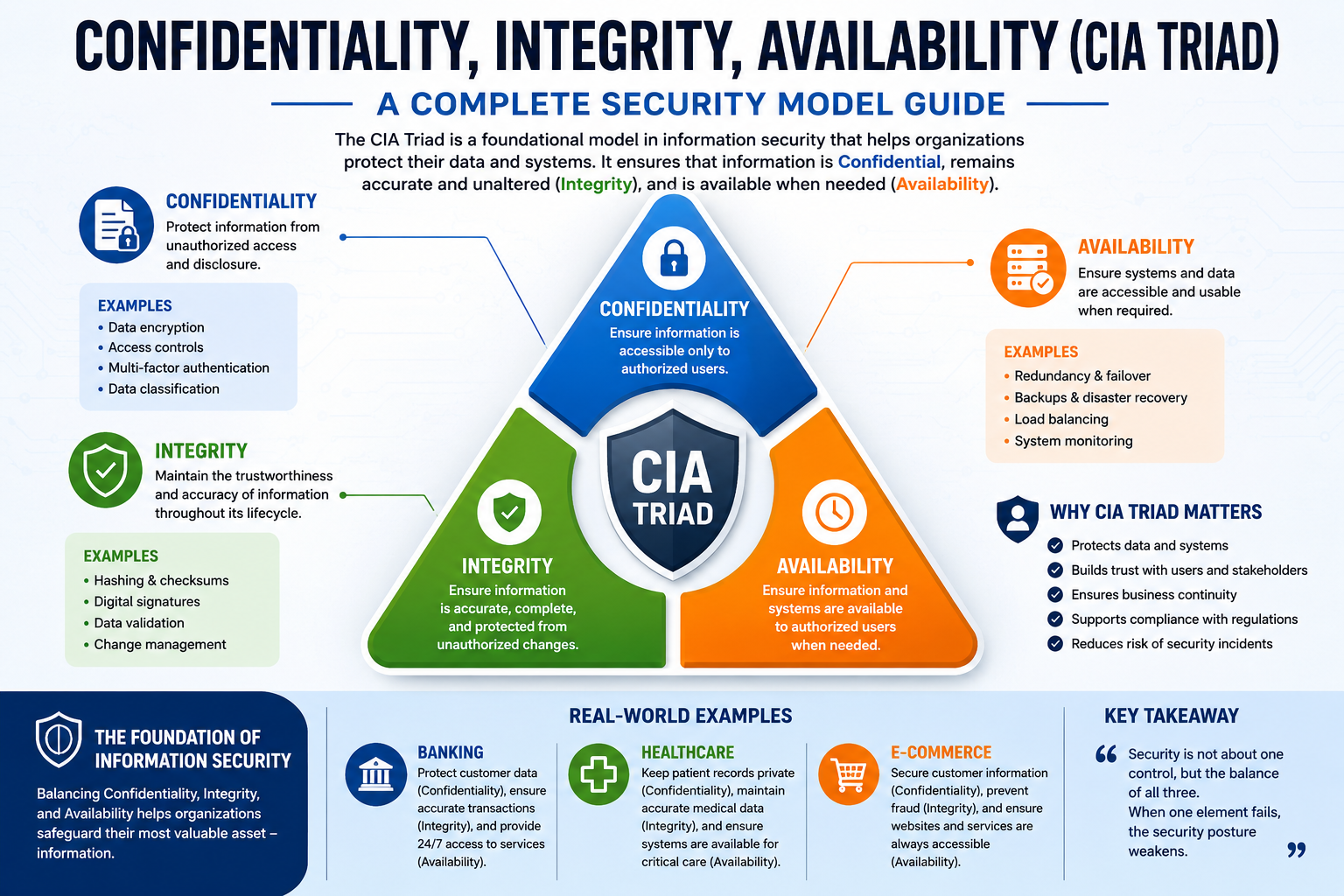
Cybersecurity today is no longer limited to protecting computers in offices or securing a company’s internal network. It has become a broad and essential discipline that influences nearly every aspect of modern life. From online banking and digital communication to healthcare systems and transportation networks, almost everything depends on secure and reliable data systems. At the heart of this protection lies a foundational concept known as the CIA Triad, which stands for Confidentiality, Integrity, and Availability.
The CIA Triad is not a tool or a software solution. Instead, it is a conceptual framework that defines the core objectives of cybersecurity. Every security strategy, policy, or control is built around these three principles. Together, they ensure that information remains private, accurate, and accessible when needed.
Confidentiality ensures that sensitive information is protected from unauthorized access. Integrity guarantees that data remains accurate and unaltered unless properly modified. Availability ensures that systems and information are accessible whenever users need them. These three principles work together to form the backbone of secure digital systems.
Understanding the CIA Triad is essential for anyone entering the field of information technology or cybersecurity because it provides the lens through which all security decisions are evaluated. Whether designing a secure application, managing a corporate network, or responding to a cyberattack, these principles guide every action.
Why the CIA Triad is the Foundation of Cybersecurity
The importance of the CIA Triad lies in its simplicity and universality. No matter how advanced technology becomes, the fundamental goals of cybersecurity remain the same. Systems must protect data from unauthorized access, ensure that information is correct and reliable, and remain available to users when needed.
Without confidentiality, private information becomes exposed, leading to identity theft, financial fraud, and loss of trust. Without integrity, data becomes unreliable, resulting in incorrect decisions, system errors, and operational failures. Without availability, systems become unusable, disrupting services and causing financial and reputational damage.
These principles are not independent; they are deeply connected. A strong cybersecurity strategy always considers how improving one area might affect the others. For example, increasing security restrictions may improve confidentiality but reduce availability. Similarly, focusing only on accessibility may weaken confidentiality and integrity.
The CIA Triad acts as a balancing framework that helps organizations design systems that are both secure and functional. It is used across industries such as banking, healthcare, government, education, and technology because it provides a universal approach to managing digital risk.
Confidentiality: Protecting Sensitive Information
Confidentiality is the principle that ensures information is accessible only to those who are authorized to view it. It focuses on protecting personal, financial, medical, and organizational data from unauthorized access. In simple terms, confidentiality is about privacy and secrecy in digital systems.
In everyday life, confidentiality is similar to keeping personal conversations private. Just as people expect their personal discussions to remain confidential, digital systems must ensure that sensitive data is not exposed to unintended users.
Organizations handle vast amounts of confidential data, including customer records, employee details, intellectual property, and financial transactions. If this information is exposed, it can lead to serious consequences such as fraud, legal issues, and loss of trust.
To maintain confidentiality, cybersecurity systems rely on multiple protective mechanisms. Encryption is one of the most important methods. It converts readable data into unreadable formats that can only be accessed with a decryption key. Even if attackers intercept encrypted data, they cannot understand it without the proper credentials.
Access control is another essential method. It determines who can access specific information and what actions they are allowed to perform. This is often implemented through passwords, multi-factor authentication, and role-based permissions. By limiting access, organizations reduce the risk of unauthorized exposure.
Data classification also plays a key role in confidentiality. It involves categorizing data based on its sensitivity level. Highly sensitive information receives stronger protection measures, while less critical data may have fewer restrictions.
Threats to Confidentiality in Modern Systems
Despite strong protective measures, confidentiality remains one of the most frequently targeted aspects of cybersecurity. Cybercriminals use various techniques to gain unauthorized access to sensitive information.
One common threat is phishing, where attackers trick users into revealing login credentials or personal information. These attacks often appear as legitimate emails or messages, making them difficult to detect.
Another major threat is malware, which includes malicious software designed to infiltrate systems and steal data. Once installed, malware can silently collect sensitive information and send it to attackers without the user’s knowledge.
Insider threats also pose a significant risk. These occur when individuals within an organization misuse their access privileges to leak or steal information. Because insiders already have legitimate access, detecting such threats can be challenging.
Weak passwords and poor authentication practices further increase the risk of confidentiality breaches. When users rely on simple or reused passwords, attackers can easily gain access through brute-force attacks or credential stuffing.
Data breaches are another major concern. These occur when attackers exploit vulnerabilities in systems to access large volumes of sensitive information. Once exposed, this data is often sold or used for malicious purposes.
Integrity: Ensuring Accuracy and Trustworthiness of Data
Integrity refers to the accuracy, consistency, and reliability of data throughout its lifecycle. It ensures that information remains unchanged unless it is properly authorized and modified. In cybersecurity, integrity is essential because decisions are often made based on the data stored in systems.
If data integrity is compromised, the consequences can be severe. Incorrect or tampered data can lead to faulty decisions, system malfunctions, and financial losses. For example, altered financial records could result in incorrect transactions, while modified medical data could affect patient treatment.
Maintaining integrity involves ensuring that data is protected from unauthorized modification, whether intentional or accidental. It also ensures that any changes made to data are tracked and verified.
Hashing is one of the primary techniques used to maintain data integrity. A hash function generates a unique digital fingerprint for a set of data. If even a small change occurs in the data, the hash value changes completely, making it easy to detect tampering.
Digital signatures are another important mechanism. They verify both the authenticity and integrity of data by confirming that it has not been altered and that it originates from a trusted source.
Version control systems also help maintain integrity by tracking changes over time. They allow users to review previous versions of data and restore them if necessary. This ensures that accidental changes can be corrected easily.
Threats to Data Integrity
Data integrity can be compromised in several ways, both intentionally and unintentionally. One major threat is unauthorized data modification, where attackers alter information to mislead users or disrupt operations.
Malware attacks can also corrupt or modify data without the user’s knowledge. Some types of malware are specifically designed to manipulate data stored in systems.
Human error is another significant risk. Mistakes during data entry, system configuration, or file handling can unintentionally alter important information.
System failures and software bugs may also affect data integrity. If a system crashes during data processing, it may result in incomplete or corrupted data.
Man-in-the-middle attacks represent another serious threat. In these attacks, hackers intercept and modify data while it is being transmitted between two parties, making the communication unreliable.
Availability: Ensuring Continuous Access to Systems and Data
Availability ensures that systems, applications, and data are accessible to authorized users whenever they are needed. In a world that relies heavily on digital services, availability is critical for maintaining productivity, communication, and business operations.
Even a short period of downtime can have significant consequences. Online services may become inaccessible, financial transactions may be delayed, and communication systems may fail. This makes availability one of the most visible and impactful aspects of cybersecurity.
To ensure availability, organizations implement redundancy systems. These systems provide backup resources such as servers, networks, and storage devices that can take over if the primary system fails.
Disaster recovery planning is another important strategy. It involves preparing for unexpected events such as cyberattacks, hardware failures, or natural disasters. A well-designed recovery plan ensures that systems can be restored quickly with minimal disruption.
Scalability also supports availability by allowing systems to handle increased demand. As user traffic grows, scalable systems can expand their capacity without crashing or slowing down.
Load balancing is commonly used to distribute traffic across multiple servers. This prevents any single server from becoming overloaded and ensures consistent performance.
Threats to System Availability
Availability can be disrupted by several types of threats. One of the most common is a Distributed Denial of Service (DDoS) attack, where attackers overwhelm a system with excessive traffic, causing it to become unavailable to legitimate users.
Hardware failures also pose a risk. If critical components such as servers or storage devices fail, systems may become temporarily or permanently inaccessible.
Software bugs and configuration errors can also lead to system downtime. Even a small error in system settings can cause widespread service disruptions.
Power outages and natural disasters can physically impact infrastructure, leading to extended periods of unavailability.
Cyberattacks targeting system resources may also degrade performance or completely shut down services.
Interconnection of Confidentiality, Integrity, and Availability
Although confidentiality, integrity, and availability are distinct principles, they are deeply interconnected. A weakness in one area can affect the others, creating security risks across the entire system.
For example, improving confidentiality through strict access controls may reduce availability if users struggle to access the information they need. Similarly, prioritizing availability without proper security measures may expose systems to unauthorized access, weakening confidentiality.
Integrity also depends on both confidentiality and availability. If unauthorized users gain access to a system, they may alter data, compromising integrity. If systems are frequently unavailable, data updates may be delayed or incomplete, also affecting integrity.
In real-world systems, cybersecurity professionals must carefully balance these principles to ensure that security does not come at the cost of usability or reliability.
Implementing the CIA Triad in Real-World Cybersecurity Systems
Understanding the CIA Triad at a conceptual level is only the beginning. The real challenge lies in applying these principles effectively within complex and constantly evolving digital environments. Modern organizations operate across cloud platforms, mobile devices, internal networks, and third-party systems, making the practical implementation of confidentiality, integrity, and availability far more dynamic than theory alone suggests.
To implement the CIA Triad successfully, organizations must design layered security systems that protect data at every stage—whether it is being stored, processed, or transmitted. This approach ensures that no single point of failure can compromise the entire system. Instead, multiple controls work together to enforce security objectives.
In real-world environments, the CIA Triad is not implemented as separate components. Instead, it is integrated into every layer of cybersecurity architecture, including network security, application design, data storage, identity management, and operational processes.
Defense in Depth and the CIA Triad
One of the most important strategies used to implement the CIA Triad is the concept of defense in depth. This approach assumes that no single security control is sufficient on its own. Instead, multiple layers of protection are applied so that if one layer fails, others continue to provide security.
For confidentiality, this means combining encryption, authentication, access control, and monitoring systems. Even if one mechanism is bypassed, others still protect sensitive information.
For integrity, defense in depth ensures that data is validated at multiple stages. Input validation, checksums, audit logs, and digital signatures all work together to detect and prevent unauthorized changes.
For availability, redundancy is built into infrastructure through backup servers, failover systems, and distributed networks. If one system becomes unavailable, another can immediately take over.
This layered approach is essential because modern cyber threats are sophisticated and often designed to bypass single security measures. By distributing protection across multiple layers, organizations significantly reduce the risk of complete system compromise.
Confidentiality in Enterprise Systems
In enterprise environments, confidentiality is enforced through a combination of technical controls and organizational policies. Large organizations handle vast amounts of sensitive data, including customer records, employee information, financial transactions, and proprietary business data. Protecting this information requires strict control over who can access it and under what conditions.
Identity and Access Management (IAM) systems play a central role in maintaining confidentiality. These systems ensure that each user is assigned a unique identity and granted only the minimum level of access necessary to perform their tasks. This concept is known as the principle of least privilege.
Multi-factor authentication adds another layer of protection by requiring users to verify their identity through multiple methods, such as passwords, mobile devices, or biometric verification. This significantly reduces the risk of unauthorized access even if credentials are compromised.
Data encryption is widely used both in transit and at rest. When data is transmitted across networks, encryption protocols ensure that it cannot be intercepted and read by attackers. Similarly, encrypted storage systems protect data even if physical devices are stolen or accessed without authorization.
Network segmentation also supports confidentiality by dividing networks into smaller, controlled sections. Sensitive systems are isolated from general network traffic, reducing the likelihood of unauthorized access spreading across the entire infrastructure.
Integrity in Digital Systems and Data Processing
Maintaining data integrity in modern systems is particularly challenging due to the speed and volume of data being processed. Organizations rely heavily on automated systems, databases, and real-time analytics, all of which must maintain accuracy without manual oversight.
Database management systems implement integrity constraints to ensure that data remains consistent. These constraints define rules that prevent invalid or contradictory information from being stored. For example, a system may prevent duplicate entries or ensure that relationships between data tables remain valid.
Transaction management systems also play a crucial role. In financial systems, for instance, transactions must either be fully completed or not executed at all. This prevents partial updates that could lead to inconsistent records.
Audit logging is another critical mechanism. It records every change made to a system, including who made the change, when it occurred, and what was modified. This creates a traceable history that can be reviewed in case of discrepancies or investigations.
In software development, integrity is maintained through secure coding practices and automated testing. Developers use validation techniques to ensure that input data does not corrupt system operations. Continuous integration systems help detect errors early by testing code changes before deployment.
Availability in High-Demand Environments
Availability becomes especially critical in environments where downtime directly impacts revenue, safety, or public services. Large-scale systems such as online retail platforms, banking networks, healthcare systems, and cloud services must operate continuously with minimal interruption.
To achieve this level of reliability, organizations design systems with high availability architectures. These architectures include multiple redundant components that ensure continuous operation even if individual parts fail.
Clustering is commonly used to connect multiple servers so that they function as a single system. If one server fails, others automatically take over its workload without disrupting service.
Cloud computing has significantly improved availability by distributing resources across geographically separated data centers. This ensures that even if one location experiences a failure, services can continue running from another region.
Backup systems are also essential for availability. Regular data backups ensure that information can be restored quickly in the event of system failure, cyberattacks, or accidental deletion.
Monitoring systems continuously track system performance and detect potential issues before they cause outages. These systems provide alerts that allow administrators to respond proactively rather than reactively.
The Role of Cryptography in the CIA Triad
Cryptography is one of the most powerful tools used to support all three elements of the CIA Triad. It provides mechanisms to protect confidentiality, ensure integrity, and support secure communication across untrusted environments.
For confidentiality, encryption algorithms transform readable data into unreadable formats. Only authorized users with the correct decryption keys can access the original information.
For integrity, cryptographic hash functions generate unique digital fingerprints of data. If even a single character is altered, the hash value changes completely, signaling potential tampering.
For authentication and integrity combined, digital signatures verify both the identity of the sender and the authenticity of the data. This ensures that information has not been modified during transmission and originates from a trusted source.
Secure communication protocols such as TLS rely heavily on cryptography to protect data exchanged over networks. These protocols ensure that sensitive information such as passwords, financial details, and personal data remains secure during transmission.
Identity and Access Management in CIA Enforcement
Identity and Access Management systems form the backbone of confidentiality enforcement in modern organizations. These systems control how users are identified, authenticated, and authorized within a digital environment.
Authentication verifies the identity of users before granting access. Authorization determines what actions users are allowed to perform once they are authenticated. Together, these processes ensure that only legitimate users can access specific resources.
Role-based access control simplifies this process by assigning permissions based on job roles rather than individual users. This ensures consistency and reduces the risk of excessive privileges.
Privileged access management adds another layer of security by monitoring and controlling access to critical systems. Users with administrative privileges are subject to stricter controls and monitoring to prevent misuse.
Session management also plays an important role. It ensures that user sessions expire after periods of inactivity, reducing the risk of unauthorized access from unattended devices.
Network Security and CIA Triad Enforcement
Network security is a critical component in enforcing the CIA Triad because networks serve as the primary medium through which data is transmitted and accessed.
Firewalls act as barriers between trusted and untrusted networks. They filter incoming and outgoing traffic based on predefined security rules, helping maintain confidentiality and availability.
Intrusion detection and prevention systems monitor network traffic for suspicious activity. These systems can detect potential attacks and take action to block them before they cause damage.
Virtual private networks create secure communication channels over public networks. They encrypt data transmissions, ensuring confidentiality even when data travels across untrusted environments.
Network monitoring tools provide real-time visibility into system performance and security. They help identify anomalies that could indicate breaches or system failures.
CIA Triad in Cloud Computing Environments
Cloud computing has transformed how organizations implement the CIA Triad. Instead of relying on physical infrastructure, companies now use virtualized resources provided by cloud service providers.
Confidentiality in cloud environments is maintained through encryption, access controls, and identity management systems. Cloud platforms provide tools that allow organizations to define strict access policies for their data.
Integrity is ensured through automated backups, versioning systems, and secure storage mechanisms. Cloud providers often include built-in tools to detect unauthorized changes and restore previous data states.
Availability is one of the strongest advantages of cloud computing. Cloud platforms distribute resources across multiple data centers, ensuring high uptime and resilience against failures.
However, cloud environments also introduce new risks. Misconfigured access settings, shared infrastructure vulnerabilities, and dependency on third-party providers can all impact CIA enforcement if not properly managed.
Monitoring, Logging, and Continuous Security Evaluation
Continuous monitoring is essential for maintaining the CIA Triad in dynamic environments. Security systems must constantly observe network activity, system performance, and user behavior to detect potential threats.
Logging systems record detailed information about system events. These logs are used to analyze incidents, identify suspicious activity, and support forensic investigations.
Security Information and Event Management systems aggregate and analyze log data from multiple sources. They provide a centralized view of security events, helping organizations respond quickly to potential threats.
Continuous evaluation ensures that security controls remain effective over time. As threats evolve, systems must be updated and adjusted to maintain protection across all three principles of the CIA Triad.
Incident Response and CIA Protection Strategies
When security incidents occur, organizations must respond quickly to minimize damage to confidentiality, integrity, and availability. Incident response plans define structured processes for detecting, containing, and recovering from security breaches.
During an incident, confidentiality may be compromised if sensitive data is exposed. Integrity may be affected if systems are altered or corrupted. Availability may be disrupted if services are taken offline.
Effective incident response focuses on identifying the source of the problem, isolating affected systems, restoring normal operations, and preventing future occurrences.
Post-incident analysis is also important. It helps organizations understand how the breach occurred and what improvements are needed to strengthen future security measures.
Building a Security Culture Around the CIA Triad
Technology alone cannot guarantee security. Human behavior plays a critical role in maintaining the CIA Triad. Organizations must build a security-aware culture where employees understand the importance of protecting data and following security policies.
Training programs help users recognize threats such as phishing, social engineering, and unsafe data handling practices. Regular awareness initiatives reinforce good security habits and reduce the likelihood of human error.
Security policies define clear rules for how data should be handled, accessed, and stored. These policies ensure consistency across the organization and align all operations with the principles of the CIA Triad.
When security becomes part of organizational culture rather than just a technical requirement, the effectiveness of confidentiality, integrity, and availability increases significantly.
CIA Triad in Modern Threat Landscape and Evolving Cyber Risks
As digital systems continue to expand, the CIA Triad operates in an environment that is far more complex than when it was first introduced. Modern cyber threats are not limited to simple viruses or unauthorized logins. Instead, attackers now use highly coordinated, automated, and intelligent techniques to bypass security systems. This evolving threat landscape places constant pressure on confidentiality, integrity, and availability, requiring organizations to continuously adapt their defenses.
Cyberattacks today are often persistent and targeted. Rather than random attempts, attackers carefully study their targets, identify weak points, and exploit them over time. These advanced persistent threats are designed to remain undetected for long periods while slowly extracting data, modifying systems, or disrupting operations. Each stage of such attacks directly challenges one or more components of the CIA Triad.
Ransomware attacks, for example, significantly impact availability by locking users out of critical systems until a ransom is paid. At the same time, they may also compromise integrity by encrypting or corrupting files. In some cases, attackers even threaten to expose stolen data, violating confidentiality as well. This shows how modern threats often target all three principles simultaneously rather than focusing on just one.
Phishing campaigns and social engineering attacks primarily target confidentiality by tricking users into revealing sensitive information. However, once attackers gain access, they may also alter data or disrupt services, affecting both integrity and availability. The interconnected nature of these attacks demonstrates why the CIA Triad must be treated as a unified defense model rather than isolated principles.
Zero Trust Architecture and the Reinforcement of CIA Principles
Traditional security models often assumed that anything inside a network perimeter could be trusted. However, this assumption no longer holds in modern environments where users access systems from multiple devices, locations, and networks. Zero Trust Architecture has emerged as a response to this challenge, fundamentally reshaping how the CIA Triad is enforced.
Zero Trust operates on the principle of “never trust, always verify.” Every user, device, and request must be continuously authenticated and authorized, regardless of its location. This approach significantly strengthens confidentiality by ensuring that access is strictly controlled at all times.
Integrity is reinforced through constant validation of system behavior and data access patterns. Any unusual activity is flagged and analyzed to detect potential tampering or unauthorized changes. Continuous verification ensures that data remains accurate and trustworthy throughout its lifecycle.
Availability is maintained by designing systems that can isolate threats without shutting down entire networks. If a suspicious activity is detected, only the affected segment is restricted while the rest of the system continues to operate normally. This minimizes disruption while maintaining security.
Zero Trust also relies heavily on identity-centric security models. Instead of focusing on network boundaries, it prioritizes user identity and device trust levels. This shift ensures that access decisions are dynamic and context-aware, strengthening all three pillars of the CIA Triad.
Data Lifecycle Management and CIA Enforcement
The CIA Triad must be applied throughout the entire lifecycle of data, from creation and storage to usage and eventual disposal. Each stage presents unique security challenges that must be addressed to maintain confidentiality, integrity, and availability.
During data creation, confidentiality is enforced by controlling who can input and access new information. Integrity is ensured by validating inputs to prevent incorrect or malicious data from entering the system.
When data is stored, encryption and secure storage mechanisms protect confidentiality. Redundant storage systems and backups support availability, ensuring that data remains accessible even in the event of system failure. Integrity is maintained through checksums and validation processes that detect corruption or unauthorized changes.
During data usage, access controls determine who can view or modify information. Logging systems track all interactions to ensure accountability and support integrity verification. Performance optimization ensures that data remains available without delay.
Finally, during data disposal, secure deletion methods are used to ensure that sensitive information cannot be recovered. This step is crucial for maintaining confidentiality even after the data is no longer needed.
Advanced Persistent Threats and Long-Term CIA Risks
Advanced Persistent Threats represent one of the most sophisticated challenges to the CIA Triad. Unlike short-term attacks, these threats are designed to remain undetected within systems for extended periods. Their primary goal is often espionage, data theft, or long-term disruption.
Confidentiality is typically the first target in such attacks, as attackers seek to extract sensitive information without being detected. They may infiltrate systems through compromised credentials or vulnerabilities and slowly escalate privileges over time.
Integrity is compromised when attackers manipulate system logs, modify data, or introduce false information. This can lead to incorrect decision-making and loss of trust in system outputs.
Availability may be affected if attackers deploy sabotage techniques or prepare systems for future disruption. Even if systems remain operational, hidden threats may degrade performance or reliability over time.
Defending against such threats requires continuous monitoring, behavioral analysis, and proactive threat hunting. Security teams must look beyond surface-level indicators and identify subtle patterns that may indicate long-term infiltration.
Role of Artificial Intelligence in Strengthening CIA Controls
Artificial intelligence has become an important tool in modern cybersecurity strategies. It enhances the ability to detect, respond to, and prevent threats that target the CIA Triad.
For confidentiality, AI systems can detect unusual access patterns that may indicate unauthorized attempts to retrieve sensitive data. Machine learning models analyze user behavior to identify deviations from normal activity.
For integrity, AI can detect anomalies in data patterns that may suggest tampering or corruption. Automated systems can compare historical data with current outputs to identify inconsistencies.
For availability, AI helps predict system failures by analyzing performance trends and identifying potential bottlenecks before they cause downtime. Predictive maintenance ensures that systems remain operational and resilient.
However, AI also introduces new risks. Attackers can use AI to automate attacks, bypass security systems, or generate more convincing phishing attempts. This creates a continuous cycle of adaptation between attackers and defenders.
Compliance Frameworks Supporting the CIA Triad
Organizations often rely on structured compliance frameworks to implement and maintain the CIA Triad effectively. These frameworks provide guidelines for security controls, risk management, and operational procedures.
Compliance frameworks emphasize confidentiality through strict access control requirements and data protection policies. They ensure that sensitive information is handled according to legal and regulatory standards.
Integrity is enforced through auditing requirements, documentation standards, and verification processes. Organizations must maintain accurate records and demonstrate that data has not been improperly altered.
Availability is supported through business continuity planning and disaster recovery requirements. Organizations must ensure that critical systems remain operational even during disruptions.
These frameworks also encourage regular assessments and audits to verify that security controls remain effective. This continuous evaluation helps organizations adapt to evolving threats while maintaining compliance.
Human Factors and Their Impact on CIA Security
Despite advanced technologies, human behavior remains one of the most significant factors influencing the effectiveness of the CIA Triad. Many security breaches occur not because of technical failures but due to human error or manipulation.
Users may accidentally expose confidential information by misconfiguring systems or sharing data with unauthorized individuals. Weak password practices can also compromise confidentiality and provide attackers with easy access.
Integrity can be affected when users inadvertently modify critical data or fail to follow proper validation procedures. Even small mistakes can lead to significant inconsistencies in system records.
Availability may be disrupted when users overload systems, mismanage resources, or fall victim to attacks that cause system shutdowns.
To address these challenges, organizations implement continuous training and awareness programs. These initiatives help users understand their role in maintaining security and encourage responsible behavior in digital environments.
Security Architecture Design and CIA Optimization
Designing secure systems requires careful consideration of how confidentiality, integrity, and availability interact within the architecture. Security architecture defines how different components of a system work together to enforce protection.
Segmentation is commonly used to isolate sensitive systems from general networks. This reduces the risk of unauthorized access and limits the impact of potential breaches.
Redundant system design ensures that critical components have backups, improving availability. If one system fails, another can immediately take over without affecting users.
Data validation layers ensure that information is checked at multiple stages before being processed or stored. This helps maintain integrity across complex systems.
Encryption layers protect data at rest and in transit, ensuring confidentiality across all communication channels.
Security architecture must also be flexible enough to adapt to changing threats and technological advancements. Static systems quickly become outdated in modern environments.
Measurement and Evaluation of CIA Effectiveness
Evaluating how well the CIA Triad is implemented requires measurable indicators. Organizations use various metrics to assess the strength and effectiveness of their security systems.
For confidentiality, metrics may include the number of unauthorized access attempts, data breach incidents, and the effectiveness of access controls.
For integrity, organizations may track data inconsistency rates, audit findings, and error detection frequency.
Availability, uptime percentage, system downtime duration, and recovery time are commonly measured.
These metrics help organizations identify weaknesses and improve their security posture over time. Continuous evaluation ensures that the CIA Triad remains effective even as systems evolve.
Emerging Technologies and Their Impact on CIA Principles
Emerging technologies such as cloud computing, Internet of Things devices, and edge computing have significantly expanded the scope of cybersecurity. While they offer increased flexibility and scalability, they also introduce new challenges for the CIA Triad.
Cloud environments distribute data across multiple locations, making confidentiality enforcement more complex. However, they also provide advanced security tools that strengthen protection when properly configured.
IoT devices generate vast amounts of data, increasing the importance of integrity verification to ensure that sensor readings and system outputs remain accurate.
Edge computing improves availability by processing data closer to users, reducing latency and dependency on centralized systems. However, it also increases the number of potential attack points.
As technology continues to evolve, the CIA Triad remains relevant but must be adapted to address new complexities and risks introduced by modern digital ecosystems.
Human Error and the Weakest Link in CIA Security
Even with advanced encryption systems, strict access controls, and highly resilient infrastructure, one factor continues to undermine cybersecurity more than any other: human error. In the context of the CIA Triad, people often become the weakest link because they interact directly with systems, data, and security policies daily.
Confidentiality is frequently compromised when users unknowingly share sensitive information. This can happen through simple mistakes such as sending files to the wrong recipient, using weak passwords, or storing confidential documents in unsecured locations. Attackers often exploit these human weaknesses through manipulation techniques rather than technical attacks.
Integrity is also affected when users make accidental changes to critical data. A misplaced decimal in a financial record or an incorrect update in a database can lead to serious downstream consequences. Unlike automated systems, humans are prone to fatigue, distraction, and oversight, all of which increase the likelihood of errors.
Availability can suffer when users unintentionally overload systems or fail to follow proper operational procedures. For example, incorrect configuration of cloud resources or mismanagement of system updates can lead to unexpected downtime or service disruptions.
Because of this, organizations place strong emphasis on security awareness training. The goal is not only to educate users about threats but also to build habits that reduce risky behavior. When users understand how their actions directly affect confidentiality, integrity, and availability, the overall security posture of the system becomes significantly stronger.
Ethical Hacking and CIA Triad Validation
Ethical hacking plays an important role in validating how well the CIA Triad is implemented within an organization. Unlike malicious attackers, ethical hackers are authorized professionals who simulate real-world cyberattacks to identify vulnerabilities before they can be exploited.
Confidentiality is tested by attempting to bypass authentication systems, access restricted data, or exploit weak encryption methods. These tests help organizations identify gaps in their access control mechanisms.
Integrity is evaluated by attempting to modify data without detection. Ethical hackers may try to alter logs, inject false information, or manipulate system processes to determine whether validation controls are effective.
Availability is tested through stress testing and simulated denial-of-service conditions. These assessments reveal how well systems can handle unexpected spikes in traffic or targeted disruptions.
The insights gained from ethical hacking help organizations strengthen their defenses and ensure that each component of the CIA Triad is properly enforced under realistic conditions.
Incident Recovery and Restoring CIA Stability
When a cybersecurity incident occurs, restoring the balance of the CIA Triad becomes a top priority. Incident recovery is not just about fixing technical issues; it is about re-establishing trust in the system’s confidentiality, integrity, and availability.
During recovery, systems affected by confidentiality breaches must be secured immediately. This often involves resetting credentials, revoking unauthorized access, and strengthening authentication mechanisms.
Integrity restoration focuses on identifying corrupted or altered data and replacing it with verified backups. Organizations rely on logs and backup systems to determine the last known accurate state of information.
Availability recovery involves bringing systems back online as quickly as possible while ensuring stability. Redundant systems and disaster recovery environments are often activated to minimize downtime.
Post-recovery analysis is also essential. It helps organizations understand how the incident occurred and what weaknesses were exposed in their CIA implementation. This information is used to improve future resilience and prevent similar incidents.
Evolving Role of CIA in Digital Transformation
As organizations undergo digital transformation, the CIA Triad continues to evolve in its application. Traditional boundaries between internal and external systems are becoming less defined, especially with remote work, cloud computing, and mobile access becoming standard.
Confidentiality must now extend beyond corporate networks to include personal devices, remote connections, and third-party integrations. This requires more adaptive access control models and continuous identity verification.
Integrity becomes more complex as data flows between multiple platforms and services. Ensuring consistency across distributed systems requires synchronization mechanisms and real-time validation processes.
Availability is increasingly dependent on global infrastructure. Systems must remain operational across different regions and time zones, requiring highly resilient architectures and intelligent load distribution.
Digital transformation does not reduce the importance of the CIA Triad; instead, it expands its scope and complexity. Organizations must continuously refine their security strategies to keep up with technological advancements and changing user behavior.
Conclusion
The CIA Triad—Confidentiality, Integrity, and Availability—remains one of the most important foundations of cybersecurity in today’s digital world. It provides a clear and practical framework for protecting information systems, guiding how data should be secured, verified, and accessed. Although technology continues to evolve rapidly, these three principles remain constant because they address the most fundamental needs of any secure system.
Confidentiality ensures that sensitive information is protected from unauthorized access, safeguarding privacy and preventing misuse of data. Integrity guarantees that information remains accurate, consistent, and trustworthy throughout its lifecycle, enabling organizations to make reliable decisions. Availability ensures that systems and data remain accessible when needed, supporting uninterrupted operations and user trust.
When these principles work together, they create a balanced and resilient security environment. However, if even one of them is weakened, the entire system becomes vulnerable. This interconnected nature highlights why cybersecurity is not about focusing on a single control but about maintaining harmony across all three pillars.
In modern environments shaped by cloud computing, mobile access, and advanced cyber threats, the CIA Triad is more relevant than ever. It helps organizations design stronger defenses, respond effectively to incidents, and adapt to evolving risks. Ultimately, understanding and applying these principles is essential for building secure systems that can withstand both current and future challenges in the digital landscape.