In today’s rapidly evolving IT landscape, organizations depend heavily on virtualization, cloud computing, and secure digital workspaces to maintain productivity and operational efficiency. Among the major players in this domain is Citrix Systems, a company widely recognized for its contributions to desktop virtualization, application delivery, and secure access technologies.
Citrix has built its reputation by enabling businesses to deliver applications and desktops to users regardless of their location or device. This capability has become increasingly important as remote work, hybrid workplaces, and cloud-based infrastructures continue to expand globally. Citrix solutions are often positioned as alternatives to other enterprise virtualization platforms, offering strong integration with cloud ecosystems and enterprise security frameworks.
Over the years, Citrix has evolved from focusing primarily on virtualization technologies to building a broader digital workspace ecosystem. This includes networking solutions, endpoint management systems, file-sharing services, and cloud-based application delivery platforms. The transition reflects a shift in enterprise IT needs—from simple virtualization to fully integrated digital work environments.
One of the key strengths of Citrix lies in its adaptability. Organizations using Microsoft Azure or hybrid cloud environments often integrate Citrix solutions to optimize application performance and secure user access. This synergy has made Citrix a valuable component in enterprise IT strategies that prioritize scalability and remote accessibility.
As the demand for skilled IT professionals in virtualization and cloud technologies grows, Citrix has established a structured certification framework. This certification path is designed to validate technical skills, ensure industry-standard expertise, and help professionals progress from foundational knowledge to advanced architectural capabilities.
Evolution of Citrix Virtualization and Cloud Ecosystem
The foundation of Citrix technology originally centered around virtualization, particularly with solutions that enabled remote desktop access and centralized application management. One of its most influential contributions was the Xen hypervisor technology, which later became a key part of open-source virtualization development under broader industry collaboration.
As enterprise computing shifted toward cloud-based systems, Citrix expanded its offerings to include cloud-native services and digital workspace platforms. Instead of limiting its scope to traditional virtualization, the company introduced solutions that support secure application delivery across hybrid and multi-cloud environments.
Modern Citrix architecture includes tools for application virtualization, desktop virtualization, secure access gateways, and unified endpoint management. These components work together to provide a seamless digital workspace experience, allowing employees to access corporate resources from virtually any device or network environment.
The transformation of Citrix from a virtualization-focused company into a comprehensive digital workspace provider reflects broader industry trends. Enterprises today require not just virtualization but also integrated solutions that combine networking, security, identity management, and cloud orchestration.
This evolution has also influenced Citrix certification design. The certification structure now covers multiple domains, including virtualization, networking, cloud integration, and enterprise security. Each certification level is aligned with real-world job roles, ensuring that professionals are prepared for practical IT environments.
Importance of Citrix Certification in Modern IT Careers
Citrix certifications play a significant role in validating technical expertise in enterprise environments. As organizations continue to adopt cloud-first strategies, the need for professionals who can manage virtualized systems and secure application delivery becomes increasingly important.
A Citrix certification demonstrates that an IT professional possesses the ability to deploy, configure, and manage complex Citrix environments. These environments often include virtual desktops, application delivery controllers, cloud-hosted infrastructure, and secure access systems.
One of the key benefits of Citrix certification is career mobility. Certified professionals are often considered for roles such as virtualization engineer, cloud administrator, system architect, and enterprise solutions consultant. These roles require a deep understanding of both infrastructure design and end-user experience optimization.
Another important aspect of Citrix certification is its alignment with enterprise needs. Unlike general IT certifications that cover broad topics, Citrix certifications are highly specialized. They focus on real-world scenarios such as managing virtual desktop infrastructure, optimizing application delivery, and ensuring secure access across distributed networks.
The certification framework also helps organizations maintain consistency in IT skill levels. When professionals are certified, employers can be confident that they meet industry-standard benchmarks for managing Citrix environments.
Additionally, Citrix certifications are recognized globally, making them valuable for IT professionals seeking international career opportunities. As enterprises increasingly adopt hybrid cloud models, the demand for Citrix-certified professionals continues to grow.
Structure of the Citrix Certification Path
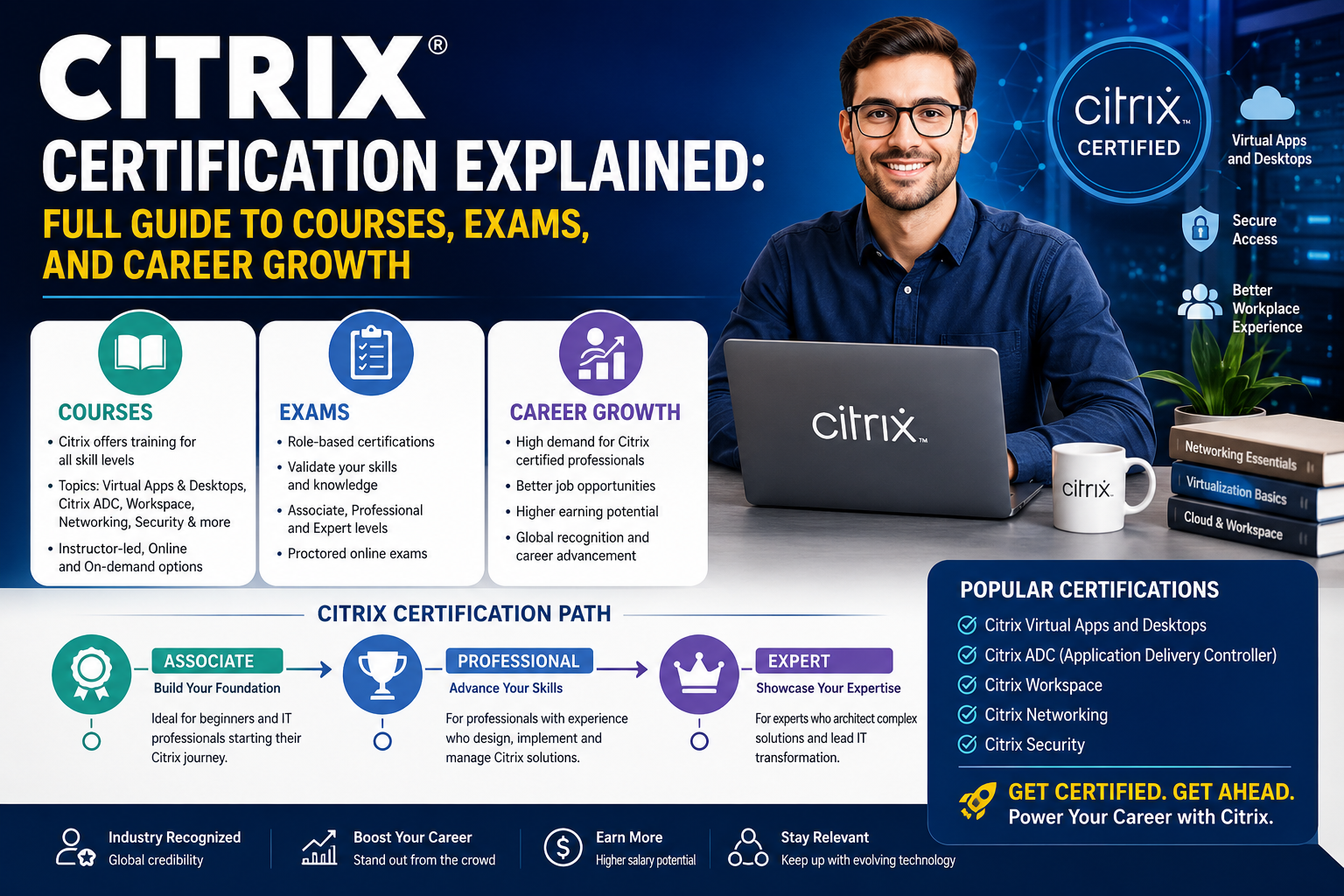
The Citrix certification path is designed in a tiered structure that allows professionals to progress gradually from entry-level knowledge to expert-level specialization. The structure is generally divided into three main levels: Associate, Professional, and Expert.
Each level builds upon the previous one, ensuring that professionals develop both theoretical understanding and practical experience before advancing.
The Associate level focuses on foundational knowledge. It is designed for individuals who are relatively new to Citrix technologies or virtualization in general. At this stage, candidates learn how to install, configure, and manage basic Citrix environments.
The Professional level targets individuals with practical experience in enterprise environments. It focuses on advanced configuration, system optimization, and troubleshooting complex Citrix deployments. Professionals at this level are expected to handle real-world infrastructure challenges.
The Expert level is the highest certification tier. It is designed for senior professionals who work as architects, consultants, or senior engineers. This level focuses on designing large-scale Citrix solutions, optimizing performance across distributed systems, and ensuring high availability in enterprise environments.
In addition to these core levels, Citrix also offers specialized certifications in areas such as networking, cloud integration, endpoint management, and SD-WAN technologies. These certifications allow professionals to specialize in specific domains based on career goals and organizational needs.
Introduction to Citrix Virtualization and Digital Workspace Concepts
Citrix virtualization technologies form the core of its certification ecosystem. Virtualization allows multiple virtual machines or desktop environments to run on a single physical server, improving resource efficiency and centralized management.
Citrix Virtual Apps and Desktops is one of the most widely used solutions in this category. It enables organizations to deliver applications and desktops to users on demand, regardless of device type or location.
The concept of a digital workspace goes beyond traditional virtualization. It integrates applications, desktops, data, and communication tools into a unified platform. This ensures that users can access everything they need from a single interface, improving productivity and reducing complexity.
Citrix digital workspace solutions are particularly valuable in remote work environments. They allow employees to securely access corporate systems from home, branch offices, or mobile devices without compromising security or performance.
The architecture behind Citrix virtualization includes several key components, such as delivery controllers, virtual delivery agents, and secure gateways. These components work together to ensure seamless application delivery and user authentication.
Citrix Certification and Industry Relevance
The Citrix certification ecosystem is closely aligned with industry requirements in virtualization, cloud computing, and enterprise networking. As organizations increasingly move toward hybrid infrastructures, the demand for professionals who understand Citrix systems continues to grow.
Citrix-certified professionals are often involved in designing and managing enterprise-level IT systems. These systems require high availability, strong security controls, and efficient resource allocation.
One of the key reasons Citrix certifications remain relevant is their focus on real-world enterprise challenges. Rather than theoretical concepts alone, the certification path emphasizes hands-on skills and practical problem-solving.
In modern IT environments, Citrix technologies are often deployed alongside cloud platforms and enterprise networking systems. This integration makes Citrix expertise valuable for organizations transitioning to cloud-first strategies.
The certification path also supports continuous learning. As Citrix updates its technologies and introduces new products, certification requirements evolve to reflect current industry standards.
Entry-Level Understanding of Citrix Certification Structure
At the foundational level, Citrix certification begins with basic virtualization concepts and system administration skills. Candidates are introduced to how virtual environments operate, how applications are delivered to end users, and how centralized management simplifies IT operations.
This stage is critical for building confidence in handling Citrix systems. It also introduces the terminology and architecture used throughout more advanced certification levels.
Entry-level certifications focus on understanding system components, basic troubleshooting, user management, and application delivery principles. These skills form the groundwork for more advanced roles in virtualization and cloud infrastructure management.
Professionals who complete this stage typically move into roles where they assist in managing Citrix environments under supervision. This practical exposure is essential for progressing to higher certification levels.
Transition Toward Advanced Citrix Concepts
As professionals advance beyond foundational knowledge, Citrix certification begins to focus on more complex enterprise scenarios. These include multi-site deployments, advanced networking configurations, and cloud integration strategies.
At this stage, professionals are expected to understand system optimization, load balancing, security policies, and performance tuning. These skills are essential for managing large-scale Citrix environments used by enterprise organizations.
Advanced Citrix concepts also include disaster recovery planning and high availability design. These are critical in ensuring business continuity in case of system failures or network disruptions.
Professionals working at this level often take on responsibilities such as system architecture design, infrastructure planning, and enterprise solution implementation.
Advancing Beyond Foundational Citrix Skills
After building a foundation in virtualization and digital workspace concepts, the Citrix certification journey moves into a more demanding phase where practical expertise becomes essential. At this stage, professionals are no longer just learning how Citrix environments function; they are expected to manage, optimize, and troubleshoot complex enterprise systems under real operational conditions.
This level of progression is where Citrix certifications begin to reflect real-world IT responsibilities. Organizations rely on certified professionals to ensure uninterrupted application delivery, secure access, and efficient infrastructure performance across hybrid environments. The focus shifts from basic administration to deeper architectural understanding and enterprise-scale decision-making.
In modern IT ecosystems, Citrix environments are rarely isolated. They are integrated with cloud platforms, identity services, networking systems, and endpoint management tools. As a result, professionals must develop a broader understanding of how different technologies interact within a unified digital workspace.
This part of the certification journey introduces advanced specialization tracks, particularly in virtualization and networking. These tracks are designed to align with job roles such as systems engineer, virtualization administrator, cloud architect, and network security specialist.
Citrix Certified Professional Level and Its Industry Role
The Citrix Certified Professional level represents the mid-tier stage of certification. It is designed for professionals who already have hands-on experience working with Citrix environments and are ready to take on more complex responsibilities.
At this level, individuals are expected to manage production environments, troubleshoot advanced issues, and optimize system performance. Unlike entry-level certifications, which focus on basic deployment and configuration, the professional level emphasizes operational stability and efficiency in enterprise systems.
Professionals at this stage typically work with large-scale Citrix deployments that support thousands of users. These environments require careful planning, structured management, and continuous monitoring to ensure consistent performance.
A major focus at the professional level is improving user experience. This includes optimizing application delivery, reducing latency, managing resource allocation, and ensuring seamless connectivity across distributed networks.
Another important aspect is system integration. Citrix environments often interact with cloud platforms, authentication systems, and enterprise directories. Professionals must understand how to configure these integrations to maintain secure and efficient workflows.
Security also becomes a critical responsibility at this level. Professionals must implement access controls, manage authentication policies, and ensure compliance with organizational security standards.
Deep Dive into Virtualization Professional Skills
Virtualization is the core domain within Citrix certification, and at the professional level, it becomes significantly more complex. Professionals are expected to manage full-scale virtual desktop infrastructures and application delivery systems that support enterprise operations.
One of the key responsibilities at this stage is managing delivery controllers and virtual delivery agents. These components ensure that users can access virtual desktops and applications without performance issues.
Another important area is image management. In large environments, virtual machine images must be standardized, updated, and deployed efficiently. Professionals must ensure that images remain consistent across multiple systems while minimizing downtime during updates.
User environment management is also critical. Professionals must configure policies that control how users interact with virtual desktops, including session persistence, personalization settings, and resource allocation.
Application delivery optimization becomes a major focus. This includes ensuring that applications run smoothly across different network conditions and device types.
Troubleshooting skills are heavily emphasized at this level. Professionals must diagnose performance issues, resolve connectivity problems, and identify configuration errors across complex infrastructures.
Citrix Certified Expert Level and Strategic Architecture
The Citrix Certified Expert level represents the highest tier in the certification hierarchy. It is designed for senior professionals who are responsible for designing and implementing enterprise-level Citrix solutions.
At this stage, the focus shifts from operational tasks to strategic planning and system architecture. Experts are expected to design scalable, secure, and highly available Citrix environments that align with business requirements.
These professionals often work closely with IT leadership teams to design infrastructure strategies that support long-term organizational goals. This includes evaluating business requirements, assessing existing systems, and recommending optimized solutions.
A key responsibility at this level is designing multi-site deployments. These environments require careful coordination between data centers, cloud platforms, and remote locations to ensure consistent performance.
Disaster recovery planning is another critical area. Experts must design systems that can recover quickly from failures while minimizing data loss and downtime.
High availability architecture is also essential. Professionals must ensure that systems remain operational even in the event of hardware failures or network disruptions.
Security architecture plays a major role as well. Experts are responsible for designing secure access models, authentication frameworks, and compliance strategies that align with enterprise security policies.
Evolution of Citrix Networking Certification Path
In addition to virtualization, Citrix offers a specialized certification track focused on networking. This track is designed for professionals who work with application delivery controllers, network optimization tools, and security gateways.
Networking has become a critical component of modern Citrix environments because application performance depends heavily on network efficiency and reliability.
The networking certification path is structured similarly to the virtualization track, with Associate, Professional, and Expert levels. Each level builds on the previous one, gradually increasing in complexity and responsibility.
At the networking level, professionals are responsible for managing traffic flow, optimizing application delivery, and securing network communication channels.
This includes configuring load balancing systems, managing SSL offloading, and implementing application firewall policies.
As professionals advance, they begin working with more complex tasks such as global server load balancing, traffic optimization, and advanced security configurations.
Citrix Networking Associate Level Responsibilities
At the associate level in networking, professionals focus on foundational networking skills within Citrix environments. This includes understanding how application delivery controllers operate and how traffic is managed between users and applications.
One of the primary responsibilities is configuring load-balancing systems. This ensures that application traffic is distributed evenly across servers to prevent performance bottlenecks.
Another important area is SSL offloading, which helps improve performance by handling encryption and decryption processes more efficiently.
Basic troubleshooting is also a key skill at this level. Professionals must identify and resolve common networking issues such as connectivity failures or configuration errors.
Security fundamentals are introduced at this stage. This includes understanding how Citrix systems protect applications and data from unauthorized access.
Citrix Networking Professional Level Complexity
At the professional networking level, responsibilities become significantly more advanced. Professionals are expected to manage enterprise-grade networking environments that require high availability, security, and performance optimization.
One of the key focus areas is application security. Professionals must configure and manage web application firewalls to protect against threats such as injection attacks, cross-site scripting, and unauthorized access attempts.
Traffic management becomes more complex at this stage. Professionals must optimize data flow across multiple networks while ensuring minimal latency and maximum reliability.
Another important responsibility is monitoring and analytics. Professionals must analyze network performance data to identify bottlenecks and optimize system performance.
Integration with enterprise systems is also critical. Citrix networking environments often interact with cloud platforms, identity management systems, and virtualization infrastructures.
Citrix Networking Expert Level and Enterprise Design
At the expert level in networking, professionals take on architectural responsibilities similar to those in virtualization. They are responsible for designing enterprise-grade networking solutions that support large-scale operations.
This includes creating advanced traffic management strategies, designing secure network architectures, and implementing global load balancing systems.
Experts must also ensure that networking systems align with organizational goals, including performance optimization, scalability, and security compliance.
Advanced authentication and authorization systems are also part of this level. Professionals design secure access frameworks that protect sensitive enterprise data.
Automation plays a growing role at this stage. Experts often design systems that automate network configuration, monitoring, and optimization processes.
Integration of Citrix with Cloud Ecosystems
One of the most important developments in Citrix certification is its integration with cloud platforms. Modern Citrix environments are often deployed in hybrid or fully cloud-based infrastructures.
This integration allows organizations to scale resources dynamically, improve accessibility, and reduce infrastructure costs.
Citrix solutions work particularly well with enterprise cloud environments because they support seamless application delivery across distributed systems.
Cloud integration also enhances security by enabling centralized identity management and policy enforcement.
Professionals working with Citrix cloud environments must understand how virtual desktops, applications, and data services operate within cloud architectures.
This includes managing cloud-hosted delivery controllers, configuring cloud-based resource allocation, and optimizing performance in distributed environments.
Role of Hybrid Infrastructure in Citrix Environments
Hybrid infrastructure plays a central role in modern Citrix deployments. Many organizations use a combination of on-premises data centers and cloud platforms to support their IT operations.
Citrix environments are designed to operate efficiently in these hybrid setups. This flexibility allows organizations to maintain legacy systems while gradually transitioning to cloud-based architectures.
Professionals must understand how to manage workloads across both environments. This includes balancing performance, cost, and security considerations.
Hybrid environments also require strong networking and identity management strategies. Professionals must ensure that users can access resources seamlessly regardless of where systems are hosted.
Growing Importance of Automation in Citrix Systems
Automation has become increasingly important in Citrix environments as systems grow in complexity. Manual management of large-scale infrastructures is no longer efficient or sustainable.
Automation helps streamline tasks such as system deployment, configuration management, performance monitoring, and security enforcement.
At advanced certification levels, professionals are expected to understand how to design and implement automated workflows that improve system efficiency.
Automation also reduces human error and improves consistency across enterprise environments.
Increasing Demand for Citrix Skilled Professionals
The demand for Citrix-skilled professionals continues to grow as organizations adopt virtualization and cloud technologies on a larger scale.
Industries such as finance, healthcare, education, and government rely heavily on secure and scalable digital workspace solutions.
Citrix-certified professionals are often considered essential for maintaining enterprise IT infrastructure.
As digital transformation accelerates, the need for professionals who understand virtualization, networking, and cloud integration becomes even more critical.
Understanding the Financial Investment in Citrix Certification
Pursuing a Citrix certification is not only a technical commitment but also a financial one. Like most enterprise-level IT certification programs, Citrix certifications require candidates to invest in exam fees, training resources, and hands-on practice environments. However, this investment is often viewed as worthwhile because of the strong career opportunities and salary growth associated with certified professionals.
The cost structure of Citrix certification is designed to reflect the level of expertise being tested. Entry-level certifications are generally more affordable, while advanced and expert-level certifications carry higher fees due to the complexity of the exams and the depth of knowledge required.
At the associate level, exam costs are typically lower because these certifications assess foundational knowledge and basic administrative skills. As candidates progress to professional and expert levels, the exam fees increase due to the advanced nature of the content, which often includes architecture design, system optimization, and enterprise-level troubleshooting.
In addition to exam fees, candidates often invest in study materials, practice labs, and training courses. While these are not mandatory, they significantly improve the chances of passing certification exams on the first attempt.
Another important factor in the overall cost is retaking exams. If a candidate does not pass on the first attempt, they may need to pay again to retake the exam, which can increase the total financial investment.
Despite these costs, many IT professionals view Citrix certification as a long-term investment in their career. The potential salary increase and job opportunities often outweigh the initial expenses.
Breakdown of Certification Levels and Associated Costs
Citrix certification costs vary depending on the level of certification being pursued. Each level corresponds to a different stage of professional development and technical expertise.
At the Associate level, certifications are designed for beginners and early-career professionals. These exams typically cost less and focus on basic system administration and virtualization concepts. The goal at this stage is to validate foundational knowledge rather than advanced expertise.
At the Professional level, certification costs are higher. These exams require candidates to demonstrate hands-on experience with real-world Citrix environments. The increased cost reflects the complexity of the skills being tested, including troubleshooting, system optimization, and infrastructure management.
At the Expert level, certification costs are the highest. These exams are designed for senior professionals who are responsible for designing enterprise-scale solutions. The complexity of these exams requires deep technical understanding and extensive practical experience.
In addition to these core levels, specialized certifications in networking, cloud integration, and endpoint management may have separate pricing structures. These certifications often require additional training courses or prerequisite certifications.
Recertification and Maintaining Certification Validity
Citrix certifications are not permanent. They typically remain valid for a fixed period, after which professionals must renew their credentials to ensure they remain current with evolving technologies.
This recertification process is important because Citrix technologies continuously evolve. New features, security updates, and architectural changes are introduced regularly, making it essential for certified professionals to stay updated.
There are generally two main methods for recertification. The first involves passing the most recent version of the certification exam. This ensures that professionals are tested on the latest technologies and best practices.
The second method involves completing approved training courses. These courses are designed to update professionals on new system features, configuration changes, and industry best practices.
If a certification expires completely, professionals may be required to retake multiple exams, including lower-level certifications, depending on the certification path.
Maintaining certification validity is important for career continuity. Employers often prefer candidates who hold active and up-to-date certifications, as this reflects current technical knowledge.
Career Opportunities with Citrix Certification
Citrix certification opens the door to a wide range of career opportunities in IT infrastructure, cloud computing, and enterprise systems administration. Certified professionals are often employed in roles that require advanced technical knowledge and problem-solving abilities.
One of the most common roles for Citrix-certified professionals is virtualization engineer. In this role, individuals are responsible for managing virtual desktop infrastructure, ensuring system stability, and optimizing application delivery.
Another common role is cloud administrator. These professionals manage cloud-hosted Citrix environments and ensure seamless integration between on-premises and cloud systems.
System administrators with Citrix certification often work in enterprise environments where they manage servers, applications, and user access systems.
At higher certification levels, professionals may work as solutions architects. These roles involve designing large-scale IT infrastructures that support business operations across multiple locations.
Network engineers with Citrix certification focus on application delivery, traffic optimization, and secure network configuration.
Consulting roles are also common, where certified professionals help organizations design, implement, and optimize Citrix environments based on business requirements.
Citrix Certification and Salary Expectations
One of the major motivations for pursuing Citrix certification is the potential for increased salary and career advancement. Certified professionals are often considered more valuable in the job market due to their specialized skills.
At the associate level, salaries are generally higher than in entry-level IT roles. Professionals at this stage typically work in support or junior administration roles.
At the professional level, salaries increase significantly. These roles require hands-on experience and the ability to manage complex systems. Professionals at this stage often work as senior administrators or engineers.
At the expert level, salaries are among the highest in the IT industry. These professionals are responsible for designing enterprise infrastructure and making strategic technical decisions.
Networking certifications within Citrix also offer strong salary potential. Professionals specializing in application delivery and network optimization are often in high demand.
Salary levels can vary depending on geographic location, industry, and experience. However, Citrix-certified professionals generally earn above-average salaries compared to non-certified peers.
Industry Demand for Citrix Professionals
The demand for Citrix-certified professionals continues to grow as organizations adopt virtualization and cloud technologies. Many enterprises rely on Citrix solutions to manage remote work environments and secure application delivery.
Industries such as banking, healthcare, education, and government heavily depend on Citrix systems to maintain secure and efficient IT operations.
The shift toward hybrid work models has further increased demand for Citrix expertise. Organizations need professionals who can ensure secure access to applications and data from remote locations.
Cloud adoption has also contributed to increased demand. Citrix solutions are often integrated with cloud platforms to enhance scalability and flexibility.
As digital transformation continues, the need for skilled Citrix professionals is expected to remain strong across multiple industries.
Training Approaches for Citrix Certification Success
Successful preparation for Citrix certification requires a structured learning approach. Because Citrix exams focus heavily on real-world scenarios, hands-on experience is essential.
One of the most effective training methods is practical lab work. Working directly with Citrix environments helps candidates understand system behavior, configuration settings, and troubleshooting techniques.
Self-paced learning is also commonly used. This involves studying documentation, practicing configurations, and reviewing system architectures independently.
Instructor-led training can provide additional structure and guidance. These sessions often focus on exam preparation strategies and advanced technical concepts.
Simulation-based learning is another effective method. This involves replicating real-world enterprise environments to practice deployment and management tasks.
Consistent practice is important for retaining technical knowledge. Regular interaction with Citrix systems helps reinforce concepts and improve problem-solving skills.
Common Challenges Faced by Citrix Certification Candidates
Many candidates face challenges when preparing for Citrix certification exams. One of the most common challenges is the complexity of virtualization concepts.
Citrix environments involve multiple interconnected components, and understanding how they interact can be difficult for beginners.
Another challenge is the need for hands-on experience. Theoretical knowledge alone is often not enough to pass advanced certification exams.
Time management is also a challenge. Preparing for Citrix certification requires significant time investment, especially for professionals who are already working full-time.
Keeping up with technology updates is another difficulty. Citrix frequently updates its products, and candidates must ensure they are studying the most current information.
Troubleshooting skills can also be challenging to develop. Many exam scenarios require candidates to identify and resolve complex system issues.
Importance of Hands-On Experience in Citrix Certification
Hands-on experience is one of the most important factors in achieving success in Citrix certification exams. Practical exposure helps candidates understand how systems behave in real-world environments.
Working directly with Citrix environments allows professionals to develop troubleshooting skills, configuration knowledge, and system optimization techniques.
Hands-on practice also helps bridge the gap between theoretical knowledge and practical application.
Many exam questions are scenario-based, requiring candidates to apply their knowledge to solve real-world problems.
Without practical experience, it can be difficult to fully understand advanced concepts such as load balancing, virtualization architecture, and network optimization.
Career Progression Through Citrix Certification Levels
Citrix certification provides a clear career progression path for IT professionals. Starting from entry-level certifications, individuals can gradually move toward advanced and expert-level roles.
At the beginning of the journey, professionals typically work in support or junior administrative roles.
As they gain experience and achieve professional-level certification, they move into more specialized roles such as system engineer or virtualization specialist.
At the expert level, professionals often transition into senior positions such as solutions architect or infrastructure consultant.
This structured progression allows professionals to continuously grow their skills and advance their careers.
Long-Term Value of Citrix Certification in the IT Industry
Citrix certification provides long-term value for IT professionals by ensuring continuous skill development and career advancement opportunities.
As technology continues to evolve, professionals with updated certifications remain competitive in the job market.
Citrix-certified professionals are often involved in strategic decision-making within organizations, particularly in areas related to virtualization and cloud infrastructure.
The certification also helps professionals stay relevant in a rapidly changing industry where new technologies are constantly emerging.
By maintaining certification and gaining hands-on experience, professionals can build long-term careers in enterprise IT environments.
Emerging Trends in Citrix-Based Enterprise Environments
Modern enterprise IT environments are evolving rapidly, and Citrix technologies continue to adapt to these changes. One of the most significant trends is the increasing reliance on hybrid digital workspaces, where organizations combine on-premises infrastructure with cloud-based services. This shift is not simply about infrastructure flexibility; it represents a broader transformation in how businesses deliver applications, manage data, and support remote users.
Citrix environments are increasingly being designed to support fluid work experiences. Employees no longer depend on a single device or location. Instead, they access applications from laptops, tablets, and mobile devices across distributed networks. This has pushed organizations to prioritize seamless session continuity, where user experience remains consistent regardless of device changes or geographic location.
Another important trend is the growing emphasis on identity-driven access. Instead of relying solely on network-based security models, enterprises are shifting toward identity verification systems that determine access based on user roles, behavior, and contextual risk factors. Citrix platforms integrate closely with identity management systems to enforce these adaptive security policies.
Expansion of Security Requirements in Virtual Environments
Security has become one of the most critical aspects of Citrix-based infrastructures. As organizations handle increasing volumes of sensitive data, protecting virtual desktops and application delivery channels has become a top priority. Traditional perimeter-based security models are no longer sufficient in distributed environments where users connect from multiple locations.
Citrix environments now incorporate layered security approaches that include endpoint verification, session monitoring, encryption, and adaptive authentication mechanisms. These layers ensure that access is continuously validated rather than granted only at the point of login.
One important development is session-level security monitoring. Instead of focusing only on login credentials, modern Citrix systems analyze user activity during active sessions. Suspicious behavior can trigger alerts or automatic session termination, reducing the risk of unauthorized access.
Another emerging security practice is micro-segmentation within virtual environments. This approach isolates workloads and restricts lateral movement across systems, minimizing the impact of potential breaches. Citrix technologies are increasingly aligned with these advanced security strategies to meet enterprise compliance standards.
Role of Automation in Modern Citrix Infrastructure Management
Automation is becoming a defining characteristic of modern Citrix environments. As infrastructures grow in complexity, manual management is no longer efficient or scalable. Automation helps organizations streamline repetitive tasks such as system provisioning, configuration updates, and performance monitoring.
In Citrix environments, automation is often applied to virtual machine deployment and application delivery workflows. Instead of manually configuring each system, administrators can use automated templates to deploy standardized environments across multiple servers.
Another key application of automation is resource scaling. In dynamic enterprise environments, workloads fluctuate based on user demand. Automated scaling systems adjust computing resources in real time, ensuring optimal performance without unnecessary resource consumption.
Automation also improves consistency across environments. By reducing human intervention, organizations minimize configuration errors and ensure uniform system behavior across different locations and deployments.
Increasing Importance of User Experience Optimization
User experience has become a central focus in Citrix environments. As organizations rely more on digital workspaces, ensuring smooth and responsive application access is critical for productivity.
Performance optimization is a key part of this process. Citrix systems are designed to minimize latency and ensure that applications respond quickly, even in low-bandwidth conditions. This is achieved through intelligent data compression, adaptive streaming, and optimized protocol handling.
Another important factor is session reliability. Users expect uninterrupted access to their applications, even when switching devices or experiencing network interruptions. Citrix technologies support session persistence, allowing users to resume their work seamlessly.
Personalization also plays a role in user experience. Modern Citrix environments allow users to maintain customized settings, application layouts, and preferences across sessions. This creates a more consistent and efficient working environment.
Integration of Artificial Intelligence in Citrix Ecosystems
Artificial intelligence is gradually being integrated into Citrix environments to enhance system performance and operational efficiency. AI-driven analytics help administrators monitor system health, detect anomalies, and predict potential performance issues before they affect users.
One of the key applications of AI in Citrix systems is predictive maintenance. By analyzing historical performance data, AI systems can identify patterns that indicate potential system failures or bottlenecks. This allows administrators to take proactive measures before issues escalate.
AI is also used in workload optimization. In virtual environments where resources are shared among many users, AI algorithms can dynamically allocate computing power based on usage patterns.
Another emerging application is intelligent user behavior analysis. By understanding how users interact with applications, AI systems can optimize resource allocation and improve overall system responsiveness.
Expansion of Multi-Cloud Citrix Deployments
Multi-cloud strategies are becoming increasingly common in enterprise IT environments, and Citrix plays an important role in enabling these architectures. Instead of relying on a single cloud provider, organizations distribute workloads across multiple platforms to improve flexibility and resilience.
Citrix environments are designed to operate across different cloud infrastructures, allowing seamless application delivery regardless of underlying platform differences. This flexibility helps organizations avoid vendor lock-in and optimize costs.
Multi-cloud deployments also improve system reliability. If one cloud environment experiences issues, workloads can be shifted to another platform without disrupting user access.
Managing multi-cloud environments requires advanced orchestration and monitoring capabilities. Citrix systems provide centralized management tools that allow administrators to oversee distributed infrastructure from a single control point.
Growing Demand for Remote Workforce Enablement
The global shift toward remote and hybrid work models has significantly increased the importance of Citrix technologies. Organizations now require secure and scalable solutions that allow employees to work from anywhere without compromising productivity or security.
Citrix digital workspace solutions provide a unified access layer for remote users. Employees can securely connect to applications, desktops, and data resources regardless of their physical location.
This capability has become essential for maintaining business continuity in distributed organizations. It also supports workforce flexibility, allowing employees to work across different time zones and environments.
Remote workforce enablement also requires strong endpoint security. Citrix systems help enforce security policies on remote devices, ensuring that corporate data remains protected even outside traditional office environments.
Evolution of Career Roles in Citrix Ecosystems
As Citrix environments become more complex, career roles within this ecosystem are also evolving. Traditional system administrator roles are expanding into more specialized positions that require deeper technical expertise.
One emerging role is the digital workspace architect. These professionals design end-to-end Citrix environments that integrate virtualization, networking, security, and cloud services.
Another growing role is a cloud integration specialist. These professionals focus on connecting Citrix environments with public and private cloud platforms to ensure seamless data and application flow.
Security-focused roles are also becoming more prominent. Citrix security specialists are responsible for designing and maintaining secure access systems, monitoring threats, and ensuring compliance with regulatory standards.
Data-driven roles are also emerging, where professionals analyze system performance metrics to improve efficiency and user experience.
Continuous Learning and Skill Adaptation in Citrix Careers
In the Citrix ecosystem, continuous learning is essential for long-term career success. As technologies evolve, professionals must regularly update their skills to stay relevant in the industry.
This includes learning new system architectures, understanding updated security models, and adapting to changes in cloud integration strategies.
Hands-on experience remains one of the most effective ways to maintain skill relevance. Working with live systems helps professionals understand real-world challenges and develop practical solutions.
Adaptability is also a key skill in Citrix-related careers. Professionals must be able to adjust to new tools, frameworks, and infrastructure models as they emerge.
The ability to learn continuously ensures that Citrix professionals remain valuable assets in rapidly changing IT environments.
Conclusion
Citrix certification represents a structured and practical pathway for IT professionals aiming to build expertise in virtualization, digital workspaces, cloud integration, and enterprise networking. Across its different levels—Associate, Professional, and Expert—the certification framework gradually develops both technical depth and strategic thinking, enabling individuals to handle everything from basic system administration to complex enterprise architecture design.
As organizations continue shifting toward hybrid and cloud-based infrastructures, Citrix skills remain highly relevant in supporting secure, scalable, and efficient digital environments. The certification path not only validates technical knowledge but also reflects real-world capabilities required in modern IT roles such as virtualization engineer, cloud architect, and network specialist.
Beyond technical proficiency, Citrix certification encourages continuous learning and adaptation, which are essential in an industry defined by rapid technological change. It also enhances career mobility by opening opportunities across industries that depend on secure application delivery and remote workforce enablement.
Ultimately, Citrix certification is more than an academic achievement—it is a long-term professional investment. It equips IT professionals with the tools, confidence, and expertise needed to contribute effectively in evolving digital ecosystems and remain competitive in the global technology landscape.