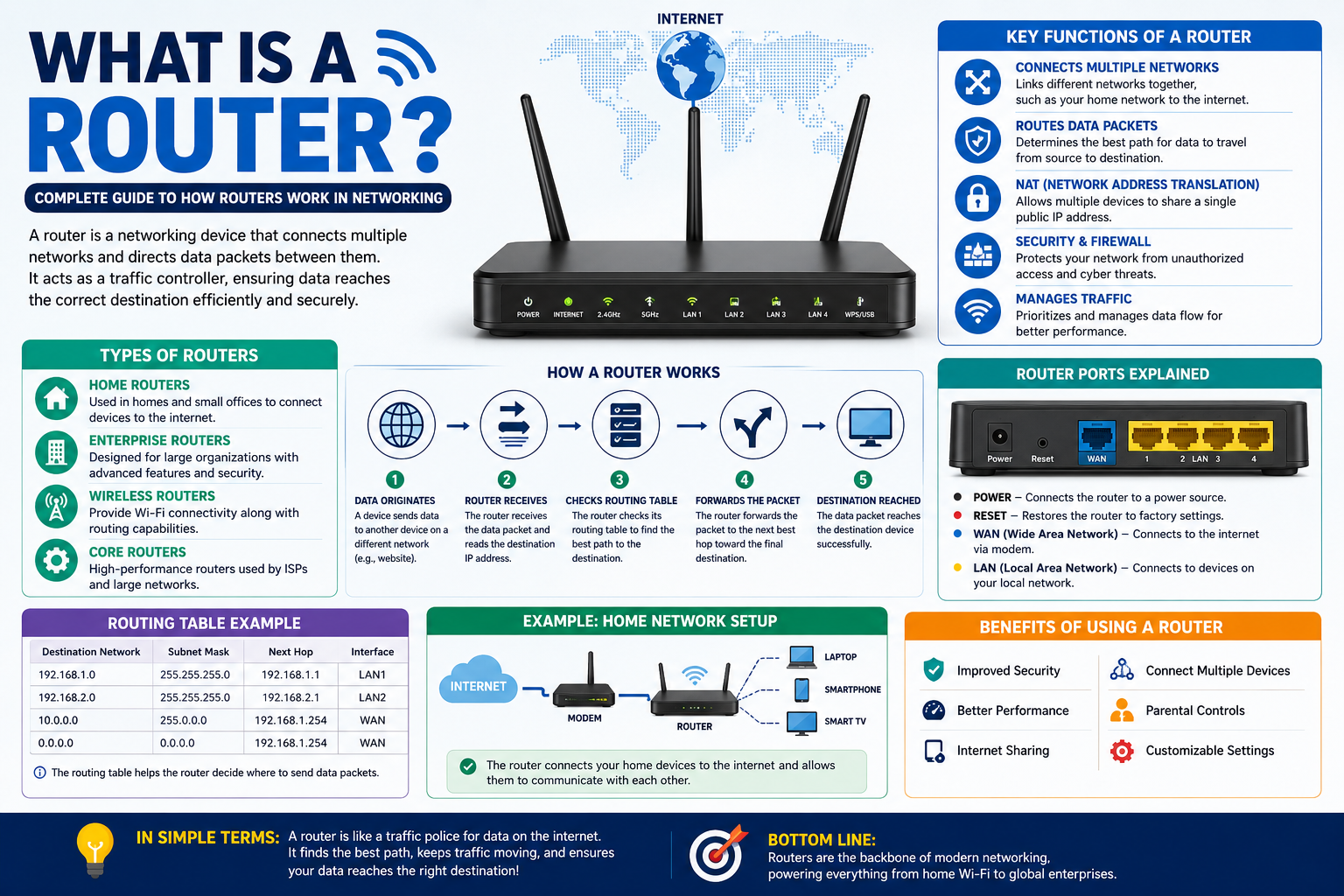
A router is one of the most important devices in any network because it acts as the central decision-maker for how data should move between different systems. Every time you send a message, open a website, stream a video, or join an online game, your data is broken into smaller pieces and sent across networks. A router is responsible for making sure each of those pieces finds the correct destination in the most efficient way possible.
At a basic level, a router connects multiple networks. These networks may be very different from each other, such as a private home network and the vast public internet. Without a router, these networks would remain isolated, unable to exchange information smoothly. The router bridges that gap by examining where data is coming from and where it needs to go, then deciding the best possible path for it.
Unlike simple devices that only pass information along blindly, a router actively interprets network addresses. Every device connected to a network has an address, and every destination also has one. The router reads these addresses and uses them like a navigation system. It does not just send data randomly; it evaluates possible routes and selects the most appropriate one based on speed, availability, and network rules.
In modern communication systems, routers are not limited to just one task. They often handle multiple responsibilities simultaneously. They can manage internal communication within a network, connect users to external networks, and even enforce basic rules about what kind of data is allowed to pass through. This makes them central to both performance and security in digital environments.
What makes a router especially important is its ability to handle constant traffic changes. Networks are never static. Devices connect and disconnect all the time, internet paths become congested, and failures can occur without warning. A router continuously adapts to these changes, ensuring that data still reaches its destination even when conditions are not ideal. This adaptability is one of the key reasons routers are essential in both small home setups and large-scale enterprise systems.
How Data Travels Through a Router Step by Step
When data is sent from one device to another, it does not travel in a single uninterrupted stream. Instead, it is broken into smaller units called packets. Each packet carries a portion of the original data along with important information about its origin and destination. A router reads this information and determines where each packet should go next.
Once a packet reaches a router, the device begins by checking the destination address. This address tells the router where the data ultimately needs to arrive. The router then consults its internal knowledge of available paths. These paths are stored in what can be thought of as a constantly updated map of the network.
After identifying possible routes, the router selects the most suitable one. This decision is based on several factors, such as distance, network speed, congestion levels, and overall reliability. The chosen path is often referred to as the next step in the journey rather than the final destination. This process repeats at every router along the way until the packet reaches its final target.
Each router only knows part of the full journey. It does not need to understand the entire route from start to finish. Instead, it focuses on the next best step. This approach allows networks to scale efficiently because no single device needs to store complete global knowledge of every possible path.
As packets move through multiple routers, they may take different routes even if they originate from the same source and are heading to the same destination. This flexibility helps balance traffic across the network. If one route becomes busy or fails, other routes can still carry the data without interruption.
This process happens extremely quickly, often in milliseconds. To the user, everything appears seamless, even though complex decision-making is occurring at every stage of transmission. This continuous routing process is what allows modern internet communication to feel fast and reliable despite the enormous scale of global networks.
Internal Structure and Key Components Inside a Router
A router is built from several internal components that work together to manage data flow efficiently. Each component has a specific role, and together they form a system capable of handling large volumes of network traffic without slowing down.
One of the most important components is the processor. This functions as the brain of the router, making decisions about where data should go. It interprets routing information and executes instructions that determine packet movement. The faster the processor, the more efficiently the router can handle multiple requests at the same time.
Another critical component is memory. Routers use memory to store routing information, temporary data, and system instructions. This includes tables that keep track of available paths and network destinations. Some of this information is temporary and constantly changing, while other parts remain more stable to support consistent performance.
Network interfaces are also essential. These are the physical or wireless connection points that allow the router to communicate with other devices and networks. Each interface serves as a gateway through which data enters and leaves the router. The number and type of interfaces can vary depending on the design and purpose of the router.
Inside the router, there is also specialized software that manages routing behavior. This software is responsible for interpreting network rules, updating routing paths, and ensuring that data is handled according to the correct protocols. It works closely with the hardware components to maintain smooth operation.
Together, these components allow a router to perform continuous analysis and decision-making. Unlike simpler devices that only forward data, a router actively processes information, evaluates options, and adapts to changing network conditions in real time. This combination of hardware and software is what makes routers capable of supporting modern digital communication systems.
How Routers Make Decisions Using Network Paths
Routers do not randomly send data across networks. Instead, they rely on structured decision-making systems that help them choose the best possible path for each packet of data. These decisions are based on predefined rules and constantly updated information about the network.
At the core of this process is the concept of routing paths. A routing path is a known direction that data can take to reach a destination. Routers maintain a record of these paths and use them to guide traffic efficiently. When a new packet arrives, the router checks its destination and compares it against available paths.
The selection process is influenced by several conditions. One important factor is distance, which refers to how many steps or intermediate devices are required to reach the destination. Shorter paths are generally preferred because they reduce delay. However, distance is not the only consideration.
Network quality also plays a major role. Some paths may be shorter but congested or unstable. In such cases, the router may choose a slightly longer but more reliable route. This helps maintain consistent performance even under heavy traffic conditions.
Routers also consider changes in network status. If a path becomes unavailable due to failure or disruption, the router quickly removes it from consideration and selects an alternative. This ability to respond dynamically ensures that communication continues even when parts of the network are not functioning properly.
Over time, routers continuously update their understanding of the network environment. They learn which paths are more efficient and adjust their decisions accordingly. This ongoing adjustment process allows networks to remain flexible and resilient, even as conditions change frequently.
The Role of Routers in Connecting Different Types of Networks
One of the most important functions of a router is connecting different networks that would otherwise be unable to communicate directly. These networks may use different addressing systems, speeds, or structures, but the router acts as a translator and bridge between them.
In a typical setup, a router connects a private internal network to a larger external network. The internal network may consist of multiple devices such as computers, phones, and smart devices. These devices communicate with each other locally, but when they need to access external resources, the router steps in to manage that connection.
The router ensures that internal communication remains separate from external traffic. This separation is important because it helps organize data flow and improves security. Devices within the same internal network can communicate quickly without involving external systems, while external communication is carefully controlled through the router.
Routers also help manage communication between different internal segments within the same organization. Large networks are often divided into smaller sections to improve efficiency. These sections still need to communicate with each other, and routers handle this internal traffic routing.
In more complex environments, routers may also connect entirely different types of networks that operate under different rules. In such cases, the router acts as a mediator, ensuring that data is properly formatted and delivered in a way that both networks can understand.
This ability to connect diverse systems is what makes routers essential in modern communication infrastructure. They do not just pass data along; they enable interaction between networks that would otherwise remain isolated from one another.
The Continuous Flow of Data and Router Adaptability
Network environments are constantly changing. Devices are added, removed, or moved, and data traffic fluctuates throughout the day. A router must continuously adapt to these changes to maintain smooth communication.
One of the key strengths of a router is its ability to monitor network conditions in real time. It keeps track of which paths are working efficiently and which are experiencing issues. This allows it to adjust its decisions instantly when necessary.
If a connection becomes slow or unstable, the router can redirect traffic through a different route without interrupting the flow of data. This adaptability ensures that users experience minimal disruption, even when underlying network conditions change unexpectedly.
Routers also handle sudden traffic increases. During peak usage periods, many devices may try to access the network at the same time. The router manages this load by distributing traffic across multiple available paths, preventing overload on any single route.
This continuous balancing act requires constant processing and decision-making. Despite the complexity involved, routers perform these tasks silently in the background, allowing users to interact with digital systems without being aware of the underlying network management.
The ability to adapt, reroute, and balance traffic is what keeps modern communication systems stable and efficient, even under heavy and unpredictable conditions.
How Routers Function in Home Networks and Enterprise Environments
Routers behave differently depending on the environment in which they are deployed, even though their core purpose remains the same. In a home network, a router is usually responsible for connecting a small number of devices to the internet. These devices may include phones, laptops, smart televisions, and other personal electronics. The router in this setting is designed for simplicity, ease of use, and automatic configuration.
In most home environments, the router performs several roles at once. It manages internet access, assigns local network addresses, and allows multiple devices to share a single connection. It is often preconfigured by service providers, meaning users do not need to manually set up routing rules or understand complex networking concepts. The focus is on convenience and stability rather than advanced customization.
In enterprise environments, routers operate on a much larger and more complex scale. They are expected to handle thousands or even millions of data transactions across multiple interconnected networks. Unlike home routers, enterprise routers are designed with advanced processing capabilities and extensive configuration options.
These routers often connect multiple internal networks within an organization, each serving different departments or functions. They must manage traffic between these networks while also maintaining secure connections to external systems. This requires a more detailed understanding of routing rules, network segmentation, and performance optimization.
Enterprise routers are also designed to be highly reliable. They often include redundancy features that allow them to continue operating even if part of the system fails. This is essential in environments where downtime can result in significant operational disruption.
While home routers prioritize simplicity and ease of use, enterprise routers prioritize control, scalability, and resilience. Despite these differences, both types rely on the same fundamental principles of routing data efficiently between networks.
Different Types of Routers and Their Functional Roles
Routers can be categorized into different types based on their purpose and deployment. Each type is designed to handle specific networking requirements and environments, ensuring that data is managed efficiently according to the needs of the system.
One common type is the core router. This type is typically used within large networks and serves as the central point for data transmission. Core routers handle extremely high volumes of traffic and are responsible for moving data quickly across major network segments. They are built for speed and reliability rather than direct interaction with end devices.
Another type is the edge router. This router operates at the boundary of a network, connecting internal systems to external networks. It plays a crucial role in managing incoming and outgoing traffic and often includes additional features related to security and traffic filtering. Edge routers are essential for controlling how data enters and leaves a network.
Access routers are designed to connect smaller networks or individual users to a larger network. These routers are commonly found in homes or small offices. Their main function is to provide connectivity while maintaining basic routing capabilities for everyday use.
There are also distribution routers, which are used to manage traffic between different segments within a larger network. They act as intermediaries, ensuring that data is efficiently distributed across various internal paths.
Each type of router serves a specific purpose, but all share the same foundational principle of directing data between networks. The differences lie in scale, complexity, and performance requirements, rather than in the basic concept of routing itself.
How Routing Protocols Enable Communication Between Routers
Routers do not operate in isolation. They communicate with each other using specialized systems known as routing protocols. These protocols allow routers to exchange information about network paths, ensuring that data can be routed efficiently across complex systems.
A routing protocol defines how routers share information about available routes and how they update their internal routing decisions. This communication is essential because networks are constantly changing. New paths may become available, existing paths may become congested, and some routes may fail.
When routers exchange information, they build a shared understanding of the network structure. This allows them to make informed decisions about where to send data. Instead of relying on fixed paths, routers use this dynamic information to select the best available route at any given moment.
Different routing protocols operate in different ways. Some focus on speed and simplicity, while others prioritize accuracy and detailed network awareness. Regardless of the method used, the goal remains the same: to ensure that data reaches its destination as efficiently as possible.
Routers continuously update their routing tables based on the information received from neighboring routers. These updates allow the network to adapt to changes in real time. If a route becomes unavailable, routers quickly identify alternative paths and adjust their decisions accordingly.
This constant exchange of information between routers forms the foundation of modern network communication. Without routing protocols, routers would be unable to coordinate effectively, leading to inefficient or broken data transmission.
Security Functions Embedded Within Router Operations
Routers play a significant role in maintaining network security by controlling how data enters and exits a network. While their primary function is routing, they also include mechanisms that help protect networks from unauthorized access and malicious activity.
One of the key security functions of a router is traffic filtering. This involves examining incoming and outgoing data and determining whether it should be allowed to pass through. The router uses predefined rules to make these decisions, ensuring that only legitimate traffic is permitted.
Routers also help isolate internal networks from external threats. By acting as a boundary between private and public networks, they reduce the risk of direct exposure to harmful traffic. This separation is an important aspect of network protection.
Another important security function is monitoring traffic patterns. Routers can detect unusual activity, such as sudden spikes in data flow or repeated connection attempts. These patterns may indicate potential security issues, prompting the router to take protective action.
In many systems, routers also support authentication processes. This ensures that only authorized devices can connect to the network. By verifying identities before allowing access, routers help maintain the integrity of the network environment.
Although routers are not dedicated security devices, they provide a first line of defense in protecting network infrastructure. Their ability to control traffic flow and enforce basic security rules makes them an essential component of network safety.
Address Management and Network Translation Inside Routers
Routers play a crucial role in managing network addresses and ensuring that devices can communicate effectively even when using different addressing systems. One of the most important functions involved in this process is network address translation.
In many networks, devices use private addresses that are not directly accessible from external networks. These private addresses allow multiple devices within a local network to communicate internally without interfering with global address systems. However, when these devices need to access external resources, their private addresses must be translated into a public format.
The router performs this translation by modifying address information as data passes through it. When a device sends data to an external destination, the router replaces the internal address with its own public-facing address. When the response returns, the router directs it back to the correct internal device.
This process allows multiple devices to share a single external connection while maintaining individual communication paths. Without this mechanism, large networks would require a unique public address for every device, which is not practical.
Routers also manage the assignment of internal addresses within a network. This ensures that each device has a unique identifier and can communicate without conflicts. The router keeps track of these assignments and updates them as devices join or leave the network.
Address management is a fundamental part of routing because it ensures that data is delivered accurately. Without proper address handling, data packets could easily be misdirected or lost within the network.
Wireless Routing and Integrated Connectivity Systems
Many modern routers combine traditional routing functions with wireless connectivity capabilities. This integration allows devices to connect without physical cables, creating flexible and convenient network environments.
In wireless routing systems, the router includes components that transmit and receive data signals over radio frequencies. These signals allow devices such as smartphones, laptops, and tablets to connect to the network without wired connections.
The routing function remains the same in wireless systems. The router still directs data between networks, but it also manages wireless communication channels. It ensures that data transmitted over wireless connections is properly routed to its destination.
Wireless routers must also manage signal distribution. This involves balancing network load across multiple devices while maintaining stable connections. As more devices connect wirelessly, the router adjusts its handling of data to ensure consistent performance.
Security is also important in wireless routing. Because wireless signals can be accessed from a distance, routers include mechanisms to control access and protect data transmission. This ensures that only authorized devices can use the network.
The integration of routing and wireless communication has made network access more flexible and widely available. It allows users to connect from virtually anywhere within range of the router, while still maintaining the structured data flow required for efficient networking.
The Role of Routers in Global Internet Infrastructure
At a global scale, routers form the backbone of internet communication. They are responsible for directing massive volumes of data across continents, countries, and service providers. This global routing system is what allows users in one part of the world to access information hosted in another.
Internet routing involves a vast network of interconnected systems that continuously exchange information about available paths. Routers at this scale are highly specialized and designed to handle enormous traffic loads without interruption.
These routers do not operate independently. Instead, they collaborate with other routers across different networks to determine the best paths for data transmission. This collaboration ensures that data can travel across complex global infrastructures efficiently.
Because the internet is constantly changing, routing decisions must be updated continuously. New connections are formed, existing ones change, and traffic patterns fluctuate. Routers adapt to these changes by updating their understanding of the global network structure.
This global routing system is highly distributed, meaning no single router has complete knowledge of the entire network. Instead, each router only understands its part of the system and relies on communication with other routers to build a complete picture.
This distributed approach allows the internet to scale effectively. It also ensures resilience, as the failure of one part of the network does not disrupt the entire system.
Performance Factors That Influence Router Efficiency
The performance of a router depends on several factors that determine how efficiently it can process and transmit data. These factors influence speed, reliability, and overall network stability.
One of the most important factors is processing power. A router with a stronger processor can handle more data simultaneously and make routing decisions more quickly. This is especially important in environments with heavy traffic.
Memory capacity also plays a role in performance. Routers use memory to store routing information and manage active connections. Limited memory can restrict the number of routes or devices a router can handle effectively.
The quality and number of network interfaces also affect performance. More interfaces allow for greater connectivity options, while higher-quality interfaces improve data transmission speed and reliability.
Network congestion is another important factor. When too many devices or data streams compete for limited bandwidth, performance can decrease. Routers must manage this congestion by distributing traffic efficiently across available paths.
Environmental conditions within the network, such as stability of connections and consistency of data flow, also influence performance. Routers continuously adapt to these conditions to maintain optimal operation.
Together, these factors determine how well a router can perform under different network conditions, from small home setups to large-scale enterprise systems.
Operational Behavior and Continuous Network Management
Routers operate continuously, managing network traffic without interruption. Their behavior is based on constant monitoring, analysis, and adjustment of data flow.
Every second, routers process a large number of data packets, making decisions about where each one should go. This ongoing activity ensures that communication remains smooth and uninterrupted.
Routers also maintain internal records of network activity. These records help them track changes in the network and adjust routing decisions accordingly. By analyzing patterns over time, routers can improve efficiency and reduce delays.
In addition to managing data flow, routers also respond to changes in network structure. When devices connect or disconnect, or when network paths change, routers update their internal systems to reflect these changes.
This continuous management process allows routers to maintain stability even in dynamic environments. They operate silently in the background, ensuring that users can interact with digital systems without being aware of the complex processes taking place.
The ability to function continuously, adapt to change, and manage large volumes of data makes routers a fundamental component of modern communication systems.
Understanding Packet Switching Behavior and Router Data Handling at Scale
Routers operate at the core of packet switching systems, which is the fundamental method used to transmit data across modern networks. In packet switching, information is broken into small units called packets, and each packet is handled independently as it moves through the network. This means that a router does not treat data as a continuous stream but instead processes many small pieces that may arrive out of order and still need to be correctly reconstructed at the destination. When a router receives these packets, it examines their headers, identifies destination information, and determines the most efficient path forward. This process is repeated continuously at every router along the journey, allowing data to move through complex and distributed networks without requiring a fixed or dedicated connection between sender and receiver. Because each packet may travel through different routes depending on network conditions, routers must constantly adapt to changes in traffic load, congestion, and link availability. This dynamic behavior allows networks to remain flexible and scalable, even when handling large volumes of data across global infrastructures.
Routing Metrics and Decision Intelligence Inside Network Paths
Routers rely on routing metrics to determine which path is most suitable for forwarding data packets. These metrics are numerical values assigned to different network routes, representing factors such as speed, reliability, bandwidth, and distance. When multiple paths are available to reach a destination, the router evaluates these metrics and selects the route with the most favorable overall value. This decision-making process is not static because network conditions are constantly changing. A path that is optimal at one moment may become less efficient due to congestion or failure in another moment. As a result, routers continuously update their understanding of the network and adjust their decisions accordingly. This intelligent evaluation allows routers to balance traffic load and avoid bottlenecks, ensuring smoother communication across the network. The concept of routing intelligence is central to modern networking because it allows systems to operate efficiently without requiring manual intervention for every change in network behavior.
Network Congestion, Queuing, and Traffic Management Inside Routers
When data arrives at a router faster than it can be processed or forwarded, congestion occurs, and the router must temporarily store packets in internal memory queues. These queues allow the router to manage traffic in an organized manner, ensuring that no data is immediately lost during periods of high demand. The way a router handles these queues directly impacts network performance, including latency and overall responsiveness. If queues become too large, delays increase, leading to slower communication between devices. Routers manage this by prioritizing certain types of traffic or by distributing packets more evenly across available paths. This behavior ensures that critical data can still be delivered efficiently even when the network is under heavy load. Traffic management inside routers is a continuous balancing act between speed and fairness, as the system must ensure that no single data stream dominates available resources while still maintaining smooth overall performance across the network.
Routing Convergence and Network Stability During Changes
Routing convergence refers to the process by which routers in a network reach a consistent understanding of network topology after a change occurs. When a network link fails or a new connection is introduced, routers must update their routing tables to reflect the new state of the network. During this adjustment period, different routers may temporarily have different views of the network, which can lead to short-term inconsistencies in routing decisions. As routing information propagates through the system, all routers gradually converge on a stable and unified view of available paths. The speed of this convergence is critical because faster convergence leads to less disruption and more stable communication. Slow convergence can result in temporary routing loops or delays in data delivery. Modern routing systems are designed to minimize convergence time by rapidly exchanging updates and recalculating optimal paths, ensuring that network stability is restored as quickly as possible after any change in structure.
Load Balancing Techniques and Efficient Traffic Distribution
Routers often use load-balancing techniques to distribute network traffic evenly across multiple available paths. Instead of sending all data through a single route, the router can divide traffic into multiple streams and forward them simultaneously through different paths. This helps prevent congestion and improves overall network performance by making better use of available bandwidth. Load balancing is particularly important in large networks where high volumes of data are constantly flowing between different systems. By distributing traffic efficiently, routers reduce the risk of bottlenecks and ensure that no single path becomes overloaded. This process also improves reliability because if one path becomes unavailable, other paths can continue carrying traffic without interruption. Load balancing decisions are based on routing information, network conditions, and performance metrics, allowing routers to dynamically adjust traffic distribution as conditions change in real time.
Router Operating Systems and Firmware Management
Every router runs on specialized software known as its operating system or firmware, which controls how the device processes data, manages connections, and executes routing decisions. This software is tightly integrated with the router’s hardware and is responsible for interpreting routing protocols, maintaining configuration settings, and handling network traffic. The firmware defines how the router behaves under different conditions and ensures that all internal components work together effectively. Updates to router firmware are important because they can improve performance, fix vulnerabilities, and add support for new networking standards. The operating system inside a router must be highly efficient because it operates in real time, processing large volumes of data with minimal delay. Unlike general-purpose systems, router firmware is optimized specifically for network operations, ensuring that routing decisions are made quickly and accurately even under heavy load conditions.
Quality of Service and Prioritization of Network Traffic
Quality of Service mechanisms in routers are designed to prioritize certain types of network traffic over others based on importance and performance requirements. Not all data flowing through a network has the same urgency or sensitivity to delay. For example, real-time communication such as voice or video requires low latency, while file downloads can tolerate longer delays. Routers use Quality of Service rules to classify traffic and assign priority levels accordingly. This ensures that time-sensitive data is delivered quickly, even when the network is congested. By managing traffic priorities, routers help maintain consistent performance for critical applications. Quality of Service also allows networks to allocate bandwidth efficiently, ensuring that high-priority services receive the necessary resources while still supporting lower-priority traffic in a balanced manner. This mechanism is essential in modern networks where multiple types of data compete for limited transmission capacity.
Virtualization, Cloud-Managed Routing, and Modern Network Control
Modern networking environments increasingly rely on virtualized and cloud-managed routing systems, where traditional physical routers are supplemented or replaced by software-based routing solutions. In virtualized environments, routing functions are implemented in software rather than dedicated hardware, allowing greater flexibility and scalability. Cloud-managed routers extend this concept by allowing centralized control of routing configurations across multiple locations. This enables administrators to manage large networks from a single interface, applying consistent policies and updates across distributed systems. Virtualized routing also improves resource utilization by allowing routing functions to run on shared infrastructure. These modern approaches separate routing intelligence from physical hardware, making networks more adaptable to changing demands and easier to scale. As a result, routing is no longer confined to physical devices alone but is increasingly integrated into broader software-defined network architectures.
Troubleshooting Network Behavior and Router Diagnostic Processes
Routers play an important role in diagnosing network issues because they maintain detailed records of traffic flow, connection attempts, and routing decisions. When a network problem occurs, routers can provide valuable information about where data is being delayed or lost. Troubleshooting often involves analyzing routing behavior to identify broken paths, congestion points, or configuration errors. Routers may detect inconsistencies in routing tables or unexpected changes in network structure that indicate underlying issues. By examining how data moves through the router, it is possible to isolate the source of a problem and determine whether it is caused by hardware failure, software misconfiguration, or external network conditions. This diagnostic capability is essential for maintaining reliable network performance, especially in large environments where multiple systems interact continuously. Routers serve not only as traffic directors but also as monitoring points that help ensure overall network health and stability.
Advanced Routing Behavior in High-Speed Backbone Networks
In large-scale backbone networks, routers operate under extreme performance demands where even minor delays can impact millions of data transactions. These backbone systems form the core infrastructure that connects major regions of the internet, and routers within them are engineered to handle extremely high throughput with minimal latency. Unlike smaller networks, where routing decisions may involve a limited number of paths, backbone routers evaluate a vast number of potential routes simultaneously, often under strict timing constraints.
At this level, routing is heavily optimized through hardware acceleration. Instead of relying solely on software-based decision-making, many high-performance routers use specialized chips designed specifically for packet forwarding. These chips allow routers to process packets at line speed, meaning data can be handled at the same rate it is received without causing bottlenecks. This is essential in backbone environments where traffic volumes are measured in gigabits or even terabits per second.
Another important aspect of backbone routing is path redundancy. Multiple physically separate routes exist between major network nodes, ensuring that if one path fails, others can immediately take over. Routers in these environments constantly monitor the health of each connection using rapid status checks. When a degradation or failure is detected, traffic is instantly rerouted, often without any noticeable disruption to end users. This level of resilience is one of the key reasons global internet connectivity remains stable even during major infrastructure issues.
Hierarchical Network Design and Router Positioning Strategy
Routers are strategically placed within hierarchical network structures to improve efficiency and scalability. Instead of treating all devices equally within a flat architecture, modern networks are divided into multiple layers, each with a specific role in traffic management. This hierarchical design allows routers to focus on specialized tasks rather than handling all traffic uniformly.
At the lower levels of this structure, routers manage local communication within smaller network segments. These routers handle frequent, short-distance data exchanges between devices in proximity. As traffic moves upward in the hierarchy, higher-level routers take responsibility for aggregating and directing traffic between larger network regions. This layered approach reduces complexity and prevents overload on individual routing devices.
The positioning of routers within this hierarchy is carefully planned to optimize both performance and reliability. Critical routers are placed at convergence points where multiple network paths intersect. These routers must be capable of handling high traffic density while maintaining precise control over data distribution. Their role is essential in ensuring that information flows smoothly between different parts of the network without unnecessary delays or congestion.
Adaptive Routing Behavior in Dynamic Network Environments
Modern routers are designed to operate in environments where network conditions change frequently and unpredictably. To handle this, they employ adaptive routing behavior, which allows them to modify their decisions based on real-time observations. This adaptability ensures that routing remains efficient even when external conditions are unstable.
Adaptive routing relies on continuous feedback from the network. Routers observe factors such as transmission delays, packet loss rates, and link stability. Based on this information, they adjust their routing preferences dynamically. If a previously optimal path begins to degrade, the router gradually reduces its usage and shifts traffic toward more stable alternatives.
This behavior is particularly important in wireless and hybrid networks, where environmental conditions can fluctuate rapidly. Unlike fixed infrastructure, wireless links may experience interference, signal degradation, or temporary disconnections. Adaptive routing allows the system to respond to these changes without manual intervention, maintaining consistent communication despite variability.
The ability to adapt also improves long-term efficiency. Over time, routers develop an understanding of which paths are consistently reliable and which are prone to issues. This accumulated knowledge helps refine routing decisions, resulting in more stable and predictable network performance.
Conclusion
A router is a fundamental component of modern networking systems that ensures data moves efficiently between different networks and devices. It acts as an intelligent traffic manager, continuously analyzing data packets, selecting optimal paths, and adapting to changing network conditions. Whether in a small home setup or a large enterprise infrastructure, routers play a crucial role in maintaining seamless communication and reliable connectivity.
Beyond simple data forwarding, routers support advanced functions such as traffic management, load balancing, address translation, and network segmentation. These capabilities allow multiple devices to share resources while maintaining stable and secure communication. Routers also interact with other routers using routing protocols, enabling coordinated decision-making across complex and distributed networks.
As networks continue to grow in size and complexity, routers have evolved into highly sophisticated systems capable of real-time adaptation and intelligent path selection. Their ability to respond to failures, manage congestion, and optimize performance makes them essential for the functioning of the global internet.
In essence, routers are the invisible backbone of digital communication, ensuring that information reaches its destination accurately, efficiently, and reliably across interconnected systems worldwide.