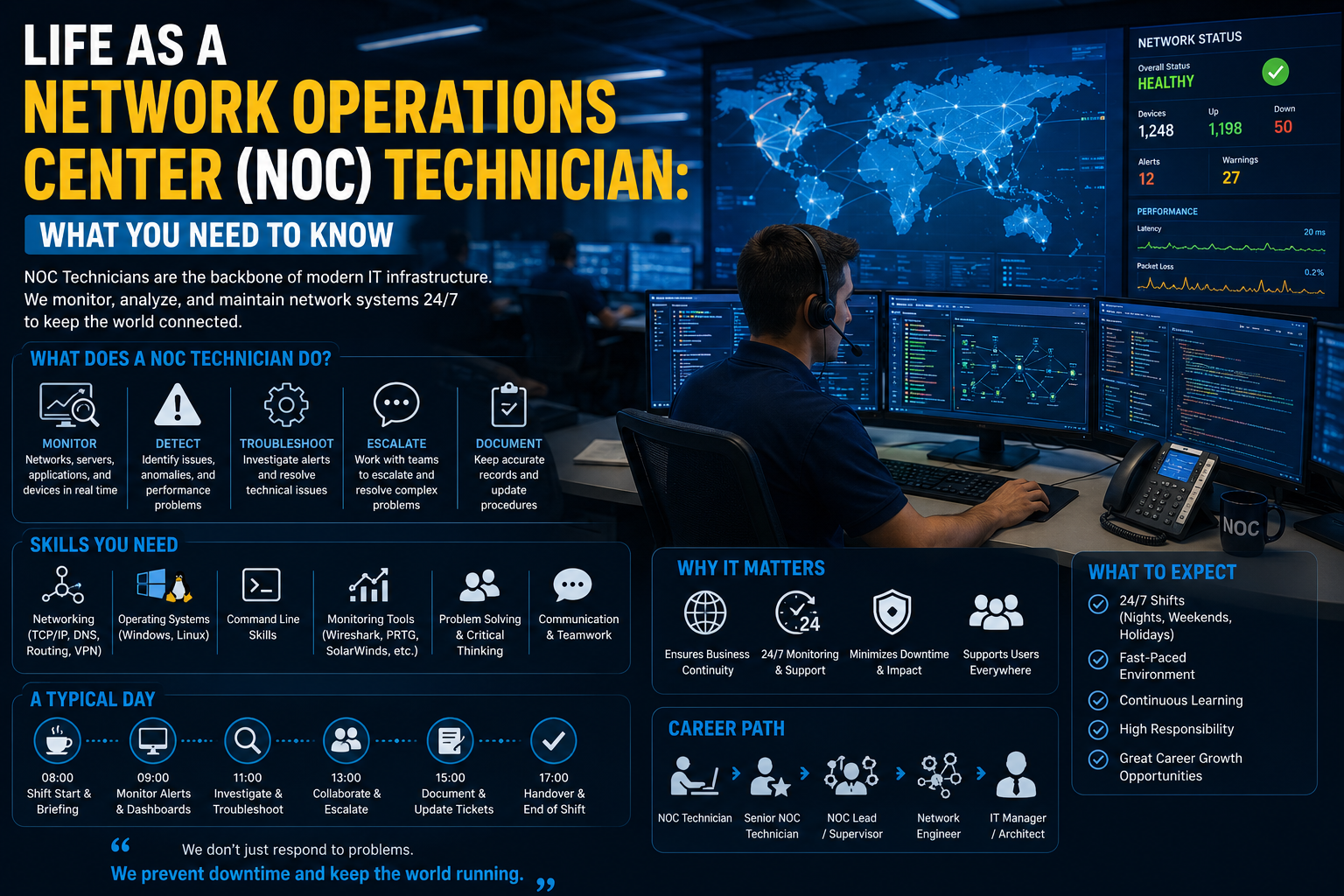
A Network Operations Center, commonly known as a NOC, is the central hub where an organization’s entire IT infrastructure is monitored, managed, and maintained in real time. It is the place where networks, servers, applications, and communication systems are observed continuously to ensure they are functioning smoothly and securely. In many ways, a NOC acts as the nervous system of modern digital organizations, where every signal, alert, and anomaly is detected and processed to keep systems stable and reliable.
The physical environment of an NOC is often designed for focus, speed, and clarity. It typically consists of a large open room filled with rows of workstations facing multiple large display screens. These screens present real-time dashboards showing system performance, network traffic, server health, security alerts, and application status. The atmosphere is highly structured and quiet, with minimal distractions, allowing technicians to concentrate on monitoring complex systems that may span across countries or even continents.
Unlike traditional IT offices, where employees may work on isolated tasks or projects, a NOC operates as a synchronized team environment. Every technician is assigned specific systems or segments of infrastructure to observe, but all work contributes to a shared goal: maintaining uninterrupted service and resolving issues before they escalate into serious disruptions. This proactive nature is what distinguishes a NOC from reactive IT support roles.
The environment is often compared to a control room in aviation or emergency response centers, where every second matters and decisions must be based on accurate, real-time information. While the term “war room” is sometimes used informally, it reflects the seriousness and urgency of the work being done. Even small fluctuations in system performance can require attention, analysis, and potential intervention.
The Core Purpose of a NOC in Modern Organizations
The primary purpose of an NOC is to ensure the continuous availability and performance of IT services. In today’s digital-driven world, organizations depend heavily on technology to operate. Websites, internal communication systems, financial transactions, cloud services, and customer applications all rely on stable infrastructure. Any downtime or disruption can lead to financial loss, security risks, and reputational damage.
A NOC exists to minimize these risks by providing constant surveillance over critical systems. It ensures that problems are detected early, often before users are even aware that something is wrong. This proactive monitoring allows organizations to maintain high levels of reliability and customer trust.
Another key function of an NOC is incident management. When something goes wrong—such as a server failure, network outage, or performance degradation—the NOC team is responsible for identifying the issue, analyzing its impact, and initiating the appropriate response. This may involve fixing the problem directly or escalating it to specialized teams, depending on complexity.
In addition to incident response, NOCs also play a major role in performance optimization. By analyzing system behavior over time, technicians can identify bottlenecks, inefficiencies, or recurring issues. These insights help improve infrastructure design and prevent future disruptions.
Security monitoring is another critical responsibility. NOCs often track unusual network activity, potential intrusion attempts, malware behavior, and other security-related events. This adds a layer of protection, complementing dedicated cybersecurity teams.
Ultimately, the NOC functions as a centralized command center that ensures all digital operations remain stable, secure, and efficient.
The Work Environment and Daily Atmosphere of an NOC
Working in a NOC is unlike most traditional office environments. The atmosphere is highly structured, time-sensitive, and driven by real-time data. Technicians typically work in shifts because IT systems must be monitored 24 hours a day, seven days a week. This continuous coverage ensures that no incident goes unnoticed, regardless of time or location.
The environment is usually quiet and focused. While there is teamwork involved, communication is often concise and task-oriented. Technicians rely heavily on monitoring tools, dashboards, and alert systems rather than lengthy discussions or meetings. Every screen in the room has a purpose, and every alert demands attention.
Shift work is a defining characteristic of the NOC lifestyle. Since systems operate around the clock, technicians may be assigned to day shifts, night shifts, or rotating schedules. Early-career professionals often start with less desirable hours, including overnight shifts. Over time, with experience and seniority, more flexible scheduling options may become available.
Despite the structured nature of the environment, there is a strong sense of coordination. Each technician plays a specific role within the larger system. Some focus on network performance, others on servers, applications, or security. Even though responsibilities differ, all team members depend on each other to maintain overall system stability.
Another important aspect of the NOC environment is the reliance on documentation. Every incident, no matter how small, must be recorded. This includes what happened, when it occurred, how it was resolved, and what steps were taken. This documentation becomes part of a knowledge base that helps future technicians respond more efficiently to similar issues.
Responsibilities and Expectations of a NOC Technician
A NOC technician is responsible for monitoring and maintaining specific segments of the IT infrastructure. Their main duty is to ensure that systems remain operational and that any irregularities are addressed quickly. While responsibilities vary depending on the organization, several core tasks are common across most NOC environments.
One of the primary responsibilities is system monitoring. Technicians continuously observe dashboards that display network traffic, server loads, application performance, and hardware status. They look for signs of abnormal behavior, such as sudden spikes in traffic, slow response times, or hardware failures.
When an issue is detected, the technician must assess its severity. Some problems can be resolved immediately using predefined procedures, while others require escalation to higher-level engineers or specialized teams. Knowing when to act independently and when to escalate is a critical skill in this role.
Another major responsibility is incident management. This involves logging issues into tracking systems, documenting details accurately, and following established procedures to resolve them. Proper documentation ensures that every incident contributes to organizational knowledge and helps prevent similar problems in the future.
NOC technicians are also responsible for proactive maintenance tasks. This includes reviewing system logs, checking performance trends, and identifying potential risks before they become serious problems. This predictive approach is a key feature of modern NOC operations.
Communication is another essential part of the role. Technicians must coordinate with other team members, engineers, and sometimes external providers. However, communication is typically brief, structured, and focused on problem resolution rather than extended discussion.
Accuracy and attention to detail are crucial. A small oversight in interpreting system data can lead to delayed responses or incorrect actions. Because of this, NOC technicians must develop strong analytical skills and remain alert throughout their shifts.
Types of Organizations That Operate NOCs
Not all organizations require a Network Operations Center, but those that manage complex or mission-critical systems almost always rely on one. These organizations can vary widely in size and industry, but they share a common need for continuous infrastructure monitoring.
Large enterprises often maintain their own internal NOCs. These companies typically have extensive IT systems supporting global operations, internal communication platforms, customer-facing applications, and data centers. Their NOCs are designed to ensure that all internal systems function without interruption.
Managed Service Providers also operate NOCs to monitor infrastructure on behalf of multiple clients. These environments are often more diverse because technicians must manage systems from different industries and configurations. This requires adaptability and broad technical knowledge.
Telecommunication companies and internet service providers rely heavily on NOCs to maintain network connectivity. Since their services form the backbone of internet communication, even minor disruptions can affect thousands or millions of users. Their NOCs focus heavily on network stability, routing, and connectivity issues.
Government and defense organizations also use NOCs to monitor critical systems that support national infrastructure and security. These environments often have stricter protocols, higher security requirements, and more sensitive data handling responsibilities.
Each type of organization has its own focus, but all NOCs share the same fundamental goal: ensuring the uninterrupted and reliable operation of IT systems.
Entry-Level Positioning and Career Entry into NOC Roles
Most individuals entering a NOC begin at an entry-level technician position. These roles are designed for individuals who have foundational knowledge of networking, systems, or IT infrastructure. While advanced expertise is not always required at the start, familiarity with basic concepts is essential.
Entry-level technicians typically focus on monitoring tasks, basic troubleshooting, and incident documentation. Over time, they gain exposure to more complex systems and responsibilities. This gradual learning process helps build confidence and technical capability.
The early stages of an NOC career often involve close supervision. Senior technicians and engineers provide guidance, review work, and help new team members understand procedures and tools. This mentorship is an important part of skill development.
As experience grows, technicians may progress through different tiers of responsibility. Each tier represents a higher level of complexity and independence. Lower tiers focus on basic troubleshooting and monitoring, while higher tiers handle more advanced issues and system-level problems.
Career entry into a NOC is not limited to a single path. Some individuals come from networking backgrounds, others from systems administration, and some from general IT support roles. The diversity of entry paths reflects the wide range of skills required in the field.
The transition into an NOC role often requires adaptability. The environment is fast-paced, structured, and highly technical. Individuals who succeed tend to be those who enjoy problem-solving, working with data, and operating in a continuous monitoring environment where attention and consistency are essential.
Core Operational Workflow Inside a NOC
The daily functioning of a Network Operations Center follows a structured operational workflow designed to ensure that every system event is detected, analyzed, and addressed in a consistent and efficient manner. This workflow is not random or reactive; it is built on carefully defined procedures that allow technicians to respond quickly while maintaining accuracy and accountability.
At the center of this workflow is continuous monitoring. Every device, application, and network component being managed by the organization sends real-time data into centralized monitoring systems. These systems convert raw technical data into readable dashboards, alerts, and performance indicators. NOC technicians rely on these tools to maintain awareness of system health at all times.
When everything is functioning normally, the workflow is relatively calm. Technicians observe dashboards, review logs, and ensure that systems remain within acceptable performance thresholds. However, the moment an anomaly is detected, the workflow shifts into action mode. Alerts are generated automatically when predefined thresholds are crossed, such as CPU spikes, network latency increases, or service downtime.
Once an alert appears, the technician begins the first stage of analysis. This involves determining whether the issue is critical, moderate, or minor. Not all alerts require immediate intervention; some may be false positives or temporary fluctuations. The ability to quickly interpret the severity of an alert is a key skill in NOC operations.
After classification, the technician either resolves the issue directly or escalates it, depending on complexity. This structured response process ensures that resources are used efficiently and that critical problems receive priority attention.
Incident Detection and Response Lifecycle
Every issue handled within an NOC follows an incident lifecycle that ensures consistency in how problems are managed. This lifecycle begins with detection and ends with resolution and documentation, forming a continuous improvement loop.
The first stage is detection. Incidents are usually identified through automated monitoring systems, although sometimes technicians may notice irregular patterns while reviewing dashboards manually. Detection is heavily reliant on preconfigured thresholds that define normal versus abnormal system behavior.
Once an issue is detected, it moves into classification. This step involves assessing the type of incident and its potential impact. For example, a network outage affecting multiple users is classified as high severity, while a minor performance delay on a non-critical application may be classified as low severity.
After classification, the response phase begins. If the technician has the authority and capability to resolve the issue, they will take immediate corrective action. This could involve restarting services, adjusting configurations, clearing network bottlenecks, or executing predefined recovery procedures.
If the issue is beyond their scope, it is escalated to a higher-tier engineer or specialized team. Escalation ensures that complex problems are handled by individuals with deeper expertise. During this phase, detailed documentation is crucial, as it provides context for the next level of support.
Once the issue is resolved, the incident enters the recovery phase. Systems are monitored closely to ensure stability and confirm that the problem has been fully addressed. Even after resolution, technicians continue to observe performance to prevent recurrence.
Finally, the documentation phase ensures that every detail of the incident is recorded. This includes the cause, resolution steps, tools used, and time taken to resolve the issue. This documentation becomes part of a knowledge base that supports future troubleshooting efforts.
Tiered Structure and Escalation System in NOC Operations
NOC environments typically operate using a tiered support structure. This system organizes technicians based on skill level, responsibility, and the complexity of tasks they handle. It ensures that issues are managed efficiently without overwhelming any single group.
At the first level, often referred to as Tier 1, technicians handle basic monitoring and initial response tasks. They are responsible for identifying alerts, performing preliminary diagnostics, and resolving simple issues using predefined procedures. Tier 1 serves as the first line of defense and is critical for early detection and quick resolution.
If an issue cannot be resolved at Tier 1, it is escalated to Tier 2. Technicians at this level have deeper technical knowledge and are capable of handling more complex problems. They may perform advanced troubleshooting, configuration changes, and system-level analysis. Tier 2 technicians often deal with recurring or multi-layered issues that require careful investigation.
Tier 3 represents the highest technical level within the NOC structure. These professionals are typically engineers or specialists with deep expertise in specific systems or technologies. They handle critical incidents, infrastructure failures, and complex root cause analysis. Tier 3 technicians also play a major role in designing solutions to prevent future incidents.
This tiered structure is not just about hierarchy; it is about efficiency. By distributing responsibilities based on complexity, NOCs ensure that resources are used effectively and that issues are resolved by the most appropriate level of expertise.
Escalation between tiers follows strict protocols. Each escalation must include detailed documentation so that the next technician understands the context, symptoms, and actions already taken. This prevents duplication of effort and speeds up resolution.
Tools and Technologies Used in a NOC Environment
The effectiveness of an NOC depends heavily on the tools and technologies used to monitor and manage systems. These tools collect vast amounts of data from across the IT infrastructure and present it in a structured, actionable format.
Monitoring tools are the backbone of NOC operations. They continuously track system performance metrics such as CPU usage, memory consumption, network traffic, disk activity, and application response times. These tools provide real-time visibility into the health of the entire infrastructure.
Alerting systems are closely integrated with monitoring tools. They generate notifications when predefined thresholds are exceeded. These alerts are often categorized by severity, allowing technicians to prioritize their response.
Log management systems are another critical component. Every system, application, and network device generates logs that record activity and events. These logs are essential for troubleshooting, as they provide a detailed history of what occurred before, during, and after an incident.
Ticketing systems are used to track incidents from detection to resolution. Each issue is assigned a ticket that includes all relevant details, updates, and resolution steps. This ensures accountability and provides a structured record of all activities.
In addition to these core tools, NOCs often use performance analytics platforms. These tools analyze historical data to identify trends, predict potential failures, and optimize system performance. Predictive analysis helps organizations prevent issues before they occur.
Security monitoring tools are also integrated into NOC environments. These tools detect unusual network activity, unauthorized access attempts, and potential cyber threats. This adds a layer of protection to the infrastructure.
Automation tools are becoming increasingly important in modern NOCs. They allow routine tasks such as system restarts, configuration updates, and data collection to be performed automatically, reducing manual workload and improving efficiency.
Skills and Competencies Required for NOC Technicians
Working in a NOC requires a combination of technical knowledge, analytical thinking, and operational discipline. While formal education and certifications may provide a foundational understanding, practical skills are what determine success in this environment.
One of the most important skills is network understanding. Technicians must be familiar with how data flows across networks, how devices communicate, and how performance issues can arise. This includes knowledge of protocols, routing, switching, and basic infrastructure concepts.
System administration skills are also essential. Many incidents involve servers, operating systems, and applications. Understanding how these systems function allows technicians to diagnose and resolve issues more effectively.
Analytical thinking plays a major role in NOC work. Technicians must interpret complex data, identify patterns, and make decisions quickly. Often, multiple alerts may occur simultaneously, requiring prioritization based on severity and impact.
Attention to detail is critical. Small indicators in logs or performance metrics can reveal larger underlying issues. Missing these details can lead to delayed responses or incomplete resolutions.
Communication skills are equally important, even though NOC environments are not customer-facing. Technicians must clearly document incidents, escalate issues properly, and communicate effectively with team members. Clear documentation ensures smooth handoffs between tiers.
Time management and discipline are necessary due to the shift-based nature of the job. Technicians must remain alert and focused during long shifts, including overnight hours. Maintaining consistency in performance regardless of time of day is essential.
Shift Work Dynamics and Operational Continuity
Shift work is a defining characteristic of NOC operations because IT infrastructure must be monitored continuously without interruption. This 24/7 requirement means that technicians work in rotating schedules that cover day, evening, and night hours.
Each shift is structured to ensure a smooth handover between teams. Before a shift ends, technicians document ongoing incidents, system status updates, and any unresolved issues. This ensures that the incoming team has full visibility into current operations.
Night shifts often require additional focus because system activity may be lower, but critical incidents can still occur without warning. Technicians must remain fully alert even during periods of low activity.
Over time, professionals often develop personal strategies to manage shift work effectively. This may include adjusting sleep schedules, maintaining consistent routines, and managing workload distribution during peak and off-peak hours.
Operational continuity is a shared responsibility. Every shift contributes to maintaining system stability, and no single team operates in isolation. The success of the NOC depends on seamless coordination across all shifts.
Real-Time Decision Making and Problem Solving
One of the most challenging aspects of NOC operations is the need for real-time decision-making. Technicians often work under pressure, especially when dealing with critical incidents that affect multiple users or systems.
In such situations, decisions must be made quickly but carefully. Technicians rely on predefined procedures, experience, and system data to determine the best course of action. There is often no time for extended analysis, so intuition combined with training plays a major role.
Problem-solving in a NOC environment is both structured and dynamic. While standard operating procedures guide responses, no two incidents are the same. Technicians must adapt their approach based on the specific nature of each issue.
Root cause analysis is an important part of this process. Once an incident is resolved, technicians work backward to understand what caused the problem. This helps prevent recurrence and improves system reliability over time.
Collaboration also plays a role in problem-solving. Even though individual technicians may handle initial responses, complex issues often require input from multiple specialists working together.
Performance Metrics and System Accountability
NOC operations are heavily driven by performance metrics that measure system health and team effectiveness. These metrics provide insight into how well the infrastructure is functioning and how efficiently incidents are being handled.
Common metrics include system uptime, response time, resolution time, and incident frequency. Uptime measures the availability of systems, while response time tracks how quickly technicians react to alerts. Resolution time measures how long it takes to fully resolve an issue.
These metrics are not only used for reporting but also for improving operations. By analyzing trends, organizations can identify weak points in infrastructure and make targeted improvements.
Accountability is built into every aspect of NOC work. Every action taken by a technician is logged, ensuring transparency and traceability. This level of accountability helps maintain high standards of operational discipline and accuracy.
Continuous improvement is a core principle in NOC environments. Data collected from incidents and performance metrics is used to refine processes, improve tools, and enhance overall system reliability.
Advanced Responsibilities in a Mature NOC Environment
As a NOC technician gains experience, the role naturally evolves beyond basic monitoring and incident response. In more mature environments, technicians are expected to engage in deeper operational responsibilities that require stronger analytical thinking, broader system awareness, and increased ownership of infrastructure stability.
At this stage, the work is no longer limited to reacting to alerts. Instead, technicians begin to understand system behavior at a structural level. They observe patterns over time, identify recurring issues, and contribute to long-term improvements in system reliability. This shift from reactive support to proactive engineering is one of the most important transitions in a NOC career.
Experienced technicians often participate in refining monitoring thresholds and alert rules. Poorly configured alerts can lead to unnecessary noise, while overly strict thresholds may delay critical detection. Adjusting these parameters requires careful evaluation of system behavior and historical incident data.
Another advanced responsibility is participation in change monitoring. In many organizations, system changes such as updates, configuration modifications, or infrastructure scaling can introduce instability. NOC teams closely observe systems during and after changes to ensure that no unexpected issues arise. This requires strong attention to detail and awareness of ongoing operational activities.
At higher levels, technicians may also assist in capacity planning. By analyzing long-term trends in CPU usage, bandwidth consumption, and storage growth, they help predict when systems will require expansion. This ensures that infrastructure continues to meet demand without performance degradation.
Deep Technical Skills Required for High-Level NOC Operations
While entry-level roles focus on monitoring and basic troubleshooting, advanced NOC positions require a much deeper technical foundation. Technicians at this level are expected to understand how systems interact at multiple layers, from physical hardware to application behavior.
Networking knowledge becomes significantly more important. This includes understanding routing protocols, subnetting, traffic flow, load balancing, and network segmentation. Advanced technicians must be able to interpret network anomalies and distinguish between infrastructure issues and application-level problems.
System-level expertise is equally important. This involves understanding operating systems, server architecture, virtualization platforms, and storage systems. Technicians must be able to diagnose issues that span multiple layers of infrastructure, often under time pressure.
Log analysis becomes a core skill at this stage. Rather than simply reviewing logs for errors, experienced technicians learn to correlate events across multiple systems. A single incident may generate dozens of related log entries, and identifying the root cause requires careful interpretation of these patterns.
Another important skill is familiarity with automation concepts. While entry-level technicians may manually resolve issues, advanced professionals often work alongside automation systems that execute predefined recovery actions. Understanding how these systems behave and when they should or should not be triggered is essential.
Security awareness also becomes increasingly important. Advanced NOC technicians must be able to recognize signs of suspicious activity, such as unusual traffic spikes, unauthorized login attempts, or unexpected configuration changes. This requires a strong understanding of both network behavior and common attack patterns.
The Role of Automation in Modern NOC Environments
Automation has transformed the way Network Operations Centers function. As IT environments become more complex, manual monitoring and response alone are no longer sufficient to maintain efficiency and speed. Automation helps reduce workload, improve response times, and minimize human error.
In modern NOCs, many routine tasks are handled automatically. These include system restarts, service recovery actions, log collection, and performance checks. When a predefined condition is met, automated scripts or tools execute corrective actions without requiring human intervention.
This does not eliminate the role of technicians; instead, it changes their focus. Rather than performing repetitive tasks, they concentrate on monitoring automation behavior, handling complex incidents, and refining system logic.
Automation also plays a major role in incident detection. Instead of relying solely on manual observation, systems continuously analyze performance data and trigger alerts when anomalies are detected. This allows issues to be identified much faster than traditional methods.
However, automation must be carefully managed. Poorly configured automation can lead to unintended consequences, such as repeated restarts or incorrect responses to temporary fluctuations. NOC technicians must understand how automated systems are structured and ensure they operate within safe parameters.
Over time, many technicians become involved in designing automation workflows. This requires logical thinking and a strong understanding of system dependencies. Each automated process must be carefully tested to ensure it behaves correctly under different conditions.
Security Monitoring and Threat Awareness in NOC Operations
Security has become one of the most critical aspects of modern NOC operations. As organizations face increasing cyber threats, NOC teams play an essential role in early detection and response to potential security incidents.
Security monitoring involves observing network traffic, system logs, and user activity for signs of suspicious behavior. This includes unusual login patterns, unexpected data transfers, unauthorized access attempts, and abnormal system behavior.
Unlike traditional cybersecurity teams that focus on in-depth threat analysis, NOC technicians are often the first to detect potential security issues. Their role is to identify anomalies and escalate them to specialized security teams for further investigation.
Understanding baseline behavior is essential in this context. Technicians must know what normal system activity looks like to recognize when something deviates from it. Even small irregularities can sometimes indicate larger security concerns.
In many environments, NOC teams work closely with security operations centers. While the two functions are distinct, they often overlap in terms of monitoring tools and incident response workflows. This collaboration ensures faster detection and mitigation of threats.
Security awareness also includes understanding common attack vectors such as denial-of-service attempts, malware infections, and unauthorized configuration changes. While NOC technicians may not directly resolve all security incidents, their ability to detect early warning signs is crucial.
Collaboration and Communication in High-Pressure Situations
Although NOC environments are often quiet and focused, communication plays a vital role in ensuring smooth operations. During critical incidents, effective collaboration becomes essential to resolving issues quickly and accurately.
When a major system failure occurs, multiple technicians may become involved simultaneously. Each person may focus on a different aspect of the problem, such as network connectivity, server health, or application behavior. Coordinating these efforts requires clear and concise communication.
In high-pressure situations, communication must be structured and efficient. Technicians rely on short, direct messages that convey essential information without unnecessary detail. This helps reduce confusion and ensures that everyone involved understands the current status of the incident.
Escalation communication is also important. When an issue is passed to a higher-tier engineer, the initial technician must provide a complete and accurate summary of the situation. This includes what has been observed, what actions have already been taken, and any relevant system data.
Post-incident communication is equally important. After an issue is resolved, teams often conduct internal reviews to understand what happened and how similar incidents can be prevented in the future. These discussions help improve processes and strengthen system reliability.
Despite the technical nature of the work, teamwork remains a central element of NOC operations. Even though individuals may focus on specific tasks, the overall success of the center depends on coordinated effort and shared understanding.
Stress Management and Cognitive Load in NOC Roles
Working in an NOC can be mentally demanding due to the need for constant attention, rapid decision-making, and exposure to time-sensitive incidents. Managing stress effectively is an important part of maintaining performance in this environment.
One of the primary sources of stress is alert overload. In complex systems, multiple alerts may occur simultaneously, creating pressure to prioritize and respond quickly. Without proper filtering and prioritization, this can lead to cognitive fatigue.
Another source of stress is the unpredictability of incidents. While many systems operate most of the time smoothly, critical failures can occur without warning. Technicians must remain prepared to respond at any moment, regardless of shift or workload.
Shift work itself can also contribute to fatigue. Working during night hours or rotating schedules can affect sleep patterns and overall energy levels. Over time, this requires adaptation and strong personal discipline to maintain consistency.
To manage cognitive load, experienced technicians often develop structured thinking patterns. They rely on procedures, checklists, and mental frameworks to process information efficiently during incidents. This reduces the mental burden of decision-making under pressure.
Team support also plays an important role in stress management. Having reliable colleagues who can assist during complex incidents helps distribute workload and reduce individual pressure.
Career Development Pathways Beyond Entry-Level NOC Roles
A career in a NOC is not static; it offers multiple pathways for professional growth and specialization. As technicians gain experience, they often transition into more advanced technical or leadership roles.
One common progression is moving into senior NOC technician positions. These roles involve handling more complex incidents, mentoring junior staff, and contributing to process improvements. Senior technicians often act as intermediaries between entry-level staff and engineering teams.
Another pathway is specialization. Some technicians choose to focus on specific areas such as networking, systems engineering, cloud infrastructure, or security monitoring. This specialization allows them to develop deeper expertise in a particular domain.
Engineering roles are another natural progression. NOC experience provides a strong foundation for transitioning into network engineering, systems engineering, or infrastructure architecture. These roles involve designing and optimizing systems rather than just monitoring them.
Some professionals move into operational leadership positions. These roles involve managing teams, coordinating shifts, improving workflows, and ensuring overall efficiency of the NOC environment. Leadership roles require both technical understanding and strong organizational skills.
Others may transition into incident management or problem management roles. These positions focus on analyzing recurring issues, improving response strategies, and reducing system downtime over time.
The Evolving Nature of NOC Work in Modern IT Systems
The role of the NOC is continuously evolving as technology advances. Modern IT environments are increasingly distributed, cloud-based, and automated, which changes the way monitoring and management are performed.
Traditional physical infrastructure monitoring is gradually being supplemented or replaced by cloud-based monitoring systems. This introduces new challenges, such as managing distributed systems across multiple regions and handling dynamic resource allocation.
The rise of containerization and microservices has also increased system complexity. Instead of monitoring a few large servers, NOC technicians now often monitor hundreds or thousands of smaller components that interact in complex ways.
Artificial intelligence and predictive analytics are beginning to play a larger role in NOC operations. These systems can identify patterns, predict failures, and even suggest corrective actions before issues occur. However, human oversight remains essential to validate and interpret these insights.
As systems become more automated and distributed, the role of the NOC technician is shifting toward higher-level analysis, decision-making, and coordination. Rather than simply reacting to system events, technicians are increasingly responsible for understanding system behavior as a whole and ensuring long-term stability across complex environments.
Evolving Monitoring Practices in Distributed and Cloud-Based Systems
As modern infrastructure continues to shift toward cloud computing and distributed architectures, the way NOC teams operate has also changed significantly. Traditional monitoring models were built around centralized physical servers and clearly defined network boundaries. Today, however, systems are spread across multiple cloud providers, data centers, and virtual environments, making visibility and control more complex.
In these environments, a single application may rely on dozens of interconnected services running in different regions. This means that when an issue occurs, it is no longer enough to check a single server or network segment. NOC technicians must trace dependencies across multiple layers of infrastructure to understand how a failure in one component can affect the entire system.
Cloud-based monitoring tools provide more flexibility, but they also introduce new challenges. Metrics are generated at a much higher volume, and systems can scale up or down dynamically depending on demand. This requires technicians to interpret fluctuating performance patterns that may not always indicate real problems.
One of the key adjustments in this environment is the shift from static monitoring thresholds to adaptive monitoring systems. Instead of fixed alert values, modern systems often use baseline behavior models that adjust according to historical data. NOC technicians must understand how these baselines are formed and when deviations represent actual risks versus normal fluctuations.
Increased Importance of Observability in Modern Operations
In addition to traditional monitoring, the concept of observability has become central to modern NOC operations. Observability goes beyond simply detecting whether a system is up or down; it focuses on understanding why a system behaves the way it does.
This is achieved through a combination of logs, metrics, and traces. Logs provide detailed event history, metrics show system performance over time, and traces follow the path of requests across distributed systems. Together, these elements allow technicians to reconstruct the full picture of system behavior.
For NOC teams, this means developing the ability to correlate data from multiple sources. A performance issue in one service may not originate from that service itself but from a dependent system elsewhere. Observability tools help uncover these hidden relationships.
This approach significantly improves troubleshooting efficiency. Instead of guessing where a problem might be, technicians can follow a structured path of evidence to identify the root cause. However, it also requires a deeper level of analytical thinking and familiarity with complex data structures.
The Human Factor in High-Automation Environments
Even as automation and AI-driven systems become more common, the human role in NOC operations remains essential. Machines can process large volumes of data and execute predefined actions, but they cannot fully interpret context, intent, or unexpected system behavior in the same way humans can.
NOC technicians act as decision-makers when automated systems reach their limits. For example, if multiple automated recovery attempts fail, human intervention is required to determine the next steps. This may involve disabling faulty automation, rerouting traffic, or coordinating with engineering teams for deeper analysis.
Another important human contribution is judgment. Not every alert generated by a system represents a real issue. Experienced technicians learn to distinguish between noise and meaningful signals. This ability comes from experience and familiarity with system behavior over time.
Humans also play a key role in adapting systems to changing conditions. While automation follows predefined rules, real-world environments evolve constantly. New applications, updated configurations, and shifting workloads require continuous refinement of monitoring strategies and response procedures.
Coordination Between Global Teams and Time Zones
In many organizations, NOC operations are distributed across multiple geographic regions. This introduces the challenge of coordinating teams that operate in different time zones while maintaining continuous system coverage.
To ensure smooth operation, responsibilities are often handed off between regional teams. Each shift must provide detailed updates about ongoing incidents, system status, and any potential risks. This ensures continuity even when teams are not physically working at the same time.
Global coordination requires strong documentation practices. Without clear records, important context can be lost during shift transitions. This is why structured reporting is a critical part of NOC operations.
Cultural and communication differences can also play a role in global environments. Teams must develop standardized communication protocols to ensure consistency and avoid misunderstandings. This often includes predefined terminology, escalation procedures, and reporting formats.
Despite these challenges, global NOC structures provide a major advantage: continuous coverage across all hours of the day. This ensures that systems are monitored without interruption, regardless of local working hours.
Conclusion
A career in a Network Operations Center represents a unique blend of constant vigilance, technical problem-solving, and real-time decision-making. Unlike traditional IT roles that focus on planned projects or isolated systems, NOC work revolves around the continuous health of entire digital infrastructures. Every alert, log entry, and performance shift carries meaning, and the ability to interpret this information quickly is what keeps systems stable and organizations running smoothly.
Over time, the role evolves from basic monitoring to deeper analytical responsibilities, where technicians begin to understand system behavior at a structural level. This progression not only strengthens technical expertise but also builds strong decision-making and coordination skills that are valuable across many areas of IT. The shift-based, high-attention environment can be demanding, yet it also offers structured growth, clear operational processes, and exposure to complex technologies used in real-world production systems.
As modern infrastructure becomes more distributed and automated, the importance of skilled NOC professionals continues to grow. They remain the critical link between raw system data and actionable responses that prevent downtime and service disruption. For those who enjoy problem-solving, working with live systems, and contributing to the stability of large-scale networks, the NOC environment offers a challenging yet highly rewarding career path.