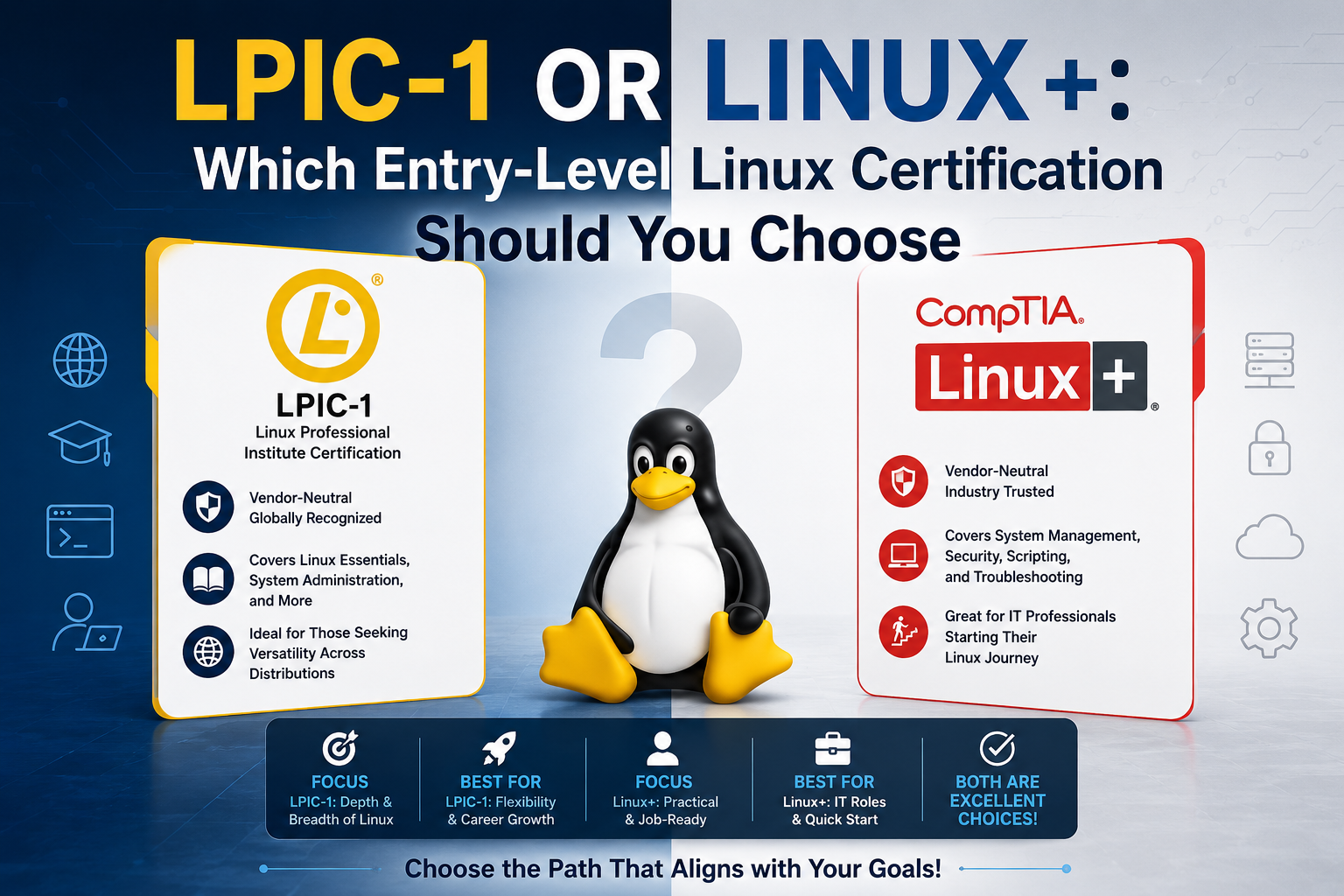
Linux has become one of the foundational technologies behind modern computing infrastructure. It runs a large portion of servers, cloud platforms, mobile systems, embedded devices, and even parts of enterprise networking equipment. While end users may not always see it directly, Linux is often working behind the scenes to power websites, applications, databases, and cloud services that people rely on every day.
One of the main reasons for Linux’s widespread adoption is its flexibility. Unlike operating systems tied to a single vendor ecosystem, Linux can be modified, customized, and deployed across a wide range of environments. This makes it especially attractive to organizations that need scalable, cost-effective, and highly stable systems. Enterprises value Linux not only for its performance but also for its reliability under heavy workloads.
As companies continue shifting toward cloud computing, virtualization, and container-based infrastructure, Linux skills have become increasingly important for IT professionals. Whether an organization is running hybrid cloud environments, managing on-premise servers, or deploying distributed applications, Linux knowledge often plays a central role in system administration and infrastructure management.
Another factor driving demand is the rise of DevOps practices. Modern IT operations now rely heavily on automation, continuous integration, and infrastructure-as-code methodologies. Linux systems are frequently the foundation on which these workflows operate. Professionals who understand Linux are better equipped to manage automated environments, troubleshoot system issues, and maintain service uptime in complex architectures.
This growing reliance on Linux has led to an increased demand for structured validation of skills. Employers often look for certifications as a way to assess whether a candidate understands not just theoretical concepts but also practical system administration tasks. This is where Linux certifications become relevant, especially in entry-level and intermediate IT roles.
Understanding Vendor-Neutral Linux Certifications
Linux certifications generally fall into two broad categories: vendor-specific and vendor-neutral. Vendor-specific certifications are tied to a particular distribution, meaning they focus on one Linux flavor and its ecosystem. Vendor-neutral certifications, on the other hand, emphasize general Linux knowledge that can be applied across multiple distributions.
Vendor-neutral certifications are especially important for beginners and early-career IT professionals because they teach transferable skills. Instead of focusing on a single Linux distribution, they cover universal concepts such as command-line usage, file system structure, process management, user permissions, networking basics, and system security. These are foundational skills that remain consistent regardless of whether a system is running Ubuntu, Debian, CentOS, or another distribution.
The appeal of vendor-neutral certifications lies in their broad applicability. In real-world IT environments, professionals rarely work with just one type of Linux system. Enterprises often use multiple distributions depending on workload requirements, compatibility needs, and organizational standards. As a result, understanding general Linux principles can be more valuable than specializing in a single distribution too early.
Another advantage is career flexibility. Vendor-neutral certifications allow professionals to apply for a wider range of roles, including system administration, network support, cloud infrastructure management, and technical support positions. Instead of being limited to a specific ecosystem, candidates can demonstrate adaptability across different environments.
In addition, vendor-neutral certifications often serve as stepping stones toward more advanced or specialized credentials. They help build a strong foundation that can later support deeper expertise in areas such as security, cloud computing, or enterprise system administration.
The Evolution of Linux+ and LPIC Relationship
The relationship between CompTIA Linux+ and the Linux Professional Institute’s LPIC-1 certification has changed over time, and understanding this history helps clarify why both certifications are often compared today.
At one point, there was a formal partnership between the two organizations. During this period, passing the CompTIA Linux+ exam could also lead to LPIC-1 certification recognition. This arrangement created a direct link between the two credentials, making them closely aligned in terms of content and recognition.
However, this partnership eventually ended, and both certifications evolved independently. After the separation, each organization began refining its own exam structure, objectives, and certification pathways. Although they still cover similar foundational Linux topics, they now differ in structure, emphasis, and evaluation style.
CompTIA continued developing Linux+ as a single certification exam focused on practical IT skills and broad system administration tasks. Its approach is designed to align with entry-level IT roles where Linux knowledge is one part of a wider skill set that may also include networking, security fundamentals, and troubleshooting.
The Linux Professional Institute, on the other hand, maintained LPIC-1 as part of a multi-level certification track. LPIC-1 is the first step in a progression that can lead to more advanced certifications. This structure emphasizes depth and long-term professional development within Linux system administration.
Because of these differences, the two certifications now represent slightly different philosophies. One is oriented toward broad IT skill development, while the other emphasizes structured progression within Linux specialization. This distinction is one of the key reasons candidates often compare them when deciding where to begin their certification journey.
Despite their separation, both certifications continue to cover overlapping foundational topics. These include Linux installation, command-line operations, user and group management, file permissions, process handling, package management, system services, and basic networking. However, the depth and style of questioning may vary depending on the certification approach.
How Linux Certification Exams Are Designed and What They Measure
Linux certification exams are designed to evaluate both theoretical understanding and practical problem-solving ability. Unlike purely academic assessments, these exams often focus on real-world tasks that a system administrator or IT support professional might encounter in a working environment.
One of the primary areas of evaluation is command-line proficiency. Since Linux systems are frequently managed through terminal interfaces, candidates are expected to demonstrate familiarity with essential commands and their practical applications. This includes navigating file systems, managing directories, editing configurations, and executing administrative tasks without graphical tools.
Another major focus area is system configuration. This involves understanding how Linux systems boot, how services are managed, and how hardware and storage components are configured. Candidates are expected to recognize how different system components interact and how to troubleshoot issues when systems fail to behave as expected.
User and permission management is also a critical component. Linux is a multi-user system, and controlling access is essential for security and operational stability. Certification exams often assess understanding of user accounts, group permissions, file ownership, and access control mechanisms. This ensures that candidates can maintain secure environments and prevent unauthorized access.
Networking fundamentals are another key area. Even at an entry level, Linux professionals must understand how systems communicate over networks. This includes configuring network interfaces, understanding IP addressing, diagnosing connectivity issues, and working with basic network tools.
Security concepts are also increasingly emphasized. Modern IT environments require strong security practices, and Linux certifications often include topics such as firewall configuration, authentication mechanisms, system hardening, and secure access protocols. While the depth of security topics varies, the goal is to ensure candidates understand how to protect systems from common vulnerabilities.
Automation and scripting are also becoming more important in certification exams. As IT environments grow more complex, manual system administration is being replaced by automated processes. Candidates may be expected to demonstrate basic scripting knowledge or understanding of automation tools that help streamline repetitive tasks.
Troubleshooting is another essential skill assessed in these exams. Rather than simply recalling commands or definitions, candidates must often analyze scenarios and determine the cause of system issues. This tests logical thinking and practical experience, which are crucial in real IT environments where problems must be resolved quickly and efficiently.
Who These Certifications Are Intended For
Linux certifications are generally designed for individuals who are either entering the IT field or looking to strengthen their foundational system administration skills. They are particularly useful for those who want to work in roles that involve managing servers, supporting infrastructure, or maintaining enterprise systems.
Entry-level IT professionals often pursue these certifications to build credibility and demonstrate technical competence. Since Linux is widely used in enterprise environments, having a certification can help candidates stand out when applying for support or junior administration roles.
Students and career changers also find value in these certifications. For individuals transitioning into IT from unrelated fields, structured learning through certification pathways provides a clear roadmap for skill development. It helps bridge the gap between theoretical learning and practical application.
System support technicians and help desk professionals may also benefit from Linux certifications. In many organizations, support teams are required to interact with Linux-based systems, even if their primary responsibilities are not centered around Linux administration. Certification helps them handle basic system tasks more effectively.
In addition, aspiring cloud professionals and DevOps beginners often start with Linux certifications. Since most cloud environments rely heavily on Linux-based systems, understanding Linux fundamentals is essential before moving into more advanced topics such as container orchestration, infrastructure automation, or cloud architecture.
Even experienced IT professionals sometimes pursue Linux certifications to formalize their knowledge or transition into more specialized roles. Certifications can serve as validation of skills that may have been acquired through hands-on experience but not formally documented.
Early Decision Factors Before Choosing a Path
Before deciding between different Linux certification paths, it is important to consider long-term career goals and the type of IT environment one intends to work in. While both certifications cover similar foundational material, they differ in structure, recognition patterns, and progression opportunities.
One key factor is career direction. Individuals who want a broad IT foundation that extends beyond Linux may lean toward certifications that align with general system administration and support roles. On the other hand, those who are committed to specializing in Linux over time may prefer a structured certification path that allows for deeper progression.
Another consideration is learning style. Some learners prefer a single comprehensive exam that covers a wide range of topics at once, while others prefer a staged approach where knowledge is built progressively through multiple certification levels. These differences can influence how manageable the preparation process feels.
Regional job market expectations can also play a role. In some regions, employers may be more familiar with certain certifications, which can influence hiring decisions. Understanding local industry preferences can help candidates choose a certification that aligns with employer expectations.
The depth of technical focus is another important factor. Some certifications emphasize practical system administration tasks in a more structured progression, while others focus on a broader overview of IT skills that include Linux as one component among many.
Finally, it is important to consider future specialization opportunities. Many professionals use entry-level Linux certifications as a foundation before moving into advanced fields such as cybersecurity, cloud engineering, or infrastructure automation. Choosing a certification path that supports future growth can help ensure long-term career development without requiring a complete shift in direction later.
Exam Structure and Evaluation Philosophy Differences
Although both Linux+ and LPIC-1 certifications assess foundational Linux administration skills, the way they structure their exams and evaluate candidates reflects two different educational philosophies. Understanding these differences helps clarify why candidates often perceive one certification as more practical or more challenging than the other.
Linux+ follows a unified exam model. Candidates take a single comprehensive test that covers a wide range of Linux topics in one sitting. This structure is designed to measure broad competency rather than segmented mastery. The idea is to simulate real-world IT environments where system administrators are expected to handle diverse responsibilities without separating tasks into isolated categories.
This single-exam approach emphasizes efficiency and speed of assessment. Candidates are evaluated across multiple domains at once, which means performance in one weak area can influence the overall outcome. The exam is designed to test how well a candidate can switch between different types of tasks under time constraints, reflecting the unpredictable nature of IT operations.
LPIC-1, in contrast, uses a multi-exam structure. Candidates must pass two separate exams to earn certification. Each exam focuses on a distinct set of competencies, dividing Linux knowledge into more focused segments. This segmentation allows for a deeper evaluation of each topic area, ensuring that candidates demonstrate consistent understanding across different technical domains.
This structure reflects a more academic and progressive approach. Instead of compressing all knowledge into a single assessment, LPIC-1 distributes evaluation across multiple stages. This reduces cognitive overload during testing and encourages more structured learning. Candidates are required to build mastery in phases, reinforcing long-term retention of concepts.
The philosophical difference between the two becomes clear in how they treat knowledge validation. Linux+ tends to measure operational readiness—how well a candidate can function in a general Linux environment. LPIC-1 focuses more on conceptual consistency and depth of understanding across multiple system components.
Another important distinction is how question styles are designed. Linux+ often includes scenario-based questions that simulate workplace tasks. These questions test decision-making under realistic conditions, such as troubleshooting a system issue or configuring services under constraints. LPIC-1 also includes scenario questions, but it places a stronger emphasis on precise technical knowledge and detailed command understanding.
In practice, this means Linux+ may feel more dynamic and situational, while LPIC-1 may feel more structured and detail-oriented. Both approaches are valid, but they appeal to different learning styles and professional expectations.
Depth vs Breadth in Curriculum Design
One of the most important differences between Linux+ and LPIC-1 lies in how each certification balances depth and breadth of knowledge. Both aim to prepare candidates for Linux-related roles, but they prioritize learning outcomes differently.
Linux+ is designed with a broad coverage model. It introduces candidates to a wide range of topics without diving too deeply into any single area. This includes system administration basics, networking fundamentals, security concepts, automation tools, and troubleshooting techniques. The goal is to produce well-rounded professionals who can operate across multiple IT domains.
This broad approach is particularly useful for individuals entering general IT roles. In many organizations, entry-level professionals are expected to handle diverse responsibilities rather than specialize immediately. Linux+ aligns well with this expectation by ensuring candidates have exposure to many aspects of Linux administration.
However, this breadth-first approach also means that some topics are covered at a relatively surface level. Candidates may learn how to perform tasks without necessarily exploring the deeper theoretical or architectural foundations behind them. This can be sufficient for operational roles but may require additional study for advanced specialization.
LPIC-1 takes a more structured depth-oriented approach. While it covers similar domains, it tends to explore each topic in greater detail. Candidates are expected to understand not just how to perform tasks, but also why systems behave in certain ways. This includes a deeper exploration of file systems, process management, system initialization, and command-line behavior.
The curriculum is designed to build strong technical foundations that can support more advanced Linux learning in later certification levels. Instead of providing broad exposure, LPIC-1 focuses on reinforcing core system administration skills in a more disciplined and layered manner.
This difference becomes especially noticeable in topics like networking and security. Linux+ may introduce general concepts and practical configurations, while LPIC-1 often expects more precise command usage and a clearer understanding of system-level interactions.
As a result, Linux+ is often perceived as more accessible for beginners, while LPIC-1 is seen as more technically rigorous. However, this does not necessarily mean one is superior; rather, they serve different educational goals within the Linux certification landscape.
Hands-on Skills vs Theoretical Alignment
Another key distinction between the two certifications is how they balance practical hands-on skills with theoretical understanding. Both certifications require candidates to demonstrate real-world Linux skills, but the emphasis differs in subtle but important ways.
Linux+ places strong emphasis on applied skills in realistic environments. Candidates are often tested on their ability to perform tasks that resemble everyday system administration responsibilities. This includes configuring systems, managing users, troubleshooting errors, and implementing security measures under typical operational conditions.
The exam style encourages practical thinking. Instead of focusing solely on memorization, candidates are expected to understand how to apply knowledge in dynamic scenarios. This reflects the realities of IT environments where administrators must solve problems quickly and efficiently.
Because of this focus, Linux+ often appeals to candidates who prefer learning through application. The certification rewards familiarity with workflows and operational processes rather than deep theoretical analysis. This makes it particularly suitable for individuals entering support roles or general IT positions.
LPIC-1 also includes practical elements, but it places a stronger emphasis on technical accuracy and structured understanding. Candidates are expected to know precise command syntax, system behaviors, and configuration details. This requires more detailed study and careful attention to system-level operations.
Theoretical alignment is more pronounced in LPIC-1 because it encourages candidates to understand Linux systems in a more formalized way. For example, rather than simply knowing how to manage processes, candidates are expected to understand how process hierarchies function and how system resources are allocated.
This deeper focus on system behavior helps build a stronger foundation for advanced topics. It prepares candidates not only to perform tasks but also to understand system architecture at a more granular level.
In practical terms, Linux+ may feel more like training for real-world job readiness, while LPIC-1 may feel more like structured technical education. Both approaches have value depending on whether the candidate prioritizes immediate employability or long-term technical depth.
Global Recognition and Employer Perception
Recognition of certifications plays a significant role in career decisions, especially for professionals seeking international opportunities or competitive job markets. Linux+ and LPIC-1 both enjoy global recognition, but their perception varies depending on region and industry context.
Linux+ benefits from strong brand recognition in certain regions, particularly in North America. It is associated with a well-established IT certification organization that is widely known among employers and hiring managers. This recognition can be advantageous for candidates applying to organizations that value standardized certification pathways.
In corporate environments where HR departments rely on familiar certification names, Linux+ may be more easily recognized during initial screening processes. This can be especially relevant for entry-level positions where certifications are used as filtering criteria.
LPIC-1, on the other hand, has a strong global footprint, particularly in technical and open-source communities. It is recognized across many countries and is often valued by employers who prioritize deep technical expertise over brand familiarity.
In regions outside North America, LPIC-1 may carry equal or sometimes greater recognition, especially among organizations that rely heavily on Linux-based infrastructure. This includes telecommunications companies, cloud service providers, and enterprise IT departments with strong Linux adoption.
Another factor influencing perception is the audience of hiring managers. Technical hiring managers often appreciate the structured depth of LPIC-1, while non-technical recruiters may be more familiar with Linux+ due to its broader branding.
In practice, both certifications are respected, but their impact can vary depending on the hiring environment. Candidates targeting global roles or specialized Linux positions may benefit from LPIC-1’s technical reputation, while those entering general IT roles in structured corporate environments may find Linux+ advantageous.
Career Path Alignment and Professional Direction
Choosing between Linux+ and LPIC-1 is often influenced by long-term career direction. While both certifications provide foundational Linux knowledge, they align differently with specific career paths in IT.
Linux+ aligns well with general IT support, junior system administration, and entry-level infrastructure roles. It is particularly suitable for professionals who expect to work in mixed technology environments where Linux is one of several systems in use. This includes help desk support, IT operations, and general system maintenance roles.
It also fits well into broader IT certification pathways that include networking, cybersecurity, and infrastructure management. Professionals who plan to diversify their skill sets beyond Linux often find Linux+ a useful starting point because it integrates well with other certifications in structured IT career frameworks.
LPIC-1 aligns more closely with dedicated Linux system administration roles. It is often chosen by individuals who intend to specialize in Linux environments or pursue advanced certifications in Linux engineering and administration. This includes roles such as Linux system administrator, infrastructure engineer, and cloud operations specialist.
Because LPIC-1 is part of a tiered certification structure, it naturally supports long-term specialization. Candidates can progress to higher-level certifications that focus on advanced system administration, security, and enterprise-level Linux management.
In cloud computing environments, both certifications are relevant, but LPIC-1 may provide deeper technical grounding for infrastructure-heavy roles. Linux+ may be more suitable for roles that involve broader IT responsibilities across cloud and on-premise systems.
In cybersecurity, Linux+ can serve as an introduction to system security concepts, while LPIC-1 provides a stronger foundation for understanding system vulnerabilities and secure configuration practices at a deeper level.
Study Experience and Preparation Challenges
The preparation experience for Linux+ and LPIC-1 differs significantly, both in structure and learning intensity. These differences can influence how candidates approach their studies and how long they may need to prepare for each certification.
Linux+ preparation is often described as more streamlined. Because the certification is based on a single exam, study materials tend to be consolidated. Candidates typically follow a structured learning path that covers all exam domains in a unified manner. This can make preparation more straightforward, especially for those new to Linux.
The learning curve is generally smoother because topics are introduced at a foundational level. Candidates are guided through system basics, gradually building toward more complex concepts. This allows for incremental learning without requiring deep specialization in any one area during the early stages.
LPIC-1 preparation is more segmented due to its multi-exam structure. Candidates often study in phases, focusing on specific domains before moving to the next. This requires more planning and discipline, as each exam covers distinct areas of Linux administration.
The depth of material also means candidates must spend more time understanding technical details. Memorization alone is not sufficient; candidates must develop a clear understanding of system behavior and command usage. This can make preparation more demanding but also more rewarding in terms of technical mastery.
Another difference lies in learning resources. Linux+ tends to have more centralized study materials, while LPIC-1 often requires candidates to gather knowledge from multiple sources. This can make LPIC-1 preparation more flexible but also more self-directed.
Hands-on practice is essential for both certifications, but LPIC-1 especially benefits from deeper lab experience. Candidates often spend more time working directly with Linux systems to reinforce theoretical knowledge.
Long-term Progression and Certification Roadmaps
Both Linux+ and LPIC-1 serve as entry points into broader certification ecosystems, but they lead to different long-term progression paths within the IT industry.
Linux+ is often part of a broader IT certification roadmap that includes networking, security, and infrastructure management. After completing Linux+, candidates may pursue certifications in cybersecurity, system administration, or cloud technologies. This creates a flexible career path that spans multiple IT domains.
This flexibility is one of Linux+’s key strengths. It allows professionals to explore different areas of IT without committing early to deep specialization. As a result, it is often chosen by individuals who are still defining their long-term career direction.
LPIC-1, in contrast, is part of a structured Linux-focused certification hierarchy. It is designed to lead into more advanced Linux certifications that cover enterprise-level administration, security, and system architecture. This creates a more linear progression toward Linux specialization.
Professionals who choose LPIC-1 often continue along a dedicated Linux career path, building increasingly advanced technical expertise over time. This pathway is particularly valuable for those aiming for senior system administration or infrastructure engineering roles.
The long-term value of each certification depends on how a professional intends to develop their career. Linux+ offers broader flexibility across IT domains, while LPIC-1 provides deeper specialization within Linux systems.
Both pathways remain relevant in modern IT environments, where Linux continues to play a central role in cloud computing, enterprise infrastructure, and system automation.
Real-World Job Roles and How Each Certification Fits Industry Expectations
In real IT environments, certifications only matter insofar as they help someone perform actual job tasks. That’s where the differences between Linux+ and LPIC-1 become more visible. While both validate foundational Linux knowledge, they tend to align with slightly different job expectations depending on how organizations structure their teams and infrastructure.
Linux+ is often associated with broader IT support and entry-level infrastructure roles. In many organizations, especially mid-sized or enterprise companies, Linux systems are not the only responsibility of a junior IT professional. Instead, these roles may involve a mix of Windows administration, networking support, cloud service management, and basic security tasks. Linux+ fits naturally into this environment because it emphasizes general Linux competency rather than deep specialization.
A professional with Linux+ certification is typically expected to handle routine system tasks such as managing user accounts, monitoring system performance, performing basic troubleshooting, and assisting in system maintenance tasks. These responsibilities often exist within a larger IT operations team where Linux is just one part of the overall infrastructure landscape.
In contrast, LPIC-1 tends to align more closely with dedicated Linux system administration roles. These positions are more focused on Linux environments specifically and require a deeper understanding of system internals, configuration management, and command-line proficiency. In such roles, Linux is not just one system among many—it is the primary platform being managed.
A Linux administrator with LPIC-1 is often responsible for configuring servers, managing services, optimizing system performance, handling security hardening, and ensuring system reliability across production environments. These tasks require a more detailed understanding of Linux behavior, especially in enterprise or cloud-based infrastructures.
Another important distinction is how each certification is perceived in DevOps environments. In DevOps teams, Linux is a foundational skill, but it is often combined with automation tools, CI/CD pipelines, and cloud platforms. Linux+ provides enough foundational knowledge to support entry into such roles, particularly where Linux is part of a broader skill set that includes scripting and infrastructure management.
LPIC-1, however, provides deeper technical grounding that can be useful in more infrastructure-heavy DevOps roles. For example, understanding how Linux handles processes, memory, and services at a lower level can be beneficial when diagnosing performance issues in containerized or distributed systems.
In cloud computing environments, Linux skills are essential because most cloud servers run on Linux-based operating systems. Linux+ prepares candidates for general cloud support roles where they may interact with virtual machines, manage deployments, or assist in basic cloud infrastructure tasks. LPIC-1, on the other hand, is more aligned with roles that require direct system-level control and deeper troubleshooting within cloud environments.
Overall, Linux+ tends to align with roles that are broader and more varied in responsibility, while LPIC-1 aligns with roles that are more specialized and Linux-focused. Neither is limited in scope, but they reflect different expectations in the workplace.
Industry Demand and Hiring Trends Across Different Regions
The demand for Linux skills continues to grow globally, but how certifications are perceived varies depending on region, industry, and organizational maturity. Understanding these trends helps explain why some professionals prefer Linux+ while others choose LPIC-1.
In North America, Linux+ often benefits from strong recognition among HR departments and general IT hiring managers. Because CompTIA is a well-established name in entry-level IT certification, Linux+ is frequently used as a screening benchmark for junior roles. This is especially true in organizations that follow structured hiring processes where certifications are used to filter candidates before technical interviews.
However, in technically driven companies—such as cloud providers, hosting companies, and enterprise infrastructure firms—hiring managers may place greater emphasis on practical Linux knowledge rather than the specific certification name. In these environments, LPIC-1 is often well regarded due to its structured and technically detailed approach.
In Europe, Asia, and other global regions, LPIC-1 tends to have stronger visibility among technical communities. This is partly because the Linux Professional Institute operates as a global non-profit organization focused on open-source education. As a result, LPIC certifications are widely recognized in regions where Linux is deeply integrated into enterprise and government systems.
Industries that rely heavily on Linux infrastructure—such as telecommunications, finance, cloud hosting, and cybersecurity—often value LPIC-1 due to its depth. These sectors typically require administrators who understand system internals and can troubleshoot complex issues in production environments.
Linux+ is more commonly associated with general IT departments, managed service providers, and organizations where IT teams handle multiple technologies simultaneously. In these environments, versatility is often more important than deep specialization.
Another trend influencing certification value is the rise of cloud-native infrastructure. As companies move toward platforms like container orchestration and serverless computing, Linux knowledge becomes a baseline requirement rather than a specialized skill. This shift has increased demand for certifications that validate fundamental Linux understanding rather than niche expertise alone.
Despite these differences, both certifications continue to hold value in the job market. Employers are increasingly focusing on practical skills and hands-on experience, with certifications serving as supporting evidence of competency rather than sole qualification criteria.
Technical Depth in System Administration Tasks
System administration in Linux environments involves a wide range of responsibilities, from basic configuration to advanced system optimization. The way Linux+ and LPIC-1 approach these tasks reflects their differing levels of technical depth.
Linux+ introduces system administration tasks at a foundational level. Candidates are expected to understand how to install and configure Linux systems, manage users and groups, handle file permissions, and perform basic service management. These skills are essential for maintaining operational systems in typical IT environments.
The focus is on practical execution rather than deep system design. For example, candidates may be required to demonstrate how to configure a network interface or troubleshoot a service that is not starting correctly. The goal is to ensure they can perform essential administrative tasks without needing advanced system knowledge.
LPIC-1 covers the same areas but in greater technical detail. Candidates are expected to understand not only how to perform tasks but also how system components interact internally. This includes a deeper understanding of file system structures, kernel operations, process scheduling, and system initialization.
For example, while Linux+ might focus on managing services using standard tools, LPIC-1 may require understanding how system services are initialized at boot time and how dependencies are resolved. This level of detail prepares candidates for more complex troubleshooting scenarios.
Another example is package management. Linux+ typically focuses on using package managers to install and update software. LPIC-1 may go further by requiring an understanding of repository configuration, dependency resolution mechanisms, and system-level package behavior.
Security is another area where depth differs significantly. Linux+ introduces basic security concepts such as user permissions, firewall configuration, and authentication methods. LPIC-1 explores more advanced topics such as system hardening, access control mechanisms, and detailed permission structures.
These differences highlight how Linux+ prepares candidates for operational tasks, while LPIC-1 prepares them for deeper system understanding and advanced administration responsibilities.
Troubleshooting Complexity and Problem-Solving Approaches
Troubleshooting is one of the most critical skills for any Linux professional, and both certifications emphasize it heavily, though in different ways.
Linux+ approaches troubleshooting from a practical, scenario-based perspective. Candidates are often presented with real-world problems such as system failures, network connectivity issues, or service disruptions. They are expected to identify the problem and apply appropriate solutions using standard tools and commands.
The emphasis is on quick diagnosis and resolution. This reflects typical IT support environments where systems must be restored quickly to minimize downtime. Candidates are encouraged to think in terms of symptoms and solutions rather than deep system analysis.
Common troubleshooting tasks include checking system logs, verifying service status, testing network connectivity, and resolving configuration errors. These tasks are designed to simulate everyday administrative challenges.
LPIC-1 takes a more analytical approach to troubleshooting. Candidates are expected to understand the underlying causes of system issues, not just the symptoms. This requires a deeper understanding of system architecture and behavior.
For example, instead of simply restarting a failed service, an LPIC-1 candidate may be expected to analyze configuration files, review system logs in detail, and identify root causes related to dependencies or system conflicts. This approach emphasizes long-term system stability rather than quick fixes.
LPIC-1 troubleshooting scenarios often require a combination of multiple skills, including command-line proficiency, system knowledge, and logical reasoning. Candidates must often piece together information from different parts of the system to identify the issue.
This difference reflects the overall philosophy of each certification. Linux+ focuses on operational troubleshooting in real-world environments, while LPIC-1 emphasizes analytical problem-solving and system-level understanding.
Automation, Scripting, and Modern Infrastructure Practices
Modern IT environments rely heavily on automation to manage complex systems efficiently. As a result, both Linux+ and LPIC-1 include topics related to scripting and automation, but their depth and focus differ.
Linux+ introduces automation concepts at a foundational level. Candidates may learn basic shell scripting, simple automation tasks, and introductory tools used for configuration management. The goal is to ensure familiarity with automation concepts rather than deep expertise.
This includes understanding how scripts can be used to automate repetitive tasks, manage system configurations, or perform scheduled operations. Candidates may also be introduced to version control concepts and basic automation frameworks.
The focus is on awareness and practical use rather than advanced scripting development. This aligns with entry-level expectations where professionals may use existing scripts rather than create complex automation systems from scratch.
LPIC-1 also covers scripting and automation, but with greater technical depth. Candidates are expected to understand shell scripting in more detail, including variables, loops, conditional logic, and system interaction.
This deeper understanding allows candidates to create and modify scripts to handle more complex system administration tasks. They are also expected to understand how scripts interact with system processes and how automation can be integrated into system workflows.
In addition, LPIC-1 places more emphasis on understanding how Linux systems support automation at a structural level. This includes scheduling tasks, managing system services programmatically, and understanding how automation integrates with system architecture.
Both certifications acknowledge the importance of automation in modern IT, but LPIC-1 prepares candidates for more advanced implementation, while Linux+ focuses on foundational awareness.
Long-Term Skill Development and Professional Growth Patterns
Career development in IT is rarely linear, and certifications often serve as stepping stones rather than final destinations. Linux+ and LPIC-1 contribute to professional growth in different ways depending on how they are integrated into long-term learning paths.
Linux+ often serves as an entry point into IT careers. It provides a broad foundation that can support movement into various IT domains, including networking, cybersecurity, cloud computing, and system administration. Professionals who start with Linux+ often use it as part of a larger certification strategy that spans multiple technologies.
This flexibility allows individuals to explore different career paths before committing to specialization. For example, someone might start with Linux+ and later transition into cybersecurity or cloud engineering based on interest and job opportunities.
LPIC-1, on the other hand, is more focused on building a deep specialization in Linux systems. It is often the first step in a structured progression that leads to advanced Linux certifications and senior system administration roles.
Professionals who follow the LPIC path typically develop strong technical expertise in Linux environments, which can lead to roles such as senior system administrator, Linux engineer, or infrastructure specialist.
Over time, this specialization can position candidates for highly technical roles that require deep system knowledge and problem-solving ability in complex environments.
Both pathways offer strong career development opportunities, but they differ in structure. Linux+ supports broad exploration across IT domains, while LPIC-1 supports focused advancement within Linux specialization.
As IT continues to evolve toward cloud-native systems, automation, and distributed infrastructure, both foundational knowledge and deep technical expertise remain valuable. The choice between these certifications ultimately reflects how a professional prefers to grow within the industry and how they envision their long-term role in technology ecosystems.
Conclusion
Choosing between Linux+ and LPIC-1 ultimately depends on how you want to shape your early IT career and how deeply you plan to specialize in Linux systems over time. Both certifications validate essential Linux skills, but they are built around different learning philosophies and career outcomes.
Linux+ is generally better suited for individuals who want a broader entry into IT. It provides a practical, well-rounded introduction to Linux while also aligning with general IT roles that include networking, security basics, troubleshooting, and system support. Its single-exam structure makes it more accessible and efficient for beginners who want to quickly gain industry-recognized credentials and move into entry-level positions.
LPIC-1, on the other hand, is designed for those who want a more structured and technically deeper path into Linux system administration. With its multi-exam format and detailed coverage of system behavior, configuration, and command-line expertise, it builds a stronger foundation for long-term specialization in Linux environments. It is especially valuable for roles that require advanced troubleshooting, infrastructure management, and enterprise-level system control.
Neither certification is universally “better”—they simply serve different professional directions. Linux+ supports flexibility and broader IT exposure, while LPIC-1 supports depth and long-term Linux specialization. In many cases, both can even complement each other depending on career progression.
Ultimately, the right choice comes down to your goals: whether you want to build a versatile IT foundation or commit to mastering Linux as a core professional skill.