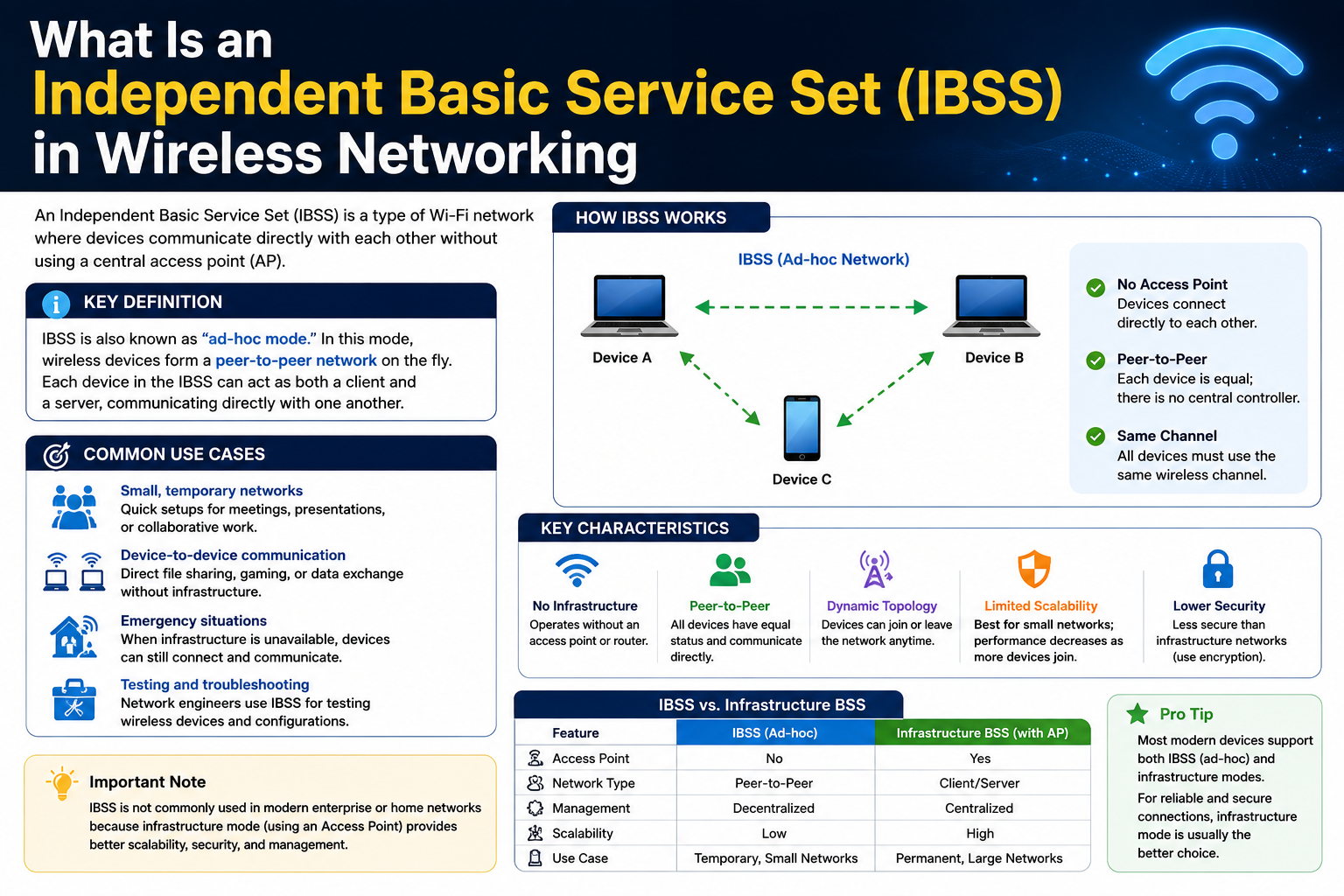
Wireless networking has evolved into a complex ecosystem of different architectures, each designed to serve specific communication needs. Among these, the Independent Basic Service Set (IBSS) stands out as a unique and highly practical configuration that enables devices to communicate directly without relying on traditional networking infrastructure. This mode is also widely known as ad-hoc networking or peer-to-peer wireless communication.
IBSS is particularly important in situations where setting up a router or access point is not possible, not practical, or simply unnecessary. Although it is not the most commonly used wireless setup in everyday home or enterprise environments, it plays a critical role in temporary, emergency, or decentralized communication scenarios. To fully understand IBSS, it is important to explore how it works, why it exists, and what makes it different from conventional wireless networking models.
At its core, IBSS represents a decentralized approach to communication. Instead of relying on a central device to coordinate traffic, each device in the network communicates directly with others within its range. This simple idea enables fast and flexible connectivity in environments where infrastructure is limited or unavailable.
The Concept of Peer-to-Peer Wireless Communication
The foundation of IBSS lies in peer-to-peer communication, where every device in the network acts both as a client and a participant in data exchange. Unlike traditional wireless networks that depend on a central access point, IBSS eliminates the need for such intermediaries. This allows devices such as laptops, tablets, smartphones, or specialized equipment to form a network instantly as long as they are within range and configured with compatible wireless settings.
In this type of setup, each device is aware of the presence of others and can transmit data directly. There is no hierarchy in the network structure, meaning no single device has control over the flow of communication. This equality between devices is one of the defining characteristics of IBSS and is what distinguishes it from infrastructure-based wireless networks.
This decentralized model is particularly useful in environments where speed and simplicity matter more than advanced network management. For instance, if a group of users needs to share files quickly without access to the internet or a router, an IBSS network can be created almost instantly. The devices simply connect and begin exchanging data.
However, because there is no central coordinating device, the network does not have advanced features such as traffic optimization, centralized security control, or seamless scalability. These limitations are an inherent part of its design, which prioritizes flexibility over structure.
How IBSS Differs from Infrastructure-Based Networks
To better understand IBSS, it is helpful to compare it with the more common infrastructure-based wireless networking model. In a typical home or office network, devices connect to a wireless router or access point. This central device manages communication, assigns IP addresses, controls data routing, and often provides access to the internet.
In contrast, IBSS removes this central point entirely. Every device in the network participates equally, and communication is handled directly between devices. This difference fundamentally changes how the network operates.
One of the most noticeable differences is in network management. In infrastructure mode, administrators can control security settings, monitor traffic, and manage connected devices from a single point. In IBSS, such centralized control does not exist. Each device is responsible for its own configuration, and coordination is distributed across all participants.
Another key difference is scalability. Infrastructure networks can support a large number of devices efficiently, especially when supported by enterprise-grade equipment. IBSS networks, however, are typically limited in size. As more devices join, performance can degrade because each device must manage multiple direct connections simultaneously.
Range and reliability also differ significantly. Infrastructure networks often use strategically placed access points to extend coverage. IBSS networks rely solely on the wireless range of individual devices, which can vary widely depending on hardware quality and environmental conditions.
Despite these limitations, IBSS remains valuable in specific contexts where simplicity and independence are more important than scalability or centralized management.
Technical Structure and Operation of IBSS Networks
IBSS operates under wireless networking standards defined by IEEE 802.11, which governs Wi-Fi communication protocols. Even though IBSS is less commonly used today, it is still part of the foundational structure of wireless communication technology.
When devices enter IBSS mode, they begin by selecting a common network identifier. This identifier allows devices to recognize each other as part of the same ad-hoc network. Once connected, devices begin broadcasting and listening for data transmissions from other participants.
Unlike infrastructure networks, there is no access point to manage authentication or coordinate communication. Instead, devices must independently agree on network parameters such as channel frequency and security settings. This requires a level of manual configuration or predefined compatibility between devices.
Communication in IBSS is typically broadcast-based within the local range. Each device listens for signals and responds accordingly, creating a mesh-like interaction pattern. However, unlike true mesh networks that include routing intelligence, IBSS does not optimize paths between devices. Data is transmitted directly between endpoints, which can lead to inefficiencies in larger networks.
Another important aspect of IBSS operation is synchronization. Since there is no central clock or controller, devices must coordinate timing themselves to maintain stable communication. This adds complexity and can occasionally lead to inconsistencies, especially when devices join or leave the network frequently.
Security in IBSS is also more challenging. Without centralized authentication systems, encryption, and access control must be configured individually on each device. This makes proper setup essential to prevent unauthorized access or data exposure.
Use Cases and Practical Scenarios for IBSS
Although IBSS is not commonly used in everyday consumer networking, it plays an important role in specialized scenarios where traditional infrastructure is unavailable or impractical.
One of the most common use cases is temporary networking. In situations where users need to quickly share files, collaborate, or exchange data without internet access, IBSS provides a simple and efficient solution. This makes it useful in environments such as conferences, field operations, or remote work sites.
Emergency response scenarios also benefit from IBSS networks. In disaster-stricken areas where communication infrastructure may be damaged or unavailable, devices can form ad-hoc networks to coordinate rescue efforts, share maps, or exchange critical information. The ability to establish communication without relying on external infrastructure can be extremely valuable in time-sensitive situations.
IBSS is also relevant in industrial and military environments. Field operations often require communication between devices in areas where deploying traditional networking equipment is not feasible. In such cases, IBSS allows teams to maintain connectivity between devices for coordination, data collection, or monitoring purposes.
Another practical application is local device interaction. Some systems require direct communication between devices for setup or synchronization. For example, certain hardware devices, sensors, or embedded systems may use ad-hoc networking during initialization or configuration phases.
In addition, IBSS can be used in educational or experimental environments where students and researchers explore wireless communication principles. Because it provides a simplified model of peer-to-peer networking, it serves as a useful tool for understanding fundamental networking concepts without the complexity of infrastructure systems.
Limitations and Performance Considerations in IBSS
While IBSS offers flexibility and independence, it also comes with several limitations that affect its practicality in larger or more demanding environments.
One of the primary limitations is performance degradation as the number of connected devices increases. Since each device must communicate directly with others, network traffic can become congested quickly. This leads to reduced speeds and increased latency, especially in environments with heavy data exchange.
Another limitation is the lack of centralized control. Without a central access point, managing the network becomes more complex. There is no single location to configure security settings, monitor activity, or optimize performance. This decentralization can make troubleshooting more difficult, especially when issues arise.
Security is also a concern in IBSS networks. Because each device is responsible for its own security configuration, inconsistencies can create vulnerabilities. Without centralized enforcement of encryption and authentication standards, the network may be more susceptible to unauthorized access.
Range limitations further restrict IBSS usability. Since communication depends on the wireless capabilities of individual devices, coverage is typically limited to a small physical area. Obstacles such as walls, interference, or distance can significantly impact connectivity.
Additionally, IBSS networks lack advanced features such as automatic routing, load balancing, and seamless scalability. These limitations make them unsuitable for long-term or enterprise-grade deployments where reliability and efficiency are critical.
Despite these challenges, IBSS remains valuable in situations where simplicity, speed, and independence are prioritized over performance and scalability.
Evolution of IBSS within IEEE 802.11 Standards
The Independent Basic Service Set (IBSS) is rooted in the IEEE 802.11 family of wireless networking standards, which define how devices communicate over Wi-Fi. While most people associate Wi-Fi with infrastructure-based connectivity through routers and access points, IBSS represents an alternative model that was designed to support decentralized communication from the very beginning of wireless networking development.
In early wireless implementations, engineers recognized that not all communication scenarios would have access to centralized infrastructure. This led to the inclusion of ad-hoc networking capabilities within the 802.11 specification. IBSS emerged as a standardized way to allow devices to form temporary networks without relying on dedicated networking hardware.
Over time, as wireless technology advanced, infrastructure-based networks became dominant due to their scalability, reliability, and centralized management features. However, IBSS remained part of the standard as a foundational capability. It continues to serve specialized use cases where simplicity and direct device-to-device communication are more important than advanced network control.
Although modern Wi-Fi systems have introduced more sophisticated alternatives such as mesh networking, IBSS still holds relevance in theoretical networking models and certification frameworks. It is often included in networking education because it helps learners understand how wireless communication can function without centralized coordination.
How Devices Discover and Form IBSS Networks
When devices participate in an IBSS network, they must first locate and recognize each other without the assistance of a central access point. This process begins with network discovery, where devices broadcast signals to indicate their availability for communication.
Unlike infrastructure networks, where a router continuously advertises the network name (SSID), IBSS requires devices to actively search for peers operating on the same channel and configuration. Each device must be set to the same network identifier and wireless channel to successfully connect.
Once a device detects another compatible participant, it joins the network and begins exchanging information directly. This process is dynamic, meaning devices can join or leave at any time without disrupting the entire network structure. However, the absence of centralized coordination means that discovery and synchronization depend heavily on individual device behavior.
Because of this decentralized discovery process, timing and configuration consistency are critical. Even minor mismatches in network settings can prevent devices from recognizing each other. This makes the initial setup slightly more manual compared to infrastructure-based wireless connections.
Once established, the IBSS network functions as a shared communication space where all devices continuously listen for transmissions from others. This creates a fluid and adaptable network structure, but also introduces variability in connectivity stability depending on device proximity and signal strength.
Addressing and Communication Flow in Ad-Hoc Networks
In an IBSS environment, communication relies on standard wireless addressing methods defined by the IEEE 802.11 protocol. Each device uses a unique MAC address, which allows it to identify and communicate with other participants in the network.
Since there is no central router to assign IP addresses automatically, devices in an IBSS network often rely on manual configuration or self-assigned addressing mechanisms such as link-local addressing. This ensures that each device has a unique identifier within the network scope.
Communication flow in IBSS is direct and peer-based. When a device sends data, it transmits packets directly to the intended recipient or broadcasts them to all participants within range. This eliminates the need for routing through intermediary devices, reducing latency in small networks.
However, this simplicity comes with trade-offs. In larger IBSS networks, communication becomes less efficient because each device must handle multiple direct connections simultaneously. There is no intelligent routing system to optimize data paths, which can lead to congestion and reduced performance.
The absence of centralized traffic management also means that network efficiency depends heavily on how well devices manage their own communication schedules. If multiple devices attempt to transmit simultaneously, collisions can occur, requiring retransmission and increasing overhead.
Despite these challenges, the direct communication model remains one of the defining strengths of IBSS, particularly in environments where minimal setup and immediate connectivity are required.
Security Mechanisms and Their Challenges in IBSS
Security in IBSS networks presents unique challenges due to the lack of centralized control. In traditional wireless networks, routers and access points enforce security policies such as authentication, encryption, and access restrictions. In IBSS, these responsibilities are distributed across all participating devices.
To secure communication, devices typically rely on encryption protocols defined within the IEEE 802.11 standard, such as WPA or WEP (though modern implementations avoid outdated methods). However, each device must independently configure and maintain these security settings, which increases the risk of inconsistencies.
One of the primary security concerns in IBSS is unauthorized access. Since there is no central authentication system, any device configured with the correct network parameters can potentially join the network. This makes careful configuration essential, especially in environments where sensitive data is transmitted.
Another challenge is key management. In encrypted IBSS networks, all devices must share the same encryption key. If one device is compromised, the entire network may be at risk. Additionally, updating or changing security credentials requires manual reconfiguration on every device.
The lack of centralized monitoring also limits the ability to detect suspicious activity. In infrastructure networks, administrators can track traffic patterns and identify anomalies. In IBSS, such visibility is distributed and often limited to individual device capabilities.
Despite these challenges, IBSS security can be effective when properly configured, especially in controlled environments where all participating devices are trusted.
Performance Behavior and Network Efficiency Factors
The performance of an IBSS network is influenced by several factors, including the number of connected devices, signal strength, and environmental interference. Since communication is handled directly between devices, each participant contributes to the overall network load.
As more devices join the network, performance typically decreases. This is because each device must manage multiple connections simultaneously, increasing processing overhead and wireless traffic. Unlike infrastructure networks that distribute load through access points, IBSS networks rely entirely on peer coordination.
Signal quality also plays a significant role in performance. Since devices communicate directly, the physical distance between them affects transmission reliability. Obstacles such as walls, furniture, or electronic interference can degrade signal strength and reduce effective bandwidth.
Another important factor is channel congestion. IBSS networks operate on a shared wireless channel, meaning all devices compete for the same communication space. Without centralized scheduling, collisions between transmissions can occur, leading to retransmissions and reduced efficiency.
Despite these limitations, IBSS can perform effectively in small-scale environments where the number of devices is limited and physical proximity is close. In such cases, direct communication can actually reduce latency compared to routed networks.
However, as network complexity increases, inefficiencies become more noticeable, making IBSS less suitable for high-performance or large-scale deployments.
Device Compatibility and Operating System Support
Support for IBSS varies across different devices and operating systems. Most wireless network adapters that comply with IEEE 802.11 standards are technically capable of supporting ad-hoc mode, but actual usability depends on software implementation.
Some modern operating systems have reduced or modified support for IBSS due to the growing dominance of infrastructure and hotspot-based networking. While certain systems still allow ad-hoc connections, others have replaced IBSS functionality with alternative features such as mobile hotspots or peer-assisted sharing protocols.
On devices that do support IBSS, configuration may require manual setup of network parameters such as SSID, channel selection, and security settings. This contrasts with infrastructure networks, where much of the configuration is handled automatically.
Mobile devices often have limited IBSS capabilities. While they may be able to connect to ad-hoc networks, they may not always be able to create them. This restriction is typically due to operating system design choices rather than hardware limitations.
In contrast, laptops and specialized devices tend to offer more flexible support, making them better suited for IBSS deployments. Industrial and embedded systems may also include ad-hoc capabilities depending on their intended use cases.
Compatibility challenges are one of the reasons IBSS is less commonly used today, as inconsistent support across platforms makes it difficult to deploy universally.
Real-World Deployment Scenarios and Constraints
IBSS networks are typically deployed in environments where rapid, temporary communication is required. These scenarios often involve situations where infrastructure is unavailable, impractical, or too time-consuming to establish.
In field operations, IBSS can support communication between mobile teams working in remote locations. Devices can quickly form a network to exchange data, share updates, or coordinate activities without relying on external systems.
In disaster response situations, IBSS can provide a critical communication layer when traditional networks are damaged or overloaded. Emergency teams can use ad-hoc networks to share information, coordinate logistics, or track resources in real time.
Industrial environments may also use IBSS for short-term device coordination, particularly during setup, maintenance, or testing phases. In such cases, temporary connectivity is more important than long-term network stability.
However, IBSS deployment is constrained by environmental factors and device limitations. Networks are typically limited in size and range, making them unsuitable for large-scale or geographically distributed operations.
Additionally, the lack of centralized management means that deployment requires careful planning to ensure consistent configuration across all devices. Without proper setup, connectivity issues can arise quickly.
Troubleshooting Common IBSS Issues
Troubleshooting IBSS networks can be more challenging than traditional wireless networks due to the absence of centralized diagnostic tools. Each device must be examined individually to identify potential issues.
One common problem is a configuration mismatch. If devices are not set to the same network identifier or channel, they will not be able to detect each other. Ensuring consistent settings across all devices is essential for successful connectivity.
Another frequent issue is signal interference. Since IBSS relies on direct communication, any disruption in wireless signals can lead to dropped connections or reduced performance. Identifying sources of interference is often necessary to restore stability.
Addressing conflicts can also cause communication failures. If devices are not properly configured with unique network addresses, data delivery may become unreliable.
Security misconfigurations are another potential issue. Inconsistent encryption settings can prevent devices from joining the network or result in partial connectivity.
Because IBSS lacks centralized monitoring, troubleshooting often involves checking each device individually, which can be time-consuming in larger setups.
IBSS in Comparison with Modern Alternatives
Modern wireless networking has introduced several alternatives to IBSS, including hotspot-based connections and mesh networking systems. These newer models address many of the limitations inherent in ad-hoc networks while maintaining some of their flexibility.
Hotspot-based systems reintroduce central coordination through a single device, typically a smartphone or dedicated access point. This improves management, security, and scalability while still allowing temporary network creation.
Mesh networks take a different approach by enabling devices to relay data through multiple nodes, creating a more resilient and scalable structure. Unlike IBSS, mesh systems include routing intelligence that optimizes communication paths.
Despite these advancements, IBSS remains relevant in scenarios where simplicity is the primary requirement. Its direct communication model offers minimal setup overhead and can be useful in situations where advanced features are unnecessary.
Each of these networking models represents a different balance between complexity, performance, and flexibility, with IBSS occupying the simplest end of the spectrum.
Environmental Factors Affecting IBSS Stability
The stability of an IBSS network is heavily influenced by environmental conditions. Since communication depends entirely on wireless signals between devices, any physical or electronic interference can significantly impact performance.
Physical barriers such as walls, metal structures, and large objects can weaken signal strength and reduce effective range. This can lead to intermittent connectivity or a complete communication breakdown between devices.
Electronic interference from other wireless devices operating on similar frequencies can also disrupt IBSS communication. In densely populated wireless environments, signal congestion becomes a major factor affecting reliability.
Device mobility introduces additional challenges. As devices move within or out of range, network topology changes dynamically. This can result in fluctuating connectivity and temporary communication gaps.
Power limitations may also affect performance, particularly in battery-powered devices. As energy-saving modes activate, wireless transmission strength may be reduced, impacting network stability.
Understanding these environmental factors is essential for maintaining a functional IBSS network, especially in dynamic or unpredictable settings.
Advanced Behavior of IBSS in Real Network Environments
Independent Basic Service Set (IBSS) networks, while conceptually simple, exhibit surprisingly complex behavior once deployed in real-world environments. Unlike controlled infrastructure-based systems, IBSS operates in a decentralized manner where every device participates equally in communication, coordination, and data handling. This creates a dynamic environment where network behavior is continuously shaped by device activity, signal conditions, and environmental factors.
In practical terms, IBSS behaves more like a fluid communication mesh than a rigid network structure. Devices constantly adjust to changes in their surroundings, such as new participants joining, existing devices leaving, or variations in wireless signal strength. This constant adaptation allows IBSS to function without centralized control, but it also introduces unpredictability in performance and stability.
One of the most important aspects of IBSS behavior is its dependency on mutual awareness between devices. Each device must actively maintain knowledge of others in the network, which means that communication is not just about sending data but also about continuously listening and updating internal state information. This dual responsibility places a higher processing burden on each participant compared to traditional wireless models.
Because of this distributed responsibility, IBSS networks often behave differently depending on the hardware and software capabilities of the devices involved. More powerful devices may handle communication more efficiently, while weaker devices may struggle to keep up with network demands, creating imbalances in performance.
Network Synchronization and Timing Challenges in IBSS
One of the most technically interesting aspects of IBSS is how devices synchronize without a central clock or controller. In infrastructure networks, synchronization is managed by access points that coordinate timing, beacon signals, and data transmission schedules. In IBSS, however, each device must independently manage synchronization with others.
To achieve this, devices rely on periodic beacon transmissions. These beacons are small signals that announce a device’s presence and help maintain network awareness. When multiple devices participate in an IBSS network, they must coordinate beacon timing to avoid conflicts and ensure that all participants remain synchronized.
However, because there is no centralized scheduling system, beacon collisions can occur. When two devices transmit beacons simultaneously, one or both signals may be lost or delayed, leading to temporary inconsistencies in network awareness.
This synchronization challenge becomes more pronounced as the number of devices increases. Each additional participant adds more beacon traffic, increasing the likelihood of timing conflicts. As a result, IBSS networks tend to perform best when kept small and relatively stable.
Another challenge is drift in timing accuracy. Without a central reference clock, devices may gradually lose synchronization over time. This can lead to delayed communication, missed transmissions, or inconsistent network state views across devices.
Despite these challenges, IBSS synchronization mechanisms are designed to be lightweight and resilient enough for short-term or low-density networking scenarios.
Data Transmission Mechanisms and Collision Handling
In IBSS networks, data transmission follows a shared medium access model. This means that all devices compete for the same wireless channel when sending information. Since there is no central controller to schedule transmissions, devices must use distributed coordination techniques to avoid excessive collisions.
One of the primary methods used is carrier sensing, where a device listens to the channel before transmitting data. If the channel appears to be free, the device proceeds with transmission. If the channel is busy, the device waits for a random backoff period before attempting again.
This approach reduces the likelihood of collisions but does not eliminate them. In busy IBSS environments, multiple devices may still attempt to transmit at nearly the same time, resulting in data collisions and retransmissions.
When collisions occur, devices must detect the failure and resend the affected data packets. This retransmission process introduces delays and reduces overall network efficiency, particularly in high-traffic situations.
Unlike infrastructure networks that use centralized coordination to minimize collisions, IBSS relies entirely on probabilistic and decentralized methods. This makes performance more variable and less predictable.
Despite these limitations, the simplicity of the transmission model allows IBSS to function effectively in small-scale environments where traffic levels remain low and manageable.
Scalability Limitations and Network Growth Behavior
One of the most significant constraints of IBSS is its limited scalability. While the network can technically support multiple devices, performance tends to degrade as more participants join.
This degradation occurs because each device must manage direct communication with multiple peers simultaneously. As the number of connections increases, so does the complexity of maintaining synchronization, handling transmissions, and processing incoming data.
In small networks, this overhead is manageable. However, as the network grows, the cumulative burden on each device increases significantly. This leads to higher latency, reduced throughput, and increased likelihood of packet loss.
Another factor affecting scalability is wireless channel congestion. Since all devices share the same communication medium, increased traffic leads to more frequent collisions and retransmissions. This further reduces efficiency as the network grows.
Additionally, IBSS lacks a hierarchical structure, which means there is no mechanism to distribute load across multiple access points or routing nodes. Every device participates equally, regardless of its capability or role.
This flat structure simplifies network design but limits scalability, making IBSS unsuitable for large or enterprise-level deployments.
In practice, IBSS networks are most effective when limited to a small number of closely located devices, typically in temporary or controlled scenarios.
Mobility and Dynamic Topology Changes in IBSS
IBSS networks are inherently dynamic due to the mobility of participating devices. Unlike fixed infrastructure networks, where access points remain stationary, IBSS devices can move freely in and out of range.
This mobility results in constant changes to network topology. As devices move, they may disconnect from some peers and connect to others, leading to a continuously evolving communication structure.
When a device joins the network, it must quickly synchronize with existing participants and integrate into the communication flow. Similarly, when a device leaves, the remaining devices must adjust their internal state to reflect the change.
These transitions are generally handled automatically, but they introduce temporary instability. During periods of frequent movement, network performance may fluctuate as devices continuously update their connections.
Mobility also affects signal quality. As the distance between devices changes, signal strength may vary, leading to inconsistent communication performance. Devices closer together will experience stronger and more stable connections, while those farther apart may struggle to maintain reliable communication.
In environments with high mobility, such as mobile field operations or moving vehicles, IBSS networks may experience frequent disruptions. This makes them better suited for relatively static or short-duration use cases.
Power Consumption and Device Resource Utilization
Because IBSS requires each device to actively participate in both sending and receiving data, power consumption can be higher compared to infrastructure-based communication models.
Wireless transmission is one of the most energy-intensive operations in portable devices. In IBSS, devices must frequently transmit beacons, listen for incoming signals, and manage multiple peer connections simultaneously. This continuous activity increases battery usage.
Devices also consume additional processing power to handle synchronization, collision detection, and retransmission logic. While these processes are not computationally heavy individually, their cumulative effect can be significant in active networks.
In battery-powered environments, this increased resource usage can limit the operational lifespan of devices participating in IBSS networks. As a result, energy efficiency becomes an important consideration in deployment scenarios.
Some devices may attempt to mitigate power consumption by reducing transmission frequency or entering low-power states. However, these optimizations can negatively impact network stability and responsiveness.
Therefore, IBSS is generally more suitable for short-term communication needs rather than long-duration deployments where power efficiency is critical.
Interference Sensitivity and Signal Reliability Factors
IBSS networks are particularly sensitive to wireless interference due to their decentralized and shared-channel nature. Since all devices operate on the same frequency channel, external signals can significantly disrupt communication.
Common sources of interference include other Wi-Fi networks, Bluetooth devices, microwave ovens, and various industrial equipment operating in similar frequency ranges. These signals can overlap with IBSS communication, leading to packet loss or degraded performance.
Physical obstructions also play a major role in signal reliability. Walls, floors, and large objects can weaken wireless signals, reducing the effective communication range between devices. In environments with many obstacles, IBSS networks may experience fragmented connectivity.
Because there is no central access point to manage signal distribution, each device must independently handle interference conditions. This makes performance highly dependent on local environmental factors.
In highly congested wireless environments, IBSS networks may struggle to maintain stable connections. This is one of the reasons infrastructure-based systems are preferred in modern wireless deployments, as they can better manage interference through channel planning and centralized coordination.
Real-Time Adaptation and Self-Healing Behavior
Despite its limitations, IBSS demonstrates a form of self-healing behavior that allows it to adapt to changing conditions without external intervention. When devices join or leave the network, remaining participants automatically adjust their communication patterns.
If a device becomes unreachable, others simply stop receiving signals from it and update their internal network state accordingly. When the device returns, it can rejoin the network and resume communication without complex reconfiguration.
This adaptability makes IBSS particularly useful in unpredictable environments where network conditions change frequently. The system does not rely on fixed roles or permanent structure, which allows it to remain functional even under unstable conditions.
However, this self-healing capability is limited by the lack of centralized coordination. While the network can adapt to changes, it cannot optimize itself for performance or efficiency. Adjustments are reactive rather than proactive.
As a result, IBSS is resilient in terms of connectivity but limited in terms of optimization and long-term stability.
Practical Constraints in Large-Scale Deployment Scenarios
Although IBSS is technically capable of supporting multiple devices, real-world deployment at a large scale is rarely practical. The combination of performance degradation, synchronization challenges, and interference sensitivity makes it unsuitable for complex environments.
In large-scale scenarios, maintaining consistent communication becomes increasingly difficult as the number of devices grows. The absence of a hierarchical structure means there is no efficient way to organize or manage traffic flow.
Additionally, troubleshooting becomes significantly more complex in larger IBSS networks. Without centralized monitoring tools, identifying and resolving issues requires manual inspection of individual devices.
Security management also becomes more difficult as the network size increases. Ensuring consistent encryption and authentication across many devices is challenging without centralized enforcement.
For these reasons, IBSS is generally reserved for small-scale, temporary, or specialized applications rather than permanent or large-scale deployments.
Environmental Adaptability and Operational Flexibility
Despite its limitations, IBSS offers a high degree of operational flexibility. It can be deployed quickly, requires minimal configuration, and does not depend on external infrastructure.
This makes it highly adaptable to a wide range of environments, from remote field operations to temporary collaboration setups. Devices can form networks spontaneously, enabling communication in situations where traditional networking is unavailable.
This flexibility is one of the key reasons IBSS remains relevant in modern networking discussions, even though more advanced technologies have largely replaced it in everyday use.
Its ability to function independently of infrastructure allows it to serve as a fallback or emergency communication method in critical situations where no other options are available.
Additional Operational Insights and Emerging Relevance of IBSS
Even though the Independent Basic Service Set (IBSS) is considered a legacy or niche wireless mode, its underlying principles continue to influence modern decentralized networking designs. The idea of direct device-to-device communication without centralized infrastructure has not disappeared; instead, it has evolved into more advanced systems such as mesh networking and mobile ad-hoc network frameworks. However, IBSS remains the simplest and most fundamental expression of this concept, and understanding its behavior helps explain how more complex systems are built.
One important operational insight is that IBSS highlights the trade-off between simplicity and control. On one hand, it removes the dependency on routers, access points, and external network infrastructure, allowing instant connectivity. On the other hand, this simplicity comes at the cost of reduced coordination, weaker scalability, and limited administrative control. This trade-off is central to many networking decisions, especially in environments where rapid deployment is more important than long-term optimization.
IBSS also demonstrates how wireless networks behave in a fully distributed environment. In such a setup, every device becomes responsible for maintaining its own view of the network. This includes tracking nearby devices, handling transmission timing, and managing connection stability. This distributed responsibility model is conceptually important because it forms the foundation of many modern peer-to-peer systems beyond traditional Wi-Fi networking.
Another notable aspect is how IBSS behaves under intermittent connectivity conditions. When devices frequently move in and out of range, the network does not collapse; instead, it continuously reorganizes itself. This resilience makes IBSS suitable for highly dynamic environments such as temporary field deployments or mobile collaboration scenarios. However, this same characteristic also makes long-term consistency difficult to maintain, since there is no persistent structure to stabilize communication patterns.
From a performance perspective, IBSS reveals the importance of coordination overhead in wireless systems. Even though data transmission is direct, a significant portion of network activity is consumed by maintenance tasks such as beacon exchange, neighbor discovery, and collision avoidance. These overhead processes become more noticeable as the network grows, often reducing the effective bandwidth available for actual data transfer.
Security considerations also gain additional complexity in IBSS when examined in practical deployments. Since there is no centralized enforcement mechanism, trust must be established manually between participating devices. This creates a model where security is only as strong as the weakest configured endpoint. In environments where devices are not uniformly controlled or configured, this can lead to inconsistencies that reduce overall network safety.
Another emerging relevance of IBSS lies in its conceptual similarity to modern decentralized systems used in distributed computing and edge networking. While IBSS itself is limited to local wireless communication, the idea of eliminating centralized control aligns with broader technological trends such as peer-based collaboration, distributed sensing networks, and autonomous device coordination.
Finally, IBSS continues to serve an educational role in networking fundamentals. It provides a clear and simplified model for understanding how wireless communication can function without infrastructure support. By studying IBSS, learners gain insight into core networking principles such as signal coordination, collision management, and distributed system behavior. These concepts remain highly relevant even in modern networking architectures that are far more complex.
Conclusion
The Independent Basic Service Set (IBSS) represents one of the most fundamental approaches to wireless communication, built on the principle of direct device-to-device connectivity without relying on centralized infrastructure. While it is not the most commonly used wireless configuration in modern networks, its importance lies in the simplicity of its design and the unique situations it is capable of supporting.
IBSS demonstrates how wireless devices can form functional networks independently, making it especially useful in environments where routers, access points, or internet connectivity are unavailable. This includes temporary setups, emergency response operations, field deployments, and short-range collaboration scenarios. In such cases, IBSS provides a fast and flexible solution that prioritizes immediate communication over long-term scalability or advanced management features.
However, the same characteristics that make IBSS simple and flexible also introduce significant limitations. The lack of centralized control leads to challenges in network coordination, security enforcement, and performance optimization. As more devices join the network, efficiency decreases due to increased collision rates, synchronization complexity, and shared channel congestion. These constraints make IBSS unsuitable for large-scale or permanent deployments, where structured infrastructure-based networks perform more effectively.
Despite these limitations, IBSS remains an important concept in the broader context of networking. It highlights the trade-offs between decentralization and control, showing how networks can function without hierarchical management while still maintaining basic communication capabilities. This understanding is valuable not only for technical implementation but also for conceptual learning in wireless networking principles.
Additionally, IBSS serves as a foundational model that has influenced the development of more advanced decentralized technologies, including mesh networks and modern peer-to-peer communication systems. While these newer technologies offer improved scalability, reliability, and security, they still rely on the same core idea of distributed communication introduced by IBSS.
In essence, IBSS occupies a unique place in wireless networking as a simple yet powerful demonstration of what devices can achieve without infrastructure. It may not be the dominant model in today’s connected world, but it continues to be relevant for specific use cases and remains an essential topic for understanding the evolution of wireless communication systems.