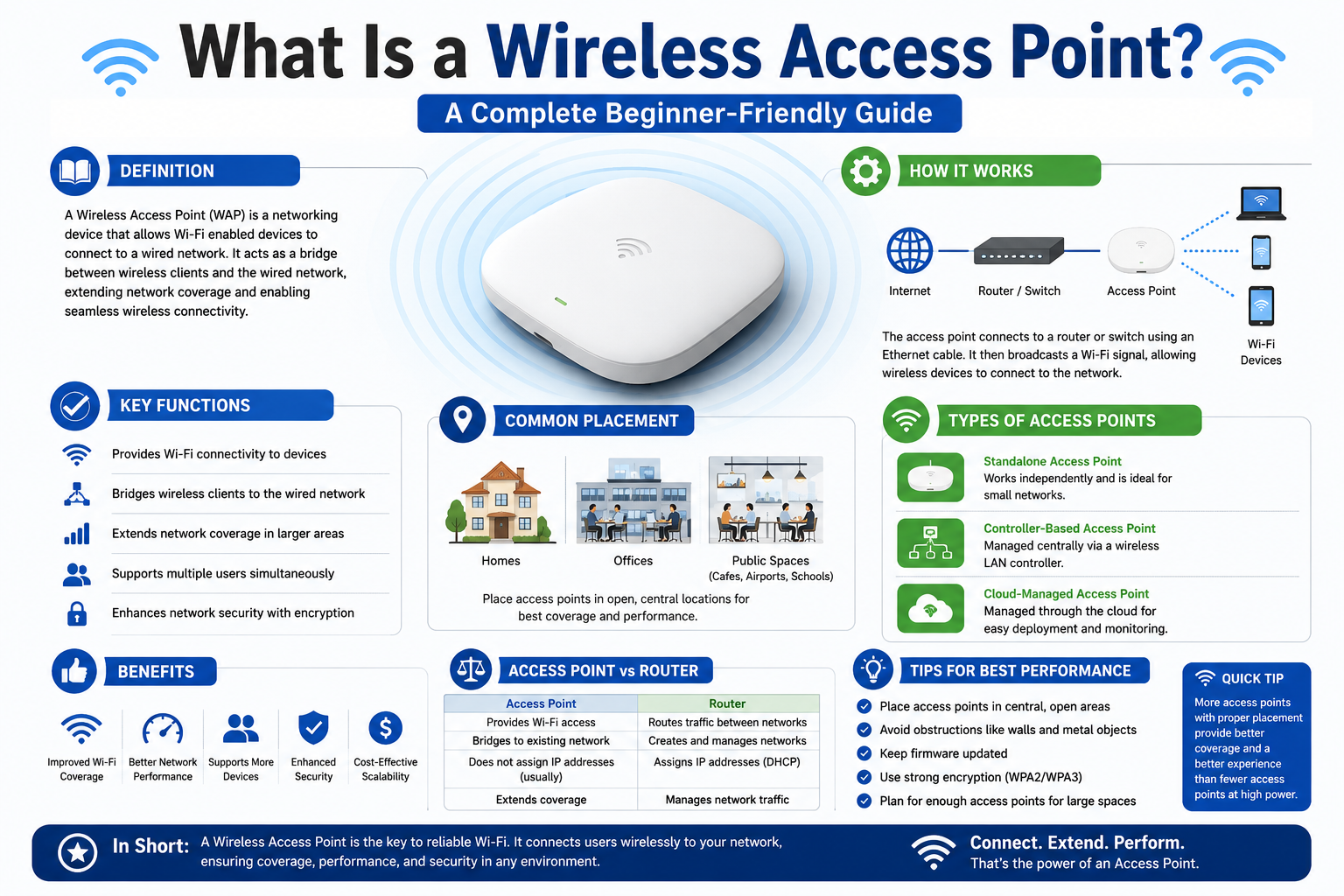
An access point is a critical component of wireless networking that serves as the bridge between wired infrastructure and wireless devices. It is responsible for broadcasting a wireless signal that allows devices such as smartphones, laptops, and tablets to connect to a network without the need for physical cables. Rather than functioning as a standalone internet provider, an access point extends an existing network by converting wired data into radio signals that can be transmitted through the air. This simple yet powerful role makes it an essential building block of modern connectivity, enabling seamless communication across homes, offices, and public environments.
How Wireless Connectivity Becomes Possible
When a device connects to Wi-Fi, it is actually communicating with an access point that acts as a gateway into the network. The access point continuously transmits a wireless signal using specific frequencies, allowing nearby devices to detect and join the network. Once connected, the device sends and receives data through the access point, which then forwards that data to other parts of the network, such as switches or routers. This process happens almost instantly, creating the illusion of direct internet access while the access point quietly manages the communication in the background.
Difference Between Access Points and Routers
Although many people use the terms interchangeably, access points and routers serve distinct purposes within a network. A router is responsible for directing traffic between different networks and ensuring that data reaches its intended destination, including the internet. An access point, on the other hand, focuses solely on providing wireless connectivity within a network. While some consumer devices combine both functions into a single unit, in professional environments these roles are often separated to improve performance, scalability, and control. Understanding this distinction helps clarify why access points are vital in larger deployments where reliable wireless coverage is required.
The Role of Access Points in Network Layers
Access points primarily operate at the lower layers of network communication, particularly those responsible for physical transmission and data link management. They handle the conversion of digital data into radio waves and manage how devices share the wireless medium. In some advanced implementations, access points may also participate in higher-level processes such as traffic prioritization or basic routing decisions. However, their primary responsibility remains focused on ensuring efficient and stable wireless communication between devices and the underlying network infrastructure.
Why Access Points Are Essential in Everyday Life
Wireless connectivity has become an expectation rather than a luxury, and access points play a central role in meeting that expectation. Whether in homes, workplaces, educational institutions, or public venues, access points provide the coverage needed to keep devices connected. Without them, users would be limited to wired connections, significantly reducing mobility and convenience. The widespread presence of access points has enabled everything from remote work to real-time communication, making them a foundational element of digital life.
Handling Multiple Devices Efficiently
One of the key strengths of an access point is its ability to support multiple devices simultaneously. Modern environments often include dozens or even hundreds of connected devices, each requiring reliable access to the network. Access points are designed to manage this demand by coordinating how devices transmit data, reducing interference, and maintaining consistent performance. This capability is especially important in high-density areas where many users rely on the same wireless infrastructure.
Standalone Access Points in Simple Environments
Standalone access points are commonly used in smaller networks, such as homes or small offices. These devices operate independently and are typically configured individually. They provide basic wireless connectivity and are relatively easy to set up, making them ideal for users who need a straightforward solution. However, because they do not communicate with other access points, they may struggle to provide seamless coverage in larger spaces where multiple units are required.
Limitations of Independent Operation
While standalone access points are convenient, they come with certain limitations. Each device operates on its own, meaning there is no centralized coordination to manage performance or optimize coverage. This can lead to issues such as signal overlap, interference, and inconsistent connectivity as users move between coverage areas. As a result, standalone access points are best suited for environments where network demands are relatively low and mobility is not a primary concern.
Controller-Based Access Points for Larger Networks
In more complex environments, controller-based access points offer a more advanced solution. These devices are managed by a centralized system that coordinates their behavior, ensuring consistent performance across the network. The controller handles tasks such as configuring settings, managing connections, and optimizing signal distribution. This centralized approach allows multiple access points to work together as a unified system, providing seamless coverage and improved reliability.
Seamless Roaming Across Coverage Areas
One of the major advantages of controller-based access points is their ability to support seamless roaming. As users move through a building or campus, their devices can transition from one access point to another without losing connectivity. This is achieved through coordination at the controller level, which ensures that all access points share information and maintain a consistent network environment. The result is a smooth user experience, even in large and dynamic spaces.
Optimizing Performance Through Coordination
Controller-based systems also help prevent interference by carefully managing channel selection and transmission power. When multiple access points operate in close proximity, improper configuration can lead to signal conflicts that degrade performance. A centralized controller continuously monitors the network and adjusts settings to maintain optimal conditions. This level of coordination is difficult to achieve with standalone devices, highlighting the value of a unified approach in demanding environments.
Cloud-Managed Access Points as a Modern Solution
Cloud-managed access points represent a newer approach to wireless networking, combining the benefits of centralized control with the flexibility of remote management. Instead of relying on a physical controller located on-site, these systems use cloud-based platforms to manage configuration and monitoring. This allows administrators to access and control the network from virtually anywhere, simplifying deployment and maintenance.
Advantages of Remote Management
The ability to manage access points remotely offers significant advantages, particularly for organizations with multiple locations. Changes can be implemented quickly without the need for on-site intervention, reducing operational complexity. Cloud-managed systems also provide advanced features such as analytics, automated updates, and enhanced visibility into network performance. These capabilities make it easier to maintain a high-quality wireless experience across diverse environments.
Adaptive Behavior in Dynamic Environments
Both controller-based and cloud-managed access points can adapt to changing conditions in real time. They monitor the surrounding wireless environment and adjust their settings to minimize interference and maximize performance. This includes selecting optimal channels, adjusting signal strength, and balancing the load between devices. Such adaptive behavior ensures that the network remains stable and efficient նույնիսկ as usage patterns evolve.
Security Considerations in Wireless Networks
Access points also play a crucial role in maintaining network security. They enforce authentication mechanisms, encrypt data transmissions, and help prevent unauthorized access. In advanced deployments, access points can integrate with security systems to detect and respond to potential threats. While wireless connectivity offers convenience, it also introduces risks, making robust security measures essential for protecting sensitive information.
Supporting Modern Applications and Demands
As technology continues to evolve, access points must support increasingly demanding applications. High-definition streaming, real-time communication, and cloud-based services all require reliable and high-speed connectivity. Modern access points are designed to handle these requirements by leveraging advanced standards and technologies that improve speed, capacity, and efficiency. This ensures that users can enjoy a seamless experience even under heavy network load.
Scalability and Future Growth
Another important aspect of access points is their ability to scale with growing network needs. Organizations can add more access points to expand coverage and capacity without disrupting existing infrastructure. This scalability makes it possible to adapt to changing requirements, whether due to increased user demand or the introduction of new technologies. A well-designed wireless network can evolve over time, providing long-term value and flexibility.
The Foundation of Wireless Connectivity
Access points serve as the foundation of wireless networking, enabling devices to connect and communicate in a way that is both convenient and efficient. They transform wired connections into wireless access, support multiple users, and adapt to dynamic environments. From simple home setups to complex enterprise deployments, access points play a central role in delivering the connectivity that modern life depends on.
Evolving Role of Access Points in a Connected World
As digital environments continue to expand, access points are becoming more intelligent and integral to overall network strategy. They are no longer limited to simply providing connectivity but are increasingly involved in analytics, user behavior insights, and network optimization. By collecting data on device usage, signal strength, and traffic patterns, modern access points help administrators make informed decisions to improve performance and user experience. This evolution reflects a broader shift toward smarter, more adaptive networks where access points act as both connection hubs and strategic tools for managing the growing complexity of wireless communication.
Final Thoughts
Access points are far more than just signal broadcasters; they are sophisticated components that shape the performance, reliability, and security of wireless networks. Whether operating independently, under centralized control, or through cloud-based platforms, they determine how effectively users can connect and interact with digital resources. Choosing the right type of access point and deploying it thoughtfully can significantly impact the overall network experience, making it essential to understand their capabilities and differences when building or upgrading a wireless environment.