Cloud automation has become a central requirement for organizations that want to scale efficiently without increasing operational complexity. Instead of manually configuring servers, networking, and application environments, businesses now rely on automated approaches that reduce human effort and improve consistency. Within AWS, automation plays a key role in simplifying infrastructure management while ensuring applications remain reliable and scalable. Two of the most widely used automation approaches are AWS Elastic Beanstalk and AWS CloudFormation. Both serve different purposes but ultimately aim to reduce manual intervention. Understanding how these tools function helps teams choose the right solution based on application needs, deployment style, and long-term infrastructure strategy.
Why Automation Matters in Cloud Infrastructure Management
Managing cloud infrastructure manually often leads to repetitive tasks, configuration errors, and inconsistent environments. Automation addresses these challenges by enabling repeatable processes that can be executed with minimal effort. It allows teams to deploy applications faster while maintaining stability across multiple environments. In modern DevOps practices, automation is not just a convenience but a necessity for continuous delivery and operational efficiency. It also reduces downtime risks by standardizing deployment workflows. AWS provides multiple automation tools that help organizations control infrastructure behavior without requiring constant manual oversight, making it easier to focus on development rather than operational maintenance.
DevOps Approach and the Role of Automation in AWS
DevOps practices emphasize collaboration between development and operations teams, and automation is a key pillar supporting this approach. By automating infrastructure provisioning and application deployment, teams can achieve faster release cycles and improved system reliability. Instead of manually configuring environments for each deployment, infrastructure can be defined once and reused multiple times. This reduces inconsistencies and ensures predictable outcomes. AWS supports DevOps principles through tools that streamline deployment, monitoring, and scaling. Elastic Beanstalk and CloudFormation both align with these principles, though they operate at different levels of abstraction within the cloud ecosystem.
Overview of AWS Automation Ecosystem and Service Categories
AWS provides a wide range of services designed to automate different aspects of cloud operations. Some tools focus on monitoring and logging, while others handle infrastructure provisioning and application deployment. This layered ecosystem allows organizations to select tools based on their specific needs. Automation can be applied to compute resources, storage, networking, and even security configurations. Within this ecosystem, Elastic Beanstalk focuses on simplifying application deployment, while CloudFormation focuses on defining complete infrastructure setups. Together, they represent two distinct approaches to achieving automation in AWS environments.
Introduction to AWS Elastic Beanstalk for Application Deployment
AWS Elastic Beanstalk is a platform designed to simplify application deployment and management. It allows developers to upload their code while the platform automatically handles infrastructure provisioning, scaling, and monitoring. This removes the need to manually configure servers or networking components. Elastic Beanstalk supports multiple programming environments, making it flexible for different development stacks. It is particularly useful for developers who want to focus on writing code rather than managing infrastructure. By abstracting underlying resources, it provides a streamlined experience where application deployment becomes faster and more efficient.
How Elastic Beanstalk Manages Infrastructure Automatically
Elastic Beanstalk works by automatically provisioning required AWS resources when an application is deployed. It sets up compute instances, load balancing, and scaling configurations based on the application requirements. The platform continuously monitors application health and adjusts resources when needed. If traffic increases, it can scale automatically to maintain performance. If issues occur, it provides monitoring insights to help diagnose problems. This automated management reduces operational complexity significantly. Users only need to provide application code and select environment settings, while the platform handles the underlying infrastructure operations seamlessly.
Deployment Workflow and Configuration in Elastic Beanstalk
The deployment process in Elastic Beanstalk begins with uploading application code, either from local environments or cloud storage locations. After that, users select a runtime environment that matches their application technology. The platform then provisions required resources and launches the application environment. Configuration options allow users to define instance types, scaling policies, networking settings, and security parameters. Once deployed, applications can be updated easily by uploading new versions. Elastic Beanstalk manages version control and ensures smooth transitions between updates, reducing downtime and deployment risks.
Practical Use Cases and Benefits of Elastic Beanstalk
Elastic Beanstalk is commonly used for web applications, APIs, and backend services that require quick deployment and automatic scaling. It is ideal for startups and development teams that want to launch applications without managing infrastructure complexity. One of its key benefits is simplicity, as it reduces the learning curve associated with cloud infrastructure. It also supports multiple programming languages, making it versatile across different projects. However, while it simplifies operations, it may limit deep customization of infrastructure compared to more advanced tools, which can be a consideration for complex architectures.
Understanding AWS CloudFormation and Infrastructure as Code Concept
AWS CloudFormation is a service that enables users to define infrastructure using code. Instead of manually creating resources, users write templates that describe the desired environment. These templates can include compute instances, databases, networking components, and more. CloudFormation interprets these templates and automatically provisions resources accordingly. This approach is known as Infrastructure as Code, where infrastructure is treated like software that can be versioned, reused, and managed systematically. It provides a structured way to build complex environments with precision and repeatability.
How CloudFormation Templates Define Cloud Resources
CloudFormation templates are written in structured formats that describe each resource and its configuration. These templates act as blueprints for infrastructure deployment. When executed, CloudFormation reads the template and creates resources in the correct order, managing dependencies automatically. This ensures that components are properly connected and functional. Templates can be reused across environments, allowing organizations to replicate infrastructure consistently. They can also be modified over time to reflect changes in system requirements, making infrastructure management more flexible and controlled.
Lifecycle Management and Advanced Features of CloudFormation
CloudFormation provides full lifecycle management of infrastructure stacks. Users can create, update, or delete entire environments through templates. It also supports rollback mechanisms, which restore previous states if deployment issues occur. This ensures stability and reduces risk during updates. Stack management allows teams to track infrastructure changes over time, improving transparency and control. Additionally, CloudFormation enables automation of multi-region deployments, making it suitable for large-scale systems that require consistent infrastructure across different environments.
Use Cases and Advantages of CloudFormation in Enterprise Systems
CloudFormation is widely used in enterprise environments where infrastructure consistency and control are critical. It is particularly valuable for managing large-scale systems that require repeatable deployments across multiple regions. It also supports version control, allowing teams to track changes and maintain infrastructure history. Another advantage is its ability to automate complex architectures with multiple dependencies. While it requires more technical understanding compared to simpler tools, it provides a higher level of control and flexibility, making it suitable for advanced cloud engineering scenarios.
Comparing Elastic Beanstalk and CloudFormation in Practical Scenarios
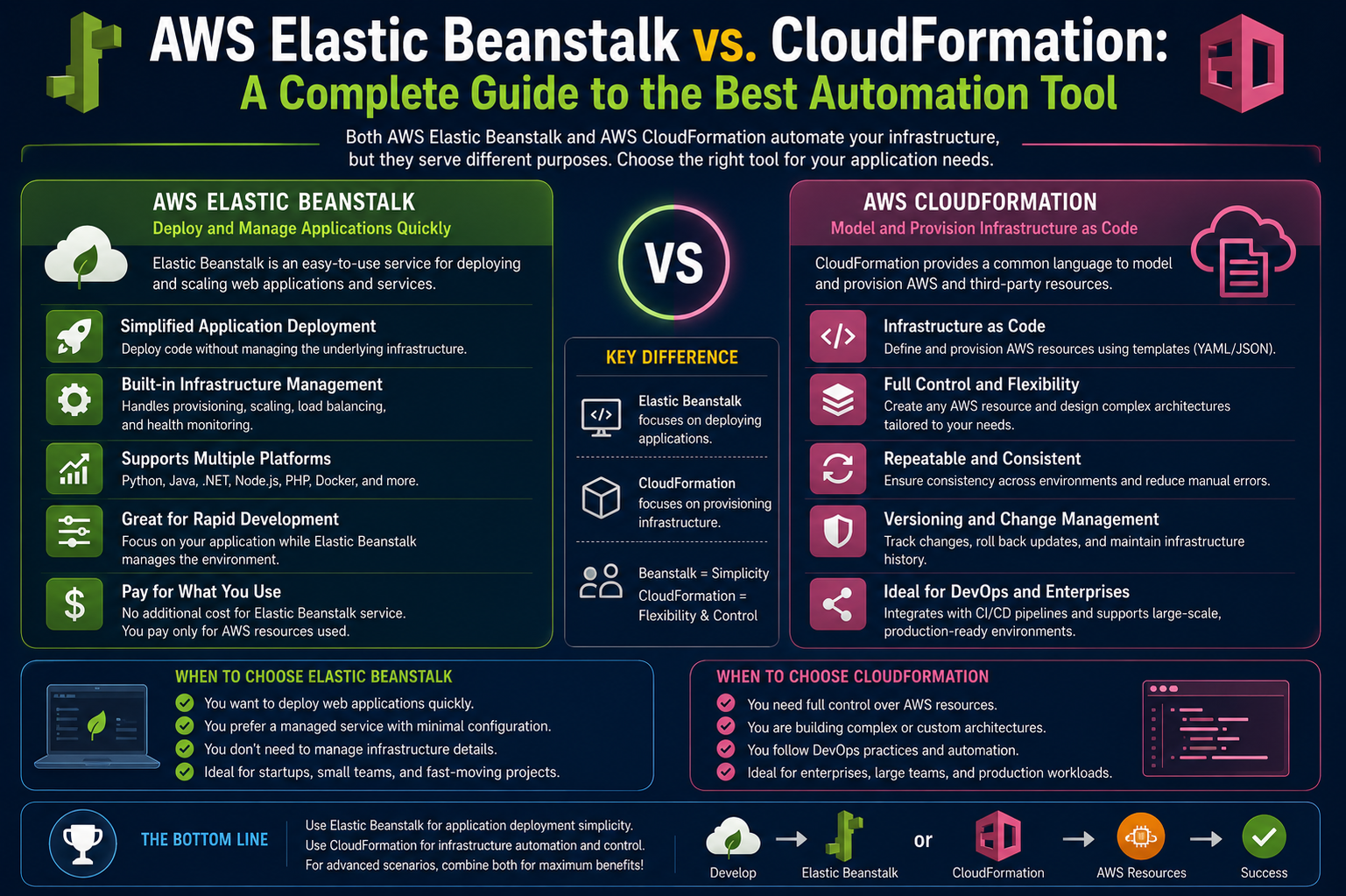
Elastic Beanstalk and CloudFormation serve different purposes even though both support automation. Elastic Beanstalk focuses on simplifying application deployment by abstracting infrastructure complexity. CloudFormation focuses on defining and managing complete infrastructure setups through code. Elastic Beanstalk is ideal for developers who want quick deployment without infrastructure management. CloudFormation is better suited for architects who need full control over environment configuration. The choice between them depends on whether the priority is ease of deployment or detailed infrastructure customization.
Selecting the Right Automation Approach Based on Requirements
Choosing between Elastic Beanstalk and CloudFormation depends on project complexity, team expertise, and long-term infrastructure needs. For simple applications or rapid development cycles, Elastic Beanstalk offers a faster and more convenient approach. For complex systems requiring precise infrastructure control, CloudFormation provides greater flexibility and scalability. Some organizations even use both tools together, leveraging Beanstalk for application deployment while using CloudFormation to manage underlying infrastructure components. Understanding the strengths of each tool helps in building efficient and scalable cloud environments.
Conclusion
AWS Elastic Beanstalk and AWS CloudFormation both play important roles in cloud automation, but they solve different problems at different levels of complexity. Elastic Beanstalk is designed to simplify application deployment by removing the burden of infrastructure management. It allows developers to focus on writing code while AWS handles provisioning, scaling, and monitoring in the background. This makes it highly suitable for teams that want speed, simplicity, and minimal operational overhead.
CloudFormation, on the other hand, is built for complete infrastructure control through Infrastructure as Code. It enables organizations to define every component of their cloud environment in a structured template, making deployments repeatable, consistent, and highly scalable. This approach is especially valuable for enterprise systems where precision, version control, and multi-region consistency are critical.
The key difference lies in abstraction versus control. Elastic Beanstalk abstracts infrastructure to simplify application hosting, while CloudFormation exposes infrastructure as code for maximum flexibility. One prioritizes ease of use, and the other prioritizes detailed configuration and automation depth.
In practice, both tools can complement each other depending on the architecture. Developers may use Elastic Beanstalk for quick application deployment, while cloud engineers rely on CloudFormation to build and manage the underlying infrastructure foundation. Choosing the right tool depends on project complexity, team expertise, and long-term scalability goals.
Ultimately, mastering both approaches gives organizations the ability to balance speed and control, enabling more efficient cloud operations and stronger DevOps practices across modern AWS environments.