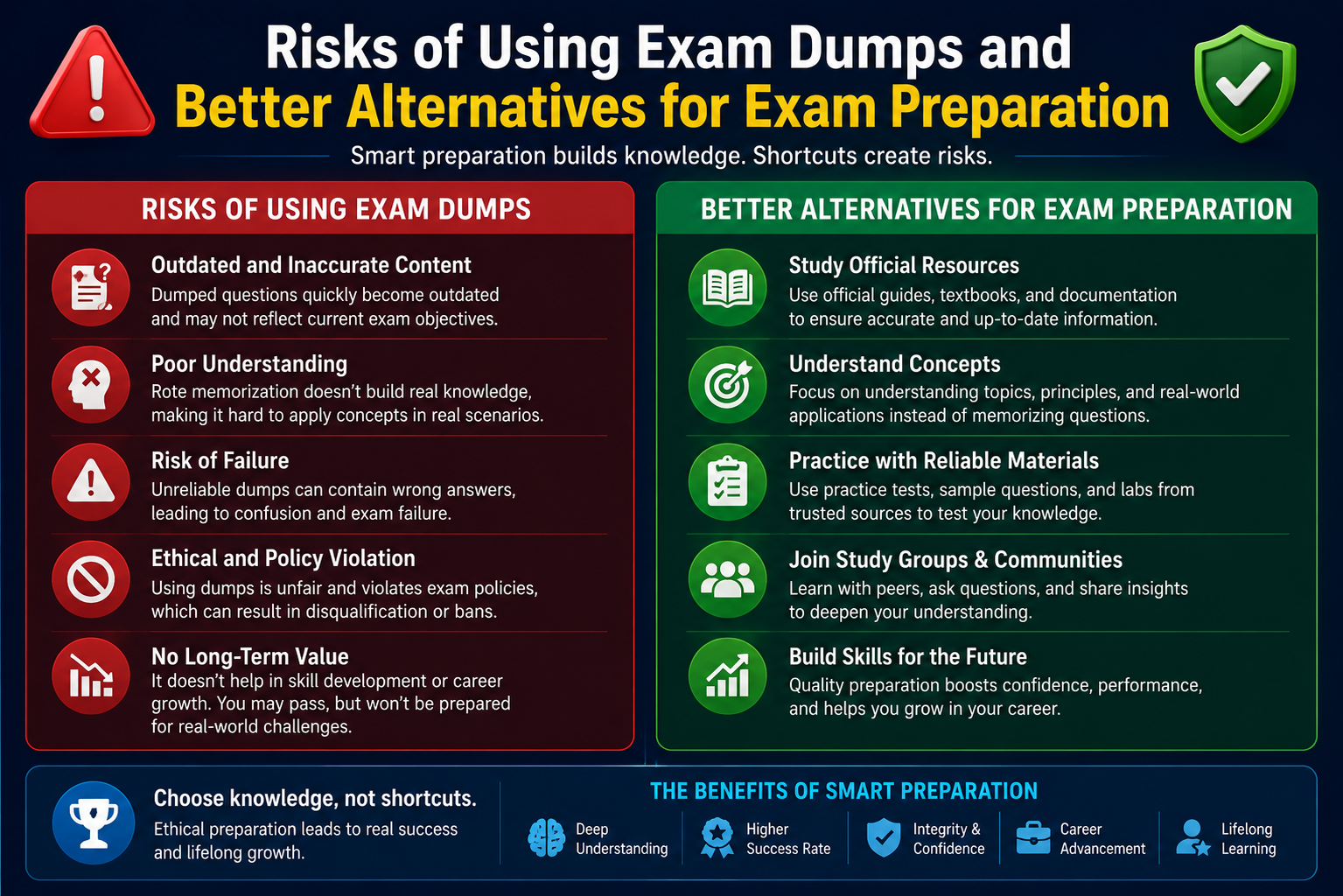
Exam dumps are collections of remembered or reconstructed exam questions and answers that are shared outside official learning channels. They usually emerge when individuals attempt to recall content after completing a certification test and then distribute it through informal platforms. The appeal of these materials comes from the belief that they provide direct access to real exam content, giving candidates a shortcut to passing. Many learners who feel pressure to succeed quickly or struggle with preparation may be tempted by them. However, this convenience hides serious problems that affect both learning quality and ethical standards. Instead of building real competence, exam dumps encourage surface-level memorization. This creates an illusion that the learner is prepared, when in reality, they may not understand the underlying concepts required for real-world application. Over time, this approach weakens confidence and leads to gaps in essential knowledge.
How Exam Dumps Are Typically Shared
Exam dumps are commonly circulated through unofficial websites, messaging groups, discussion forums, and shared digital files. Some sources claim to provide “real exam questions,” but there is no verified process to confirm authenticity. These materials are often copied and reposted repeatedly, making it impossible to trace their origin. In many cases, the content is inaccurate, outdated, or completely fabricated. Because they are not regulated, there is no quality control or review process. Learners may unknowingly rely on incorrect answers, believing they are studying valid material. This creates confusion during preparation and leads to poor performance when facing the actual exam. The structure of exam dumps also encourages rote memorization instead of understanding, which reduces a learner’s ability to adapt to new or slightly changed questions in the real assessment environment.
Why Exam Dumps Create a False Sense of Confidence
One of the biggest risks of exam dumps is the illusion of readiness they create. When learners repeatedly review the same set of questions and answers, they may begin to recognize patterns and feel confident about their performance. However, this confidence is misleading because it is based on memorization rather than comprehension. In real exams, questions are often designed to test understanding in different formats, requiring analytical thinking and application of knowledge. When candidates rely on memorized dumps, they struggle to adjust when questions are phrased differently. This gap between perceived knowledge and actual skill can lead to unexpected failure. Even if someone passes using such methods, they may find themselves unprepared in real job situations where practical problem-solving is required.
Policy Violations and Exam Integrity Rules
Using exam dumps directly violates most certification exam policies and agreements. When candidates register for an exam, they agree to strict rules that prohibit sharing or using unauthorized materials. These rules exist to protect fairness and ensure that certifications reflect real knowledge and ability. Engaging with exam dumps is considered dishonest because it bypasses the intended learning process. If discovered, the consequences can include cancellation of exam results, removal of certifications, and in severe cases, permanent bans from certification programs. These penalties are not limited to intentional misuse; even unknowing reliance on unauthorized content can lead to serious consequences. The strict enforcement of these policies highlights how seriously exam providers treat the integrity of their certification systems.
Risks of Certification Cancellation and Penalties
When certification authorities detect the use of unauthorized materials, they may take strong action against the candidate. This can include invalidating exam scores even after certification has been issued. In some cases, entire certification histories may be revoked, affecting years of professional effort. Beyond cancellation, individuals may be restricted from taking future exams, limiting career advancement opportunities. These penalties can have long-lasting effects on employment prospects, especially in industries where certifications are essential for job roles. Employers also value integrity, and having a revoked certification record can damage trust. The risk is not worth the temporary advantage that exam dumps seem to offer, especially when legitimate study methods can achieve the same or better results without consequences.
How Detection Systems Identify Unauthorized Content Use
Modern certification systems use advanced monitoring techniques to detect irregular exam behavior. These systems analyze response patterns, timing, and consistency across answers. If a candidate shows unusual patterns, such as answering questions too quickly without logical variation, it may raise suspicion. Statistical models can compare performance against thousands of other test-takers to identify anomalies. In some cases, repeated similarities between exam responses and known dump content can also be flagged. These detection methods are constantly improving, making it increasingly difficult to rely on unauthorized materials without risk. Even if detection does not happen immediately, retrospective analysis can uncover inconsistencies later. This means that candidates are never truly safe when relying on such shortcuts.
Impact on Genuine Learning and Skill Development
Exam dumps severely limit real learning because they encourage memorization rather than understanding. True education involves connecting concepts, solving problems, and applying knowledge in different situations. When learners depend on dumps, they skip these essential steps and fail to build a strong foundation. As a result, they may pass an exam but lack the ability to perform effectively in real-world scenarios. This becomes especially problematic in technical fields where practical skills are critical. Employers expect certified professionals to handle tasks independently, but individuals who relied on dumps often struggle when faced with unfamiliar challenges. Over time, this gap can hinder career growth and reduce professional credibility.
Mismatch Between Memorization and Real Job Requirements
Most professional roles require practical application of knowledge rather than simple recall of answers. Exam dumps focus on memorizing questions, which does not prepare individuals for dynamic work environments. In real situations, problems are rarely presented in the same format as exam questions. Employees must analyze issues, adapt solutions, and make informed decisions. Someone who has only memorized answers may find it difficult to transfer knowledge to practical tasks. This mismatch becomes clear when entering the workforce, as theoretical memorization fails to support real problem-solving needs. Employers value individuals who understand concepts deeply, not those who rely on shortcuts that bypass genuine learning.
Why Brain Science Opposes Shortcut Learning Methods
Human memory is designed to retain information more effectively through repetition, understanding, and active engagement. Learning that involves deep processing, such as practicing tasks or explaining concepts, strengthens long-term memory. Exam dumps, however, rely on short-term memorization, which fades quickly after the exam. This type of learning does not create strong neural connections, making it difficult to recall information later. Additionally, cramming large amounts of content in a short time overwhelms the brain and reduces retention. Effective learning requires spacing study sessions over time and engaging with material in meaningful ways. Shortcut methods go against these natural learning processes, resulting in weak knowledge retention.
Problems With Accuracy and Reliability of Shared Questions
One of the major risks of exam dumps is their lack of reliability. Since they are created unofficially, there is no way to verify whether the content is accurate or up to date. Many questions may be incorrectly remembered or altered during sharing. Some answers may even be completely wrong, leading learners to study incorrect information. Because certification exams are updated regularly, outdated material becomes even more misleading. Depending on unreliable content can cause confusion during the actual test, especially when questions differ from what was expected. This unpredictability makes exam dumps a risky and ineffective study method.
How Inaccurate Material Misguides Preparation
When learners rely on incorrect exam dumps, their entire preparation strategy becomes flawed. Instead of focusing on core concepts, they may spend time memorizing wrong answers. This misdirection reduces their ability to understand the subject as a whole. During the exam, when faced with unfamiliar questions, they may struggle to respond correctly. Even worse, they may develop false confidence based on incorrect practice. This creates a cycle of poor preparation and disappointing results. Over time, it becomes clear that shortcuts not only waste time but also damage the learning process by reinforcing wrong information.
Long-Term Professional Reputation Risks
Beyond exams, using unauthorized shortcuts can affect long-term professional reputation. Certifications are meant to demonstrate skill and trustworthiness in a field. If someone earns a certification dishonestly, they risk being exposed when they cannot perform required tasks at work. This can lead to loss of credibility among colleagues and employers. Professional reputation is difficult to rebuild once damaged, and it can limit future opportunities. Employers value integrity and competence, and any indication of dishonest certification practices can negatively impact career growth. Building skills honestly ensures lasting trust and stronger professional standing.
Conclusion
Exam dumps may appear to offer a quick and easy path to passing certification exams, but the reality behind them is far more damaging than helpful. They replace meaningful understanding with shallow memorization, creating gaps in knowledge that eventually surface in both exams and real-world job performance. What looks like a shortcut often becomes a barrier to true professional growth.
Certifications are designed to validate real skills, problem-solving ability, and practical understanding. When someone relies on unauthorized exam materials, they undermine the very purpose of certification and put their credibility at risk. Even if short-term success is achieved, it comes with long-term consequences such as lack of confidence, poor job performance, and potential loss of certification.
On the other hand, legitimate study methods—such as structured learning, hands-on practice, and consistent revision—build lasting knowledge. These approaches may require more time and effort, but they create real competence that can be applied in actual work environments. This not only improves exam performance but also strengthens career opportunities and professional reputation.
In the end, true success is not defined by how quickly an exam is passed, but by how well the knowledge is understood and applied. Choosing honest preparation over shortcuts ensures long-term growth, stronger skills, and a career built on trust and ability rather than risk and uncertainty.