In the complex ecosystem of the internet, every website depends on a structured system that ensures users can access content quickly and reliably. This system is known as the Domain Name System, which acts as a bridge between human-friendly domain names and machine-readable IP addresses. Without it, users would need to memorize long numerical strings instead of simple website names. Among the many components that make this system efficient, CNAME records play a distinct and valuable role by enabling seamless redirection between domain names without exposing the underlying technical complexity.
The Core Purpose of a CNAME Record
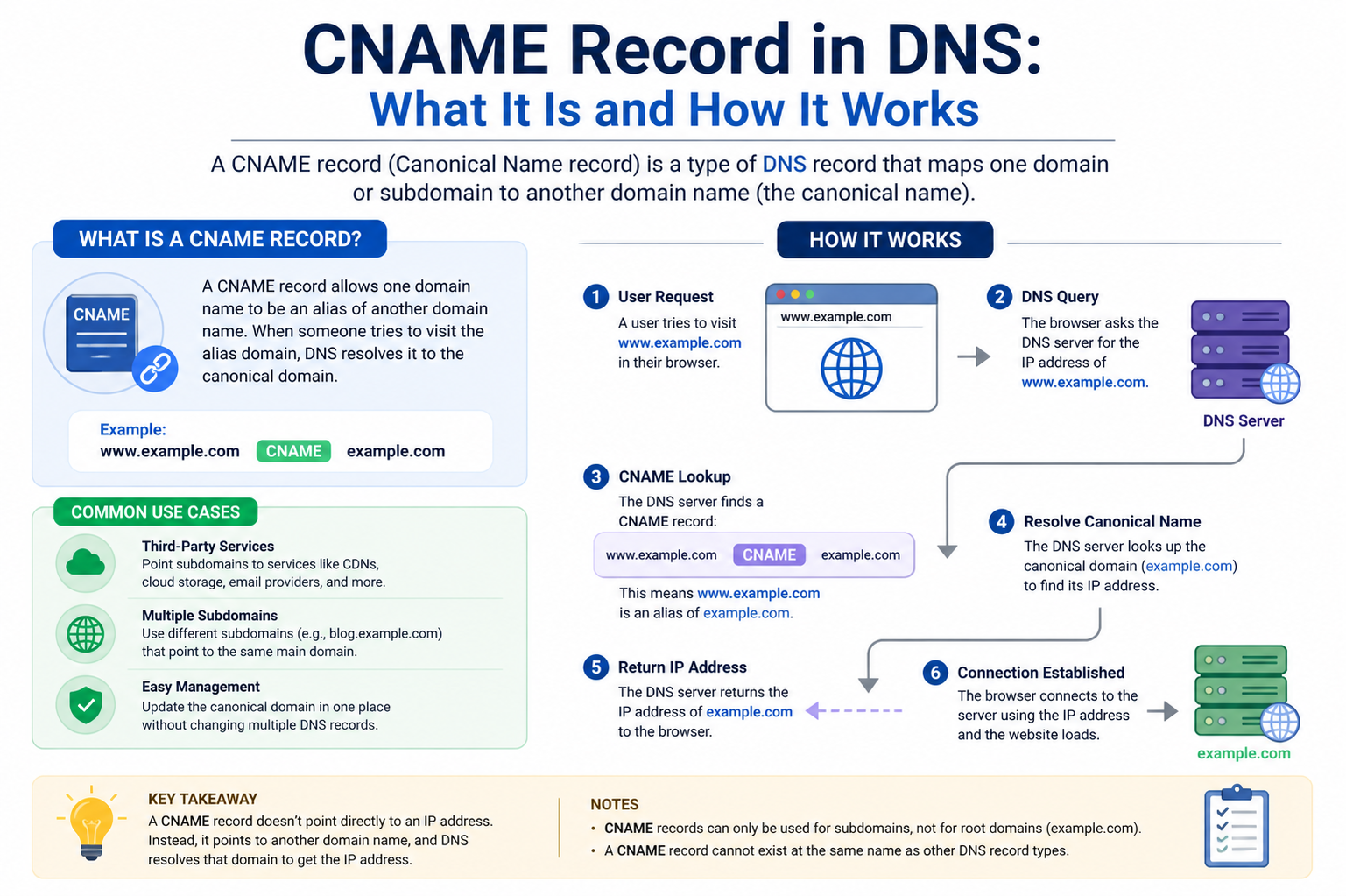
A CNAME record, short for “canonical name,” serves as a method of aliasing one domain name to another. Instead of pointing directly to an IP address, it directs a domain or subdomain to a different hostname. This creates a smooth redirection process where users are automatically guided from one address to another without noticing any interruption. The experience remains fluid, and the transition happens behind the scenes through DNS queries, ensuring that navigation feels instant and effortless.
How CNAME Records Simplify Navigation
From a user’s perspective, accessing a website should be straightforward. They type a domain name and expect immediate results. CNAME records help maintain this simplicity by acting as forwarding instructions. When a request is made to a domain configured with a CNAME, the DNS system responds by pointing to another domain name. This second domain is then resolved to an IP address, completing the connection. The entire process occurs in milliseconds, making it invisible to users while maintaining efficiency in how requests are handled.
Behind-the-Scenes Resolution Process
When a user enters a domain associated with a CNAME record, the DNS resolver initiates a lookup request. Instead of returning an IP address immediately, the DNS server responds with the canonical name specified in the record. This triggers another lookup request, this time for the target domain. Once the correct IP address is retrieved, the connection is established. Though this involves multiple steps, modern systems handle these operations so quickly that the user experiences no delay, highlighting the efficiency of DNS architecture.
Why CNAME Records Are Widely Used
CNAME records are particularly useful in scenarios where flexibility and scalability are required. They allow administrators to manage domain mappings without needing to constantly update IP addresses. This becomes especially important in environments where infrastructure changes frequently, such as cloud-based platforms. By pointing a domain to another hostname rather than an IP address, any changes to the underlying system can be handled without modifying the original DNS configuration, saving time and reducing the risk of errors.
Practical Example of CNAME Functionality
Consider a situation where a website owner wants multiple subdomains to direct users to a single main site. Instead of assigning separate IP addresses or duplicating configurations, a CNAME record can be used to point each subdomain to the primary domain. When users access any of these subdomains, they are automatically routed to the main destination. This approach keeps the setup clean, minimizes redundancy, and ensures consistency across different entry points.
Supporting Modern Hosting Environments
Modern hosting environments often rely on dynamic infrastructure, where IP addresses can change due to scaling, maintenance, or optimization processes. In such cases, using direct IP mappings would require constant updates to DNS records. CNAME records eliminate this burden by allowing domains to reference stable hostnames instead. The hosting provider manages any internal changes, while the domain owner maintains a consistent configuration. This separation of responsibilities enhances reliability and reduces administrative overhead.
Enhancing Flexibility for Domain Management
One of the key advantages of CNAME records is the flexibility they provide in managing domain structures. Organizations can easily reorganize their web presence, migrate services, or integrate third-party solutions without disrupting user access. By updating the target of a CNAME record, administrators can redirect traffic to new locations without requiring users to change how they access the service. This adaptability is essential in maintaining continuity during transitions or upgrades.
Differences Between CNAME and Other DNS Records
While CNAME records focus on aliasing one domain to another, other DNS record types serve different purposes. For example, A records directly map a domain name to an IP address. This is the most straightforward form of DNS resolution, providing a direct path to a server. In contrast, CNAME records introduce an additional step by referencing another domain, which is then resolved separately. Each type has its own use case, and understanding these differences helps in choosing the right configuration for specific needs.
When to Use CNAME Instead of A Records
Deciding between a CNAME record and an A record often depends on the nature of the service being used. If a system requires a stable and direct connection to a known IP address, an A record is typically the best choice. However, if the service operates on dynamic infrastructure or requires frequent updates, a CNAME record offers a more practical solution. Many third-party services recommend using CNAME records because they allow for seamless adjustments without requiring user intervention.
Common Use Cases in Web Services
CNAME records are frequently used in conjunction with content delivery networks, load balancing systems, and cloud applications. These services often operate across multiple servers and locations, distributing traffic to optimize performance and reliability. By using CNAME records, they can direct users to the most appropriate resource without exposing the complexity of their infrastructure. This ensures that users receive fast and consistent access regardless of their location.
Role in Subdomain Management
Subdomains are an integral part of many websites, used for organizing content, separating services, or creating distinct user experiences. CNAME records make it easy to manage these subdomains by linking them to a primary domain or external service. Instead of configuring each subdomain individually, administrators can use CNAME records to maintain a centralized structure. This approach simplifies management and reduces the likelihood of configuration errors.
Impact on Performance and Efficiency
Although CNAME records introduce an additional lookup step, their impact on performance is minimal due to modern caching mechanisms and optimized DNS resolution processes. Once a lookup is completed, the result is stored temporarily, allowing subsequent requests to be resolved more quickly. This ensures that the benefits of flexibility and scalability outweigh any minor delays introduced by the extra step in resolution.
Simplifying Infrastructure Changes
As websites grow and evolve, changes to infrastructure are inevitable. Servers may be upgraded, services may be relocated, or new technologies may be adopted. CNAME records provide a layer of abstraction that simplifies these transitions. By updating the target domain, administrators can redirect traffic without altering the original domain structure. This reduces downtime and ensures a smooth experience for users during changes.
Managing TTL and Propagation
Every DNS record, including CNAME records, includes a value known as time to live. This determines how long the record is cached by DNS resolvers before a new lookup is required. Adjusting this value can influence how quickly changes propagate across the internet. A shorter duration allows updates to take effect more quickly, while a longer duration improves efficiency by reducing the frequency of lookups. Balancing these factors is an important aspect of DNS management.
Ensuring Consistency Across Services
Consistency is crucial when managing multiple services or platforms. CNAME records help maintain uniformity by allowing different domains to point to a single destination. This ensures that users receive the same experience regardless of how they access the service. It also simplifies updates, as changes only need to be made in one place rather than across multiple configurations.
Reducing Administrative Complexity
Handling DNS configurations can become complex, especially when managing multiple domains and services. CNAME records reduce this complexity by providing a straightforward way to link domains together. Instead of dealing with multiple IP addresses and configurations, administrators can rely on a single reference point. This streamlines management and makes it easier to maintain accurate and up-to-date records.
Supporting Scalable Web Architectures
Scalability is a key consideration in modern web development. As traffic increases, systems must be able to handle higher loads without compromising performance. CNAME records support scalable architectures by enabling flexible routing of traffic. By pointing to hostnames that can adapt to changing conditions, they allow services to expand and adjust without requiring major changes to DNS configurations.
Maintaining Transparency for Users
One of the most important aspects of CNAME records is that they operate entirely behind the scenes. Users are not aware of the redirection process, nor do they need to understand how it works. They simply access a domain and receive the expected content. This transparency ensures a seamless user experience while allowing administrators to manage complex configurations in the background.
Adapting to Evolving Technology
As technology continues to evolve, the need for flexible and efficient DNS solutions becomes increasingly important. CNAME records remain a fundamental tool in adapting to these changes. Whether integrating new services, migrating to different platforms, or optimizing performance, they provide a reliable method for managing domain relationships without disrupting user access.
Balancing Simplicity and Functionality
CNAME records strike a balance between simplicity and functionality. They offer an easy way to manage domain aliases while supporting advanced use cases in modern web environments. By understanding how they work and when to use them, administrators can create efficient and adaptable DNS configurations that meet the demands of evolving digital landscapes.
Understanding the Relationship Between CNAME Records and DNS Structure
CNAME records exist within a broader DNS framework that is designed to translate human-readable domain names into machine-usable data. While they may seem simple on the surface, their role becomes clearer when viewed as part of a layered system where each record type has a specific responsibility. Rather than working in isolation, CNAME records interact with other DNS entries to complete the process of resolving a domain request, making them an essential component of a well-structured DNS configuration.
How DNS Queries Interact with CNAME Records
When a domain configured with a CNAME record is requested, the DNS resolver does not immediately return an IP address. Instead, it provides the canonical name specified in the record. This response effectively redirects the resolver to perform another query, this time for the referenced domain. Only after this second lookup is completed does the resolver obtain the final IP address needed to establish a connection. This multi-step interaction highlights how CNAME records act as intermediaries rather than direct endpoints.
The Importance of DNS Resolution Chains
CNAME records often form part of a resolution chain, where one query leads to another until the final destination is reached. This chain must always end with a record that resolves to an IP address, such as an A record. Without this final step, the resolution process would remain incomplete, preventing access to the intended resource. Maintaining a clear and efficient resolution chain is critical to ensuring that DNS queries are processed quickly and accurately.
Avoiding Misconfigurations in CNAME Usage
Improper use of CNAME records can lead to issues such as resolution delays or failed connections. One common mistake is creating loops, where a CNAME points to another domain that eventually points back to the original. This creates an endless cycle that DNS resolvers cannot resolve. Another issue arises when CNAME records are used in situations where direct IP mapping is required. Understanding these limitations helps prevent configuration errors and ensures reliable performance.
CNAME Records and Root Domain Limitations
One important restriction is that CNAME records are generally not used at the root domain level. The root domain typically requires direct mapping to an IP address, which is handled by A records. This limitation exists because the root domain must support multiple types of DNS records simultaneously, something that conflicts with the behavior of CNAME records. As a result, CNAMEs are most commonly applied to subdomains rather than the main domain itself.
How CNAME Records Support Third-Party Integrations
Many external services rely on CNAME records to integrate seamlessly with custom domains. Instead of requiring users to manage complex configurations, these services provide a hostname that users can reference through a CNAME record. This approach allows the service provider to manage their infrastructure while users maintain control over their domain names. It creates a clean separation between the service and the domain, simplifying both setup and maintenance.
Flexibility in Redirecting Traffic Across Domains
CNAME records are not limited to linking subdomains within the same domain. They can also be used to redirect traffic to entirely different domains. This capability is particularly useful for consolidating web properties or directing users to external platforms. By configuring a CNAME record, administrators can ensure that traffic is routed correctly without requiring users to remember multiple domain names.
Managing Changes in Dynamic Environments
In environments where systems are frequently updated or scaled, maintaining accurate DNS records can become challenging. CNAME records provide a practical solution by allowing domains to reference stable hostnames rather than changing IP addresses. This ensures that updates within the infrastructure do not require constant modifications to DNS settings, reducing administrative effort and minimizing the risk of downtime.
Understanding Time to Live in CNAME Records
The time to live value plays a significant role in how CNAME records behave across the internet. It determines how long a DNS resolver caches the result of a query before requesting fresh data. A shorter duration allows changes to propagate more quickly, while a longer duration reduces the frequency of queries, improving efficiency. Choosing the right value depends on the balance between flexibility and performance requirements.
The Role of Caching in DNS Performance
Caching is a key factor in the efficiency of DNS resolution. Once a CNAME record is resolved, the result is stored temporarily by the resolver. This means that subsequent requests for the same domain can be handled more quickly, as the resolver does not need to repeat the entire lookup process. Effective caching reduces latency and ensures a smoother experience for users accessing the domain.
Handling Multiple Subdomains with CNAME Records
Organizations often manage multiple subdomains for different services or applications. CNAME records provide a convenient way to handle these subdomains by linking them to a central domain or service. This approach simplifies management and ensures consistency across different parts of the domain structure. It also makes it easier to implement changes, as updates can be made in one place rather than across multiple records.
Balancing Redundancy and Efficiency
While CNAME records offer flexibility, it is important to use them thoughtfully to avoid unnecessary complexity. Excessive chaining or redundant configurations can increase the time required for DNS resolution. By keeping configurations simple and avoiding unnecessary layers, administrators can maintain both efficiency and reliability in their DNS setup.
Ensuring Compatibility with DNS Standards
CNAME records must adhere to established DNS standards to function correctly. This includes ensuring that they do not conflict with other record types and that they are configured in a way that supports proper resolution. Following best practices helps prevent issues and ensures that DNS queries are processed as expected across different systems and networks.
The Impact of CNAME Records on Website Availability
Properly configured CNAME records contribute to the overall availability of a website. By allowing domains to adapt to changes in infrastructure, they help maintain consistent access even during updates or migrations. However, misconfigurations can have the opposite effect, leading to downtime or inaccessible services. Careful planning and testing are essential to ensuring reliable performance.
Using CNAME Records for Service Abstraction
CNAME records provide a layer of abstraction that separates domain names from the underlying infrastructure. This abstraction allows administrators to make changes behind the scenes without affecting how users access the service. It also enables more flexible system design, as components can be updated or replaced without requiring changes to the public-facing domain.
Simplifying Domain Migrations
Migrating a website or service to a new platform can be a complex process, but CNAME records help simplify this transition. By updating the target of a CNAME record, administrators can redirect traffic to the new location without requiring users to change their behavior. This ensures a smooth migration process and minimizes disruption to users.
Maintaining Consistency Across Distributed Systems
In distributed systems where services are spread across multiple locations, maintaining consistency is essential. CNAME records help achieve this by directing traffic to a single hostname that can manage distribution internally. This ensures that users are always routed to the appropriate resource, regardless of where it is located.
Optimizing DNS Configurations for Scalability
As systems grow, DNS configurations must be able to scale accordingly. CNAME records support this growth by providing a flexible way to manage domain relationships. By linking domains to scalable hostnames, administrators can ensure that their DNS setup can handle increasing demand without requiring significant changes.
Reducing the Risk of Configuration Errors
Managing DNS records manually can lead to errors, especially in complex environments. CNAME records reduce this risk by simplifying the process of linking domains. Instead of managing multiple IP addresses, administrators can rely on a single reference point, making it easier to maintain accurate configurations.
Supporting Seamless User Experiences
Ultimately, the goal of any DNS configuration is to provide a seamless experience for users. CNAME records contribute to this by enabling smooth redirection and consistent access to services. By handling complexity behind the scenes, they allow users to interact with domains in a simple and intuitive way, ensuring that technical details remain invisible while functionality remains robust.
Practical Approach to Creating CNAME Records
Setting up a CNAME record is a structured process that requires attention to detail but does not demand advanced technical expertise. The goal is to create a reliable link between a chosen subdomain and a target hostname. This process begins with a clear understanding of the purpose behind the record, whether it is to connect a service, simplify navigation, or integrate with an external platform. A well-planned setup ensures that the record functions correctly and delivers a seamless experience to users.
Selecting the Right Subdomain for Your Needs
The first step in creating a CNAME record is choosing an appropriate subdomain. This name should be simple, meaningful, and easy for users to remember. It often reflects the function it serves, such as directing users to a specific service or application. A clear naming strategy not only improves usability but also helps maintain an organized DNS structure, especially when managing multiple subdomains.
Accessing the DNS Management Interface
To create or modify DNS records, administrators must use a DNS management interface provided by their hosting or domain service. This interface contains the DNS zone, which is essentially a list of all records associated with a domain. Within this environment, users can view existing configurations, edit entries, or add new ones. Familiarity with this interface is essential for effective DNS management.
Creating a New CNAME Record Entry
Once inside the DNS management panel, the next step is to create a new record. This typically involves selecting the CNAME record type and entering the required details. The subdomain is specified as the name, while the target hostname is entered as the value. This value represents the destination to which traffic will be redirected. Accuracy is critical at this stage, as even a small error can prevent the record from functioning properly.
Understanding the Role of the Target Hostname
The target hostname in a CNAME record is the destination that the subdomain will resolve to. This is usually provided by a service or defined by the administrator based on the intended configuration. It must be a valid and reachable domain name that ultimately resolves to an IP address. Ensuring that the target is correctly configured is essential for the success of the CNAME record.
Configuring Time to Live Settings
When creating a CNAME record, administrators must also define the time to live value. This determines how long the record is cached by DNS resolvers before a new lookup is required. Choosing an appropriate duration is important, as it affects both performance and the speed at which updates take effect. Shorter durations allow for quicker changes, while longer durations reduce the number of DNS queries.
Saving and Applying the Configuration
After entering all necessary details, the record must be saved within the DNS management system. This action updates the DNS zone and initiates the process of making the new record available across the internet. Although the change is immediate within the management interface, it takes time for the update to propagate to DNS servers worldwide.
Understanding DNS Propagation Delays
DNS propagation refers to the time it takes for changes to be recognized across all DNS servers. This delay occurs because different servers update their cached records at different intervals. During this period, some users may see the new configuration while others continue to experience the old one. Patience is required, as propagation is a natural part of how DNS operates.
Verifying That the Record Is Working Correctly
Once the propagation period has passed, it is important to verify that the CNAME record is functioning as expected. This can be done by performing a DNS lookup or accessing the subdomain directly. A successful configuration will redirect users to the intended destination without errors. Verification helps identify any issues early and ensures that the setup meets its intended purpose.
Troubleshooting Common Setup Issues
Even with careful configuration, issues can arise when setting up a CNAME record. Common problems include incorrect target hostnames, typographical errors, or conflicts with existing records. Identifying the root cause of these issues often involves reviewing the DNS configuration and ensuring that all values are accurate. Addressing these problems promptly helps maintain reliable access to the domain.
Avoiding Conflicts with Other DNS Records
CNAME records must be used in a way that does not conflict with other record types. For example, a subdomain configured with a CNAME record should not have additional records of different types assigned to it. Such conflicts can lead to unpredictable behavior and resolution failures. Maintaining a clean and consistent DNS structure is essential for avoiding these issues.
Maintaining Clear Documentation of Changes
Keeping track of DNS changes is an important aspect of effective management. Documenting the purpose and configuration of each CNAME record helps ensure that future updates can be made with confidence. This practice is especially valuable in environments where multiple administrators are involved, as it provides clarity and reduces the risk of errors.
Testing Changes Before Full Deployment
In critical environments, it is often beneficial to test DNS changes before applying them broadly. This can involve using temporary subdomains or staging environments to confirm that the configuration works as intended. Testing helps identify potential issues without affecting the primary domain, ensuring a smoother deployment process.
Using CNAME Records for Service Integration
CNAME records are frequently used to connect domains with external services. These services typically provide a hostname that must be referenced in the DNS configuration. By creating a CNAME record that points to this hostname, administrators can integrate the service with their domain. This approach simplifies the process and allows the service provider to manage underlying infrastructure changes.
Adapting to Infrastructure Updates
As systems evolve, changes to infrastructure may require updates to DNS configurations. CNAME records make this process easier by allowing administrators to update the target hostname without altering the public-facing domain. This flexibility ensures that services remain accessible even as underlying components change.
Ensuring Security and Reliability
While CNAME records are primarily used for redirection, they also play a role in maintaining secure and reliable connections. Proper configuration ensures that users are directed to the correct destination, reducing the risk of misrouting or service disruption. Regular reviews of DNS settings help maintain a secure environment.
Managing Large-Scale DNS Environments
In large organizations, DNS management can become complex due to the number of domains and services involved. CNAME records help simplify this complexity by providing a consistent method for linking domains. This approach makes it easier to manage large-scale environments and maintain accurate configurations across multiple systems.
Optimizing Performance Through Efficient Configuration
Efficient DNS configuration contributes to overall system performance. By minimizing unnecessary complexity and ensuring that CNAME records are used appropriately, administrators can reduce resolution times and improve user experience. Thoughtful planning and regular optimization are key to achieving this goal.
Supporting Continuous Improvement in DNS Management
DNS management is an ongoing process that requires continuous attention and refinement. CNAME records are a valuable tool in this process, offering flexibility and adaptability as systems evolve. By understanding their role and applying best practices, administrators can maintain efficient and reliable DNS configurations that support long-term growth.
Advanced Considerations for Using CNAME Records
As DNS environments become more sophisticated, the role of CNAME records extends beyond basic redirection. They begin to support complex architectures where services are distributed, scaled, and frequently updated. Understanding these advanced considerations allows administrators to use CNAME records not just as a convenience, but as a strategic tool in designing resilient and adaptable systems.
Designing DNS for High Availability
High availability is a critical requirement for modern applications, and DNS plays a central role in achieving it. CNAME records contribute by enabling domains to point to hostnames that are managed across redundant systems. These hostnames can represent clusters, load-balanced endpoints, or geographically distributed services. By relying on a CNAME instead of a fixed IP address, administrators can ensure that traffic is always directed to an available resource, even if individual components fail.
Supporting Load Distribution Strategies
In environments where traffic must be distributed efficiently, CNAME records often act as an entry point to load balancing mechanisms. Instead of directing users to a single server, the CNAME points to a hostname that intelligently routes requests across multiple endpoints. This helps prevent bottlenecks and ensures that no single system becomes overwhelmed, contributing to better performance and stability.
Integrating with Content Delivery Networks
Content delivery networks rely heavily on DNS configurations to deliver content from the closest or most efficient location. CNAME records are commonly used to connect a domain to a CDN endpoint. When users access the domain, the CDN determines the optimal server to respond to the request. This improves loading times and enhances the overall user experience, especially for audiences distributed across different regions.
Managing Failover and Redundancy
CNAME records can also play a role in failover strategies. By pointing to a hostname that can switch between primary and backup systems, administrators can ensure continuity during outages. If the primary system becomes unavailable, the underlying service can redirect traffic to a secondary location without requiring changes to the DNS record itself. This approach minimizes downtime and maintains service reliability.
Handling Multi-Service Architectures
Modern applications often consist of multiple interconnected services, each serving a specific function. CNAME records help organize these services by allowing different subdomains to point to their respective endpoints. This creates a clear and manageable structure where each service can be accessed independently while remaining part of a unified domain strategy.
Ensuring Scalability in Growing Systems
As applications grow, their infrastructure must scale to handle increased demand. CNAME records support this growth by enabling domains to reference scalable hostnames that can adapt to changing conditions. Whether adding new servers or expanding into new regions, the DNS configuration remains stable, allowing the system to evolve without disrupting user access.
Reducing Dependency on Static Configurations
Static configurations can become a limitation in dynamic environments where change is constant. CNAME records reduce this dependency by introducing a level of indirection between the domain and the underlying infrastructure. This allows administrators to make adjustments behind the scenes without modifying the public-facing configuration, providing greater flexibility and control.
Improving Maintainability of DNS Records
Maintaining DNS records can become challenging as systems grow in complexity. CNAME records simplify this task by reducing the number of direct mappings that need to be managed. Instead of updating multiple records with new IP addresses, administrators can update a single target hostname, and all associated CNAME records will automatically reflect the change.
Avoiding Excessive Chaining in Configurations
While CNAME records can be chained, excessive chaining should be avoided. Each additional step in the resolution process introduces a slight delay and increases the potential for misconfiguration. Keeping the chain as short as possible ensures faster resolution and reduces the likelihood of errors, maintaining an efficient DNS setup.
Understanding the Impact on Email and Other Services
CNAME records are not suitable for all types of DNS configurations. Certain services, such as email delivery, require specific record types and cannot rely on CNAME records for proper operation. Misusing CNAME records in these contexts can lead to service disruptions. It is important to understand the requirements of each service before deciding how to configure DNS records.
Monitoring and Auditing DNS Configurations
Regular monitoring and auditing of DNS configurations are essential for maintaining reliability and security. CNAME records should be reviewed პერიოდically to ensure they point to valid and intended destinations. This helps identify outdated or incorrect entries that could affect performance or lead to unexpected behavior.
Adapting to Changes in Service Providers
When working with external service providers, changes to their infrastructure can impact DNS configurations. CNAME records provide a buffer against these changes by allowing providers to update their hostnames internally. As long as the CNAME record points to the correct hostname, the service continues to function without requiring updates from the domain owner.
Enhancing Security Through Proper Configuration
While DNS is not a security mechanism by itself, proper configuration contributes to a safer environment. Ensuring that CNAME records point only to trusted destinations reduces the risk of misdirection or malicious activity. Regular validation of DNS entries helps maintain integrity and prevents unauthorized changes.
Supporting Automation in DNS Management
Automation is increasingly used in managing infrastructure, and DNS is no exception. CNAME records integrate well with automated systems, allowing updates to be applied consistently and efficiently. By incorporating DNS management into automated workflows, organizations can reduce manual effort and improve accuracy.
Balancing Performance with Flexibility
CNAME records offer significant flexibility, but this must be balanced with performance considerations. While the additional lookup step is generally negligible, excessive complexity can impact resolution times. Designing a streamlined DNS structure ensures that the benefits of flexibility do not come at the cost of speed.
Preparing for Future Expansion
A well-designed DNS configuration anticipates future growth and changes. CNAME records make it easier to accommodate new services, platforms, or architectural changes without requiring major restructuring. This forward-thinking approach ensures that the system remains adaptable as requirements evolve.
Aligning DNS Strategy with Business Needs
DNS configurations should align with the overall goals of the organization. CNAME records support this alignment by providing a flexible way to manage domain relationships. Whether the focus is on performance, scalability, or ease of management, they can be tailored to meet specific objectives.
Maintaining a Clean and Organized DNS Environment
Organization is key to effective DNS management. Clearly structured records, consistent naming conventions, and regular maintenance all contribute to a reliable system. CNAME records help achieve this by simplifying domain relationships and reducing clutter in the DNS zone.
Building a Resilient and Adaptable DNS Foundation
Ultimately, CNAME records are a foundational element in building a DNS system that is both resilient and adaptable. By understanding their capabilities and limitations, administrators can design configurations that support modern applications while maintaining simplicity and reliability.
Conclusion
CNAME records are an essential part of DNS that provide a flexible way to connect one domain or subdomain to another without directly linking to an IP address, making domain management simpler and more efficient. By acting as aliases, they allow seamless redirection behind the scenes, ensuring users reach the correct destination without noticing the underlying complexity. Their true value becomes clear in modern environments where infrastructure changes frequently, as they enable updates and scaling without constant DNS modifications. This adaptability reduces administrative effort, improves reliability, and supports integration with various services. When implemented correctly, CNAME records help maintain a stable, organized, and user-friendly web experience while ensuring that systems remain scalable and easy to manage over time.