Cybersecurity has become one of the most critical pillars of modern digital infrastructure. As organizations expand their digital systems, cloud environments, and remote operations, the attack surface for cyber threats continues to grow. This has created a strong demand for professionals who can design secure systems, manage risks, and respond to incidents effectively. In response, the industry has developed a wide range of certifications aimed at validating cybersecurity skills at different levels of experience.
Among the most respected organizations in this space is ISC2, a global nonprofit association known for setting high standards in information security certification and professional ethics. ISC2 certifications are widely recognized across industries, particularly in enterprise environments and government sectors, because they emphasize not only technical knowledge but also structured security thinking, governance, and risk management.
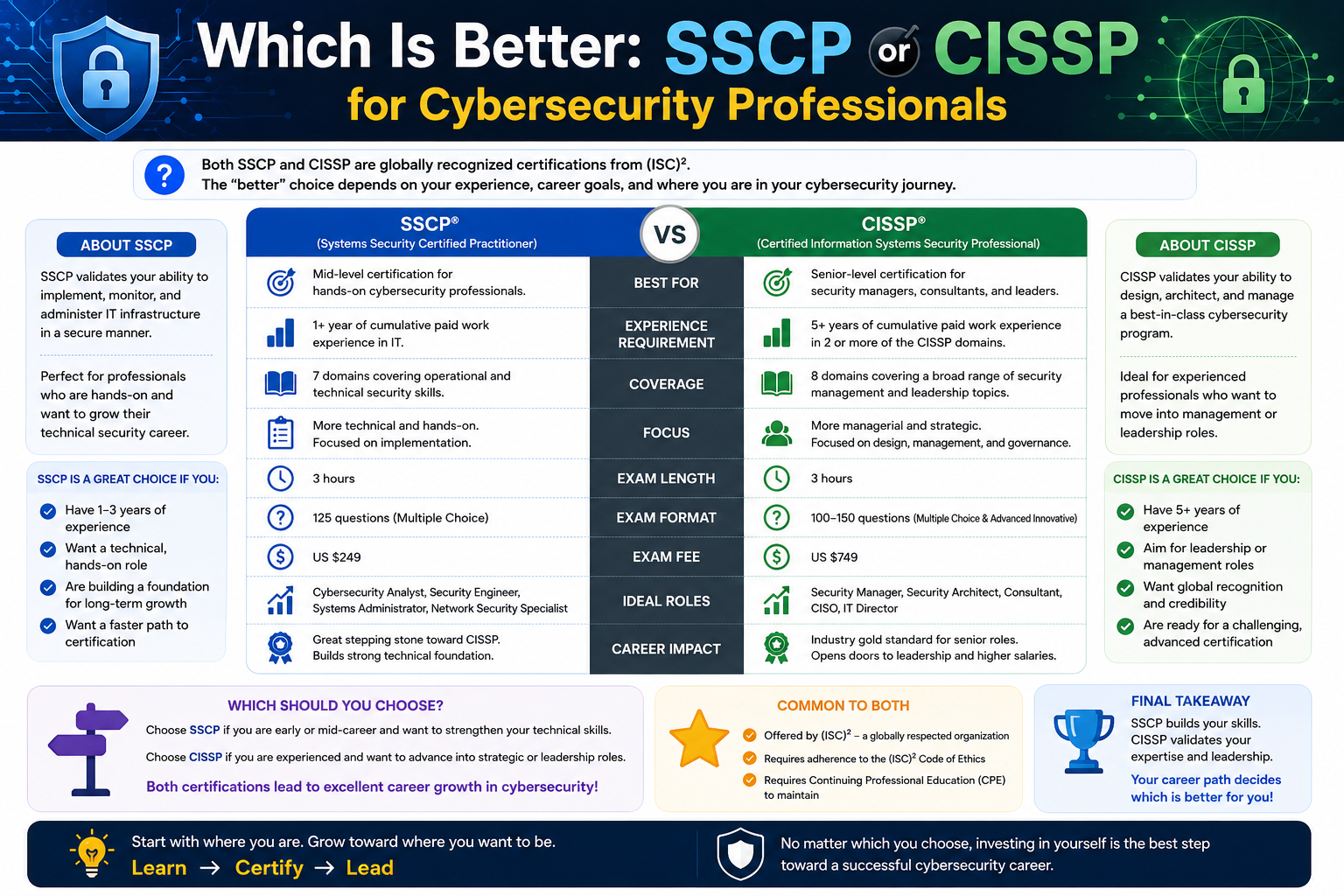
Within ISC2’s certification ecosystem, two credentials often stand out when discussing career progression in cybersecurity: the Certified Information Systems Security Professional (CISSP) and the Systems Security Certified Practitioner (SSCP). These certifications are not competing alternatives in a direct sense; instead, they serve different stages of a cybersecurity career journey. One is designed for experienced professionals moving into leadership or architecture roles, while the other supports early-career practitioners developing hands-on technical skills.
Understanding the difference between these two certifications requires a deeper look into their purpose, structure, difficulty level, and the kind of professional growth they support. CISSP, in particular, is often considered a milestone certification in cybersecurity careers, while SSCP is more aligned with foundational operational roles.
To understand why CISSP is so highly regarded and why it is often considered challenging, it is important to explore what the certification represents, what it covers, and what it demands from candidates.
Understanding CISSP as a Senior-Level Cybersecurity Certification
The Certified Information Systems Security Professional certification is widely regarded as one of the most advanced and comprehensive cybersecurity certifications available today. It is designed for individuals who already have significant experience in the field and are responsible for designing, managing, and overseeing security programs rather than just implementing isolated technical tasks.
Unlike entry-level certifications that focus heavily on tools and basic security concepts, CISSP is structured around broad security principles and enterprise-level thinking. It emphasizes how security decisions are made within organizations, how risks are evaluated, and how security frameworks are implemented across complex systems.
The certification is often associated with roles such as security architect, security manager, security consultant, IT director, and senior analyst. These roles require not just technical understanding but also strategic decision-making capabilities.
One of the defining aspects of CISSP is that it is not purely technical. Instead, it blends technical knowledge with governance, risk management, compliance, and operational security. This makes it suitable for professionals who are transitioning from hands-on technical roles into leadership positions.
Because of this wide scope, CISSP is considered challenging. It requires candidates to understand not only how security technologies work but also why certain security decisions are made at the organizational level. It also expects familiarity with global security frameworks, legal considerations, and enterprise risk management strategies.
The Knowledge Domains That Shape CISSP
The CISSP certification is structured around eight major domains of cybersecurity knowledge. These domains represent the core areas that security professionals are expected to understand at a high level when working in enterprise environments.
Security and Risk Management
This domain focuses on the foundational principles of cybersecurity governance. It includes topics such as confidentiality, integrity, and availability, which form the core of information security. It also covers risk assessment methodologies, compliance requirements, legal considerations, and ethical practices in cybersecurity.
Professionals working in this area must understand how organizations define security policies and how those policies align with business objectives. They must also be able to evaluate risks and recommend appropriate controls based on organizational needs.
Asset Security
Asset security focuses on protecting organizational assets, including data, hardware, software, and intellectual property. This domain emphasizes data classification, ownership, retention policies, and secure handling procedures.
A key concept in this domain is ensuring that sensitive information is properly categorized and protected throughout its lifecycle. This includes secure storage, transmission, and disposal of data.
Security Architecture and Engineering
This domain is highly technical and focuses on designing secure systems. It includes secure design principles, hardware and software security mechanisms, cryptographic systems, and secure engineering processes.
Professionals working in this area are expected to understand how security controls are built into system architecture. This includes designing systems that are resilient against attacks and ensuring that security is integrated at every layer of infrastructure.
Communication and Network Security
This domain deals with securing network infrastructure and communication channels. It includes network protocols, secure communication methods, network architecture, and protection against network-based attacks.
Understanding this domain is essential for ensuring that data remains secure while being transmitted across internal and external networks. It also involves knowledge of encryption methods and secure communication standards.
Identity and Access Management
Identity and access management focuses on controlling who has access to systems and data. This includes authentication methods, authorization mechanisms, identity lifecycle management, and access control models.
This domain is critical in preventing unauthorized access and ensuring that users only have access to the resources necessary for their roles. It also involves managing credentials and ensuring secure identity verification processes.
Security Assessment and Testing
This domain focuses on evaluating the effectiveness of security controls. It includes vulnerability assessments, penetration testing concepts, security audits, and testing methodologies.
Professionals in this area are responsible for identifying weaknesses in systems and ensuring that security controls function as intended. They also help organizations improve their security posture through continuous evaluation.
Security Operations
Security operations involve the day-to-day management of security systems. This includes monitoring systems for threats, managing security incidents, and ensuring operational continuity.
It also covers areas such as logging, monitoring, detection systems, and incident response coordination. This domain ensures that security is actively maintained and not just designed at a theoretical level.
Software Development Security
This domain focuses on integrating security into the software development lifecycle. It includes secure coding practices, application security testing, and understanding vulnerabilities in software systems.
As modern organizations rely heavily on software applications, this domain ensures that security is built into applications from the beginning rather than added later.
CISSP Experience Requirements and Professional Expectations
One of the most important aspects of CISSP is its experience requirement. Unlike many certifications that allow candidates to pass exams without prior work experience, CISSP requires candidates to have substantial real-world cybersecurity experience.
Typically, candidates must have several years of full-time experience in at least two of the CISSP domains. This requirement ensures that individuals holding the certification have practical exposure to cybersecurity challenges and are not relying solely on theoretical knowledge.
This experience requirement is a key reason why CISSP is considered a senior-level certification. It is not designed for beginners but for professionals who have already worked in security roles and are ready to move into higher-level responsibilities.
For individuals who pass the exam but do not yet meet the experience requirement, there is a pathway that recognizes them at a provisional level. This allows them to continue gaining experience while demonstrating that they have passed a rigorous cybersecurity examination.
Another important requirement is professional endorsement. Candidates must be validated by another certified professional who can confirm their experience and professional background. This adds a layer of credibility and trust to the certification process.
Exam Structure and Cognitive Demands of CISSP
The CISSP exam is known for its depth and adaptive structure. It uses a computerized adaptive testing format, meaning that the difficulty of questions can change based on the candidate’s performance.
The exam includes a large number of questions that test not only factual knowledge but also analytical thinking and decision-making ability. Many questions are scenario-based, requiring candidates to evaluate complex situations and choose the most appropriate security response.
The exam duration can extend for several hours, reflecting the intensity and complexity of the assessment. It is designed to test endurance as well as understanding, ensuring that candidates can maintain focus under pressure.
Unlike exams that focus on memorization, CISSP emphasizes conceptual understanding. Candidates are expected to think like security professionals who must balance technical constraints, business needs, and risk considerations.
This makes preparation for CISSP significantly different from many other certifications. It requires a shift from learning isolated technical facts to understanding how security principles are applied in real organizational environments.
Professional Value and Industry Recognition of CISSP
CISSP holds strong recognition across industries and is often viewed as a benchmark certification for cybersecurity leadership roles. Many organizations consider it a preferred or even required credential for senior security positions.
One of the reasons for its strong industry value is its broad coverage of cybersecurity domains. CISSP-certified professionals are expected to have a well-rounded understanding of security, making them suitable for roles that require cross-functional decision-making.
In addition, CISSP is widely recognized in government and regulated industries where security compliance and structured frameworks are essential. This makes it particularly valuable for professionals working in sectors such as finance, defense, healthcare, and critical infrastructure.
Another major factor contributing to its value is its association with higher-level job roles. CISSP is often linked to positions that involve leadership, architecture design, and security governance rather than entry-level technical tasks.
Because of this, CISSP is frequently seen as a career-defining certification rather than a stepping stone. It represents a transition from technical execution to strategic security management.
CISSP and Its Role in Career Progression
For many cybersecurity professionals, CISSP represents a long-term career goal. It is often pursued after gaining several years of experience in roles such as security analyst, system administrator, or network engineer.
The certification helps professionals transition into roles where they are responsible for designing security frameworks, managing teams, and aligning security strategies with business objectives.
It also plays a role in increasing professional credibility. Organizations often view CISSP-certified individuals as capable of handling complex security environments and making informed decisions under pressure.
Because of its broad scope, CISSP does not focus on a single technology or tool. Instead, it builds a holistic understanding of cybersecurity, making it suitable for professionals who want to move beyond specialized technical roles.
At this stage in the discussion, it becomes clear why CISSP is often compared with SSCP. While CISSP focuses on advanced security leadership and architecture, SSCP is more oriented toward hands-on operational security roles. However, understanding SSCP in detail requires a separate examination of its structure, purpose, and career relevance.
SSCP as a Practitioner-Focused Cybersecurity Certification
While CISSP represents a senior-level certification aimed at strategic security leadership, the Systems Security Certified Practitioner certification is positioned at a more operational level. It is designed for professionals who are actively involved in implementing, managing, and maintaining security controls within real-world environments.
SSCP is especially relevant for individuals working in technical cybersecurity roles where hands-on tasks are central to daily responsibilities. These roles often include managing network security configurations, monitoring systems for suspicious activity, responding to incidents, and ensuring that security controls are properly implemented across the infrastructure.
Unlike certifications that emphasize broad governance or organizational policy, SSCP focuses on the execution of security practices. It helps professionals develop the ability to work directly with systems, tools, and processes that protect organizational environments from threats.
This makes SSCP particularly valuable for individuals who are transitioning from general IT roles into cybersecurity or those who want to strengthen their technical foundation before moving into more advanced certifications later in their careers.
The certification is structured to validate that candidates understand not just theoretical security concepts, but also how those concepts are applied in operational environments. This distinction is important because cybersecurity is not only about designing secure systems but also about maintaining and defending them on a continuous basis.
Foundational Philosophy Behind SSCP
The core philosophy of SSCP revolves around practical security implementation. It assumes that cybersecurity professionals at this level are directly involved in safeguarding systems rather than designing enterprise-wide security strategies.
This means SSCP emphasizes operational competence, including the ability to configure secure systems, manage access controls, monitor network activity, and respond effectively to security incidents.
Where CISSP focuses on “why security decisions are made,” SSCP focuses more on “how security is implemented and maintained.” This difference shapes the entire structure of the certification and the expectations placed on candidates.
SSCP is built around the idea that strong cybersecurity begins with strong technical execution. Even the most advanced security frameworks cannot be effective unless they are properly implemented and continuously maintained by skilled practitioners.
As a result, SSCP plays a critical role in bridging the gap between entry-level IT knowledge and advanced cybersecurity expertise. It prepares professionals to take on responsibilities in security operations centers, system administration teams, and network security roles.
Core Knowledge Areas Covered in SSCP
The SSCP certification is organized into several key domains that represent the essential technical skills required for operational cybersecurity roles. Each domain focuses on a specific aspect of system security, ensuring that candidates develop a well-rounded understanding of practical security implementation.
Access Control Systems and Identity Management
One of the foundational areas in SSCP is access control. This domain focuses on ensuring that only authorized users can access systems, applications, and data.
It includes concepts such as authentication mechanisms, authorization models, and identity lifecycle management. Professionals working in this area must understand how to manage user identities from creation to termination, ensuring that access rights are properly assigned and revoked when necessary.
This domain also emphasizes the importance of enforcing the principle of least privilege, which ensures that users only have the minimum level of access required to perform their job functions.
In real-world environments, improper access control is one of the most common causes of security breaches. Therefore, SSCP places strong emphasis on ensuring that practitioners can properly configure and manage identity systems.
Security Operations and Administrative Practices
Security operations form the backbone of SSCP. This domain focuses on the day-to-day activities required to maintain secure systems.
It includes system monitoring, log analysis, configuration management, and routine security maintenance tasks. Professionals in this area are responsible for ensuring that systems remain secure after deployment.
They also work closely with security tools such as intrusion detection systems, antivirus solutions, and centralized logging platforms. These tools help identify unusual behavior and potential security incidents before they escalate.
Administrative practices also include managing security policies at the operational level. This involves ensuring that systems comply with organizational security standards and that configurations are consistently applied across environments.
Unlike high-level governance roles, this domain is focused on execution rather than policy creation. It ensures that security measures are actively functioning within technical environments.
Risk Identification, Monitoring, and Analysis
This domain focuses on identifying potential threats and vulnerabilities within systems and networks. It teaches professionals how to recognize early warning signs of security issues and assess their potential impact.
Risk identification involves understanding how threats emerge and how they can affect systems. This includes analyzing vulnerabilities in software, hardware, and network configurations.
Monitoring plays a key role in this process. Security practitioners must continuously observe system behavior to detect anomalies that may indicate malicious activity.
Analysis involves evaluating the severity of risks and determining appropriate responses. This requires both technical understanding and analytical thinking.
SSCP emphasizes practical risk awareness, ensuring that professionals can recognize and respond to threats in real time rather than relying solely on theoretical models.
Incident Response and Recovery Processes
Incident response is one of the most critical areas in SSCP. It focuses on how organizations detect, respond to, and recover from security incidents.
Security professionals must be able to identify incidents quickly and take appropriate action to contain them. This may involve isolating affected systems, removing malicious code, or restoring services from backups.
Recovery processes are equally important. After an incident has been contained, systems must be restored to normal operation while ensuring that vulnerabilities are addressed to prevent recurrence.
This domain emphasizes structured response procedures, ensuring that security teams follow consistent steps when handling incidents.
In real-world environments, effective incident response can significantly reduce the impact of security breaches and minimize downtime.
Cryptography and Secure Communication
Cryptography is a fundamental component of cybersecurity, and SSCP includes a strong focus on its practical application.
This domain covers encryption methods, hashing algorithms, and secure communication protocols. It also includes the use of cryptographic systems to protect data confidentiality and integrity.
Professionals working in this area must understand how encryption is applied in real systems, including secure data storage and transmission.
They also need to be familiar with common cryptographic protocols used in network communication, ensuring that data remains protected while moving across systems.
Unlike theoretical cryptography, SSCP emphasizes practical implementation and configuration of cryptographic tools within enterprise environments.
Network and Infrastructure Security
Network security is another core area of SSCP. It focuses on protecting organizational networks from unauthorized access, attacks, and disruptions.
This includes understanding network architecture, segmentation, secure routing, and firewall configuration. Professionals must be able to design and maintain secure network environments that minimize exposure to threats.
They also need to understand common network-based attacks and how to defend against them. This includes denial-of-service attacks, man-in-the-middle attacks, and unauthorized access attempts.
Infrastructure security extends beyond networks to include servers, endpoints, and cloud environments. SSCP ensures that practitioners understand how to secure all components of the IT infrastructure.
Systems and Application Security
This domain focuses on securing operating systems and applications. It includes understanding system hardening techniques, secure configuration practices, and vulnerability management.
Application security is particularly important in modern environments where software systems play a central role in business operations.
Professionals must understand how vulnerabilities arise in applications and how they can be mitigated through secure development and configuration practices.
This domain also includes patch management, ensuring that systems remain up to date with the latest security updates.
By focusing on systems and applications, SSCP ensures that practitioners can secure both the infrastructure and the software running on it.
Experience Requirements and Practical Expectations for SSCP
SSCP requires candidates to have some level of practical experience in cybersecurity or related IT roles. However, the experience requirement is significantly lower compared to CISSP.
Typically, candidates need around one year of hands-on experience in one or more SSCP domains. This makes the certification accessible to early-career professionals who are just beginning their cybersecurity journey.
In some cases, academic qualifications in cybersecurity can partially waive experience requirements, allowing students or recent graduates to enter the certification pathway more easily.
This lower barrier to entry reflects the practical nature of SSCP. It is designed to validate operational skills rather than advanced leadership or architectural expertise.
Candidates are expected to demonstrate familiarity with real systems and environments, even if their experience is limited compared to senior professionals.
Exam Structure and Skill Evaluation in SSCP
The SSCP exam is designed to assess both knowledge and practical understanding of cybersecurity concepts. It includes a range of questions that test technical comprehension, problem-solving ability, and applied knowledge.
The exam duration is shorter than the CISSP, and the number of questions is also lower. However, the focus remains on understanding how security concepts are applied in real-world scenarios.
Many questions are scenario-based, requiring candidates to evaluate situations and choose the most appropriate technical response.
Unlike purely theoretical exams, SSCP emphasizes operational decision-making. Candidates must demonstrate that they can apply security knowledge effectively in practical environments.
The exam is structured to ensure that certified professionals are capable of handling real cybersecurity tasks, particularly in operational roles such as system administration and security monitoring.
Role of SSCP in Security Operations Environments
SSCP-certified professionals often work in environments where continuous monitoring and rapid response are essential. One of the most common workplaces for SSCP holders is a security operations center.
In such environments, professionals are responsible for monitoring security alerts, analyzing logs, and responding to potential incidents. They play a critical role in identifying threats before they escalate into serious breaches.
SSCP also prepares professionals for roles in network security teams, where they manage firewalls, intrusion detection systems, and secure network configurations.
In system administration roles, SSCP knowledge helps ensure that servers and endpoints are configured securely and maintained properly over time.
The certification is highly practical, meaning that its value is most visible in day-to-day operational tasks rather than strategic planning or policy development.
Technical Depth and Practical Emphasis Compared to CISSP
One of the most important distinctions between SSCP and CISSP lies in their approach to cybersecurity knowledge.
SSCP is deeply technical and focused on implementation. It emphasizes how systems are configured, how security tools are used, and how incidents are handled at the operational level.
CISSP, on the other hand, focuses more on architecture, governance, and strategic decision-making. It is less about hands-on configuration and more about designing security frameworks for entire organizations.
This difference makes SSCP more suitable for individuals who prefer working directly with systems, while CISSP is better suited for those who want to move into leadership or design roles.
Despite these differences, both certifications share a common foundation in cybersecurity principles. This means that SSCP can serve as a stepping stone toward CISSP for professionals who plan to advance their careers over time.
Career Development Pathways Starting with SSCP
SSCP often serves as an entry point into structured cybersecurity career progression. Many professionals begin with foundational IT roles and then move into SSCP-level responsibilities as they gain experience.
From there, they may progress into more specialized security roles or pursue advanced certifications that expand their scope of knowledge.
SSCP helps build the technical foundation required for more advanced certifications by reinforcing core concepts such as access control, network security, and incident response.
Over time, professionals who begin with SSCP often move into more senior roles where certifications like CISSP become relevant.
This progression reflects a natural evolution from technical execution to strategic leadership within cybersecurity careers.
SSCP vs CISSP: Structural Differences in Purpose and Career Positioning
Although SSCP and CISSP both originate from ISC2 and share a foundation in cybersecurity principles, they are built for distinctly different professional stages. The most important distinction lies not in their difficulty alone, but in their intended career positioning.
SSCP is designed for practitioners who are actively involved in operational security tasks. These individuals typically work in environments where systems must be monitored, configured, and maintained on a continuous basis. Their responsibilities are immediate and technical, focusing on keeping infrastructure secure in real time.
CISSP, in contrast, is designed for professionals who have moved beyond daily operational tasks into roles where they define security direction, design frameworks, and make strategic decisions. These individuals are often responsible for entire security programs rather than individual systems.
This difference in purpose influences everything from exam structure to required experience. SSCP validates hands-on technical ability, while CISSP validates a combination of experience, leadership capability, and conceptual understanding of enterprise security.
In simple terms, SSCP aligns with execution, while CISSP aligns with design and governance. This structural difference is why the two certifications are often seen as complementary rather than interchangeable.
Skill Depth and Cognitive Demand Comparison Between SSCP and CISSP
One of the most important ways to understand the difference between SSCP and CISSP is to examine the level of cognitive complexity required by each certification.
SSCP primarily tests applied knowledge. Candidates are expected to understand how systems operate securely and how to perform tasks such as configuring access controls, monitoring networks, and responding to incidents. The focus is on the direct application of security concepts in controlled environments.
CISSP, on the other hand, requires abstract and strategic thinking. Candidates must evaluate scenarios involving organizational risk, compliance requirements, and architectural trade-offs. Instead of focusing on how to implement a solution, CISSP focuses on which solution is most appropriate in a given business context.
This difference creates a significant gap in mental approach. SSCP candidates often think in terms of tools, systems, and procedures. CISSP candidates must think in terms of frameworks, policies, and long-term security impact.
For example, an SSCP-level question might involve identifying the correct configuration for a firewall rule or determining the appropriate response to a system alert. A CISSP-level question might involve choosing the most appropriate security governance strategy for an organization expanding into multiple international markets.
This distinction highlights why CISSP is considered more challenging—not necessarily because it is more technical, but because it requires a broader and more abstract way of thinking.
Career Stage Alignment and Professional Identity
SSCP and CISSP are closely tied to career stages within cybersecurity. They effectively represent two different phases of professional identity development.
SSCP is typically associated with early to mid-stage professionals. These individuals are often building their experience in technical environments such as IT support, system administration, network operations, or junior security analyst roles. Their focus is on gaining hands-on exposure to cybersecurity tools and processes.
At this stage, professionals are still developing their technical confidence and learning how security systems behave in real-world environments. SSCP helps formalize this knowledge by validating that they understand core operational security principles.
CISSP, however, is associated with senior professionals who have already accumulated significant field experience. These individuals are often responsible for designing security architectures, leading teams, or advising organizations on risk management strategies.
Their professional identity is less about executing tasks and more about shaping security direction. CISSP reflects this shift by requiring a broader understanding of enterprise security systems and organizational governance.
Because of this alignment, SSCP and CISSP are rarely positioned as competing certifications. Instead, they represent different stages in a natural cybersecurity career progression.
Technical Versus Strategic Orientation in Real-World Environments
In practical workplace environments, the difference between SSCP and CISSP becomes even more apparent.
SSCP-certified professionals typically work within operational security teams. Their responsibilities include monitoring security systems, responding to alerts, managing user access, and maintaining secure configurations. They are deeply involved in day-to-day security operations.
These professionals often interact directly with tools such as intrusion detection systems, endpoint protection platforms, and identity management systems. Their work is continuous and reactive, requiring quick responses to emerging threats.
CISSP-certified professionals operate at a different level. They are often responsible for designing the policies and frameworks that SSCP-level professionals implement. Instead of monitoring alerts, they define how alerts should be interpreted and escalated.
CISSP professionals also engage with stakeholders outside of technical teams. They may interact with executives, compliance officers, and business leaders to align security strategies with organizational goals.
This difference creates a layered security structure within organizations. SSCP professionals ensure systems remain secure in real time, while CISSP professionals ensure that the overall security strategy is effective and sustainable.
Exam Complexity and Learning Curve Differences
The learning curve for SSCP and CISSP differs significantly due to their scope and depth.
SSCP is more approachable for individuals with limited cybersecurity experience. Its content is structured around practical concepts that can be directly applied in technical environments. Candidates can often relate exam material to real-world tasks they perform in IT roles.
The exam emphasizes understanding of security operations, network protection, access control, and incident response. While it still requires preparation, the scope is narrower and more focused on technical execution.
CISSP, however, presents a much broader and more complex learning challenge. It covers a wide range of domains that span technical, managerial, and strategic areas of cybersecurity.
The difficulty does not come from memorizing facts but from understanding how different security concepts interact within large organizations. Candidates must often evaluate multiple correct answers and select the most appropriate one based on context.
This makes CISSP preparation more conceptual and scenario-driven. It requires shifting from a technical mindset to a business-oriented security mindset, which can be challenging for professionals accustomed to hands-on technical work.
Organizational Expectations and Hiring Perspectives
From an employer’s perspective, SSCP and CISSP signal different capabilities and levels of responsibility.
SSCP is often viewed as an indicator of technical readiness for operational security roles. Employers see SSCP-certified professionals as individuals who can contribute to security teams by performing essential tasks such as system monitoring, access control management, and incident response support.
It is commonly associated with junior and mid-level positions where technical execution is the primary requirement.
CISSP, in contrast, is often viewed as a leadership or advanced expertise credential. Employers associate it with candidates who can take ownership of security programs, design enterprise architectures, and manage risk at an organizational level.
Because of this, CISSP is frequently included in job requirements for senior security roles or positions involving compliance and governance responsibilities.
In many organizations, CISSP is not just a technical qualification but also a trust indicator. It signals that the professional has both experience and the ability to think strategically about cybersecurity challenges.
This difference in perception plays a major role in shaping career opportunities and job responsibilities for holders of each certification.
Transition Pathways from SSCP to CISSP
One of the most common career progression paths in cybersecurity involves starting with SSCP and later advancing to CISSP. This progression reflects a natural growth from technical execution to strategic leadership.
Professionals often begin their cybersecurity journey in IT or support roles, where they gain exposure to system administration, network management, and basic security tasks. SSCP then serves as a formal validation of their growing technical expertise.
After earning SSCP, professionals typically continue gaining experience in more complex security environments. Over time, they may take on responsibilities such as security analysis, incident response coordination, or infrastructure protection.
As their experience expands, they become eligible for CISSP, which requires a deeper understanding of enterprise security principles and a broader organizational context.
This transition is not just about passing another exam. It represents a shift in thinking—from focusing on individual systems to understanding entire security ecosystems.
Professionals who successfully move from SSCP to CISSP often find themselves transitioning into roles with greater responsibility, broader scope, and increased influence within their organizations.
Industry Adoption and Global Recognition Differences
Both SSCP and CISSP are globally recognized certifications, but their level of industry adoption differs based on role requirements.
SSCP is widely recognized in technical environments where operational security skills are required. It is commonly valued in organizations that rely heavily on hands-on security management, such as IT service providers, managed security firms, and enterprise IT departments.
However, its recognition is often limited to technical and mid-level roles.
CISSP, on the other hand, has broader global recognition across industries and sectors. It is frequently referenced in job descriptions for senior cybersecurity positions and is widely respected in corporate, government, and regulated industries.
Its recognition extends beyond technical teams into executive-level discussions about risk management and security governance.
This broader recognition makes CISSP a more influential certification in terms of career mobility, especially for professionals seeking leadership roles or international opportunities.
Security Domain Overlap and Knowledge Progression
Although SSCP and CISSP differ in depth and scope, they share foundational cybersecurity concepts. This overlap is intentional and reflects a structured learning progression.
Both certifications cover areas such as access control, network security, cryptography, and incident response. However, the level of detail and application differs significantly.
SSCP focuses on how these concepts are implemented in operational environments. CISSP focuses on how these concepts are integrated into enterprise-wide security strategies.
This layered approach allows professionals to build knowledge progressively. SSCP provides the technical foundation, while CISSP expands that foundation into strategic understanding.
This progression ensures that professionals moving from SSCP to CISSP are not learning entirely new concepts but rather expanding their understanding of familiar ones in more complex contexts.
Workplace Impact and Responsibility Distribution
In real-world cybersecurity teams, SSCP and CISSP-certified professionals often work together in complementary roles.
SSCP professionals are responsible for implementing security controls and maintaining system integrity daily. They ensure that systems are properly configured, monitored, and protected against threats.
CISSP professionals oversee the design and governance of these security controls. They ensure that organizational policies are aligned with risk management strategies and regulatory requirements.
This division of responsibility creates a layered security model within organizations. SSCP professionals handle operational execution, while CISSP professionals handle strategic oversight.
This structure is essential in modern cybersecurity environments, where complexity requires both technical depth and strategic direction.
The interaction between these roles ensures that security is both effectively implemented and continuously improved over time.
Long-Term Career Impact and Professional Evolution
Over the long term, SSCP and CISSP contribute differently to professional growth.
SSCP helps individuals establish themselves in the cybersecurity field by validating their technical capabilities. It provides a strong foundation for roles that require hands-on security expertise.
CISSP, however, shapes long-term career trajectories by enabling access to leadership, consulting, and architecture-focused roles. It supports professional evolution into positions that influence organizational security strategy.
Many professionals begin with SSCP as a practical entry point and later use CISSP as a milestone for career advancement.
This progression reflects a broader pattern in cybersecurity careers, where technical expertise eventually evolves into strategic responsibility as experience grows.
The Role of Continuous Learning in SSCP and CISSP Career Growth
Cybersecurity is not a static field, and both SSCP and CISSP emphasize the importance of ongoing professional development. Security threats evolve rapidly, and new attack techniques emerge as technology advances. Because of this, professionals holding either certification must continuously update their knowledge to remain effective in their roles.
For SSCP-level practitioners, continuous learning often focuses on new tools, system configurations, and evolving attack patterns. Since these professionals work directly with operational systems, staying updated on technical changes is essential for maintaining secure environments. This may include learning about updated firewall technologies, improved identity management systems, or new approaches to monitoring and detection.
For CISSP-certified professionals, continuous learning is more strategic in nature. It involves staying informed about emerging security frameworks, regulatory changes, and evolving risk management methodologies. These professionals must understand how global cybersecurity trends impact organizational decision-making and long-term security planning.
Both certifications require ongoing professional education to maintain active status, reinforcing the idea that cybersecurity expertise must be continuously developed rather than treated as a one-time achievement. This requirement ensures that certified professionals remain aligned with current industry standards and best practices.
Over time, this commitment to continuous learning strengthens both technical capability and strategic awareness. SSCP professionals gradually build deeper operational expertise, while CISSP professionals refine their ability to manage complex security ecosystems. This ongoing development helps maintain the relevance and value of both certifications throughout a cybersecurity career lifecycle.
Conclusion
SSCP and CISSP represent two important but distinctly different milestones within the cybersecurity profession. While both certifications come from ISC2 and share a common foundation in core security principles, they are designed to serve different career stages, responsibilities, and professional goals.
SSCP is best understood as a practitioner-focused certification. It supports individuals who are actively involved in securing systems, managing access controls, monitoring networks, and responding to security incidents. Its value lies in strengthening hands-on technical capability and building confidence in operational cybersecurity environments. For early-career professionals or those transitioning from general IT roles into security, SSCP provides a structured way to validate essential skills and establish a foothold in the industry.
CISSP, on the other hand, represents a higher level of professional maturity and responsibility. It is designed for experienced individuals who are moving toward leadership, architecture, or strategic security roles. Rather than focusing on how to perform technical tasks, CISSP emphasizes how security decisions are made at an organizational level, how risks are managed, and how enterprise-wide security frameworks are designed and maintained.
The relationship between the two certifications is not competitive but progressive. SSCP can serve as a foundation that builds technical understanding, while CISSP expands that knowledge into broader security governance and leadership capabilities. Many cybersecurity professionals naturally evolve from SSCP-level roles into CISSP-level responsibilities as their experience and career ambitions grow.
Ultimately, the choice between SSCP and CISSP depends on where a professional currently stands in their career journey and where they aim to go. SSCP is ideal for building operational expertise, while CISSP is suited for shaping security strategy and leading complex environments.
Both certifications remain highly respected in the global cybersecurity landscape, and each plays a meaningful role in strengthening the overall security workforce.