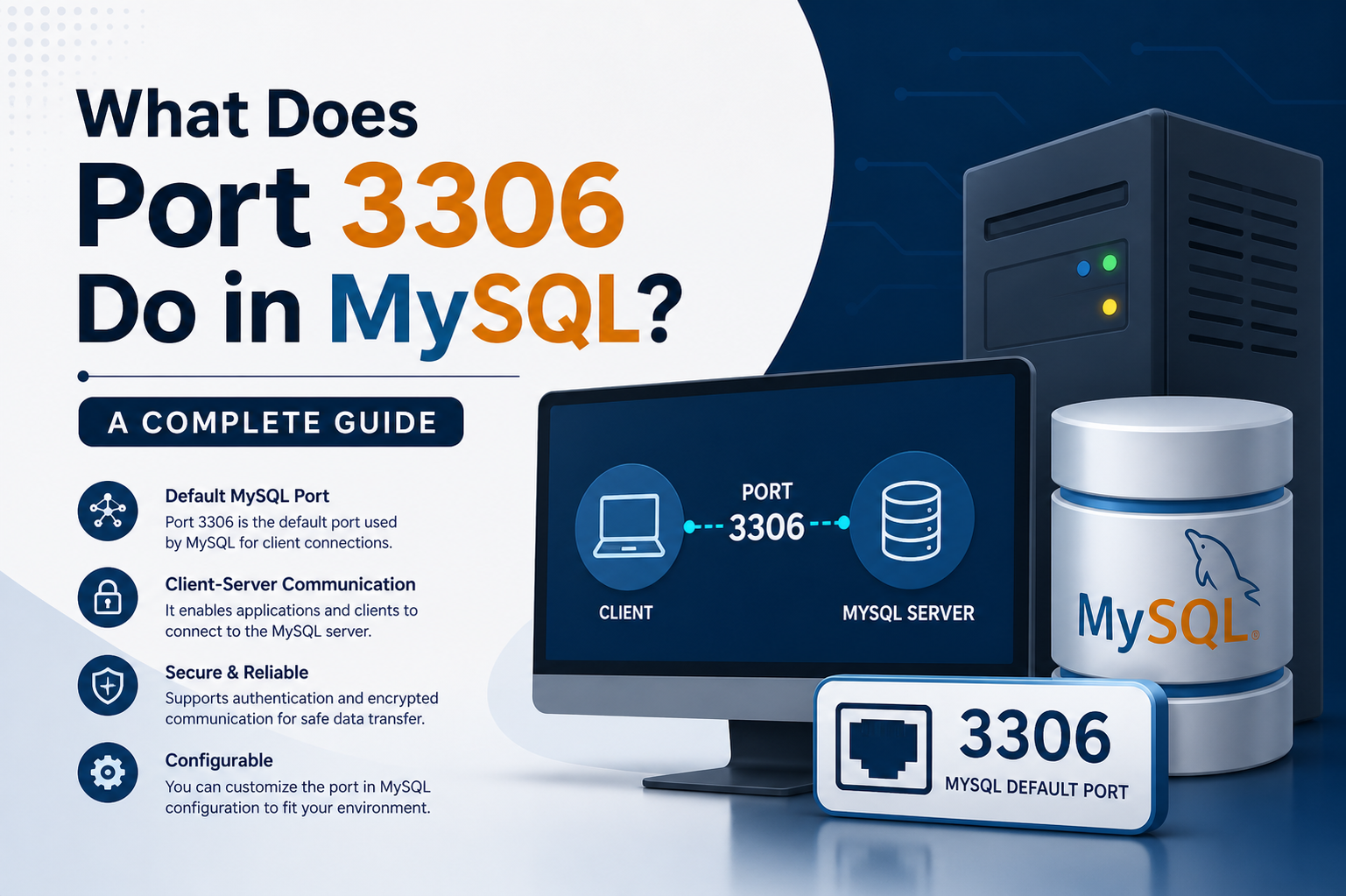
MySQL port 3306 is widely recognized as the default communication gateway used by the MySQL database system to exchange data between applications and database servers. In simple terms, it acts as a dedicated channel through which software applications send requests and receive responses from a MySQL database. Whenever an application needs to store, retrieve, or modify data, it relies on this port to establish a stable and structured connection. This communication is essential for enabling databases to serve dynamic content, manage records, and support real-time operations across various digital platforms.
The concept of a port in networking refers to a logical endpoint that allows different services to operate simultaneously on a single device without interfering with each other. Port 3306 is specifically reserved by convention for MySQL, which helps systems quickly identify where database-related communication should be directed. This standardization simplifies configuration, improves compatibility across tools and applications, and ensures consistent behavior in different environments.
How Port 3306 Enables Database Communication
When an application needs to interact with a MySQL database, it initiates a connection request directed to port 3306 on the database server. This request typically uses the Transmission Control Protocol, commonly known as TCP, which ensures reliable and ordered delivery of data. Once the request reaches the server, MySQL verifies the credentials provided by the client. If authentication is successful, a session is established, allowing the application to send SQL commands and receive results.
This interaction is continuous and dynamic. For example, a web application may send multiple queries within a single session, retrieving user data, updating records, or inserting new entries. Each of these operations flows through port 3306, making it a central component in database-driven systems. Without this port, applications would have no standardized way to communicate with MySQL servers, leading to inconsistencies and potential failures in data handling.
The reliability provided by TCP is particularly important in this context. Database operations often involve critical data, and any loss or corruption during transmission could result in significant issues. TCP ensures that all packets are delivered correctly and in the proper sequence, which is why it is the preferred protocol for MySQL communication over port 3306.
The Role of SQL in Port 3306 Communication
Structured Query Language, commonly known as SQL, is the language used by applications to interact with MySQL databases. Through port 3306, applications send SQL statements that instruct the database on what actions to perform. These actions can range from simple data retrieval to complex data manipulation and analysis.
For instance, when an application needs to fetch information from a database table, it sends a query through port 3306. The MySQL server processes the query, retrieves the relevant data, and sends the results back through the same port. This process happens in real time, enabling applications to deliver dynamic and responsive user experiences.
SQL commands are powerful and versatile, allowing developers to perform a wide range of operations. These include selecting data, inserting new records, updating existing entries, and deleting unwanted information. Each of these operations relies on port 3306 as the communication bridge between the application and the database server.
Why Port 3306 Is the Default Choice
Every network-based service typically has a default port assigned to it, and MySQL is no exception. Port 3306 serves as the standard port for MySQL, meaning that most applications and tools are preconfigured to use it unless specified otherwise. This default setting simplifies deployment and reduces the need for manual configuration.
Using a default port also promotes consistency across different systems and environments. Developers, system administrators, and network engineers can rely on port 3306 as the expected endpoint for MySQL communication, making troubleshooting and maintenance more straightforward. It eliminates ambiguity and ensures that all components in a system can seamlessly connect to the database without additional setup.
However, while port 3306 is the default, it is not mandatory. In certain scenarios, organizations may choose to use a different port for security or operational reasons. Changing the default port can help reduce exposure to automated attacks that target well-known ports. Despite this flexibility, port 3306 remains the most commonly used option due to its widespread recognition and compatibility.
Applications That Depend on Port 3306
A wide variety of applications rely on port 3306 to interact with MySQL databases. These include enterprise systems, web applications, and administrative tools. Enterprise applications often use MySQL to manage large volumes of data, such as customer records, financial transactions, and inventory information. These systems depend on reliable database communication to ensure accurate and efficient operations.
Web applications are among the most common users of MySQL and port 3306. When users interact with a website, such as submitting a form or logging into an account, the application sends requests to the database to process and retrieve information. This interaction happens seamlessly through port 3306, enabling real-time updates and personalized experiences.
Administrative tools also utilize port 3306 to manage and maintain MySQL databases. These tools allow database administrators to perform tasks such as backups, performance monitoring, and configuration management. By connecting through port 3306, they can execute commands and access data directly from the database server.
The Importance of Reliable Data Transfer
Reliability is a critical factor in database communication, and port 3306 plays a key role in ensuring that data is transmitted accurately. The use of TCP provides mechanisms for error detection, retransmission, and flow control, which are essential for maintaining data integrity. This is especially important in scenarios where data consistency is crucial, such as financial systems or transactional applications.
In contrast, the User Datagram Protocol, or UDP, is not commonly used with port 3306 because it does not guarantee reliable delivery. While UDP can be faster in certain situations, it lacks the safeguards needed for database operations. As a result, TCP remains the preferred choice for MySQL communication, ensuring that all data exchanged through port 3306 is accurate and complete.
Security Considerations Around Port 3306
By default, MySQL communication over port 3306 is not encrypted, which means that data transmitted between the client and server could potentially be intercepted. To address this, MySQL can be configured to use secure connections through encryption protocols. When encryption is enabled, both the client and server must support and use the same security mechanisms to establish a protected connection.
Securing port 3306 is essential for protecting sensitive data and preventing unauthorized access. This can be achieved through various measures, such as using strong authentication credentials, restricting access through firewalls, and enabling encryption. These practices help ensure that only authorized users can connect to the database and that data remains secure during transmission.
How Port 3306 Supports Modern Development
Modern software development relies heavily on databases, and port 3306 plays a crucial role in enabling seamless integration between applications and MySQL servers. Developers use various programming languages and frameworks to build applications that interact with databases, and these tools are typically designed to work with port 3306 by default.
Backend programming languages provide libraries and drivers that simplify the process of connecting to MySQL databases. These drivers handle the complexities of network communication, allowing developers to focus on writing application logic. By using port 3306, these tools can establish connections, send queries, and process results efficiently.
Frameworks further enhance this process by providing structured ways to manage database interactions. They often include built-in support for MySQL, making it easier to configure connections and execute queries. Port 3306 serves as the foundation for these interactions, ensuring that applications can communicate with databases reliably and consistently.
The Role of Port 3306 in Data-Driven Systems
Data-driven systems depend on efficient and reliable communication between applications and databases. Port 3306 is a fundamental component of this communication, enabling applications to access and manipulate data in real time. Whether it is a small website or a large enterprise system, the ability to interact with a database is essential for delivering functionality and value.
As data continues to play a central role in technology, the importance of port 3306 remains significant. It provides a standardized and dependable way for applications to connect to MySQL databases, supporting a wide range of use cases and industries. From managing user information to powering complex analytics, port 3306 is at the heart of database communication.
How MySQL Handles Core Database Operations
MySQL performs a set of fundamental operations that are essential for managing data. These operations are often referred to as CRUD, which stands for Create, Read, Update, and Delete. Each of these actions is executed through SQL commands sent over port 3306, allowing applications to interact with the database in a structured and efficient manner.
Creating data involves inserting new records into a database table. Reading data allows applications to retrieve information based on specific criteria. Updating data modifies existing records, while deleting data removes unwanted entries. Together, these operations provide a complete framework for managing data within a MySQL database.
Port 3306 facilitates all of these operations by serving as the communication channel between the application and the database server. It ensures that commands are delivered accurately and that results are returned promptly, enabling smooth and efficient data management.
The Foundation of MySQL Connectivity
At its core, port 3306 represents the foundation of MySQL connectivity. It is the entry point through which all database interactions occur, making it an essential component of any system that relies on MySQL. By providing a standardized and reliable communication pathway, it enables applications to access and manage data effectively.
Understanding how port 3306 works is crucial for anyone involved in database management, software development, or network administration. It provides insight into how applications communicate with databases and highlights the importance of proper configuration and security. As systems continue to evolve, the role of port 3306 remains a key element in ensuring seamless and efficient database operations.
Transport Protocols and Communication Behavior
Port 3306 primarily operates using the Transmission Control Protocol, which ensures that every piece of data exchanged between an application and a MySQL server arrives accurately and in the correct order. This reliability is critical because database interactions often involve structured queries and sensitive information that must not be lost or corrupted during transmission. When a connection is established, TCP performs a handshake process that confirms both the client and server are ready to communicate. This process forms the foundation of stable and persistent database sessions, allowing applications to send multiple requests without reestablishing the connection each time.
Although it is technically possible to use the User Datagram Protocol with port 3306, it is rarely implemented in real-world environments. UDP lacks the reliability mechanisms that TCP provides, such as acknowledgment of received packets and retransmission of lost data. In database systems, where precision and consistency are essential, UDP introduces unnecessary risk. As a result, TCP remains the dominant and practical choice for communication over port 3306, ensuring that all interactions between applications and MySQL servers are dependable and consistent.
Authentication and Session Establishment
Before any meaningful interaction can take place over port 3306, the MySQL server must authenticate the client attempting to connect. This process involves verifying credentials such as usernames and passwords. Once the server confirms the identity of the client, it grants access and establishes a session. This session acts as a secure channel through which SQL commands can be transmitted and executed.
During this stage, the server may also apply access control rules that determine what actions the client is allowed to perform. For example, some users may have permission to read data but not modify it, while others may have full administrative privileges. These permissions are enforced throughout the session, ensuring that database operations remain controlled and secure. Port 3306 facilitates this entire process by acting as the communication endpoint through which authentication requests and responses are exchanged.
Encryption and Secure Communication
By default, communication over port 3306 is not encrypted, which means that data transmitted between the client and server could potentially be intercepted. However, MySQL provides the ability to enable encrypted connections, adding a layer of security to protect sensitive information. When encryption is configured, both the client and server must support and agree on the encryption method before establishing a connection.
Secure communication ensures that data such as login credentials and query results cannot be easily accessed by unauthorized parties. This is particularly important in environments where databases are accessed over public or untrusted networks. Enabling encryption on port 3306 transforms it from a simple communication channel into a secure pathway for data exchange, significantly reducing the risk of data breaches and unauthorized access.
Integration with Web Applications
Modern web applications rely heavily on databases to deliver dynamic and interactive content. Port 3306 plays a central role in enabling this functionality by allowing web servers to communicate with MySQL databases. When a user interacts with a website, such as submitting a form or requesting information, the web server processes the request and sends a corresponding query to the database through port 3306.
The database then processes the query and returns the results, which the web server uses to generate a response for the user. This entire process ঘটে rapidly and seamlessly, creating the impression of real-time interaction. Without port 3306, this communication would not be possible, and web applications would be limited to static content. Its role in enabling dynamic data retrieval and manipulation makes it a cornerstone of modern web development.
Content Management Systems and Database Interaction
Content management systems depend on databases to store and manage large amounts of information, including text, images, and user data. These systems use MySQL as a backend database and rely on port 3306 to handle communication between the application and the database server. Every time content is created, updated, or retrieved, the system sends queries through this port.
This interaction allows content management systems to provide features such as user authentication, content publishing, and data organization. Port 3306 ensures that these operations are carried out efficiently and reliably, enabling the system to handle multiple users and large volumes of data simultaneously. Its role in supporting these platforms highlights its importance in content-driven environments.
Web Frameworks and Simplified Connectivity
Web frameworks are designed to simplify the process of building applications, and they often include built-in support for database connectivity. These frameworks handle the complexities of establishing connections, managing sessions, and executing queries, allowing developers to focus on application logic. Port 3306 serves as the underlying communication channel that these frameworks use to interact with MySQL databases.
By abstracting the technical details of database communication, frameworks make it easier for developers to integrate MySQL into their applications. They provide standardized methods for connecting to the database, executing queries, and handling results. Despite this abstraction, all communication still flows through port 3306, making it an essential component of the development process.
Programming Languages and Database Drivers
Backend programming languages provide libraries and drivers that enable applications to connect to MySQL databases. These drivers are specifically designed to work with port 3306, handling tasks such as connection management, query execution, and data retrieval. When a developer writes code to interact with a database, the driver translates these instructions into network requests that are sent through port 3306.
This process allows applications to perform complex database operations with minimal effort. Developers can use high-level programming constructs to interact with the database, while the driver manages the underlying communication. Port 3306 acts as the bridge between the application and the database server, ensuring that all requests and responses are transmitted accurately.
Client and Server Roles in Communication
In a typical MySQL setup, there are two main components involved in communication: the client and the server. The client is the application or tool that initiates the connection, while the server is the system that hosts the database. Port 3306 is used by both components to establish and maintain communication.
When a client needs to access data, it sends a request to the server through port 3306. The server processes the request and sends back the results through the same port. This bidirectional communication allows for efficient data exchange and ensures that both components remain synchronized. In some cases, server-to-server communication may also occur, particularly in distributed systems or replication setups, further emphasizing the importance of port 3306.
Handling High Volumes of Database Traffic
As applications grow in complexity and user base, the volume of database traffic increases significantly. Port 3306 must handle multiple simultaneous connections, each representing a different client or request. MySQL servers are designed to manage this load by efficiently handling concurrent connections and processing queries in parallel.
This scalability is essential for maintaining performance and responsiveness in high-demand environments. Techniques such as connection pooling and load balancing are often used to optimize the use of port 3306, ensuring that resources are utilized effectively. By managing connections efficiently, systems can maintain high levels of performance even under heavy workloads.
Administrative Tools and Maintenance Operations
Database administrators rely on specialized tools to manage and maintain MySQL servers. These tools connect to the database through port 3306, allowing administrators to perform tasks such as backups, monitoring, and configuration changes. For example, backup utilities can connect to the database and extract data for storage, ensuring that it can be restored in case of failure.
Monitoring tools use port 3306 to gather information about database performance, such as query execution times and resource usage. This data helps administrators identify and resolve issues, ensuring that the system operates smoothly. Port 3306 serves as the gateway for these operations, enabling administrators to maintain control over the database environment.
The Importance of Connection Management
Effective connection management is crucial for maintaining the performance and stability of systems that rely on port 3306. Each connection consumes resources on both the client and server, so it is important to manage them efficiently. Techniques such as reusing connections and limiting the number of simultaneous connections can help prevent resource exhaustion.
Connection timeouts and idle connection handling are also important considerations. If connections are left open unnecessarily, they can consume valuable resources and degrade performance. Properly managing connections ensures that port 3306 can handle the demands of modern applications without becoming a bottleneck.
The Expanding Role of Port 3306 in Modern Systems
As technology continues to evolve, the role of port 3306 extends beyond traditional database applications. It is increasingly used in cloud-based environments, microservices architectures, and containerized applications. These modern systems rely on efficient and reliable database communication, making port 3306 more important than ever.
In containerized environments, multiple services may need to access the same database. Port 3306 enables these services to communicate with the database server, regardless of their location or deployment model. This flexibility allows developers to build scalable and modular applications that can adapt to changing requirements.
The continued relevance of port 3306 highlights its importance as a fundamental component of database connectivity. Its ability to support a wide range of use cases and environments ensures that it remains a key element in the architecture of modern applications.
Security Risks Associated with Port 3306
Port 3306, while essential for MySQL communication, can also become a target for malicious activity if not properly secured. Because it is the default port and widely known, attackers often scan networks specifically looking for systems that expose this port to the internet. Once discovered, these systems may be subjected to various attack techniques aimed at gaining unauthorized access to the database. The risk increases significantly when security configurations are weak or outdated, making it easier for attackers to exploit vulnerabilities.
One of the primary concerns is unauthorized access through poorly configured permissions or exposed services. If a MySQL server allows connections from any IP address without proper restrictions, it creates an open entry point for attackers. Port 3306 essentially becomes a gateway that, if left unprotected, can lead directly to sensitive data. This highlights the importance of limiting access only to trusted sources and ensuring that database services are not unnecessarily exposed to public networks.
SQL Injection and Application-Level Threats
SQL injection is one of the most well-known attack methods targeting database systems. It occurs when an attacker inserts malicious SQL code into input fields of an application, which is then executed by the database. Since applications communicate with MySQL through port 3306, any vulnerability in the application layer can indirectly expose the database to exploitation.
For example, if user input is not properly validated or sanitized, an attacker can manipulate queries to retrieve unauthorized data or even modify the database structure. This type of attack does not directly target the port itself but uses it as the pathway through which malicious commands are executed. Preventing SQL injection requires secure coding practices, including input validation, parameterized queries, and proper error handling.
Brute Force Attacks on Database Credentials
Another common threat associated with port 3306 is brute force attacks. In this scenario, attackers attempt to gain access by repeatedly trying different username and password combinations. Because port 3306 is the entry point for MySQL authentication, it becomes the focus of these attacks. Automated tools can rapidly test thousands of credential combinations, increasing the likelihood of success if weak passwords are used.
The effectiveness of brute force attacks depends largely on the strength of the credentials protecting the database. Weak or commonly used passwords significantly increase the risk of unauthorized access. Implementing strong password policies, limiting login attempts, and using additional authentication mechanisms can greatly reduce the chances of a successful attack. Port 3306 itself is not inherently insecure, but its exposure makes it a frequent target for such activities.
The Importance of Strong Password Policies
Password security plays a crucial role in protecting MySQL databases accessed through port 3306. Strong passwords act as the first line of defense against unauthorized access. A secure password should be complex, unique, and difficult to guess, incorporating a mix of letters, numbers, and special characters.
Organizations often enforce password policies to ensure that users create strong credentials. These policies may include requirements for minimum length, complexity, and periodic updates. By enforcing these rules, the risk of brute force attacks and unauthorized access can be significantly reduced. Additionally, avoiding the reuse of passwords across multiple systems further enhances security.
Port 3306 serves as the gateway for authentication, so ensuring that only strong credentials are accepted is essential for maintaining the integrity of the database. Weak passwords can undermine even the most advanced security measures, making it critical to prioritize this aspect of database protection.
Firewall Configuration and Network Restrictions
One of the most effective ways to secure port 3306 is through proper firewall configuration. Firewalls can be used to control which systems are allowed to connect to the MySQL server, effectively limiting access to trusted sources. By restricting incoming connections to specific IP addresses or networks, administrators can prevent unauthorized access attempts from external sources.
Network segmentation is another important strategy. By placing the database server within a private network and restricting access through controlled gateways, organizations can reduce exposure to potential threats. Port 3306 should ideally not be accessible directly from the public internet unless absolutely necessary. Instead, connections should be routed through secure channels, such as virtual private networks or application servers.
These measures help ensure that port 3306 is only accessible to authorized clients, significantly reducing the attack surface and enhancing overall security.
Encryption and Data Protection Strategies
While port 3306 does not use encryption by default, enabling secure communication is a critical step in protecting data. Encryption ensures that any information transmitted between the client and server cannot be easily intercepted or read by unauthorized parties. This is especially important when dealing with sensitive data such as personal information or financial records.
When encryption is enabled, both the client and server must support the same security protocols. This ensures that data is securely transmitted and that the connection cannot be easily compromised. In addition to encryption, other data protection strategies such as secure key management and certificate validation further enhance the security of communication over port 3306.
By implementing these measures, organizations can transform port 3306 into a secure communication channel, protecting both the integrity and confidentiality of the data being transmitted.
Common Exploits Targeting Port 3306
Attackers often use a variety of techniques to exploit systems that expose port 3306. These techniques may include scanning for open ports, identifying vulnerable MySQL versions, and attempting to exploit known weaknesses. Once a vulnerability is identified, attackers may attempt to gain access to the database or disrupt its operation.
Exploits can also target misconfigurations, such as default credentials or unnecessary privileges. For example, if a database user has more permissions than required, an attacker who gains access to that account can perform a wider range of actions. This underscores the importance of following the principle of least privilege, where users are granted only the permissions necessary for their role.
Regular updates and patches are also essential for protecting against known vulnerabilities. Keeping the MySQL server up to date ensures that security fixes are applied, reducing the risk of exploitation through port 3306.
Port Scanning and Exposure Risks
Port scanning is a common technique used by attackers to identify open ports on a system. Since port 3306 is associated with MySQL, it is often included in these scans. If the port is found to be open, it signals the presence of a MySQL server, making it a potential target for further attacks.
Reducing exposure is key to mitigating this risk. This can be achieved by closing unused ports, using non-default ports, or implementing intrusion detection systems that monitor for suspicious activity. While changing the port number does not eliminate risk entirely, it can reduce the likelihood of automated attacks that target default configurations.
Port 3306 should be carefully managed to ensure that it is only accessible when necessary and that appropriate security measures are in place to protect it from unauthorized access.
Managing Access Control and User Privileges
Access control is a critical aspect of securing MySQL databases. By defining user roles and permissions, administrators can control what actions each user is allowed to perform. This ensures that even if a user account is compromised, the potential damage is limited.
Port 3306 is the entry point for all database interactions, so enforcing strict access control policies is essential. Users should only be granted the permissions they need to perform their tasks, and administrative privileges should be restricted to trusted individuals. Regular audits of user accounts and permissions can help identify and address potential security issues.
Proper access control not only enhances security but also improves accountability, as each action can be traced back to a specific user. This is particularly important in environments where data integrity and compliance are critical.
The Role of Monitoring and Logging
Monitoring and logging are essential for detecting and responding to security incidents involving port 3306. By tracking connection attempts, query activity, and system events, administrators can identify unusual behavior that may indicate an attack. For example, repeated failed login attempts could signal a brute force attack, while unexpected queries may indicate unauthorized access.
Logs provide valuable insights into how the database is being used and can help identify potential vulnerabilities. By analyzing this data, administrators can take proactive measures to strengthen security and prevent future incidents. Port 3306 serves as the نقطة of entry for all database interactions, making it a key focus for monitoring efforts.
Implementing automated alerting systems can further enhance security by notifying administrators of suspicious activity in real time. This allows for quick response and mitigation, reducing the potential impact of security incidents.
Balancing Accessibility and Security
While securing port 3306 is essential, it is also important to ensure that legitimate users can access the database without unnecessary barriers. Striking the right balance between accessibility and security is a key challenge for administrators. Overly restrictive measures can hinder productivity, while insufficient security can expose the system to risks.
Achieving this balance requires careful planning and ongoing management. By implementing layered security measures, such as firewalls, encryption, and access control, organizations can create a secure environment that still allows for efficient database access. Port 3306 remains the central point of communication, and its proper management is critical for maintaining both security and functionality.
As systems continue to evolve, the importance of securing port 3306 will only increase. By understanding the risks and implementing best practices, organizations can protect their databases and ensure reliable and secure communication.
Port Conflicts and Service Limitations
Port 3306, like any network port, can only be actively used by a single service at a time on a given system. This limitation is fundamental to how operating systems manage network communication. When a MySQL server binds to port 3306, it reserves that port exclusively for its own use. If another service attempts to use the same port simultaneously, a conflict occurs, preventing the second service from starting or functioning correctly.
These conflicts often arise in environments where multiple database services or applications are installed on the same machine. For example, if a previous MySQL instance is still running in the background, a new instance will not be able to bind to port 3306 until the existing one is stopped. Identifying and resolving such conflicts requires checking active services and ensuring that only one process is assigned to the port at any given time. This highlights the importance of proper service management and awareness of system resource usage.
Running Multiple MySQL Instances on Different Ports
Although only one service can use port 3306 at a time, it is entirely possible to run multiple MySQL instances on the same system by assigning them different ports. Each instance operates independently, with its own configuration, data directory, and network settings. By configuring additional instances to use alternative ports, administrators can create isolated environments for testing, development, or multi-tenant applications.
For instance, one MySQL instance may continue to use port 3306 as the primary database, while another instance runs on a different port such as 3307 or 3308. Applications must then be configured to connect to the appropriate port depending on which database instance they need to access. This flexibility allows for efficient resource utilization and supports complex deployment scenarios without requiring separate physical servers.
Managing multiple instances requires careful planning to avoid confusion and ensure that each service is properly maintained. Clear documentation and consistent naming conventions can help administrators keep track of different configurations and prevent operational issues.
Containerization and Sharing MySQL Across Services
In modern development environments, containerization has become a popular approach for deploying applications. Containers allow developers to package applications and their dependencies into isolated units that can run consistently across different environments. When using containers, multiple services often need to access a single MySQL database, and port 3306 plays a crucial role in enabling this communication.
To share a MySQL database with multiple containers, the database service is typically exposed on port 3306, allowing other containers to connect to it over a network. This setup ensures that all services can interact with the same database while maintaining their own isolated environments. Proper network configuration is essential to ensure that containers can discover and communicate with the database service reliably.
In such architectures, port 3306 acts as a central hub for database communication. Each containerized application connects to the database through this port, sending queries and receiving responses as needed. This approach simplifies data management and ensures consistency across different components of the system.
Scaling Applications with Port 3306
As applications grow and user demand increases, the need for scalable database solutions becomes more important. Port 3306 supports scalability by enabling multiple clients to connect to a single MySQL server simultaneously. The server manages these connections and processes queries efficiently, allowing applications to handle increased workloads without significant performance degradation.
Scaling can be achieved through various techniques, such as adding more powerful hardware, optimizing database queries, or distributing the workload across multiple servers. In distributed systems, multiple MySQL servers may be used to handle different aspects of the workload, such as read and write operations. Even in these complex setups, port 3306 remains the primary communication channel for database interactions.
Load balancing and replication are also commonly used to improve scalability and reliability. Load balancers can distribute incoming connections across multiple database servers, while replication ensures that data is synchronized between servers. These techniques enhance performance and provide redundancy, ensuring that applications remain responsive even under heavy load.
Replication and Server-to-Server Communication
MySQL replication is a powerful feature that allows data to be copied from one server to another. This is commonly used for backup purposes, load distribution, and high availability. In replication setups, port 3306 is often used for communication between the primary server and its replicas.
The primary server sends updates to the replicas, which apply the changes to their own copies of the database. This process ensures that all servers remain synchronized and that data is consistently available across the system. Replication can be configured in various ways, including one-to-one, one-to-many, and even complex multi-source arrangements.
Server-to-server communication over port 3306 must be carefully secured to prevent unauthorized access and ensure data integrity. Encryption and authentication mechanisms are typically used to protect replication traffic, ensuring that only trusted servers can participate in the replication process.
Performance Optimization and Port Usage
Optimizing the performance of MySQL communication over port 3306 involves several factors, including network configuration, query efficiency, and resource management. Efficient use of the port ensures that applications can communicate with the database بسرعة and without unnecessary delays.
One important aspect of performance optimization is minimizing latency, which is the time it takes for data to travel between the client and server. This can be achieved by optimizing network routes, reducing unnecessary overhead, and ensuring that the server is located close to the application in terms of network topology. Additionally, optimizing SQL queries can reduce the amount of data that needs to be transmitted, further improving performance.
Connection pooling is another technique that enhances performance by reusing existing connections instead of creating new ones for each request. This reduces the overhead associated with establishing connections and allows port 3306 to handle a larger number of requests efficiently.
Troubleshooting Connectivity Issues
Issues with port 3306 can disrupt database communication and impact application performance. Common problems include blocked ports, incorrect configurations, and network failures. Troubleshooting these issues requires a systematic approach to identify and resolve the underlying cause.
One of the first steps is to verify that the MySQL service is running and listening on port 3306. If the service is not active, it must be started before connections can be established. Firewall settings should also be checked to ensure that the port is not being blocked. Network connectivity between the client and server must be confirmed, as any disruption can prevent successful communication.
Logs and diagnostic tools can provide valuable insights into connectivity issues. By analyzing error messages and connection logs, administrators can identify patterns and pinpoint the source of the problem. Addressing these issues promptly ensures that port 3306 remains a reliable communication channel for database operations.
Custom Port Configuration and Flexibility
While port 3306 is the default for MySQL, it is not the only option. Administrators can configure MySQL to use a different port if needed. This flexibility can be useful for avoiding conflicts, enhancing security, or meeting specific organizational requirements.
Changing the port requires updating both the server configuration and any client applications that connect to the database. Once the new port is set, all communication must be directed to that port instead of 3306. Although this adds an extra step to configuration, it can provide additional control over how the database is accessed.
Using non-default ports can also reduce the likelihood of automated attacks that target well-known ports. However, it should not be relied upon as the sole security measure. Comprehensive security practices must still be implemented to protect the database.
Future Relevance of Port 3306
Despite the rapid evolution of technology, port 3306 continues to play a vital role in database communication. Its widespread adoption and compatibility with a vast ecosystem of tools and applications ensure that it remains relevant in modern computing environments. From traditional server setups to cloud-based architectures, port 3306 provides a consistent and reliable means of connecting to MySQL databases.
As new technologies emerge, the principles underlying port 3306 remain applicable. Reliable communication, secure data exchange, and efficient resource management are fundamental requirements for any database system. Port 3306 embodies these principles, making it a cornerstone of MySQL connectivity.
Final Conclusion
Port 3306 serves as the backbone of MySQL communication, enabling applications, servers, and tools to interact with databases in a structured and reliable manner. It provides a standardized pathway for sending queries, receiving results, and managing data across a wide range of environments. From simple web applications to complex distributed systems, its role remains essential in ensuring seamless database operations.
Understanding how port 3306 works, along with its associated risks and best practices, is crucial for building secure and efficient systems. By properly configuring, securing, and managing this port, organizations can ensure that their databases remain accessible, performant, and protected. Its continued importance in modern technology highlights its value as a fundamental component of database-driven applications.