Modern web applications are expected to be fast, responsive, and capable of handling massive volumes of traffic without slowing down. Whether it’s an e-commerce platform during a sale, a social media feed updating in real time, or a streaming service serving millions of users simultaneously, performance is everything. One of the biggest bottlenecks in achieving high performance is the time it takes to retrieve data from a database. Even well-optimized databases can struggle under heavy loads, leading to delays that directly impact user experience. This is where Redis becomes incredibly valuable.
Understanding Redis at Its Core
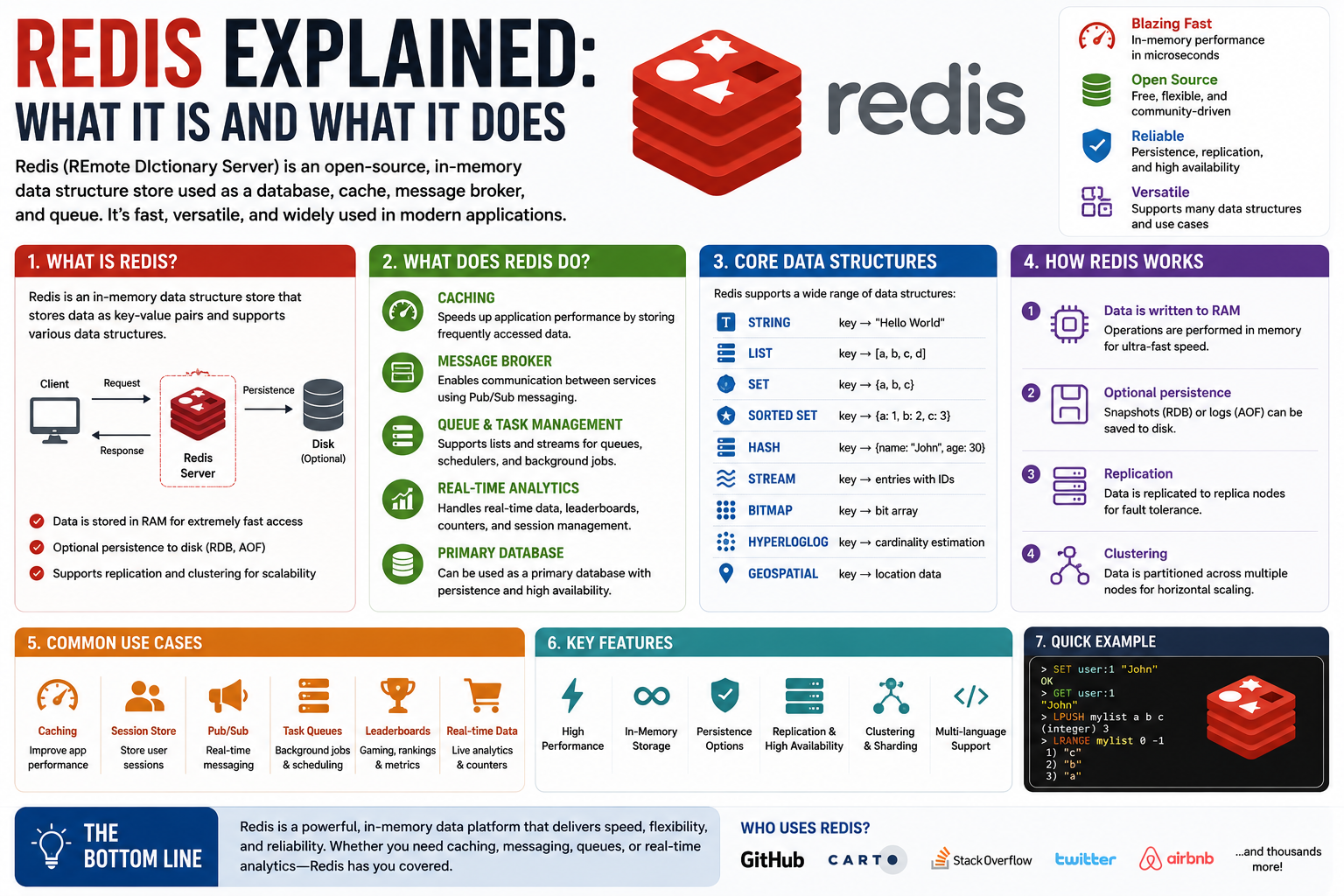
Redis is an in-memory data store primarily used as a caching layer to improve application performance. While it is often referred to as a cache, Redis is more than just that. It is a powerful data structure store that can function as a database, cache, and message broker. What makes Redis unique is where and how it stores data. Unlike traditional databases that rely on disk-based storage, Redis stores data in system memory, also known as RAM.
This design choice is critical. Accessing data from RAM is significantly faster than retrieving it from a hard drive or even a solid-state drive. Because of this, Redis can deliver responses in milliseconds, making it ideal for applications that require real-time or near real-time performance.
Why Speed Matters in Modern Applications
In a typical application, when a user requests data, the system often queries a database. Even under ideal conditions, database queries can take hundreds of milliseconds. When scaled across thousands or millions of users, this delay compounds and becomes a major performance issue. Additionally, databases are often hosted on separate servers, meaning every request involves network communication, further increasing latency.
Redis helps solve this problem by acting as a high-speed intermediary. Instead of querying the database every time, the application first checks Redis. If the requested data is already stored there, it is returned instantly. This drastically reduces response time and minimizes the load on the database.
How Redis Stores Data
Redis uses a key-value data model. This means every piece of data is stored as a value associated with a unique key. This approach is simple yet extremely efficient. Unlike relational databases that organize data into tables with rows and columns, Redis focuses on direct access, which contributes to its speed.
In addition to basic key-value pairs, Redis supports advanced data structures such as lists, sets, sorted sets, hashes, and more. These structures allow developers to handle complex data scenarios efficiently without sacrificing performance.
Redis Compared to Traditional Databases
Traditional databases are designed for durability and long-term storage. They ensure that data is preserved even if the system shuts down unexpectedly. Redis, on the other hand, prioritizes speed over persistence. Since it stores data in memory, it is considered volatile, meaning data can be lost if the system loses power or restarts.
This difference highlights an important point: Redis is not typically used as a replacement for a primary database. Instead, it works alongside one. The database remains the source of truth, while Redis serves as a fast-access layer that improves performance.
Volatility and Data Persistence
Because Redis operates in memory, data persistence becomes a consideration. If the system crashes or restarts, the data stored in Redis may be lost unless persistence mechanisms are configured. While Redis does offer options for saving data to disk periodically, it is still primarily used for temporary data that can be reconstructed from a more permanent source.
For this reason, critical or long-term data should always be stored in a traditional database. Redis is best used for data that is frequently accessed and can be quickly regenerated if needed.
Common Use Cases of Redis
Redis is widely used in various scenarios where speed and efficiency are essential. One of the most common use cases is caching database query results. By storing frequently requested data in Redis, applications can avoid repeated database queries, significantly improving performance.
Another common use case is session management. Web applications often need to store user session data, such as login states or preferences. Redis is ideal for this because it allows quick read and write operations.
Redis is also used for real-time analytics, leaderboards, messaging systems, and rate limiting. Its support for different data structures makes it versatile enough to handle a wide range of application needs.
Reducing Database Load
One of the biggest advantages of using Redis is the reduction in database workload. Databases can become overwhelmed when handling a large number of concurrent requests. By offloading frequent read operations to Redis, the database is freed up to handle more critical tasks.
This not only improves performance but also enhances scalability. Applications can support more users without requiring significant changes to the underlying database infrastructure.
Improving User Experience
Speed directly impacts user satisfaction. Slow-loading applications can frustrate users and lead to higher bounce rates. Redis helps ensure that applications remain fast and responsive, even under heavy traffic.
By delivering data quickly, Redis contributes to a smoother user experience. This is particularly important for applications where real-time interaction is expected, such as online gaming, financial platforms, and social media services.
Reducing Network Overhead
In many architectures, databases are hosted on separate servers or even in different regions. Each request to the database involves network communication, which adds latency. Redis can be deployed closer to the application, reducing the need for repeated network calls.
This not only speeds up data retrieval but also reduces network congestion, leading to more efficient system performance overall.
How Redis Works in Practice
When a user requests data, the application follows a simple process. It first checks Redis to see if the data is already available. If it is, the data is returned immediately. If not, the application queries the database, retrieves the data, returns it to the user, and then stores it in Redis for future use.
This approach is often referred to as cache-aside or lazy loading. It ensures that only frequently accessed data is stored in Redis, optimizing memory usage.
Data Synchronization Strategies
Since Redis is not the primary data store, it must stay in sync with the database. This can be achieved in several ways. One approach is to update Redis whenever data is written to the database. Another approach is to use background processes that monitor changes and update Redis accordingly.
These strategies ensure that the data in Redis remains accurate and consistent with the database, preventing issues such as stale or outdated information.
Deployment Options for Redis
Redis can be deployed in various environments depending on the needs of the application. It can be installed locally for development and testing or deployed on servers for production use. Many organizations prefer using managed cloud services for Redis because they simplify setup, maintenance, and scaling.
Cloud-based Redis solutions often include features such as automatic backups, high availability, and data replication. These features reduce the operational burden and ensure reliability in production environments.
Scalability and High Availability
Redis is designed to scale. It supports clustering, which allows data to be distributed across multiple nodes. This ensures that the system can handle large datasets and high traffic volumes.
High availability is achieved through replication, where data is copied across multiple instances. If one instance fails, another can take over, ensuring uninterrupted service. These capabilities make Redis suitable for mission-critical applications.
Security Considerations
While Redis is powerful, it must be properly secured. Since it is often used as a central component in application architecture, unauthorized access can lead to serious issues. Security measures such as authentication, encryption, and network isolation should be implemented to protect data.
Performance Benefits in Real-World Scenarios
In real-world applications, Redis can reduce response times from hundreds of milliseconds to just a few milliseconds. This improvement may seem small in isolation, but at scale, it has a significant impact. Faster response times lead to better user engagement, higher conversion rates, and improved overall performance.
Flexibility and Versatility
Redis is not limited to caching. Its support for various data structures allows it to be used in creative ways. For example, sorted sets can be used to build leaderboards, while lists can be used for task queues. This flexibility makes Redis a valuable tool in modern application development.
Ease of Integration
Redis integrates easily with most programming languages and frameworks. It has a simple command structure and a wide range of client libraries, making it accessible to developers. This ease of use contributes to its popularity and widespread adoption.
When to Use Redis
Redis is best suited for scenarios where speed is critical and data access patterns are predictable. It is particularly useful for read-heavy applications, real-time systems, and situations where reducing database load is a priority.
However, it should not be used as the sole data store for critical information unless proper persistence and backup strategies are in place.
Conclusion
Redis is a powerful tool that plays a crucial role in modern application architecture. By storing data in memory, it delivers exceptional speed and performance, making it ideal for caching and real-time data processing. While it is not a replacement for traditional databases, it complements them by reducing load, improving response times, and enhancing scalability.
Its ability to handle various data structures, support high availability, and integrate seamlessly with different technologies makes it a versatile solution for developers. When used correctly, Redis can transform the performance of an application, ensuring that it remains fast, efficient, and capable of handling even the most demanding workloads.