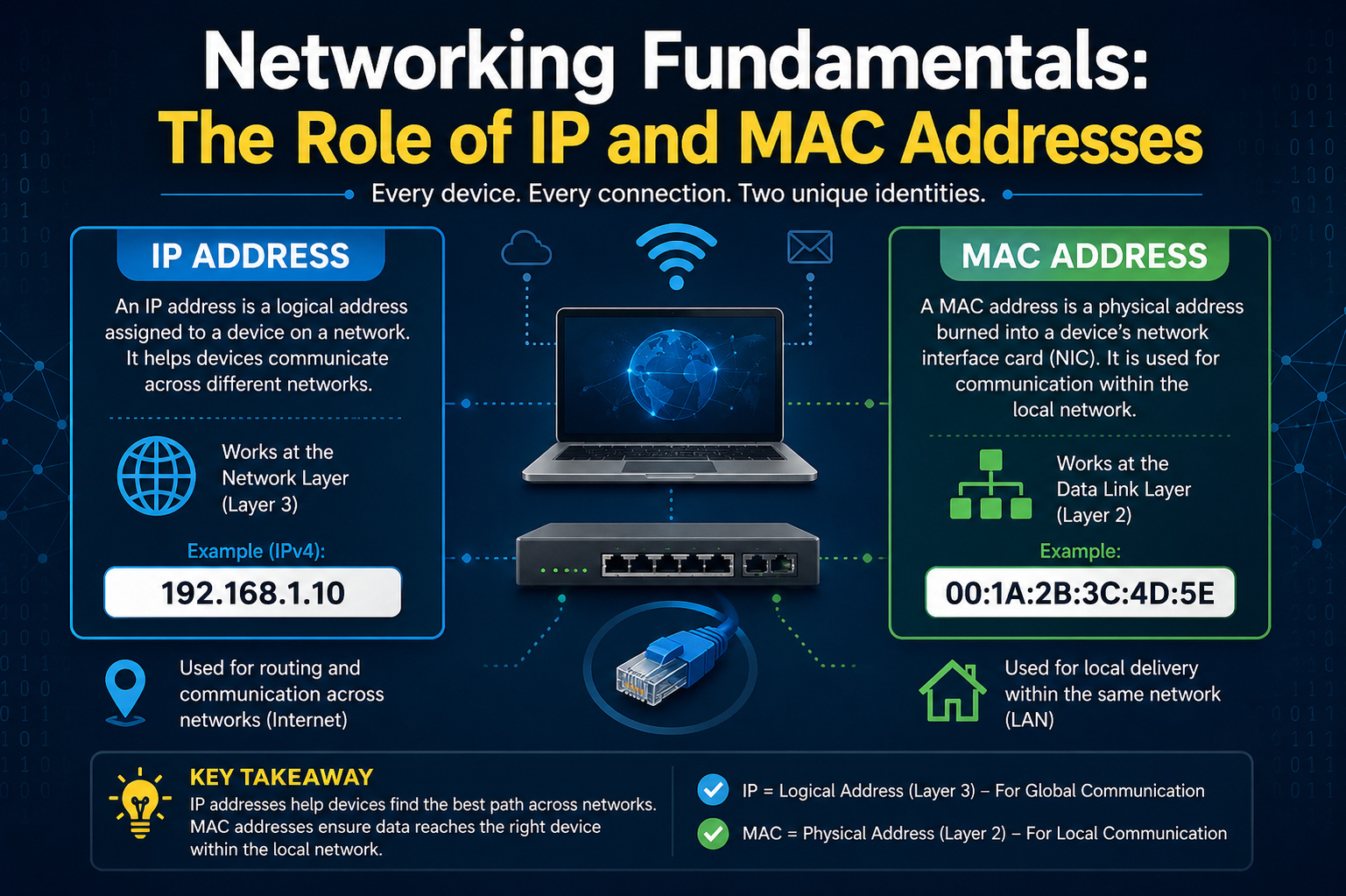
In modern networking, every device that connects to a network must be uniquely identifiable. This identification is what allows data to travel from one device to another without confusion or loss. Two key elements make this possible: IP addresses and MAC addresses. While they may seem similar at first glance, they serve very different purposes and operate at different layers of networking. A MAC address is tied directly to the physical hardware of a device, while an IP address is more flexible and can change depending on the network environment. Together, they create a system that ensures communication across both local and global networks happens efficiently and accurately. Understanding how these identifiers function is essential for grasping even the most basic networking concepts, whether you’re browsing the web or managing a network setup.
The Hidden Complexity Behind Simple Internet Actions
When you type a website address into your browser and press enter, the process feels almost instant. However, behind this simple action lies a complex series of operations that ensure your request reaches the correct destination and that the response finds its way back to you. Your device must determine where to send the request, identify itself to the network, and navigate through multiple layers of communication protocols. During this process, both IP and MAC addresses play critical roles. The IP address helps route your request across networks, potentially spanning the globe, while the MAC address ensures that data is delivered to the correct device within a local network. Without these systems working together, the internet as we know it would not function.
Defining the MAC Address as a Hardware Identifier
A MAC address, short for Media Access Control address, is a unique identifier assigned to a device’s network interface. This address is embedded into the hardware by the manufacturer, making it a permanent feature of the device. It is typically represented as a 12-digit hexadecimal number, divided into pairs for readability. Because of its design, every MAC address is intended to be globally unique, which ensures that no two devices share the same identifier at the hardware level. This uniqueness is critical for local network communication, as it allows routers and switches to distinguish between devices connected to the same network. Even though most users never interact directly with MAC addresses, they are constantly in use behind the scenes.
Why MAC Addresses Are Considered Physical Addresses
MAC addresses are often referred to as physical addresses because they are directly tied to the hardware of a device. Unlike IP addresses, which can be assigned and reassigned, a MAC address remains constant throughout the life of the network interface. This permanence makes it especially useful for identifying devices within a local network environment. When data is transmitted across a network, it ultimately needs to reach a specific physical device, and the MAC address provides the means to do so. Even if a device changes networks or receives a new IP address, its MAC address remains the same, acting as a consistent point of identification at the hardware level.
Understanding the Structure of a MAC Address
The structure of a MAC address is not random; it is carefully organized to include information about the manufacturer and the specific device. The first portion of the address identifies the organization that produced the network interface, while the remaining portion is a unique identifier assigned by that manufacturer. This structured approach ensures that no two devices end up with the same MAC address, even when produced in large quantities. The use of hexadecimal notation allows for a vast number of possible combinations, making it highly unlikely for duplicates to occur. This design supports the scalability of modern networking, where billions of devices are connected worldwide.
Defining the IP Address as a Logical Identifier
In contrast to MAC addresses, IP addresses serve as logical identifiers for devices on a network. They are not permanently tied to hardware and can change depending on the network configuration. An IP address allows a device to be located within a network and enables communication between devices across different networks. It functions much like a mailing address, directing data to the correct destination. However, unlike a physical address, an IP address can be reassigned or updated as needed. This flexibility is essential for managing large and dynamic networks, where devices frequently join and leave.
Dynamic Nature of IP Address Assignment
In modern networks, most IP addresses are assigned dynamically rather than being permanently fixed. This means that when a device connects to a network, it is temporarily given an IP address from a pool of available addresses. This assignment can change over time, especially when the device reconnects or the network resets. Dynamic addressing helps conserve IP address space and simplifies network management. It allows administrators to efficiently allocate addresses without needing to manually configure each device. While some devices may use static IP addresses for consistency, the majority rely on dynamic assignment for everyday connectivity.
Static vs Dynamic IP Addressing Concepts
Static IP addresses are those that remain constant and are manually assigned to a device. These are often used for servers or systems that need to be reliably accessible at a fixed address. On the other hand, dynamic IP addresses are automatically assigned and can change over time. Each approach has its advantages depending on the use case. Static addresses provide stability and predictability, while dynamic addresses offer flexibility and ease of management. Understanding the difference between these two types of IP addressing is important for designing and maintaining efficient networks.
The Role of IP Addresses in Communication Across Networks
IP addresses are essential for enabling communication beyond a local network. When data needs to travel from one network to another, the IP address acts as the primary identifier that guides the data along its path. Routers use IP addresses to determine the best route for delivering packets to their destination. This process involves analyzing the destination IP address and forwarding the data through a series of interconnected networks until it reaches its final endpoint. Without IP addressing, it would be impossible to coordinate communication across the vast and complex structure of the internet.
Introducing the Concept of Subnet Masks
A subnet mask is another critical component in networking that works alongside IP addresses. It helps determine which portion of an IP address refers to the network and which part identifies the specific device within that network. By applying a subnet mask, a system can understand whether a destination is within the same local network or requires routing through a gateway. This distinction is important for efficient communication, as it allows devices to send data directly when possible or rely on routers when necessary. Subnet masks act as a guide for interpreting IP addresses correctly.
Breaking Down Network and Host Portions
Every IP address is divided into two main parts: the network portion and the host portion. The network portion identifies the broader network to which the device belongs, while the host portion specifies the individual device within that network. The subnet mask defines how this division is made. For example, in a common subnet configuration, the first part of the address may represent the network, while the remaining part identifies the host. This separation allows networks to be organized logically and supports efficient data routing. Understanding this division is fundamental to grasping how devices communicate within and across networks.
How Subnet Masks Simplify Network Communication
Subnet masks simplify communication by enabling devices to quickly determine whether a destination is local or remote. If the destination IP address matches the network portion of the sender’s address, the data can be sent directly. If not, it must be forwarded to a router for further processing. This decision-making process happens automatically and is crucial for maintaining efficient network performance. By clearly defining network boundaries, subnet masks help reduce unnecessary traffic and ensure that data takes the most appropriate path to its destination.
The Interdependence of MAC and IP Addresses
While MAC and IP addresses serve different purposes, they are deeply interconnected in practical networking scenarios. When a device wants to communicate with another device on the same network, it uses the IP address to identify the destination logically. However, the actual delivery of data relies on the MAC address. This means that both identifiers must work together to complete the communication process. The IP address provides the “what” and “where,” while the MAC address ensures the “how” at the hardware level. This collaboration is essential for seamless data transfer within local networks.
Understanding Local Network Communication Dynamics
Within a local area network, devices communicate using a combination of IP and MAC addressing. When one device needs to send data to another, it first determines whether the destination is on the same network. If it is, the device must find the MAC address associated with the destination IP address. This process involves consulting a local cache or initiating a request to discover the correct mapping. Once the MAC address is known, the data can be packaged and delivered directly to the target device. This efficient system allows for quick and reliable communication within a network.
The Importance of Address Resolution Processes
To bridge the gap between IP and MAC addresses, networks use a process that resolves one into the other. This process ensures that devices can translate logical addresses into physical ones when needed. It plays a critical role in enabling communication, as it allows devices to locate each other accurately within a network. Without this mechanism, devices would struggle to deliver data correctly, leading to communication failures. Address resolution is a foundational concept that underpins many networking operations and ensures that the system functions smoothly.
Building a Strong Foundation in Networking Concepts
Understanding how IP addresses, MAC addresses, and subnet masks work together provides a strong foundation for learning more advanced networking topics. These basic elements form the building blocks of all network communication, from small home setups to large enterprise systems. By mastering these concepts, you gain insight into how data moves, how devices interact, and how networks are structured. This knowledge is not only useful for technical professionals but also for anyone who wants to better understand the technology they use every day.
Exploring Communication Within a Home Network Environment
In a typical home network, multiple devices connect to a single router that acts as the central hub for communication. These devices may include computers, smartphones, gaming consoles, smart TVs, and other connected equipment. Even though each device performs different tasks, they all rely on the same underlying networking principles to communicate with one another and access the internet. The router assigns IP addresses to each device, ensuring that every connection remains organized and conflict-free. At the same time, each device retains its own unique MAC address, which is used for identification at the hardware level. This combination allows all devices to coexist and interact smoothly within the same network.
Understanding Default Private IP Address Ranges
Most home networks operate within a predefined range of private IP addresses. These ranges are reserved specifically for internal use and are not directly accessible from the public internet. One of the most commonly used ranges starts with 192.168.x.x, which is often the default configuration for residential routers. This setup ensures that devices within the home network can communicate with each other securely while sharing a single public IP address for external communication. By using private IP ranges, networks can support multiple devices without requiring a unique public address for each one, making the system more efficient and scalable.
How Routers Assign Unique IP Addresses to Devices
When a device connects to a network, the router automatically assigns it an IP address from a pool of available addresses. This process ensures that no two devices share the same IP address at the same time, which could otherwise cause communication conflicts. The assignment is typically handled by a system that manages address distribution dynamically, allowing devices to join and leave the network without manual configuration. Each assigned IP address includes a common network portion and a unique host portion, making it easy to identify both the network and the specific device. This system keeps the network organized and ensures smooth communication between devices.
Visualizing Devices Within the Same Network Segment
Imagine a scenario where several devices are connected to the same network. Each device shares the same network prefix but has a different ending value that distinguishes it from others. For example, one device might end in .5, another in .6, and so on. This structure allows the network to group devices logically while still maintaining unique identifiers for each one. When a device wants to communicate with another, it uses the shared network portion to recognize that the destination is local. This recognition simplifies the communication process and reduces the need for external routing.
Initiating Communication Between Devices on a Network
When one device needs to send data to another within the same network, it begins by identifying the destination using its IP address. The sending device checks whether the destination IP belongs to the same network. If it does, the device prepares to send the data directly rather than forwarding it through a router to an external network. However, before the data can be delivered, the sending device must determine the physical MAC address associated with the destination IP. This step is crucial because the actual transmission of data on a local network relies on MAC addresses rather than IP addresses alone.
The Role of the Router in Internal Communication
Although devices can communicate directly within a local network, the router still plays an important role in managing traffic and maintaining organization. It keeps track of connected devices and helps facilitate communication when necessary. In some cases, the router acts as an intermediary, especially when devices rely on it to resolve address mappings. The router also ensures that data packets are directed correctly and that network resources are used efficiently. Even in simple home networks, the router serves as a central authority that keeps everything running smoothly.
Understanding the ARP Cache and Its Purpose
To efficiently map IP addresses to MAC addresses, devices and routers maintain a table known as the ARP cache. This cache stores previously resolved mappings, allowing the system to quickly retrieve the necessary information without repeating the discovery process. When a device wants to communicate with another, it first checks the ARP cache to see if the required mapping already exists. If it does, the device can proceed immediately with data transmission. This caching mechanism significantly improves network performance by reducing unnecessary requests and speeding up communication.
What Happens When a Mapping Is Not Found
If the ARP cache does not contain the required mapping, the network must initiate a process to discover the correct MAC address. This involves sending a request to all devices on the network, asking which one corresponds to the target IP address. This type of request is known as a broadcast because it is sent to every device within the network segment. Each device receives the request, but only the one with the matching IP address responds. This response includes the device’s MAC address, allowing the sender to complete the mapping and proceed with communication.
The Broadcast Mechanism in Network Communication
Broadcasting is an essential feature of local networks that allows devices to communicate with all other devices simultaneously when necessary. While it is not used for regular data transmission, it plays a key role in processes like address resolution. By sending a broadcast request, a device can quickly identify the location of another device without prior knowledge of its MAC address. However, excessive broadcasting can lead to network congestion, so it is used carefully and only when needed. Proper network design helps minimize unnecessary broadcasts while maintaining efficient communication.
Responding to Address Resolution Requests
When a device receives a broadcast request asking for a specific IP address, it checks whether the address matches its own. If it does, the device responds directly to the sender with its MAC address. This response is not broadcast but sent as a unicast message, meaning it is directed specifically to the requesting device. This targeted response ensures that the necessary information is delivered efficiently without involving other devices unnecessarily. Once the sender receives the MAC address, it can update its ARP cache and proceed with data transmission.
Storing and Reusing Address Mappings
After successfully resolving an IP address to a MAC address, the mapping is stored in the ARP cache for future use. This means that subsequent communications with the same device can occur without repeating the discovery process. The cached entries are typically temporary and may expire after a certain period, ensuring that the network remains adaptable to changes. For example, if a device leaves the network or its configuration changes, the outdated mapping will eventually be removed, allowing a new one to be established. This dynamic approach keeps the network accurate and efficient.
The Efficiency of Local Data Transmission
Once the correct MAC address is known, data transmission within the local network becomes straightforward. The sending device packages the data into frames that include both the destination MAC address and the source MAC address. These frames are then transmitted across the network, where switches and other devices use the MAC address to direct the data to the correct destination. This process happens بسرعة and reliably, allowing devices to exchange information with minimal delay. The combination of IP and MAC addressing ensures that data reaches the intended recipient without confusion.
Distinguishing Between Local and Remote Communication
One of the key functions of IP addressing and subnetting is to determine whether communication should occur locally or be routed externally. If the destination IP address falls within the same network range, the communication is handled internally. If it falls outside that range, the data must be sent to a router, which then forwards it to the appropriate external network. This distinction is crucial for efficient network operation, as it prevents unnecessary routing and reduces latency. By understanding this concept, you can better appreciate how networks manage different types of communication.
The Role of Gateways in Network Communication
When a device needs to communicate with a destination outside its local network, it relies on a gateway, typically the router. The gateway acts as an entry and exit point for data traveling between networks. The sending device forwards the data to the gateway, which then determines the best path to reach the destination. This process involves multiple steps and may pass through several intermediate networks before arriving at the final endpoint. The gateway ensures that data is properly routed and that communication between different networks is seamless.
Maintaining Order in Multi-Device Networks
As more devices are added to a network, maintaining order becomes increasingly important. Each device must have a unique IP address and a distinct MAC address to avoid conflicts. The router plays a central role in managing these identifiers and ensuring that communication remains organized. It keeps track of connected devices, assigns addresses, and facilitates communication between them. By maintaining a structured system, the network can handle multiple simultaneous connections without issues. This organization is essential for both performance and reliability.
The Importance of Understanding Network Fundamentals
Grasping how devices communicate within a network provides valuable insight into the broader world of networking. Concepts like IP addressing, MAC addressing, ARP, and subnetting form the foundation of all network operations. Whether you are troubleshooting connectivity issues or setting up a new network, this knowledge allows you to understand what is happening behind the scenes. It also prepares you for more advanced topics, such as network security, routing protocols, and large-scale network design. A strong understanding of these fundamentals is a key step toward mastering networking as a whole.
Understanding Communication Beyond the Local Network
When devices need to communicate outside their local network, the process becomes more complex but follows a logical structure built on the same foundational principles. Inside a local network, devices can directly identify and reach each other using MAC addresses once the correct mapping is known. However, when the destination lies on a completely different network, the device cannot directly access the target’s MAC address. Instead, it must rely on its configured gateway, usually the router, to handle the communication. This transition from local to external communication is a critical step in understanding how the internet operates as a collection of interconnected networks rather than a single unified system.
The Role of the Default Gateway in External Communication
The default gateway acts as the bridge between a local network and the outside world. When a device determines that the destination IP address is not part of its own subnet, it forwards the data to the gateway instead of attempting direct delivery. The gateway then takes responsibility for routing the data toward its destination. From the device’s perspective, the gateway is simply another device on the local network, identified by its own IP and MAC address. However, its function is far more significant, as it serves as the entry point to other networks and ultimately to the global internet.
How Data Packets Travel Across Multiple Networks
Once data leaves the local network through the gateway, it enters a broader network of interconnected routers. Each router examines the destination IP address and determines the next best path for forwarding the data. This process is repeated multiple times as the data moves closer to its destination. Each step is known as a “hop,” and the path taken may vary depending on network conditions and routing decisions. Despite the complexity of this journey, the process happens rapidly, often within milliseconds, allowing users to experience seamless connectivity across vast distances.
Encapsulation and the Journey of Data Frames
Data does not travel across networks as raw information. Instead, it is packaged into structured units that include both the payload and the necessary addressing information. At the local level, data is encapsulated into frames that include MAC addresses. As it moves across networks, it is handled as packets containing IP addresses. Each layer of the networking model adds or modifies headers to ensure proper delivery. When the data reaches its destination network, the process is reversed, and the information is delivered to the correct device using its MAC address. This layered approach ensures compatibility and efficiency across different types of networks and technologies.
Why MAC Addresses Are Not Used Across the Internet
MAC addresses are only relevant within a local network segment and are not used for communication across the internet. This is because MAC addresses do not provide any information about the location of a device beyond its immediate network. In contrast, IP addresses are designed to be hierarchical and routable, allowing them to guide data across multiple networks. As data moves from one network to another, the MAC addresses in the frame are replaced with new ones შესაბამის to each segment, while the IP address remains consistent from source to destination. This distinction highlights the different roles played by MAC and IP addressing in networking.
The Concept of Network Address Translation (NAT)
In most home and business networks, multiple devices share a single public IP address when accessing the internet. This is made possible through a process known as Network Address Translation. NAT allows a router to translate private internal IP addresses into a public address that can be recognized on the internet. When data is sent out, the router modifies the source IP address to its own public address and keeps track of the connection. When the response returns, the router uses its records to forward the data back to the correct internal device. This process enables efficient use of limited public IP addresses while maintaining secure communication.
How NAT Enhances Security and Efficiency
Beyond conserving IP addresses, NAT also provides a layer of security by hiding the internal structure of a network. External systems only see the public IP address of the router, not the individual devices behind it. This makes it more difficult for unauthorized users to directly access internal devices. Additionally, NAT helps manage traffic by controlling how data flows in and out of the network. By keeping track of active connections, the router ensures that responses are delivered to the correct device, maintaining both efficiency and reliability in communication.
The Interaction Between DNS and IP Addressing
While IP addresses are essential for routing data, they are not always convenient for human use. This is where domain name systems come into play. Instead of remembering numerical IP addresses, users can enter easy-to-remember domain names. When a request is made, the domain name is translated into an IP address, allowing the network to locate the correct destination. This translation process happens quickly and transparently, making the internet more user-friendly. Although this system operates independently of MAC addressing, it works alongside IP addressing to facilitate seamless communication.
Handling Data at the Destination Network
When data reaches the destination network, the process of delivering it to the correct device begins again. The final router recognizes that the destination IP address belongs to a device within its network. It then uses a process similar to local communication to determine the corresponding MAC address. If the mapping is not already known, it initiates a request to discover it. Once the correct MAC address is identified, the data is delivered to the intended device. This final step completes the journey, ensuring that the information reaches its precise destination.
Error Handling and Reliability in Data Transmission
Networks are designed to handle errors and ensure reliable data delivery. During transmission, data may encounter issues such as packet loss, delays, or corruption. Various protocols work together to detect and correct these problems. For example, mechanisms exist to request retransmission of lost data or to verify the integrity of received information. While IP addressing focuses on routing, other protocols ensure that communication remains accurate and dependable. This combination of routing and reliability mechanisms allows networks to function effectively even under challenging conditions.
The Importance of Routing Decisions in Network Performance
Routing decisions play a significant role in determining how efficiently data travels across networks. Routers use routing tables and algorithms to select the best path for forwarding data. These decisions take into account factors such as network congestion, link availability, and distance to the destination. Efficient routing helps minimize delays and ensures that data reaches its destination as quickly as possible. In large networks, advanced routing protocols are used to dynamically adjust paths based on changing conditions, maintaining optimal performance.
Understanding Latency and Its Impact on Communication
Latency refers to the time it takes for data to travel from the source to the destination. Several factors can influence latency, including the number of hops, network congestion, and the physical distance between devices. While modern networks are designed to minimize latency, it can still affect performance, especially in applications that require real-time communication. Understanding how data travels across networks helps explain why latency occurs and how it can be managed. This knowledge is particularly useful when optimizing network performance or troubleshooting delays.
Security Considerations in Network Communication
As data travels across multiple networks, it becomes important to ensure that it remains secure. Various techniques are used to protect data from unauthorized access and tampering. Encryption, authentication, and secure communication protocols all play a role in safeguarding information. While IP and MAC addresses are primarily used for identification and routing, they also contribute to security by enabling controlled access to network resources. Proper network configuration and security practices help protect both local and external communications.
The Evolution of Networking Technologies
Networking technologies have evolved significantly over time, adapting to the growing demands of users and devices. Early networks were relatively simple, with limited connectivity and fixed addressing schemes. Today, networks are highly dynamic and capable of supporting billions of devices worldwide. Advances in addressing, routing, and communication protocols have made it possible to achieve high levels of performance and reliability. Understanding the role of IP and MAC addresses within this evolving landscape provides valuable insight into how modern networks function.
Building Toward Advanced Networking Knowledge
As you deepen your understanding of networking, concepts like IP addressing, MAC addressing, and routing serve as stepping stones to more advanced topics. These include areas such as network segmentation, virtualization, cloud networking, and cybersecurity. By mastering the fundamentals, you create a strong foundation for exploring these more complex subjects. Whether your goal is to manage networks professionally or simply to understand how technology works, this knowledge equips you with the tools needed to navigate the digital world effectively.
Understanding Advanced Interaction Between Addressing Components
As networking environments grow more complex, the interaction between IP addresses, MAC addresses, and subnetting becomes increasingly sophisticated. These components are not isolated; instead, they operate as a tightly integrated system that ensures seamless communication across devices and networks. Each layer of communication depends on the correct functioning of the others. For example, even if an IP address correctly identifies a destination, the absence of a valid MAC mapping at the local level would prevent successful delivery. This interdependence highlights the importance of understanding how each element contributes to the overall communication process. In larger environments, these interactions are optimized through advanced configurations, but the fundamental principles remain the same as those seen in smaller networks.
Scaling Network Design from Home to Enterprise
While home networks are relatively simple, enterprise networks introduce additional layers of complexity. Instead of a single router and a handful of devices, large organizations may have multiple routers, switches, and segmented networks working together. Each segment may have its own subnet, allowing administrators to organize devices based on function, department, or location. This segmentation improves performance and enhances security by limiting unnecessary traffic between different parts of the network. Despite the increased complexity, the same core concepts apply: IP addresses provide logical identification, MAC addresses ensure physical delivery, and subnet masks define the structure of communication.
The Role of Switching in MAC Address Management
In larger networks, switches play a crucial role in managing MAC address-based communication. Unlike routers, which operate primarily at the IP level, switches focus on directing data within a local network using MAC addresses. They maintain tables that map MAC addresses to specific ports, allowing them to forward data efficiently to the correct destination. When a frame enters a switch, it examines the destination MAC address and determines the appropriate path. This process reduces unnecessary traffic and improves overall network performance. Switches essentially act as intelligent traffic managers, ensuring that data reaches the right device without flooding the entire network.
Segmentation and Its Impact on Network Efficiency
Network segmentation involves dividing a larger network into smaller, more manageable sections. Each segment operates as its own subnet, with a defined range of IP addresses and a clear boundary for communication. This approach helps reduce congestion by limiting broadcast traffic to smaller groups of devices. It also enhances security by isolating sensitive systems from the rest of the network. Segmentation relies heavily on subnet masks and routing rules to ensure that communication between segments occurs in a controlled and efficient manner. By organizing networks in this way, administrators can maintain better control over performance and security.
Broadcast Domains and Their Limitations
A broadcast domain is a portion of a network where broadcast messages are received by all devices within that segment. While broadcasting is useful for tasks like address resolution, excessive broadcasts can lead to performance issues. In large networks, limiting the size of broadcast domains becomes essential to prevent congestion. This is achieved through segmentation and the use of routers, which do not forward broadcast messages between different networks. By controlling broadcast domains, networks can maintain efficiency even as they scale to support a large number of devices.
The Relationship Between Subnets and Network Organization
Subnets play a key role in organizing networks into logical structures. By defining clear boundaries for IP address ranges, subnets allow administrators to group devices based on specific criteria. This organization simplifies management and improves communication efficiency. For example, devices within the same subnet can communicate directly, while communication between subnets requires routing through a gateway. This structured approach ensures that data flows in an orderly manner and that network resources are used effectively. Subnetting is a powerful tool for managing both small and large networks.
Enhancing Security Through Addressing Techniques
Addressing mechanisms also contribute to network security. By controlling how IP addresses are assigned and how MAC addresses are recognized, administrators can implement policies that restrict unauthorized access. Techniques such as filtering based on MAC addresses or assigning specific IP ranges to trusted devices can help protect network resources. Additionally, segmentation and subnetting create barriers that limit the spread of potential threats. While these methods are not the only security measures, they form an important part of a comprehensive network security strategy.
Monitoring and Managing Network Traffic
Effective network management involves monitoring how data flows between devices. By analyzing traffic patterns, administrators can identify potential issues such as congestion, bottlenecks, or unauthorized activity. Tools and protocols are used to track both IP-level and MAC-level communication, providing a detailed view of network behavior. This information helps in optimizing performance and ensuring reliable connectivity. Understanding how addressing works is essential for interpreting this data and making informed decisions about network configuration.
Adapting to Modern Networking Demands
As technology continues to evolve, networks must adapt to support new types of devices and applications. The rise of mobile devices, cloud computing, and the Internet of Things has increased the demand for flexible and scalable networking solutions. Despite these changes, the core principles of IP and MAC addressing remain relevant. New technologies build upon these foundations, introducing enhancements that improve efficiency and security. By understanding the basics, you can better appreciate how modern networking solutions are designed and implemented.
The Importance of Consistency in Network Configuration
Consistency is a key factor in maintaining a stable network. Properly configured IP addressing schemes, subnet masks, and routing rules ensure that devices can communicate without issues. Inconsistent configurations can lead to conflicts, connectivity problems, and reduced performance. By following best practices and maintaining a structured approach to network design, administrators can avoid these challenges. This consistency is especially important in larger environments, where even small errors can have significant impacts.
Troubleshooting Common Network Issues
When network problems arise, understanding the roles of IP and MAC addresses can help identify the root cause. Issues such as duplicate IP addresses, incorrect subnet masks, or missing ARP entries can disrupt communication. By systematically analyzing these components, it becomes easier to pinpoint and resolve problems. Troubleshooting often involves checking address assignments, verifying mappings, and ensuring that routing is functioning correctly. A solid grasp of networking fundamentals is invaluable in diagnosing and fixing these issues efficiently.
Future Trends in Network Addressing
The future of networking includes ongoing developments in addressing and communication technologies. As the number of connected devices continues to grow, new approaches are being introduced to handle the increased demand. These include expanded address spaces and more advanced routing techniques. While these innovations bring new capabilities, they still rely on the fundamental concepts of identifying devices and directing data. Understanding IP and MAC addressing provides a foundation for adapting to these future changes and staying current in the field of networking.
Integrating Knowledge for Practical Application
Applying networking knowledge in real-world scenarios requires an understanding of how different components work together. Whether setting up a home network or managing a large enterprise system, the principles of addressing, routing, and segmentation are essential. By integrating these concepts, you can design networks that are efficient, secure, and scalable. Practical experience reinforces theoretical knowledge, helping you develop the skills needed to handle a wide range of networking challenges.
The Value of Continuous Learning in Networking
Networking is a constantly evolving field, and staying informed about new developments is crucial. Building on foundational knowledge allows you to explore advanced topics and adapt to changing technologies. Continuous learning helps you remain effective in managing and troubleshooting networks, whether in a personal or professional context. By maintaining a strong understanding of core concepts like IP and MAC addressing, you position yourself to succeed in an increasingly connected world.
Final Thoughts
A clear understanding of how IP addresses, MAC addresses, and subnet masks function together is essential for anyone working with or relying on modern networks. These elements form the backbone of communication, enabling devices to identify each other, exchange data, and operate within structured environments. From simple home setups to complex enterprise systems, the same principles apply, demonstrating the universality of these concepts. By mastering these fundamentals, you gain the insight needed to navigate, manage, and optimize networks effectively in any context.