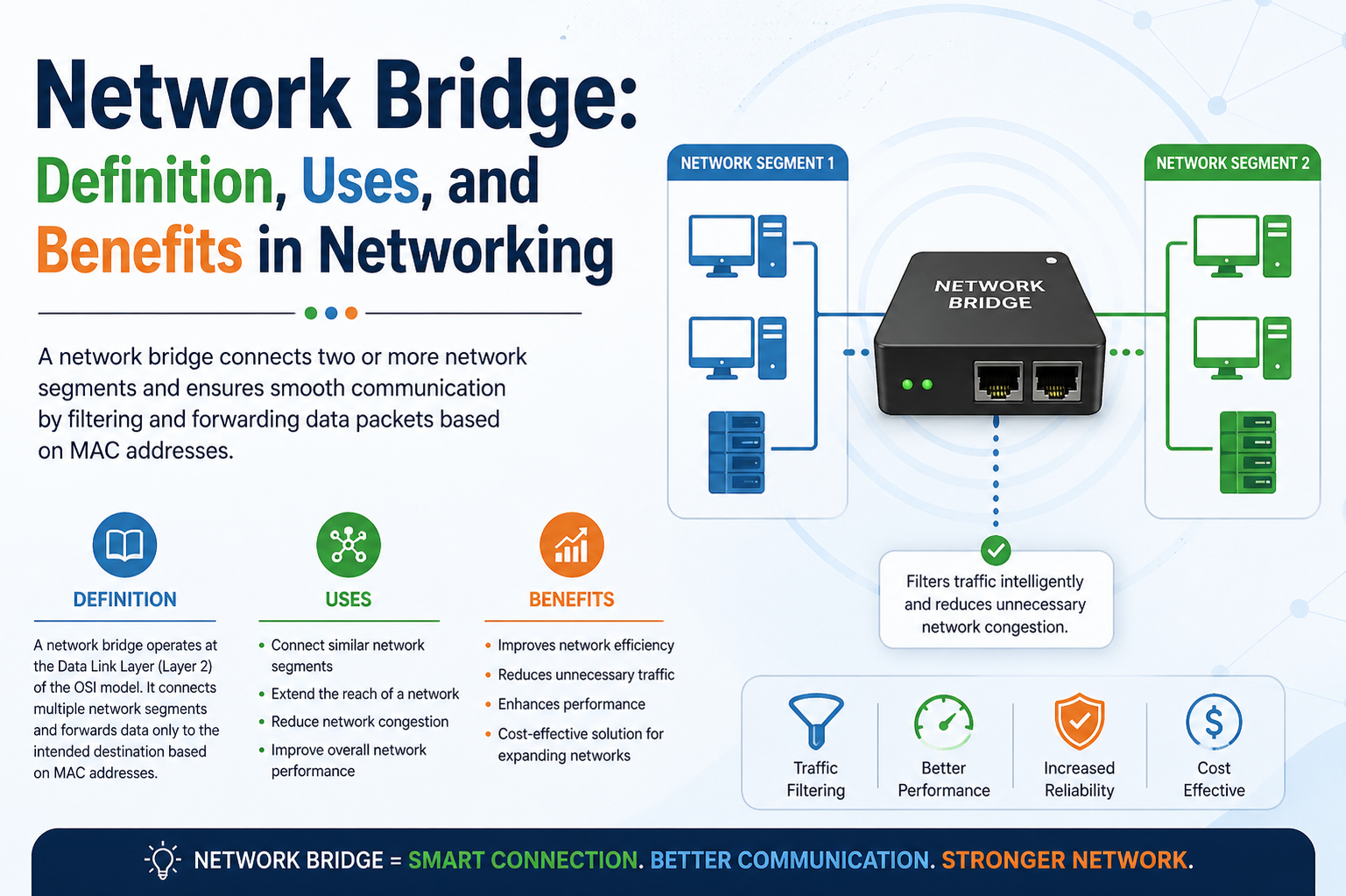
A network bridge is a fundamental networking device designed to connect multiple segments of a local area network while intelligently managing the flow of data between them. At its core, a bridge works at the data link layer, often referred to as Layer 2 of the OSI model, where it uses physical addressing to make forwarding decisions. Instead of relying on IP-based logic, it examines MAC addresses embedded in data frames to determine where traffic should go. This makes it a specialized yet efficient tool for dividing larger networks into smaller, more organized sections without introducing unnecessary complexity.
In practical terms, a network bridge acts like a checkpoint between two network segments. When data travels from one segment to another, the bridge inspects the frame, identifies the source and destination addresses, and decides whether to forward or block the traffic. This filtering capability ensures that only relevant data crosses between segments, reducing unnecessary congestion. By limiting the spread of traffic, bridges help maintain smoother communication and prevent network overload, especially in environments where multiple devices are competing for bandwidth.
The simplicity of a bridge does not mean it lacks importance. In fact, understanding how it works provides a strong foundation for grasping more advanced networking concepts. While modern networks often rely on switches and routers, the principles behind bridging still play a critical role in how these advanced devices function. Bridges laid the groundwork for efficient traffic management and segmentation, concepts that remain essential in today’s interconnected systems.
Another key aspect of a network bridge is its ability to learn from network activity. As it processes data frames, it builds a table of MAC addresses associated with each connected segment. This table allows the bridge to make faster and more accurate forwarding decisions over time. When a frame arrives, the bridge checks this table to see where the destination device is located. If it knows the location, it sends the frame directly to the correct segment. If it does not, it temporarily broadcasts the frame to all segments until it learns the correct path. This learning process makes the bridge more efficient as network activity continues.
The role of a network bridge becomes even more evident in environments where network segmentation is necessary. Large networks can become difficult to manage if all devices share the same communication space. By dividing the network into smaller segments, a bridge reduces the number of devices that receive each transmission. This not only improves performance but also makes it easier to identify and resolve issues. Instead of dealing with an entire network, administrators can focus on specific segments, making troubleshooting more efficient and less time-consuming.
How a Network Bridge Operates Internally
To fully appreciate the value of a network bridge, it is important to understand how it operates behind the scenes. When a data frame arrives at the bridge, the device begins by examining the source MAC address. This information is then recorded in the bridge’s internal table, linking the address to the segment from which the frame originated. This step is crucial because it allows the bridge to build a dynamic map of the network over time.
Once the source address is recorded, the bridge looks at the destination MAC address. If the destination is found in the table, the bridge forwards the frame only to the appropriate segment. This targeted forwarding minimizes unnecessary traffic and ensures that data reaches its intended destination quickly. If the destination address is not found, the bridge temporarily sends the frame to all connected segments, a process known as flooding. Although flooding may seem inefficient, it is a necessary step for discovering unknown devices and updating the address table.
Filtering is another critical function performed by a network bridge. If the bridge determines that both the source and destination devices are on the same segment, it blocks the frame from crossing into other segments. This prevents redundant traffic from spreading across the network and helps maintain optimal performance. By keeping local traffic within its own segment, the bridge reduces congestion and improves overall efficiency.
The ability to learn, forward, and filter data frames is what makes a network bridge effective. These operations occur continuously and automatically, requiring minimal manual configuration. As the network evolves, the bridge adapts by updating its address table, ensuring that it always has an accurate view of device locations. This adaptability is one of the reasons bridges are considered reliable components in network design.
It is also worth noting that a network bridge does not interpret or modify the data within the frames it processes. Its primary focus is on the addressing information, which it uses to guide its decisions. This makes the bridge a transparent device, meaning it operates without altering the content of the communication. Devices on either side of the bridge can communicate as if they are part of the same network, even though the bridge is actively managing the traffic between them.
Differences Between Network Bridges and Other Devices
Although network bridges share some similarities with other networking devices, they serve a distinct purpose that sets them apart. One of the most common comparisons is between bridges and routers. While both devices connect different parts of a network, they operate at different layers and use different methods to handle traffic. A router works at a higher layer and uses logical addressing to route data between networks, whereas a bridge focuses solely on physical addressing within a local network.
This distinction has important implications for how each device is used. Routers are designed for complex tasks such as directing traffic across multiple networks, implementing security policies, and managing IP-based communication. Bridges, on the other hand, are simpler devices that excel at segmenting a single network and improving its efficiency. They do not provide advanced routing capabilities or deep inspection of data, but they offer a straightforward solution for reducing congestion and organizing network traffic.
Another device often compared to a bridge is a network switch. In fact, modern switches can be thought of as advanced versions of bridges. While a traditional bridge connects only a few segments, a switch can handle many connections simultaneously. Despite this difference in scale, both devices rely on similar principles, such as MAC address learning and frame forwarding. Understanding how a bridge works makes it easier to understand the behavior of switches and other advanced networking equipment.
The simplicity of a network bridge can be both an advantage and a limitation. On one hand, it requires minimal configuration and is easy to deploy, making it suitable for basic networking needs. On the other hand, it lacks the advanced features found in routers and managed switches, such as detailed traffic control and security mechanisms. For this reason, bridges are often used in specific scenarios where their straightforward functionality is sufficient.
Despite these differences, the importance of a network bridge should not be underestimated. It represents a foundational concept in networking, demonstrating how data can be managed efficiently within a local environment. By focusing on segmentation and traffic control, bridges help create more organized and reliable networks, even in situations where advanced devices are not required.
The Role of Network Bridges in Improving Network Performance
One of the primary reasons for using a network bridge is to enhance overall network performance. In a large, unsegmented network, all devices share the same communication space, which can lead to frequent collisions and congestion. When multiple devices attempt to send data at the same time, their transmissions can interfere with each other, resulting in delays and reduced efficiency. A bridge addresses this issue by dividing the network into smaller segments, each with its own communication space.
By creating separate segments, the bridge reduces the number of devices competing for bandwidth within each segment. This leads to fewer collisions and smoother data transmission. Devices can communicate more efficiently because they are not constantly contending with unrelated traffic from other parts of the network. As a result, the overall performance of the network improves, even without increasing its physical capacity.
Another way a network bridge improves performance is by controlling broadcast traffic. In a typical network, certain types of messages are broadcast to all devices. While these messages are necessary for functions such as device discovery, they can become overwhelming if allowed to spread across the entire network. A bridge limits the reach of broadcast traffic by containing it within specific segments. This ensures that only relevant devices receive the broadcast, reducing unnecessary load on the network.
The benefits of segmentation extend beyond performance. A well-organized network is easier to manage and troubleshoot. When an issue arises, administrators can focus on a specific segment rather than analyzing the entire network. This targeted approach saves time and makes it easier to identify the root cause of problems. In addition, segmentation can improve security by isolating sensitive areas of the network, preventing unauthorized access from other segments.
Network bridges also support compatibility between different types of network technologies. For example, they can connect segments that use different physical media or communication standards, allowing devices to interact seamlessly. This flexibility makes bridges valuable in environments where diverse technologies need to coexist. By acting as an intermediary, the bridge ensures that data flows smoothly between segments, regardless of their underlying differences.
Ultimately, the role of a network bridge is to create a more efficient, organized, and manageable network environment. Through segmentation, filtering, and intelligent forwarding, it helps maintain optimal performance while reducing complexity. Understanding these benefits provides a clear picture of why network bridges remain an important concept in the study of networking.
When and Why to Use a Network Bridge
A network bridge becomes particularly useful in situations where a network has grown beyond a simple, single-segment structure and begins to experience performance or management challenges. As more devices are added to a local area network, the volume of traffic increases, and the likelihood of congestion rises. In such environments, introducing a bridge allows administrators to divide the network into smaller, more controlled segments without completely redesigning the infrastructure. This makes it an efficient solution for scaling networks while maintaining stability and performance.
One of the most practical scenarios for using a network bridge is when there is a need to separate groups of devices that frequently communicate among themselves but do not require constant interaction with other parts of the network. By placing these devices within their own segment, a bridge ensures that their internal communication remains local, reducing the amount of traffic that must cross into other segments. This not only improves performance but also creates a more organized network structure that is easier to understand and manage.
Another reason to use a network bridge is to extend the reach of an existing network. In cases where physical distance or structural limitations prevent a direct connection, a bridge can link two separate segments, effectively making them part of the same network. This is particularly useful in large buildings or campuses where different sections need to be connected without running extensive cabling. By acting as an intermediary, the bridge allows data to flow seamlessly between these areas while still maintaining segmentation.
Bridges are also valuable in environments where different network technologies need to be integrated. For instance, if one segment uses a wired connection and another uses wireless communication, a bridge can connect the two without requiring significant changes to either system. This ability to adapt to diverse technologies makes bridges a flexible solution for evolving networks, where compatibility is often a key concern.
Despite their usefulness, it is important to recognize that network bridges are not designed to handle every networking challenge. They are best suited for situations where Layer 2 segmentation is sufficient. If a network requires advanced routing, detailed traffic control, or enhanced security features, other devices may be more appropriate. Understanding the strengths and limitations of a bridge ensures that it is used effectively within the right context.
Understanding Bridge Mode and Its Practical Applications
Bridge mode is a configuration that allows a device to function purely as a network bridge, focusing on connecting and segmenting network traffic without performing higher-level routing tasks. When a device operates in bridge mode, it essentially becomes transparent to the network, passing data between segments while applying Layer 2 logic. This mode is commonly used in scenarios where simplicity and efficiency are prioritized over advanced functionality.
In many networking setups, bridge mode is used to disable routing features on devices that would otherwise act as routers. For example, a device that typically assigns IP addresses and manages network traffic can be switched to bridge mode to allow another device to take over those responsibilities. This is often done to avoid conflicts or to centralize network management. By doing so, the network can maintain a clear and consistent structure, with each device performing a specific role.
Bridge mode is particularly beneficial in environments where multiple access points or network devices need to work together without creating separate networks. By enabling bridge mode, these devices can share the same network space, allowing seamless communication between all connected devices. This is especially useful in large homes, offices, or public spaces where consistent connectivity is essential.
Another important application of bridge mode is in reducing network complexity. When multiple devices attempt to perform routing functions simultaneously, it can lead to issues such as double addressing or conflicting configurations. By placing certain devices in bridge mode, these complications can be avoided, resulting in a cleaner and more efficient network design. This approach simplifies troubleshooting and ensures that data flows smoothly across the network.
While bridge mode offers several advantages, it is important to use it appropriately. Since it removes higher-level routing capabilities, it may limit certain features such as advanced security controls or traffic prioritization. For this reason, it is typically used in conjunction with other devices that handle these tasks. By combining bridge mode with proper network planning, it is possible to achieve both simplicity and functionality.
Key Benefits of Network Bridges in Modern Networking
The use of network bridges provides several significant benefits that contribute to the overall efficiency and reliability of a network. One of the most notable advantages is segmentation, which allows a large network to be divided into smaller, more manageable sections. This division helps reduce congestion by limiting the number of devices that share the same communication space, resulting in smoother and more efficient data transmission.
Improved performance is another major benefit of using a network bridge. By reducing the size of collision domains, bridges minimize the chances of data collisions, which occur when multiple devices attempt to transmit data simultaneously. Fewer collisions mean less retransmission of data, leading to faster communication and better use of available bandwidth. This improvement is particularly noticeable in busy networks where high traffic levels can otherwise cause delays and disruptions.
Network bridges also play a role in controlling broadcast traffic. In a large network, broadcast messages can quickly become overwhelming if they are allowed to propagate freely. A bridge limits the spread of these messages by containing them within specific segments, ensuring that only relevant devices receive them. This not only reduces unnecessary traffic but also helps maintain a more stable and predictable network environment.
Another advantage of network bridges is their ability to connect different types of network technologies. In many cases, networks consist of a mix of wired and wireless devices, each with its own communication standards. A bridge can link these different technologies, enabling them to work together seamlessly. This flexibility makes bridges an important tool in environments where compatibility and integration are essential.
Simplicity is also a key benefit of network bridges. Unlike more complex networking devices, bridges require minimal configuration and are relatively easy to deploy. This makes them an ideal choice for basic networking needs, where advanced features are not necessary. Their straightforward operation allows administrators to focus on other aspects of network management without being burdened by complicated setup प्रक्रures.
Limitations and Considerations When Using Network Bridges
While network bridges offer many advantages, they also come with certain limitations that must be taken into account. One of the primary limitations is their reliance on Layer 2 functionality. Since bridges operate using MAC addresses, they do not have the ability to make decisions based on higher-level information such as IP addresses or application data. This restricts their usefulness in complex networks যেখানে advanced routing and traffic management are required.
Another consideration is scalability. Traditional network bridges are designed to connect a limited number of segments, and their performance can degrade as the network grows. As more devices are added, the bridge’s address table becomes larger, and the process of managing traffic becomes more demanding. In such cases, more advanced devices may be needed to handle the increased load efficiently.
Security is another area where network bridges have limitations. Because they focus primarily on traffic forwarding and filtering, they do not provide the same level of protection as devices that operate at higher layers. For example, a bridge cannot inspect the content of data packets or enforce complex security policies. This means that additional measures may be required to ensure the safety of the network, especially in environments যেখানে sensitive data is being transmitted.
Network loops are also a potential issue when using bridges. If multiple bridges are connected in a way that creates a loop, data frames can circulate indefinitely, leading to network congestion and instability. To prevent this, protocols such as the Spanning Tree Protocol are used to identify and eliminate loops. Understanding how to manage these risks is essential for maintaining a stable network.
Finally, it is important to consider the role of network bridges within the broader context of network design. While they are useful for segmentation and basic connectivity, they are not a complete solution for all networking needs. By recognizing their strengths and limitations, administrators can use bridges effectively as part of a larger, well-planned network infrastructure.
Step-by-Step Process of Setting Up a Network Bridge
Setting up a network bridge involves configuring a system so that it can connect and manage traffic between multiple network interfaces. While the exact steps may vary depending on the operating system or device being used, the underlying process remains consistent. The goal is to create a logical interface that combines two or more physical interfaces, allowing them to function as a single bridged connection. This setup enables seamless communication between different network segments while maintaining the benefits of segmentation and traffic control.
The first step in configuring a network bridge is identifying the available network interfaces on the system. These interfaces represent the physical or virtual connections that will be part of the bridge. By examining the system’s network configuration, administrators can determine which interfaces are active and suitable for bridging. This step is essential because the bridge relies on these interfaces to transmit and receive data across segments.
Once the interfaces are identified, the next step is preparing them for inclusion in the bridge. This typically involves setting the interfaces to a mode where they do not independently manage IP addressing. Instead, they act as ports within the bridge, allowing the bridge itself to handle communication. This approach ensures that traffic flows through the bridge rather than being processed separately by each interface.
After preparing the interfaces, a new bridge interface is created. This virtual interface represents the combined functionality of the selected physical interfaces. It is configured with the necessary network settings, such as obtaining an IP address if required. The bridge interface becomes the primary point of interaction for the network, while the individual interfaces operate in the background as part of the bridge structure.
The final step in the setup process is applying and verifying the configuration. Once the bridge is created, the system’s networking services are restarted or refreshed to activate the changes. At this stage, it is important to test connectivity between the bridged segments to ensure that data is flowing correctly. Successful communication indicates that the bridge is functioning as intended, allowing devices on different segments to interact seamlessly.
Common Tools and Environments for Bridge Configuration
Network bridges can be configured in a variety of environments, ranging from personal computers to enterprise-grade networking systems. One of the most common platforms for setting up a bridge is a Linux-based system, which provides flexible tools for managing network interfaces. These tools allow administrators to create and control bridges with a high degree of customization, making Linux a popular choice for both learning and professional use.
In a typical Linux environment, commands are used to list available interfaces, create bridge devices, and assign interfaces to the bridge. Configuration files may also be edited to ensure that the bridge settings persist after a system restart. This approach provides a balance between manual control and automation, allowing administrators to tailor the bridge configuration to their specific needs.
Other operating systems also support network bridging, often through graphical interfaces that simplify the process. These interfaces allow users to select the desired network connections and combine them into a bridge with minimal effort. While this method may not offer the same level of detail as command-line tools, it is accessible and effective for basic configurations.
Virtualization platforms are another environment where network bridges are commonly used. In these setups, a bridge connects virtual machines to the physical network, enabling them to communicate as if they were separate physical devices. This is particularly useful for testing and development, حيث multiple virtual systems need to interact within the same network space. By using a bridge, these systems can share resources and communicate efficiently دون requiring complex routing configurations.
The versatility of network bridges across different environments highlights their importance as a networking tool. Whether used in a simple home setup or a complex virtual infrastructure, bridges provide a reliable way to connect and manage network segments. Understanding how to configure them in various contexts enhances their usefulness and ensures that they can be applied effectively in different scenarios.
Troubleshooting Network Bridge Issues Effectively
Even with careful configuration, network bridges can sometimes encounter issues that disrupt connectivity or performance. Troubleshooting these problems requires a systematic approach that focuses on identifying and resolving the root cause. By understanding common issues and their solutions, administrators can quickly restore normal network operation and minimize downtime.
One of the first steps in troubleshooting a network bridge is checking the physical connections. Faulty cables, loose connections, or damaged hardware can prevent data from flowing between segments. Ensuring that all connections are secure and functioning properly is a fundamental step that should not be overlooked. In many cases, resolving a physical issue can immediately restore network functionality.
Another important step is verifying the bridge configuration. Incorrect settings, such as improperly assigned interfaces or missing parameters, can prevent the bridge from operating correctly. Reviewing the configuration and ensuring that all details are accurate can help identify and fix these issues. Paying attention to small details, such as naming conventions and interface assignments, is crucial for successful troubleshooting.
Address conflicts can also cause problems in a bridged network. When multiple devices share the same address, it can lead to communication errors and network instability. Checking for duplicate addresses and resolving any conflicts ensures that each device can communicate without interference. This step is particularly important in networks where devices are frequently added or reconfigured.
Monitoring network traffic is another effective troubleshooting technique. By analyzing the flow of data frames, administrators can identify unusual patterns or bottlenecks that may indicate a problem. Tools designed for network analysis can provide valuable insights into how traffic is being handled by the bridge, مما يساعد في pinpointing the source of the issue.
Restarting network services or devices is often a simple yet effective solution. Temporary glitches or configuration changes may not take effect until the system is refreshed. Performing a restart can clear these issues and restore normal operation. While this approach may not address underlying problems, it is a useful step in the troubleshooting process.
Best Practices for Maintaining a Stable Network Bridge
Maintaining a network bridge requires ongoing attention to ensure that it continues to operate efficiently and reliably. One of the most important best practices is keeping the network configuration organized and well-documented. Clear documentation يساعد administrators understand how the bridge is set up and makes it easier to identify and resolve issues عندما they arise.
Regular monitoring of network performance is another key practice. By keeping track of traffic levels, error rates, and overall performance, administrators can detect potential problems before they become serious. This proactive approach helps maintain a stable network environment and ensures that the bridge continues to function as expected.
It is also important to update and maintain the systems involved in the bridge. Software updates and patches can improve performance, fix bugs, and enhance compatibility with other devices. Keeping systems up to date reduces the risk of issues and ensures that the bridge remains compatible with evolving network technologies.
Avoiding unnecessary complexity is another principle that contributes to stability. While it may be tempting to add multiple bridges or create intricate configurations, doing so can increase the likelihood of errors and make troubleshooting more difficult. Keeping the design simple and focused on the network’s needs helps maintain reliability and ease of management.
Finally, implementing safeguards against common issues such as network loops is essential. Using protocols and proper design techniques prevents data from circulating endlessly within the network, which can cause severe performance problems. By following best practices and maintaining a clear understanding of how the bridge operates, administrators can ensure that their network remains stable and efficient over time.
Advanced Concepts and Evolution of Network Bridging
As networking technology has evolved, the concept of a network bridge has expanded beyond its original simplicity into more advanced and dynamic implementations. While early bridges were standalone devices connecting just a few network segments, modern systems have integrated bridging functionality into more sophisticated hardware and software solutions. Despite these advancements, the core idea remains the same: intelligently forwarding data at the data link layer to improve efficiency and organization within a network.
One of the most important developments in bridging is the introduction of intelligent switching. Modern switches are essentially multi-port bridges that can handle a large number of devices simultaneously. They use the same MAC address learning process as traditional bridges but operate at much higher speeds and with greater scalability. This evolution has allowed networks to grow significantly without sacrificing performance, as switches can manage traffic across dozens or even hundreds of ports with minimal delay.
Another key advancement is the use of protocols designed to enhance the stability of bridged networks. For example, the Spanning Tree Protocol plays a crucial role in preventing network loops. In complex environments where multiple bridges or switches are interconnected, loops can form and cause frames to circulate endlessly. This leads to broadcast storms and severe performance degradation. The protocol automatically detects these loops and disables redundant paths, ensuring that the network remains stable while still providing backup routes in case of failure.
Virtualization has also transformed the way network bridging is used. In modern data centers and cloud environments, bridges are often implemented in software rather than hardware. Virtual bridges connect virtual machines to each other and to the physical network, enabling seamless communication across different layers of infrastructure. This approach provides flexibility and scalability, allowing administrators to create and modify network topologies بسرعة دون needing physical changes.
These advancements highlight how the basic principles of bridging continue to underpin modern networking technologies. Even as networks become more complex, the fundamental role of managing traffic at the data link layer remains essential for maintaining efficiency and reliability.
Security Considerations in Network Bridging
While network bridges are effective at managing traffic and improving performance, they are not inherently designed with advanced security features. Because they operate at a lower layer of the networking model, their primary focus is on forwarding frames rather than inspecting or filtering content at a deeper level. This means that additional measures are often required to ensure a secure network environment.
One potential security concern is unauthorized access between network segments. Since a bridge allows communication between segments, it can inadvertently provide a pathway for malicious activity if proper controls are not in place. To mitigate this risk, administrators often implement additional security mechanisms such as access control policies, network segmentation strategies, and monitoring tools. These measures help ensure that only authorized devices and users can access specific parts of the network.
Another consideration is the risk of broadcast-based attacks. Because bridges forward certain types of broadcast traffic, an attacker could exploit this behavior to flood the network with unnecessary data. This can lead to congestion and reduced performance, affecting all connected devices. Monitoring network traffic and implementing rate-limiting techniques can help prevent such attacks and maintain a stable environment.
Data interception is also a concern in bridged networks. Since bridges do not encrypt or deeply inspect traffic, sensitive information could potentially be intercepted if the network is not properly secured. Using encryption protocols and secure communication methods helps protect data as it travels across the network, reducing the risk of unauthorized access.
Despite these challenges, network bridges can still be part of a secure network design when combined with appropriate safeguards. By understanding their limitations and implementing complementary security measures, administrators can ensure that bridging contributes to both performance and protection.
Real-World Applications of Network Bridges
Network bridges are used in a wide range of real-world scenarios, demonstrating their versatility and practical value. In office environments, bridges are often employed to separate departments or teams into different network segments. This allows each group to operate efficiently within its own segment while still maintaining the ability to communicate with other parts of the organization عندما necessary.
In educational institutions, network bridges تساعد connect different buildings or sections of a campus. By linking these areas, students and staff can access shared resources such as servers, printers, and الإنترنت دون experiencing significant delays or disruptions. The segmentation provided by bridges also helps manage traffic more effectively, ensuring that no single area overwhelms the entire network.
Home networking is another area where bridges are commonly used. For example, a wireless device can be configured in bridge mode to extend the coverage of an existing network. This allows devices in different parts of a home to connect seamlessly, even if they are far from the main access point. By bridging the connection, users can enjoy consistent الإنترنت access throughout their living space.
In industrial and enterprise environments, bridges play a role in connecting specialized systems and equipment. These systems often rely on different communication standards, and a bridge can facilitate interaction between them. This capability is particularly important in settings where reliability and compatibility are critical, such as manufacturing facilities or large-scale operations.
The adaptability of network bridges makes them suitable for a variety of applications, from simple home setups to complex organizational networks. Their ability to connect, segment, and manage traffic ensures that they remain a valuable tool in modern networking.
Final Thoughts
A network bridge represents one of the foundational building blocks of modern networking, offering a simple yet powerful way to connect and manage network segments. By operating at the data link layer and using MAC addresses to make forwarding decisions, it provides an efficient method for controlling traffic and reducing congestion within a local area network. Its ability to learn from network activity and adapt to changing conditions makes it a reliable component in a wide range of environments.
Throughout its evolution, the network bridge has maintained its relevance by adapting to new technologies and requirements. From traditional hardware devices to modern software-based implementations, the principles of bridging continue to influence how networks are designed and managed. Concepts such as segmentation, traffic filtering, and efficient data forwarding remain essential for ensuring optimal performance and organization.
While network bridges have certain limitations, particularly in terms of advanced routing and security features, they excel in scenarios where simplicity and efficiency are the प्राथमिक goals. When used alongside other networking devices and security measures, they contribute to a balanced and effective network infrastructure. Understanding how and when to use a bridge allows administrators to make informed decisions that enhance both performance and reliability.
In the broader context of networking, mastering the concept of a network bridge provides valuable insight into how data flows within a network. It serves as a stepping stone to more advanced topics, helping build a strong foundation for further learning and practical application. By appreciating its role and capabilities, one can better understand the complex systems that power modern communication and connectivity.