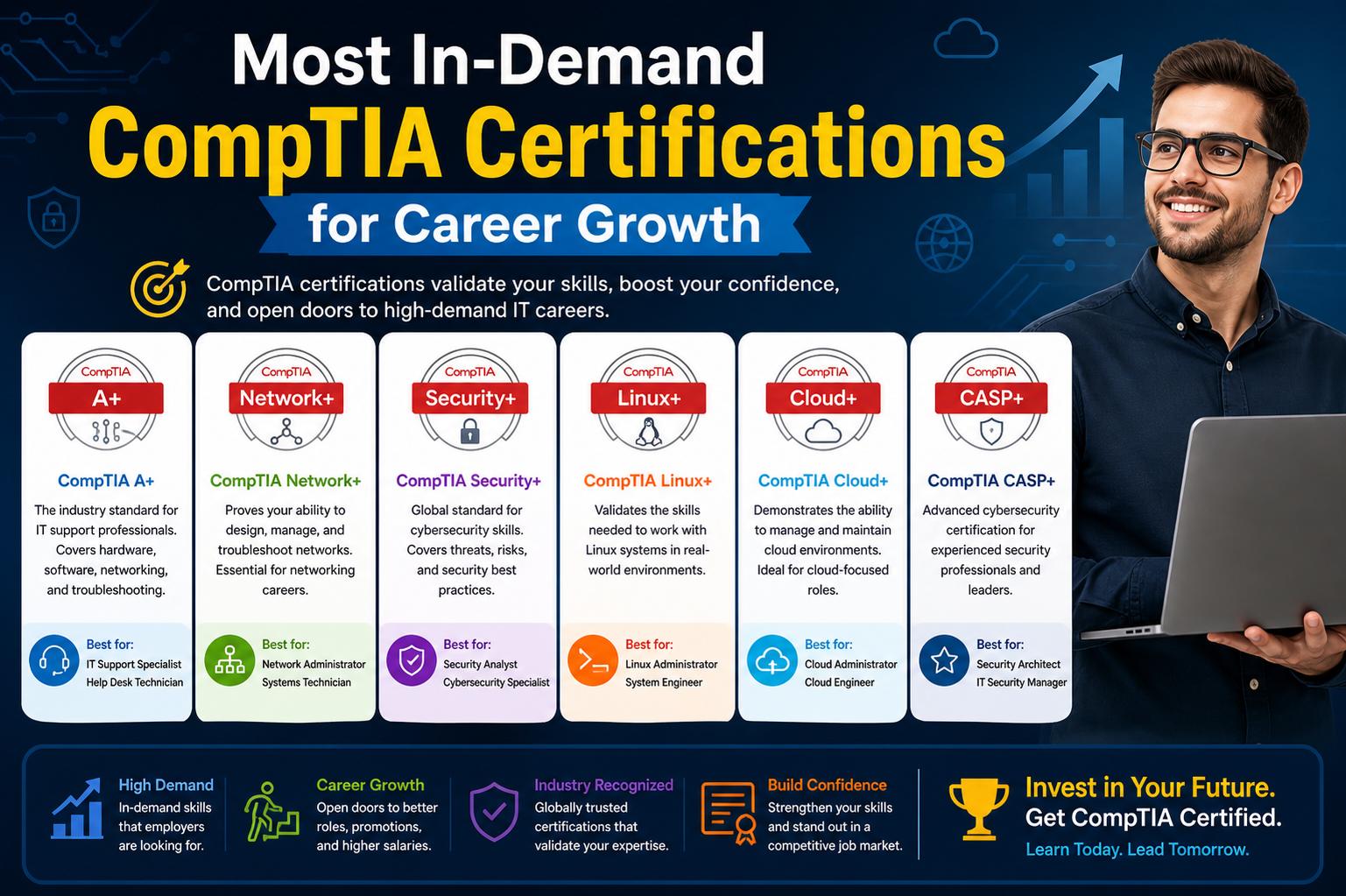
In the field of information technology, professional certifications play a major role in demonstrating real-world skills, structured knowledge, and job readiness. Unlike informal learning or self-taught experience, certifications provide a standardized way to validate what an individual can do in practical environments. CompTIA certifications are widely recognized because they focus on foundational and role-based skills rather than locking learners into a single vendor or specific technology ecosystem. This makes them highly flexible for professionals who want to work across different systems, platforms, and industries.
Why Vendor-Neutral Certifications Matter in Modern IT Environments
One of the strongest advantages of CompTIA certifications is their vendor-neutral approach. Instead of teaching skills tied to one company’s tools or products, they focus on universal IT concepts such as networking, security, troubleshooting, cloud fundamentals, and infrastructure management. This is especially important in modern workplaces where companies often use a combination of technologies from different providers. Professionals who understand general principles rather than only specific tools are more adaptable, easier to train, and more valuable across different roles.
How CompTIA Certifications Shape Career Entry in IT Fields
For individuals entering the IT industry, certifications act as a structured pathway into technical careers. Many beginners face challenges because employers expect some level of proven knowledge, even for entry-level positions. CompTIA certifications help bridge this gap by providing recognized proof of understanding in core IT domains. They help candidates demonstrate readiness for roles in technical support, networking assistance, system maintenance, and cybersecurity assistance, even without extensive prior work experience.
Introduction to Early Career IT Learning Through Foundational Certifications
For newcomers, CompTIA offers certifications designed to introduce essential IT concepts in a structured and approachable way. These certifications help learners understand how computers operate, how networks communicate, and how basic troubleshooting is performed. Instead of focusing on advanced engineering tasks, early certifications build confidence by teaching how different components of IT systems interact. This foundational knowledge becomes the stepping stone for more advanced technical learning in later stages of a career.
Exploring CompTIA Tech+ as a Starting Point for IT Understanding
CompTIA Tech+ is designed for individuals who are still exploring whether a career in information technology is the right path. It introduces core concepts such as hardware basics, software interaction, networking principles, and digital literacy. The purpose of this certification is not to specialize but to help learners evaluate their interest and aptitude in IT. It allows individuals to experience a broad overview of the field before committing to a specific career direction, which can save time and effort in the long run.
How Tech+ Helps Identify Career Direction in Technology Fields
One of the key benefits of Tech+ is its role as a discovery tool. Many people are uncertain about which area of IT suits them best, such as networking, cybersecurity, cloud systems, or technical support. By covering a wide range of introductory topics, this certification helps individuals identify which areas they naturally understand or enjoy. It provides clarity about personal strengths and interests, which is valuable when choosing a more focused certification or career path later.
Transitioning from Exploration to Professional IT Readiness
After gaining initial exposure through foundational learning, many learners move toward certifications that prepare them for actual job roles. At this stage, the focus shifts from exploration to professional readiness. This transition is important because it represents the move from theoretical understanding to applied technical skills. Learners begin preparing for real-world tasks such as troubleshooting systems, configuring devices, supporting users, and managing basic IT infrastructure in workplace environments.
CompTIA A+ as a Core Certification for Entry-Level IT Professionals
CompTIA A+ is widely recognized as one of the most important entry-level certifications in the IT industry. It is designed for individuals who are ready to begin working in technical support or similar roles. This certification covers a broad range of topics, including hardware components, operating systems, software troubleshooting, networking fundamentals, and basic security practices. It is often considered a benchmark for foundational IT competence in many organizations.
Skills Developed Through the A+ Certification Pathway
The A+ certification builds practical skills that are directly applicable to real job environments. Candidates learn how to install and configure hardware components, manage operating systems, troubleshoot system errors, and support end users effectively. It also introduces virtualization concepts and basic cloud-related knowledge, which are increasingly important in modern IT infrastructure. Additionally, it emphasizes professional communication skills, which are essential when working in support roles or customer-facing technical positions.
Understanding the Importance of Hands-On IT Practice
A key aspect of preparing for certifications like A+ is developing hands-on experience. Theoretical knowledge alone is not sufficient for success in IT roles, as real-world environments often involve unpredictable issues and complex system interactions. Practical learning helps candidates become familiar with troubleshooting processes, device configuration, and system maintenance. This type of experience ensures that learners are not only prepared for exams but also capable of handling real technical challenges in workplace scenarios.
Building Confidence Through Structured IT Learning Paths
Structured certification paths provide a clear roadmap for skill development. Instead of randomly learning different technologies, learners follow a guided progression that gradually increases in complexity. This structured approach helps reduce confusion and ensures that foundational knowledge is strong before moving into advanced topics. It also helps learners track their progress and build confidence as they complete each stage of their IT education journey.
Why Foundational Certifications Remain Relevant in Advanced IT Careers
Even as professionals advance into specialized fields such as cybersecurity, cloud engineering, or network architecture, foundational certifications continue to hold value. The core concepts learned in early certifications remain relevant throughout an IT career. Understanding how systems operate at a basic level helps professionals make better decisions when dealing with complex infrastructures. Strong fundamentals also make it easier to learn new technologies as they emerge.
Preparing for Progression into Networking and Technical Specializations
Once foundational certifications are completed, learners are typically prepared to move into more specialized areas such as networking or security. These advanced paths build upon earlier knowledge and introduce more complex concepts. For example, networking certifications focus on communication between systems, infrastructure design, and network optimization. Security-focused paths emphasize protection strategies, risk management, and system defense techniques. The transition into specialization is smoother when foundational knowledge is strong.
How IT Certification Pathways Support Long-Term Career Growth
Certification pathways in IT are designed to support continuous professional development. As technology evolves, professionals are encouraged to update their skills and expand their knowledge. CompTIA certifications provide a flexible framework that allows individuals to grow from beginner-level understanding to advanced expertise over time. This progression helps professionals remain competitive in the job market and adapt to new technological demands without needing to restart their learning journey.
Understanding the Role of Networking Knowledge in IT Career Growth
Networking is one of the most important pillars of information technology because it forms the backbone of communication between systems, devices, and services. Without networking, modern digital environments would not function effectively. For IT professionals, understanding how networks operate is essential for troubleshooting issues, maintaining connectivity, and ensuring smooth data flow across systems. This knowledge is especially important in business environments where downtime or misconfiguration can directly impact productivity and operations.
How CompTIA Certifications Support Networking Skill Development
CompTIA offers structured learning pathways that help professionals build strong networking foundations. These certifications focus on understanding how devices communicate, how data is transmitted, and how networks are designed and maintained. Instead of focusing on a single vendor’s tools or configurations, the emphasis is placed on universal networking principles. This approach allows learners to apply their knowledge across different technologies and workplace environments without being limited to one ecosystem.
Building a Strong Foundation with Network Concepts and Infrastructure
A key part of networking education involves learning how different types of networks operate, including local area networks, wide area networks, and wireless systems. Professionals must understand how data travels between devices, how routers and switches function, and how network topologies affect performance. These foundational concepts are essential for anyone who wants to work in IT infrastructure or technical support roles where connectivity issues are common.
Understanding Real-World Network Deployment and Configuration
Beyond theory, IT professionals must also learn how to deploy and configure networks in real-world environments. This includes setting up physical hardware, configuring IP addressing, managing wireless access points, and ensuring secure communication between systems. Practical networking skills are highly valued because they allow professionals to quickly diagnose and resolve issues that affect business operations. Hands-on experience is critical in developing confidence in these tasks.
Importance of Network Monitoring and Performance Optimization
Once a network is operational, it must be continuously monitored to ensure efficiency and reliability. IT professionals are responsible for identifying performance bottlenecks, detecting unusual activity, and maintaining optimal network speed. Monitoring tools help track data usage, system health, and potential security threats. Understanding how to analyze network performance is a key skill for maintaining stable and efficient IT environments.
Strengthening Security Awareness Within Networking Environments
Networking is closely connected to cybersecurity because every connected system presents potential vulnerabilities. IT professionals must understand how to secure networks against unauthorized access, data breaches, and malicious attacks. This includes learning about firewalls, encryption, access control, and secure communication protocols. Security awareness is not limited to cybersecurity specialists; it is essential for all networking professionals.
Developing Problem-Solving Skills in Network Troubleshooting
Network troubleshooting is one of the most important practical skills in IT. When systems fail to connect or performance drops, professionals must quickly identify the root cause and apply appropriate solutions. This requires analytical thinking and a structured approach to diagnosing issues. Common problems may involve hardware failures, configuration errors, or external disruptions. Effective troubleshooting minimizes downtime and ensures business continuity.
Preparing for Advanced Networking and Infrastructure Roles
As professionals gain experience in networking, they often progress into more advanced roles such as network administration, infrastructure engineering, or system architecture. These roles require deeper technical knowledge and the ability to design scalable and efficient network systems. Advanced responsibilities may include managing enterprise-level networks, optimizing cloud connectivity, and implementing large-scale security strategies.
The Growing Importance of Hybrid and Cloud Networking
Modern IT environments are no longer limited to traditional on-premises networks. Many organizations now use hybrid systems that combine physical infrastructure with cloud-based services. This shift requires professionals to understand how cloud platforms interact with traditional networks. Managing hybrid environments involves integrating multiple technologies while ensuring seamless communication and security across all systems.
Introduction to Cybersecurity as a Core IT Discipline
Cybersecurity has become one of the most critical areas in information technology due to the increasing number of digital threats and attacks. Organizations rely on skilled professionals to protect their systems, data, and users from cyber risks. Cybersecurity involves a wide range of responsibilities, including monitoring systems, identifying vulnerabilities, and implementing protective measures. It is a field that requires both technical expertise and strategic thinking.
Foundational Security Concepts for IT Professionals
Before specializing in cybersecurity, professionals must understand basic security principles such as confidentiality, integrity, and availability. These principles form the foundation of all security practices. IT professionals must also learn how threats operate, including malware, phishing, and unauthorized access attempts. Understanding these concepts helps in building stronger defense mechanisms within IT systems.
Developing Skills for Security Monitoring and Threat Detection
Security monitoring involves continuously observing systems for signs of suspicious activity. IT professionals use various tools to detect anomalies, track network traffic, and analyze system logs. Early detection of threats is essential for preventing damage and reducing risk. This requires attention to detail and the ability to interpret complex data patterns that may indicate security issues.
Understanding Compliance and Regulatory Requirements in IT Security
Organizations must comply with various legal and regulatory standards related to data protection and privacy. IT professionals working in security roles must understand these requirements and ensure that systems are configured accordingly. Compliance ensures that organizations avoid legal penalties and maintain trust with customers and stakeholders. It also plays a key role in shaping security policies and procedures.
Expanding into Specialized Cybersecurity Roles
As professionals gain more experience in security, they may move into specialized roles such as penetration testing, security analysis, or incident response. These roles require advanced knowledge of attack techniques, defense strategies, and forensic investigation. Specialization allows professionals to focus on specific areas of cybersecurity and develop deeper expertise.
Introduction to Advanced Cybersecurity Responsibilities
Advanced cybersecurity roles involve designing and managing complex security systems across entire organizations. Professionals in these positions are responsible for creating security architectures, leading security teams, and developing long-term protection strategies. They must also stay updated with evolving threats and continuously adapt their approaches to maintain strong security postures.
The Importance of Continuous Learning in IT Security Fields
Cybersecurity is a constantly evolving field, which means professionals must engage in continuous learning to stay effective. New threats, technologies, and vulnerabilities emerge regularly, requiring updated knowledge and skills. Continuous learning ensures that IT professionals remain capable of defending systems against modern cyber risks while adapting to changing technological environments.
Advancing into Specialized Cybersecurity Skill Sets
As IT professionals move beyond foundational cybersecurity knowledge, they begin focusing on more specialized technical areas that require deeper expertise and practical application. At this stage, the work becomes less about general security awareness and more about actively identifying vulnerabilities, simulating attacks, and designing advanced defense mechanisms. These roles demand strong analytical thinking, technical precision, and the ability to work in complex digital environments where threats are constantly evolving.
Understanding Ethical Hacking and Vulnerability Assessment Roles
One of the more advanced directions in cybersecurity involves ethical hacking, where professionals intentionally attempt to exploit systems in controlled environments. The goal is not to cause damage but to identify weaknesses before malicious attackers can take advantage of them. Vulnerability assessment plays a key role in this process, as it involves scanning systems, analyzing potential risks, and recommending improvements to strengthen overall security posture.
Introduction to Penetration Testing as a Specialized Security Practice
Penetration testing is a focused discipline within cybersecurity that involves simulating real-world cyberattacks on systems, networks, and applications. Professionals in this area must think like attackers while staying within ethical and legal boundaries. They test defenses by attempting to bypass security controls, identify weak points, and document findings in a structured way. This practice helps organizations understand how their systems would perform under actual attack conditions.
Developing Practical Skills for Security Exploitation and Reporting
In penetration testing roles, technical skill alone is not enough. Professionals must also be able to document their findings clearly and communicate risks effectively to technical and non-technical stakeholders. Reporting is a critical part of the process because it translates technical vulnerabilities into actionable business insights. This ensures that organizations can prioritize fixes based on real risk levels rather than just technical complexity.
Strengthening Knowledge in Network-Based Attack Simulation
A major part of advanced cybersecurity work involves simulating attacks across different types of network environments. This includes testing wired networks, wireless systems, and hybrid infrastructures that combine on-premises and cloud resources. Professionals must understand how attackers move through networks, escalate privileges, and exploit weak configurations. This knowledge helps in designing stronger defensive strategies.
Building Expertise in Security Architecture and Enterprise Protection
At a more advanced level, cybersecurity professionals contribute to the design of entire security systems rather than just identifying individual vulnerabilities. Security architecture involves planning how different layers of protection work together across an organization. This includes designing access control systems, defining security policies, and ensuring that all components of an IT environment align with organizational security goals.
Introduction to High-Level Cybersecurity Leadership Responsibilities
Senior cybersecurity roles often involve leadership responsibilities where professionals guide teams, manage security operations, and make strategic decisions about risk management. These roles require a combination of technical expertise and management skills. Leaders must ensure that security measures are effectively implemented while also aligning with business objectives and regulatory requirements.
Understanding Advanced Security Practitioner Skill Requirements
At the highest levels of cybersecurity, professionals are expected to handle complex security challenges that span entire enterprise environments. This includes evaluating security readiness, designing resilient systems, and responding to advanced threats. These responsibilities require deep technical understanding as well as the ability to assess risk at a strategic level. Professionals in these roles often influence organizational security direction.
Introduction to Cloud Computing as a Core IT Infrastructure Component
Cloud computing has become a central part of modern IT systems because it allows organizations to scale resources, improve flexibility, and reduce infrastructure costs. Instead of relying solely on physical hardware, companies can use cloud platforms to store data, run applications, and manage services. This shift has created new opportunities for IT professionals to specialize in cloud architecture and management.
Understanding Vendor-Neutral Cloud Knowledge and Its Importance
One of the most valuable aspects of cloud-focused IT certifications is their vendor-neutral approach. Instead of focusing on a single cloud provider, professionals learn general cloud concepts that apply across multiple platforms. This includes understanding how cloud systems are designed, how resources are allocated, and how services are deployed in different environments. This flexibility is essential in modern multi-cloud strategies.
Learning Cloud Architecture, Deployment, and Operations Principles
Cloud architecture involves designing systems that can operate efficiently in virtual environments. Professionals must understand how to deploy applications, manage virtual machines, and ensure system availability. Cloud operations also involve monitoring performance, scaling resources based on demand, and maintaining security across distributed systems. These responsibilities require both technical knowledge and operational awareness.
Understanding Cloud Security and Data Protection Strategies
Security in cloud environments is a major concern because data is stored and processed across remote servers. IT professionals must ensure that cloud systems are protected against unauthorized access, data leaks, and configuration errors. This involves implementing encryption, access control policies, and continuous monitoring systems. Cloud security also requires understanding shared responsibility models between providers and organizations.
Developing Skills for Multi-Platform Cloud Management
Many organizations use more than one cloud provider to meet different business needs. This creates a complex environment where systems must work together seamlessly. IT professionals must understand how to manage workloads across multiple platforms, ensure compatibility between services, and maintain consistent security policies. This requires adaptability and strong problem-solving skills.
Introduction to IT Project Management in Technical Environments
IT project management focuses on planning, organizing, and executing technology-related projects within organizations. These projects may involve system upgrades, infrastructure deployment, software implementation, or network expansion. Effective project management ensures that technical initiatives are completed on time, within budget, and according to requirements.
Understanding Project Planning and Resource Coordination in IT
Project planning involves defining goals, allocating resources, and creating structured timelines for completion. IT project managers must coordinate between technical teams, stakeholders, and business leaders to ensure alignment. This requires strong communication skills and the ability to manage competing priorities. Proper planning reduces risks and increases the likelihood of project success.
Learning Different Methodologies Used in IT Project Execution
IT projects can be managed using different methodologies depending on their size and complexity. Some approaches focus on structured planning and sequential execution, while others emphasize flexibility and iterative development. Understanding these methodologies helps project managers choose the most appropriate approach based on project requirements and organizational needs.
Developing Risk Management and Problem-Solving Abilities in Projects
Every IT project involves risks such as delays, budget overruns, or technical challenges. Project managers must identify potential risks early and develop strategies to minimize their impact. Problem-solving skills are essential for addressing unexpected issues that arise during project execution. Effective risk management ensures smoother project delivery and better outcomes.
Enhancing Communication Skills for Technical and Business Collaboration
IT project managers act as a bridge between technical teams and business stakeholders. They must translate complex technical information into understandable language for decision-makers. Strong communication ensures that everyone involved in a project has a clear understanding of goals, progress, and challenges. This alignment is essential for successful project completion.
Understanding the Role of Structured Certification in Career Progression
Structured certifications in cybersecurity, cloud computing, and project management help professionals build a clear career path. Each certification adds a layer of knowledge and practical skill, allowing individuals to gradually move into more advanced roles. This progression ensures continuous development and long-term career stability in the IT industry.
Exploring the Importance of Advanced IT Career Progression
As professionals move further in their information technology journey, the focus shifts from foundational and intermediate skills to advanced expertise that influences entire systems, infrastructures, and organizational strategies. At this level, IT roles are no longer limited to execution but extend into planning, designing, optimizing, and securing complex environments. Advanced certifications and knowledge help professionals transition into leadership and architecture-focused positions where decisions impact large-scale systems.
Understanding Enterprise-Level IT Responsibilities and Expectations
Enterprise IT environments are significantly more complex than small or mid-sized systems. They involve multiple interconnected technologies, hybrid infrastructures, distributed cloud systems, and high-security requirements. Professionals working at this level must understand how different components interact across networks, applications, storage systems, and security layers. Their responsibilities often include ensuring system stability, scalability, and resilience across entire organizations.
Introduction to High-Impact Decision Making in IT Roles
At advanced stages, IT professionals are expected to contribute to strategic decision-making. This includes evaluating technology investments, selecting infrastructure solutions, and designing long-term IT roadmaps. These decisions must balance performance, cost, security, and scalability. Strong analytical skills and deep technical understanding are required to make choices that align with both business goals and technological efficiency.
Expanding Knowledge into Advanced Cybersecurity Architecture
Cybersecurity at an advanced level involves designing and implementing security frameworks that protect entire organizations. Instead of focusing only on detecting threats, professionals create layered defense systems that prevent attacks before they occur. This includes designing identity management systems, securing cloud infrastructures, enforcing encryption standards, and ensuring compliance with industry regulations across all systems.
Understanding Security Governance and Organizational Risk Management
Security governance plays a crucial role in enterprise environments by defining policies, procedures, and standards that guide how security is managed. Professionals in this area assess organizational risks and ensure that appropriate controls are in place. Risk management involves identifying potential threats, evaluating their impact, and implementing strategies to minimize exposure. This structured approach ensures long-term protection and operational stability.
Developing Expertise in Penetration Testing and Ethical Security Evaluation
Penetration testing at advanced levels goes beyond basic vulnerability scanning and involves deep analysis of system weaknesses across multiple attack surfaces. Professionals simulate complex cyberattacks that mimic real-world adversaries. This includes testing application security, network resilience, wireless defenses, and cloud configurations. The goal is to uncover hidden vulnerabilities that could be exploited under sophisticated attack conditions.
Strengthening Analytical Reporting and Security Communication Skills
Advanced cybersecurity professionals must be able to communicate findings in a clear and impactful way. Technical reports are not just documentation but strategic tools that help organizations make informed decisions. These reports must translate complex vulnerabilities into understandable risks and actionable recommendations. Strong communication ensures that security improvements are implemented effectively across teams.
Introduction to Cloud Infrastructure at Scale in Modern IT Systems
Cloud infrastructure has become a critical part of enterprise IT systems due to its scalability, flexibility, and efficiency. Large organizations rely on cloud platforms to manage data storage, application hosting, and computational workloads. Professionals working in this area must understand how to design systems that remain stable under high demand while maintaining performance and security across distributed environments.
Understanding Multi-Cloud and Hybrid IT Environments
Many organizations use multiple cloud providers alongside traditional on-premises systems. This creates hybrid and multi-cloud environments that require careful integration and management. IT professionals must ensure that different platforms work together seamlessly while maintaining consistent security policies and performance standards. This requires advanced knowledge of interoperability, networking, and cloud architecture design.
Developing Advanced Cloud Security and Compliance Strategies
Security in cloud environments becomes more complex as systems scale. Professionals must implement advanced security controls such as identity and access management, data encryption, threat detection, and automated security monitoring. Compliance also becomes more important, especially in industries that handle sensitive data. Ensuring that cloud systems meet regulatory requirements is a critical responsibility at this level.
Introduction to IT Infrastructure Optimization and Performance Engineering
Optimizing IT infrastructure involves improving system efficiency, reducing latency, and ensuring maximum resource utilization. Professionals analyze system performance data to identify bottlenecks and inefficiencies. They then implement solutions that enhance speed, reliability, and scalability. Performance engineering ensures that IT systems can handle increasing workloads without degradation in service quality.
Understanding IT Project Leadership and Strategic Execution
At advanced levels, IT project management evolves into leadership roles where professionals oversee large-scale initiatives that span multiple teams and departments. These projects often involve significant budgets, complex timelines, and high business impact. Leaders must ensure that technical execution aligns with organizational strategy while managing risks, resources, and stakeholder expectations.
Developing Strategic Planning Skills for Technology Implementation
Strategic planning in IT involves long-term thinking about how technology will support business growth and innovation. Professionals must evaluate emerging technologies, anticipate future needs, and design systems that remain relevant over time. This requires both technical insight and business awareness, ensuring that IT investments deliver sustained value.
Understanding the Role of Advanced Certifications in Career Advancement
Advanced certifications play a key role in helping IT professionals move into senior positions. They validate expertise in specialized areas such as cybersecurity architecture, cloud engineering, and network design. These certifications demonstrate the ability to handle complex systems and lead technical initiatives. They also help professionals stand out in competitive job markets.
Introduction to Expert-Level IT Credential Development
The evolution of IT certifications is moving toward more specialized and expert-level credentials that focus on highly advanced skills. These certifications are designed for professionals who already have years of experience and want to deepen their expertise in specific domains. They cover areas such as advanced data systems, cloud networking, and enterprise cybersecurity architecture.
Understanding the Expansion of Specialized Certification Pathways
As the IT industry evolves, certification pathways are expanding to include more specialized fields. This allows professionals to focus on niche areas such as artificial intelligence integration, advanced cloud networking, and enterprise-scale cybersecurity. Specialization helps individuals build deep expertise that aligns with emerging industry demands.
Exploring Future-Oriented IT Skill Development Trends
The future of IT careers is shaped by continuous technological advancement. Skills in automation, artificial intelligence, cloud orchestration, and advanced cybersecurity are becoming increasingly important. Professionals who continuously upgrade their knowledge and adapt to new technologies are more likely to succeed in long-term career growth.
Understanding the Importance of Continuous Learning in IT Careers
Continuous learning is essential in information technology because the industry changes rapidly. New tools, threats, and systems emerge regularly, requiring professionals to stay updated. Lifelong learning ensures that IT professionals remain relevant, adaptable, and capable of handling modern technological challenges effectively.
Building a Strong IT Career Pathway
A successful IT career is built through structured learning, practical experience, and continuous skill development. From foundational knowledge to advanced specialization, each stage plays a critical role in shaping professional growth. Certifications help guide this journey by providing clear milestones and validating expertise at every level, ultimately supporting long-term success in the technology industry.
Bringing IT Certification Knowledge Together for Career Clarity
As information technology continues to evolve, the role of structured certifications becomes even more important for professionals at every stage of their journey. From foundational knowledge to advanced specialization, each certification level contributes to building a complete skill set that is both practical and industry-relevant. The value of CompTIA certifications lies in their ability to create a clear learning path that supports beginners, supports mid-level professionals, and prepares experienced individuals for leadership and architectural responsibilities. This progression ensures that learning is not random but guided, allowing professionals to grow with purpose and direction.
Understanding the Long-Term Value of CompTIA Certification Pathways
One of the most important aspects of CompTIA certifications is their long-term relevance in the IT industry. Unlike training that focuses on short-term tools or platform-specific knowledge, these certifications emphasize core principles that remain stable even as technologies change. Concepts such as networking fundamentals, security principles, system troubleshooting, and cloud architecture continue to apply across evolving environments. This long-term value makes them a strong foundation for anyone aiming to build a sustainable IT career.
How Structured Learning Strengthens Professional Confidence
A structured certification journey helps professionals build confidence gradually. Instead of jumping directly into complex topics, learners move step by step through increasing levels of difficulty. This allows them to fully understand each concept before progressing further. Over time, this structured learning approach reduces uncertainty and strengthens problem-solving ability, which is essential in real-world IT environments where challenges often require calm analysis and logical thinking.
Connecting Foundational Knowledge with Advanced IT Specializations
Every advanced IT role is built upon foundational knowledge. Whether working in cybersecurity, cloud computing, networking, or project management, professionals rely on basic principles learned early in their careers. Understanding how systems communicate, how security layers function, and how infrastructure is maintained creates the base needed for advanced problem-solving. Without this foundation, higher-level skills become difficult to apply effectively in real scenarios.
The Importance of Practical Experience Alongside Certification Learning
While certifications provide structured knowledge, practical experience is equally important for long-term success in IT. Real-world exposure allows professionals to apply what they have learned in controlled environments. Hands-on practice helps develop troubleshooting speed, technical accuracy, and adaptability. IT environments are often unpredictable, so practical experience ensures professionals are prepared to handle real system issues confidently.
Developing Adaptability in a Rapidly Changing Technology Landscape
Technology continues to evolve at a fast pace, introducing new tools, platforms, and security challenges. Professionals who succeed in IT are those who remain adaptable and open to continuous learning. Certifications help support this adaptability by teaching underlying concepts rather than fixed technologies. This ensures that professionals can adjust to new systems and environments without needing to relearn the basics each time technology changes.
Building Career Stability Through Continuous Skill Development
Career stability in IT is strongly linked to continuous skill improvement. Professionals who regularly update their knowledge remain relevant in competitive job markets. Certifications act as milestones that encourage ongoing development and provide recognition for newly acquired skills. This ongoing progression helps individuals remain employable and prepared for new opportunities as the industry evolves.
Understanding the Role of Certifications in Professional Recognition
Certifications are not only learning tools but also forms of professional recognition. They demonstrate commitment, discipline, and technical capability to employers. In many cases, certifications help candidates stand out during hiring processes or qualify for roles that require verified knowledge. This recognition plays a key role in career advancement and professional credibility within the IT industry.
Balancing Specialization and General IT Knowledge
A successful IT career often requires balancing general knowledge with specialized expertise. While foundational certifications provide broad understanding, advanced certifications allow professionals to focus on specific areas such as cybersecurity engineering, cloud infrastructure, or network architecture. This balance ensures that professionals remain versatile while also developing deep expertise in their chosen field.
Preparing for Future IT Industry Demands and Innovations
The future of IT will continue to be shaped by automation, artificial intelligence, cloud transformation, and advanced cybersecurity challenges. Professionals who prepare early by building strong foundational knowledge and progressing into specialized skills will be better positioned to adapt to these changes. Continuous learning and certification progression ensure readiness for emerging technologies and industry shifts.
Final Conclusion
Building a successful career in information technology requires a combination of structured learning, practical experience, and continuous skill development. CompTIA certifications provide a clear and flexible pathway that supports professionals from the beginning of their journey to advanced levels of expertise. By focusing on core IT principles and gradually advancing into specialized fields, individuals can develop the knowledge and confidence needed to succeed in real-world environments. Ultimately, long-term success in IT depends on consistent growth, adaptability, and a commitment to lifelong learning, and structured certifications play a vital role in making that journey clear and achievable.